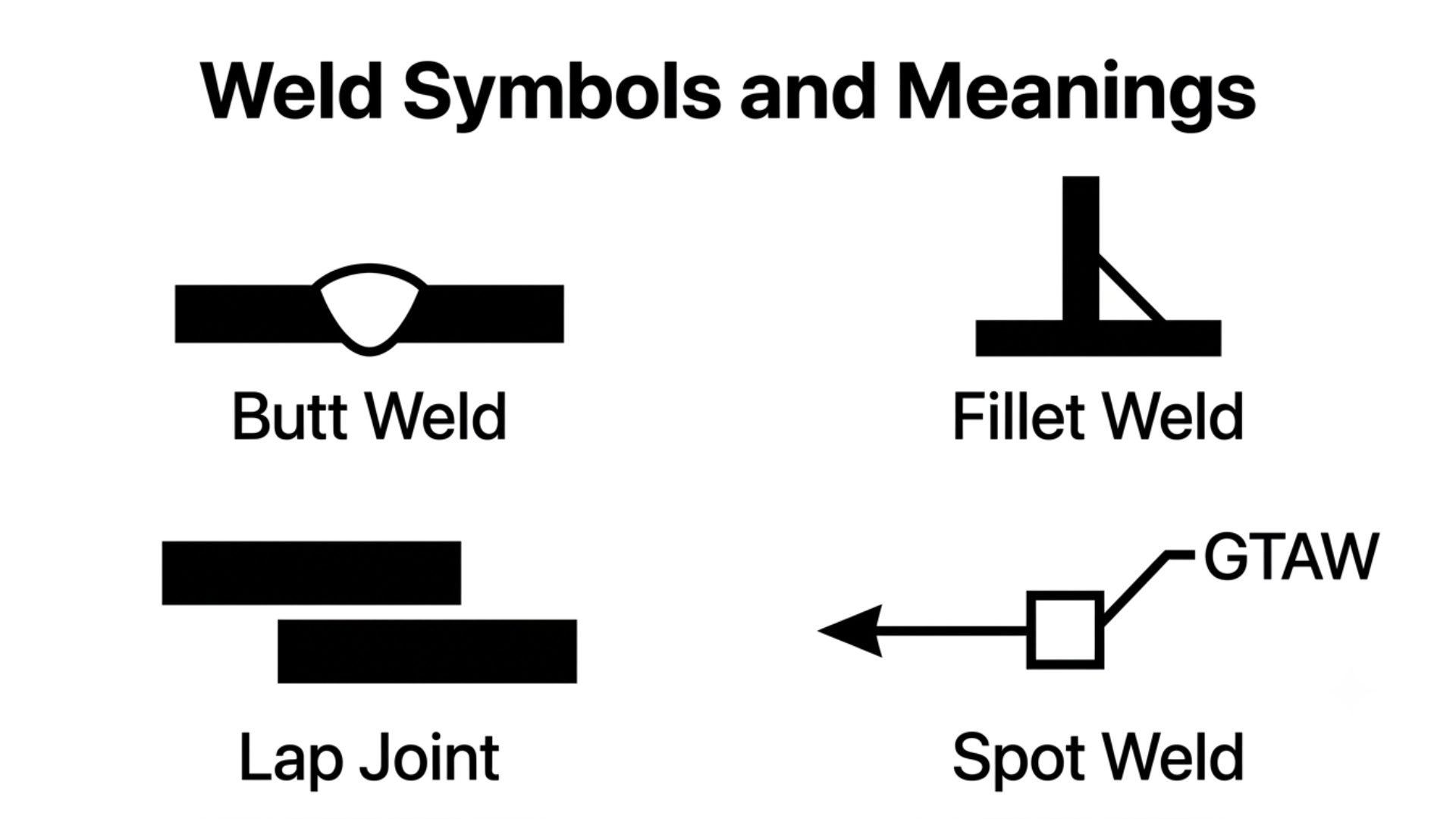
If you’ve ever looked at a welding blueprint, you’ve probably noticed small lines, arrows, triangles, circles, and other marks that seem confusing at first.
I remember feeling the same way when I first learned to read fabrication drawings. Once you understand them, though, these symbols become a simple language that tells welders exactly what to do.
Learning weld symbols and meanings is important for anyone involved in welding, fabrication, engineering, construction, or manufacturing.
Whether you’re a beginner, student, inspector, or experienced welder looking for a refresher, understanding these symbols helps prevent costly mistakes and ensures high-quality welds.
In this guide, you’ll learn what the most common weld symbols mean, where they’re used, and how to read them with confidence.
What Do Weld Symbols Mean?
Weld symbols are standardized graphic marks used on engineering drawings to communicate how a weld should be made. The fillet weld symbol, shown as a right triangle, is the most common welding symbol because fillet welds are widely used in structural steel, fabrication, and manufacturing.
Each symbol tells the welder important information such as:
- The type of weld
- Weld size
- Location
- Length
- Finish
- Groove preparation
- Special welding requirements
What Are Weld Symbols and Meanings?
Weld symbols are a universal visual language used on fabrication drawings and blueprints. Instead of writing lengthy instructions, engineers use standardized symbols that communicate welding requirements quickly and accurately.
Most countries follow standards published by organizations such as the American Welding Society (AWS) or ISO. Although minor differences exist between standards, the basic concepts remain similar.
A complete welding symbol usually includes:
- Reference line
- Arrow
- Basic weld symbol
- Dimensions
- Supplementary symbols
- Tail (optional)
The exact meaning depends on where the symbol is placed and what additional information accompanies it. Reading the entire symbol—not just the shape—is essential.
Weld Symbols and Meanings Comparison Table
| Symbol | Main Meaning | Best Use |
| Fillet Weld | Joins two surfaces at right angles | Structural fabrication |
| Groove Weld | Full penetration joint | Thick metal plates |
| Square Groove | Simple butt joint | Thin materials |
| V-Groove | V-shaped joint preparation | Heavy fabrication |
| Bevel Groove | One edge beveled | Pipe and plate welding |
| U-Groove | Rounded groove | Thick sections |
| J-Groove | J-shaped edge preparation | Pressure vessels |
| Plug Weld | Fills a hole to join plates | Overlapping metal |
| Slot Weld | Fills elongated slot | Heavy-duty joints |
| Spot Weld | Resistance welding point | Automotive manufacturing |
| Seam Weld | Continuous resistance weld | Tanks and sheet metal |
| Back Weld | Reinforces opposite side | High-strength joints |
Top 12 Weld Symbols and Their Meanings
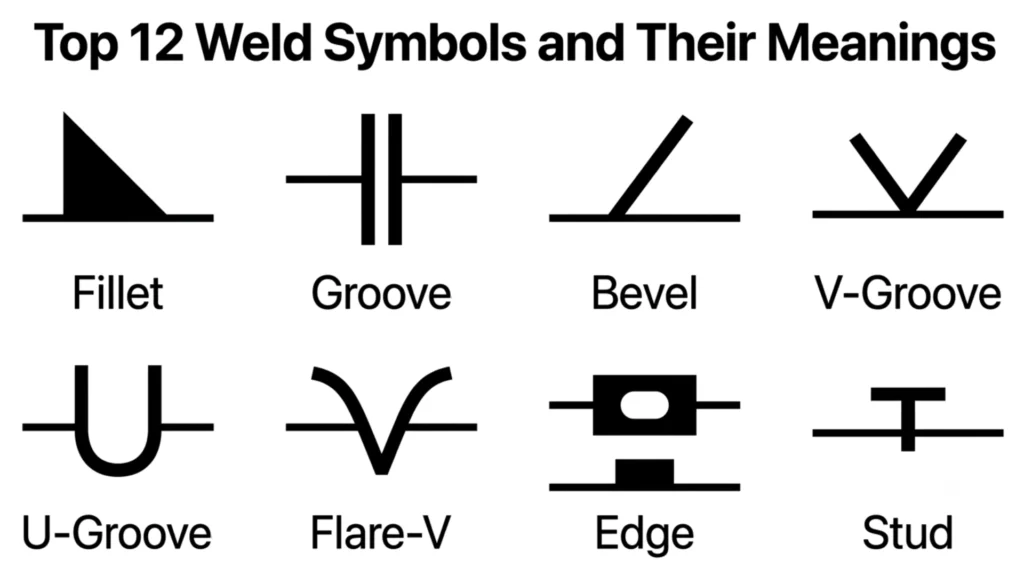
Fillet Weld Symbol: The Most Common Weld
The fillet weld symbol looks like a right triangle and is the symbol most welders encounter first. It indicates a weld joining two metal surfaces that meet at approximately 90 degrees.
Fillet welds are widely used because they require less preparation than groove welds while providing excellent strength for many applications. Structural steel, trailers, frames, brackets, and machinery commonly use this weld.
On drawings, dimensions specify leg size and weld length, ensuring consistent results.
Best for: Structural steel, equipment frames, brackets, fabrication drawings, general welding.
Groove Weld Symbol: Strong Joint Penetration
The groove weld symbol indicates that the edges of two pieces are prepared before welding to achieve deeper penetration and stronger joints.
Groove welds are often used when full strength across the joint is required. Engineers specify groove type, angle, root opening, and depth depending on material thickness.
These welds appear frequently in bridges, pipelines, pressure vessels, and heavy equipment.
Best for: Pressure vessels, bridges, pipelines, heavy fabrication, critical structural work.
Square Groove Symbol: Simple Butt Joint
A square groove weld joins two square-edged pieces without beveling. It’s commonly used on thinner materials where complete penetration can be achieved without extensive edge preparation.
Because preparation is minimal, square groove welds reduce manufacturing time and cost while maintaining sufficient strength for light to medium applications.
They’re common in sheet metal work and light fabrication.
Best for: Thin steel, fabrication shops, sheet metal, light manufacturing.
V-Groove Symbol: Deep Penetration Welding
The V-groove symbol indicates that both workpieces are beveled to create a V-shaped opening before welding.
This preparation allows weld metal to penetrate deeply into thick materials, creating exceptionally strong joints.
V-groove welds are popular in heavy construction, pressure piping, and structural projects where weld integrity is critical.
Best for: Heavy steel, bridge construction, industrial equipment, pressure piping.
Bevel Groove Symbol: Single-Side Preparation
Unlike a V-groove, the bevel groove requires only one piece to be beveled while the other remains square.
This method simplifies preparation when access is limited or when only one side of the joint can be machined.
It’s frequently used in pipe fabrication and heavy plate welding.
Best for: Pipe welding, industrial fabrication, repair work, thick plates.
U-Groove Symbol: Reduced Weld Metal
A U-groove uses rounded edges instead of straight bevels. This design reduces the amount of filler metal required while still providing excellent penetration.
Although machining a U-groove requires additional preparation, the savings in filler material and reduced welding time often justify the extra effort on thick materials.
Best for: Pressure vessels, nuclear work, thick components, industrial fabrication.
J-Groove Symbol: Efficient Thick Material Welding
The J-groove resembles the letter “J,” with one rounded edge and one square edge.
This design offers many of the advantages of a U-groove while requiring preparation on only one workpiece. It’s commonly used where access is limited.
J-groove welds are often found in large industrial structures and heavy equipment.
Best for: Heavy fabrication, structural repairs, thick steel, industrial machinery.
Plug Weld Symbol: Joining Overlapping Plates
A plug weld fills a circular hole in one plate to connect it with another plate underneath.
Instead of welding around the outside edges, the weld fills the prepared hole, creating a secure connection.
Plug welds are common when lap joints require additional strength or when access to joint edges is restricted.
Best for: Overlapping plates, reinforcement, automotive repair, fabrication.
Slot Weld Symbol: Longer Reinforcement
A slot weld works similarly to a plug weld but uses an elongated slot rather than a circular hole.
The increased weld area distributes loads over a larger surface, making slot welds useful in heavy-duty applications.
They’re frequently specified in structural fabrication and transportation equipment.
Best for: Heavy machinery, trailers, bridges, structural reinforcement.
Spot Weld Symbol: Fast Sheet Metal Joining
Spot welding joins overlapping sheets using electrical resistance instead of filler metal.
The symbol identifies where individual weld spots should be placed, including spacing and diameter.
This process is heavily used in automotive manufacturing because it’s fast, repeatable, and economical.
Best for: Automotive panels, appliances, sheet metal, production manufacturing.
Seam Weld Symbol: Continuous Resistance Weld
A seam weld forms a continuous weld rather than separate spot welds.
It’s produced using rotating electrodes that create an uninterrupted sealed joint.
This method is excellent for products requiring leak-resistant seams, including tanks, drums, and fuel containers.
Best for: Fuel tanks, containers, sheet metal, sealed assemblies.
Back Weld Symbol: Extra Strength from the Opposite Side
A back weld is applied after completing the main weld from the opposite side of the joint.
Its purpose is to improve root penetration, increase strength, and eliminate possible defects.
Back welds are common in high-quality structural and pressure applications where joint reliability is essential.
Best for: Pressure piping, structural steel, bridges, critical welds.
Best Weld Symbols and Meanings for Training and Learning
If you’re learning welding, focus on mastering these symbols first because they appear most often in fabrication drawings:
- Fillet weld
- Groove weld
- V-groove
- Square groove
- Plug weld
- Spot weld
Understanding these six symbols gives beginners a solid foundation before moving on to more advanced welding specifications.
Best Weld Symbols for Drawings, CAD, and Design
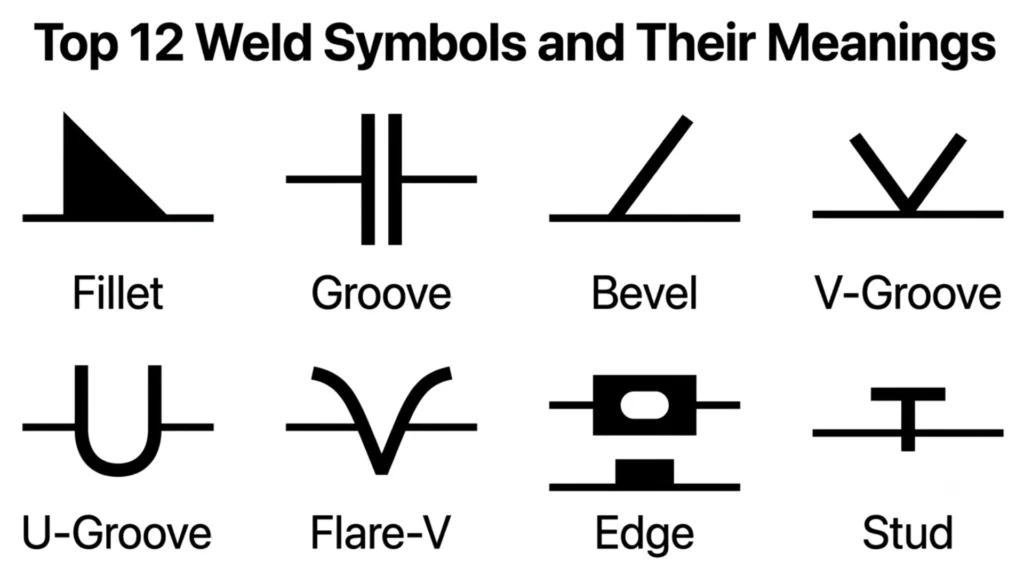
Engineering drawings should communicate instructions clearly and consistently. Good weld symbols are standardized, uncluttered, and easy to recognize.
When creating fabrication drawings, remember to:
- Use standardized AWS or ISO symbols.
- Include accurate dimensions.
- Show weld location clearly.
- Add finishing symbols when needed.
- Avoid unnecessary complexity.
Clean, consistent symbols improve communication between engineers, fabricators, and inspectors.
Best Weld Symbols for Professional Practice
Different industries rely on different weld symbols depending on the job.
For structural steel, the fillet weld is often the most common choice because of its strength and efficiency.
Pressure vessel fabrication frequently requires groove, U-groove, and J-groove symbols to ensure full penetration and safe operation.
Automotive production relies heavily on spot and seam weld symbols for high-volume manufacturing.
Choosing the correct symbol depends on material thickness, load requirements, inspection standards, and manufacturing methods.
Before Using Welding Symbols
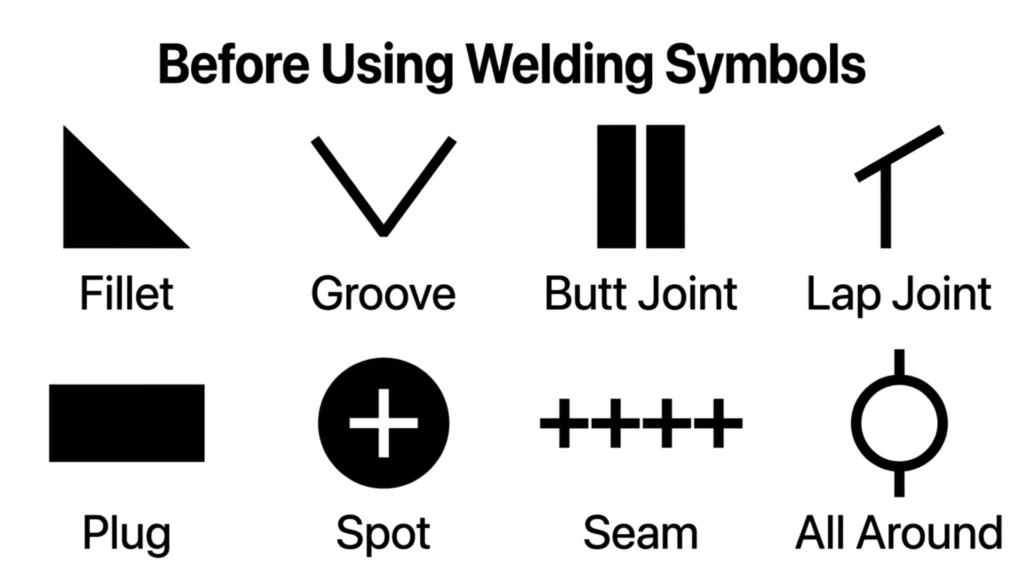
Although many weld symbols look simple, each one follows strict engineering standards.
Before creating fabrication drawings or interpreting blueprints:
- Verify whether the drawing follows AWS, ISO, or another standard.
- Never assume symbols have identical meanings across every standard.
- Check dimensions carefully.
- Read the entire welding symbol, not only the basic shape.
- When unsure, consult the applicable welding code.
Proper interpretation prevents fabrication errors and improves weld quality.
How to Choose the Right Weld Symbol
Selecting the correct weld symbol depends on the application.
Consider these factors:
- Material thickness
- Joint type
- Required weld strength
- Manufacturing process
- Accessibility
- Inspection requirements
- Applicable welding standards
The simplest symbol isn’t always the best choice. Engineers balance strength, cost, production speed, and safety when specifying welds.
FAQs About Weld Symbols and Meanings
What is the most common weld symbol?
The fillet weld symbol is the most commonly used welding symbol. It appears on countless fabrication drawings because fillet welds are suitable for many structural and manufacturing applications.
What do welding symbols tell you?
Welding symbols communicate the type of weld, its location, dimensions, finishing requirements, and any special instructions needed to produce the correct weld.
What does the triangle weld symbol mean?
The triangle represents a fillet weld. It tells the welder to create a weld joining two surfaces that meet at an angle, usually around 90 degrees.
Why are weld symbols important?
Weld symbols eliminate confusion by providing standardized instructions. They improve quality, reduce errors, save time, and ensure everyone interprets fabrication drawings consistently.
Are AWS and ISO weld symbols the same?
They share many similarities but are not identical. Some symbol placement, notation, and formatting differ, so always identify which standard the drawing follows.
What is the easiest weld symbol to learn?
Most beginners start with the fillet weld symbol because it’s simple, widely used, and forms the basis for understanding more complex welding symbols.
Can beginners learn welding symbols quickly?
Yes. With regular practice and blueprint reading, most beginners can recognize common weld symbols within a relatively short period. Learning the reference line, arrow, and basic symbols first makes the process much easier.
Where are weld symbols used?
You’ll find weld symbols on engineering drawings, fabrication blueprints, CAD models, structural steel plans, manufacturing documents, piping drawings, and inspection paperwork.
Final Thoughts
Understanding weld symbols and meanings is one of the most valuable skills for anyone working with fabrication drawings or welding projects.
These standardized symbols provide clear instructions that improve communication, reduce mistakes, and help produce safe, high-quality welds.
By learning the most common weld symbols first and practicing how to read complete welding symbols, you’ll build confidence whether you’re in the shop, classroom, or on the job site.

Dylan Anderson is a writer who enjoys turning complex topics into simple, engaging content that readers can actually use. His work focuses on clear explanations, practical insights and storytelling that feels natural and relatable. He is also the fictional author of The Quiet Compass of Ashford and Where the Cedar Lantern Glows. When he’s away from his keyboard, Dylan enjoys hiking, reading, and discovering inspiration in everyday life. He believes great writing should be informative, easy to understand and enjoyable from beginning to end.
 Adam Sullivan