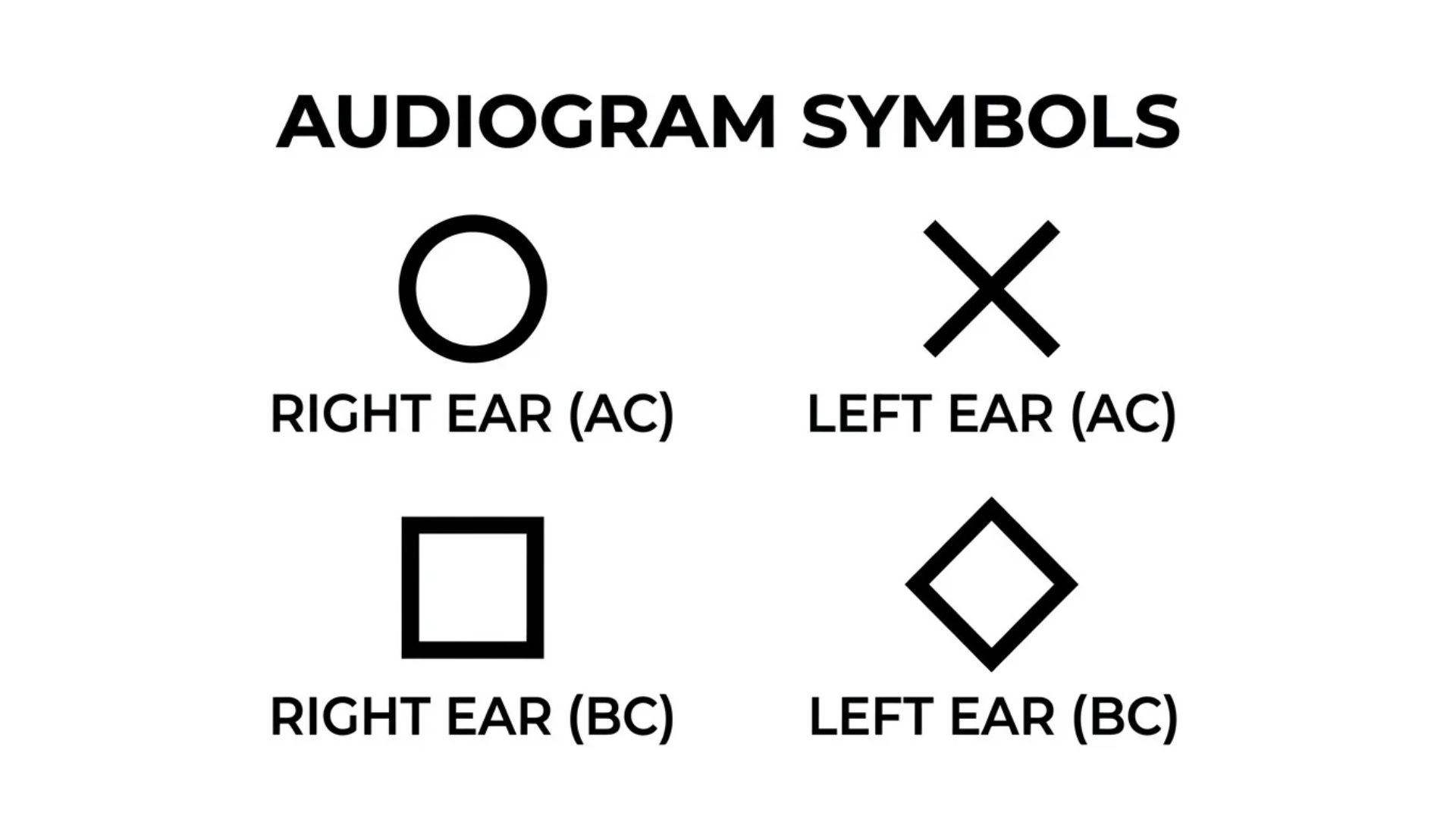
An audiogram can look confusing when you first see one. You may notice circles, X marks, triangles, squares, brackets, and arrows scattered across a graph. Each mark has a specific purpose. Together, they show how your ears respond to sounds at different pitches and volumes.
If you have recently completed a hearing test, understanding audiogram symbols can help you make sense of your results. You can learn which marks represent your right and left ears, how air conduction differs from bone conduction, and why audiologists sometimes use masking symbols.
This guide explains the most common audiogram symbols with simple definitions, comparison tables, and practical examples. You will also learn how to recognize different hearing patterns and understand what the lines and arrows on your report mean.
What Are Audiogram Symbols?
Audiogram symbols are letters, shapes, and special marks used to record hearing test results on a graph. Each symbol identifies a particular hearing threshold and provides information about the ear, testing method, or test condition.
Audiologists use these symbols during pure-tone audiometry. This hearing test measures the softest sounds a person can detect at several frequencies.
For example, a circle usually represents an unmasked air-conduction threshold for the right ear. An X usually represents an unmasked air-conduction threshold for the left ear.
Other marks identify bone-conduction testing, masked thresholds, sound-field measurements, and responses that could not be obtained within the audiometer’s output range.
Audiogram symbols are important because they allow hearing professionals to record results consistently. They also make it easier to compare hearing sensitivity between ears and across different appointments.
Why Do Audiologists Use Different Symbols?
Audiologists use different symbols because a hearing test involves more than one type of measurement.
A symbol may tell you:
- Which ear was tested: Right ear, left ear, or an unspecified response.
- How sound was delivered: Through earphones, a bone vibrator, or a loudspeaker.
- Whether masking was used: Masking noise helps prevent the opposite ear from detecting the test sound.
- What response occurred: A regular threshold or no response at the available test limit.
- Which testing condition applied: Unaided or aided hearing measurements.
Without these distinctions, it would be difficult to understand exactly what a particular hearing threshold represents.
What Is a Hearing Threshold?
A hearing threshold is the lowest sound level a person can detect at a particular frequency under the conditions of the test.
Audiologists usually record thresholds in decibels hearing level (dB HL). They measure several pitches because a person may hear low-frequency sounds differently from high-frequency sounds.
For example, someone might detect a low-pitched tone at a relatively soft level but need a louder sound to detect a high-pitched tone.
Each symbol on an audiogram records one of these measurements.
Audiogram Symbols Chart and Their Meanings
The following table explains commonly used symbols in conventional pure-tone audiometry. These symbols follow widely used audiometric notation, although individual clinics may use additional or locally defined marks.
| Symbol | Ear or placement | Testing method | Meaning |
| O | Right ear | Unmasked air conduction | Right-ear hearing threshold |
| X | Left ear | Unmasked air conduction | Left-ear hearing threshold |
| △ | Right ear | Masked air conduction | Right-ear threshold with masking |
| □ | Left ear | Masked air conduction | Left-ear threshold with masking |
| < | Right mastoid placement | Unmasked bone conduction | Bone-conduction threshold using right-side placement |
| > | Left mastoid placement | Unmasked bone conduction | Bone-conduction threshold using left-side placement |
| [ | Right mastoid placement | Masked bone conduction | Masked bone-conduction threshold |
| ] | Left mastoid placement | Masked bone conduction | Masked bone-conduction threshold |
| S | Unspecified ear | Sound-field testing | Response through a loudspeaker |
| V | Forehead placement | Unmasked bone conduction | Forehead bone-conduction threshold |
Important: This is a simplified reference chart, not a universal legend for every audiogram. Exact notation can depend on the professional standard and clinic software. Check the legend on your own report before identifying an unfamiliar symbol.
A symbol may also have an arrow attached to indicate no response at the maximum available output. This is a response-status marker rather than a completely separate testing method.
Quick Difference Between the Main Symbols
The easiest way to remember the most familiar symbols is to focus on the two basic air-conduction marks.
- O usually means right-ear air conduction.
- X usually means left-ear air conduction.
- △ and □ commonly indicate masked air-conduction testing.
- < and > commonly indicate bone-conduction vibrator placement.
- [ and ] commonly indicate masked bone-conduction testing.
- S commonly identifies a sound-field response.
These distinctions help you understand why an audiogram may contain several different shapes at the same frequency.
Right Ear and Left Ear Audiogram Symbols
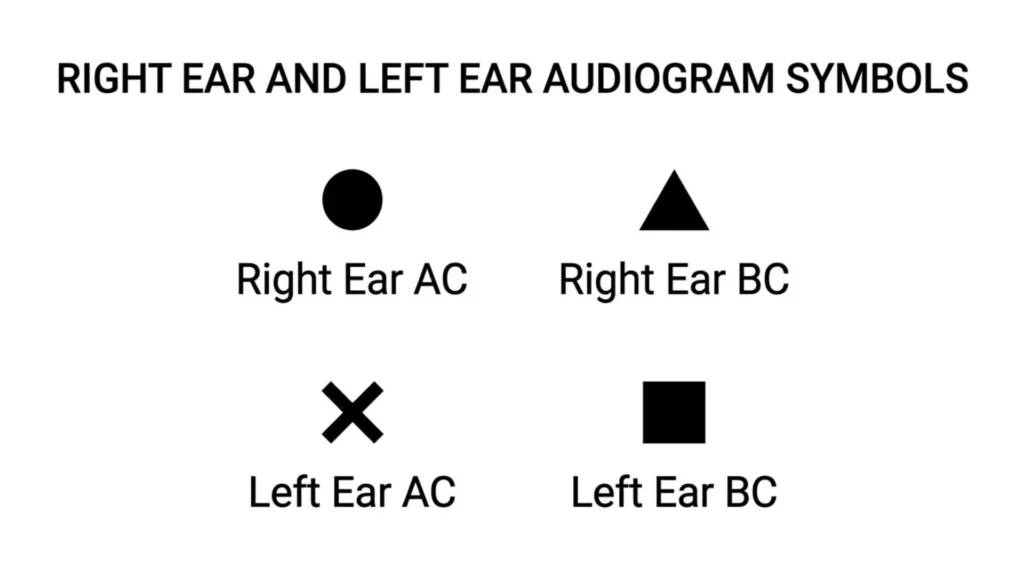
Audiograms usually record the right and left ears separately. This allows an audiologist to identify differences between the two sides.
The most familiar symbols are O and X. They appear on many standard hearing test reports.
O Symbol: What Does It Mean on an Audiogram?
The O symbol represents the right ear’s unmasked air-conduction threshold in a commonly used audiometric system.
During air-conduction testing, you wear headphones or small insert earphones. The audiologist plays tones at different frequencies and adjusts their volume to find the softest level you can hear.
Each O mark records the right ear’s threshold at a specific frequency.
For example, an O placed at 1,000 Hz and 15 dB HL indicates that the recorded right-ear threshold at that frequency was 15 dB HL.
Several O symbols may be connected with a line to show the right ear’s hearing pattern across different frequencies.
X Symbol: What Does It Mean on a Hearing Test?
The X symbol represents the left ear’s unmasked air-conduction threshold.
The testing process is similar to the right-ear test. You listen to tones through earphones, and the audiologist records the lowest level you can detect.
Each X mark identifies the left ear’s threshold at a particular frequency.
When audiologists compare O and X marks, they can see whether both ears have similar hearing sensitivity or whether one ear performs differently.
For example, if the X symbols appear lower on the graph than the O symbols, the left ear generally needs louder sounds to detect those tested frequencies.
Red and Blue Audiogram Symbols
Many clinics use red and blue colors to make audiograms easier to read.
- Red: Usually identifies the right ear.
- Blue: Usually identifies the left ear.
The conventional color arrangement helps people distinguish the two sets of results quickly.
However, color should not be your only guide. The actual shapes and the printed legend provide the important testing information.
Some reports appear in black and white, especially when printed or copied. O and X remain distinguishable even without color.
What If the O and X Symbols Overlap?
Sometimes right-ear and left-ear thresholds are identical at a particular frequency and hearing level.
When this happens, the two symbols may overlap on the graph. You might see what looks like one combined mark instead of two separate symbols.
This does not automatically mean that the audiologist forgot to record an ear. Both results may simply have the same plotted position.
The audiogram legend or original digital report can help clarify overlapping marks.
Air Conduction and Bone Conduction Symbols
Air conduction and bone conduction are two different ways of measuring hearing sensitivity.
Both methods help audiologists understand how sound reaches the inner ear. However, they use different pathways and testing equipment.
Air Conduction Symbols
Air conduction testing measures how well sound travels through the normal hearing pathway.
Sound enters the outer ear, travels through the ear canal, moves the eardrum and middle-ear bones, and reaches the inner ear.
The audiologist usually uses headphones or insert earphones to deliver tones.
Common air-conduction symbols include:
- O for unmasked right-ear testing.
- X for unmasked left-ear testing.
- △ for masked right-ear testing.
- □ for masked left-ear testing.
These symbols show the softest sounds detected through the air at the tested frequencies.
Air-conduction results provide an overall picture of hearing sensitivity. However, they do not identify which part of the hearing system causes a problem by themselves.
Bone Conduction Symbols
Bone conduction testing measures hearing through vibrations delivered to the skull.
The audiologist places a small bone vibrator against the mastoid bone behind the ear or, in some situations, on the forehead.
The vibrations travel through the skull and stimulate the cochlea, bypassing much of the normal outer- and middle-ear sound pathway.
Common mastoid bone-conduction symbols include:
- < for unmasked testing with right mastoid placement.
- for unmasked testing with left mastoid placement.
- [ for masked testing with right mastoid placement.
- ] for masked testing with left mastoid placement.
A forehead placement may use a different symbol, such as V for an unmasked forehead bone-conduction threshold under the convention described by ASHA.
An important detail is that an unmasked bone-conduction symbol may identify the vibrator’s placement rather than prove which inner ear detected the sound. Bone-conducted vibrations can stimulate both cochleae.
Why Do Audiologists Compare Air and Bone Conduction?
Comparing air and bone conduction results helps audiologists understand whether a hearing problem may involve the outer or middle ear, the inner ear, or both.
For example, air-conduction thresholds may be poorer than bone-conduction thresholds. This difference can suggest a conductive component.
When both sets of thresholds are elevated without a meaningful air-bone gap, a sensorineural component may be present.
The complete test results are necessary for accurate interpretation.
What Do Masked Audiogram Symbols Mean?
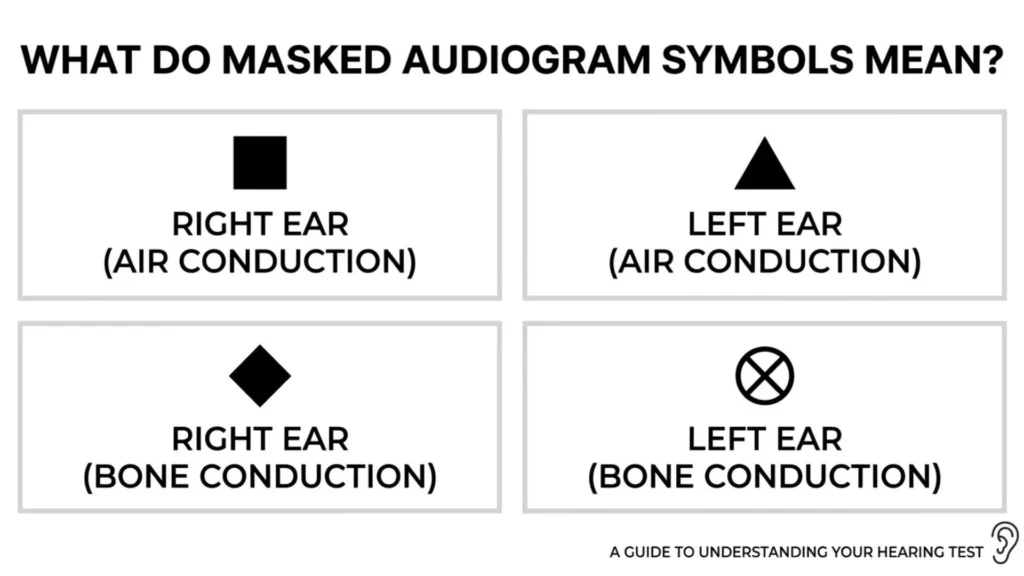
Masked audiogram symbols indicate that the audiologist used masking noise during testing.
Masking involves playing noise into the ear that is not being tested. Its purpose is to prevent that ear from detecting a tone intended for the other ear.
This matters because sound can sometimes travel through the skull and reach the opposite cochlea. Without appropriate masking, the audiologist may mistakenly record a response from the better-hearing ear.
Why Is Masking Necessary?
Imagine that your right ear hears much better than your left ear.
During a test, the audiologist sends a tone to your left ear. If that tone is loud enough, it may cross through your skull and reach the right inner ear.
You might respond even though your left ear did not actually detect the tone.
Masking introduces noise into the right ear to reduce this risk. This allows the audiologist to obtain a more reliable measurement of the left ear.
The need for masking depends on the testing method, hearing thresholds, equipment, and the relationship between the ears.
Masked Air Conduction Symbols
Common masked air-conduction symbols include:
- △ for the right ear.
- □ for the left ear.
These marks indicate that masking was used while measuring air-conduction thresholds.
They do not automatically mean that a person has severe hearing loss. Masking is simply a technique for improving the reliability of certain measurements.
Masked Bone Conduction Symbols
Masked bone-conduction testing also uses special symbols.
In a commonly used convention:
- [ represents masked bone conduction with right mastoid placement.
- ] represents masked bone conduction with left mastoid placement.
Masking is particularly important in bone-conduction testing because vibrations can stimulate both inner ears.
The audiologist must determine whether the response belongs to the intended side before interpreting the result as an ear-specific threshold.
What Does an Arrow Mean on an Audiogram?
An arrow attached to an audiogram symbol generally indicates that no response was obtained at the maximum output available for that test condition and frequency.
For example, an O with an attached arrow may show that the right ear did not respond before the audiometer reached its available testing limit.
The symbol is placed at the highest level tested rather than at a confirmed hearing threshold.
Does an Arrow Mean Complete Deafness?
No. An arrow does not automatically mean that a person cannot hear anything.
It means the audiologist could not establish a threshold within the available output range of the equipment for that particular test condition.
The person’s actual hearing threshold may be beyond the measurable limit. However, the audiogram cannot establish its exact value from that test alone.
Why Do Arrows Point in Different Directions?
The direction of a no-response arrow can depend on the original symbol and the audiometric convention.
Under the ASHA convention, arrows are attached to the lower portion of the relevant symbol. Their direction is adjusted according to whether the symbol identifies the right or left ear. Some unspecified sound-field and bone-conduction marks use a straight downward arrow.
Therefore, do not assume every arrow has exactly the same orientation.
How Should You Interpret a No-Response Result?
A no-response result needs to be considered alongside the test frequency, equipment limits, transducer, and other hearing measurements.
For example, a person may respond at several lower frequencies but show no response at a higher frequency because the available output was insufficient to establish a threshold.
An audiologist can explain what that result means within the complete hearing evaluation.
What Does No Response Mean on a Hearing Test?
No response means the person did not detect the test tone at the highest level the audiometer could deliver under the specific testing conditions.
It is a statement about the measurement, not a complete diagnosis.
No-response results can occur during:
- Air-conduction testing.
- Bone-conduction testing.
- Sound-field testing.
The audiologist records the result using the appropriate symbol with a no-response marker.
No Response Versus a Measured Hearing Threshold
These two results are different.
A measured threshold means the audiologist found a level at which the person could detect the tone according to the test procedure.
A no-response result means the test reached its available limit without establishing that threshold.
For example, if the audiometer can deliver a tone up to a particular level but the person does not respond, the audiologist cannot claim that the person’s exact threshold equals that maximum level.
The result should be reported as no response at the specified limit.
Why Do Audiogram Symbols Differ Between Clinics?
Not every audiogram looks exactly the same.
Professional guidelines provide standardized symbol systems, but clinics may use different software, reporting formats, or additional symbols for particular testing conditions.
Some reports may also follow regional professional conventions.
Different Symbol Systems and Local Conventions
A clinic may use the common O and X symbols for ordinary air-conduction thresholds but add other marks for specialized tests.
The appearance of masked, aided, sound-field, and forehead bone-conduction symbols may depend on the convention used.
This is why an audiogram should include a legend explaining its marks.
Why the Legend Matters More Than Color
Color coding is helpful, but it does not provide all the information.
For example, red may identify the right ear and blue may identify the left ear. However, color alone does not tell you whether a measurement came from air conduction, bone conduction, or sound-field testing.
The shape and position of each mark carry additional information.
Always use the report’s legend when a symbol does not match the examples in a general guide.
What Should You Do When a Symbol Looks Different?
Do not assume that an unfamiliar mark is an error.
Instead:
- Check the symbol legend printed on your report.
- Look for a note identifying the testing method.
- Check whether the symbol includes an arrow or another modifier.
- Ask your audiologist to explain the mark if its meaning remains unclear.
This approach is safer than guessing from a symbol found on another clinic’s website.
What Do Aided Audiogram Symbols Mean?
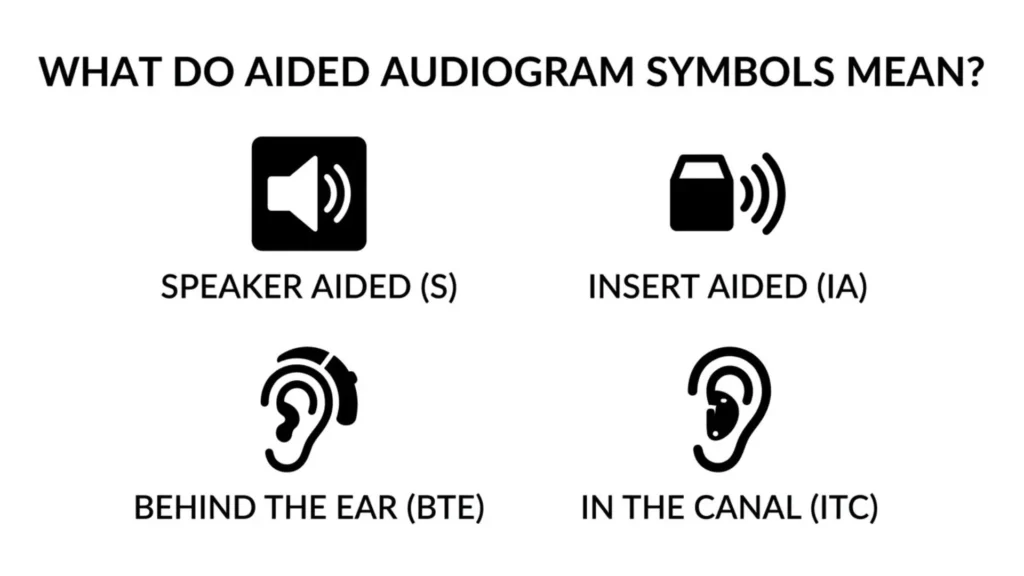
Aided hearing measurements describe results obtained while a person uses hearing assistance, such as hearing aids.
These results differ from ordinary unaided hearing thresholds because the hearing device changes the sound delivered to the listener.
Aided measurements may be collected in a sound field using loudspeakers. Some clinics also use specialized test arrangements.
Aided Versus Unaided Hearing Results
Unaided testing measures hearing without the assistance of a hearing device.
Aided testing measures hearing under a specified device condition.
For example, an audiologist may compare responses with and without hearing aids to understand how the person performs under different conditions.
However, aided sound-field results should not be treated as identical to separate unaided thresholds for the right and left ears. A loudspeaker may produce a combined response, and the better-hearing ear may contribute to what the person detects.
How Are Aided Results Marked?
There is no single symbol that every clinic must use for every aided measurement.
Professional guidance recommends using clearly defined, locally determined symbols that do not conflict with other marks on the audiogram.
Your report should identify whether the measurement was aided, which device condition was used, and how the result was obtained.
How to Read an Audiogram Graph
Once you understand the symbols, the next step is learning how to read the graph.
An audiogram has two main axes. One displays sound frequency, while the other displays hearing level.
The position of each symbol shows the quietest sound detected at a particular frequency during the test.
Frequency: Understanding Pitch in Hertz
Frequency measures how high or low a sound is. It is measured in Hertz (Hz).
The horizontal axis usually places lower frequencies on the left and higher frequencies on the right.
Common frequencies include:
- 250 Hz
- 500 Hz
- 1,000 Hz
- 2,000 Hz
- 3,000 Hz
- 4,000 Hz
- 6,000 Hz
- 8,000 Hz
Lower frequencies are associated with deeper sounds. Higher frequencies include sharper sounds and many speech details.
Testing several frequencies helps audiologists identify whether hearing sensitivity changes across different pitches.
Hearing Level: Understanding Decibels
The vertical axis measures hearing level in decibels hearing level (dB HL).
Unlike many ordinary graphs, the numbers increase as you move downward.
Softer sounds appear near the top. Louder sounds appear farther down.
This means that a symbol near the top generally represents better hearing sensitivity than one much lower on the chart.
For example, a threshold of 10 dB HL is better than a threshold of 50 dB HL at the same frequency.
Remember that 0 dB HL does not mean complete silence. It is a standardized reference level for hearing sensitivity.
What Does 0 dB HL Mean?
Zero decibels hearing level represents a reference point based on standardized hearing thresholds.
It does not mean that no sound exists.
A person with a threshold of 0 dB HL can hear very soft sounds around the reference level for that frequency.
Some people have thresholds below 0 dB HL. This can indicate better-than-reference hearing sensitivity at certain frequencies.
What Do the Lines Between Audiogram Symbols Mean?
Lines connect hearing thresholds to make patterns easier to see.
A solid line commonly connects air-conduction thresholds recorded for the same ear.
For example, a line connecting several O symbols shows the right ear’s air-conduction pattern. A separate line connecting X symbols shows the left ear’s pattern.
Bone-conduction thresholds are generally not connected in the same way. In some audiograms, dashed lines may connect bone-conduction results when an air-bone gap is present.
No-response symbols should not be connected to ordinary response symbols.
Why Are Some Audiogram Symbols Not Connected?
Not every measurement needs a connecting line.
Bone-conduction results are often left unconnected because they represent a different testing pathway. Unmasked bone-conduction responses also require caution because they may not identify one specific inner ear.
A no-response result should remain separate from ordinary measured thresholds.
If two symbols appear close together without a line, it does not necessarily indicate missing information. The audiologist may be following standard graphing conventions.
What Is an Air-Bone Gap on an Audiogram?
An air-bone gap is the difference between air-conduction and bone-conduction hearing thresholds at the same frequency.
It occurs when the air-conduction threshold is poorer than the bone-conduction threshold by a clinically meaningful amount.
For example, imagine the following results at 1,000 Hz:
| Test method | Hearing threshold |
| Air conduction | 45 dB HL |
| Bone conduction | 15 dB HL |
| Difference | 30 dB |
This example shows a 30 dB air-bone gap.
The bone-conduction threshold is better because it bypasses much of the outer- and middle-ear sound pathway.
What Does an Air-Bone Gap Suggest?
A meaningful air-bone gap may indicate a conductive component of hearing loss.
This means sound is having difficulty traveling through the outer or middle ear, even though the inner ear may respond better to bone-conducted vibrations.
Possible causes can include middle-ear fluid, eardrum problems, or changes involving the small bones of the middle ear.
However, an air-bone gap does not identify the exact cause by itself. The audiologist may need additional tests and an examination of the ear.
Does Every Air-Bone Gap Mean Conductive Hearing Loss?
Not necessarily.
Some gaps may be influenced by testing conditions, calibration limitations, measurement variability, or other factors.
For example, isolated high-frequency gaps require careful interpretation.
Audiologists compare the complete results, including masking, tympanometry, speech testing, and clinical findings, before drawing conclusions.
What Do Different Audiogram Patterns Mean?
Audiogram patterns describe how hearing thresholds change across frequencies.
The overall shape can provide useful information about hearing sensitivity. However, the shape alone does not identify the cause of a hearing problem.
Normal Hearing Pattern
A normal or near-normal pattern generally shows thresholds within the expected range across the tested frequencies.
Many adult classification systems use approximately -10 to 20 dB HL as a normal range. Other clinical systems use slightly different limits.
A professional should interpret the complete results rather than rely on one number.
Conductive Hearing Loss Pattern
Conductive hearing loss involves difficulty moving sound through the outer or middle ear.
The audiogram may show poorer air-conduction thresholds with better bone-conduction thresholds.
This difference creates an air-bone gap.
Sensorineural Hearing Loss Pattern
Sensorineural hearing loss involves the inner ear or auditory nerve pathways.
Air- and bone-conduction thresholds are usually both elevated without a significant air-bone gap.
The exact pattern can vary according to the person and the frequencies affected.
Mixed Hearing Loss Pattern
Mixed hearing loss includes both conductive and sensorineural components.
Air- and bone-conduction thresholds may both be elevated, with a meaningful difference between them.
The audiologist uses the complete test results to identify the pattern.
How to Recognize Different Audiogram Shapes
Apart from the type of hearing loss, audiologists may describe an audiogram by its overall shape or configuration.
These descriptions explain how thresholds change across frequencies.
Flat Audiogram
A flat audiogram shows relatively similar hearing thresholds across the tested frequencies.
The graph does not have a major upward or downward slope.
For example, thresholds may remain around a similar level from low to high frequencies.
Sloping Audiogram
A sloping audiogram shows poorer hearing thresholds as frequency increases.
The graph generally moves downward toward the right side.
This pattern can help explain why someone has difficulty hearing high-pitched sounds or certain speech sounds.
Rising Audiogram
A rising audiogram shows poorer thresholds at lower frequencies and better thresholds at higher frequencies.
The graph generally moves upward toward the right side.
This configuration means hearing sensitivity differs between low- and high-pitched sounds.
Notched Audiogram
A notched audiogram contains a noticeable dip in hearing sensitivity at certain frequencies, followed by better thresholds at nearby frequencies.
A notch may appear around 3,000 to 6,000 Hz.
A particular notch pattern can sometimes be associated with noise exposure, but it does not prove the cause of hearing loss.
Asymmetric Audiogram
An asymmetric audiogram shows a meaningful difference between the hearing thresholds of the two ears.
One ear may have better hearing sensitivity than the other at some or several frequencies.
An audiologist should evaluate significant differences, especially when they are new or unexplained.
How to Read an Audiogram With Examples
A simple example can make the entire graph easier to understand.
Imagine that an audiologist records the following right-ear and left-ear air-conduction thresholds.
| Frequency | Right ear (O) | Left ear (X) |
| 250 Hz | 10 dB HL | 15 dB HL |
| 500 Hz | 10 dB HL | 15 dB HL |
| 1,000 Hz | 15 dB HL | 20 dB HL |
| 2,000 Hz | 20 dB HL | 25 dB HL |
| 4,000 Hz | 35 dB HL | 45 dB HL |
| 8,000 Hz | 40 dB HL | 50 dB HL |
These figures are fictional and provided only to demonstrate how an audiogram works.
Step 1: Identify the Ears
The O column represents the right ear.
The X column represents the left ear.
This allows you to compare both ears at each frequency.
Step 2: Compare the Frequencies
Look at the thresholds from 250 Hz through 8,000 Hz.
In this example, the thresholds become higher at the upper frequencies.
That means louder sounds are needed to detect those pitches.
Step 3: Compare Both Ears
The left-ear thresholds are slightly higher than the right-ear thresholds in this example.
This indicates poorer recorded hearing sensitivity in the left ear at the listed frequencies.
Step 4: Look at the Overall Shape
The results show a downward trend as the frequencies increase.
This is an example of a sloping audiogram configuration.
Step 5: Avoid Making a Diagnosis
The example only shows air-conduction thresholds.
Without bone-conduction results, masking information, and the rest of the clinical assessment, you cannot determine the type or cause of hearing loss.
This is why an audiologist should interpret the complete hearing test.
What Does an Upside-Down V Mean on an Audiogram?
An upside-down V may appear on some audiograms to represent a forehead bone-conduction threshold.
Under the ASHA convention, V is used for an unmasked forehead bone-conduction result.
The forehead position matters because the bone vibrator is placed differently from the usual mastoid position behind the ear.
Forehead placement may be useful in certain clinical situations, including when mastoid placement is unsuitable.
The exact symbol and its orientation should always be checked against the audiogram legend.
Do not confuse this mark with an ordinary air-conduction symbol or assume it identifies a separate ear response.
What Does S Mean on an Audiogram?
S commonly represents a sound-field hearing response.
During sound-field testing, tones are presented through loudspeakers rather than individual earphones.
The person sits in a test room and responds when they hear the sounds.
How Is Sound-Field Testing Different?
Individual earphone testing allows the audiologist to measure each ear separately.
Sound-field testing does not isolate the ears in the same way.
A person may detect the sound with whichever ear hears it better. Therefore, a sound-field threshold should not automatically be treated as a separate right-ear or left-ear result.
Why Is Sound-Field Testing Used?
Audiologists may use sound-field testing to assess hearing under specific conditions.
It can be helpful when evaluating responses with hearing devices or when individual earphone testing is not appropriate for a particular measurement.
The audiogram should clearly identify the testing condition.
Why Are Audiogram Symbols Important?
Audiogram symbols help audiologists record and interpret hearing test results accurately.
Each symbol contributes information that a simple number cannot provide by itself.
Here are the main reasons they matter:
- Identify the tested ear: Different shapes distinguish right and left measurements.
- Show the testing method: Air and bone conduction use separate symbols.
- Record masking conditions: Special marks indicate when masking noise was used.
- Display hearing thresholds: Each symbol records a response at a specific frequency and sound level.
- Identify no-response results: Arrows show when the test reached its available output limit.
- Compare hearing patterns: Connecting marks can reveal changes across frequencies.
- Support hearing care: Audiologists use the complete results to plan further evaluation and discuss treatment options.
A consistent symbol system also makes it easier to compare results from different appointments.
Common Mistakes When Reading Audiogram Symbols
Audiograms can be confusing, especially if you have never seen one before. Understanding a few common mistakes can help you avoid misreading your results.
Assuming O and X Mean the Same Thing
O and X represent different ears in the commonly used air-conduction system.
O identifies the right ear, while X identifies the left ear.
Do not switch them when comparing your results.
Thinking Lower Symbols Mean Better Hearing
On an audiogram, the hearing-level numbers increase as you move downward.
A threshold lower on the graph usually means the person needed a louder sound to detect that frequency.
Confusing Air and Bone Conduction
Air conduction and bone conduction measure different pathways.
Their results should be compared rather than treated as interchangeable.
Assuming an Arrow Means Complete Deafness
A no-response arrow indicates that the person did not respond at the available maximum output.
It does not establish that the person cannot hear any sound.
Ignoring the Audiogram Legend
A general symbol guide cannot explain every mark used by every clinic.
Always check the legend printed on your own report.
Treating an Audiogram as a Medical Diagnosis
An audiogram provides important information about hearing sensitivity.
However, it does not independently explain every possible cause of hearing difficulty.
An audiologist or appropriate medical professional must interpret the results alongside other findings.
When Should You Discuss Your Audiogram With an Audiologist?
You should discuss your hearing test with a qualified audiologist if you are unsure about the symbols, thresholds, or patterns on your report.
A professional can explain whether your results suggest a conductive, sensorineural, or mixed hearing pattern.
You should also seek professional advice if you notice:
- New or worsening difficulty hearing conversations.
- A noticeable difference between your ears.
- Persistent ringing or other unusual ear symptoms.
- Difficulty understanding speech in noisy environments.
- Changes in hearing after an illness, injury, or loud-noise exposure.
Sudden hearing loss deserves particular attention. If your hearing suddenly becomes weaker over hours or a few days, seek urgent medical assessment rather than waiting for a routine hearing appointment.
An audiogram is only one part of a complete hearing evaluation. Your symptoms, medical history, ear examination, and other test findings also matter.
Frequently Asked Questions About Audiogram Symbols
What does O mean on an audiogram?
O usually represents the right ear’s unmasked air-conduction threshold. It shows the softest sound detected through headphones or insert earphones at a particular frequency.
What does X mean on a hearing test?
X usually represents the left ear’s unmasked air-conduction threshold. Audiologists use it to record the softest sounds the left ear detects during pure-tone testing.
What do triangles and squares mean on an audiogram?
Triangles commonly represent masked right-ear air-conduction thresholds, while squares represent masked left-ear air-conduction thresholds. Masking helps prevent the opposite ear from detecting the test sound.
What do brackets mean on an audiogram?
Brackets commonly represent masked bone-conduction thresholds. The opening direction helps identify the vibrator placement under the relevant audiometric convention.
What do red and blue mean on an audiogram?
Red usually identifies the right ear, while blue usually identifies the left ear. However, the symbol shapes and printed legend provide important information even when color is unavailable.
What does a downward arrow mean on an audiogram?
An arrow generally indicates that no response was obtained at the maximum available output for that frequency and test condition. It does not automatically mean complete deafness.
What does S mean on an audiogram?
S commonly represents a sound-field response. It indicates that sounds were presented through a loudspeaker instead of individual earphones. The result may reflect the better-hearing ear or a combined response.
What does an air-bone gap mean?
An air-bone gap is a difference between air-conduction and bone-conduction thresholds. A clinically meaningful gap may indicate a conductive component of hearing loss.
Why are some audiogram symbols not connected?
Some symbols, especially bone-conduction and no-response marks, are not connected because they represent different testing conditions. Lines are generally used to show air-conduction threshold patterns.
Can an audiogram show hearing loss in only one ear?
Yes. An audiogram records right-ear and left-ear results separately. It can show that one ear has poorer hearing sensitivity than the other.
What is the difference between an audiogram and a hearing test?
A hearing test is the procedure used to measure hearing sensitivity. An audiogram is the graph that displays the results of that test.
Can I understand my audiogram without an audiologist?
You can learn the common symbols, graph measurements, and hearing patterns. However, identifying the cause and clinical significance of hearing loss requires professional interpretation.
Conclusion
Audiogram symbols turn hearing test measurements into a visual record of how each ear responds to different sounds. Circles, X marks, triangles, squares, brackets, and arrows each communicate specific information about the testing process.
Once you understand these marks, reading your hearing report becomes easier. You can identify the right and left ears, distinguish air conduction from bone conduction, and understand why audiologists use masking.
You can also recognize common audiogram shapes and learn what an air-bone gap may indicate. However, symbols alone cannot diagnose a hearing condition or explain its cause.
Use this guide as a starting point, then ask your audiologist to explain your actual results. Understanding your hearing test is an important step toward making informed decisions about your hearing health.

Adam Sullivan is a dedicated writer who enjoys transforming everyday topics into engaging and informative content. His writing focuses on making complex ideas simple, practical and enjoyable for readers of all backgrounds. Adam is also the fictional author of The Lantern Beyond Autumn Hills and Where the Morning Horizon Waits. Outside of writing, he enjoys photography, traveling and discovering inspiration through new experiences. He believes great content should be both helpful and easy to connect with.
 Dylan Anderson