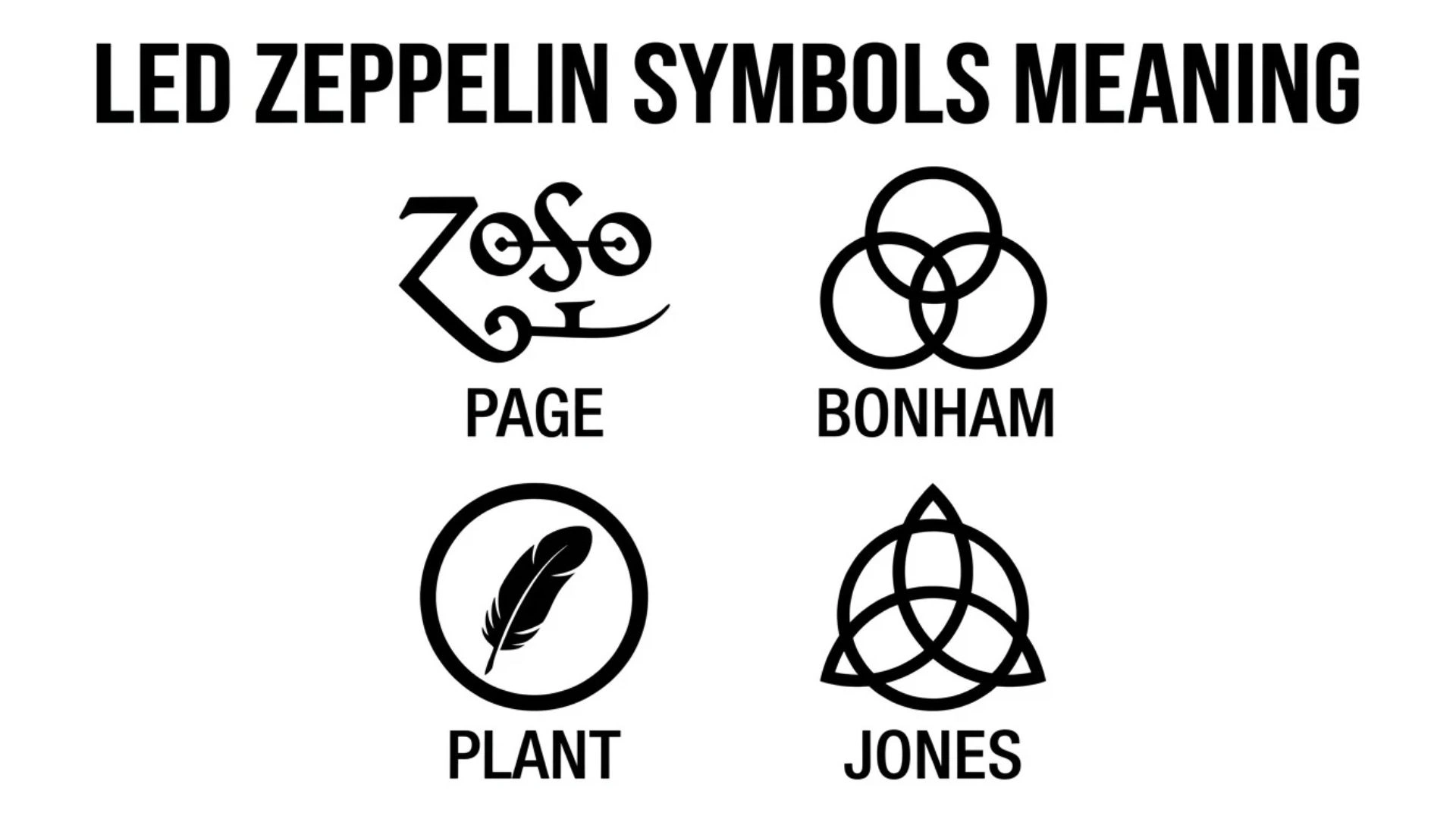
Led Zeppelin’s four mysterious symbols have fascinated rock fans for more than five decades. They first appeared on the band’s untitled 1971 album, commonly known as Led Zeppelin IV. Instead of printing a regular album title, the group used four personal designs, one for each member.
The symbols belong to Jimmy Page, Robert Plant, John Paul Jones, and John Bonham. Each has a different background. Page created his own mysterious design, Plant chose a feather enclosed in a circle, Jones selected a symbol associated with confidence and competence, and Bonham picked three interlocking rings.
Fans often call Page’s design Zoso, although he never intended it to spell that word. The other symbols have their own stories, including connections to historical reference books, ancient imagery, and personal interpretations.
This guide explains the Led Zeppelin symbols’ meanings, where the designs came from, and which details are confirmed. It also explores the fifth symbol associated with Sandy Denny, the album’s unusual artwork, and the theories that continue to attract fans.
What Are the Four Led Zeppelin Symbols?
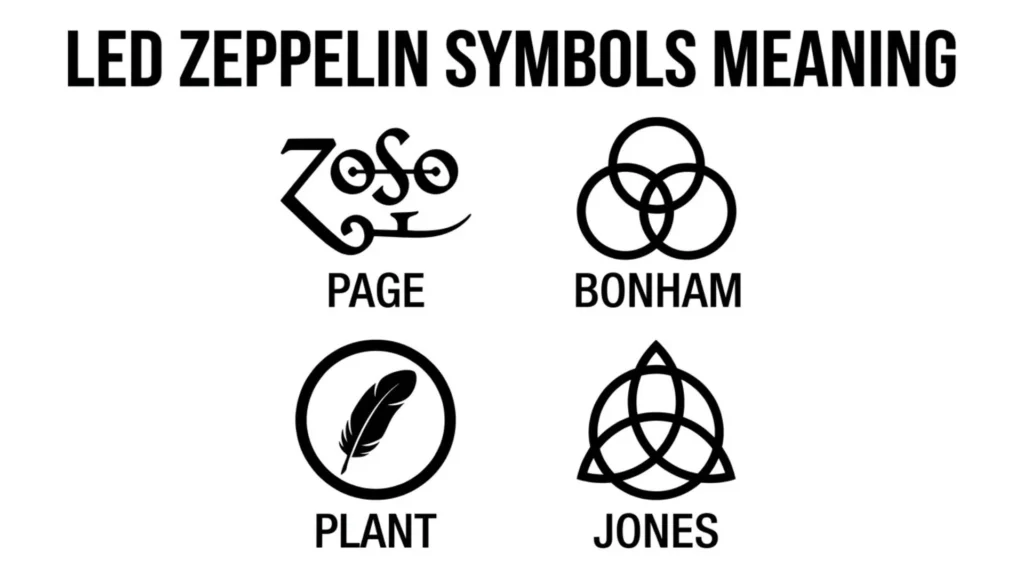
The four Led Zeppelin symbols are personal emblems chosen by the band’s members for their fourth studio album. They replaced a conventional title and became the visual identity of the 1971 release.
The album is officially untitled. Fans and music publications commonly call it Led Zeppelin IV, Four Symbols, or Zoso. These names help identify the record, but none is its printed official title.
Each symbol represents one musician:
- Jimmy Page: A complex personal design commonly called Zoso.
- Robert Plant: A feather enclosed in a circle.
- John Paul Jones: A distinctive three-part design inside a circle.
- John Bonham: Three interlocking rings.
The four designs do not come from one shared writing system or ancient tradition. Each member selected a symbol for personal reasons, and their origins differ.
| Band member | Symbol description | Commonly associated meaning |
| Jimmy Page | Zoso-like personal sigil | Private meaning; possible astrological and esoteric connections |
| Robert Plant | Feather inside a circle | Feather symbolism, courage, writing, and philosophical ideas |
| John Paul Jones | Three-part design inside a circle | Confidence and competence |
| John Bonham | Three interlocking rings | Often interpreted as mother, father, and child |
The meanings in this table are not equally certain. Page has kept his design’s full meaning private, while the other three have more commonly reported explanations.
Why Did Led Zeppelin Use Symbols Instead of an Album Title?
Led Zeppelin wanted its fourth album to look different from a conventional rock release. The group had faced criticism over its previous work, and Jimmy Page wanted to present the new record without the usual emphasis on the band’s name or a printed title.
Page suggested using a symbol as the album’s identity. The idea developed into four separate designs because the group had four members. Each musician could choose a sign that felt personal.
The decision created an unusual challenge for record stores, music magazines, and newspapers. They could not simply print a normal album title. They had to reproduce the unfamiliar designs instead.
The Idea Behind the Four Symbols
The symbols gave each member an individual identity while keeping the album connected as one project.
The approach also matched the band’s interest in artistic experimentation. Led Zeppelin had already developed a distinctive visual style through its album covers, photography, and artwork.
Rather than explaining every design to the public, the group allowed the symbols to speak for themselves. That decision created curiosity and encouraged listeners to investigate their origins.
Why Is the Album Called Led Zeppelin IV?
The album has no conventional printed title. Music fans began calling it Led Zeppelin IV because it was the band’s fourth studio album.
Other informal names include Four Symbols and Zoso. The second name describes the four designs, while the third comes from the nickname commonly given to Jimmy Page’s symbol.
These names are useful when discussing the record, but it is important to remember that the original album was untitled.
Jimmy Page Zoso Symbol: Origin, Theories, and Meaning
Jimmy Page’s symbol is the most mysterious of the four. Fans commonly call it Zoso because its unusual shape looks as though it contains the letters Z, O, S, and O.
Page designed the emblem himself. However, he has never given the public a complete explanation of what it means.
What Did Jimmy Page Say About Zoso?
Page has offered a small amount of information about his design without revealing its full meaning.
In a later interview, he described it as being about “invoking and being invocative.” He then declined to explain further.
This comment is the strongest starting point for understanding the symbol. It suggests that Page intended something personal and evocative rather than a simple word or decorative logo.
In a 1972 interview, he also clarified that the design was his own and that it was never meant to spell “Zoso.”
Why Do Fans Call It Zoso?
The nickname comes from the design’s appearance. Some viewers interpret its shapes as four letters and read them as Z-O-S-O.
The name became popular because it offers an easy way to identify the symbol. Fans, collectors, and music writers continue to use it when discussing Page’s emblem.
However, Page did not create it as a written word. Calling it the Zoso symbol is convenient, but treating “Zoso” as its confirmed translation is inaccurate.
The Saturn and Capricorn Theory
One popular theory connects Page’s design with Saturn, the planet associated with Capricorn in astrology.
Page was born under the Capricorn zodiac sign. This detail has encouraged fans to look for astrological connections in the emblem.
Some interpretations suggest that parts of the design resemble historical symbols associated with Saturn or other planets. These comparisons have appeared in discussions of astrology and esoteric symbolism.
However, Page has not confirmed that the symbol represents Saturn or Capricorn. The connection remains a theory rather than an established explanation.
The 1844 French Symbol Reference
Another interesting detail concerns a nineteenth-century French reference book titled Le Triple Vocabulaire Infernal Manuel du Demonomane, published in 1844.
A design resembling Page’s emblem has been identified in discussions of this book. The similarity has encouraged theories about the symbol’s historical background.
Still, a similar-looking image does not prove that Page copied the design directly from that publication. It also does not establish what the symbol meant to him personally.
The reference is worth mentioning because it adds historical context, but it should not be presented as the final answer to the Zoso mystery.
Is the Zoso Symbol Connected to the Occult?
Jimmy Page’s interest in occult subjects is well known. He collected material related to esoteric traditions and had a strong interest in the work of occult writer Aleister Crowley.
That background helps explain why fans examine Zoso through an occult lens. Its unusual appearance and Page’s limited comments have also encouraged speculation.
However, the symbol should not automatically be described as satanic. There is no confirmed explanation from Page identifying it as a satanic sign.
The most accurate description is that Zoso is Page’s personal sigil, with possible historical, astrological, and esoteric associations. Its intended meaning remains private.
Robert Plant Feather Symbol: Meaning, Ma’at, and Its Origins
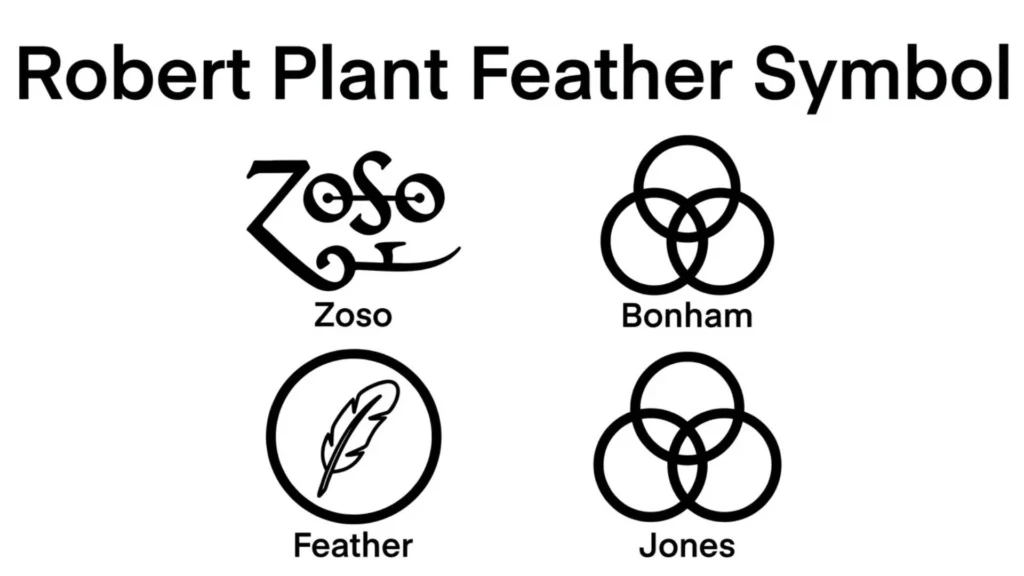
Robert Plant’s symbol features a feather enclosed within a circle. It is often associated with courage, writing, ancient Egyptian imagery, and philosophical ideas.
Unlike Page’s emblem, Plant has discussed some of the ideas behind his choice.
What Does Robert Plant’s Feather Symbol Mean?
Plant described the feather as a symbol with a broad and interesting heritage. He mentioned its association with courage among Native American tribes.
The feather also has a connection with writing. A feather quill was historically used as a writing instrument, making it a fitting image for a musician known for his lyrics.
Its common interpretations include:
- Courage and bravery
- Writing and creative expression
- Truth and justice
- Personal freedom
- Spiritual or philosophical ideas
These meanings come from different cultural and historical contexts. They should not be treated as one universal definition of the symbol.
The Feather of Ma’at Connection
One popular interpretation connects Plant’s feather with Ma’at, the ancient Egyptian goddess associated with truth, justice, balance, and cosmic order.
In ancient Egyptian religious imagery, Ma’at’s feather played an important role in the judgment of the dead. The heart of a deceased person was weighed against the feather as part of the judgment process.
The feather therefore carries associations with truth, moral balance, and justice.
This connection helps explain why people interpret Plant’s design as a symbol of truth or spiritual balance. However, the complete design’s exact historical origin should not be reduced to this one explanation.
The Feather as a Symbol of Writing
A feather can also suggest creativity and communication because people once used feather quills to write.
That association makes the design particularly suitable for Plant. As Led Zeppelin’s lyricist, he used words and imagery to create many of the band’s most memorable songs.
The symbol can therefore be understood as a personal emblem connected with expression, imagination, and the power of language.
The Sacred Symbols of Mu Connection
Plant’s feather design has also been linked with The Sacred Symbols of Mu, a book by James Churchward.
Churchward promoted the idea of Mu, a supposed lost continent and ancient civilization. His claims are not accepted as established archaeological or geological history.
The book contains symbols that have been compared with Plant’s feather design. This connection is useful when discussing possible influences, but it does not establish that the civilization described by Churchward actually existed.
The safest explanation is that Plant selected his own feather design and discussed its wider symbolic heritage. Its possible links to Ma’at and the book about Mu are part of the design’s background, not a single confirmed definition.
John Paul Jones Symbol Meaning: Confidence and Competence
John Paul Jones selected a symbol made from three connected forms inside a circle. It is one of the more unusual designs on Led Zeppelin IV.
Its commonly reported meaning connects two personal qualities: confidence and competence.
What Does John Paul Jones’ Symbol Represent?
The design is associated with someone who has both confidence and competence.
These qualities work together. Confidence helps a person trust their judgment and take responsibility. Competence means they have the ability and knowledge to handle the task.
The symbol therefore suggests more than simply feeling confident. It points toward someone who can support that confidence with real ability.
This interpretation is especially interesting because Jones was a highly skilled multi-instrumentalist, arranger, and musician within Led Zeppelin.
Where Did John Paul Jones Find His Symbol?
Jones selected his design from Rudolf Koch’s The Book of Signs, a collection of historical and symbolic designs.
The book offered a source of distinctive signs rather than requiring the band members to create every emblem from scratch.
The confidence-and-competence explanation is often connected with the difficulty of drawing the design accurately. In other words, the symbol’s precise form was part of its reported significance.
Is John Paul Jones’ Symbol a Rune?
The design is often described as a rune, but the distinction needs care.
In a 1972 interview, Jimmy Page explained that only the two middle symbols were actually runes. These were Plant’s feather and Jones’ design.
He also rejected the rumor that the symbols were Icelandic runes.
The term “rune” generally refers to characters from historical writing systems, especially Germanic alphabets. It is not accurate to assume that every unusual symbol on the album belongs to one ancient alphabet.
John Bonham’s Three Interlocking Rings Meaning
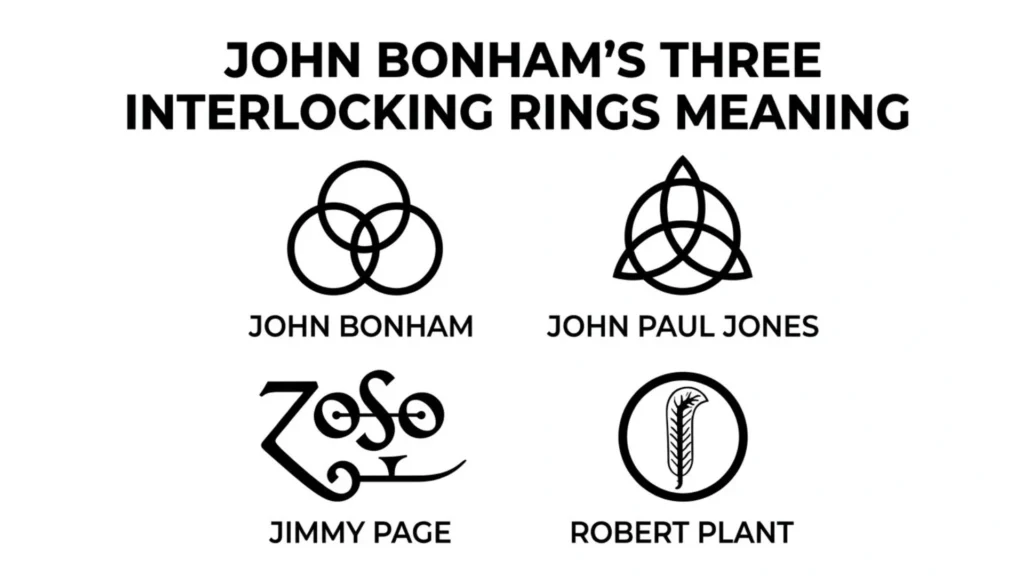
John Bonham’s emblem consists of three interlocking rings. It is often interpreted as a symbol of family, unity, and the connection between three people.
Bonham selected this design from the same book used by John Paul Jones.
What Do John Bonham’s Three Rings Represent?
The most widely repeated interpretation connects the three rings with a family of three: mother, father, and child.
This explanation is often associated with Bonham’s family life. The design can also suggest unity because each ring remains part of one connected arrangement.
Common interpretations include:
- Family connection
- Togetherness
- Unity
- Relationships between parents and children
- Three individual parts forming one whole
The family explanation is widely reported, but it should be described as an interpretation rather than a complete statement of Bonham’s private intentions.
Why Did John Bonham Choose the Three Rings?
Bonham selected the design from Rudolf Koch’s The Book of Signs. Accounts of the choice commonly report that he liked the appearance of the three rings.
The band’s selection process was personal. Not every member chose a symbol because of a long explanation or a complicated historical meaning.
That detail is important because fans sometimes assume that all four designs were carefully selected to communicate a specific philosophical message.
The Ballantine Beer Logo Connection
One interesting piece of Led Zeppelin trivia is the resemblance between Bonham’s three rings and the emblem used by Ballantine beer.
The similarity became a talking point among fans because Bonham was known for enjoying alcohol.
It is an amusing connection, but it does not prove that he chose the symbol because of the beer logo. The reported source of the design is Koch’s book.
The Ballantine connection is best treated as an additional visual coincidence rather than the symbol’s original meaning.
Are the Three Rings Borromean Rings?
Fans sometimes compare Bonham’s design with Borromean rings. These are three linked circles with a special geometric property: removing any one ring causes the other two to separate.
The arrangement is used in different settings to represent interdependence and unity.
However, the comparison should be made carefully. A design that looks like three interlocking rings is not automatically a mathematically exact Borromean arrangement.
Unless the specific reproduction has been checked, it is safer to call Bonham’s emblem the three interlocking rings.
What Is the Fifth Led Zeppelin Symbol?
The four main symbols represent the band’s four members. However, a fifth, smaller emblem is associated with singer Sandy Denny.
Denny performed with Robert Plant on “The Battle of Evermore,” one of the songs on Led Zeppelin IV. The additional symbol acknowledges her contribution.
Who Was Sandy Denny?
Sandy Denny was a British singer-songwriter known for her work with Fairport Convention and her solo music.
Her voice appears alongside Plant’s on “The Battle of Evermore.” The song has a folk-inspired sound and uses imagery connected with fantasy, conflict, and mythology.
Denny’s contribution was significant enough to receive its own small emblem in the album’s presentation.
What Does Sandy Denny’s Symbol Look Like?
The fifth design is commonly described as three downward-pointing triangles.
It appears in the album’s credits as a mark associated with Denny rather than as one of the four main member symbols.
Some accounts connect the design with the Godhead. However, the exact intended meaning is not as clearly documented as the fact that it identifies Denny’s contribution.
For accuracy, it is best to describe it as Sandy Denny’s symbol and treat more specific spiritual explanations as reported interpretations.
Where Did the Four Led Zeppelin Symbols Come From?
The four symbols have different origins. Understanding those differences helps explain why the designs should not all be described as ancient runes or symbols from one culture.
| Band member | Reported origin | Important detail |
| Jimmy Page | His own design | The full personal meaning remains private. |
| Robert Plant | His own feather design | He discussed its wider symbolic heritage. |
| John Paul Jones | Rudolf Koch’s The Book of Signs | Associated with confidence and competence. |
| John Bonham | Rudolf Koch’s The Book of Signs | Three rings, often interpreted as a family of three. |
The Role of Rudolf Koch’s The Book of Signs
Rudolf Koch was a German typographer and designer known for his work with lettering and symbolic forms.
His book, The Book of Signs, collects designs from different historical and cultural backgrounds.
John Paul Jones and John Bonham selected their symbols from this reference. Their choices gave the album two emblems with a connection to an existing collection of signs.
Why the Origins Matter
The origin of a symbol and its meaning are not always the same thing.
A design may have an older historical background but acquire a personal meaning when someone chooses it. That is why Page’s symbol, Plant’s feather, and the two designs from Koch’s book should be discussed separately.
It also explains why some popular online interpretations are uncertain. A similar-looking historical sign does not automatically prove what a musician intended.
Are the Led Zeppelin Symbols Actually Runes?
Not all four Led Zeppelin symbols are runes.
The word “rune” usually refers to characters from historical writing systems, particularly those used by Germanic peoples. Fans sometimes use it loosely to describe any mysterious or ancient-looking sign.
Jimmy Page addressed this question in a 1972 interview. He explained that only the two middle symbols were actually runes. He also rejected the rumor that they were Icelandic.
This means the four symbols have different backgrounds:
- Page’s design is his personal emblem.
- Plant’s feather is his own design with several symbolic associations.
- Jones’ design came from Koch’s book.
- Bonham’s three rings also came from Koch’s book.
Calling the entire group “ancient runes” may sound convenient, but it does not accurately describe the designs’ different origins.
Led Zeppelin IV Album Cover Meaning and Hidden Details
The four symbols are an important part of Led Zeppelin IV, but they are not the only interesting details in its artwork.
The album cover features an old man carrying a bundle of sticks. The image appears against a wall in a changing urban environment. The back cover and inner artwork add more details that help explain the album’s visual identity.
The Old Man Carrying Sticks
The front cover shows an elderly man carrying a large bundle of sticks on his back.
Robert Plant found the picture in a junk shop in Reading, England. He and Jimmy Page decided to use it as the main image for the album.
For years, the man’s identity was uncertain. In 2023, researchers connected the image with a Victorian photograph of a Wiltshire thatcher named Lot Long.
The photograph was believed to have been taken by Ernest Howard Farmer in the late nineteenth century. This discovery added a real historical identity to an image that had become one of rock music’s most recognizable album covers.
The Contrast Between Old and New
Jimmy Page explained that the image was intended to contrast the old way of life with modern development.
The old man carrying sticks represents a traditional rural world. The buildings behind him suggest urban growth and the arrival of a newer environment.
Page described the concept as showing the old being replaced while the new comes forward.
This interpretation gives the cover a deeper meaning than simply showing an interesting vintage photograph. It reflects change, development, and the relationship between traditional life and the modern world.
The Oxfam Poster
A small Oxfam poster can also be seen in the album artwork. Its message reads, “Someone dies from hunger every day.”
The poster adds a social dimension to the image. It reminds viewers that poverty and hunger exist alongside the modern buildings and changing surroundings.
The detail is easy to overlook because the old man attracts most of the attention. However, it gives the artwork another layer of meaning.
The Hermit Illustration Inside the Album
The inner artwork features a figure associated with the Hermit tarot card.
Jimmy Page explained that the illustration represented self-reliance and wisdom. Artist Barrington Colby created the image.
This illustration is separate from the four member symbols. It forms part of the album’s broader visual presentation and adds another reference to personal reflection and independence.
Why the Album Artwork Still Attracts Attention
The cover does not provide one simple explanation for every image. Instead, it combines a historical photograph, modern architecture, a social message, and symbolic artwork.
That mixture encourages viewers to look more closely. It also reflects the band’s decision to create an album identity that did not rely on a conventional title or a photograph of the musicians.
How to Identify Each Led Zeppelin Symbol
If you see the designs on a record sleeve, poster, tattoo, or piece of merchandise, focus on their overall shapes.
Jimmy Page’s Zoso Symbol
Page’s emblem is the most complex of the four. It has curved and angular parts that can look like letters when viewed quickly.
Remember that Zoso is a fan nickname, not a confirmed word or translation.
Robert Plant’s Feather Symbol
Plant’s design is easier to identify because it shows a feather enclosed within a circle.
The feather is the central feature. Its associations include courage, writing, and other philosophical interpretations.
John Paul Jones’ Symbol
Jones’ design has three connected forms inside a circular outline.
It is often recognized by its balanced, symmetrical appearance.
John Bonham’s Three Rings
Bonham’s symbol consists of three interlocking circular shapes.
Its simple structure makes it one of the easiest designs to recognize.
Quick Symbol Identification Chart
| Symbol | Visual clue | Member |
| Zoso | Complex letter-like sigil | Jimmy Page |
| Feather in a circle | Central feather surrounded by a circle | Robert Plant |
| Three-part circular design | Three connected forms inside a circle | John Paul Jones |
| Three rings | Three interlocking circular shapes | John Bonham |
The symbols may look slightly different across posters, merchandise, and reproductions. Use a reliable image of the original album artwork when checking a particular version.
Are Led Zeppelin Symbols Used in Tattoos and Merchandise?
Yes. Fans use the four symbols in tattoos, clothing, posters, jewelry, and other collectibles. Their distinctive shapes make them recognizable without needing the band’s full name.
Led Zeppelin Symbol Tattoos
Many fans choose a symbol associated with their favorite member or a personal connection to the band’s music.
Popular choices include:
- Jimmy Page’s Zoso design for its mysterious appearance.
- Robert Plant’s feather for its associations with courage and creativity.
- John Paul Jones’ design for its connection with confidence and competence.
- John Bonham’s rings for their association with family and unity.
Before getting a tattoo, compare the artwork with a reliable reproduction. Small differences can change the appearance of a design.
Which Led Zeppelin Symbol Should You Choose for a Tattoo?
Choose based on the meaning that matters most to you.
| Personal meaning | Symbol to consider |
| Mystery and individuality | Jimmy Page’s Zoso |
| Creativity and expression | Robert Plant’s feather |
| Confidence and ability | John Paul Jones’ design |
| Family and togetherness | John Bonham’s rings |
| Appreciation for the whole band | All four symbols together |
You do not need to choose the symbol of your favorite musician. A design can also represent a personal value or memory.
Led Zeppelin Clothing and Accessories
The four symbols appear on shirts, jackets, necklaces, bracelets, and other fan items.
Some designs use one emblem, while others place all four together. Fans may also choose artwork that combines the symbols with the album’s title or release year.
If authenticity matters to you, check whether the item is officially licensed. A product featuring the symbols is not automatically official band merchandise.
Using the Symbols in Personal Artwork
The designs also work in posters, framed prints, and music-room decorations.
If you create your own artwork, preserve the original shapes and identify each member correctly. This is especially important for Page’s design, which is often altered in unofficial reproductions.
Why Are the Led Zeppelin Symbols Still Popular?
The four designs remain popular because they connect music history with personal identity and visual mystery.
Each Symbol Represents a Different Musician
The designs give each band member a recognizable personal emblem. Fans can identify the musicians through the artwork without needing a traditional portrait.
The Album’s Untitled Presentation Was Unusual
Most albums display a title and artist name prominently. Led Zeppelin IV took a different approach, which made the symbols a central part of its identity.
Some Meanings Remain Unanswered
Page’s decision not to reveal the full meaning of his emblem keeps the discussion alive. Fans continue to compare historical references and explore possible explanations.
The Designs Work Beyond the Album
The symbols have become recognizable in tattoos, merchandise, posters, and fan collections. Their simple visual identities help them remain relevant to new generations of listeners.
Frequently Asked Questions About Led Zeppelin Symbols Meaning
What Do the Four Led Zeppelin Symbols Mean?
The four symbols represent Jimmy Page, Robert Plant, John Paul Jones, and John Bonham. Page’s design is commonly called Zoso, Plant chose a feather in a circle, Jones selected a symbol associated with confidence and competence, and Bonham chose three interlocking rings.
What Does the Zoso Symbol Mean?
The exact meaning of Jimmy Page’s Zoso symbol remains private. Page described it as being about invoking and being invocative, but he did not reveal a complete explanation.
Did Jimmy Page Ever Reveal the Meaning of Zoso?
No complete explanation is publicly confirmed. Page has made brief comments about the design but has not explained its full personal meaning.
Is Zoso an Ancient Symbol?
Similar-looking designs have been identified in historical references, including a nineteenth-century French book. However, that resemblance does not prove the exact origin of Page’s design or its intended meaning.
Is Jimmy Page’s Symbol Connected to Saturn?
Some fans connect Zoso with Saturn and Page’s Capricorn zodiac sign. This is a popular astrological theory, not a meaning Page has confirmed.
What Does Robert Plant’s Feather Symbol Stand For?
Plant’s feather has associations with courage, writing, and philosophical ideas. It is also commonly connected with the feather of Ma’at, the ancient Egyptian goddess associated with truth and justice.
Why Did John Paul Jones Choose His Symbol?
Jones selected his design from Rudolf Koch’s The Book of Signs. It is commonly explained as representing someone who possesses both confidence and competence.
What Do John Bonham’s Three Rings Mean?
The three rings are often interpreted as representing a family of three: mother, father, and child. They also suggest unity and connection, although the complete personal reason for Bonham’s choice is not fully documented.
Is John Bonham’s Symbol the Ballantine Beer Logo?
The three-ring design resembles the Ballantine beer emblem. The resemblance became a popular piece of band trivia, but the reported source of Bonham’s symbol was Rudolf Koch’s The Book of Signs.
What Is the Fifth Led Zeppelin Symbol?
The fifth symbol is associated with Sandy Denny, who sang with Robert Plant on “The Battle of Evermore.” It is commonly described as three downward-pointing triangles and appears in the album’s credits.
Are All Four Led Zeppelin Symbols Runes?
No. In a 1972 interview, Jimmy Page said that only the two middle designs were runes. The four symbols have different origins and should not all be described as members of one ancient writing system.
Why Is Led Zeppelin IV Sometimes Called Four Symbols?
The album is officially untitled and displays four symbols instead of a conventional title. Fans use the name Four Symbols because each design represents one band member.
What Does the Led Zeppelin IV Album Cover Represent?
Jimmy Page explained that the old man carrying sticks represented the old way of life, while the modern buildings behind him represented new development. The artwork creates a contrast between traditional rural life and the changing urban environment.
Who Is the Man on the Led Zeppelin IV Album Cover?
The man has been identified as Lot Long, a nineteenth-century thatcher from Wiltshire, England. Researchers connected the image with a Victorian photograph taken by Ernest Howard Farmer.
Is the Led Zeppelin Feather Symbol Egyptian?
The feather is commonly associated with Ma’at, the ancient Egyptian goddess of truth and justice. However, Robert Plant described the feather as having a wider symbolic heritage, so its meaning should not be limited to one culture.
Can I Use a Led Zeppelin Symbol for a Tattoo?
You can choose a Led Zeppelin-inspired design for a personal tattoo. Check the original artwork carefully, consider the symbol’s history, and work with a tattoo artist who can reproduce its details accurately.
Conclusion
The four Led Zeppelin symbols represent four musicians, but their meanings and origins are different. Jimmy Page’s Zoso remains the most mysterious because he has never fully explained it. Robert Plant’s feather connects with courage, writing, and philosophical traditions. John Paul Jones’ design is associated with confidence and competence, while John Bonham’s three rings are commonly interpreted as a family symbol.
The fifth emblem acknowledges Sandy Denny’s contribution to “The Battle of Evermore.” Beyond the symbols, the album’s artwork adds another layer of meaning through its old photograph, modern buildings, Oxfam poster, and Hermit illustration.
The most important distinction is between documented history and popular interpretation. Some explanations have strong support, while others remain theories. That mixture of personal meaning and unanswered questions is part of what makes the Led Zeppelin symbols so fascinating.

Dylan Anderson is a writer who enjoys turning complex topics into simple, engaging content that readers can actually use. His work focuses on clear explanations, practical insights and storytelling that feels natural and relatable. He is also the fictional author of The Quiet Compass of Ashford and Where the Cedar Lantern Glows. When he’s away from his keyboard, Dylan enjoys hiking, reading, and discovering inspiration in everyday life. He believes great writing should be informative, easy to understand and enjoyable from beginning to end.
 Adam Sullivan