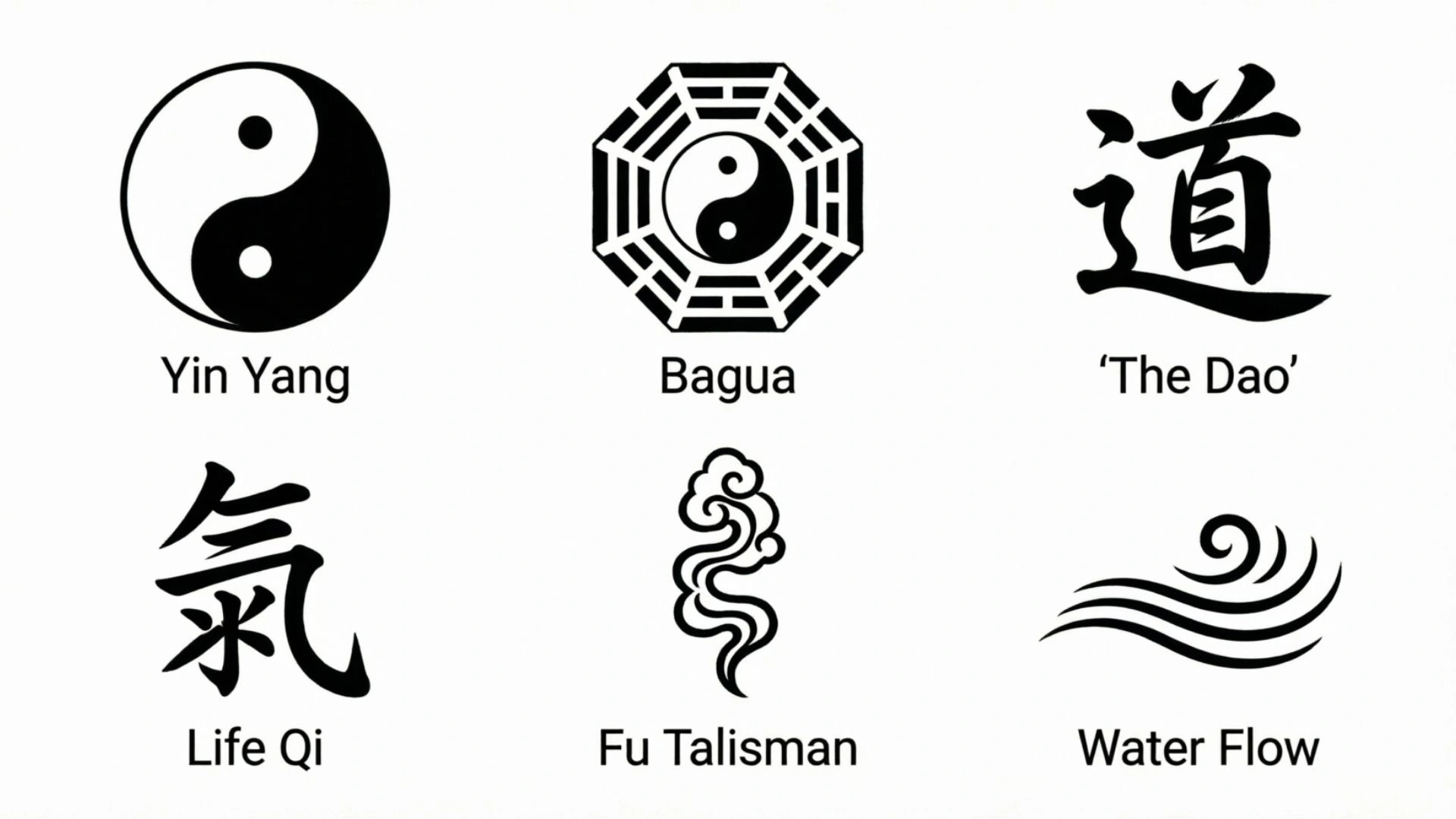
Daoism, also spelled Taoism, is one of China’s major philosophical and religious traditions. Its ideas have shaped Chinese philosophy, spirituality, literature, medicine, art, and views of nature for centuries.
Because Daoism developed over a long period and includes different schools and practices, its symbolism is much richer than a single familiar image.
When people search for Daoism symbols, they often expect to find the yin-yang symbol. It is certainly one of the best-known symbols associated with Daoist thought, but it is not the only one. The Bagua, the character 道, Daoist talismans, the Eight Immortals, dragons, tigers, cranes, peaches, tortoises, mountains, water, and other imagery can all appear in Daoist philosophy, cosmology, religious practice, and art.
There is also an important distinction to make. Some symbols connected with Daoism have much older or broader roots in Chinese culture. Yin and yang, for example, were not created exclusively by Daoism. Likewise, dragons and peaches appear in many Chinese cultural and religious settings.
This guide explains the most important Daoism symbols and their meanings, where they come from, how they are used, and how to tell specifically Daoist symbolism from broader Chinese imagery.
What Are Daoism Symbols?
Daoism symbols are visual signs, diagrams, characters, objects, animals, figures, and natural images used to express ideas associated with Daoist philosophy, cosmology, religious practice, mythology, and spiritual traditions.
Unlike a modern brand that has one official logo, Daoism does not have one universally accepted symbol that represents everything within the tradition.
Instead, Daoist symbolism developed across different periods and schools.
Some symbols communicate philosophical ideas such as balance and change. Others relate to cosmology, immortality, religious ritual, protective practices, or the Daoist pantheon.
The most recognizable examples include:
| Symbol | Name | Common Association |
| ☯ | Yin-Yang / Taijitu | Complementary forces, balance, and change |
| ☰–☱ | Bagua / Eight Trigrams | Cosmology, change, and divination |
| 道 | Dao | The Way |
| 🐉 | Dragon | Yang, east, rain, transformation |
| 🐅 | Tiger | Yin, west, strength |
| 🐢 | Tortoise | Longevity, endurance, divination |
| Crane | Crane | Longevity and immortality |
| Peach | Peach | Longevity and immortality |
| Gourd | Gourd | Immortality and Daoist immortals |
| Eight Immortals | Daoist immortals | Immortality and spiritual attainment |
| Talisman | Fu | Ritual and religious functions |
| Five Phases | Wu Xing | Natural and cosmic processes |
These meanings are broad associations, not fixed translations that apply in every historical context.
What Is the Main Symbol of Daoism?
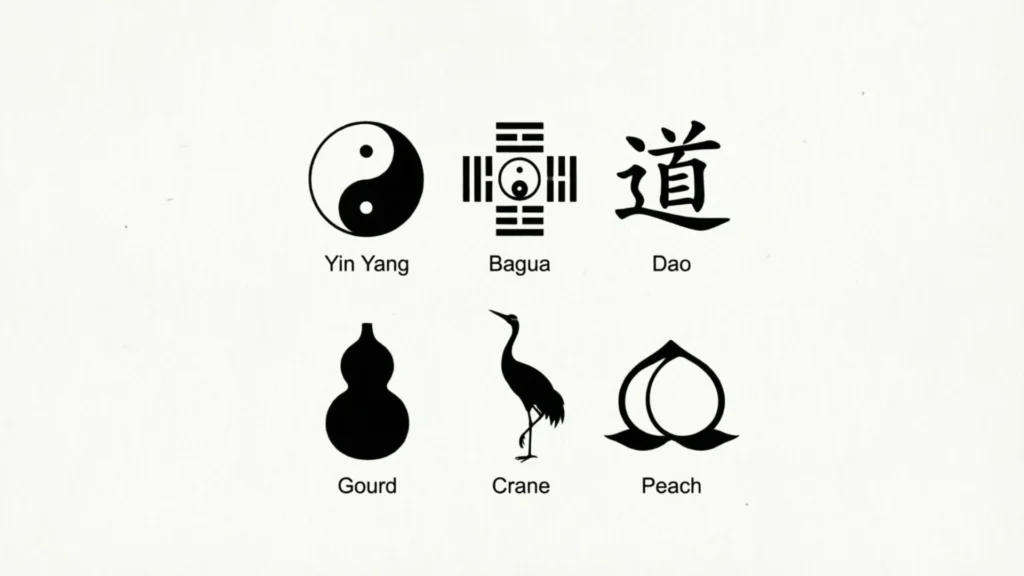
The yin-yang symbol, commonly called the taijitu, is the most widely recognized symbol associated with Daoist thought.
Its circular design contains two interlocking forms, traditionally represented in black and white. Each side contains a small portion of the opposite color.
The image is associated with yin and yang, complementary aspects or phases of reality that interact and transform.
However, it is more accurate to say that yin-yang is the best-known symbol associated with Daoism, rather than calling it the one official symbol of Daoism.
The history of yin and yang extends beyond Daoism, and the familiar graphic developed over time within broader Chinese intellectual and cosmological traditions. The Internet Encyclopedia of Philosophy notes that traditions focused on yin and yang existed alongside other schools of early Chinese thought.
Daoist thought incorporated yin-yang into a broader understanding of the Dao, cosmic change, and harmony.
Daoism Symbols List and Meanings
For readers who want a quick reference, the following list brings the major symbols together in one place.
| Daoism Symbol | Meaning or Association | How It Is Used |
| Yin-Yang | Complementarity and dynamic balance | Philosophy, cosmology, art |
| Bagua | Eight patterns of change | Cosmology, divination, religious imagery |
| 道 | The Way | Philosophy, calligraphy |
| Dragon | Yang, east, rain, cosmic energy | Art, cosmology, religious imagery |
| Tiger | Yin, west, strength | Art and cosmological imagery |
| Tortoise | Longevity and endurance | Art, divination, cosmology |
| Crane | Longevity | Art and immortality imagery |
| Peach | Immortality and long life | Mythology and Daoist-associated art |
| Gourd | Immortality and magical contents | Immortal imagery |
| Eight Immortals | Attainment of immortality | Art, stories, religious culture |
| Daoist Talisman | Ritual and spiritual function | Religious practice |
| Mountains | Nature, sacred landscapes, spiritual realms | Landscape art |
| Water | Flow, adaptability, natural process | Philosophy and art |
| Five Phases | Cycles and transformations | Cosmological systems |
The table is useful as a starting point, but individual symbols need context. A dragon painted on a temple object, for example, may have a different significance from a dragon used on imperial decoration.
The Yin-Yang Symbol in Daoism
What Does Yin-Yang Mean?
Yin and yang describe complementary aspects or phases of reality.
Traditional associations include:
Yin:
- Shade
- Water
- West
- Tiger
- Receptive or inward qualities
Yang:
- Light
- Fire
- East
- Dragon
- Active or outward qualities
The Met describes yin and yang as alternating phases of cosmic energy whose dynamic balance is associated with cosmic harmony.
The important idea is that yin and yang are interrelated, rather than two completely separate substances.
The familiar symbol communicates this relationship visually.
What Do the Black and White Parts Mean?
The black and white halves represent yin and yang.
Their curved shapes suggest movement rather than a rigid division.
The small circle of the opposite color within each half is often understood as showing that each aspect contains the potential or presence of the other.
This makes the symbol particularly useful for expressing ideas of:
- Complementarity
- Change
- Interdependence
- Harmony
- Cycles
- Transformation
Does Yin Mean Evil?
No.
One of the most common modern misunderstandings is to interpret yin as evil and yang as good.
That is not an accurate way to understand the traditional concept.
Yin and yang are better understood as complementary aspects or phases that interact within a larger system. The distinction is not simply “good versus bad.”
Is Yin-Yang Exclusively Daoist?
No.
Yin-yang has a much broader history in Chinese thought.
The concept predates the formation of Daoism as an organized religious tradition and appears in several Chinese intellectual traditions. The Internet Encyclopedia of Philosophy discusses early yin-yang thought as a distinct current alongside schools such as Confucianism and Daoism.
Daoism nevertheless gives yin-yang an important place within its understanding of cosmic change and harmony.
Bagua and the Eight Trigrams
The Bagua, or Eight Trigrams, is another major symbol system associated with Chinese cosmology and Daoist traditions.
The Bagua consists of eight three-line figures. Each line is either continuous or broken.
A continuous line is associated with yang, while a broken line is associated with yin.
The eight trigrams are:
| Trigram | Name | Traditional Association |
| ☰ | Qian | Heaven |
| ☷ | Kun | Earth |
| ☵ | Kan | Water |
| ☲ | Li | Fire |
| ☳ | Zhen | Thunder |
| ☴ | Xun | Wind |
| ☶ | Gen | Mountain |
| ☱ | Dui | Lake |
The Bagua has connections with the Yijing, Chinese cosmology, divination, and later Daoist traditions. Historical objects demonstrate the use of the Eight Trigrams in Daoist cosmological contexts.
What Are the Eight Bagua Symbols?
Each trigram is traditionally associated with natural phenomena and other layers of interpretation.
Qian (☰) is associated with Heaven.
Kun (☷) is associated with Earth.
Kan (☵) is associated with Water.
Li (☲) is associated with Fire.
Zhen (☳) is associated with Thunder.
Xun (☴) is associated with Wind.
Gen (☶) is associated with Mountain.
Dui (☱) is associated with Lake.
These simple descriptions are useful for beginners, but the Bagua has much more complex interpretive systems involving directions, seasons, family relationships, qualities, and other correspondences.
Bagua and Daoist Cosmology
The Bagua became important within Chinese cosmological thought and Daoist traditions.
It can appear alongside yin-yang imagery and other diagrams that attempt to describe patterns of transformation in the natural and cosmic world.
The Met has historical objects in which the Eight Trigrams appear on ritual or cosmological objects, demonstrating that the Bagua was more than a modern decorative pattern.
The Dao Symbol
The Chinese character 道 is one of the most meaningful symbols connected with Daoist philosophy.
It is commonly translated as “the Way,” “the path,” or “the way things are.”
But 道 is not simply a logo for Daoism.
The concept of Dao is fundamental to Chinese philosophy and appears in different contexts. In Daoist philosophy, the Dao can refer to the underlying way or process through which reality unfolds.
The Internet Encyclopedia of Philosophy explains Dao as a term associated with “the Way” and with reality as an ongoing process of transformation.
Is 道 the Official Symbol of Daoism?
No.
The character 道 is the written form of the word Dao and is highly meaningful within Daoist philosophy, but it should not be treated as a universal official logo of the religion.
It is better described as a key written concept of Daoist thought.
For calligraphy, artwork, or tattoos, the character can therefore be meaningful, but its meaning should be understood as “Dao” or “the Way,” not simply “Daoism.”
Daoist Animal Symbols
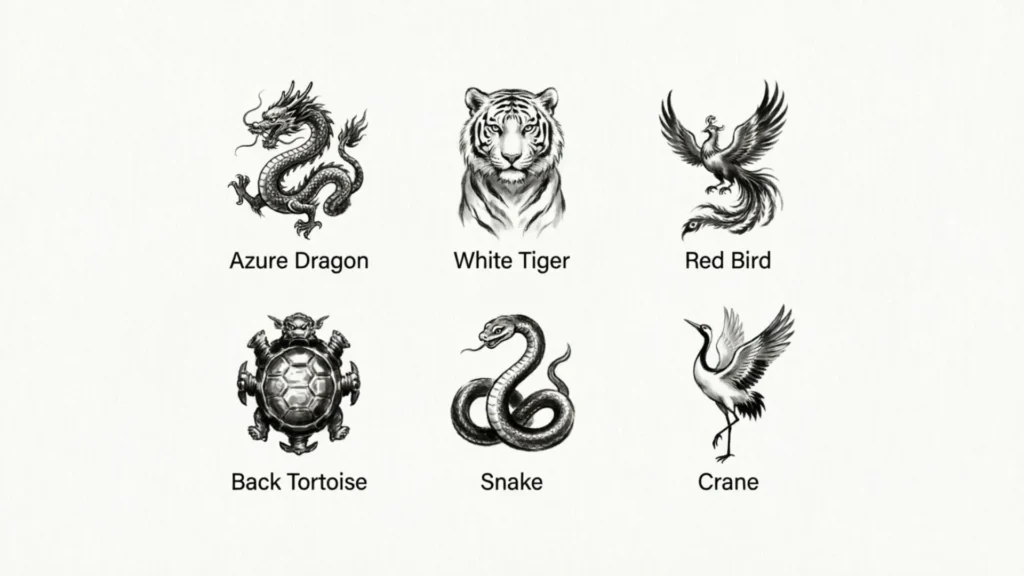
Animals play an important role in Chinese religious art and cosmological symbolism.
Some are strongly associated with Daoist imagery, while others belong to much broader Chinese traditions.
Dragon Symbol
The dragon is one of the most powerful creatures in Chinese symbolism.
In Daoist cosmological imagery, the dragon can be associated with yang, the east, water, clouds, rain, and cosmic energy.
The Met describes yin as associated with the west and tiger, while yang is associated with the east and dragon. It also notes Daoist imagery in which dragons embody cosmic energy capable of producing clouds and rain.
A dragon can therefore represent:
- Yang
- Power
- Transformation
- Rain
- Water
- Cosmic energy
- The eastern direction
However, dragons are not exclusively Daoist. They have a much broader history in Chinese culture.
Tiger Symbol
The tiger is traditionally associated with yin in certain Chinese cosmological systems.
In the classic dragon-and-tiger pairing, the tiger corresponds with the west while the dragon corresponds with the east.
The pair can therefore express complementary forces.
A tiger may also suggest:
- Strength
- Protection
- Yin
- The west
- Earthly power
The dragon and tiger should not simply be reduced to “good animal versus bad animal.” Their traditional pairing is about complementary forces.
Tortoise Symbol
The tortoise has long been associated with longevity and endurance in Chinese culture.
It also has important connections with divination.
A historical Chinese inkstone in the Met’s collection has a tortoise-shaped design with the Eight Trigrams engraved on the shell. The museum identifies the tortoise as a symbol of longevity and endurance and connects the trigrams with Daoist cosmology.
For this reason, the tortoise can be meaningful when discussing:
- Longevity
- Endurance
- Stability
- Divination
- Cosmological symbolism
Crane Symbol
The crane is widely associated with long life and longevity in Chinese art.
It appears in imagery connected with immortals and auspicious themes.
A crane is therefore often chosen for artwork or decorative designs representing:
- Long life
- Grace
- Longevity
- Spiritual aspiration
It is important to remember that the crane is a broader Chinese cultural symbol rather than an exclusively Daoist emblem.
Deer Symbol
The deer also appears in traditional Chinese art and Daoist-associated imagery.
It can occur alongside cranes, dragons, and other auspicious creatures.
Its symbolic meaning varies according to the particular artwork and cultural setting, so it is better not to assign one universal Daoist meaning to every deer image.
Daoism Symbols of Longevity and Immortality
Longevity and immortality are especially important themes in religious Daoism.
Daoist traditions developed practices concerned with health, cultivation, longevity, and immortality, and these themes became major subjects in Daoist art.
Peach Symbol
The peach is one of the most recognizable Chinese symbols of longevity and immortality.
It is especially famous through stories of supernatural peaches associated with immortality.
Peach imagery appears in Chinese art alongside immortals and other auspicious motifs. Smithsonian collections, for example, include works connecting peaches with Daoist immortals and longevity imagery.
A peach can therefore symbolize:
- Long life
- Immortality
- Vitality
- Auspiciousness
- Spiritual aspiration
Gourd Symbol
The gourd is another fascinating symbol associated with Daoist immortals.
In traditional imagery, a gourd can serve as a container for special substances, medicines, or the liquor of immortality.
The Met notes that gourds carried by Daoist immortals were traditionally associated with a special container for the liquor of immortality.
This makes the gourd particularly relevant to stories and images of immortals.
Pine Tree Symbol
Pine trees appear frequently in Chinese art as symbols of endurance and longevity.
In Daoist-associated landscape art, trees can also become visual expressions of vitality and cosmic energy.
The Met discusses a Daoist painting of a pine tree in which the tree’s form recalls the curved movement of the yin-yang diagram and expresses an idea of qi, or cosmic energy.
Eight Immortals
The Eight Immortals are among the most famous figures associated with Chinese religious and artistic traditions.
They became popular as a group during the medieval period and came to represent the attainment of immortality.
Each immortal has distinctive attributes that help identify them.
For example, Lan Caihe is traditionally shown with a basket, while Han Xiangzi is associated with a flute.
The Eight Immortals can represent:
- Immortality
- Spiritual attainment
- Longevity
- Individuality
- Wisdom
- Different paths through life
Their stories also make them popular subjects for paintings, ceramics, textiles, carvings, and decorative art.
Daoist Deities and Sacred Figures
Daoism is not only a philosophy. Religious Daoism developed an extensive religious structure with texts, rituals, deities, priests, and different schools.
This means that sacred figures can also function as visual symbols.
Laozi
Laozi is traditionally regarded as the author of the Daodejing and one of the foundational figures of Daoist philosophy.
His historical identity and the exact circumstances surrounding the formation of the text are subjects of scholarly discussion.
In Daoist art, Laozi may be depicted as a sage or immortal.
The Met’s collection includes historical representations identified as Daoist images of Laozi.
The Three Pure Ones
The Three Pure Ones are among the highest deities in the religious Daoist pantheon.
They are particularly important when discussing organized religious Daoism rather than Daoism only as a philosophical tradition.
The Met identifies the Three Purities as the highest deities in the Daoist pantheon.
Their imagery is therefore relevant to temples, religious art, ritual traditions, and representations of the Daoist cosmos.
The Eight Immortals
The Eight Immortals occupy a special place between mythology, popular religious culture, literature, and Daoist-associated traditions.
They became particularly popular in Chinese art and are recognizable by their distinctive objects and attributes.
Because they are strongly connected with immortality, they remain some of the most recognizable figures in Daoist-inspired artwork.
Daoist Talismans and Ritual Symbols
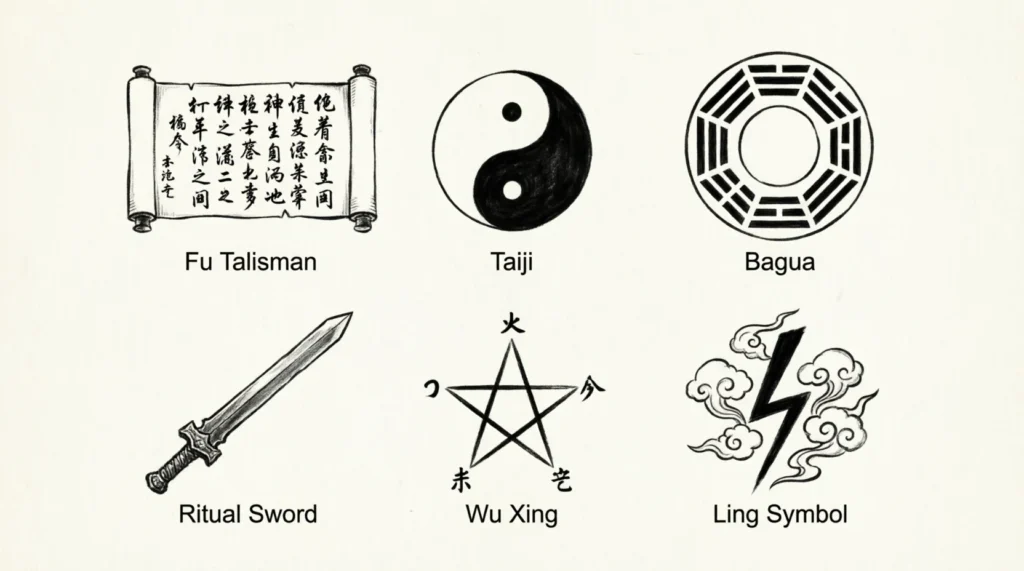
Daoist symbolism is not limited to philosophical diagrams and animals.
Religious Daoism also includes talismans, ritual writings, seals, diagrams, and sacred objects.
A Daoist talisman may be called a fu and can have a specific ritual purpose depending on the tradition.
What Is a Daoist Talisman?
A Daoist talisman is a ritual object or written form used within particular religious traditions.
Its purpose can involve:
- Protection
- Ritual authority
- Spiritual communication
- Purification
- Healing-related practices
- Warding off harmful influences
The exact meaning depends on the specific talisman and the Daoist tradition in which it is used.
The Met notes that talismans and ritual services formed part of the practical religious life of Daoist communities.
How to Avoid Fake Daoist Symbols
This is important because many websites label any mysterious Chinese-looking character as an “ancient Daoist protection symbol.”
That is not reliable.
Before identifying a symbol as Daoist, consider:
- Where does the symbol come from?
- Is there a documented historical example?
- What text or tradition explains it?
- Is it a religious talisman or a modern decorative design?
- Does its meaning depend on a particular ritual?
- Is the Chinese writing actually readable and correctly reproduced?
A strange-looking collection of lines is not automatically a Daoist talisman.
Daoist religious traditions contain many schools and ritual systems, so one talisman should not be treated as representative of all Daoism.
Five Phases in Daoist Symbolism
The Five Phases, commonly called the Five Elements or Wu Xing, are another important part of traditional Chinese cosmological thought.
The five are:
- Wood
- Fire
- Earth
- Metal
- Water
The term “Five Phases” can be useful because these are not simply five physical substances. They describe dynamic relationships, transformations, and cycles.
These ideas appear across Chinese thought and should not be presented as an exclusively Daoist invention.
They can be connected with:
- Seasons
- Directions
- Natural processes
- Colors
- Cycles
- Bodily systems
- Cosmological correspondences
The Five Phases may appear alongside yin-yang and Bagua systems in traditional cosmological interpretations.
Daoism Symbols of Balance, Harmony, and Nature
Daoism has a strong connection with natural processes and the idea of responding appropriately to the changing world.
This is why natural imagery is so important in Daoist art.
Mountains
Mountains can represent sacred landscapes, spiritual retreats, and realms associated with immortals.
Daoist landscape paintings may use mountains not merely as scenery but as expressions of a larger vision of nature and the cosmos.
Water
Water is frequently used in Chinese philosophy and art as an image of adaptability, movement, and natural flow.
In Daoist-inspired interpretations, water can suggest a way of acting that does not rely on rigid force.
Clouds
Clouds are common in Chinese religious and artistic imagery.
In Daoist art, clouds can appear around immortals, sacred mountains, dragons, and celestial beings.
They can help create the visual impression of heavenly or supernatural realms.
Natural Landscapes
Daoist landscape art often treats nature as more than background scenery.
The Met notes that Daoist paintings can transform mountains, trees, and landscapes into visual expressions of cosmic energy and Daoist ideas.
This is one reason landscape imagery can be just as meaningful as a recognizable geometric symbol.
Daoism Symbols of Protection
Protection is one of the most common modern reasons people search for Daoist symbols.
Possible symbols and traditions include:
- Specific Daoist talismans
- Bagua imagery
- Protective deities
- Dragons
- Tigers
- Ritual seals
- Sacred diagrams
However, there is no single universal “Daoist protection symbol.”
The Bagua, for example, has multiple historical functions involving cosmology, divination, and systems of change. Calling it only a “protection symbol” oversimplifies its history.
Likewise, a talisman’s protective purpose depends on its particular ritual tradition.
Daoism Symbols in Chinese Art
Daoist symbolism has influenced Chinese visual culture for centuries.
It appears in:
- Paintings
- Ceramics
- Jade carvings
- Bronze objects
- Textiles
- Temple decoration
- Ritual robes
- Sculptures
- Calligraphy
- Landscape art
One object can contain several symbolic systems at the same time.
For example, a Daoist religious object might combine:
- Eight Trigrams
- Yin-yang imagery
- Dragons
- Clouds
- Sun and moon
- Immortals
- Sacred mountains
- Animals
- Stars
The Met’s collections demonstrate how Daoist imagery could combine cosmological symbols, religious figures, natural imagery, and ritual objects.
Are These Symbols Exclusively Daoist?
Not always.
This is one of the most important facts to understand when studying Daoism symbols.
Symbols Closely Connected With Daoist Traditions
These can include:
- Daoist talismans
- Daoist ritual objects
- Daoist deities
- Three Pure Ones
- Eight Immortals
- Daoist sacred landscapes
- Daoist religious imagery
Symbols Shared With Wider Chinese Thought
These include:
- Yin-yang
- Bagua
- Five Phases
- Dragon
- Tiger
- Tortoise
- Crane
- Peach
This does not make their connection with Daoism unimportant. It simply means that their history is broader.
The Met specifically notes that Daoist art and symbolism sometimes overlap with Buddhist, Confucian, and popular Chinese traditions. Religious and secular artists could also use similar imagery.
Daoism vs. Taoism: Are the Symbols Different?
No.
Daoism and Taoism are two English spellings referring to the same broad Chinese tradition.
The difference comes mainly from different systems of romanizing Chinese.
Therefore, these searches usually overlap:
- Daoism symbols
- Taoism symbols
- Daoist symbols
- Taoist symbols
- Daoism symbol meanings
- Taoism symbol meanings
The spelling changes, but the underlying subject is the same.
Daoist Symbols vs. Buddhist Symbols
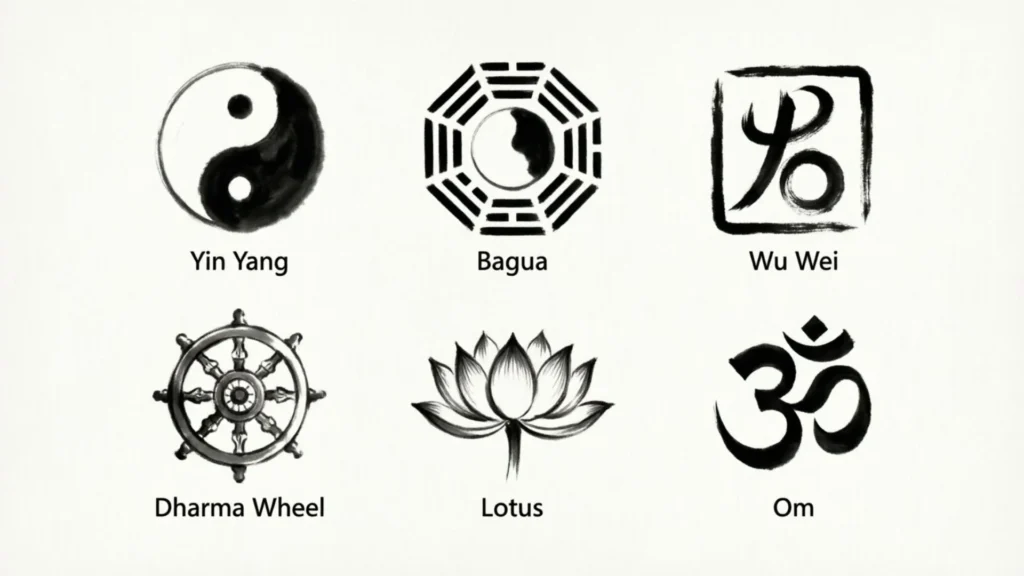
Chinese Buddhist and Daoist art can sometimes look similar.
This is partly because the two traditions interacted for centuries and sometimes shared artistic motifs, objects, and visual conventions.
For example, clouds, dragons, mountains, flowers, and other imagery may appear in different religious settings.
This means you should not identify a symbol only by its appearance.
Look at:
- The object on which it appears
- Other symbols nearby
- The historical period
- The inscription
- The religious setting
- The figure being represented
The Met notes that Daoist and Buddhist pantheons, rituals, architecture, and art could overlap, particularly in later Chinese history.
Symbols Commonly Mistaken for Daoist Symbols
Some symbols are frequently labeled “Daoist” online even though their history is broader.
Yin-Yang
Strongly associated with Daoist thought, but the concept of yin and yang predates organized Daoism and belongs to broader Chinese intellectual history.
Bagua
Closely connected with Daoist cosmology but also connected with the Yijing and wider Chinese systems of thought.
Dragon
Important in Daoist cosmological imagery but also central to Chinese imperial, folk, literary, and decorative traditions.
Peach
Strongly connected with immortality stories but not an exclusively Daoist object.
Crane
A major symbol of longevity in Chinese art, but not a uniquely Daoist emblem.
Five Phases
An important Chinese cosmological system that extends beyond Daoism.
Understanding these distinctions makes a discussion of Daoism symbols more historically accurate.
Daoism Symbols for Tattoos
Daoist symbols are popular tattoo choices because many have simple visual forms and deep associations.
But a tattoo should be chosen based on the actual meaning and historical context, not just a random internet translation.
Best Daoist-Inspired Tattoo for Balance
The yin-yang is the most recognizable option.
It can communicate:
- Balance
- Complementarity
- Change
- Harmony
- Interdependence
Best Tattoo for the Concept of the Way
The Chinese character 道 is a minimalist choice for someone interested in the philosophical idea of the Dao.
It represents the word/concept “Dao” rather than functioning as a universal logo for Daoism.
Best Tattoo for Change and Cosmology
The Bagua can work well for someone interested in Chinese cosmology and systems of transformation.
Because different Bagua arrangements and interpretations exist, verify the exact design before getting it permanently tattooed.
Best Tattoo for Strength
A tiger can communicate strength and can also carry yin-related cosmological associations.
A dragon can work better for someone who wants imagery connected with yang, transformation, or cosmic power.
Best Tattoo for Complementary Forces
A dragon-and-tiger composition is a strong choice when the goal is to represent complementary forces.
Best Tattoo for Longevity
Consider:
- Crane
- Peach
- Tortoise
- Pine
- Eight Immortals
These offer more specific longevity imagery than a generic yin-yang design.
Before Getting a Daoist Symbol Tattoo
Check the:
- Chinese characters
- Calligraphy
- Trigram arrangement
- Historical meaning
- Religious context
- Translation
- Orientation
This is especially important for talismans. A sacred ritual design should not automatically be treated as ordinary decoration.
Daoism Symbols for Jewelry and Art
Daoist-inspired imagery can work beautifully in jewelry, paintings, wall art, and decorative objects.
Yin-Yang Jewelry
A simple choice for balance and harmony.
Bagua Jewelry
A geometric option for someone interested in Chinese cosmology and traditional symbolism.
Dragon Jewelry
A stronger, more dramatic option associated with power and transformation.
Crane Jewelry
A softer choice associated with longevity.
Peach Designs
Useful for traditional Chinese longevity and immortality themes.
Dao Character Jewelry
The character 道 can provide a minimalist design centered on the philosophical idea of the Way.
When religious imagery is used in jewelry, it is worth remembering that a symbol may have sacred meaning for practicing communities beyond its decorative appearance.
Which Daoism Symbol Should You Choose?
If you are choosing a symbol for a tattoo, artwork, necklace, or personal design, start with the meaning you want to communicate.
| Your Intended Meaning | Symbol to Consider |
| Balance | Yin-yang |
| Harmony | Yin-yang |
| The Way | 道 |
| Change | Bagua |
| Chinese cosmology | Bagua |
| Strength | Tiger |
| Yang energy | Dragon |
| Complementary forces | Dragon and tiger |
| Longevity | Crane or tortoise |
| Immortality | Peach or Eight Immortals |
| Endurance | Tortoise or pine |
| Religious/ritual protection | Specific Daoist talisman |
| Nature | Mountains, water, clouds |
This approach is better than choosing a symbol simply because it looks attractive.
A Brief History of Daoist Symbolism
Daoist symbolism did not develop all at once.
Early Chinese Thought
Ideas involving the Dao, yin-yang, natural processes, and cosmic change developed within the broader intellectual world of ancient China.
The Daodejing and Zhuangzi became foundational texts associated with philosophical Daoism, although the historical development and authorship of these texts are complex.
Development of Religious Daoism
Over time, Daoism developed into organized religious traditions with scriptures, rituals, priests, deities, talismans, and different schools.
This expansion greatly increased the range of Daoist symbols.
Medieval Daoist Art
During later periods, Daoist art became increasingly diverse.
Artists produced images of:
- Immortals
- Deities
- Sacred mountains
- Dragons
- Ritual objects
- Cosmological diagrams
- Religious figures
The Met’s collections show how extensive this visual tradition became.
Modern Symbolism
Today, yin-yang, Bagua, dragons, Dao characters, and other imagery are used worldwide.
Some uses remain connected with Daoist thought or Chinese religious culture, while others are simply modern decorative or philosophical references.
Common Misunderstandings About Daoism Symbols
Daoism Has One Official Symbol
Not exactly.
Yin-yang is the best-known symbol associated with Daoism, but Daoist traditions contain many different symbols, diagrams, figures, and ritual objects.
Yin Means Bad and Yang Means Good
This is an oversimplification.
Yin and yang describe complementary aspects or phases rather than a simple moral opposition.
Every Bagua Is a Protection Symbol
No.
The Bagua has broader connections with cosmology, divination, and systems of change.
Every Chinese Dragon Is Daoist
No.
Dragons are widespread throughout Chinese culture.
Every Chinese Character Is a Daoist Symbol
Definitely not.
A Chinese character may have an ordinary linguistic meaning and may have nothing specifically to do with Daoism.
Every Mysterious Chinese Diagram Is a Talisman
No.
Authentic Daoist talismans belong to specific ritual and religious contexts.
Daoism Is Only About Yin-Yang
Yin-yang is important, but Daoism encompasses much more, including the Dao, natural processes, cultivation, ritual, cosmology, religious institutions, deities, and immortality traditions.
Frequently Asked Questions About Daoism Symbols
What is the main symbol of Daoism?
The yin-yang symbol, or taijitu, is the best-known symbol associated with Daoist thought. It represents the dynamic relationship between yin and yang. However, Daoism does not have only one universal symbol.
What are the 8 symbols of Daoism?
The eight trigrams of the Bagua are Qian, Kun, Kan, Li, Zhen, Xun, Gen, and Dui. They are traditionally associated with Heaven, Earth, Water, Fire, Thunder, Wind, Mountain, and Lake.
Is yin-yang a Daoist symbol?
Yes, yin-yang is strongly associated with Daoist philosophy and cosmology, but the concepts of yin and yang have a broader history in Chinese thought and are not exclusively Daoist.
What does the Daoist symbol ☯ mean?
The ☯ symbol is commonly understood as the taijitu, representing yin and yang and their complementary relationship. It is commonly associated with balance, change, and harmony.
What does the Bagua symbol mean?
The Bagua represents eight trigrams made from combinations of broken and unbroken lines. It is connected with the Yijing, cosmology, divination, and Daoist traditions.
What animal represents Daoism?
There is no single official Daoist animal. Dragons and tigers are important in Chinese cosmological imagery, while cranes and tortoises can represent longevity and endurance.
What flower represents Daoism?
There is no single official Daoist flower. The peach is strongly associated with longevity and immortality in Chinese mythology and Daoist-associated imagery.
What does 道 mean?
The character 道 means “way,” “path,” or “the Way.” In Daoist philosophy, Dao refers to a fundamental way or process of reality.
Are Taoism and Daoism symbols the same?
Yes. Taoism and Daoism are two English spellings for the same broad Chinese tradition, so searches for Taoist and Daoist symbols generally overlap.
What is the Daoist symbol for protection?
There is no single universal protection symbol. Certain talismans, ritual objects, deities, and Bagua-related imagery can have protective functions in particular contexts.
What is a Daoist talisman?
A Daoist talisman, often called a fu, is a ritual object or written form used in particular Daoist religious traditions. Its purpose and meaning depend on the specific tradition and ritual context.
Are the Eight Immortals Daoist symbols?
The Eight Immortals are a famous group of legendary figures strongly associated with Daoist religious and cultural traditions. They became symbolic of the attainment of immortality and are widely represented in Chinese art.
Is the dragon a Daoist symbol?
The dragon appears in Daoist cosmological and religious imagery, where it can be associated with yang, the east, water, clouds, rain, and cosmic energy. But dragons are also important throughout Chinese culture and are not exclusively Daoist.
Final Thoughts
Daoism symbols are much more than the familiar yin-yang design.
The yin-yang is the most recognizable symbol associated with Daoist thought, but the larger symbolic tradition includes the Bagua and its eight trigrams, the character 道, Daoist talismans, immortals, sacred figures, dragons, tigers, tortoises, cranes, peaches, gourds, mountains, water, and other natural imagery.
The most useful way to understand these symbols is to look at context.
A dragon may have a Daoist cosmological meaning in one artwork and a broader cultural or imperial meaning in another. The Bagua can relate to cosmology and divination rather than simply “protection.” A peach may represent immortality without being an exclusively Daoist object.
This distinction makes the study of Daoist symbolism more interesting and more accurate.
Whether you are researching Chinese philosophy, choosing a tattoo, designing jewelry, studying traditional art, or simply wondering what a Daoist symbol means, the best approach is to look beyond a one-word definition and learn how the symbol fits into the larger tradition.
Sources and Further Reading
- The Metropolitan Museum of Art Daoism and Daoist Art: A detailed overview of Daoist philosophy, cosmology, religious development, art, yin-yang, dragons, immortals, talismans, and sacred imagery.
- Internet Encyclopedia of Philosophy Yinyang: Background on the history and development of yin-yang thought in Chinese philosophy.
- Internet Encyclopedia of Philosophy Daoist Philosophy: Discussion of the Dao, change, yin-yang, and foundational Daoist ideas.
- The Metropolitan Museum of Art Eight Trigrams: Historical evidence of Bagua imagery and its relationship with Chinese cosmological traditions.
- The Metropolitan Museum of Art Eight Daoist Immortals: Information about the Eight Immortals and their association with immortality.
- Smithsonian National Museum of Asian Art: Collection material illustrating peaches, immortals, and longevity imagery in Chinese art.

Adam Sullivan is a dedicated writer who enjoys transforming everyday topics into engaging and informative content. His writing focuses on making complex ideas simple, practical and enjoyable for readers of all backgrounds. Adam is also the fictional author of The Lantern Beyond Autumn Hills and Where the Morning Horizon Waits. Outside of writing, he enjoys photography, traveling and discovering inspiration through new experiences. He believes great content should be both helpful and easy to connect with.
 Lily Anderson