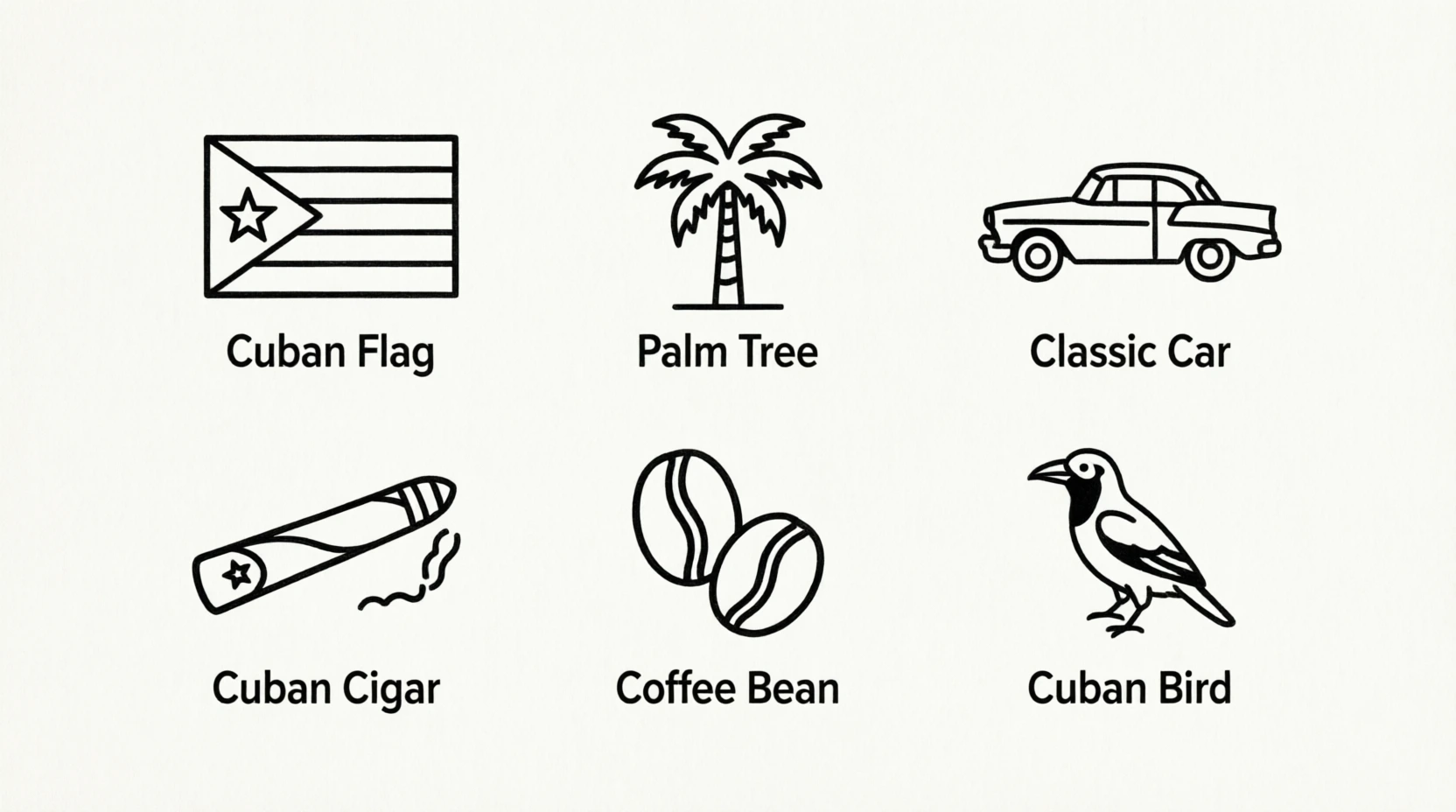
Cuban symbols reflect much more than the country’s flag. They tell stories about national identity, independence, nature, history, family heritage, religion, music, and everyday Cuban culture.
Some symbols have an official national status, while others have become strongly associated with Cuba through history and popular culture.
The royal palm, mariposa flower, tocororo bird, Cuban flag, and coat of arms are examples of symbols closely connected with Cuban identity.
Other images, such as classic cars, tobacco, music, and Havana architecture, are cultural symbols rather than official national emblems.
This distinction matters if you are researching Cuban symbols and meanings for a school project, tattoo, artwork, logo, family-history project, or cultural design.
Below, you will find the most important Cuban symbols, what they represent, where they come from, and how to choose one that matches the meaning you want.
What Are Cuban Symbols? (Quick Answer)
Cuban symbols are national emblems, natural elements, historical figures, religious imagery, and cultural objects associated with Cuba.
The best-known examples include:
- 🇨🇺 The Cuban flag
- The Cuban coat of arms
- The royal palm
- The mariposa flower
- The tocororo, or Cuban trogon
- The Cuban national anthem
- José Martí
- The map of Cuba
- Afro-Cuban religious symbols
- Cuban music and dance
- Tobacco and coffee
- Classic Cuban cars
- Havana architecture
Not all of these have official national status. Some are national symbols, while others are simply powerful representations of Cuban culture and heritage.
Cuban Symbols List and Their Meanings
If you only need a quick reference, this table gives you a starting point.
| Cuban symbol | Main association |
| Cuban flag | National identity and independence |
| Cuban coat of arms | Sovereignty and nationhood |
| National anthem | Patriotism and independence |
| Royal palm | Cuban landscape and national identity |
| Mariposa flower | National floral heritage |
| Tocororo | Cuban wildlife and national identity |
| José Martí | Independence, literature, and Cuban identity |
| Map of Cuba | Homeland, ancestry, and heritage |
| Cuban music | Cultural expression and community |
| Tobacco | Agricultural and cultural heritage |
| Coffee | Cuban food and everyday culture |
| Classic cars | Modern visual image of Cuba |
| Havana architecture | Cuban urban and historical heritage |
| Afro-Cuban religious imagery | Spiritual and cultural traditions |
The important point is that this is a cultural reference list, not a claim that every item is an official symbol of the Cuban state.
Cuban National Symbols
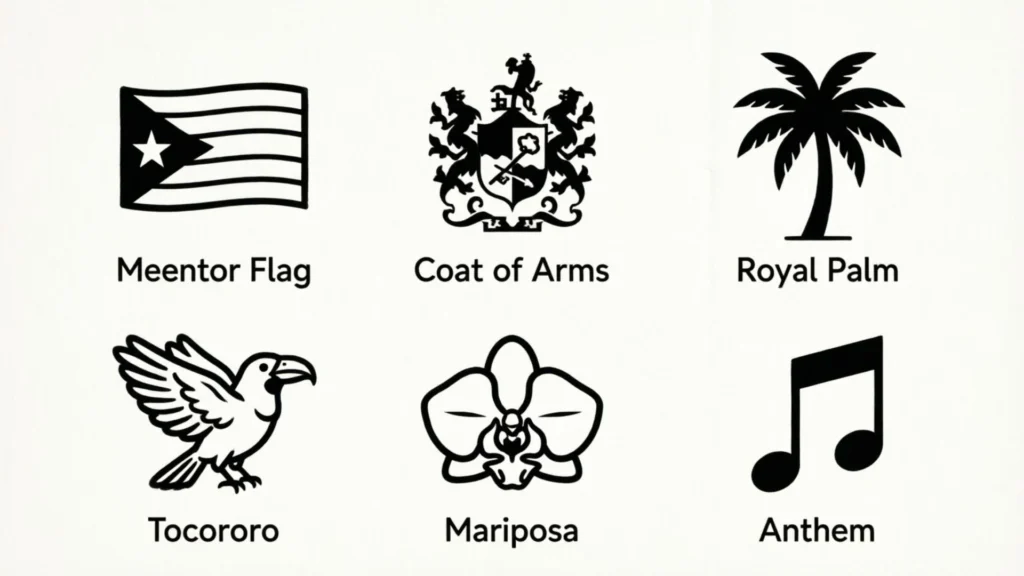
The strongest place to begin is with symbols that have a direct national connection.
Cuban Flag
The Cuban flag is perhaps the clearest visual representation of Cuba.
It consists of five horizontal stripes, three blue and two white, together with a red triangle at the hoist containing a white five-pointed star.
The flag is closely connected with Cuba’s history of independence and national sovereignty. It can therefore represent Cuba as a country, Cuban heritage, patriotism, independence, or a personal connection to the island.
The exact symbolism of its elements is rooted in the history of the flag rather than simply being modern decorative meanings.
What Do the Cuban Flag Colors Mean?
The Cuban flag contains three main colors: blue, white, and red.
Its design is historical and political, so it is better to discuss its colors in relation to the flag’s established symbolism rather than assigning broad meanings such as “blue means peace” without evidence.
The three blue stripes are traditionally connected with the historical divisions of Cuba, while the two white stripes are associated with purity and the ideals of the independence movement.
The red triangle and white star are also part of the flag’s independence symbolism.
Because the meaning comes from the history of the flag, the complete design is more important than interpreting each color separately.
Cuban Coat of Arms
The coat of arms is another major national emblem.
Known as the Escudo de la República de Cuba, it contains several elements connected with Cuba’s geography, national history, and independence.
Among its imagery are a key, a rising sun, blue and white sections, and the royal palm.
The coat of arms has a more formal role than the flag and is particularly appropriate when discussing official Cuban national symbolism.
Cuban National Anthem
The Bayamo National Anthem, commonly known as La Bayamesa, is an important part of Cuba’s national identity.
Its history is connected with the Cuban independence struggle and the city of Bayamo.
An anthem is different from a visual symbol because it is musical rather than pictorial, but it belongs in a complete discussion of national symbols because it expresses patriotic and historical identity.
Royal Palm
The royal palm is one of the most recognizable natural symbols associated with Cuba.
Its scientific name is Roystonea regia, and the tree is strongly connected with the Cuban landscape. It also appears prominently in the Cuban coat of arms.
The royal palm is especially useful as a symbol when someone wants something that suggests Cuba without using the national flag.
It can represent:
- Cuban nature
- The island’s landscape
- National heritage
- Strength and endurance as a personal interpretation
- A connection to Cuba
The royal palm’s connection to Cuba is not simply a modern design trend. Historical descriptions of Cuba have long emphasized the prominence of palms in the island’s landscape. The Library of Congress’s historical collections also describe the royal palm as a characteristic feature of Cuba’s landscape.
Mariposa Flower
The white mariposa, commonly known as butterfly jasmine and scientifically as Hedychium coronarium, is Cuba’s national flower.
Its white blossoms and fragrance have made it an important part of Cuban botanical and cultural identity.
For modern designs, the mariposa can be used to represent Cuban heritage, beauty, nature, or personal memories of the island.
However, it is better to describe “beauty” or “purity” as an interpretation unless a specific historical source establishes that meaning.
Tocororo
The tocororo, or Cuban trogon (Priotelus temnurus), is Cuba’s national bird.
Its striking feathers include red, white, and blue, colors that also appear in the Cuban flag.
The bird has a particularly strong connection to Cuban identity because it is native to the island.
For tattoos and artwork, the tocororo is a good choice for someone who wants a Cuban symbol based on wildlife rather than a political emblem.
Cuban Symbols of Freedom and Independence
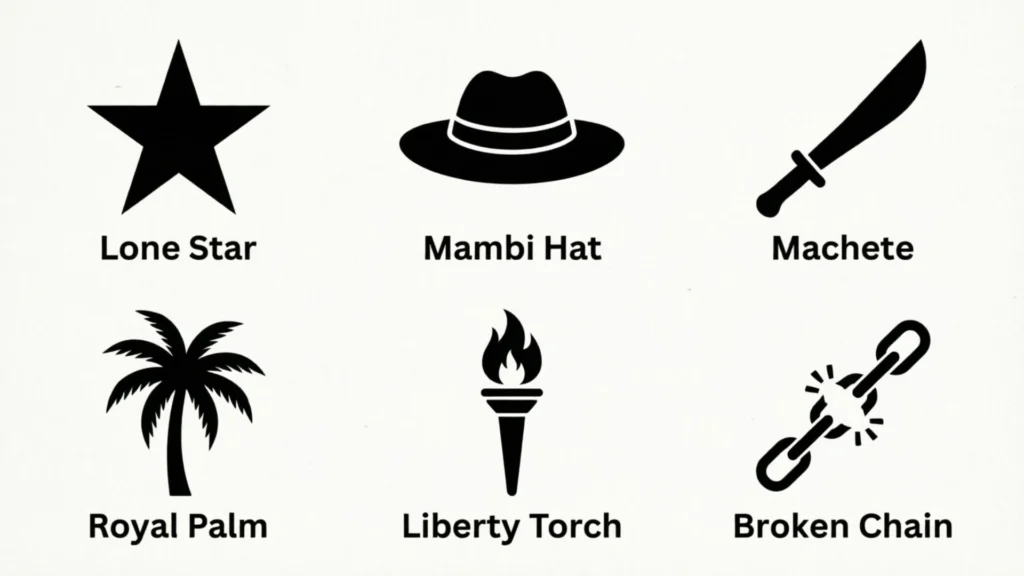
Freedom and independence are important themes in Cuban history, so several symbols can carry these associations.
Cuban Flag and Independence
The Cuban flag is closely connected to the country’s independence history.
Using it in artwork or a tattoo can therefore communicate national pride, Cuban ancestry, independence, or connection to the island.
The meaning can still vary from person to person. A Cuban living abroad might use the flag to represent family roots, while another person may use it primarily as a national or historical symbol.
José Martí
José Martí is one of the most important figures in Cuban history.
He was a writer, poet, journalist, political thinker, and independence activist. His work and ideas have had a lasting influence on Cuban national identity.
For this reason, his name, portrait, writings, and monuments can function as symbols of:
- Cuban independence
- Patriotism
- Literature
- Education
- National identity
José Martí is a historical figure rather than an official emblem, so it is more accurate to call him a symbolic figure of Cuban identity.
Antonio Maceo
Antonio Maceo was another major figure in Cuba’s independence history.
Known for his military leadership during the independence struggles, Maceo is often remembered in connection with resistance, independence, and Cuban nationalism.
His image can therefore have a strong historical meaning, particularly in educational or commemorative contexts.
Cuban Symbols of Nature
Cuba’s landscape provides many symbols that feel distinctly connected to the island.
Royal Palm
The royal palm is the strongest natural choice for a Cuban-themed design.
It works well for:
- Tattoos
- Paintings
- Posters
- Logos
- Jewelry
- Travel designs
- Family-heritage artwork
A palm silhouette can communicate Cuba without making the design as literal as a flag.
Tocororo
The tocororo represents Cuba’s native birdlife and national identity.
Its natural colors also make it visually distinctive, making it suitable for colorful artwork or tattoos.
Mariposa
The mariposa represents Cuba’s national floral heritage.
Its white appearance makes it particularly suitable for minimalist designs, botanical artwork, memorial pieces, and subtle heritage tattoos.
Cuban Symbols of Family and Heritage
Not everyone searching for Cuban symbols wants a political or historical symbol.
For many people, the subject is personal.
A Cuban symbol can represent:
- Parents or grandparents from Cuba
- A birthplace
- Immigration history
- Family ancestry
- Childhood memories
- Cultural identity
- A connection to relatives still living on the island
Cuban Flag for Family Heritage
A Cuban flag can represent family roots as well as national identity.
Adding a family name, date, hometown, or meaningful phrase can make the design personal without changing the historical meaning of the flag itself.
Map of Cuba
The outline of Cuba is a popular modern heritage symbol.
It can represent:
- Homeland
- Birthplace
- Ancestry
- Family roots
- Memories
- Connection to Cuba
The map is best described as a cultural or personal symbol, not as an official national emblem.
Royal Palm for Heritage
A royal palm can provide a more subtle way to represent Cuban ancestry.
Someone may choose it because it reminds them of the landscape associated with their family or childhood rather than because it has one fixed symbolic meaning.
Afro-Cuban Symbols and Religious Traditions
Cuban culture includes rich African, European, Indigenous, and Caribbean influences. Afro-Cuban religious traditions are an important part of that cultural history.
Santería, also known as Regla de Ocha, developed in Cuba from Yoruba religious traditions alongside other historical and cultural influences.
The Library of Congress describes Santería as an Afro-Cuban religious tradition with Yoruba roots and documents the role of orisha imagery and bead necklaces in religious practice.
This means Afro-Cuban religious symbols should not be treated simply as decorative Cuban icons.
Orishas
Orishas are sacred spiritual beings within Yoruba-derived religious traditions.
Different orishas are associated with particular stories, natural forces, qualities, colors, objects, and forms of devotion.
Their symbolism can vary by tradition and religious lineage, so simplified internet lists should be treated cautiously.
Eleguá
Eleguá is associated in Yoruba-derived traditions with roads, crossroads, communication, and openings.
Because these meanings have religious significance, an image connected with Eleguá should be understood within its cultural and spiritual context.
Yemayá
Yemayá is strongly associated with the sea and motherhood in Yoruba-derived traditions.
The connection with the ocean can be particularly meaningful in Cuban cultural contexts because Cuba is an island nation.
Ochún
Ochún, also written Oshún, is associated with rivers, beauty, love, sweetness, and other themes within Yoruba-derived religious traditions.
Yellow and gold are commonly associated with her in religious contexts.
Changó
Changó, also written Shango, is associated with thunder, lightning, fire, power, and other qualities in Yoruba-derived traditions.
Red and white are commonly associated with Changó.
These descriptions are simplified introductions, not complete explanations of the religious traditions. If you are considering sacred religious imagery for a tattoo or artwork, learn its meaning from knowledgeable cultural or religious sources first.
Cuban Cultural Symbols
Some of the strongest images associated with Cuba are not official national symbols at all.
They are cultural images that have become recognizable through history, tourism, art, music, photography, and everyday life.
Cuban Music
Music is one of the most powerful ways to represent Cuban culture.
Cuban musical traditions include son, rumba, danzón, and many other styles that developed through complex African, European, and Caribbean influences.
Musical instruments, dancers, drums, and musical notes can therefore work as Cuban cultural imagery.
Tobacco
Cuban tobacco has a long-standing association with the country’s agricultural and commercial history.
Tobacco leaves and cigars are frequently used in imagery representing Cuban culture.
However, tobacco is better described as a cultural and agricultural symbol rather than an official national symbol.
Cuban Coffee
Coffee is another familiar part of Cuban food culture.
Cuban coffee traditions can be represented through espresso cups, coffee beans, cafés, or traditional serving styles.
Again, this is cultural symbolism rather than official national symbolism.
Classic Cuban Cars
Vintage American cars are strongly associated with modern visual images of Havana.
They appear frequently in photography, travel media, artwork, and tourism imagery.
The classic car is therefore a powerful modern cultural association with Cuba, but it is not an ancient Cuban symbol or an official national emblem.
Havana Architecture
Havana’s historic streets, colorful buildings, plazas, balconies, and distinctive architecture can also represent Cuban heritage.
The Library of Congress’s collections document Havana architecture alongside Cuban flags, palms, and other elements of the city’s visual identity.
Cuban Symbols of Love, Family, and Personal Meaning
There is no single official Cuban symbol that universally means “love.”
Instead, people often create personal combinations.
For example:
| Design | Possible personal meaning |
| Cuban flag + heart | Love for Cuba |
| Cuba map + family name | Family ancestry |
| Royal palm + date | Memory of a place or person |
| Mariposa + initials | Family or personal remembrance |
| Tocororo + Cuban flag | Cuban identity and pride |
| Cuba map + birth date | Birthplace or heritage |
These are personal interpretations, not official definitions.
This distinction is useful because it prevents modern tattoo symbolism from being mistaken for traditional Cuban symbolism.
Cuban Symbols for Tattoos
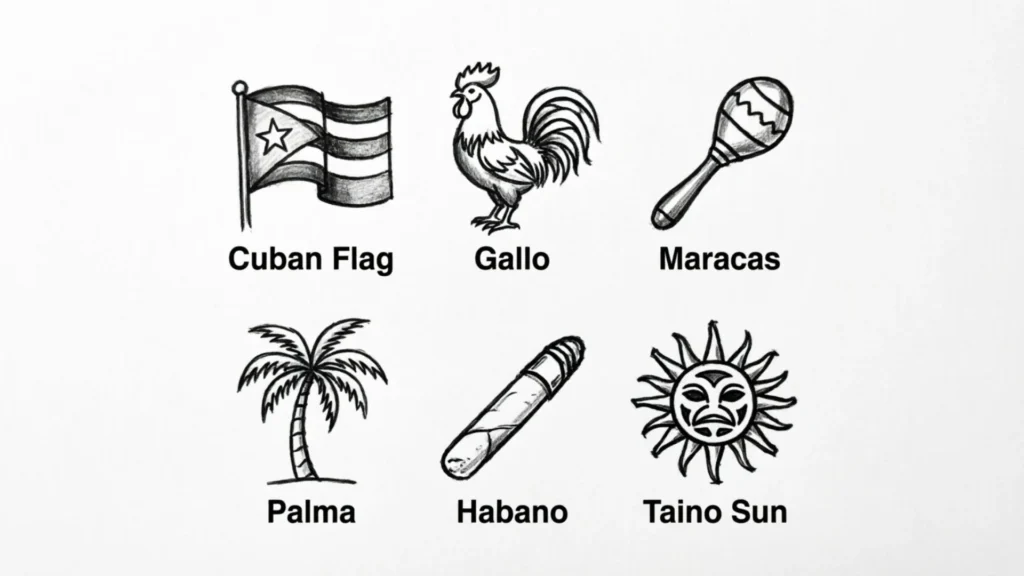
Cuban symbols can make meaningful tattoos, especially when they connect with family history or personal heritage.
Best Cuban Tattoo for National Pride
The Cuban flag is the most direct option.
It immediately communicates a connection with Cuba and can be combined with a date, name, or location.
Best Subtle Cuban Tattoo
The royal palm is an excellent choice for someone who wants a Cuban reference without using the flag.
A small palm silhouette can work as a minimalist tattoo.
Best Cuban Bird Tattoo
The tocororo is a distinctive choice because it is Cuba’s national bird.
Its natural colors can also create a more detailed tattoo.
Best Cuban Flower Tattoo
The mariposa offers a softer botanical option.
It can work especially well for a small, elegant, or memorial design.
Best Cuban Heritage Tattoo
The outline of Cuba can represent family roots, birthplace, ancestry, or a lasting connection to the island.
Afro-Cuban Religious Tattoos
Religious imagery deserves additional care.
If you are considering an orisha or another sacred image, don’t choose it solely because you like its appearance. Learn what the figure represents, how it is used, and whether the design has religious significance.
A sacred symbol should be approached as part of a living tradition rather than as a generic decoration.
Cuban Symbols for Art, Logos, and Jewelry
Cuban imagery can work well in visual design because many symbols have recognizable shapes.
For Artwork
Good combinations include:
- Royal palm + Cuban flag
- Tocororo + tropical foliage
- Mariposa + Cuban colors
- Havana buildings + palm trees
- Cuba map + family names
- Classic car + Havana street scene
For Logos
A business or creative project might use:
- Palm silhouettes
- Cuba’s outline
- Tropical imagery
- Flag-inspired colors
- Havana architecture
However, a private business should avoid creating a design that falsely suggests official government affiliation.
For Jewelry
Common Cuban-inspired jewelry concepts include:
- Cuban flag pendants
- Cuba map pendants
- Palm-tree charms
- Tocororo designs
- Mariposa flower designs
- Personalized heritage pieces
The strongest choice depends on whether the goal is national pride, family heritage, nature, or personal memory.
Cuban Symbols for Social Media and Emojis
Modern social media allows people to express Cuban identity without using traditional symbols.
Examples include:
🇨🇺 Cuba
🇨🇺❤️
🇨🇺🌴
🇨🇺🌊
🇨🇺☀️
🇨🇺🎶
These combinations are modern emoji expressions, not historical Cuban symbols.
That distinction is important if you are creating educational content about Cuban symbolism.
Cuban Symbols vs. Caribbean Symbols
Cuba is part of the Caribbean, so some imagery overlaps with other Caribbean cultures.
Palm trees, beaches, tropical flowers, music, colorful buildings, and ocean imagery can all appear across the region.
Therefore, a tropical image is not automatically a uniquely Cuban symbol.
The Cuban flag, coat of arms, royal palm, mariposa, and tocororo have a much more direct connection with Cuban national identity.
Cuban Symbols vs. Taíno Symbols
Cuba has Indigenous history connected with Taíno and other Indigenous Caribbean peoples.
However, it is inaccurate to treat every modern “Taíno symbol” found online as an exclusively Cuban symbol.
Specific Indigenous motifs should be connected to their archaeological, historical, or cultural context whenever possible.
The distinction matters because Indigenous Caribbean symbolism is broader than modern Cuban branding.
The Library of Congress, for example, documents representations of Taíno heritage in Cuba, including the reconstructed Taíno village at Laguna del Tesoro in Matanzas.
Cuban Symbols by Meaning
If you know the feeling or idea you want to represent, use this quick guide.
| You want to represent | Consider |
| Cuba itself | Cuban flag |
| National identity | Cuban flag or coat of arms |
| Independence | Cuban flag or José Martí |
| Cuban nature | Royal palm |
| Native wildlife | Tocororo |
| National flower | Mariposa |
| Family heritage | Cuba map or Cuban flag |
| Birthplace | Cuba map |
| Literature and independence | José Martí |
| Havana nostalgia | Classic Cuban car |
| Cuban music | Musical instruments or dance imagery |
| Afro-Cuban spirituality | A specific religious symbol studied in context |
| Tropical Cuban landscape | Royal palm and coastal imagery |
Remember that some meanings in this table are direct associations, while others are practical ways people may use the imagery today.
How to Choose the Right Cuban Symbol
Choosing becomes easier when you start with the meaning rather than the picture.
If You Want an Official Cuban Symbol
Choose the Cuban flag, coat of arms, national anthem, royal palm, mariposa, or tocororo.
If You Want Something Subtle
Choose a royal palm, mariposa, or small Cuba map.
If You Want to Honor Family Heritage
Consider the Cuban flag, map of Cuba, royal palm, hometown imagery, or a personalized combination.
If You Want to Represent Independence
The Cuban flag or a historical reference to José Martí can communicate this idea.
If You Want a Nature Symbol
The royal palm, mariposa, or tocororo are strong choices.
If You Want Afro-Cuban Spiritual Meaning
Start with the specific religious tradition and learn the meaning of the symbol before using it.
Common Mistakes When Using Cuban Symbols
Calling Every Cuban-Inspired Image an Official Symbol
Classic cars, cigars, coffee, music, and Havana buildings are culturally associated with Cuba, but they are not all official national symbols.
Inventing Meanings for Colors
Not every color used in a Cuban design has an established historical meaning.
Avoid presenting personal interpretations as facts.
Treating Religious Symbols as Decorations
Afro-Cuban religious imagery can be sacred.
Learn the context before using it for tattoos, clothing, jewelry, or branding.
Calling Every Palm a Cuban Symbol
The royal palm has a particularly strong connection with Cuba. That does not mean every palm-tree image is uniquely Cuban.
Confusing Cuban and Caribbean Identity
An image may be Caribbean without being specifically Cuban.
Treating Modern Tattoo Meanings as Ancient Traditions
A person may use a Cuba map to represent family love, for example, but that does not mean “the map of Cuba traditionally means family love.”
Personal symbolism and historical symbolism are different.
Frequently Asked Questions About Cuban Symbols
What is the most famous Cuban symbol?
The Cuban flag is the most recognizable national symbol of Cuba. The royal palm, coat of arms, mariposa, and tocororo are also strongly connected with Cuban identity.
What is the national symbol of Cuba?
Cuba has several important national symbols rather than one single symbol. These include the national flag, coat of arms, national anthem, royal palm, mariposa flower, and tocororo.
What flower represents Cuba?
The mariposa, or butterfly jasmine (Hedychium coronarium), is Cuba’s national flower.
What bird represents Cuba?
The tocororo, or Cuban trogon (Priotelus temnurus), is Cuba’s national bird.
What tree represents Cuba?
The royal palm (Roystonea regia) is strongly associated with Cuba and is featured on the country’s coat of arms.
What symbolizes freedom in Cuba?
The Cuban flag has a strong historical connection with independence and national sovereignty. The tocororo is also associated with Cuban identity and is sometimes interpreted through the idea of freedom.
What symbolizes Cuban heritage?
The Cuban flag, map of Cuba, royal palm, tocororo, and mariposa can all be used to represent Cuban heritage, depending on the context.
What is a good Cuban symbol for a tattoo?
The best choice depends on your intended meaning. A royal palm is subtle, the tocororo represents Cuba’s native wildlife, the mariposa represents national floral heritage, and the Cuban flag is the most direct national symbol.
Are Cuban cars a Cuban symbol?
Classic American cars are a powerful modern visual association with Cuba, especially Havana, but they are not official national symbols.
What are Afro-Cuban symbols?
Afro-Cuban traditions include many sacred symbols associated with religious practices, including imagery and objects connected with orishas. Their meanings depend on the specific tradition and should be understood in cultural and religious context.
Is the Cuban flag a symbol of freedom?
The Cuban flag has an important connection with Cuba’s independence history, so it can represent independence and national sovereignty. The exact personal meaning depends on the person and context.
Is the Cuba map an official Cuban symbol?
The outline of Cuba is a common cultural and personal representation of the country, but it should not be confused with an official national emblem such as the flag or coat of arms.
Sources and Further Reading
For a topic involving national history, cultural identity, and religious traditions, reliable references are more useful than repeating unsourced symbol lists.
The Library of Congress provides historical collections documenting Cuban flags, Havana, Cuban landscapes, Taíno heritage, Santería, and other aspects of Cuban history and culture.
Historical Library of Congress material also documents the prominent place of the royal palm in descriptions of Cuba’s landscape.
These sources are particularly useful when distinguishing established historical or cultural information from modern interpretations used in tattoos, artwork, and social media.
Final Thoughts
Cuban symbols represent a rich mixture of national identity, independence, nature, history, family heritage, religion, and everyday culture.
The Cuban flag and coat of arms are among the clearest national symbols. The royal palm, mariposa, and tocororo connect Cuban identity with the island’s natural world. Historical figures such as José Martí represent important parts of Cuba’s independence and intellectual history.
Beyond official symbols, Cuba’s music, tobacco, coffee, Havana architecture, classic cars, and Afro-Cuban traditions provide additional ways to understand the country’s cultural identity.
The most important thing is to keep official symbolism, historical associations, religious meanings, and personal interpretations separate. If you are choosing a Cuban symbol for a tattoo, artwork, logo, or family project, understanding that difference will help you choose something that is both meaningful and culturally respectful.

Lily Anderson is a passionate writer who enjoys turning everyday ideas into engaging and easy-to-read stories. She loves creating content that helps readers learn something new while keeping them entertained. Lily is the author of the original titles Whispers Between Ordinary Days and The Quiet Map of Tomorrow. When she’s not writing, she enjoys reading, exploring new places, and finding inspiration in everyday life. Her goal is to create meaningful content that readers can connect with and remember.
 Adam Sullivan