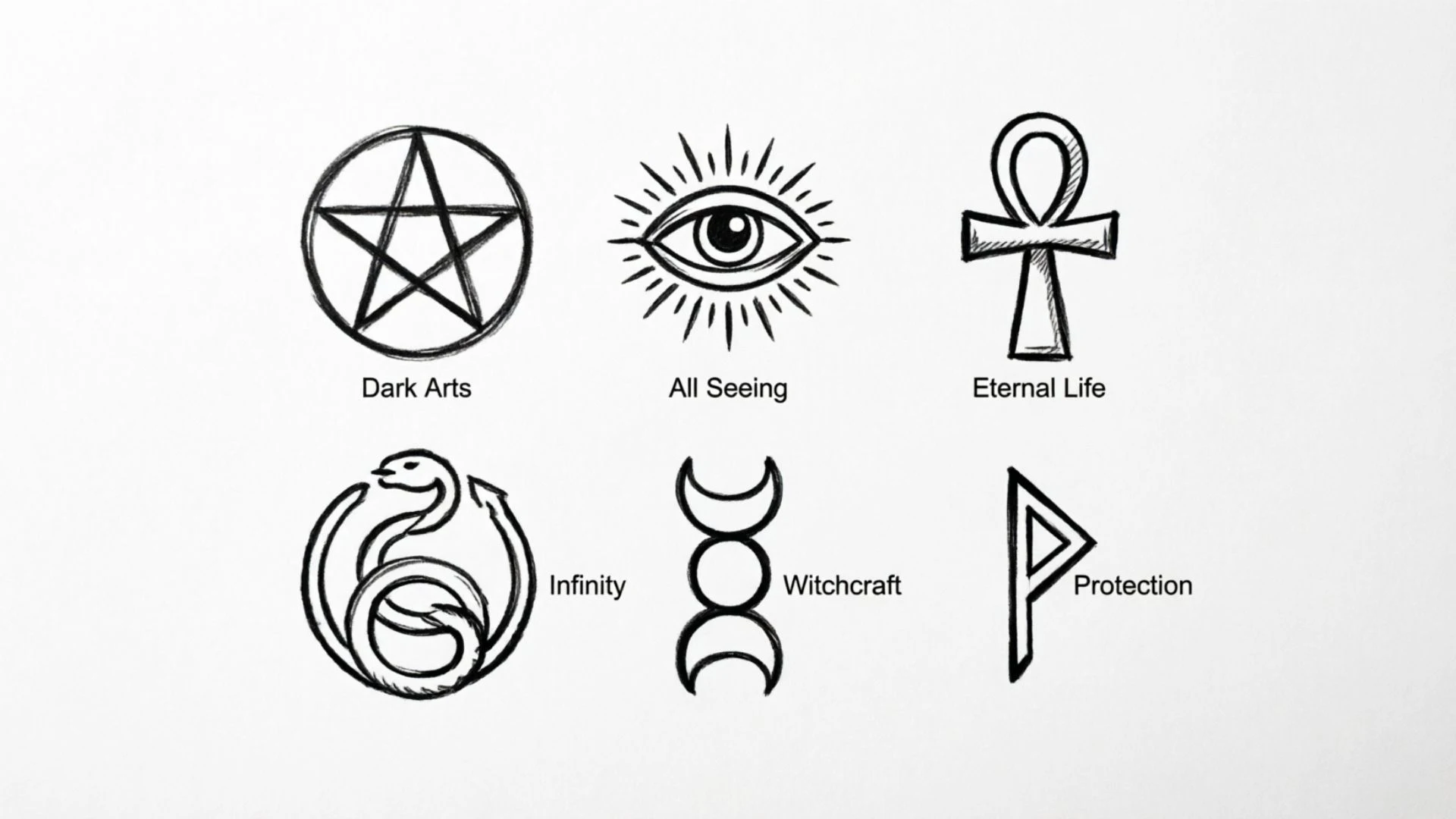
Mystic symbols have a special way of making ordinary shapes feel meaningful. A spiral can suggest a journey, an eye can represent awareness, and a serpent forming a circle can remind us of endless cycles.
These images appear in ancient artwork, religious traditions, philosophy, manuscripts, jewelry, architecture, tattoos, and modern spiritual practices.
But there is an important question behind all of this: what actually makes a symbol mystical?
There is no single worldwide list of mystic symbols, and not every mysterious-looking image has an ancient secret meaning.
Some symbols come from established religious traditions, some developed through philosophical or esoteric movements, and others gained their current spiritual meanings much later.
That difference matters when researching symbolism.
In this guide, you will discover common mystic symbols and their meanings, their historical and cultural backgrounds, symbols associated with protection, transformation, wisdom, balance, and spiritual growth, and the differences between mystical, spiritual, esoteric, and occult symbolism.
What Are Mystic Symbols? (Quick Answer)
Mystic symbols are signs, images, shapes, or patterns that are associated with spiritual ideas, hidden or specialized knowledge, philosophical concepts, religious traditions, transformation, or experiences that people consider beyond ordinary physical understanding.
Common examples include the Ouroboros, Ankh, Eye of Providence, Eye of Horus, Yin-Yang, Pentagram, Hexagram, Triquetra, Om, Lotus, Tree of Life, Spiral, Flower of Life, Mandala, and Labyrinth.
However, these symbols do not all belong to one tradition. Their meanings can change according to culture, historical period, religion, artistic setting, and modern interpretation.
What Are Mystic Symbols?
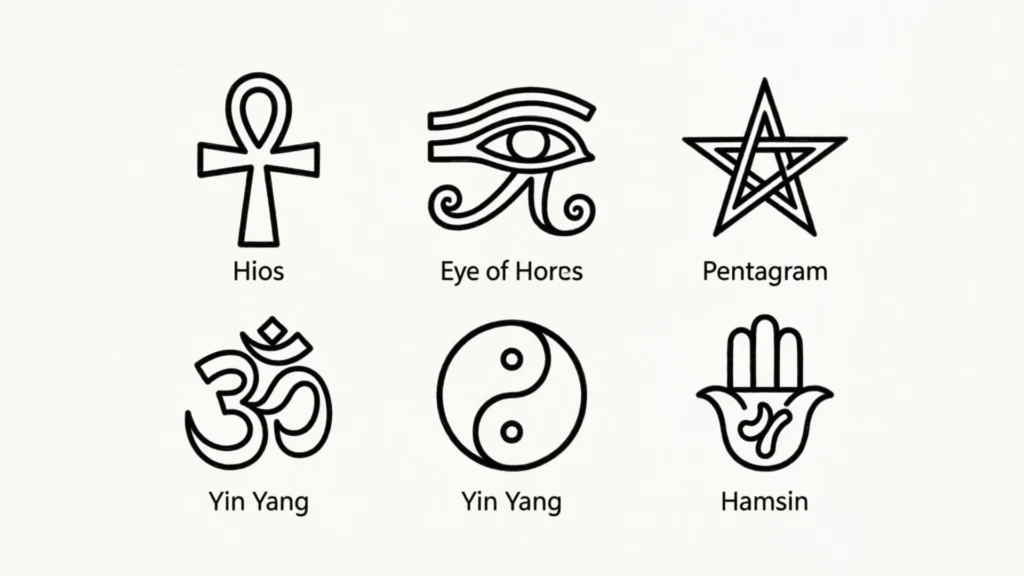
Mystic symbols are visual forms used to express ideas that may be difficult to communicate through ordinary words.
They can represent concepts such as life, death, renewal, balance, spiritual awareness, creation, transformation, protection, nature, or the relationship between the physical and spiritual worlds.
The term mystic is broad. It can describe ideas connected with mystical experiences, spiritual insight, contemplation, or the search for a deeper reality.
For that reason, mystic symbolism is better understood as a broad category rather than a single ancient system.
What Makes a Symbol Mystical?
A symbol can take on mystical significance when people use it to represent something beyond its literal appearance.
For example, a circle is simply a geometric shape. Yet circles have been used in many traditions to suggest wholeness, eternity, cycles, unity, or completeness.
Likewise, a serpent can simply be an animal in artwork. In other contexts, it can represent renewal, danger, wisdom, fertility, transformation, or other ideas.
The meaning comes from context and tradition, not just the shape.
Are All Ancient Symbols Mystic?
No.
Ancient cultures used symbols for many reasons. Some were religious, while others were political, decorative, astronomical, practical, or connected with everyday life.
A symbol does not become mystical simply because it is old.
This is especially important online, where modern spiritual interpretations are sometimes presented as if they were established ancient beliefs. A reliable explanation should distinguish between:
- Historical use
- Religious meaning
- Philosophical interpretation
- Later esoteric associations
- Modern spiritual interpretation
- Personal symbolism
Mystic Symbols vs Spiritual, Esoteric, and Occult Symbols
These terms often overlap, but they are not exact synonyms.
| Term | General Meaning |
| Mystic | Related to mystical experience, spiritual insight, or deeper reality |
| Spiritual | Connected with spirituality, inner life, or religious belief |
| Esoteric | Associated with specialized, restricted, or less widely understood knowledge |
| Occult | Traditionally connected with hidden knowledge or practices concerning forces beyond ordinary understanding |
| Sacred | Connected with something regarded as holy or religiously significant |
A symbol may fit more than one category.
For example, a symbol may have a religious origin but later become popular in esoteric art. Another may be used in modern spirituality without having originally been created for that purpose.
Understanding this difference helps prevent the common mistake of treating every mystical-looking design as an occult symbol.
Mystic Symbols and Their Meanings
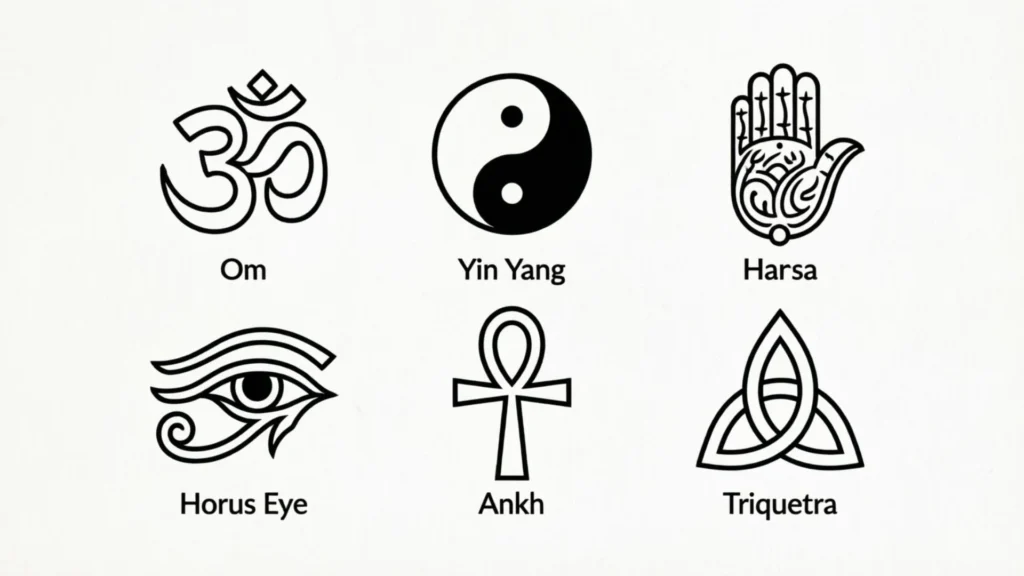
The following symbols are among the most recognizable images associated with mystical, spiritual, philosophical, religious, or esoteric ideas.
Their meanings should always be understood within their historical context.
1. Ouroboros
The Ouroboros is usually shown as a serpent or dragon eating its own tail, creating a circle.
Its circular form makes it a powerful image of cycles. Historical examples appear in ancient Egyptian material and later became important in European alchemical traditions.
The symbol is commonly associated with:
- Cycles
- Renewal
- Eternity
- Death and rebirth
- Transformation
- Continuity
In modern spiritual use, the Ouroboros often represents personal transformation or the idea that an ending can become the beginning of something new.
Its meaning is especially effective for people who have gone through a major life transition.
2. Ankh
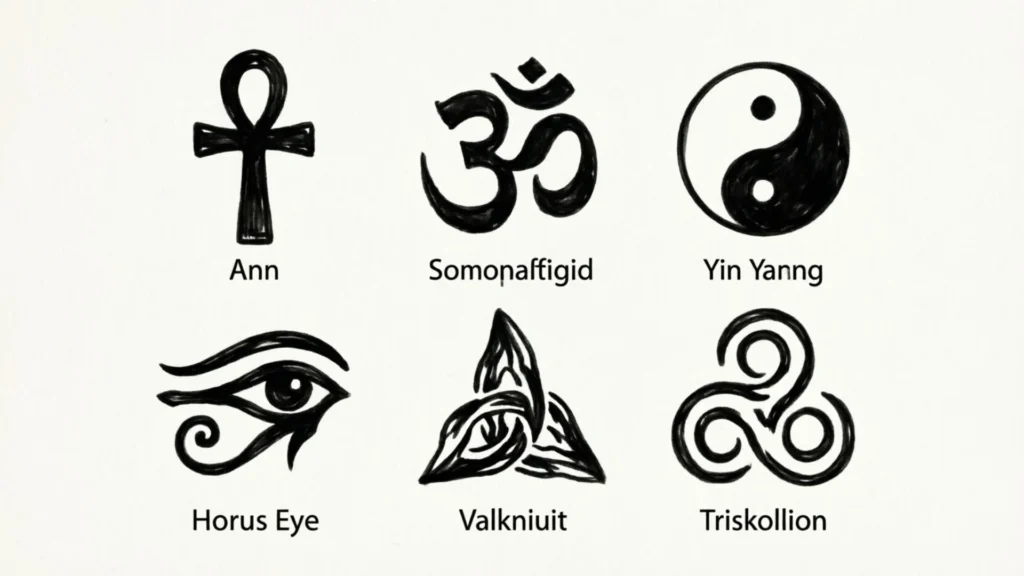
The Ankh is one of the most recognizable symbols of ancient Egypt. It resembles a cross with a loop at the top.
Ancient Egyptian artwork frequently connects the Ankh with life and divine or royal imagery.
Today, people may associate it with:
- Life
- Vitality
- Continuity
- Rebirth
- Spiritual existence
Its strongest historical association is with life, while many additional mystical meanings are modern interpretations.
3. Eye of Providence
The Eye of Providence is commonly depicted as an eye surrounded by rays and sometimes enclosed within a triangle.
It has historical connections with Christian iconography and the idea of divine providence or divine watchfulness.
Modern interpretations may connect the symbol with:
- Awareness
- Divine protection
- Guidance
- Observation
- Higher consciousness
The symbol is sometimes incorrectly described as automatically representing secret societies. Its meaning depends on the context in which it is used.
4. Eye of Horus
The Eye of Horus is an ancient Egyptian symbol associated with Horus and has important connections with protection, restoration, and well-being in Egyptian symbolism.
It is visually distinctive because of its stylized eye and markings.
Modern users may interpret it as a symbol of:
- Protection
- Awareness
- Healing
- Strength
- Spiritual perception
These modern meanings should not replace its specific Egyptian religious context.
5. Yin-Yang
The Yin-Yang symbol is associated with Chinese philosophical traditions.
Its familiar black-and-white form contains two interconnected sections, each containing a small portion of the opposite color.
Rather than representing simple good versus evil, the symbol expresses complementary forces and their relationship.
It is commonly connected with:
- Balance
- Harmony
- Change
- Complementarity
- Interdependence
The symbol is a reminder that apparently opposite forces can exist together rather than being completely separate.
6. Pentagram
A pentagram is a five-pointed star created from five connected lines.
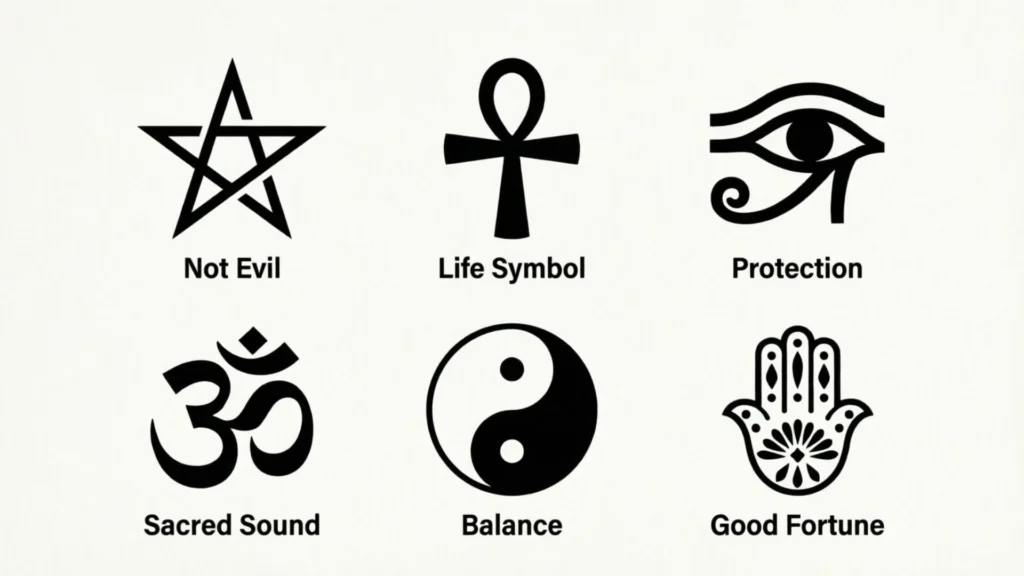
It has appeared in different historical, religious, philosophical, and cultural contexts, so it does not have one universal meaning.
Depending on the tradition, it may be associated with:
- Protection
- Harmony
- The elements
- Human beings
- Philosophical concepts
- Spiritual symbolism
The orientation of the pentagram and the context in which it appears can also affect its interpretation.
7. Hexagram
A hexagram is formed from two overlapping triangles.
The shape has appeared in multiple cultural settings. It is strongly associated with the Star of David in Judaism, while similar geometric forms have also appeared elsewhere.
In certain mystical and esoteric traditions, the two triangles have been interpreted through ideas such as:
- Above and below
- Unity
- Opposing forces
- Balance
- Spirit and matter
Its meaning should always be connected to the particular tradition being discussed.
8. Triquetra
The Triquetra is a three-part knot-like design often associated with Celtic-inspired imagery and later religious and popular uses.
The threefold structure has encouraged interpretations involving:
- Unity
- Cycles
- Three stages
- Interconnection
- Mind, body, and spirit
Some of these meanings are modern symbolic interpretations rather than proven meanings from an ancient Celtic belief system.
9. Om
The symbol ॐ, commonly represented as Om or Aum, is deeply significant in Hindu traditions and also important in other Indian religious and philosophical traditions.
It is associated with sacred sound, meditation, consciousness, and philosophical ideas about ultimate reality.
Today, Om is often used in meditation and wellness settings.
However, reducing it to simply a “peace symbol” misses its deeper religious and philosophical importance.
10. Lotus
The lotus is an important spiritual and religious symbol in several Asian traditions.
Its natural growth pattern provides a powerful metaphor: the plant emerges from muddy water and opens above the surface.
Because of this, lotus symbolism is often connected with:
- Purity
- Spiritual development
- Awakening
- Growth
- Transformation
Modern spiritual communities frequently use the lotus as a symbol of overcoming difficult circumstances.
11. Tree of Life
The Tree of Life appears in several religious, mythological, philosophical, and mystical traditions.
Although its meaning is different in different traditions, the basic image of roots, trunk, and branches naturally suggests connection and growth.
Common symbolic themes include:
- Life
- Wisdom
- Growth
- Connection
- Family
- Spiritual development
There is no single universal Tree of Life meaning. Its interpretation should be connected to the tradition being discussed.
12. Spiral
The spiral is one of the oldest and most widespread geometric forms found in human art.
Spiral designs appear in many cultures, including prehistoric and ancient artistic traditions.
Because the shape moves inward or outward, modern symbolic interpretations often connect it with:
- Growth
- Movement
- Cycles
- Transformation
- Personal development
- The journey of life
A spiral’s historical meaning can vary considerably, so it should not automatically be assigned one mystical definition.
13. Flower of Life
The Flower of Life is a geometric pattern formed from overlapping circles.
It has become especially popular in modern sacred geometry, spiritual art, jewelry, and tattoos.
Modern interpretations commonly associate it with:
- Unity
- Creation
- Interconnectedness
- Harmony
- Geometric order
The important distinction is that modern sacred-geometry interpretations should not automatically be described as ancient beliefs simply because similar geometric patterns existed historically.
14. Sri Yantra
The Sri Yantra is a complex geometric diagram used within Hindu traditions, particularly in certain forms of worship and meditation.
It consists of interlocking triangles arranged around a central point.
Its traditional context is much more specific than the general category of “mystic geometry.”
Modern discussions often connect it with:
- Meditation
- Divine reality
- Concentration
- Sacred geometry
- Spiritual practice
Because it is part of a living religious tradition, its meaning is best understood through that tradition rather than through generalized mystical claims.
15. Mandala
A mandala is a geometric or symbolic design, often organized around a center.
Mandalas have important roles in several Asian religious traditions, particularly Buddhism and Hinduism, where they can function as sacred diagrams and meditation aids.
Modern uses include:
- Meditation
- Art
- Personal reflection
- Mindfulness
- Decorative design
Not every circular modern pattern is technically a traditional mandala.
16. Sun Symbol
The sun has been symbolically important across many cultures.
Its light and warmth naturally made it an important image for life, power, energy, time, and divine associations in various traditions.
Modern interpretations may connect sun imagery with:
- Vitality
- Confidence
- Light
- Energy
- Renewal
- Personal power
The precise meaning depends on the culture and design.
17. Moon Symbol
Moon imagery is strongly connected with cycles because the Moon appears to change through recognizable phases.
Different cultures have associated the Moon with time, nature, fertility, deities, night, and other concepts.
Modern spiritual interpretations commonly connect moon symbols with:
- Change
- Cycles
- Reflection
- Intuition
- Mystery
- Renewal
These meanings are broad modern associations and should not be presented as one universal ancient interpretation.
18. Labyrinth
A labyrinth is a winding path leading toward a central point.
Labyrinth designs have appeared in different historical and cultural contexts. In modern spiritual settings, walking a labyrinth can be used as a contemplative or reflective practice.
The labyrinth can symbolize:
- A journey
- Self-reflection
- Patience
- Searching
- Inner exploration
- Finding one’s way
Unlike a maze, a traditional labyrinth is generally designed as a single winding route rather than a puzzle with multiple dead ends.
19. Alchemical Symbols
Alchemy developed different symbolic systems across historical traditions, including European, Islamic, and other intellectual contexts.
Alchemical imagery can include symbols for substances, planets, processes, and philosophical concepts.
Modern interpretations sometimes connect alchemical symbols with:
- Transformation
- Purification
- Change
- Inner development
- The relationship between matter and spirit
However, alchemical symbolism is a complex historical subject and should not be reduced to a simple collection of “magic symbols.”
20. Phoenix
The phoenix is a legendary bird associated with death, renewal, and rebirth in different cultural traditions, especially in ancient Mediterranean and later European literature.
Its modern symbolic meaning is particularly strong.
It is often used to represent:
- Rebirth
- Recovery
- Renewal
- Resilience
- Starting again
The phoenix is especially popular in tattoos and artwork because its story naturally represents rising after destruction.
21. Serpent Symbol
The serpent is one of the most complex symbolic animals in world mythology and religion.
It can represent very different things depending on the tradition.
Possible associations include:
- Renewal
- Fertility
- Wisdom
- Danger
- Healing
- Transformation
- Life and death
Because the serpent has contradictory meanings across cultures, it should never be described as universally positive or negative.
22. Star Symbols
Stars have been used as symbols in religious, cultural, political, navigational, and artistic contexts.
A star can represent:
- Guidance
- Hope
- Light
- Divine associations
- Aspiration
- The heavens
Different star shapes have different histories, so identifying the exact design is important.
23. Protective Knot Symbols
Knots and interwoven designs have been used in many cultures for decorative, religious, and symbolic purposes.
Their continuous structure can naturally suggest:
- Connection
- Continuity
- Protection
- Eternity
- Interdependence
Modern interpretations often focus on the idea of creating a symbolic boundary against negativity.
24. Elemental Symbols
Earth, air, fire, and water have been represented symbolically in various philosophical and esoteric traditions.
These symbols are often used to represent qualities such as:
- Stability
- Movement
- Transformation
- Emotion
- Energy
- Change
Their exact forms and meanings depend on the specific tradition.
25. Sacred Geometric Forms
Sacred geometry is a broad modern term covering geometric patterns that are given spiritual, philosophical, or symbolic significance.
Examples include:
- Circles
- Triangles
- Spirals
- Hexagons
- Interlocking shapes
- Geometric diagrams
- Mandalas
Geometry itself does not prove a spiritual claim. The mystical meaning comes from the tradition or interpretation attached to the form.
Mystic Symbols at a Glance
| Symbol | Main Historical or Traditional Association | Common Modern Interpretation |
| Ouroboros | Cycles and alchemical symbolism | Renewal and transformation |
| Ankh | Life in ancient Egypt | Life and spiritual vitality |
| Eye of Providence | Divine providence | Guidance and awareness |
| Eye of Horus | Ancient Egyptian religious symbolism | Protection and restoration |
| Yin-Yang | Chinese philosophy | Balance and harmony |
| Pentagram | Multiple historical contexts | Protection or spiritual symbolism |
| Hexagram | Multiple traditions; important Jewish association | Balance and unity |
| Triquetra | Threefold knot design and later traditions | Unity and cycles |
| Om | Hindu and Indian philosophical traditions | Meditation and consciousness |
| Lotus | Asian religious traditions | Growth and awakening |
| Tree of Life | Multiple religious and mythological traditions | Connection and growth |
| Spiral | Widespread ancient artistic form | Growth and transformation |
| Flower of Life | Geometric design; modern sacred geometry | Unity and creation |
| Sri Yantra | Hindu sacred diagram | Meditation and spiritual focus |
| Mandala | Hindu and Buddhist sacred diagrams | Reflection and meditation |
| Sun | Many ancient cultural traditions | Energy and vitality |
| Moon | Many cultural traditions | Cycles and change |
| Labyrinth | Historical architectural and symbolic forms | Inner journey |
| Phoenix | Legendary rebirth imagery | Resilience and renewal |
| Serpent | Many religious and mythological traditions | Transformation and wisdom |
What Do Mystic Symbols Represent?
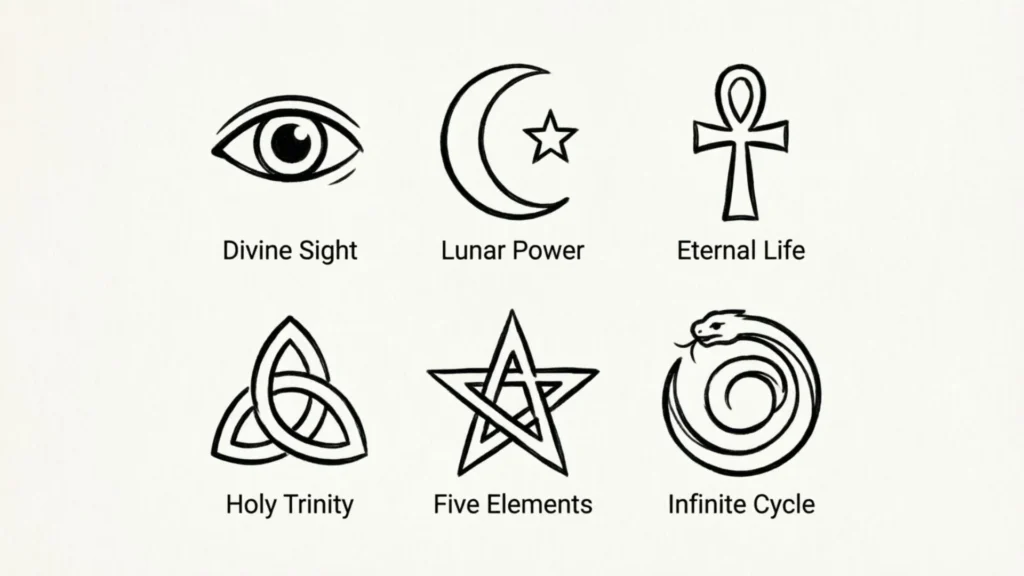
Mystic symbols can represent many different ideas. Rather than giving every symbol the same vague meaning, it is more useful to group them according to the concept a person wants to express.
Mystic Symbols for Protection
Protection is one of the most common reasons people choose symbolic designs.
Depending on the tradition, protective symbolism can include eye motifs, amulets, religious symbols, knots, and certain geometric forms.
The important point is that a symbol should not be described as literally creating supernatural protection without evidence.
For many modern users, protection is symbolic. A necklace, tattoo, or artwork may serve as a reminder of safety, strength, boundaries, or personal resilience.
Mystic Symbols for Transformation
Transformation is strongly represented by symbols such as:
- Ouroboros
- Lotus
- Spiral
- Phoenix
- Serpent imagery
The Ouroboros emphasizes cycles. The lotus emphasizes growth through difficult conditions. The phoenix represents renewal after destruction, while the spiral suggests movement and development.
Together, these symbols offer different ways to express the idea of change.
Mystic Symbols for Spiritual Awakening
Symbols connected with spiritual awakening include the lotus, Om, mandala, and certain meditation-related geometric designs.
The meaning of “awakening” differs between traditions.
For one person, it may mean becoming more self-aware. For another, it may have a specific religious or philosophical meaning.
Therefore, the symbol should be interpreted according to the tradition rather than assuming that all spiritual paths define awakening in the same way.
Mystic Symbols for Wisdom
Wisdom is often represented through symbols involving eyes, trees, books, serpents, stars, or other culturally specific imagery.
The Tree of Life is especially useful as a modern representation of knowledge and growth, while eye symbolism can represent perception or awareness.
However, there is no universal mystical symbol of wisdom.
Mystic Symbols for Strength
Strength can be represented through many images, including the sun, lion, serpent, mountain, or protective symbols.
The most appropriate choice depends on what kind of strength you want to communicate.
Physical strength, emotional resilience, courage, spiritual endurance, and personal confidence are not exactly the same thing.
Mystic Symbols for Balance
The Yin-Yang is one of the clearest symbols associated with complementary forces and balance.
Geometric designs can also express symmetry and harmony.
For personal symbolism, balance may represent:
- Work and rest
- Mind and body
- Strength and softness
- Change and stability
- Individuality and connection
Mystic Symbols for Love
Love symbolism is not limited to one mystical sign.
Hearts, flowers, intertwined forms, circles, and certain religious symbols can all express love or connection depending on context.
The lotus may represent compassionate spiritual development, while interwoven designs can suggest lasting connection.
Mystic Symbols for Healing and Renewal
Symbols such as the lotus, phoenix, spiral, and certain protective or religious signs are sometimes used to represent healing or recovery.
It is important to make a distinction here:
Using a symbol to represent healing is not the same as claiming that the symbol medically heals a person.
A tattoo or necklace can serve as a personal reminder of recovery, hope, or emotional renewal, but it should not replace appropriate medical care.
Mystic Symbols for Rebirth
Rebirth is strongly associated with:
- Phoenix
- Lotus
- Ouroboros
- Butterfly imagery
- Cyclical symbols
These images are particularly popular among people marking a major change in their lives.
What Are the Most Powerful Mystic Symbols?
There is no universally accepted ranking that determines which mystical symbol is the “most powerful.”
Symbolic power depends on the culture, tradition, historical context, and personal meaning attached to the image.
If you are choosing a symbol according to a particular idea, this guide can help:
| Your Intended Meaning | Symbols to Explore |
| Protection | Eye symbols, protective amulets, relevant religious symbols |
| Transformation | Ouroboros, lotus, spiral |
| Rebirth | Phoenix, lotus, Ouroboros |
| Balance | Yin-Yang, geometric forms |
| Life | Ankh |
| Meditation | Om, mandala, Sri Yantra |
| Growth | Lotus, Tree of Life, spiral |
| Inner journey | Labyrinth, spiral |
| Renewal | Phoenix, Ouroboros |
| Awareness | Eye symbols |
This approach is more useful than claiming that one symbol is objectively more powerful than another.
Ancient Mystic Symbols and Their Origins
Mystical symbolism did not originate in one civilization.
Different societies developed symbolic languages according to their religions, philosophies, natural environments, artistic traditions, and ideas about existence.
Egyptian Symbolism
Ancient Egyptian culture produced a rich visual language.
Symbols such as the Ankh and Eye of Horus became strongly connected with religious ideas.
Egyptian symbols are especially popular today, but modern interpretations sometimes combine several unrelated Egyptian symbols into a generalized “mystical” system.
Historical context helps avoid that mistake.
Greek and Roman Symbolism
Greek and Roman mythology contains numerous symbolic animals, objects, gods, and stories.
Serpents, laurel, celestial imagery, weapons, animals, and mythological creatures could all carry specific meanings.
Some later mystical traditions also reinterpreted classical symbols.
Indian Symbolism
Indian religious and philosophical traditions contain exceptionally rich symbolic systems.
Om, lotus imagery, mandalas, chakras, yantras, and other forms can have specific meanings within Hindu, Buddhist, Jain, and related traditions.
These should not all be combined into one generalized category because each tradition has its own history and interpretation.
Chinese Symbolism
Chinese philosophy and religion have developed important symbolic concepts involving balance, nature, cosmic relationships, animals, colors, numbers, and celestial imagery.
The Yin-Yang is one of the most recognizable examples.
Its meaning is more nuanced than the simplified modern phrase “good and evil.”
Celtic-Inspired Symbolism
Celtic-inspired knots, spirals, crosses, and other designs are popular in modern jewelry and tattoos.
Some designs have historical archaeological contexts, while others were developed or popularized much later.
This is why claims about a single ancient “Celtic mystical dictionary” should be treated carefully.
Jewish and Christian Symbolism
Jewish and Christian traditions contain many important symbols, including stars, crosses, fish, lambs, vines, doves, and other imagery.
Some symbols have specifically religious meanings, while others have developed additional cultural meanings over time.
A symbol associated with a living religious tradition should be understood respectfully and within its actual context.
Alchemical and Esoteric Traditions
European alchemy and later esoteric movements created complex symbolic systems involving metals, planets, elements, animals, geometric shapes, and transformation.
These traditions are especially important to modern discussions of mystical symbolism.
However, modern internet lists sometimes mix historical alchemy with unrelated New Age concepts. Keeping the traditions separate makes the information more reliable.
Mystic Symbols in Modern Spirituality
Mystic symbols are now used far beyond their original historical settings.
You may see them on:
- Jewelry
- Tattoos
- Clothing
- Home décor
- Meditation materials
- Artwork
- Books
- Journals
- Digital designs
- Personal spiritual objects
Modern users often create personal meanings for symbols.
For example, someone may use an Ouroboros as a reminder of recovering from a difficult period, even if that exact personal interpretation was not part of the symbol’s original historical use.
Personal symbolism is valid as personal symbolism. It simply should not be presented as historical fact.
How to Identify an Unknown Mystic Symbol
Finding the meaning of an unfamiliar symbol can be difficult because many designs look similar.
Use a careful process instead of relying on the first result you find online.
Step 1: Study the Shape
Look closely at:
- Number of points
- Lines
- Circles
- Triangles
- Animals
- Eyes
- Letters
- Knots
- Geometric patterns
Small design differences can completely change the identity of a symbol.
Step 2: Look for Text or Inscriptions
Letters or words can provide important clues about the symbol’s origin.
A symbol accompanied by Sanskrit, Greek, Hebrew, Latin, Arabic, or another writing system may belong to a specific cultural or religious context.
Step 3: Identify the Cultural Context
Ask where the symbol was found.
A symbol on an Egyptian artifact should be researched differently from a symbol appearing in a medieval European manuscript or a modern spiritual tattoo.
Step 4: Check Historical Examples
Museum collections, academic sources, historical books, and reputable cultural institutions are generally better sources than unsourced social media posts.
Step 5: Separate Original Meaning From Modern Meaning
If one website says a symbol means “wealth, protection, psychic power, love, healing, and abundance,” that does not mean all those meanings are historically established.
Look for evidence of when and where each interpretation developed.
How to Choose a Mystic Symbol
Choosing a meaningful symbol becomes easier when you start with the idea rather than the appearance.
Ask yourself:
Historical Meaning or Personal Meaning?
This is an important choice.
You may want:
A historically meaningful symbol:
Choose one whose traditional meaning matches your intention.
A personally meaningful symbol:
Choose an image that reminds you of your own experience, even if the interpretation is modern.
Neither approach is automatically better. The important thing is being honest about the difference.
Mystic Symbols for Tattoos
Mystic symbols are popular tattoo choices because they can express an idea without using words.
Small Mystic Symbols
Small designs work well when you want something subtle.
Possible choices include:
- Small spiral
- Minimalist lotus
- Ankh
- Simple star
- Tiny moon
- Small Ouroboros
The smaller the design, the more important it becomes to choose a shape that will remain recognizable over time.
Mystic Symbols for Transformation Tattoos
For transformation, consider:
- Ouroboros
- Phoenix
- Lotus
- Spiral
- Butterfly imagery
Each communicates change differently.
The Ouroboros suggests cycles, the phoenix suggests renewal after destruction, and the lotus suggests growth through difficult conditions.
Mystic Symbols for Protection Tattoos
Protection-themed tattoos can include historically protective symbols, eye motifs, religious imagery, or symbolic knots.
Before choosing one, research its cultural meaning carefully.
A symbol that looks like a generic protective design may have a specific religious or cultural identity.
Mystic Symbols for Spiritual Growth
Lotus, Om, mandala, Tree of Life, and certain sacred diagrams can be meaningful choices for people who want to represent spiritual development.
When using a symbol from a living religious tradition, understanding its actual meaning is an important part of respectful use.
Common Misconceptions About Mystic Symbols
Mystical symbolism attracts a lot of misinformation online.
Every Ancient Symbol Has a Secret Meaning
Not necessarily.
Many ancient designs were decorative, political, religious, or practical rather than secret mystical codes.
All Mystic Symbols Come From One Ancient Tradition
They do not.
Mystical and symbolic traditions developed independently across many cultures and historical periods.
A Modern Meaning Must Be an Ancient Meaning
This is one of the most common mistakes.
A symbol can acquire a new meaning hundreds or thousands of years after its original use.
A Symbol Is Automatically Powerful Because It Is Ancient
Age does not prove supernatural power.
A symbol can be historically important without possessing an objectively measurable supernatural effect.
Every Symbol Has One Universal Meaning
Meanings can vary dramatically.
A serpent is an excellent example. In different traditions it can represent wisdom, danger, fertility, healing, renewal, or other ideas.
Mystical Means Evil
No.
Mystical symbolism includes religious, philosophical, contemplative, artistic, and esoteric traditions. A mysterious appearance does not make a symbol evil.
Are Mystic Symbols Religious?
Some are religious, while others are philosophical, cultural, artistic, or modern spiritual symbols.
For example, Om has a deep connection with Hindu traditions. The Ankh belongs to ancient Egyptian religious symbolism. Mandalas have important roles in Hindu and Buddhist traditions.
A spiral, on the other hand, may appear simply as an artistic design in one historical context and receive a spiritual interpretation in another.
The safest approach is to ask:
Who used this symbol, when, and for what purpose?
Are Mystic Symbols Dangerous or Evil?
A symbol’s appearance does not determine whether it is good, evil, dangerous, or harmless.
Many symbols have complex histories and have been interpreted differently by different communities.
The same design may be sacred in one setting, decorative in another, and used for a completely different purpose somewhere else.
If you are concerned about a particular symbol, research its specific cultural and historical context rather than judging it only by appearance.
Why Are People Drawn to Mystic Symbols?
Symbols can communicate ideas quickly.
A person may be attracted to a mystical design because it represents:
- A personal transformation
- A spiritual journey
- A cultural connection
- A difficult experience
- A new beginning
- Personal strength
- Nature
- Mystery
- Self-reflection
Symbols also provide a visual language for experiences that can be difficult to describe.
A small tattoo or pendant may carry a personal story that would otherwise require an entire paragraph to explain.
How Mystic Symbols Work in Personal Meaning
A symbol can have three layers of meaning:
Historical meaning:
What the symbol meant in its original culture or tradition.
Modern cultural meaning:
How later communities or popular culture interpreted it.
Personal meaning:
What the symbol represents to an individual.
These three meanings do not have to be identical.
For example, someone may choose a lotus because it reminds them of recovering from hardship. That is a meaningful personal interpretation even though it is not necessarily the complete historical explanation of lotus symbolism.
Ancient Meaning vs Modern Mystic Meaning
Understanding this distinction is one of the best ways to research symbols responsibly.
| Symbol | Historical/Traditional Context | Common Modern Interpretation |
| Ankh | Life in ancient Egyptian symbolism | Life, rebirth, vitality |
| Ouroboros | Ancient and later alchemical traditions | Transformation and renewal |
| Om | Hindu and related Indian traditions | Meditation and consciousness |
| Yin-Yang | Chinese philosophical tradition | Balance and harmony |
| Lotus | Asian religious traditions | Spiritual growth |
| Spiral | Many ancient artistic contexts | Personal development |
| Flower of Life | Geometric design with modern sacred-geometry associations | Unity and creation |
| Phoenix | Legendary rebirth imagery | Resilience and new beginnings |
The modern interpretation may be meaningful, but it should not automatically be labeled ancient.
A Simple Guide to Choosing the Right Mystic Symbol
If you are still unsure which symbol fits your purpose, start with the idea you want to express.
For New Beginnings
Consider the phoenix, lotus, or Ouroboros.
For Personal Growth
Consider the spiral, Tree of Life, or lotus.
For Balance
Consider Yin-Yang imagery or balanced geometric designs.
For Life
Research the Ankh and its ancient Egyptian context.
For Meditation
Explore Om, mandalas, or specific traditional yantras.
For Transformation
The Ouroboros, phoenix, lotus, and spiral offer different forms of transformation symbolism.
For an Inner Journey
A labyrinth or spiral can provide a strong visual metaphor for searching, reflection, and personal development.
Frequently Asked Questions About Mystic Symbols
What is the oldest mystic symbol?
There is no universally accepted single “oldest mystic symbol.” Some symbolic geometric forms, animals, and natural motifs appear in prehistoric and ancient art, but their original meanings are often uncertain. It is safer to discuss specific symbols within their archaeological and cultural context than to name one symbol as the oldest.
What is the most powerful mystic symbol?
There is no objective or universally recognized most powerful mystic symbol. The importance of a symbol depends on its tradition, historical role, and personal significance. Different symbols are associated with different ideas such as protection, transformation, life, balance, or spiritual awareness.
What symbol represents transformation?
The Ouroboros, lotus, phoenix, and spiral are commonly used to represent transformation. The Ouroboros emphasizes cycles, the phoenix emphasizes rebirth, the lotus emphasizes growth, and the spiral suggests movement and development.
What symbol represents protection?
Protection symbolism varies between cultures. Eye motifs, protective amulets, knots, religious signs, and certain geometric symbols have been used for protective purposes in different traditions. The exact meaning depends on the symbol’s historical context.
What symbol represents spiritual awakening?
The lotus is commonly associated with spiritual development and awakening in several Asian traditions. Om is also deeply connected with spiritual and philosophical concepts in Hindu traditions. Modern spiritual communities may also use mandalas and other contemplative designs.
What symbol represents wisdom?
There is no single universal symbol of wisdom. Trees, eyes, serpents, books, stars, and other images can represent wisdom or knowledge in different traditions. The Tree of Life is a popular modern choice for representing growth and knowledge.
What symbol represents rebirth?
The phoenix is one of the clearest modern symbols of rebirth. The lotus and Ouroboros can also represent renewal, cycles, and transformation.
What symbol represents balance?
Yin-Yang is one of the best-known symbols associated with complementary forces and balance. Its meaning is more nuanced than simply representing two opposing sides because each side contains an element of the other.
Are mystic symbols the same as occult symbols?
No. The terms overlap in some contexts, but they are not identical. Mystic symbolism can involve spiritual experience or deeper philosophical ideas, while occult symbolism is more specifically associated with hidden knowledge or practices. A symbol’s context determines how it should be understood.
Are mystic symbols religious?
Some are religious, while others are philosophical, cultural, artistic, or modern spiritual. Om, the Ankh, and traditional mandalas, for example, have specific religious or cultural contexts. A modern spiral design may simply have personal symbolic meaning.
Can I use a mystic symbol as a tattoo?
Yes, but research the symbol before getting it permanently inked. Some designs belong to living religious or cultural traditions and may have meanings you do not expect. Understanding the history and context helps you make a more informed choice.
Do mystic symbols have universal meanings?
No. Symbolic meanings can change between cultures, historical periods, religions, and modern communities. A symbol that represents protection in one context may represent something completely different in another.
How can I identify an unknown mystical symbol?
Start by examining its shape, orientation, inscriptions, animals, geometric elements, and surrounding artwork. Then research its cultural origin and compare it with reliable historical or museum sources. Avoid relying on a single unsourced social media post or symbol-list website.
Do mystic symbols really have supernatural powers?
There is no general scientific basis for claiming that a symbol itself has supernatural powers. Symbols can have powerful cultural, religious, emotional, and personal significance, but symbolic meaning should not automatically be confused with measurable supernatural effects.
Final Thoughts on Mystic Symbols
Mystic symbols are much more than mysterious shapes. They are part of a long human tradition of using visual language to express ideas about life, death, nature, consciousness, transformation, balance, faith, and the unknown.
The most important thing to remember is that there is no single universal dictionary of mystic symbols. An Ankh belongs to a different historical context from Yin-Yang. Om has a different religious background from the Ouroboros. A modern sacred-geometry design may have a very different history from an ancient religious symbol.
That difference makes the subject more interesting, not less.
If you are researching a symbol for a tattoo, piece of jewelry, artwork, meditation practice, or personal journey, look beyond the short “meaning” attached to it. Find out where the symbol came from, how it was originally used, and which meanings developed later.
Then you can decide what it means to you.
A meaningful symbol does not need to be mysterious simply because it is old. Its real value can come from the history behind it, the tradition that shaped it, or the personal story you choose to connect with it.

Adam Sullivan is a dedicated writer who enjoys transforming everyday topics into engaging and informative content. His writing focuses on making complex ideas simple, practical and enjoyable for readers of all backgrounds. Adam is also the fictional author of The Lantern Beyond Autumn Hills and Where the Morning Horizon Waits. Outside of writing, he enjoys photography, traveling and discovering inspiration through new experiences. He believes great content should be both helpful and easy to connect with.