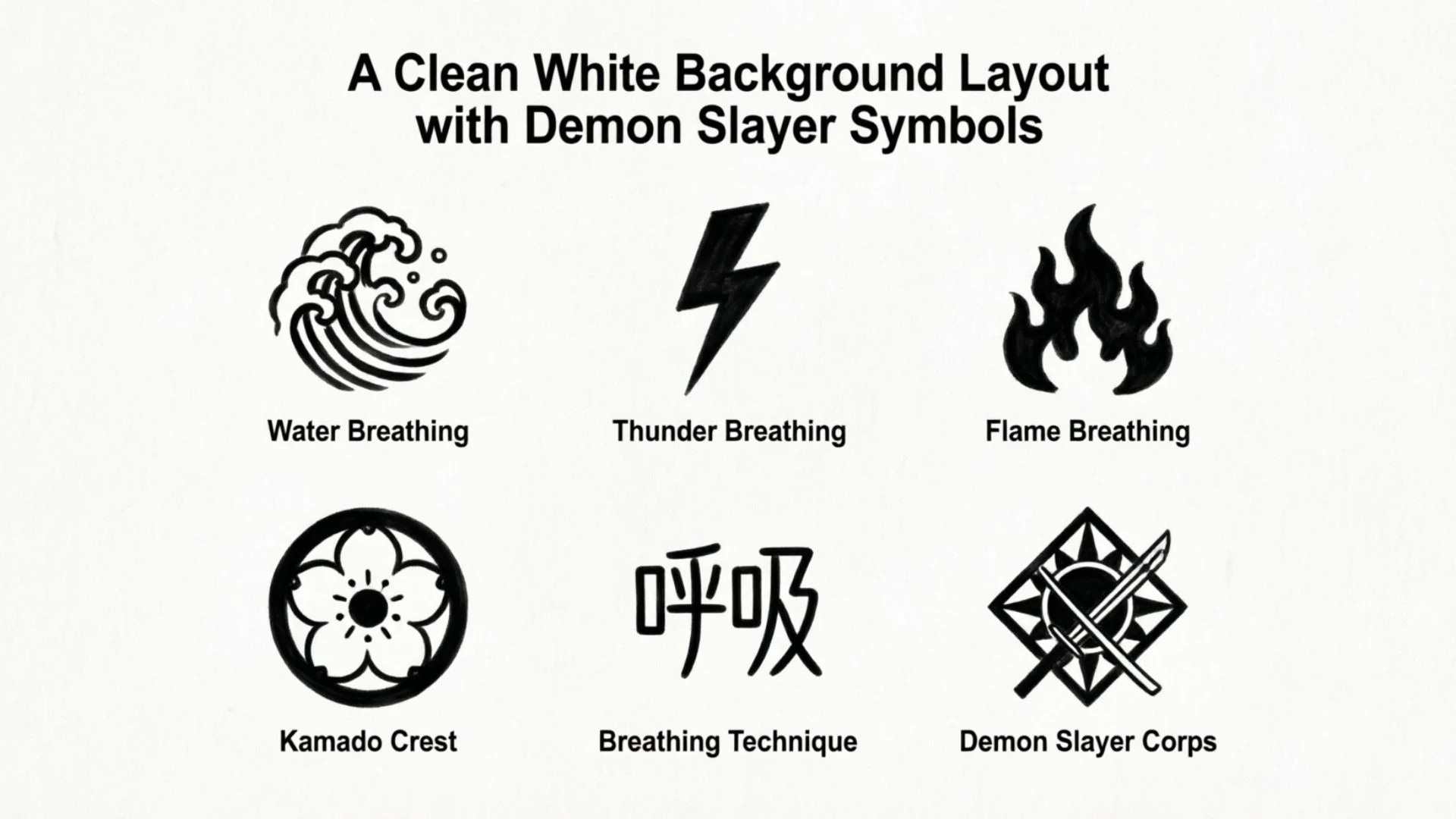
If you love Demon Slayer: Kimetsu no Yaiba, you have probably noticed that its most memorable details are more than simple decorations.
From Tanjiro’s hanafuda earrings to the Demon Slayer Corps emblem and the patterns worn by different characters, these designs help tell the story.
I find these symbols especially interesting because you can recognize a character or idea without seeing their name. You can also use them as inspiration for a tattoo, artwork, phone wallpaper, jewelry, or personal collection.
For you, the best symbol may depend on what you connect with most family, courage, sacrifice, protection, friendship, or determination.
Some designs come directly from the anime, while others are visual motifs associated with its characters and themes. Understanding that difference makes the symbols much more meaningful.
Let’s explore the most recognizable Demon Slayer symbols, what they mean in the story, and how fans commonly use them today.
What Symbol Represents Demon Slayer? (Quick Answer)
The Demon Slayer Corps kanji symbol, “滅” (metsu), is one of the clearest symbols associated with Demon Slayer. It appears on the back of the Corps uniform and conveys the idea of destruction or annihilation.
However, Tanjiro Kamado’s hanafuda earrings are arguably the most recognizable visual symbol from the series. Within the story, they are connected to Tanjiro’s family, the legacy of Sun Breathing, and Yoriichi Tsugikuni.
Other important Demon Slayer symbols and motifs include the Demon Slayer Mark, wisteria, Nichirin swords, character clothing patterns, Nezuko’s bamboo muzzle, and the visual motifs associated with different Breathing Styles.
What Are Demon Slayer Symbols?
Demon Slayer symbols are recognizable signs, objects, patterns, kanji, marks, and character motifs connected with Demon Slayer: Kimetsu no Yaiba.
Some are official elements of the fictional world. Others are visual designs strongly associated with particular characters.
For example, the “metsu” kanji is connected directly with the Demon Slayer Corps uniform, while Tanjiro’s hanafuda earrings are a personal family heirloom. The official anime character material also identifies Tanjiro as a Demon Slayer who uses Water Breathing and Hinokami Kagura.
It is also important to separate fictional meaning from real-world meaning. Hanafuda, for example, refers to a real Japanese card tradition, while its particular use as Tanjiro’s earrings belongs to the fictional story. The same principle applies to Japanese patterns, kanji, and religious or cultural imagery.
Demon Slayer Symbols Comparison Table
| Symbol | Main Meaning | Best Use |
| 滅 Metsu | Annihilation of demons | Tattoos, anime art |
| Hanafuda Earrings | Sun Breathing legacy and family inheritance | Tattoos, jewelry |
| Demon Slayer Mark | Exceptional fighting ability and destiny | Tattoos, character art |
| Wisteria | Protection from demons | Decorative art, tattoos |
| Nichirin Sword | Demon Slayer identity | Posters, tattoos |
| Tanjiro’s Checkered Haori | Family, identity, perseverance | Fan art, clothing |
| Nezuko’s Bamboo Muzzle | Restraint and protection | Tattoos, character art |
| Nezuko’s Asanoha Pattern | Traditional Japanese visual motif | Clothing, design |
| Zenitsu’s Lightning Motif | Thunder Breathing and speed | Tattoos, graphics |
| Inosuke’s Boar Mask | Wildness and identity | Fan art, tattoos |
| Rengoku’s Flame Motif | Flame Breathing and character identity | Tattoos, artwork |
| Giyu’s Half-and-Half Haori | Memory, friendship, and loss | Tattoos, fan designs |
Top 12 Demon Slayer Symbols and Their Meanings
1. 滅 Metsu: The Symbol of the Demon Slayer Corps
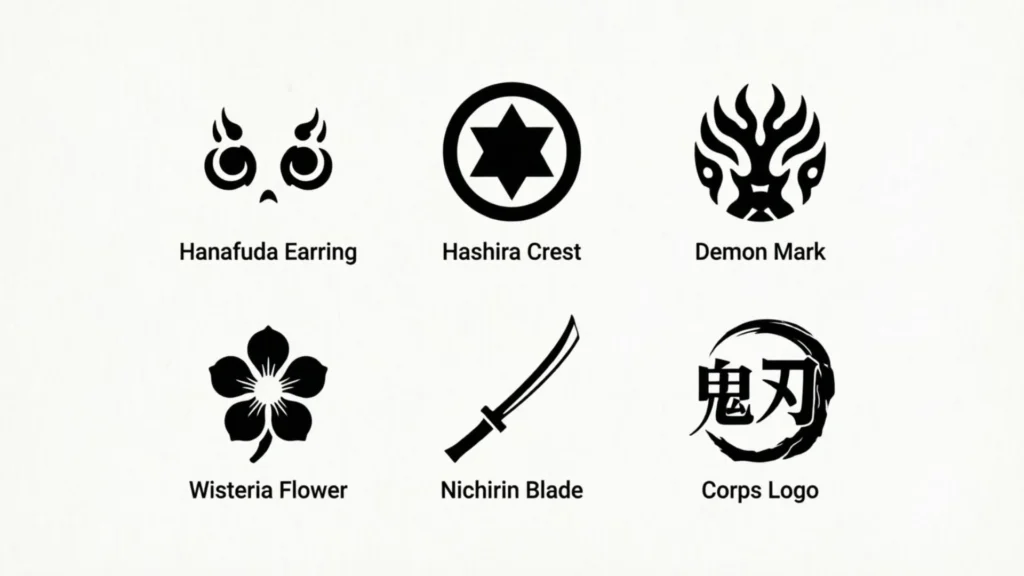
The kanji 滅 (metsu) is one of the most direct Demon Slayer symbols. It appears on the back of the standard Demon Slayer Corps uniform. The character carries the meaning of destruction, extinction, or annihilation, fitting the Corps’ mission of fighting demons.
Unlike a random Japanese character chosen for decoration, this mark belongs specifically to the fictional organization in Demon Slayer. That makes it a strong choice for fans who want a symbol connected to the Corps rather than one particular character.
It works especially well as minimalist artwork because a single kanji can create a clean visual design.
Best for: Small tattoos, anime collections, minimalist designs, posters, fan art
2. Tanjiro’s Hanafuda Earrings: Family and Sun Breathing
Tanjiro’s hanafuda earrings are probably the most recognizable accessory in the series. They are inherited through the Kamado family and connect Tanjiro’s story with the legacy of Sun Breathing and Yoriichi Tsugikuni. Muzan also recognizes the earrings because of their association with his past encounter with Yoriichi.
“Hanafuda” literally refers to Japanese playing cards, commonly translated as “flower cards.” The earrings are inspired by the visual language of hanafuda but are not simply an ordinary hanafuda card reproduced as jewelry.
For many fans, the design suggests inheritance, memory, family, and perseverance.
Best for: Jewelry, earrings, tattoos, family-themed artwork, fan collections
3. Demon Slayer Mark: Determination and Exceptional Ability
The Demon Slayer Mark is a distinctive marking that appears on certain powerful swordsmen. Tanjiro’s mark develops from the scar on his forehead and becomes associated with his growth as a fighter.
Within the story, the mark is not merely a decorative tattoo. It is connected with extraordinary physical ability and the demanding path followed by elite Demon Slayers.
Because each character’s mark has a distinctive appearance, fans often choose a character-specific version for tattoos rather than using a generic symbol.
Best for: Character tattoos, anime-inspired artwork, personal reminders of determination
4. Wisteria: Protection From Demons
Wisteria is one of the recurring protective elements in Demon Slayer. It is particularly associated with places that help protect humans from demons.
This gives wisteria a useful symbolic layer: beauty exists alongside danger, and something delicate-looking can become a source of safety. Unlike some character-specific designs, the flower can also stand on its own as a decorative tattoo or botanical illustration.
If you want a Demon Slayer-inspired design without making the tattoo look like obvious anime merchandise, a wisteria branch can be a subtle option.
Best for: Floral tattoos, protective themes, elegant artwork, subtle anime designs
5. Nichirin Sword: The Identity of a Demon Slayer
Nichirin swords are among the most recognizable objects in the series. They are special swords used by Demon Slayers to fight demons, and their colors can differ between users.
Tanjiro’s famous sword is black, while other characters have distinctly colored blades. This makes the sword both a weapon and a visual identifier.
A Nichirin blade works well in fan art because you can personalize it around your favorite character. Adding the character’s haori pattern or another motif can make the design even more recognizable.
Best for: Posters, sword tattoos, character artwork, collectibles, digital designs
6. Tanjiro’s Checkered Haori: Family and Identity
Tanjiro’s green-and-black checkered haori is almost as recognizable as his earrings. It gives his character a distinctive silhouette and remains visually connected to his family background.
The checkered pattern is not simply a general “Demon Slayer symbol.” It is primarily a character motif associated with Tanjiro. That distinction matters if you want an accurate design.
For fans, the pattern can represent Tanjiro’s kindness, persistence, family loyalty, and growth throughout the story.
Best for: Clothing-inspired tattoos, backgrounds, posters, wallpapers, fan art
7. Nezuko’s Bamboo Muzzle: Restraint and Humanity
Nezuko’s bamboo muzzle is one of the defining visual elements of her character. It is connected to her unusual position as a demon who refuses to attack humans and instead fights alongside her brother.
The official anime description emphasizes that Nezuko protects humans through both hypnotic suggestion and her own willpower.
Because of this, the bamboo muzzle can be interpreted as a visual reminder of restraint, self-control, and the struggle between a person’s nature and their choices.
Best for: Nezuko tattoos, character art, minimalist anime designs, symbolic artwork
8. Nezuko’s Asanoha Pattern: A Traditional Visual Motif
Nezuko’s clothing includes a geometric asanoha or hemp-leaf pattern, a traditional Japanese pattern that predates Demon Slayer. Therefore, it should not be treated as a symbol invented by the anime.
Its use in Nezuko’s character design helps create a strong connection to Japanese visual culture while giving her clothing an instantly recognizable appearance.
If you want a Nezuko-inspired tattoo or design, using the pattern respectfully as a Japanese textile motif can be more subtle than reproducing an entire character.
Best for: Textile-inspired art, backgrounds, clothing designs, Nezuko tattoos
9. Zenitsu’s Lightning Motif: Thunder and Speed
Zenitsu Agatsuma is associated with Thunder Breathing, making lightning one of the clearest visual ideas connected with him.
The official character description identifies Zenitsu as a Demon Slayer and a user of Thunder Breathing.
Lightning works particularly well as a minimalist fan symbol because it can be reduced to a few sharp lines. You do not necessarily need Zenitsu’s face, name, or entire costume for another fan to understand the reference.
Best for: Small tattoos, minimalist designs, speed themes, Zenitsu fan art
10. Inosuke’s Boar Mask: Wildness and Identity
Inosuke’s boar mask is instantly recognizable and strongly separates him visually from the other members of Tanjiro’s group.
The mask reflects his unusual upbringing and wild personality, making it more than a costume accessory. It is closely tied to his identity and the way he presents himself.
For artwork, the boar head can be used alone or combined with Inosuke’s swords for a more detailed composition.
Best for: Inosuke tattoos, bold artwork, character illustrations, anime collections
11. Rengoku’s Flame Motif: Passion and Flame Breathing
Kyojuro Rengoku is closely associated with flames, both through his Flame Breathing style and his distinctive character design. The official anime character pages list Rengoku among the major characters of the series.
Flames also make excellent standalone artwork because they can communicate energy, passion, courage, and determination even without explicitly showing the character.
For a Rengoku-inspired tattoo, combining a flame shape with a sword or his recognizable hair colors can create a strong reference.
Best for: Rengoku tattoos, memorial designs, motivational artwork, posters
12. Giyu’s Half-and-Half Haori: Memory and Character Identity
Giyu Tomioka’s unusual haori design is divided into two distinct visual sections. It is closely connected to his character history and the people important to him.
Unlike a generic geometric pattern, the design has narrative significance within Giyu’s story. That makes it especially meaningful to fans who connect with his quiet personality and emotional history.
For a tattoo, even a simplified half-and-half pattern can work without reproducing the entire character.
Best for: Giyu tattoos, character art, memorial-inspired designs, minimalist patterns
Best Demon Slayer Symbols for Tattoos
The best tattoo depends on whether you want something immediately recognizable or something subtle.
For an obvious anime reference, Tanjiro’s hanafuda earrings, the Metsu kanji, a Nichirin sword, or a character-specific mark are strong choices.
For a more understated design, consider wisteria, lightning, flames, a simplified haori pattern, or a small bamboo motif.
Some popular options include:
- Metsu kanji — for the Demon Slayer Corps
- Hanafuda earrings — for Tanjiro and the Sun Breathing legacy
- Wisteria — for protection
- Nichirin sword — for the Demon Slayer journey
- Flames — for Rengoku
- Lightning — for Zenitsu
- Boar mask — for Inosuke
- Bamboo muzzle — for Nezuko
Before getting a Japanese kanji tattoo, it is especially wise to verify the exact character and intended meaning with a reliable Japanese-language source or qualified native speaker.
Best Demon Slayer Symbols for Logos and Design
If you are creating fan art, posters, social media graphics, stickers, or other creative designs, choose symbols that remain recognizable when made small.
The Metsu kanji, a simplified Nichirin sword, hanafuda earrings, lightning, flames, and wisteria are visually effective because they have clear silhouettes.
For a clean logo-style design, avoid putting too many details into one mark. A single recognizable motif usually works better than combining five or six characters into a crowded image.
If you are creating something for commercial use, remember that Demon Slayer characters, names, artwork, and distinctive franchise elements are copyrighted and may also involve trademarks. A fan design and a commercial brand are not necessarily treated the same way.
Best Demon Slayer Symbols for Family, Spiritual, or Personal Meaning
The series gives fans many ways to connect fictional symbols with real personal ideas.
These personal interpretations are different from official canon. It is perfectly reasonable to give a symbol your own meaning, as long as you do not present a personal interpretation as an established fact from the series.
Before Using Cultural or Sacred Symbols
Some Demon Slayer designs draw on real Japanese culture, traditional patterns, Japanese writing, or historical imagery.
That means it is worth learning what you are using before turning it into a tattoo, logo, product, or commercial design. Hanafuda, for example, is a real Japanese card tradition, not a fictional invention created for the anime.
You should also be careful with Japanese kanji. A character can have several readings or nuances, and a visually attractive symbol may not mean what an online translation claims.
Respecting the source does not make your design less creative. It usually makes it more thoughtful and accurate.
How to Choose the Right Symbol for Demon Slayer
Start by asking yourself what you want the symbol to say.
1. Choose a personal meaning.
Do you want family, courage, protection, sacrifice, friendship, or determination?
2. Decide how obvious you want the reference to be.
A character’s exact accessory is instantly recognizable, while wisteria or flames can be much more subtle.
3. Check cultural meaning.
If the design includes Japanese writing or traditional patterns, understand its real-world background first.
4. Think about size.
Tiny tattoos need simple shapes. Detailed character designs generally require more space.
5. Consider where it will be used.
A tattoo, logo, poster, piece of jewelry, and social media icon have different design requirements.
6. Verify the details.
Small differences in kanji, patterns, colors, or character designs can change whether a fan considers the symbol accurate.
FAQs About Demon Slayer Symbols
What is the best symbol for Demon Slayer?
The Metsu (滅) kanji is one of the clearest symbols of the Demon Slayer Corps because it appears on the Corps uniform. Tanjiro’s hanafuda earrings are another highly recognizable choice, especially if you want a symbol connected with Tanjiro and Sun Breathing.
What symbol represents Tanjiro?
Tanjiro is most strongly associated with his hanafuda earrings, green-and-black checkered haori, forehead mark, and Nichirin sword. The earrings are especially important because they connect his family history with the legacy of Sun Breathing and Yoriichi.
What is a good Demon Slayer tattoo?
A good tattoo depends on your favorite character and desired meaning. Hanafuda earrings work well for Tanjiro fans, flames suit Rengoku, lightning suits Zenitsu, and a boar mask represents Inosuke. For a general Corps tattoo, the Metsu kanji is a simple option.
What symbol represents family in Demon Slayer?
Tanjiro’s hanafuda earrings are one of the strongest family-related symbols in the series because they are inherited through his family and connect generations to the Sun Breathing legacy. This makes them especially suitable for a family-themed fan design.
What is a simple Demon Slayer symbol?
The Metsu kanji, a small lightning bolt, flame, wisteria flower, or simplified hanafuda earring design can work as a simple symbol. The best choice depends on whether you want a general Demon Slayer reference or a particular character reference.
What symbol represents protection in Demon Slayer?
Wisteria is closely associated with protection from demons in the series. Nezuko can also represent protection because she fights against demons while protecting humans. The official character description specifically highlights her decision to protect humans.
What do Tanjiro’s earrings mean?
Within Demon Slayer, Tanjiro’s earrings are a family heirloom connected with the Sun Breathing tradition and Yoriichi Tsugikuni. Muzan recognizes the design because it reminds him of Yoriichi, making the earrings an important story symbol rather than simple decoration.
Is the Demon Slayer Metsu symbol real Japanese?
The character 滅 is a real Japanese kanji associated with meanings such as destruction or extinction. However, its specific use as the symbol on the Demon Slayer Corps uniform belongs to the fictional world of Demon Slayer. Some explanations also discuss its stylized presentation in the series.
Final Thoughts
The best Demon Slayer symbols are not simply attractive designs. Many of them carry pieces of a character’s history, family, abilities, or personal struggle.
Tanjiro’s hanafuda earrings point toward inheritance and Sun Breathing, the Metsu kanji identifies the Demon Slayer Corps, and character motifs such as flames, lightning, wisteria, and the boar mask make individual stories recognizable.
If you are choosing one for a tattoo, piece of jewelry, or artwork, focus first on the meaning you want to carry with you. A simple symbol with a personal connection can become much more memorable than a complicated design chosen only because it looks cool.
Explore Demon Slayer symbols, their meanings, character motifs, tattoo ideas, and cultural context, from Tanjiro’s earrings to the Metsu Corps symbol.

Adam Sullivan is a dedicated writer who enjoys transforming everyday topics into engaging and informative content. His writing focuses on making complex ideas simple, practical and enjoyable for readers of all backgrounds. Adam is also the fictional author of The Lantern Beyond Autumn Hills and Where the Morning Horizon Waits. Outside of writing, he enjoys photography, traveling and discovering inspiration through new experiences. He believes great content should be both helpful and easy to connect with.