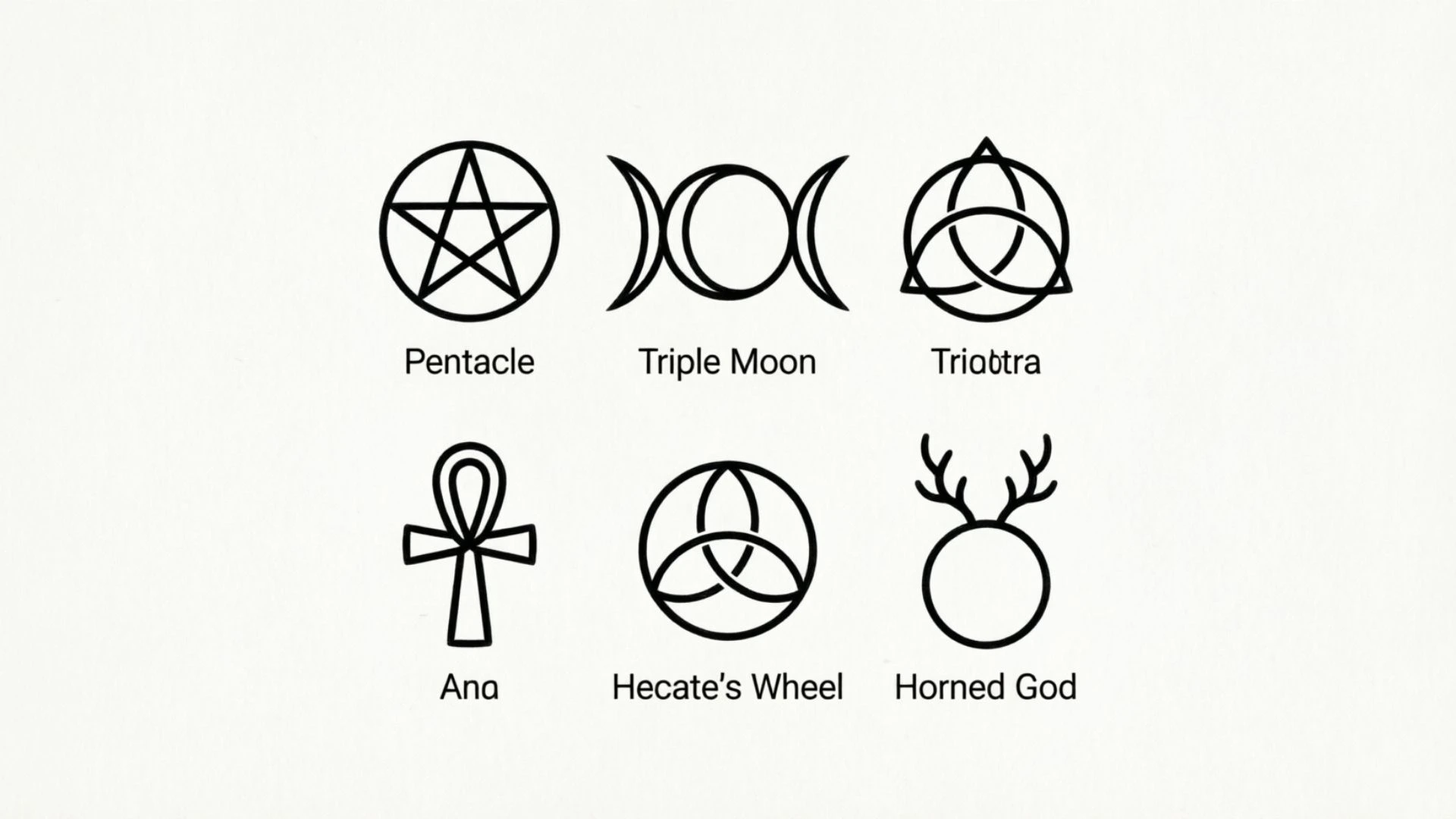
Wiccan symbols can look mysterious at first, especially when you see a pentacle, Triple Moon, spiral, crescent moon, or other meaningful design without knowing what it represents.
For people exploring Wicca, these symbols can offer a simple way to understand ideas such as nature, balance, protection, transformation, femininity, spirituality, and the changing seasons.
However, there is an important point to understand: not every symbol used by Wiccans originated in Wicca.
Wicca is a modern religious movement that developed in Britain during the 20th century, while some symbols commonly used by modern Wiccans come from much older cultures, religions, magical traditions, or modern Pagan movements.
Meanings can also vary between Wiccan traditions and individual practitioners. A symbol may have one common interpretation but carry a more personal meaning for someone who uses it.
You will also find practical guidance for choosing symbols for tattoos, jewelry, altars, and personal spiritual practice.
What Are the Main Wiccan Symbols? (Quick Answer)
It commonly represents the five elements Earth, Air, Fire, Water, and Spirit along with balance and the relationship between the individual and nature.
Other commonly encountered Wiccan or modern Pagan symbols include the pentagram, Triple Moon, Horned God symbolism, Wheel of the Year, elemental symbols, spirals, Goddess symbolism, moon phases, and solar imagery.
Some symbols frequently seen in Wiccan settings, such as the ankh, triquetra, triskele, and certain Celtic designs, are not uniquely Wiccan.
There is also no single official list of symbols that every Wiccan follows. Wicca contains different traditions, beliefs, and practices, so symbolism can vary.
Wiccan Symbols and Meanings at a Glance
| Symbol | Common Meaning | Common Context |
| Pentacle | Balance, protection, five elements | Jewelry, altar, ritual |
| Pentagram | Five elements, spiritual symbolism | Ritual, art, jewelry |
| Triple Moon | Goddess, lunar cycles, life stages | Jewelry, altar, tattoos |
| Horned God | Nature, animals, masculine divine energy | Ritual and devotional symbolism |
| Wheel of the Year | Seasonal cycle and nature | Sabbats and seasonal practice |
| Earth | Stability, grounding, physical life | Elemental work |
| Air | Thought, communication, movement | Elemental work |
| Fire | Energy, will, transformation | Ritual and symbolism |
| Water | Emotion, intuition, cleansing | Ritual and symbolism |
| Spirit | Connection, unity, divine presence | Elemental symbolism |
| Spiral | Growth, movement, cycles | Art and ritual |
| Triskele | Cycles, movement, threefold patterns | Broader Pagan/Celtic use |
| Triquetra | Threefold unity and interconnectedness | Broader spiritual use |
| Moon | Cycles, intuition, change | Lunar rituals |
| Sun | Vitality, life, energy | Seasonal and solar symbolism |
| Athame | Ritual intention and direction | Ceremonial tool |
| Chalice | Water, receptivity, sacred union | Ritual |
| Wand | Direction of energy and intention | Ritual |
| Cauldron | Transformation and creation | Ritual and symbolism |
| Besom | Cleansing and purification | Ritual |
What Makes a Symbol “Wiccan”?
A common mistake is assuming that every mystical-looking symbol is automatically Wiccan. In reality, Wiccan symbolism is a mixture of modern religious symbolism, older European traditions, natural imagery, ceremonial tools, and symbols adopted from wider Pagan or occult practices.
Wicca also emphasizes nature and cycles. This is why the Moon, Sun, seasons, elements, animals, plants, and fertility imagery often appear in Wiccan practices.
Wiccan Symbols vs Pagan Symbols
Pagan is a broad term that can refer to many different modern religious and spiritual traditions. Wicca is one of those traditions.
This means a Pagan symbol is not automatically a Wiccan symbol.
Likewise, the triquetra has a long history outside modern Wicca.
The safest approach is to describe such symbols as used in Wicca or modern Paganism, rather than claiming that Wicca invented them.
Ancient Symbols vs Modern Wiccan Use
Another important distinction is between an ancient symbol and a symbol that has an ancient history but a modern Wiccan interpretation.
Wicca itself is modern, so calling every Wiccan symbol an “ancient Wiccan symbol” can create a misleading impression.
For instance, the ankh originated in ancient Egypt. The triquetra has historical associations with Celtic and Christian contexts. The pentagram appeared in different ancient cultures long before modern Wicca.
Modern Wiccans may give these symbols new or adapted meanings, but their original historical context still matters.
The Most Important Wiccan Symbols and Their Meanings
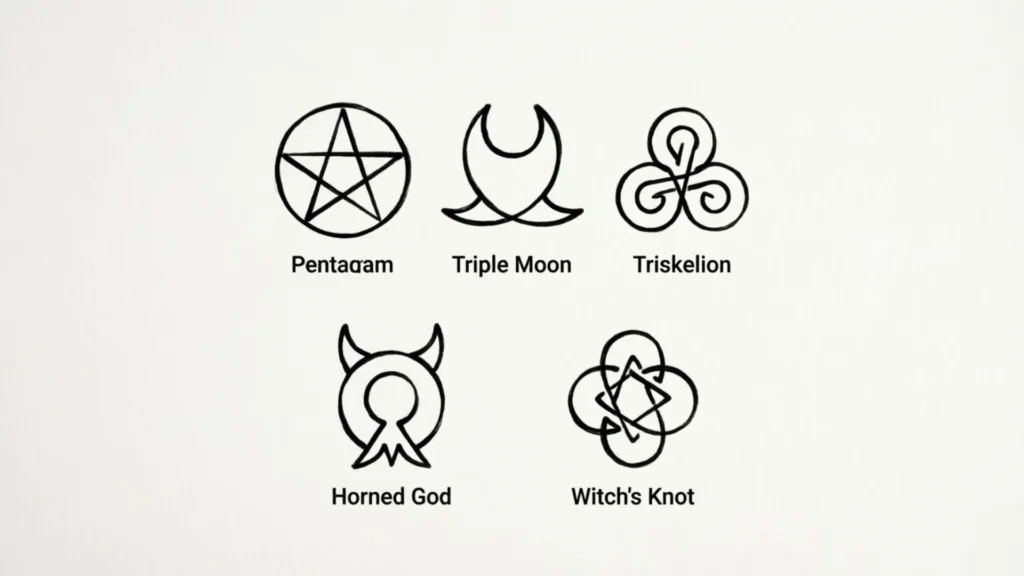
1. Pentacle
In many modern Wiccan interpretations, the five points correspond to Earth, Air, Fire, Water, and Spirit. The surrounding circle can suggest unity, wholeness, cycles, or the interconnected nature of these forces.
You may see pentacles on necklaces, altar objects, ritual tools, artwork, and tattoos.
The exact interpretation can differ between traditions, so it is better to think of these meanings as common associations rather than universal rules.
2. Pentagram
The symbol has a much longer history than Wicca. Different cultures and traditions have used five-pointed stars for different purposes.
Its orientation can also affect interpretation.
It is important not to automatically label an inverted pentagram as “evil.” Its meaning depends heavily on the tradition and context in which it appears.
3. Pentacle vs Pentagram
The difference is simple:
- Pentagram: five-pointed star without a surrounding circle.
- Pentacle: commonly a pentagram enclosed within a circle.
The circle is significant because it changes the visual structure and often reinforces ideas of wholeness, containment, unity, and interconnectedness.
4. Triple Moon
The Triple Moon is usually shown as three lunar phases: waxing crescent, full moon, and waning crescent.
It is strongly associated with modern Goddess spirituality and is commonly interpreted through the Maiden, Mother, and Crone framework.
The three phases can symbolize:
- Growth
- Fullness
- Decline and renewal
- Birth, life, and death
- Change and recurring cycles
The symbol is especially popular in jewelry and tattoos because its meaning combines femininity, lunar energy, transformation, and the natural rhythm of life.
The Maiden-Mother-Crone interpretation is a modern spiritual framework and should not be presented as a universal belief held by every Wiccan.
5. Horned God
The Horned God is an important form of divine symbolism in many Wiccan traditions.
He is often associated with wilderness, animals, hunting, fertility, masculinity, vitality, and the natural world.
The horns are generally symbolic of connection with animals and nature rather than an indication of the Christian Devil.
Different Wiccan traditions understand the Horned God differently. Some view him as a particular deity, while others understand him as an aspect of a broader divine polarity.
6. Wheel of the Year
The Wheel of the Year represents the recurring cycle of the seasons.
Many Wiccans and other modern Pagans observe eight seasonal festivals, commonly known as:
- Samhain
- Yule
- Imbolc
- Ostara
- Beltane
- Litha
- Lughnasadh or Lammas
- Mabon
These festivals connect spiritual practice with changes in nature, agriculture, daylight, and seasonal transitions.
The exact way each festival is celebrated depends on the tradition and individual practitioner.
7. Goddess Symbolism
Goddess symbolism is central to many forms of Wicca, although Wiccan theology varies widely.
The Goddess may be associated with the Moon, Earth, fertility, intuition, creation, wisdom, and the feminine aspects of nature.
There is no single universal “Goddess symbol.” Instead, practitioners may use the Triple Moon, crescent moons, spirals, lunar imagery, or representations of particular goddesses.
8. Spiral
The spiral is a powerful symbol of movement, growth, cycles, and transformation.
Its continuous shape can suggest that life does not always move in a straight line. Instead, experiences can repeat while still bringing change and development.
Spiral imagery can therefore work well in Wiccan artwork, meditation spaces, altar decorations, and personal symbols of spiritual growth.
9. Triskele or Triple Spiral
The triskele, also called a triple spiral in some contexts, consists of three connected spiraling forms.
It has historical associations that predate Wicca, especially in ancient European archaeological contexts and later Celtic symbolism.
In modern Pagan settings, it can be interpreted through ideas such as:
- Cycles
- Movement
- Growth
- Threefold patterns
- Life, death, and renewal
Because of its wider history, it is more accurate to call it a Pagan or Celtic-associated symbol used by some Wiccans, rather than an exclusively Wiccan creation.
10. Triquetra
The triquetra is a three-pointed, interwoven knot-like design.
It has appeared in different historical and religious contexts, including Celtic-associated artwork and Christian symbolism.
Modern Wiccans and Pagans may interpret it as representing interconnectedness, threefold relationships, cycles, or spiritual unity.
Its meaning therefore depends on the context in which it is being used.
Wiccan Element Symbols and Their Meanings
The five elements are among the most important concepts in modern Wiccan symbolism.
They are commonly identified as Earth, Air, Fire, Water, and Spirit.
The elements are not simply the physical substances described by modern science. Within Wiccan and related magical traditions, they function as symbolic categories representing different qualities of experience and nature.
Earth
Earth commonly represents:
- Stability
- Grounding
- Physical existence
- Growth
- Patience
- Material concerns
Earth symbolism may appear through stones, soil, plants, trees, mountains, crystals, or green and brown imagery.
A person using Earth symbolism might associate it with feeling grounded, steady, and connected to the physical world.
Air
Air is often associated with:
- Thought
- Communication
- Knowledge
- Movement
- Ideas
- Mental clarity
Birds, feathers, wind, clouds, and open skies can all be used as imagery connected with Air.
Air symbolism can be particularly meaningful when someone is focusing on learning, communication, creativity, or clearer thinking.
Fire
Fire commonly represents:
- Energy
- Passion
- Courage
- Willpower
- Transformation
- Action
Candles and flames are common forms of Fire imagery in ritual settings.
Fire can symbolize the ability to transform something old into something new, making it a natural symbol for personal change.
Water
Water is often associated with:
- Emotion
- Intuition
- Cleansing
- Healing
- Adaptability
- Reflection
The ocean, rivers, rain, shells, and water-filled ritual vessels can all carry Water symbolism.
For many practitioners, Water represents the emotional and intuitive side of spiritual life.
Spirit
Spirit is sometimes treated as the element that connects or transcends the other four.
It can represent:
- Unity
- Consciousness
- Divine connection
- Spiritual awareness
- The unseen
- Wholeness
Not every Wiccan tradition uses exactly the same elemental system or symbolism, so interpretations can differ.
Wiccan Moon and Sun Symbols
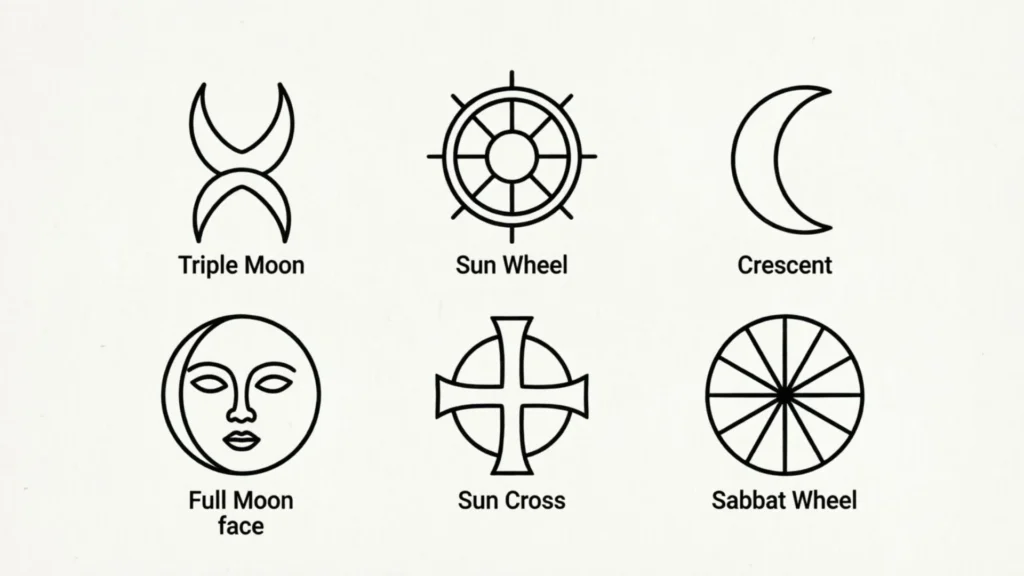
The Moon and Sun are especially important in Wiccan and modern Pagan symbolism because they reflect natural cycles.
Waxing Moon
The waxing Moon is commonly associated with growth, development, attraction, building energy, and moving toward a goal.
It can serve as a symbolic reminder that progress often happens gradually.
Full Moon
The Full Moon represents fullness, visibility, completion, and heightened lunar symbolism.
Many Wiccan traditions place particular importance on full-moon rituals, although practices vary.
Waning Moon
The waning Moon is often associated with release, reflection, rest, reduction, and letting go.
For someone using Moon symbolism personally, it can represent clearing away habits or situations that are no longer useful.
Sun Symbol
The Sun can symbolize life, vitality, energy, strength, warmth, and illumination.
Sun imagery may also connect with seasonal celebrations and solar cycles.
A simple circle with rays is one of the most recognizable ways to represent solar energy.
Wiccan Ritual Symbols and Tools
Some things commonly called “Wiccan symbols” are actually ritual tools.
These objects can have symbolic meanings, but they are not necessarily symbols in the same sense as the pentacle or Triple Moon.
Athame
An athame is a ritual knife used in some Wiccan traditions.
It is generally associated with directing intention or symbolic energy rather than ordinary cutting.
Its meaning and ritual use vary between traditions.
Chalice
The chalice is a ritual cup often associated with Water.
It can symbolize receptivity, emotion, the feminine principle, or sacred union.
In some Wiccan rituals, the chalice and athame may be brought together symbolically to represent complementary forces.
Wand
A wand can be used to symbolically direct intention or energy during ritual.
Different practitioners may associate it with Air, Fire, or other elemental correspondences depending on their tradition.
The important point is that there is no single universal correspondence used by everyone.
Cauldron
The cauldron is strongly connected with transformation, creation, mystery, and rebirth.
Its symbolism is partly connected to the image of a vessel that changes what is placed inside it.
It may also be used practically in certain rituals, although many modern practitioners use it mainly as a symbolic altar object.
Besom
A besom is a ritual broom commonly associated with cleansing and purification.
In symbolic use, sweeping a space with a besom can represent clearing away unwanted energy or creating a fresh beginning.
Wiccan Symbols by Meaning
People often search for a Wiccan symbol because they already know the meaning they want to express.
There is no official universal symbol for every intention, but some symbols have common modern associations.
Protection
The pentacle is one of the most commonly associated Wiccan symbols for protection.
Other protective imagery may include circles, protective knotwork, elemental symbols, or personally meaningful signs.
Protection symbolism is generally about intention and spiritual practice. It should not be treated as a guaranteed physical shield or substitute for real-world safety measures.
Love
For love, practitioners may choose:
- Rose imagery
- Heart symbols
- Venus-associated symbolism
- Goddess imagery
- Moon symbolism
- Interlocking circles
The best symbol depends on whether the intended meaning is romantic love, self-love, friendship, fertility, or emotional connection.
Strength and Courage
Symbols of Fire, the Sun, the Horned God, oak trees, lions, and other strong natural imagery may be used to represent courage and resilience.
The Sun is especially suitable when the intended message is vitality, confidence, or inner strength.
Healing and Renewal
Healing symbolism may include:
- Water
- Spirals
- Moon cycles
- Green plants
- Herbs
- Seeds
- The cauldron
These symbols can represent restoration, renewal, emotional recovery, and the natural process of change.
They should be understood as spiritual or symbolic representations rather than medical treatments.
Growth and Transformation
The spiral is particularly effective as a symbol of personal growth.
The Wheel of the Year and changing Moon phases can also represent transformation because they remind us that life moves through recurring stages.
For a personal symbol, combining a spiral with a leaf, Moon, or seasonal imagery can create a meaningful representation of growth.
Wiccan Symbols for Tattoos and Jewelry
Wiccan symbols are popular choices for tattoos because many have strong meanings while remaining visually simple.
The pentacle, Triple Moon, crescent Moon, spiral, elemental symbols, Sun, and Wheel of the Year can all be adapted into tattoo designs.
Meaningful Tattoo Ideas
A tattoo can be based on the personal meaning you want to express:
| Personal Meaning | Symbol Ideas |
| Protection | Pentacle, circle |
| Feminine spirituality | Triple Moon, Goddess imagery |
| Personal growth | Spiral, tree, Moon cycle |
| Strength | Sun, Fire, Horned God imagery |
| Nature | Leaves, Earth symbolism, seasonal wheel |
| Emotional healing | Water, Moon, spiral |
| Balance | Pentacle, paired elemental imagery |
| Transformation | Cauldron, spiral, changing Moon |
A symbol does not need to be complicated to be meaningful. Often, a simple design is easier to understand and has more lasting visual appeal.
What to Check Before Getting a Symbol Tattoo
Before choosing a Wiccan or Pagan symbol permanently, research its history.
Ask:
- Is it specifically Wiccan?
- Does it have an older cultural or religious origin?
- Does it have multiple meanings?
- Could its modern meaning differ from its historical meaning?
- Am I comfortable with how other people might interpret it?
This is particularly important with symbols such as the pentagram, triquetra, ankh, and triskele because they have histories that extend beyond modern Wicca.
How to Identify an Unknown Wiccan Symbol
If you find an unfamiliar symbol on jewelry, an altar, artwork, or a tattoo, do not rely only on its appearance.
Look at Its Shape
Start with basic visual features.
Is it:
- A five-pointed star?
- Three Moons?
- A spiral?
- A knot?
- A circle?
- A crescent?
- A cross-like design?
- An elemental shape?
Small differences can completely change the identity of a symbol.
Check Its Historical Context
Next, investigate where the symbol comes from.
A symbol may have:
- Ancient Egyptian origins
- Celtic associations
- Greek or Roman history
- Christian history
- Medieval European connections
- Modern occult origins
- Modern Wiccan usage
Knowing the history prevents you from incorrectly calling every symbol “Wiccan.”
Compare Modern and Original Meanings
A symbol can have an older meaning and a newer spiritual interpretation.
For example, a symbol may have originated thousands of years ago but now be used by modern Pagans with a different emphasis.
Both facts can be true.
This is why good symbol research should explain origin, modern interpretation, and context rather than providing one simple definition.
Common Misconceptions About Wiccan Symbols
Is the Pentacle Evil?
No. The pentacle is not inherently evil.
In many Wiccan contexts, it represents the five elements, balance, nature, and spiritual symbolism.
Is Every Pagan Symbol Wiccan?
No.
Paganism covers many traditions, while Wicca is one modern Pagan religion.
Some symbols overlap between traditions, while others are specific to particular groups or historical cultures.
Are Wiccan Symbols Ancient?
Some symbols used by Wiccans have ancient roots, but Wicca itself is modern.
This distinction matters.
It is more accurate to say that Wiccans adopted, adapted, or incorporated certain older symbols into a modern religious framework.
Are Wicca and Witchcraft the Same?
No.
Wicca is a religious tradition, while witchcraft is a broader practice or set of practices that can exist inside or outside Wicca.
A person can practice witchcraft without identifying as Wiccan, and not every Wiccan necessarily practices witchcraft in the same way.
Frequently Asked Questions
What is the most famous Wiccan symbol?
It commonly represents the five elements and ideas such as balance, unity, and spiritual connection.
What is the difference between a pentagram and a pentacle?
A pentagram is a five-pointed star. A pentacle commonly refers to a pentagram enclosed within a circle.
What does the Triple Moon mean?
It can symbolize cycles, femininity, transformation, and the changing nature of life.
What are the five Wiccan elements?
The five commonly recognized elements are Earth, Air, Fire, Water, and Spirit. They represent symbolic qualities and relationships rather than simply the physical substances described by modern science.
What is the Wiccan symbol for protection?
The pentacle is one of the most common symbols associated with protection in modern Wiccan practice. Circles and other personally meaningful protective symbols may also be used.
Is the Ankh a Wiccan symbol?
The ankh is primarily an ancient Egyptian symbol, traditionally associated with life. It is not originally a Wiccan symbol, although some modern Wiccans and Pagans may use it in spiritual practice.
Is the Triquetra a Wiccan symbol?
has a broader historical background, including Celtic-associated and Christian contexts.
Can non-Wiccans wear Wiccan symbols?
Generally, wearing a symbol does not automatically make someone a member of a religion. However, it is respectful to understand the history and meaning of a symbol before using it, particularly when it has specific cultural or religious significance.
Are all witches Wiccan?
No. Witchcraft is broader than Wicca. Some witches are Wiccan, while others follow different Pagan, folk, ceremonial, or personal spiritual traditions.
What symbol represents Wiccan nature spirituality?
There is no single official symbol for nature spirituality, but the pentacle, Earth imagery, spirals, trees, leaves, seasonal symbols, Moon phases, and the Wheel of the Year are commonly suitable representations.
What is the Wiccan symbol for love?
There is no universal official Wiccan love symbol. Rose imagery, hearts, Goddess symbolism, Moon imagery, and other symbols connected with affection and relationship can be used depending on personal intention.
What is the Wiccan symbol for healing?
Water, spirals, plants, Moon cycles, and symbols of renewal are often used to represent healing and restoration. These meanings are symbolic and should not be confused with medical treatment.
Conclusion
Understanding Wiccan symbols and meanings is about more than memorizing a list of shapes. Each symbol has a story, and that story may include ancient history, modern Pagan interpretation, Wiccan ritual, nature spirituality, or personal meaning.
The pentacle remains one of the strongest symbols associated with modern Wicca, while the Triple Moon highlights lunar cycles and Goddess spirituality. The Wheel of the Year connects spiritual practice with seasonal change, and the five elements provide a symbolic framework for Earth, Air, Fire, Water, and Spirit.
At the same time, symbols such as the ankh, triquetra, triskele, and pentagram remind us why historical context matters.
If you are choosing a symbol for an altar, necklace, artwork, or tattoo, focus on what the symbol means to you, where it comes from, and how different traditions understand it. That approach will help you choose symbolism that is not only beautiful but also informed and meaningful.

Adam Sullivan is a dedicated writer who enjoys transforming everyday topics into engaging and informative content. His writing focuses on making complex ideas simple, practical and enjoyable for readers of all backgrounds. Adam is also the fictional author of The Lantern Beyond Autumn Hills and Where the Morning Horizon Waits. Outside of writing, he enjoys photography, traveling and discovering inspiration through new experiences. He believes great content should be both helpful and easy to connect with.