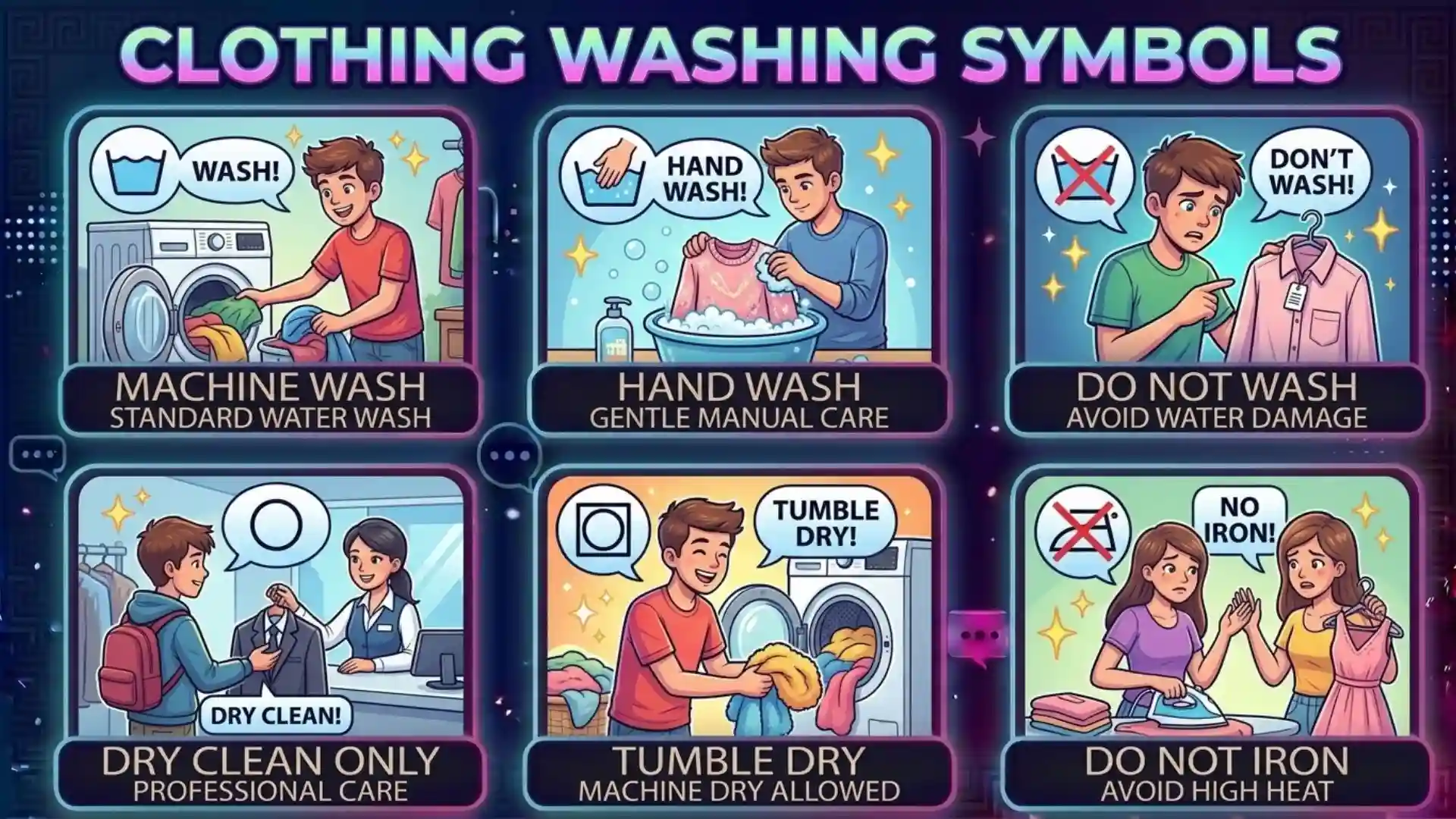
Clothing washing symbols tell you how to clean your clothes without damaging the fabric. These small pictures on garment labels explain whether you can use a washing machine, which water temperature to choose, whether bleach is safe, and how to dry or iron an item. Once you understand them, you can make better laundry decisions without guessing.
The five main categories of clothing care symbols are washing, bleaching, drying, ironing, and professional textile care. Each category has its own basic shape. A washtub represents washing, a triangle represents bleaching, a square represents drying, an iron represents ironing, and a circle represents professional cleaning. Additional marks, such as numbers, dots, lines, and crosses, provide more specific instructions.
This guide explains clothing washing symbols in simple English, with an easy-to-follow chart, practical examples, and answers to common laundry questions. Whether you’re washing a cotton T-shirt, a wool sweater, delicate silk, or everyday jeans, you’ll learn how to read the care label and choose a suitable cleaning method.
Clothing Washing Symbols Chart
The fastest way to understand a clothing care label is to identify its symbols before you start washing. The following chart explains the main symbol families and what you should do when you see them.
| Symbol or marking | Meaning | What to do |
| Washtub | Washing instructions | Check the temperature and washing method. |
| Washtub with a number | Maximum washing temperature | Do not exceed the stated temperature. |
| Washtub with a hand | Hand washing | Wash gently by hand according to the label. |
| Washtub with one underline | Mild washing process | Choose a gentler cycle with reduced mechanical action. |
| Washtub with two underlines | Very mild washing process | Use an extra-gentle cycle when machine washing is permitted. |
| Crossed-out washtub | Do not wash | Avoid washing and follow the remaining care instructions. |
| Triangle | Bleaching instructions | Check whether bleaching is permitted. |
| Triangle with diagonal lines | Restricted bleaching | Use only the permitted type of bleach under the applicable system. |
| Crossed-out triangle | Do not bleach | Avoid bleaching agents. |
| Square | Drying instructions | Check the marks inside the square. |
| Square with a circle | Tumble drying | Use a machine dryer only at the permitted heat level. |
| Square with a circle and one dot | Low-heat tumble drying | Select a low-heat dryer setting. |
| Square with a circle and two dots | Medium-heat tumble drying | Select the permitted medium-heat setting. |
| Crossed-out tumble-drying symbol | Do not tumble dry | Choose an appropriate alternative drying method. |
| Square with a curved line at the top | Line drying | Hang the garment to dry. |
| Square with three vertical lines | Drip drying | Allow water to drain naturally without wringing. |
| Square with a horizontal line | Flat drying | Lay the garment flat to dry. |
| Iron with one dot | Low-temperature ironing | Use a low heat setting. |
| Iron with two dots | Medium-temperature ironing | Use a medium heat setting. |
| Iron with three dots | High-temperature ironing | Use high heat only if the label permits it. |
| Crossed-out iron | Do not iron | Avoid ironing the garment. |
| Circle with letters | Professional cleaning instructions | Show the label to a professional cleaner when needed. |
| Crossed-out circle | Do not dry-clean | Avoid the prohibited dry-cleaning process. |
These descriptions follow the general logic of recognized textile-care labeling systems. Exact markings can differ between systems, so use the complete symbol and any accompanying written instructions rather than relying on a single feature. The International Organization for Standardization’s ISO 3758 framework and the US ASTM care-symbol guide provide useful references for interpreting these labels.
What Do Clothing Washing Symbols Mean?
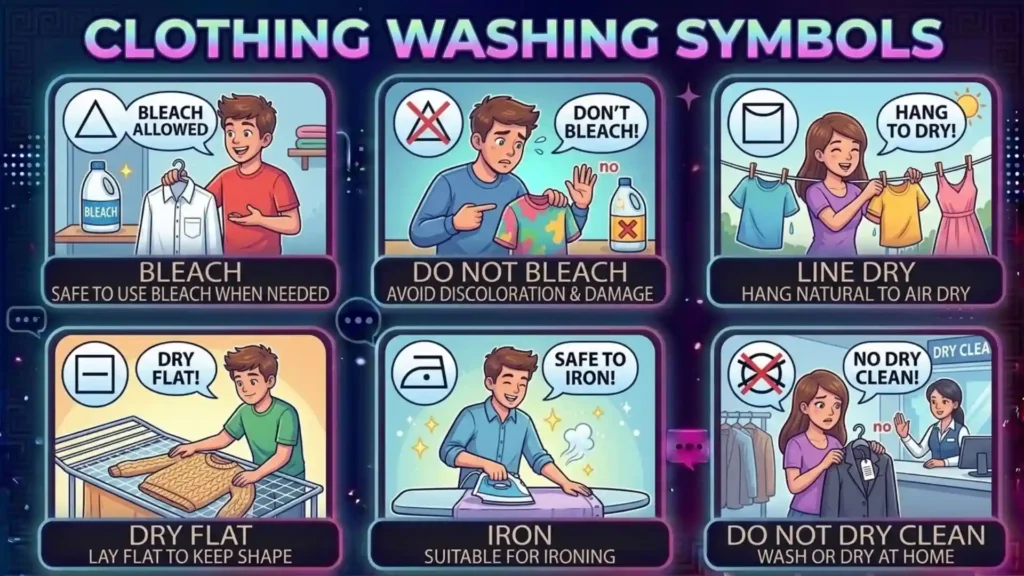
Clothing washing symbols communicate the safest permitted care process for a garment. They help you determine how much heat, water, agitation, and other treatment the fabric can tolerate.
Understanding the five main categories makes the entire label easier to read.
Washing Symbols
The washing symbol looks like a washtub filled with water.
A number inside the tub indicates the maximum washing temperature in degrees Celsius in the international symbol system. Underlines beneath the tub indicate that the garment needs a milder washing process.
Common washing instructions include:
- Washtub with 30: The maximum washing temperature is 30°C (86°F).
- Washtub with 40: The maximum washing temperature is 40°C (104°F).
- Washtub with 60: The maximum washing temperature is 60°C (140°F).
- Washtub with a hand: Hand wash the garment gently.
- Washtub with one underline: Use a mild washing process.
- Washtub with two underlines: Use a very mild washing process.
- Crossed-out washtub: Do not wash the garment using the indicated process.
The temperature number represents a limit, not a requirement to use that exact setting. If a garment permits washing at 40°C, a cooler cycle may also be suitable when it cleans the item effectively.
For example, a lightly worn cotton shirt may clean well at 30°C. A heavily soiled garment may need a different approach, but you should never exceed the temperature allowed by its label.
Bleaching Symbols
The triangle represents bleaching instructions. It tells you whether you can use bleach to help remove stains or brighten a garment.
Bleach can be useful for suitable fabrics, but the wrong product may cause fading, discoloration, or fiber damage.
Look for these common markings:
- Empty triangle: Bleaching is permitted under the applicable care-label system.
- Triangle with two diagonal lines: Only the permitted non-chlorine or oxygen-based bleach treatment is allowed in the international system.
- Crossed-out triangle: Do not bleach the garment.
An empty triangle does not mean that bleach is necessary. It means that the treatment is permitted under the relevant labeling system.
If a colored shirt has a stubborn stain but carries a crossed-out triangle, avoid using bleach. Check the detergent instructions and choose a compatible stain-removal method instead.
Drying Symbols
The square represents drying instructions. A circle inside the square indicates tumble drying, while other marks inside or around the square can describe natural drying methods.
These symbols matter because excessive heat can shrink some fabrics, damage elastic fibers, or affect decorative finishes.
Common drying instructions include:
- Square with a circle: Tumble drying is permitted, subject to the additional markings.
- Square with a circle and one dot: Low-heat tumble drying.
- Square with a circle and two dots: Medium-heat tumble drying in the international system.
- Crossed-out square with a circle: Do not tumble dry.
- Square with a curved line at the top: Line drying.
- Square with three vertical lines: Drip drying.
- Square with a horizontal line: Flat drying.
Dots in the tumble-drying symbol indicate the permitted heat level. Lines in natural-drying symbols describe how to position or hang the garment.
If a sweater needs flat drying, place it on a clean, suitable surface and reshape it gently. Hanging a wet, heavy sweater can stretch its shoulders and body.
Ironing Symbols
The iron symbol tells you whether ironing is permitted and how much heat you can use.
Different fibers and fabric finishes respond differently to heat. A setting that works for cotton may damage a delicate synthetic material.
In the international system, the dots indicate the maximum permitted ironing temperature:
- One dot: Low heat, up to approximately 110°C (230°F).
- Two dots: Medium heat, up to approximately 150°C (302°F).
- Three dots: High heat, up to approximately 200°C (392°F).
- Crossed-out iron: Do not iron.
A separate marking may prohibit steam ironing. If you see that instruction, do not assume that a low-temperature steam setting is safe.
When ironing a delicate garment, check the label first. If ironing is permitted, begin with the recommended temperature and avoid pressing decorative details directly.
Professional Cleaning Symbols
A circle indicates professional textile-care instructions. Letters inside the circle provide information about the cleaning process or permitted solvent category.
These markings are particularly relevant to tailored suits, structured jackets, delicate dresses, and other garments that may require specialist treatment.
Common examples include:
- Circle with P: Indicates a professional dry-cleaning process defined by the applicable labeling system.
- Circle with F: Indicates a particular professional dry-cleaning solvent category.
- Circle with W: Used in relevant systems to indicate professional wet cleaning.
- Crossed-out circle: Do not use the prohibited dry-cleaning process.
The letters are instructions for professional cleaners. They are not home washing-machine settings.
Professional wet cleaning is also different from ordinary household washing. It uses specialized equipment and controlled processes designed for garments that require particular care.
If your garment has professional-care instructions and you’re unsure what they mean, ask a qualified cleaner before attempting to wash it at home.
How to Read Clothing Washing Symbols Step by Step
You don’t need to memorize every symbol before doing laundry. Follow a simple sequence whenever you check a care label.
Step 1: Check the Washing Instructions
Start with the washtub symbol. Determine whether the garment can be machine-washed, needs hand washing, or must not be washed.
If the symbol contains a number, note the maximum temperature. If it has one or two underlines, choose the corresponding mild or very mild process.
Step 2: Check the Bleaching Instructions
Look for the triangle. An empty triangle generally permits bleaching under the applicable international system, while a crossed-out triangle prohibits it.
If the symbol restricts bleaching to a particular type, don’t substitute a different product without checking its suitability.
Step 3: Read the Drying Instructions
Find the square and inspect any circles, dots, lines, or crosses.
A tumble-drying symbol means the dryer may be used under the specified conditions. A crossed-out symbol means you should choose another permitted drying method.
If the label calls for line drying, drip drying, or flat drying, follow that instruction rather than guessing.
Step 4: Check the Ironing Symbol
Look at the iron and count the dots. Use the permitted temperature range, and check for any restriction on steam.
If the iron is crossed out, avoid ironing the garment.
Step 5: Review Professional-Care Instructions
Finally, check for a circle and any letters inside it. These may indicate a specific professional cleaning method.
Reading the complete label is important because a garment may be washable but unsuitable for tumble drying or ironing.
What Do the Numbers and Dots on Washing Symbols Mean?
Numbers and dots both communicate limits, but their meanings depend on the symbol that contains them.
Washing Temperature Numbers
Numbers inside the washtub indicate the maximum washing temperature in the international care-symbol system.
| Label marking | Temperature in Celsius | Approximate Fahrenheit |
| Tub marked 30 | 30°C | 86°F |
| Tub marked 40 | 40°C | 104°F |
| Tub marked 50 | 50°C | 122°F |
| Tub marked 60 | 60°C | 140°F |
| Tub marked 95 | 95°C | 203°F |
These are examples of temperatures used in international care labeling. A garment may use only some of these markings, depending on its care requirements.
A lower temperature can be suitable for lightly soiled laundry, provided the fabric and detergent are compatible with that setting. However, cooler water may not remove every stain or type of soil equally well.
Drying and Ironing Dots
Dots inside the tumble-drying and ironing symbols indicate permitted heat levels.
For tumble drying, one dot generally means low heat, while two dots indicate medium heat in the international system. Three dots may indicate a higher permitted heat level.
For ironing, one dot indicates low heat, two indicate medium heat, and three indicate high heat.
Do not treat dots as universal temperature indicators. Their meaning depends on the symbol in which they appear.
Lines Under Washing Symbols
Lines beneath the washtub indicate a gentler washing process.
- No underline: Normal washing process.
- One underline: Mild washing process with reduced mechanical action.
- Two underlines: Very mild washing process.
These marks do not replace the temperature instruction. A tub marked 30 with two underlines means that the garment needs both the specified temperature limit and a very mild washing process.
Clothing Washing Symbols for Different Fabrics
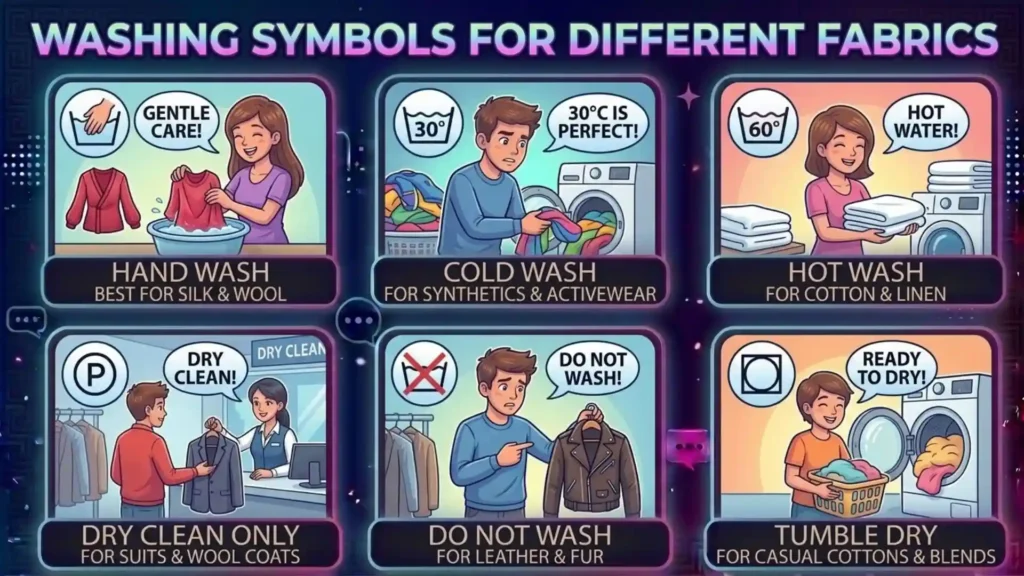
Fabric type can help you understand why a garment needs a particular care method. However, never rely on the fiber name alone. Two garments made from the same material can have different care requirements because of their construction, dye, lining, or finish.
Cotton
Cotton is commonly used for T-shirts, shirts, underwear, towels, and everyday clothing. Many cotton garments tolerate machine washing, but some may shrink or lose color under unsuitable conditions.
Check the temperature and drying symbols before washing. For colored cotton, turning the garment inside out may help reduce visible wear from friction.
If the label permits tumble drying, follow the stated heat limit. Otherwise, choose an appropriate natural-drying method.
Wool
Wool sweaters, scarves, and cardigans may shrink, stretch, or become felted when exposed to unsuitable heat and agitation.
Some wool garments can be machine-washed on a dedicated wool or very mild cycle. Others require hand washing or professional cleaning.
Follow the specific instructions on the label. If flat drying is indicated, reshape the garment gently and allow it to dry horizontally.
Silk
Silk garments may be sensitive to rough handling, unsuitable detergents, and excessive heat. Some silk items can be washed using a permitted gentle method, while others require professional care.
Check the full label before deciding whether to hand-wash or machine-wash the garment. Never assume that every silk item can safely be washed at home.
If ironing is allowed, use the indicated temperature and avoid pressing delicate decorative details.
Polyester
Polyester is used in shirts, trousers, jackets, dresses, and many blended fabrics. Although polyester garments are often suitable for machine washing, their construction and finishes can change the recommended care method.
Check the tumble-drying and ironing symbols carefully. Excessive heat can affect some synthetic fibers, prints, elastic components, and special finishes.
Denim
Denim jeans and jackets may fade with repeated washing, and some garments can shrink under unsuitable conditions.
Follow the label’s temperature and drying instructions. Avoid assuming that every pair of jeans can tolerate hot water or high dryer heat.
For dark denim, washing with similar colors and turning the garment inside out may help reduce visible color loss.
Linen
Linen is commonly used in shirts, trousers, dresses, and summer clothing. It can wrinkle easily, and some linen garments may shrink if treated incorrectly.
Check the washing temperature and ironing instructions. If ironing is permitted, use the indicated heat level and follow any additional directions.
Activewear and Stretch Fabrics
Activewear often contains stretch fibers, elastic components, printed graphics, or moisture-management finishes.
These features can be sensitive to excessive heat or unsuitable cleaning products. Follow the garment’s washing and drying symbols, and avoid applying high heat unless the label explicitly permits it.
Common Clothing Washing Symbols You Should Never Ignore
Some symbols deserve special attention because ignoring them can cause permanent damage.
Do Not Wash
A crossed-out washtub means the garment must not undergo the prohibited washing process.
Do not assume that cold water or a gentle cycle makes washing safe. Review the other care instructions to determine whether professional cleaning is required.
Do Not Bleach
A crossed-out triangle means bleaching is not permitted under the applicable system.
Avoid using chlorine bleach or other bleaching products against the label’s instructions. Choose a compatible stain-treatment method instead.
Do Not Tumble Dry
A crossed-out tumble-drying symbol means you should not use a machine dryer for the garment.
Check the rest of the label to determine whether line drying, drip drying, or flat drying is suitable.
Do Not Iron
A crossed-out iron means ironing is prohibited.
Do not assume that a very low setting will be safe. Some materials and finishes can be damaged by direct heat even when the iron is set low.
Do Not Dry-Clean
A crossed-out circle means the specified dry-cleaning process is prohibited.
It does not automatically mean that household washing is safe. Follow the remaining care instructions and ask a professional cleaner if you’re uncertain.
How to Wash Clothes Correctly Using Care Symbols
Once you understand the label, you can use the instructions to create a safer and more efficient laundry routine.
Sort Clothes Before Washing
Separate garments by color, fabric, and care requirements. Keep delicate items away from heavy garments that may cause friction.
Check pockets and close zippers or fasteners where appropriate. These small steps can help prevent damage during washing.
Choose the Right Washing Cycle
Use a normal, mild, or very mild cycle according to the label. Don’t choose a regular cycle for a garment that requires reduced mechanical action.
If the label specifies hand washing, follow that instruction rather than assuming a machine’s delicate cycle is equivalent.
Use a Suitable Water Temperature
Select a temperature that does not exceed the label’s maximum. A cooler wash may work well for lightly soiled garments, but consider the type of dirt and the detergent’s instructions.
Never increase the temperature simply because you want a faster wash.
Use Compatible Laundry Products
Choose a detergent suitable for the fabric and garment color. Check any restrictions on bleach or other cleaning products before adding them to the wash.
Using more detergent than necessary does not automatically make clothes cleaner. Follow the product’s directions.
Dry According to the Label
If tumble drying is allowed, select the permitted heat setting. If the label calls for natural drying, follow the specified method.
For garments that need flat drying, arrange them carefully and reshape them gently before leaving them to dry.
Iron Only When Permitted
Check the iron symbol before pressing the garment. Choose the permitted temperature and follow any restrictions on steam.
When the label prohibits ironing, do not experiment with a hot iron on an inconspicuous area. Use another garment-care method only if it is appropriate for the item.
Common Mistakes People Make When Reading Laundry Symbols
Even people who do laundry regularly can misread care labels. Avoid these common errors to help protect your clothes.
- Ignoring the maximum temperature: A garment marked 30°C should not be washed at 60°C.
- Confusing washing and drying symbols: A square with a circle indicates tumble drying, not washing.
- Ignoring underlines: One or two lines under a washtub indicate a milder washing process.
- Assuming every fabric needs the same care: Cotton, wool, silk, and synthetic blends may require different treatment.
- Using bleach without checking the triangle: Some garments cannot safely tolerate bleaching products.
- Choosing the highest ironing setting: The dots on the iron indicate the permitted heat level.
- Treating hand washing and machine washing as interchangeable: A hand-wash instruction requires a suitable gentle method.
- Ignoring natural-drying instructions: Hanging a garment that needs to dry flat can stretch or distort it.
- Removing the care label too early: Keeping the label makes future laundry decisions easier.
The easiest way to avoid these mistakes is to read the complete label before washing, drying, or ironing the garment.
Are Clothing Washing Symbols the Same in Every Country?
Clothing care symbols are designed to communicate care instructions across language barriers, but labeling systems are not identical everywhere.
International ISO 3758-based symbols are widely used in many markets. In the United States, the Federal Trade Commission’s Care Labeling Rule permits qualifying ASTM care symbols to be used in place of written terms when the regulatory requirements are met.
The systems share the same broad ideas, including washing, bleaching, drying, ironing, and professional care. However, some details and symbol variations differ.
If you’re reading a label on imported clothing, don’t assume that every symbol matches the system you’re used to. Consult a reliable guide for the applicable system, and follow accompanying written instructions where available.
Why Clothing Washing Symbols Matter
Care symbols are more than small pictures sewn into a garment. They help you make informed decisions about cleaning and maintaining your wardrobe.
They Help Prevent Fabric Damage
Following the label can reduce the risk of shrinkage, fading, stretching, and damage caused by unsuitable heat or cleaning products.
They Help Clothes Last Longer
Appropriate washing and drying methods can help preserve a garment’s shape, appearance, and useful life. That may also reduce the need to replace clothes because of preventable laundry mistakes.
They Make Laundry Easier
Once you recognize the main shapes, you can check a care label quickly without searching for every instruction online.
They Reduce Guesswork
Instead of assuming all shirts or sweaters need the same treatment, you can follow the instructions designed for the particular garment.
They Support Better Garment Care
Care labels provide guidance about permitted treatments. They do not guarantee that every stain will come out, but they help you choose a cleaning method that is appropriate for the item.
Frequently Asked Questions About Clothing Washing Symbols
What Are the Five Main Clothing Washing Symbols?
The five main categories are washing, bleaching, drying, ironing, and professional textile care. Their basic shapes are a washtub, triangle, square, iron, and circle. Additional markings explain temperature limits, washing intensity, and other care requirements.
What Does 30°C Mean on a Washing Label?
A washtub marked 30 indicates that the maximum washing temperature is 30°C, or approximately 86°F, in the international symbol system. It does not mean you must use exactly that temperature. A lower setting may be suitable if it cleans the garment effectively.
What Does a Crossed-Out Washing Symbol Mean?
A crossed-out washtub means you must not use the prohibited washing process. Check the remaining care instructions to determine whether the garment needs professional cleaning or another treatment.
What Do Dots on Laundry Symbols Mean?
Dots indicate heat levels in symbols such as tumble drying and ironing. One dot generally indicates low heat, two dots indicate medium heat, and three dots indicate high heat in the relevant international system. Always check which symbol contains the dots.
What Does a Square With a Circle Mean?
A square with a circle indicates tumble drying. Additional dots show the permitted dryer heat level. If the symbol is crossed out, avoid machine tumble drying.
What Does a Triangle Mean on a Clothing Label?
A triangle indicates bleaching instructions. An empty triangle generally permits bleaching under the applicable international system, while a crossed-out triangle means not to bleach. A triangle with diagonal lines restricts bleaching to the permitted type of product.
What Do One and Two Lines Under a Washing Symbol Mean?
One underline indicates a mild washing process with reduced mechanical action. Two underlines indicate a very mild process. The temperature shown in the tub still applies.
Can You Machine-Wash Clothes Marked Hand Wash?
You should follow the hand-wash instruction unless the garment’s manufacturer provides additional guidance confirming a suitable machine method. A machine’s delicate cycle may not reproduce the same treatment as careful hand washing.
What Is the Difference Between Line Dry and Drip Dry?
Line drying means hanging a garment to dry. Drip drying means allowing water to drain naturally without wringing the item. The garment’s construction and care instructions determine which method is appropriate.
Are Clothing Washing Symbols the Same in the US and UK?
The broad categories are similar, but the systems can differ in their exact symbols and details. US labels may use ASTM symbols or written instructions under applicable FTC requirements, while many other markets use ISO 3758-based care symbols.
What Should You Do If a Clothing Care Label Is Missing?
Check any remaining tags, the manufacturer’s product information, or the retailer’s care guidance. Consider the garment’s construction and fabric, but don’t rely on fiber content alone to determine a safe washing method. If the item is delicate or expensive, seek professional advice before cleaning it.
Can You Ignore a Washing Symbol If You Use Cold Water?
No. Cold water does not automatically make a prohibited washing process safe. A crossed-out washtub or other restriction should be treated seriously, regardless of the temperature you choose.
Conclusion
Clothing washing symbols make it easier to care for your clothes without relying on guesswork. Remember the five main categories: the washtub for washing, the triangle for bleaching, the square for drying, the iron for ironing, and the circle for professional textile care.
Pay attention to numbers, dots, underlines, and crossed-out marks because these details explain the limits of each cleaning process. Always read the complete label before washing, drying, or ironing a garment. A few seconds spent checking the instructions can help you avoid preventable damage and keep your favorite clothes looking their best.

Dylan Anderson is a writer who enjoys turning complex topics into simple, engaging content that readers can actually use. His work focuses on clear explanations, practical insights and storytelling that feels natural and relatable. He is also the fictional author of The Quiet Compass of Ashford and Where the Cedar Lantern Glows. When he’s away from his keyboard, Dylan enjoys hiking, reading, and discovering inspiration in everyday life. He believes great writing should be informative, easy to understand and enjoyable from beginning to end.
 Adam Sullivan