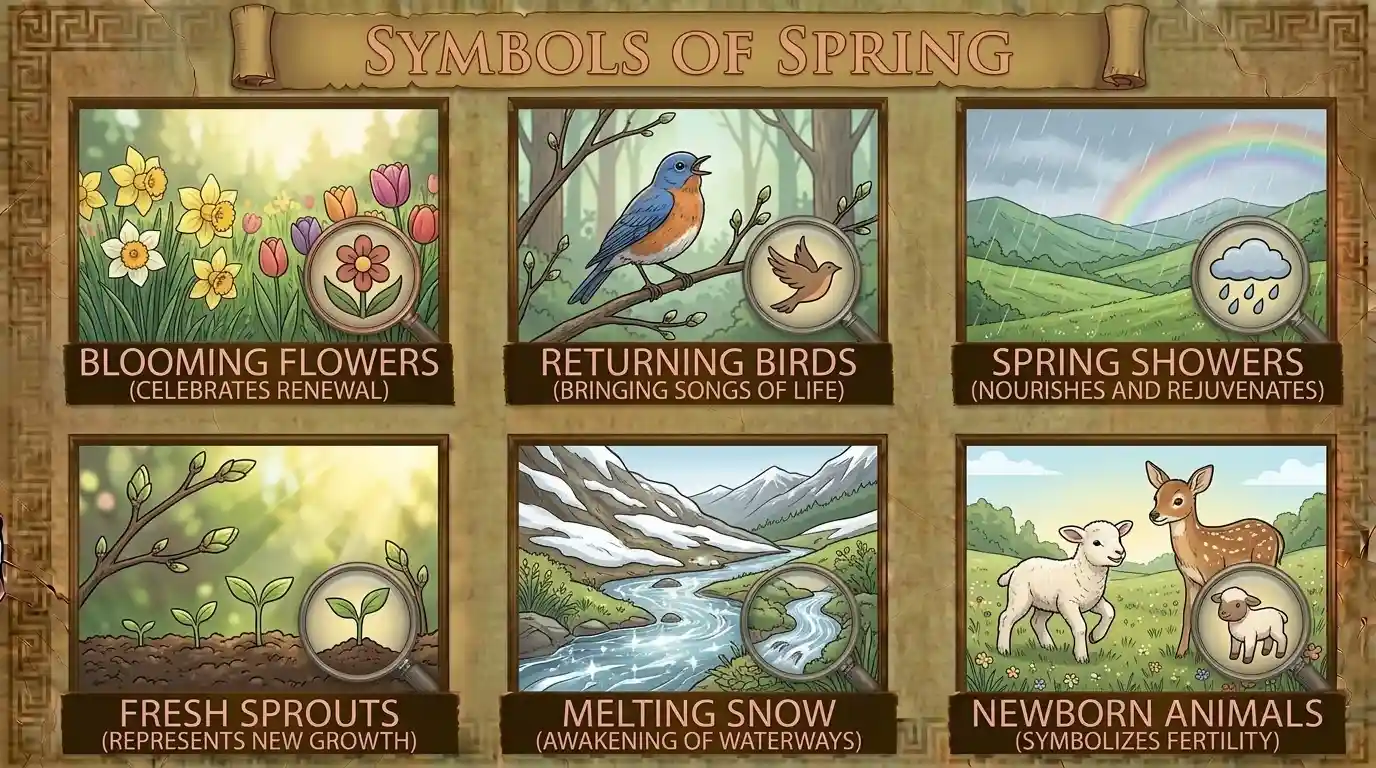
Spring is one of the most recognizable symbols of new life, renewal, growth, and fresh beginnings. As winter fades, flowers bloom, trees produce new leaves, birds become more active, and gardens begin to grow again. Because of these visible changes, people have used spring imagery to express hope, transformation, fertility, beauty, and the return of life.
Common symbols of spring include flowers, seeds, green leaves, butterflies, birds, rabbits, eggs, rain, sunshine, gardens, and the spring equinox. Some are natural signs that spring has arrived, while others gained symbolic meanings through religion, mythology, art, literature, and cultural traditions.
There is no single universal meaning for every spring symbol. A flower may represent renewal in one context, beauty in another, and a specific religious idea in another. Understanding that difference makes spring symbolism more interesting and accurate.
What Are the Symbols of Spring? (Quick Answer)
The most common symbols of spring include:
- Flowers — renewal, beauty, and new life
- Seeds — potential, beginnings, and growth
- Green leaves — life, freshness, and vitality
- Butterflies — transformation and change
- Birds — return, freedom, and seasonal renewal
- Rabbits — fertility, abundance, and new life
- Eggs — potential, birth, and rebirth
- Rain — nourishment and growth
- Sunshine — warmth, energy, and awakening
- Garden — cultivation, abundance, and life
- Rainbow — hope and renewal
- Spring equinox — transition and balance
- Fresh grass — growth and restored vitality
- Cherry blossoms — renewal and the temporary nature of beauty
Together, these symbols communicate one central idea: life begins to emerge and grow again after winter.
What Does Spring Symbolize?
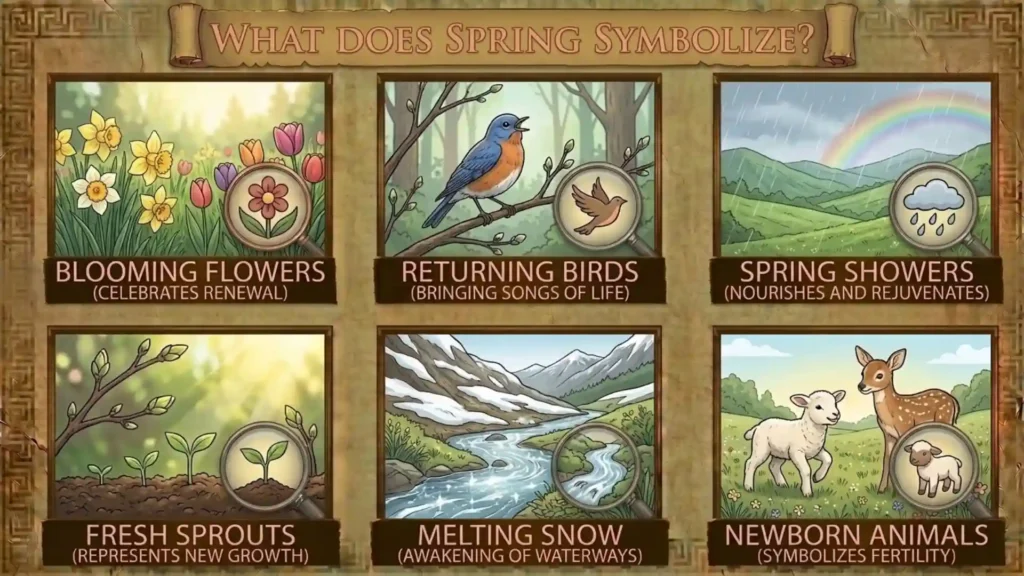
Spring is commonly associated with a transition from dormancy to visible growth. This natural change has made the season a powerful metaphor in many cultures and forms of creative expression.
Renewal and Rebirth
One of the most common meanings of spring is renewal.
During winter, many trees lose their leaves, some plants become dormant, and landscapes can appear quiet and bare. Spring brings visible signs of change. Buds open, flowers appear, and new leaves develop.
Because of this transformation, spring is often used as a symbol of returning life.
The idea of rebirth doesn’t have to mean literal birth. It can also describe a new stage in someone’s life, a renewed relationship, a fresh opportunity, or recovery after a difficult period.
New Beginnings
Spring can symbolize a fresh start.
A seed beginning to grow provides an easy metaphor for a new idea or opportunity. A flower opening can represent something moving from possibility into visible reality.
This is why spring imagery frequently appears in:
- Greeting cards
- Poems
- Paintings
- Weddings
- Journals
- Inspirational writing
- Home decoration
- Tattoos
- Personal-growth themes
Growth and Fertility
Spring is also associated with growth and fertility because plants begin producing new vegetation and many animals become active during the season.
Seeds, flowers, gardens, eggs, and rabbits can therefore appear in spring symbolism connected with fertility or abundance.
However, fertility is only one interpretation. Spring can also represent creativity, development, opportunity, and personal growth.
Hope and Transformation
After a cold or dormant season, the arrival of flowers and sunlight can naturally suggest hope.
Spring can therefore become a metaphor for moving forward:
winter → transition → growth → renewal
The butterfly adds another layer because its life cycle is commonly used as a symbol of transformation.
Symbols of Spring at a Glance
| Spring Symbol | Common Meaning | Why It Is Associated With Spring |
| Flower | Renewal and beauty | Plants begin blooming |
| Seed | Potential and beginnings | Seeds develop into new plants |
| Green leaf | Growth and vitality | Trees and plants produce new foliage |
| Butterfly | Transformation | Butterflies emerge during warmer seasons |
| Bird | Return and freedom | Many birds become more visible or migrate seasonally |
| Robin | Seasonal renewal | Often recognized as a spring bird in parts of the Northern Hemisphere |
| Rabbit | Fertility and abundance | Associated with reproduction and spring traditions |
| Egg | New life | Contains developing life and appears in spring/Easter traditions |
| Rain | Nourishment and growth | Spring rainfall supports plant growth |
| Sun | Warmth and awakening | Increasing warmth and daylight accompany spring in many regions |
| Garden | Growth and abundance | Plants are cultivated and bloom |
| Rainbow | Hope and renewal | Appears in rain and is often used positively in art |
| Equinox | Transition and balance | Marks a key astronomical seasonal point |
| Fresh grass | Vitality | New vegetation emerges |
| Cherry blossom | Renewal and fleeting beauty | Blossoms are strongly associated with spring in many places |
These meanings are common associations rather than universal rules. Cultural context can change what a symbol communicates.
15 Common Symbols of Spring and Their Meanings
Flowers
Flowers may be the most recognizable visual symbol of spring.
Their appearance marks the return of visible plant growth after winter in many temperate regions. Daffodils, tulips, crocuses, snowdrops, and cherry blossoms are especially associated with the season.
Flowers can symbolize:
- New life
- Beauty
- Renewal
- Hope
- Growth
- Love
- Fresh beginnings
Spring flowers also have different meanings depending on the species and cultural setting.
Seeds
A seed represents potential.
It may look small and inactive, but it contains the possibility of future growth. This makes seeds especially useful as metaphors for:
- New ideas
- Personal development
- Future opportunities
- Patience
- Potential
- New beginnings
A seed is therefore a useful spring symbol when the focus is not on visible results but on what is beginning beneath the surface.
Green Leaves
Fresh green leaves symbolize growth, freshness, and vitality.
After many deciduous trees lose their leaves during autumn and winter, new foliage provides one of the clearest visual signs of seasonal change.
Green leaves can also represent:
- Renewal
- Health
- Nature
- Energy
- Continuity
- Growth
Butterfly
The butterfly is widely used as a symbol of transformation.
Its life cycle makes it especially suitable for spring-themed imagery. The movement from caterpillar to chrysalis to adult butterfly provides a natural metaphor for major personal change.
In spring symbolism, a butterfly may suggest:
- Transformation
- Personal growth
- Freedom
- Change
- Emergence
- A fresh stage of life
The butterfly is therefore different from a flower. A flower emphasizes renewal and growth, while a butterfly more strongly emphasizes transformation.
Birds
Birds can represent return, movement, freedom, and seasonal awakening.
Migratory birds are particularly relevant because their arrival can be a visible seasonal event.
Bird imagery may communicate:
- Freedom
- Hope
- Return
- Movement
- New beginnings
- Connection with nature
The exact meaning depends on the bird and the cultural context.
Robin
In parts of North America and Europe, the robin is strongly associated with the changing seasons.
A robin can therefore symbolize:
- Spring’s arrival
- Renewal
- New activity
- Hope
- Return
It is important to remember that seasonal associations vary by location. A bird that signals spring in one region may not have the same significance elsewhere.
Rabbit
Rabbits and hares are often associated with fertility, abundance, and new life because of their reproductive capacity.
Their connection with spring also appears in Easter traditions. Historical explanations for Easter hare and rabbit traditions are complex, and scholars do not treat every popular explanation as established fact. The National Trust notes that the exact role of Ēostre in Anglo-Saxon traditions is uncertain, while modern Easter imagery includes hares, rabbits, eggs, and spring flowers.
The rabbit can therefore be used as a spring symbol for:
- Fertility
- Abundance
- New life
- Energy
- Seasonal renewal
Egg
The egg is a particularly clear symbol of potential and new life.
An egg contains life that has not yet emerged, making it a natural metaphor for beginnings.
Eggs also have important Easter associations. In Christian contexts, Easter imagery connects the egg with new life and resurrection. Some Christian explanations also connect the egg with the tomb and the emergence of new life.
As a general spring symbol, an egg can represent:
- New life
- Potential
- Birth
- Rebirth
- Hope
- A new beginning
Rain
Spring rain can symbolize nourishment and growth.
Rain supplies water that plants need to grow, making it a natural companion to spring flowers and green landscapes.
As a metaphor, rain may represent:
- Nourishment
- Cleansing
- Growth
- Renewal
- Preparation for new life
Rain can also have emotional meanings in art. A spring rainstorm may symbolize change before a period of growth.
Sun
The spring sun commonly represents warmth, energy, light, and awakening.
As the Northern Hemisphere moves toward summer after the March equinox, daylight increases and temperatures generally become warmer.
Sun imagery can therefore communicate:
- Energy
- Optimism
- Awakening
- Warmth
- Hope
- Life
Garden
A garden is a useful symbol because it combines several spring ideas in one image.
A garden requires planting, care, patience, and growth. It can therefore symbolize:
- Abundance
- Cultivation
- Personal growth
- New life
- Beauty
- Patience
- Reward
A garden can also represent the idea that growth requires ongoing care rather than happening automatically.
Rainbow
A rainbow can symbolize hope, beauty, and positive change.
Because rainbows appear when sunlight interacts with water droplets, they can naturally connect rain and sunlight in spring imagery.
Its meaning varies greatly by culture and context, so it is better described as a common modern symbol of hope rather than a universal spring symbol.
Spring Equinox
The spring equinox is an astronomical event associated with seasonal transition.
In the Northern Hemisphere, the March equinox marks the beginning of astronomical spring. NASA explains that an equinox occurs when the center of the Sun crosses Earth’s equatorial plane.
Symbolically, the spring equinox can represent:
- Balance
- Transition
- Renewal
- A turning point
- The movement from winter toward summer
Fresh Grass
Fresh grass provides another visual sign of renewed plant growth.
Its green color and rapid seasonal development make it useful as a symbol of:
- Vitality
- Growth
- Freshness
- Renewal
- Natural abundance
Spring Flowers and Their Meanings
Flowers deserve special attention because they are among the strongest visual representations of spring.
The Natural History Museum highlights daffodils, cherry blossom, primroses, and other blooming plants as recognizable signs of spring.
Daffodil
Daffodils are strongly associated with spring and are often used to represent:
- Renewal
- Hope
- Fresh beginnings
- Cheerfulness
- The arrival of warmer weather
Their bright yellow flowers make them especially recognizable in spring landscapes.
Google Arts & Culture describes daffodils as a common first sign of spring and notes their place in Easter traditions.
Tulip
Tulips are another classic spring flower.
Depending on context, tulips can represent:
- Beauty
- Love
- Freshness
- Spring
- Renewal
Their wide range of colors also makes them useful for communicating different emotions.
Crocus
Crocuses are among the flowers associated with early spring.
They can symbolize:
- Awakening
- Hope
- New growth
- The end of winter
Because they can appear when the landscape is still relatively bare, they make a natural metaphor for life returning after dormancy.
Snowdrop
Snowdrops are often connected with the transition from winter to spring.
Their delicate flowers appearing during cold periods can make them a symbol of:
- Hope
- Resilience
- Renewal
- Endurance
- The beginning of change
Cherry Blossom
Cherry blossoms are one of the world’s most recognizable spring images.
They can symbolize:
- Renewal
- Beauty
- Spring
- Impermanence
- The temporary nature of life
Cherry blossoms are particularly important in Japanese cultural contexts, where their seasonal blooming has inspired art, festivals, poetry, and reflection on impermanence.
It is better to discuss this cultural meaning specifically rather than claiming that every person everywhere interprets cherry blossoms in exactly the same way.
Daisy
Daisies can contribute ideas of:
- Freshness
- Innocence
- Simplicity
- Cheerfulness
Their appearance in spring gardens makes them a common seasonal decoration.
Lily
Lilies have meanings that extend beyond spring.
In Christian Easter traditions, the white lily has a particularly strong association with resurrection, purity, and hope. Google Arts & Culture identifies the white lily as a traditional Easter flower and discusses its association with resurrection.
Therefore, lily symbolism should be presented as cultural and religious symbolism, rather than as a universal meaning of spring.
Spring Animals and Their Symbolic Meanings
Animals can represent spring through both their seasonal behavior and their cultural associations.
Rabbit
Rabbit symbolism commonly focuses on fertility, abundance, and new life.
The connection is especially visible in Easter imagery, although the historical development of the Easter rabbit is more complicated than the simple claim that it is an ancient universal spring symbol.
Butterfly
The butterfly represents transformation particularly well because of its life cycle.
For spring-themed writing or artwork, it can symbolize the idea of emerging from one stage of life into another.
Robin
The robin can represent the return of life and seasonal change where it is recognized as a spring indicator.
Bee
Bees are closely connected with flowering plants and pollination.
As symbols, they can suggest:
- Activity
- Cooperation
- Productivity
- Abundance
- Connection with nature
The bee therefore adds an ecological dimension to spring symbolism.
Frog
Frogs can be associated with spring because warmer and wetter conditions can increase their activity and breeding behavior in many regions.
Symbolically, frogs can represent:
- Water
- Renewal
- Seasonal awakening
- Transformation
- Fertility
Birds
Birds can represent movement and return, particularly when migratory species return to seasonal habitats.
This makes them useful symbols for a new chapter or a return after absence.
Spring Colors and What They Represent
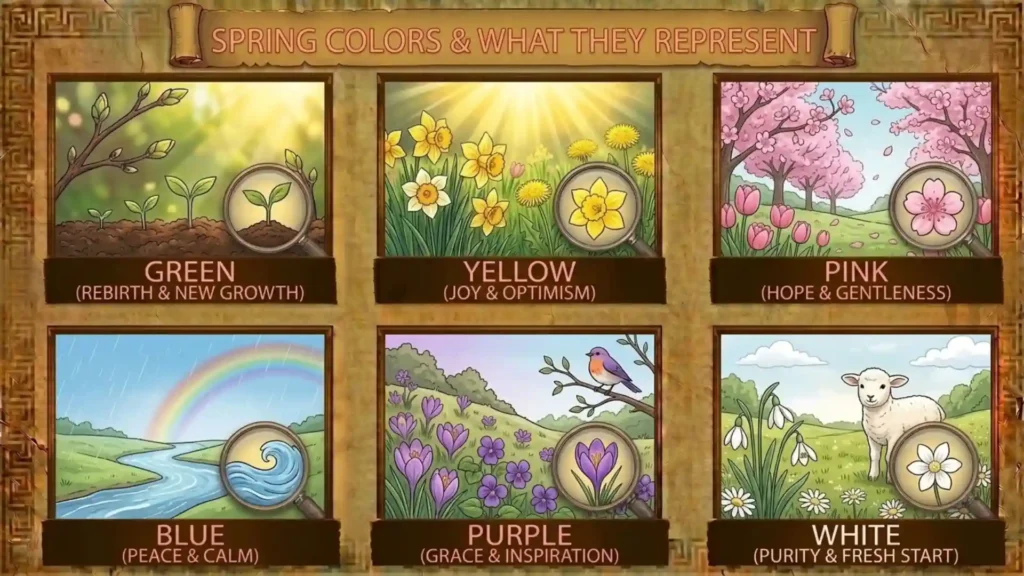
Color is another important part of spring symbolism.
Green
Green is perhaps the most obvious spring color.
It can represent:
- Growth
- Nature
- Renewal
- Freshness
- Vitality
New leaves and grass make green especially visible during spring.
Yellow
Yellow can suggest:
- Sunshine
- Energy
- Happiness
- Warmth
- Optimism
Daffodils also make yellow strongly associated with spring.
Pink
Pink appears prominently in many spring blossoms.
It may be used to suggest:
- Flowers
- Love
- Gentleness
- Youth
- Beauty
White
White can communicate:
- Freshness
- Purity
- Simplicity
- New beginnings
However, white has different religious and cultural meanings around the world.
Purple
Purple appears in flowers such as crocuses, violets, and certain tulips.
Depending on context, it can suggest:
- Beauty
- Spring flowers
- Elegance
- Spirituality
Blue
Blue can represent the spring sky and water.
In spring artwork, it can help communicate:
- Calmness
- Fresh air
- Open skies
- Rain
- Renewal
These color meanings are common creative associations rather than fixed symbolic rules.
What Does the Spring Equinox Symbolize?
The spring equinox can symbolize balance and transition because it marks a key point in Earth’s annual journey around the Sun.
An equinox occurs twice each year. During an equinox, Earth’s axis is not tilted toward or away from the Sun in the same way it is around the solstices, and the Sun crosses the equatorial plane.
The March equinox is the spring equinox in the Northern Hemisphere, while it marks autumn in the Southern Hemisphere.
Why Is It Associated With Balance?
The word “equinox” comes from Latin roots associated with equal night. However, day and night are not precisely equal everywhere on the equinox. Atmospheric refraction and the apparent size of the Sun affect the observed length of daylight.
Symbolically, however, the idea of near-balance has made the equinox useful for representing:
- Balance
- Transition
- Change
- Renewal
- A turning point
Spring Symbols in Different Cultures
Spring symbolism appears in many cultures, but different traditions developed their own meanings and practices.
Easter
In the Northern Hemisphere, Easter often falls during spring.
Modern Easter imagery commonly includes:
- Flowers
- Eggs
- Rabbits
- Chicks
- Lilies
- Spring colors
These images can overlap with general spring ideas of new life and renewal. Google Arts & Culture notes that flowers, eggs, chicks, and bunnies are used in Easter traditions to represent fresh beginnings and rebirth.
Christian Easter symbolism also has its own theological meanings, particularly around resurrection and new life. These should not be treated as identical to secular spring symbolism.
Nowruz
Nowruz, the Persian New Year, is closely connected with the arrival of spring and the vernal equinox.
Its symbolism includes ideas of:
- Renewal
- New beginnings
- Family
- Hope
- A new year
It demonstrates how the arrival of spring can become part of a broader cultural idea of starting again.
Holi
Holi is a major Hindu festival associated with color, community, and the seasonal transition into spring in South Asia.
Its meanings and traditions are diverse, so it should not simply be reduced to “a spring festival.” The religious, regional, and cultural dimensions are important.
Japan and Cherry Blossoms
Cherry blossoms are strongly associated with spring in Japan.
Their short blooming period has also encouraged reflection on impermanence and the temporary nature of beauty.
This is a useful reminder that spring symbolism can include both new life and the fact that beautiful things do not last forever.
Spring Festivals
Spring festivals around the world can focus on:
- Seasonal change
- Agriculture
- New life
- Flowers
- Community
- Renewal
- Religious observance
The shared themes do not mean these festivals all have the same history. Each tradition should be understood within its own cultural setting.
Spring Symbols in Mythology
Spring has inspired myths about seasonal cycles, vegetation, fertility, and the return of life.
Persephone and Demeter
The Greek myth of Persephone and Demeter is one of the most famous stories associated with seasonal change.
Persephone’s movement between the world above and the underworld has traditionally been connected with the cycle of vegetation and the changing seasons.
The story provides a powerful metaphor for:
- Loss and return
- Dormancy and renewal
- Seasonal cycles
- Separation and reunion
It should be understood as mythological symbolism, not as a scientific explanation for why seasons occur.
Flora
Flora was a Roman goddess associated with flowers and flowering plants.
Her association with blossoms makes her particularly relevant when discussing historical representations of spring, flowers, and fertility.
Other Spring Traditions
Different societies have developed their own stories and figures connected with:
- Agriculture
- Fertility
- Flowers
- Rain
- Sunlight
- Seasonal change
Rather than forcing all of these into one “spring mythology,” it is more accurate to recognize that they developed in different cultural environments.
What Does Spring Symbolize Spiritually?
In modern spiritual writing, spring is often interpreted as a period of renewal and awakening.
People may use spring as a metaphor for:
- Starting over
- Releasing old habits
- Personal growth
- Emotional renewal
- Hope
- Creativity
- Transformation
- Reconnecting with nature
For example, someone beginning a new chapter after a difficult period might describe their experience as “coming into spring.”
These interpretations are personal or spiritual rather than scientific. There is no single spiritual meaning that applies to everyone.
Spring Symbolism in Literature and Art
Spring has long been useful in creative work because it provides a natural metaphor for change.
Spring as Youth
Because spring comes early in the annual cycle, writers may use it as a metaphor for youth, freshness, and early stages of life.
Spring as Love
Flowers, warm weather, gardens, and birds can create romantic imagery.
Spring can therefore symbolize:
- Attraction
- New relationships
- Romance
- Emotional awakening
Spring as Hope
Spring can contrast with winter.
A writer might use bare winter branches followed by green leaves to show a character moving from hardship toward hope.
Spring as Impermanence
Cherry blossoms provide a particularly strong example.
The flowers are beautiful, but their short blooming period can symbolize the temporary nature of beauty, happiness, or life.
This creates a more complex interpretation than simply saying “spring means happiness.”
Spring Symbols for Tattoos
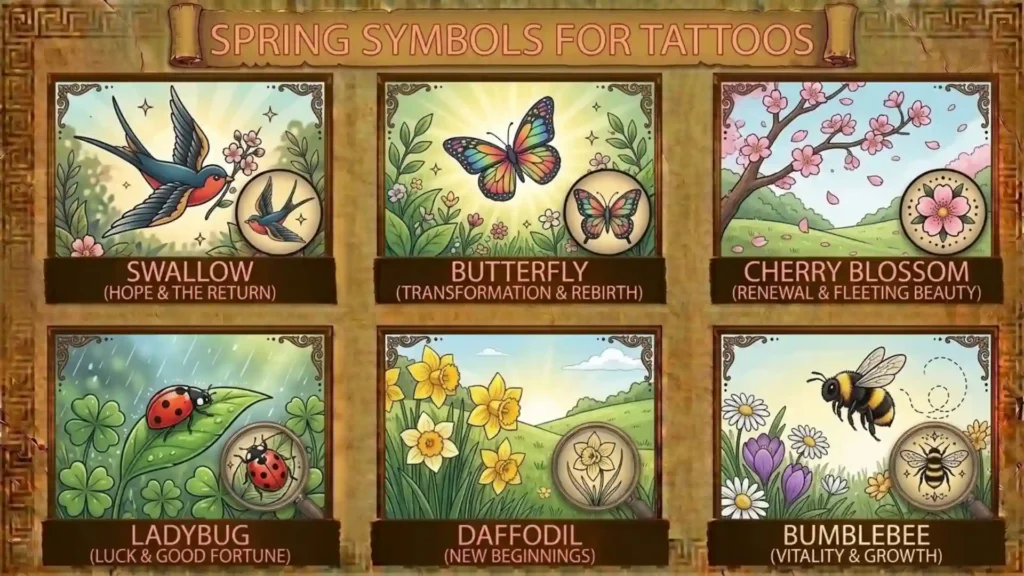
Spring symbols can work well in tattoos because many of them have recognizable visual forms.
Daffodil Tattoo
A daffodil can suggest:
- Renewal
- Hope
- New beginnings
- Spring
Butterfly Tattoo
A butterfly can represent:
- Transformation
- Personal growth
- Freedom
- Change
Cherry Blossom Tattoo
A cherry blossom can represent:
- Renewal
- Beauty
- Impermanence
- A meaningful life chapter
Seed or Sprout Tattoo
A seed or young plant can symbolize:
- Potential
- Growth
- A new beginning
- Patience
Bird Tattoo
A bird can suggest:
- Freedom
- Return
- Movement
- A new chapter
Sun Tattoo
A spring sun can represent:
- Warmth
- Energy
- Hope
- Awakening
Tattoo meanings are highly personal, so these should be viewed as possible interpretations rather than fixed definitions.
Spring Symbols for Artwork, Decor, and Gifts
Spring symbols are useful in visual design because many of them are immediately recognizable.
For a New Beginning
Consider:
- Seed
- Sprout
- Sunrise
- Flower
- Fresh leaves
For Growth
Consider:
- Tree
- Garden
- Green leaves
- Vine
- Growing plant
For Transformation
Consider:
- Butterfly
- Emerging flower
- Bird leaving a nest
For Hope
Consider:
- Daffodil
- Sunrise
- Rainbow
- Green sprout
For Love
Consider:
- Tulip
- Cherry blossom
- Flower bouquet
For Freshness
Consider:
- Rain
- Green leaves
- Blue sky
- Fresh grass
These combinations can work for greeting cards, posters, journals, invitations, home decor, and seasonal artwork.
Spring Symbols by Meaning
Sometimes readers don’t want to know what a particular object means. They already know the idea they want to express and need a symbol that fits it.
| Meaning You Want to Express | Spring Symbols to Consider |
| New beginning | Seed, sprout, flower |
| Renewal | Flower, green leaf, spring rain |
| Hope | Daffodil, sunrise, green growth |
| Transformation | Butterfly |
| Growth | Tree, leaf, garden |
| Fertility | Rabbit, egg, seed |
| Abundance | Garden, flowers, rabbit |
| Love | Tulip, blossom |
| Freedom | Bird |
| Energy | Sun |
| Balance | Spring equinox |
| Beauty | Cherry blossom, flowers |
| Freshness | Rain, leaves, grass |
| Rebirth | Egg, flower, new growth |
| Potential | Seed |
| Resilience | Snowdrop, early spring flower |
The best symbol depends on the exact message rather than on a single universal definition.
Spring Symbols vs. Signs of Spring
These two ideas are related but not identical.
Signs of Spring
A sign of spring is something that indicates the season is arriving or changing.
Examples include:
- Flowers blooming
- Trees producing leaves
- Birds returning
- Longer daylight
- Warmer temperatures
- Increased insect activity
- Fresh grass
- Spring rain
The Natural History Museum, for example, identifies blooms, blossom, and other changes in plants as recognizable signs of spring.
Symbols of Spring
A symbol of spring is an object, image, color, or idea that people use to communicate what spring means.
Examples include:
- Butterfly = transformation
- Egg = new life
- Flower = renewal
- Green = growth
- Rabbit = fertility
- Sunrise = awakening
A flower can be both a sign of spring and a symbol of spring, but the two concepts are not exactly the same.
Spring Symbols for Kids
Spring symbolism can also be explained simply for children.
- Flower: new life
- Seed: something beginning to grow
- Butterfly: change
- Egg: new life
- Rabbit: spring and new life
- Bird: return and freedom
- Sun: warmth and light
- Rain: helps plants grow
- Green leaves: new growth
- Rainbow: hope and beauty
These examples can be useful for classroom projects, spring crafts, writing assignments, and children’s artwork.
Why Is Spring Associated With Fertility?
Spring is associated with fertility because it is a season of visible growth in many parts of the world.
Plants begin producing new growth, flowers bloom, and many animals become more active.
Symbols such as:
- Seeds
- Eggs
- Rabbits
- Flowers
- Gardens
can therefore become connected with fertility and abundance.
However, spring symbolism is much broader than fertility. It can also represent creativity, hope, transformation, renewal, and personal growth.
What Does Spring Symbolize in Life?
Spring can work as a metaphor for a new stage of life.
For one person, it may represent recovery after a difficult experience. For another, it may represent starting school, beginning a relationship, moving somewhere new, or pursuing a new goal.
Common life meanings include:
- Starting over
- Growing as a person
- Leaving the past behind
- Discovering new opportunities
- Recovering hope
- Becoming more confident
- Beginning something meaningful
The central metaphor is simple:
Something that seemed dormant can begin growing again.
Is Spring Always a Symbol of Happiness?
Not necessarily.
Spring can represent happiness and hope, but it can also symbolize change, uncertainty, youth, desire, impermanence, and the passing of time.
A flower may represent new life, but it also reminds us that flowers eventually fade. Cherry blossoms are particularly useful for this more complicated interpretation.
In literature, spring can therefore represent both:
renewal and impermanence.
This makes the season more interesting than a simple symbol of happiness.
Frequently Asked Questions
What are the main symbols of spring?
The main symbols of spring include flowers, seeds, green leaves, butterflies, birds, rabbits, eggs, rain, sunshine, gardens, fresh grass, and the spring equinox. These symbols are commonly associated with renewal, growth, new beginnings, transformation, fertility, and hope.
What does spring symbolize?
Spring commonly symbolizes renewal, rebirth, growth, hope, transformation, fertility, and new beginnings. Its meaning can change according to cultural, religious, literary, or personal context.
What flower represents spring?
There is no single flower that universally represents spring. Daffodils, tulips, crocuses, snowdrops, cherry blossoms, daisies, and other seasonal flowers are strongly associated with spring in different regions and traditions.
What animal represents spring?
Rabbits, butterflies, birds, robins, bees, and frogs are commonly associated with spring. Their meanings vary. Rabbits may suggest fertility and abundance, butterflies transformation, birds return and freedom, and bees activity and pollination.
What does a butterfly symbolize in spring?
A butterfly commonly symbolizes transformation, change, growth, and emergence. Its life cycle makes it a particularly strong metaphor for moving from one stage of life into another.
Why is the egg a symbol of spring?
An egg can symbolize potential and new life because it contains developing life. Eggs also have strong Easter associations, where they can carry meanings connected with new life and resurrection.
What colors symbolize spring?
Green, yellow, pink, white, purple, and blue are commonly used in spring imagery. Green often suggests growth, yellow warmth and sunshine, pink blossoms, white freshness, and blue sky or water. These associations can vary by culture and context.
What does the spring equinox symbolize?
The spring equinox can symbolize transition, balance, and renewal. Astronomically, it is the point when the Sun crosses Earth’s equatorial plane; in the Northern Hemisphere, the March equinox marks the beginning of astronomical spring.
What does spring symbolize spiritually?
In modern spiritual interpretations, spring is often associated with awakening, renewal, personal growth, fresh starts, hope, and transformation. These are interpretive meanings rather than universal spiritual rules.
What does spring symbolize in literature?
Spring can symbolize youth, love, renewal, hope, transformation, and the return of life. Writers can also use it to explore impermanence because flowers and other seasonal features are temporary.
What symbolizes new beginnings in spring?
Seeds, sprouts, flowers, eggs, sunrise, green leaves, and the spring equinox can all represent new beginnings. A seed is especially useful when the focus is on potential, while a flower emphasizes visible renewal.
Why are rabbits associated with spring?
Rabbits and hares became associated with spring in part because of their reproductive symbolism and their presence in European Easter traditions. The historical development of Easter rabbit traditions is complex, so it is better not to claim one simple universal origin.
What is the difference between a spring symbol and a sign of spring?
A sign of spring is an observable seasonal change, such as flowers blooming or birds returning. A spring symbol is an image or object that people use to communicate an idea associated with the season, such as a butterfly representing transformation.
What are good spring symbols for tattoos?
Butterflies, flowers, cherry blossoms, seeds, sprouts, birds, suns, and daffodils can all work as spring-themed tattoo symbols. Their meanings can be personalized around growth, transformation, renewal, hope, or new beginnings.
Are spring symbols the same in every culture?
No. Some themes, such as growth and seasonal renewal, appear in many traditions, but individual symbols can have different meanings. A flower, rabbit, egg, or color may have a specific religious or cultural meaning in one setting and a broader seasonal meaning in another.
Conclusion
Symbols of spring are closely connected with the return of life, growth, renewal, and change. Flowers show visible new growth, seeds represent potential, green leaves suggest vitality, and butterflies provide a natural image of transformation.
Animals add another layer of meaning. Rabbits can suggest fertility and abundance, birds can represent return and freedom, while bees connect spring with activity and flowering plants. Eggs can represent new life, while rain and sunshine support the physical growth associated with the season.
The spring equinox adds an astronomical dimension by marking an important seasonal transition. Cultural traditions such as Easter, Nowruz, Holi, and cherry-blossom celebrations show that people around the world have developed different ways of expressing the arrival of a new season.
Ultimately, spring does not have one fixed symbolic meaning. It can represent a fresh beginning, personal growth, hope after difficulty, transformation, beauty, fertility, or the temporary nature of life. That flexibility is what makes spring symbolism useful in art, literature, celebrations, tattoos, and everyday life.

Adam Sullivan is a dedicated writer who enjoys transforming everyday topics into engaging and informative content. His writing focuses on making complex ideas simple, practical and enjoyable for readers of all backgrounds. Adam is also the fictional author of The Lantern Beyond Autumn Hills and Where the Morning Horizon Waits. Outside of writing, he enjoys photography, traveling and discovering inspiration through new experiences. He believes great content should be both helpful and easy to connect with.
 Dylan Anderson