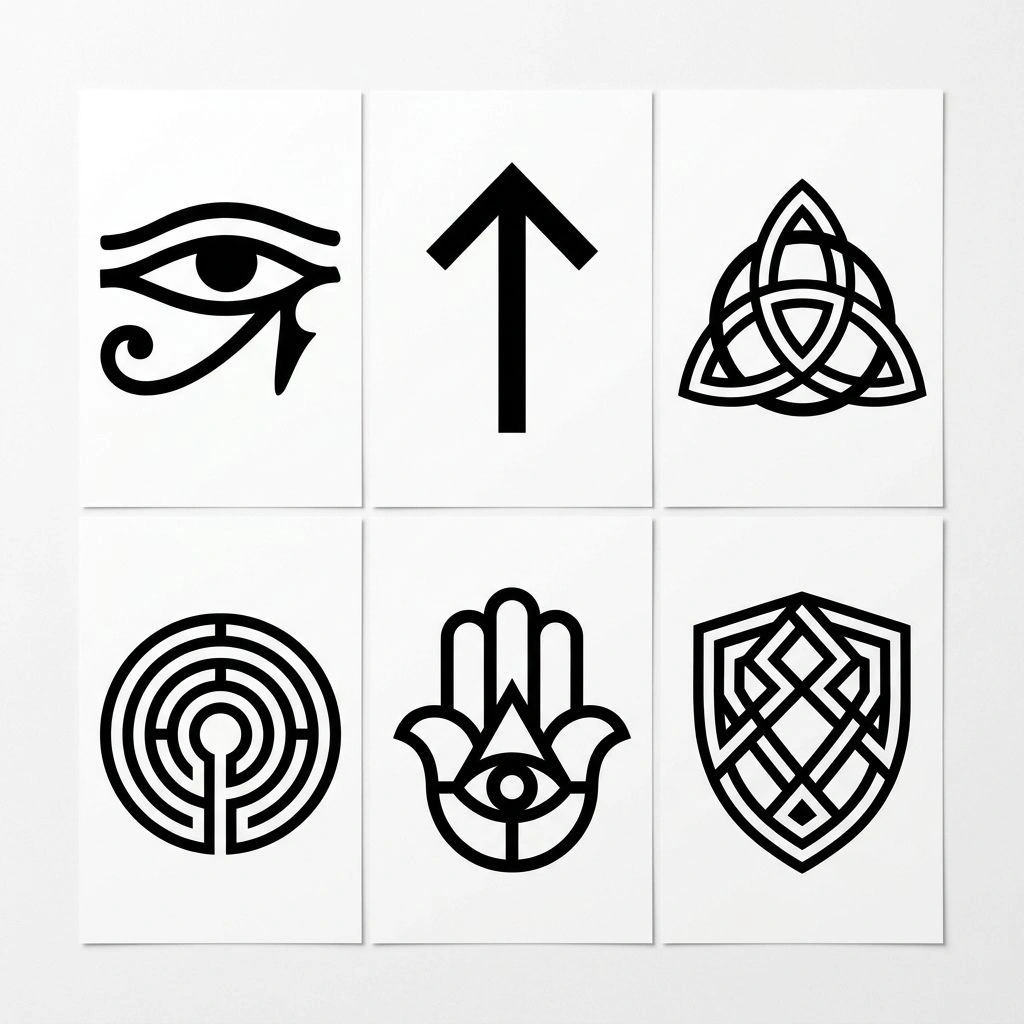
Protective symbols are signs, images, objects, and designs that people have traditionally associated with safety, protection, healing, strength, blessing, renewal, or protection from harmful influences. They appear in religious traditions, ancient amulets, jewelry, household decorations, tattoos, artwork, and personal objects.
Some of the best-known examples include the Hamsa, Nazar, Eye of Horus, Mjölnir, pentagram, Tyet, scarab, djed, and ankh. However, these symbols do not all mean exactly the same thing. Some have well-documented histories as protective amulets, while others are more strongly connected with life, healing, stability, divine power, or renewal.
That distinction matters when researching protective symbols. A symbol can have a modern protective interpretation without having originally been created for that purpose. Likewise, a symbol associated with life or healing may be included in a broader discussion of protection without being a dedicated protection sign.
This guide explains the meanings, origins, cultural contexts, and modern uses of protective symbols while separating documented historical traditions from newer personal or spiritual interpretations.
Quick Answer: What Are Protective Symbols? (Quick Answer)
Protective symbols are visual signs or objects traditionally connected with guarding against harm, providing blessing, supporting healing, expressing strength, or representing safety and divine care.
Some of the most recognizable examples include:
| Symbol | Main Meaning or Association | Common Protective Context |
| Hamsa | Protection and blessing | Protection from the evil eye |
| Nazar | Warding off the evil eye | Envy or harmful gaze |
| Eye of Horus | Healing, restoration, protection | Ancient Egyptian amulets |
| Mjölnir | Thor, strength, divine protection | Norse religious tradition |
| Tyet | Protection and Isis | Ancient Egyptian funerary protection |
| Pentagram | Varies by tradition | Spiritual protection in some traditions |
| Scarab | Rebirth and renewal | Egyptian life and afterlife symbolism |
| Djed | Stability and endurance | Ancient Egyptian symbolism |
| Ankh | Life and vitality | Ancient Egyptian religious symbolism |
| Eye of Providence | Divine watchfulness | Western religious symbolism |
The most important point is that there is no single universal protective symbol. Meaning depends on culture, religion, historical period, design, and how the symbol is being used.
What Is a Protective Symbol?
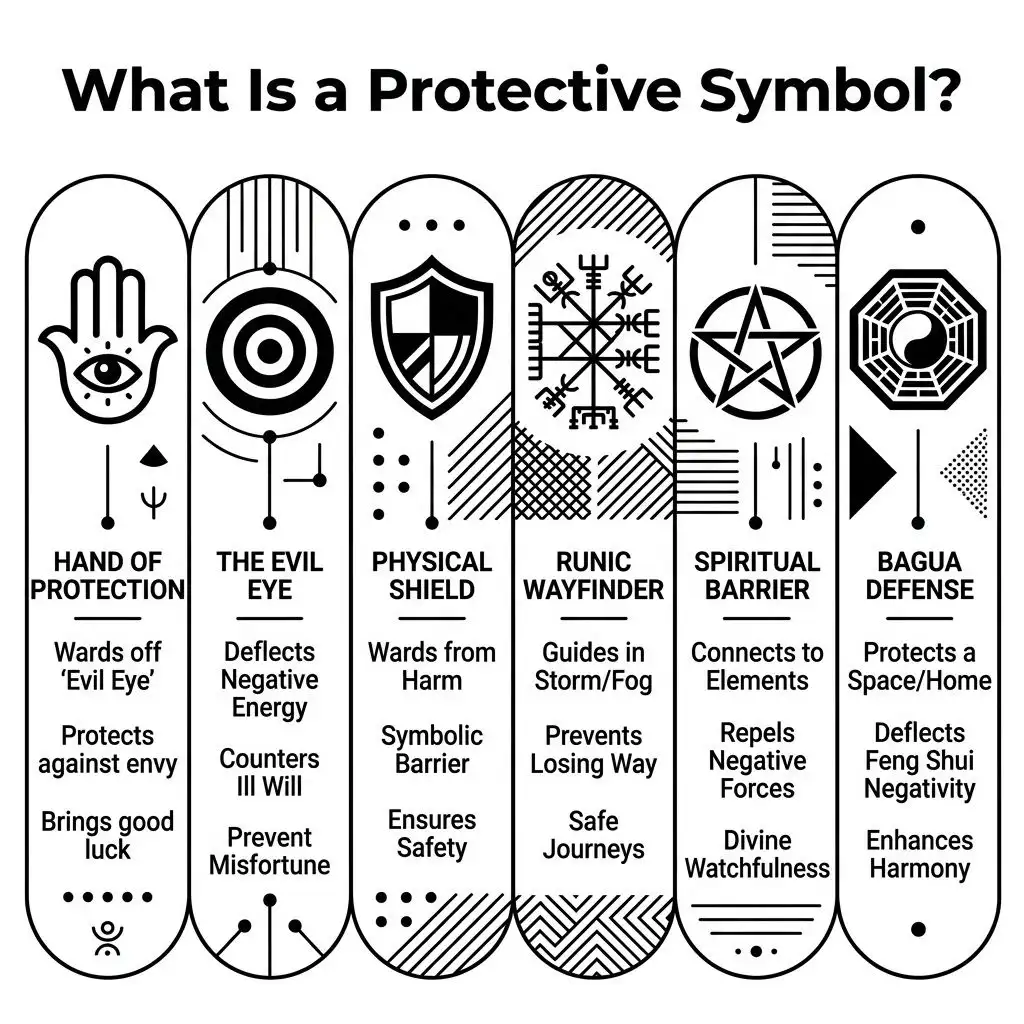
A protective symbol is an image or sign that a particular culture, religion, or community associates with protection or another closely related idea.
Protection can have many meanings.
It might refer to:
- Protection from the evil eye
- Protection from illness
- Protection during travel
- Protection of children or families
- Protection in battle
- Divine protection
- Protection in the afterlife
- Healing and restoration
- Strength against danger
- Spiritual defense
- Stability and continuity
- Protection from harmful influences
Ancient Egyptian evidence provides a clear example of how broad this idea could be. The British Museum explains that Egyptians used symbols as amulets associated with protection, power, good fortune, health, stability, life, and rebirth. These objects could be worn or used in both everyday life and funerary contexts.
Symbol, Amulet, and Talisman
These words are related but should not automatically be treated as interchangeable.
A symbol is a sign or image that communicates an idea.
An amulet is an object traditionally worn, carried, or placed somewhere because it was believed to provide protection or another beneficial effect.
A talisman generally refers to an object believed to possess a particular beneficial or protective quality.
For example, the Eye of Horus is a symbol. An ancient pendant made in the form of the Eye of Horus could function as a protective amulet.
What Is an Apotropaic Symbol?
Apotropaic is a useful historical term for something intended to avert or ward off harm or evil.
An apotropaic object might use an eye, animal, deity, gesture, inscription, or other design that people believed could help keep danger away.
Museums provide several examples. The Metropolitan Museum of Art, for instance, describes certain ancient objects as having an apotropaic function associated with warding off the evil eye.
This term is especially useful when studying ancient protective symbols because it describes the intended protective function without claiming that the object has scientifically proven supernatural powers.
Protective Symbols at a Glance
Different symbols communicate different types of protection.
Symbols Specifically Associated With Protection
The Hamsa, Nazar, Eye of Horus, and Tyet have particularly strong associations with protective traditions or amuletic use.
Symbols Associated With Strength and Defense
Mjölnir is connected with Thor, a powerful Norse god who fights giants and other threats. Thor’s hammer pendants also appear in Viking-Age archaeological collections.
Symbols Associated With Life and Renewal
The ankh is primarily associated with life, while the scarab is strongly connected with new life and rebirth. The British Museum identifies these meanings directly in its educational material on ancient Egyptian amulets.
Symbols Associated With Stability
The djed represents stability and endurance in ancient Egyptian symbolism.
Symbols Associated With Divine Watchfulness
The Eye of Providence is better understood through the concept of divine providence and watchfulness than as a universal protection amulet.
This distinction prevents very different symbols from being treated as though they all have exactly the same historical purpose.
10 Protective Symbols and Their Meanings
Hamsa: Protection, Blessing, and the Evil Eye
The Hamsa, also called the khamsa, is a hand-shaped symbol found in Middle Eastern and North African cultural contexts.
The Arabic term khamsa relates to the number five and refers to the five fingers of the hand.
The symbol has been used by different communities, and its religious and cultural meanings can vary. Museum collections document Hamsa or khamsa amulets associated with protection from the “eye of envy” or evil eye.
What Does the Hamsa Symbolize?
The Hamsa can be associated with:
- Protection
- Blessing
- Safety
- The evil eye
- Good fortune
- Cultural identity
- Spiritual or religious meaning
Its open-hand design can also suggest a visual idea of stopping or guarding against something harmful.
Hamsa as an Amulet
Historical examples show that the hand was not merely decorative.
The British Museum holds hand-shaped pendants and necklaces described as amulets used for protection against the eye of envy. The museum also notes that hand amulets have a long history in the Middle East and North Africa.
The Metropolitan Museum likewise describes the khamsa as a common talismanic element in Middle Eastern and North African jewelry and identifies its protective association with the evil eye.
Hamsa, Hand of Fatima, and Hand of Miriam
Different names may be used for hand-shaped protective symbols in different cultural and religious contexts.
Khamsa describes the hand form.
Hand of Fatima is a name used in some Islamic cultural contexts.
Hand of Miriam is used in some Jewish contexts.
It is important not to assume that every Hamsa has one identical religious meaning. Historical examples show that the symbol has appeared across different communities.
Nazar and the Evil Eye
The Nazar is commonly represented by a blue-and-white or multicolored eye design and is associated with protection from the evil eye.
The distinction between the two terms is important.
The evil eye refers to the traditional belief in harmful influence associated with a gaze, often connected with envy or ill intention.
The Nazar is a protective object associated with that belief.
What Does the Nazar Symbol Mean?
The Nazar can represent:
- Protection from the evil eye
- Defense against envy
- Watchfulness
- Safety
- Cultural tradition
- Personal protection
Its use varies across regions, and modern versions are often found in jewelry, home decorations, accessories, and gifts.
Hamsa vs. Nazar
The two symbols are related in modern protective culture but are visually different.
| Feature | Hamsa | Nazar |
| Shape | Open hand | Eye |
| Common association | Protection and blessing | Evil-eye protection |
| Traditional contexts | Middle Eastern and North African communities | Mediterranean and Middle Eastern contexts |
| Often worn as | Pendant, bracelet, charm | Bracelet, pendant, charm |
| Can appear together? | Yes | Yes |
A Hamsa may include an eye in its center, which is one reason the two symbols are often discussed together.
Why Is the Eye So Common in Protective Symbolism?
The eye naturally suggests watchfulness and observation.
In different traditions, eye imagery has been connected with awareness, divine observation, harmful gazes, or protection.
However, not every eye symbol has the same origin.
An Eye of Horus, Nazar, and Eye of Providence should not be automatically treated as variations of one ancient symbol.
Eye of Horus: Protection, Healing, and Restoration
The Eye of Horus, known in ancient Egyptian as the wedjat, is one of the best-documented protective symbols from ancient Egypt.
The Metropolitan Museum of Art describes the wedjat as the healed eye of Horus. According to the museum, the symbol embodies healing power and rebirth, while amulets in its form were believed to protect their wearers and transfer regenerative power.
What Does the Eye of Horus Represent?
Its major associations include:
- Protection
- Healing
- Restoration
- Regeneration
- Rebirth
- Well-being
- Divine power
The story behind the symbol helps explain these meanings.
In Egyptian mythology, Horus’s eye was injured or lost during conflict with Seth and later restored. The restored eye became a symbol of wholeness and renewal.
Eye of Horus as an Ancient Amulet
This is not merely a modern interpretation.
The Metropolitan Museum describes the wedjat as one of the most popular amulets in ancient Egypt. Examples were used by both living people and the dead.
The museum’s collection contains wedjat amulets dating across multiple periods of Egyptian history, demonstrating how enduring this form of protective symbolism was.
Eye of Horus and Healing
The healing association is particularly important.
The word wedjat relates to the idea of being sound or restored again. That makes the symbol different from a generic protective eye.
It connects protection with the restoration of something that has been damaged.
This is why the Eye of Horus can represent both protection and healing without treating the two concepts as identical.
Eye of Horus vs. Eye of Ra
The Eye of Horus and Eye of Ra are frequently confused because both involve Egyptian divine eye symbolism.
They should not simply be treated as two names for the same symbol.
Eye of Horus
The Eye of Horus is especially associated with:
- Horus
- Healing
- Restoration
- Rebirth
- Protection
- The wedjat amulet
Eye of Ra
The Eye of Ra is associated with the solar deity Ra and has its own mythology and meanings.
It can be connected with:
- Solar power
- Divine authority
- Protection
- Punishment or destructive force
- A feminine divine manifestation in certain myths
The exact meaning of an Egyptian “eye” therefore depends heavily on the deity, myth, and artistic context.
Tyet: The Protective Knot of Isis
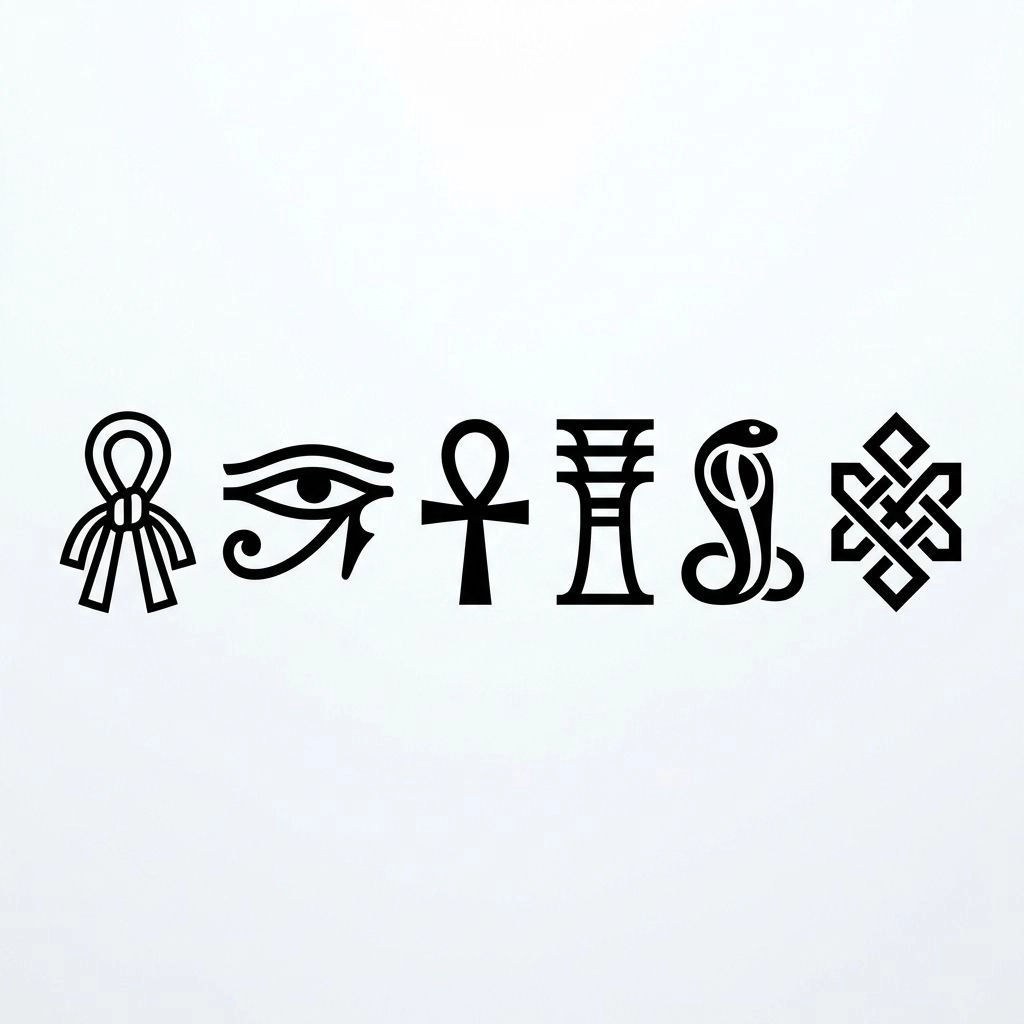
The Tyet, sometimes called the knot of Isis, is a particularly useful symbol to include when discussing ancient protection.
The Metropolitan Museum identifies the Tyet as a symbol of protection and connects it with the goddess Isis. Its New Kingdom examples were associated with protection in the afterlife.
What Does the Tyet Symbolize?
The Tyet can represent:
- Protection
- Isis
- Afterlife protection
- Divine care
- Amuletic power
The symbol resembles a knotted piece of cloth.
The connection with knots is significant in ancient Egyptian amuletic traditions. The Metropolitan Museum notes that Egyptians used knots as amulets and believed they could bind and release magical power.
Why the Tyet Matters
The Tyet is a stronger historical example of a protective symbol than vague claims about generic “protective knots.”
This is important because modern websites sometimes assign protective meanings to broad knotwork designs without enough evidence for the specific historical claim.
Mjölnir: Thor’s Hammer and Protection
Mjölnir is the hammer of Thor in Norse mythology.
Thor is associated with thunder, strength, and the defense of the gods and the world against giants and other threats.
The Swedish History Museum describes Thor as a powerful god and protector who fought giants with his hammer, Mjölnir. It also preserves Viking-Age Thor’s hammer pendants.
What Does Mjölnir Symbolize?
Mjölnir can represent:
- Strength
- Thor’s power
- Protection
- Religious identity
- Defense against threats
- Norse cultural heritage
The British Museum also describes a Viking-period Thor’s hammer pendant as an amulet that may have been associated with protection or luck.
Thor’s Hammer Pendants
Archaeological examples demonstrate that miniature Thor’s hammers were made as pendants during the Viking Age.
The Swedish History Museum notes that such finds are common and that Mjölnir was one of Thor’s most recognizable attributes.
At the same time, archaeology does not always tell us exactly why a particular person wore an individual pendant.
For that reason, it is safer to say that Mjölnir pendants were associated with Thor and may have carried protective, religious, identity, or other meanings, rather than assigning one purpose to every archaeological example.
Pentagram and Pentacle: Protection Depends on Context
The pentagram is a five-pointed star.
A pentacle commonly refers to a pentagram enclosed within a circle.
Their meanings are complicated because the five-pointed star has appeared in different historical, religious, mathematical, magical, and modern cultural contexts.
What Can the Pentagram Represent?
Depending on context, the pentagram can be associated with:
- Balance
- The elements
- Spirituality
- Religious identity
- Harmony
- Esoteric traditions
- Protection
Is the Pentagram a Protective Symbol?
In some modern spiritual and religious traditions, the pentagram or pentacle is used as a protective symbol.
However, it would be inaccurate to claim that every pentagram throughout history was created for protection.
Its meaning depends on:
- Historical period
- Orientation
- Surrounding symbols
- Religious tradition
- Cultural setting
- Modern interpretation
This is an excellent example of why symbol shape alone does not always reveal meaning.
Scarab: Rebirth and Renewal
The scarab beetle was an important symbol in ancient Egypt.
Its strongest associations are with new life, rebirth, regeneration, and renewal.
The British Museum identifies the scarab as a symbol of new life and rebirth in its educational material on ancient Egyptian amulets.
Why Is the Scarab Associated With Protection?
The scarab’s symbolism connected it with renewal and continued existence.
Ancient Egyptian beliefs about life and death were closely connected, so an amulet associated with rebirth could also have protective significance, particularly in funerary contexts.
Scarab vs. Eye of Horus
Both can appear in discussions of Egyptian protection, but their strongest meanings differ.
| Symbol | Stronger traditional association |
| Eye of Horus | Healing, restoration, protection |
| Scarab | Rebirth, renewal, new life |
| Ankh | Life |
| Djed | Stability and endurance |
| Tyet | Protection and Isis |
This distinction makes the symbolism easier to understand.
Djed: Stability and Endurance
The djed is an ancient Egyptian symbol associated with stability.
The British Museum identifies it with stability and endurance, while Metropolitan Museum educational material describes the djed sign as meaning stability and connecting it with Osiris.
What Does the Djed Represent?
The djed can symbolize:
- Stability
- Endurance
- Continuity
- Strength
- Order
Its meaning makes it relevant to protection because stability itself can be viewed as a form of security.
However, the djed should not be described simply as an ancient Egyptian equivalent of a modern “protection charm.”
Its primary symbolism is more specific.
Ankh: Life and Vitality
The ankh is one of the most recognizable ancient Egyptian symbols.
Its primary meaning is life.
The British Museum lists the ankh among Egyptian amuletic symbols and identifies its meaning as life.
What Does the Ankh Represent?
The ankh can represent:
- Life
- Vitality
- Existence
- Continuity
- Regeneration
Is the Ankh a Protection Symbol?
It is more accurate to call the ankh a symbol of life rather than a dedicated protection symbol.
However, life, health, divine favor, and protection could overlap in ancient religious contexts.
Some Egyptian amulets combined several signs and concepts. The British Museum, for example, documents an amulet combining the ankh with symbols associated with endurance and dominion.
Eye of Providence: Divine Watchfulness
The Eye of Providence is an eye, often shown within a triangle.
It is commonly associated with divine providence, God’s watchfulness, and spiritual oversight.
Is the Eye of Providence a Protective Symbol?
It can be interpreted as protective because divine watchfulness may imply divine care.
However, it is better to describe its main idea as providence and divine oversight rather than claiming that it is a universal protective amulet.
This distinction prevents confusion between religious symbolism and amuletic traditions such as the Nazar or wedjat.
Ancient Egyptian Protective Symbols
Ancient Egypt provides one of the richest bodies of evidence for protective symbolism.
The British Museum explains that Egyptians used symbolic amulets for protection, power, good fortune, health, stability, life, and rebirth. They could be painted onto objects, created as three-dimensional pieces, or worn by people during life and after death.
Eye of Horus
Associated with healing, restoration, rebirth, and protection.
Tyet
Associated with Isis and protection, particularly in funerary contexts.
Scarab
Associated with new life and rebirth.
Djed
Associated with stability and endurance.
Ankh
Associated primarily with life.
Protective Deity Amulets
Egyptians also used amulets representing deities.
The Metropolitan Museum, for example, documents an Isis amulet intended to invoke the goddess’s protection and powers for its wearer.
This shows that Egyptian protection symbolism was not limited to abstract signs. Images of gods and goddesses could also serve protective purposes.
Protective Symbols From Around the World
Protective symbolism is not limited to one civilization.
Different cultures have used different images to express safety, divine assistance, strength, healing, or defense.
Middle Eastern and North African Traditions
The Hamsa or khamsa is one of the clearest examples.
Museum collections document hand-shaped amulets used against the “eye of envy,” including examples associated with Jewish and Muslim communities.
Mediterranean and Evil-Eye Traditions
The belief in harmful effects associated with the evil eye appears across several regions and historical traditions.
Protective eye imagery and amulets developed in different forms.
The important point is that “evil eye” traditions are broader than one single country or religion.
Ancient Egyptian Traditions
Egyptian examples include the:
- Eye of Horus
- Tyet
- Scarab
- Djed
- Ankh
- Protective deity amulets
Norse Tradition
Mjölnir provides a strong example of a symbol associated with Thor, strength, defense, and Norse religious identity.
Western Religious and Esoteric Traditions
The pentagram, pentacle, and Eye of Providence have acquired different meanings in different historical and modern contexts.
They should therefore be explained with attention to the specific tradition rather than treated as universally protective signs.
What Do Protective Symbols Protect Against?
“Protection” can refer to many different things.
Protection From the Evil Eye
The Nazar and Hamsa are commonly associated with protection from the evil eye or eye of envy. Museum collections provide direct evidence for this use of hand amulets.
Protection and Healing
The Eye of Horus connects protection with healing and restoration.
Protection Through Divine Power
Symbols or amulets depicting deities can express a desire for divine assistance.
Ancient Egyptian Isis amulets are one documented example.
Strength and Defense
Mjölnir is associated with Thor’s role as a powerful defender and his battles against giants.
Protection in the Afterlife
Ancient Egyptian funerary amulets were used in contexts where people sought protection and favorable conditions beyond death.
The Eye of Horus and Tyet provide important examples.
Protective Symbols by Meaning
Instead of asking which protective symbol is “the most powerful,” it is more useful to ask what meaning you want the symbol to communicate.
Protection and Safety
Consider symbols with documented protective traditions such as:
- Hamsa
- Nazar
- Eye of Horus
- Tyet
Strength and Protection
Mjölnir is especially associated with Thor’s strength and defensive role.
Healing and Restoration
The Eye of Horus has particularly strong associations with healing and restoration.
Life and Vitality
The ankh is primarily associated with life.
Rebirth and Renewal
The scarab is strongly connected with new life and rebirth.
Stability and Endurance
The djed represents stability and endurance.
Divine Watchfulness
The Eye of Providence communicates divine oversight and providence.
This meaning-based approach is more accurate than ranking symbols according to supposed supernatural power.
Protective Symbols for Tattoos
Protective symbols are popular tattoo subjects because a person can use a permanent image to express a personal value, cultural connection, spiritual belief, or life experience.
Hamsa Tattoo Meaning
A Hamsa tattoo may represent:
- Protection
- Blessing
- Cultural identity
- Protection from the evil eye
- Personal faith
Nazar Tattoo Meaning
A Nazar tattoo may symbolize protection from envy or the evil eye within traditions that use the symbol for that purpose.
Eye of Horus Tattoo Meaning
An Eye of Horus tattoo can represent:
- Protection
- Healing
- Restoration
- Resilience
- Ancient Egyptian cultural interest
Mjölnir Tattoo Meaning
A Mjölnir tattoo can communicate:
- Strength
- Norse identity
- Connection with Thor
- Protection
- Personal resilience
Scarab Tattoo Meaning
A scarab tattoo often works well for ideas such as:
- Rebirth
- Transformation
- Renewal
- New beginnings
- Ancient Egyptian symbolism
Pentagram Tattoo Meaning
A pentagram tattoo requires more attention to context because its meaning differs among religious and spiritual traditions.
Before choosing a culturally significant tattoo, research its historical meaning rather than relying only on a modern social-media interpretation.
Protective Symbols in Jewelry
Jewelry has long provided a convenient way to carry symbolic objects close to the body.
Examples include:
- Hamsa necklaces
- Nazar bracelets
- Eye of Horus pendants
- Mjölnir pendants
- Egyptian amulets
- Scarab jewelry
- Ankh necklaces
- Pentacle jewelry
Historical museum collections demonstrate that protective symbolism was incorporated into jewelry and wearable objects.
For example, the British Museum preserves Hamsa-shaped necklaces and pendants used as amulets against the eye of envy.
The Metropolitan Museum also documents North African jewelry containing khamsa imagery associated with protection.
Why Do People Wear Protective Symbols?
Modern wearers may choose symbolic jewelry because of:
- Cultural heritage
- Religion
- Family tradition
- Personal spirituality
- Personal resilience
- Emotional meaning
- Interest in history
- Aesthetic preference
A modern wearer does not necessarily interpret the symbol exactly as someone did hundreds or thousands of years ago.
Protective Symbols for the Home
Protective symbols can also appear in household decoration.
Examples include:
- Hamsa wall art
- Nazar decorations
- Religious symbols
- Traditional amulets
- Egyptian-inspired artwork
- Personal spiritual objects
What Does a Protective Symbol Near a Door Mean?
A protective symbol near an entrance may represent a wish for safety, blessing, welcome, and protection of the household.
For someone following a particular cultural or religious tradition, the symbol may have a more specific meaning.
However, displaying a symbol should not be presented as a guaranteed method of preventing crime, illness, or other physical dangers.
Its value may be cultural, religious, symbolic, or personal.
Protective Symbols vs. Good Luck Symbols
Protection and luck are related but different concepts.
| Protective Symbol | Good Luck Symbol |
| Associated with guarding against harm | Associated with favorable fortune |
| May represent defense or safety | May represent opportunity or prosperity |
| Often linked with amulets | Often linked with charms |
| Nazar is an example of evil-eye protection | Four-leaf clover is a common luck example |
| Some symbols can represent both | Some symbols can represent both |
A person can also use one object for both purposes.
For example, an amulet may traditionally be associated with protection while also being believed to bring good fortune.
Protective Symbols vs. Religious Symbols
Not every religious symbol is a protection symbol.
A symbol can be:
- Religious
- Cultural
- Protective
- Decorative
- Historical
- Personal
Sometimes it can be several of these at once.
The ankh, for example, is primarily a symbol of life.
The Eye of Providence is primarily connected with divine providence.
The Eye of Horus has a stronger documented amuletic and protective role.
The distinction makes symbolic interpretation more accurate.
Historical Meanings vs. Modern Interpretations
One of the easiest ways to misunderstand protective symbols is to treat a modern interpretation as though it were an ancient fact.
A better approach is to separate the two.
Eye of Horus
Historical: healing, restoration, rebirth, protection.
Modern: protection, awareness, resilience, Egyptian identity.
The historical protective use is supported by ancient amulets in museum collections.
Scarab
Historical: rebirth, regeneration, new life.
Modern: transformation, new beginnings, personal growth.
Mjölnir
Historical: Thor’s hammer and a symbol connected with Norse religious tradition.
Modern: strength, heritage, identity, courage, protection.
Archaeological finds demonstrate the use of Thor’s hammer pendants during the Viking Age, although the precise personal meaning of every pendant cannot be known.
Hamsa
Historical/cultural: protection from the evil eye or eye of envy in documented Middle Eastern and North African traditions.
Modern: protection, blessing, cultural identity, and personal spirituality.
The important lesson is that modern symbolic meaning can be meaningful without being presented as the original historical meaning.
Do Protective Symbols Actually Protect You?
This question requires a distinction between historical belief, cultural meaning, and scientific evidence.
Historically, people genuinely believed that certain amulets and symbols could protect them.
There is physical evidence for these practices.
Ancient Egyptian wedjat amulets, for example, were believed to protect their wearers and provide regenerative power.
Hamsa amulets were used in documented Middle Eastern and North African contexts against the eye of envy.
Thor’s hammer pendants have also been interpreted in archaeological contexts as possible protective or lucky amulets.
However, historical belief does not automatically establish scientific effectiveness.
There is no general scientific evidence that simply wearing or displaying a symbol physically prevents illness, accidents, crime, or supernatural harm.
That does not make the symbol meaningless.
A protective symbol can still have genuine:
- Cultural value
- Religious value
- Historical value
- Emotional value
- Personal significance
- Artistic value
For many people, the symbol functions as a reminder of faith, heritage, courage, healing, or resilience.
How to Choose a Protective Symbol
Rather than looking for the “strongest” symbol, start with the meaning you want to express.
If Your Focus Is Evil-Eye Protection
The Nazar and Hamsa have documented associations with evil-eye or eye-of-envy protection.
If Your Focus Is Healing and Restoration
The Eye of Horus is particularly appropriate from a historical-symbolism perspective.
If Your Focus Is Strength
Mjölnir connects strongly with Thor’s power and defensive role.
If Your Focus Is Life
The ankh is primarily associated with life and vitality.
If Your Focus Is Rebirth
The scarab represents renewal and new life.
If Your Focus Is Stability
The djed represents stability and endurance.
If Your Focus Is Ancient Egyptian Protection
The Eye of Horus and Tyet are particularly relevant because of their documented connections with Egyptian amuletic protection.
If Your Focus Is Modern Spiritual Protection
A pentagram or pentacle may carry protective meaning within particular modern traditions, but its interpretation should be understood within that specific tradition.
The right question is not:
“Which symbol is most powerful?”
A better question is:
“Which symbol has a documented meaning that matches the message I want to express?”
How to Identify a Protective Symbol
If you find an unfamiliar symbol on jewelry, artwork, architecture, or an old object, don’t identify it only by its appearance.
Consider these questions:
- What does it look like?
- Is it an eye, hand, animal, weapon, knot, star, or geometric design?
- Does it contain writing or inscriptions?
- What culture or region is it associated with?
- What historical period does it come from?
- Is it an amulet or simply decorative?
- Does a museum or academic source document its meaning?
- Is the claimed interpretation historical or modern?
This method is especially useful because many symbols look similar while having completely different meanings.
For example, an eye could represent the Eye of Horus, a Nazar, the Eye of Providence, or another design.
Why Cultural Context Matters
Symbols do not have one permanent meaning everywhere.
Their interpretation can change according to:
- Culture
- Religion
- Historical period
- Geography
- Artistic style
- Orientation
- Surrounding symbols
- Personal interpretation
The same hand shape can be interpreted differently in different communities.
The same five-pointed star can have different meanings in different traditions.
Likewise, an Egyptian eye symbol should not automatically be interpreted as a modern evil-eye design simply because both contain an eye.
Understanding context makes symbolic interpretation more accurate and respectful.
Frequently Asked Questions
What are protective symbols?
Protective symbols are signs, images, objects, or designs traditionally associated with safety, protection, healing, strength, blessing, or warding off harm. Their meanings depend on cultural and historical context.
What symbol protects against the evil eye?
The Nazar is a well-known protective amulet associated with the evil eye. The Hamsa or khamsa is also associated with protection from the eye of envy in documented Middle Eastern and North African traditions.
What is the difference between Hamsa and Nazar?
The Hamsa is a hand-shaped symbol, while the Nazar is generally an eye-shaped protective amulet. Both can be associated with protection from the evil eye, but they have different forms and cultural histories.
What is the most famous ancient Egyptian protection symbol?
The Eye of Horus, or wedjat, is one of the best-known ancient Egyptian protective symbols. Museum collections contain numerous ancient examples of wedjat amulets that were believed to provide protection and regenerative power.
What does the Eye of Horus protect against?
Historically, the Eye of Horus was used as a protective amulet and was associated with healing, restoration, regeneration, and rebirth. It is better to describe these as traditional Egyptian beliefs rather than a scientifically proven protective effect.
What is the difference between the Eye of Horus and Eye of Ra?
The Eye of Horus is associated with Horus and has strong connections with healing, restoration, rebirth, and protection. The Eye of Ra belongs to a different set of Egyptian myths and is associated with the solar power and authority of Ra.
What does Mjölnir symbolize?
Mjölnir is Thor’s hammer in Norse mythology. It is associated with Thor’s strength, power, and defensive role. Viking-Age Thor’s hammer pendants have also been found archaeologically.
Is the ankh a protection symbol?
The ankh is primarily a symbol of life. It can appear in broader discussions of Egyptian well-being and religious symbolism, but describing it simply as a protection symbol loses its more specific historical meaning.
What does the scarab symbolize?
The scarab is strongly associated with new life, rebirth, regeneration, and renewal in ancient Egyptian symbolism.
What does the djed symbolize?
The djed represents stability and endurance in ancient Egyptian symbolism. It is associated with Osiris and provides an example of how stability can be an important form of symbolic security.
What is the Tyet symbol?
The Tyet, or knot of Isis, is an ancient Egyptian symbol associated with protection. Museum records connect it with Isis and protection in the afterlife.
What protective symbols are good for tattoos?
Common choices include the Hamsa, Nazar, Eye of Horus, Mjölnir, scarab, ankh, and pentagram. Their meanings differ, so the historical and cultural context should be considered before choosing one as permanent body art.
What protective symbols are used in jewelry?
Hamsa and Nazar pendants, Eye of Horus pieces, Mjölnir pendants, Egyptian amulets, scarabs, and ankhs are examples. Museum collections provide historical evidence for several types of protective jewelry and amulets.
Are protective symbols scientifically proven to work?
There is no general scientific evidence that wearing or displaying a particular symbol physically prevents supernatural harm, illness, accidents, or other dangers. Protective symbols can nevertheless have important cultural, religious, historical, and personal meanings.
Conclusion
Protective symbols appear throughout human history because people have long used images and objects to express ideas about safety, strength, healing, divine care, renewal, and defense against harm.
The Hamsa and Nazar are strongly connected with evil-eye and eye-of-envy traditions, while the Eye of Horus has well-documented ancient Egyptian associations with protection, healing, restoration, and regeneration. The Tyet provides another clear Egyptian example of protective symbolism.
Other symbols have broader meanings. Mjölnir connects protection with Thor’s strength and defensive role. The scarab represents rebirth and renewal, the djed represents stability and endurance, and the ankh primarily represents life. The pentagram and Eye of Providence require more contextual interpretation because their meanings vary between traditions.
The most important lesson is that not every symbol associated with protection has the same history or purpose. A modern interpretation may differ from an ancient one, and a symbol that represents life or stability should not automatically be labeled a dedicated protection charm.
If you’re researching a protective symbol for a tattoo, necklace, home, artwork, religious practice, or personal reminder, look at its origin, historical use, cultural context, and documented meaning. That approach gives you a more accurate understanding than simply assigning every symbol the same idea of supernatural protection.
Protective symbols can carry powerful cultural and personal meaning even when their traditional protective claims are not scientific facts. Their real significance often lies in the stories, beliefs, identities, and values that people attach to them.

Adam Sullivan is a dedicated writer who enjoys transforming everyday topics into engaging and informative content. His writing focuses on making complex ideas simple, practical and enjoyable for readers of all backgrounds. Adam is also the fictional author of The Lantern Beyond Autumn Hills and Where the Morning Horizon Waits. Outside of writing, he enjoys photography, traveling and discovering inspiration through new experiences. He believes great content should be both helpful and easy to connect with.
 Dylan Anderson