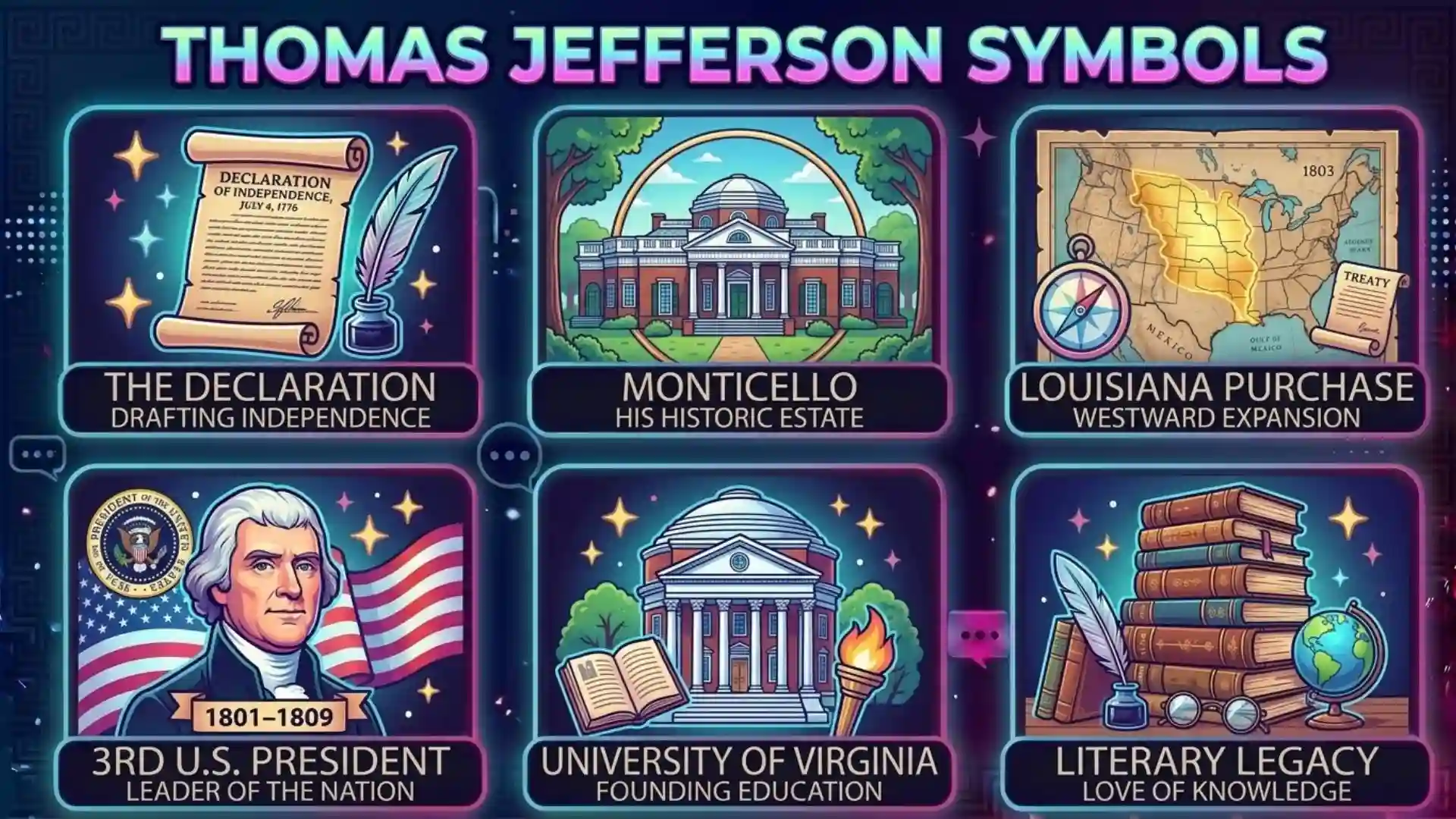
When people search for Thomas Jefferson symbols, they may be looking for a personal emblem, historical symbol, coat of arms, seal, tattoo idea, school-project image, or a symbol that represents Jefferson’s ideas and achievements.
The important thing to know is that Thomas Jefferson did not have one single official symbol that represented him in every context. Instead, several symbols are directly or closely connected to his life. These include his personal seal with the TJ initials, his coat of arms, Monticello, his obelisk tombstone, the Declaration of Independence, the Virginia Statute for Religious Freedom, and the University of Virginia.
Other imagery has a more specific connection. Jefferson served with Benjamin Franklin and John Adams on the first committee appointed to create a Great Seal for the United States in 1776. That committee’s proposal included imagery and ideas that later influenced the national seal, but it was not the final Great Seal. The final design developed through later work and was approved in 1782.
Jefferson’s own tombstone provides another useful clue. He selected three accomplishments that he wanted future generations to remember: the Declaration of Independence, the Virginia Statute for Religious Freedom, and the University of Virginia.
So, if you want to understand Thomas Jefferson symbols accurately, it helps to separate personal symbols, architectural symbols, achievement symbols, memorial symbols, and national symbols connected to his work.
What Is the Thomas Jefferson Symbol? (Quick Answer)
There is no single official Thomas Jefferson symbol.
The TJ personal seal is one of the most direct symbols associated with Jefferson himself. Monticello is his best-known architectural symbol, while the obelisk at his grave represents the legacy he personally selected for remembrance.
Other important symbols include:
- TJ initials — Jefferson’s personal identity
- Personal seal — his personal emblem and motto
- Coat of arms — armorial design used by Jefferson
- Monticello — his home and architectural work
- Monticello dome — a recognizable architectural feature
- Obelisk — his chosen memorial design
- Declaration of Independence — one of the achievements he wanted remembered
- Virginia Statute for Religious Freedom — his contribution to religious liberty
- University of Virginia — his educational and architectural project
- Eye of Providence — appeared in the first Great Seal committee’s proposal
- E Pluribus Unum — appeared in the first committee proposal and survived into the final Great Seal
- Moses and Pharaoh imagery — part of the early Great Seal proposals
- Indian Peace Medal — a government medal bearing Jefferson’s portrait
- Classical architecture — a major part of Jefferson’s architectural language
These symbols do not all have the same historical status. That distinction is important.
Thomas Jefferson Symbols at a Glance
| Symbol | Type of connection | Main association |
| TJ initials | Personal | Thomas Jefferson’s identity |
| Personal seal | Personal | Jefferson’s correspondence and motto |
| “Rebellion to tyrants…” | Personal/political | Motto used by Jefferson |
| Coat of arms | Personal/heraldic | Armorial bearings Jefferson used |
| Monticello | Architectural | Jefferson’s home and design |
| Monticello dome | Architectural | Jeffersonian architecture |
| Obelisk | Memorial | Jefferson’s chosen legacy |
| Declaration of Independence | Achievement | Independence and political liberty |
| Virginia Statute for Religious Freedom | Achievement | Religious freedom |
| University of Virginia | Achievement/education | Education and intellectual freedom |
| Eye of Providence | Great Seal proposal | Part of the first national-seal design |
| E Pluribus Unum | Great Seal proposal | “Out of Many, One” |
| Moses and Pharaoh | Great Seal proposal | Biblical liberation imagery |
| Indian Peace Medal | Historical object | Jefferson’s presidency and diplomacy |
| Liberty imagery | Broader political symbolism | Freedom and resistance to tyranny |
| Classical columns and domes | Architectural | Jefferson’s classical influences |
This classification prevents a common mistake: calling every American symbol associated with the Revolutionary period a personal symbol of Jefferson.
Is There an Official Thomas Jefferson Symbol?
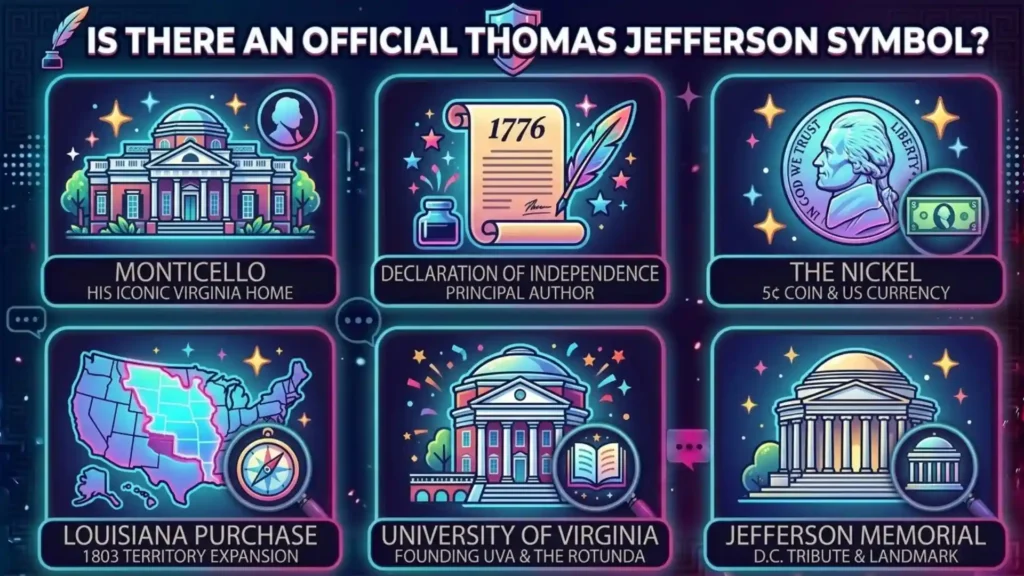
No single emblem was established as an official universal symbol of Thomas Jefferson.
Jefferson lived in a period when people used personal seals, heraldic designs, architectural motifs, documents, medals, and inscriptions rather than modern logos.
His personal seal is therefore different from a modern corporate logo. It was a historical personal emblem associated with his correspondence and identity.
Monticello is different again. It was Jefferson’s home and architectural project rather than a formal personal emblem.
His tombstone is another category. Jefferson actually specified its design and inscription, making it especially valuable when studying the way he wanted his accomplishments remembered.
A useful way to classify Jefferson symbols is:
- Personal: TJ seal and coat of arms
- Architectural: Monticello and the University of Virginia
- Memorial: obelisk and epitaph
- Achievement-based: Declaration, religious-freedom statute, and university
- National-design: symbols from the 1776 Great Seal proposal
- Broader cultural: liberty imagery and classical motifs
Thomas Jefferson’s Personal Seal
The personal seal of Thomas Jefferson is one of the most direct answers to the question of what symbol represents him.
Jefferson used a seal featuring his initials TJ and the phrase:
“Rebellion to tyrants is obedience to God.”
The Library of Congress explains that Benjamin Franklin proposed this phrase during the 1776 Great Seal discussions. Jefferson embraced it and used it in connection with his own seals and correspondence.
What Does the TJ Symbol Mean?
The TJ initials are simply an abbreviated identification of Thomas Jefferson.
Unlike a modern monogram created for branding, the initials were incorporated into a historical personal seal.
For readers looking for a simple Thomas Jefferson symbol, the letters TJ have a particularly direct connection because they identify Jefferson himself rather than representing a broader American idea.
What Does Jefferson’s Personal Seal Look Like?
The historical seal combines several visual elements.
The central feature is the TJ monogram, surrounded by decorative design and associated with Jefferson’s motto.
The exact appearance can vary depending on the surviving impression or reproduction being examined, so a modern graphic should not automatically be treated as an exact historical original.
The important identifying features are:
- TJ initials
- A personal-seal format
- Jefferson’s motto
- Decorative heraldic-style presentation
What Does “Rebellion to Tyrants Is Obedience to God” Mean?
The phrase expresses the idea that resisting tyranny can be understood as consistent with obedience to God.
The wording has an important historical detail: Jefferson did not originate the phrase. The Library of Congress identifies Benjamin Franklin as the person who proposed it during the 1776 Great Seal discussions. Jefferson nevertheless strongly embraced the sentiment and incorporated it into designs and personal seals.
This makes the phrase a genuine Jefferson-associated symbol while avoiding the inaccurate claim that Jefferson invented it.
The Thomas Jefferson Coat of Arms
Another historical symbol associated with Jefferson is his coat of arms.
Monticello documents Jefferson’s use of armorial bearings similar to those long associated with the Jeaffresons of Dullingham House in Cambridgeshire. Impressions of the arms survive on some of Jefferson’s papers, and later generations of his family also treated the design as connected to him.
The design is described as:
- A blue shield
- A silver fret
- Three red leopard heads
- A crest featuring a Talbot’s head
- A motto associated with liberty
The motto is:
“Ab eo libertas a quo spiritus.”
It has been translated as meaning roughly “The spirit comes from him from whom liberty comes,” or more freely, “He who gives life gives liberty.”
What Does the Jefferson Coat of Arms Mean?
The coat of arms belongs to the world of heraldry, so its meaning should not be treated exactly like the meaning of a modern logo.
It connects Jefferson with:
- Personal identity
- Family association
- Heraldic tradition
- Liberty imagery
- Historical status
The liberty-related motto makes the design especially interesting when studying symbols connected with Jefferson’s broader intellectual and political interests.
Did Thomas Jefferson Have an Official Coat of Arms?
This question needs careful wording.
Jefferson did use the armorial design, and surviving documents demonstrate that use. However, the historical record does not establish that he had an officially granted right to those arms in the way readers may imagine from modern descriptions of heraldic entitlement. Monticello specifically discusses this uncertainty.
Therefore, it is safer to say:
Thomas Jefferson used armorial bearings associated with him.
It is less accurate to simply call them an officially granted “Jefferson family coat of arms.”
Monticello as a Thomas Jefferson Symbol
Monticello is probably the most recognizable physical symbol connected with Thomas Jefferson.
Jefferson spent more than forty years designing and redesigning his mountaintop home. Monticello became an expression of his interests in architecture, classical design, science, agriculture, books, art, and domestic life.
Today, its distinctive silhouette makes it immediately recognizable.
What Does Monticello Represent?
Monticello can represent several aspects of Jefferson’s life:
- Architecture
- Classical learning
- Intellectual curiosity
- Virginia
- Jefferson’s personal life
- His interest in design
- His changing ideas about domestic architecture
Monticello is sometimes described as simply a symbol of Jefferson’s genius or ideals. A more historically useful approach is to recognize it as a complex historic site shaped by Jefferson, his family, enslaved people, free workers, and later preservation efforts. The Monticello Foundation emphasizes that the site’s history includes the many enslaved and free people who lived and worked there.
What Does the Monticello Dome Symbolize?
The dome is one of the most recognizable features of Monticello.
Jefferson added the dome during the redesign of the house, drawing on European and classical architectural influences. The redesigned Monticello was largely completed by 1809.
The dome can therefore serve as a visual shorthand for:
- Thomas Jefferson
- Monticello
- Neoclassical architecture
- Jefferson’s architectural interests
- Classical influence
The Dome Room itself is an octagonal space with circular windows and an oculus skylight. Its design drew on classical architectural sources, including material associated with Andrea Palladio.
Why Is Monticello Such a Strong Jefferson Symbol?
Monticello is especially useful as a symbol because it connects several parts of Jefferson’s life at once.
It was not simply a house. Jefferson continuously modified it and used it as a setting for his books, scientific interests, collections, family life, and agricultural activities.
It therefore represents the architectural and personal side of Jefferson more directly than a generic American symbol such as an eagle or flag.
Thomas Jefferson’s Obelisk and Tombstone
The obelisk at Jefferson’s grave is one of the most historically revealing symbols associated with him.
Before his death, Jefferson left instructions for the monument that would mark his grave. He provided a sketch of an obelisk and specified the inscription he wanted.
The inscription identifies Jefferson as:
- Author of the Declaration of American Independence
- Author of the Statute of Virginia for Religious Freedom
- Father of the University of Virginia
Jefferson explained that he wanted to be remembered through these achievements.
Why Is the Obelisk Important?
The obelisk is important because it reflects Jefferson’s own choice of legacy.
His epitaph does not list every office he held. Instead, it highlights three accomplishments that he considered especially important.
That makes the obelisk more than a grave marker. It is a historical statement about how Jefferson wanted his life to be remembered.
What Does the Jefferson Obelisk Represent?
The obelisk can be associated with:
- Memory
- Legacy
- The Declaration of Independence
- Religious freedom
- Education
- Jefferson’s own view of his accomplishments
It is therefore one of the strongest symbols to use when discussing Jefferson’s chosen legacy.
The Three Achievements Thomas Jefferson Wanted to Be Remembered For
Jefferson’s tombstone gives readers a particularly direct answer to the question:
What did Thomas Jefferson consider important enough to put on his grave?
He selected three achievements:
| Achievement | Symbolic association |
| Declaration of Independence | Independence and political liberty |
| Virginia Statute for Religious Freedom | Freedom of conscience and religion |
| University of Virginia | Education and intellectual freedom |
Monticello identifies these as the three accomplishments Jefferson specifically selected for remembrance.
Declaration of Independence
Jefferson was the principal drafter of the Declaration of Independence.
The National Archives explains that a committee of five was appointed to prepare the document, with the actual drafting delegated to Jefferson. John Adams and Benjamin Franklin reviewed and changed his draft, and Congress subsequently revised and adopted the document.
As a symbol, the Declaration can therefore represent:
- Independence
- Political liberty
- Natural rights
- Self-government
- The American founding
- Jefferson’s role as a principal drafter
It is important to distinguish Jefferson’s authorship role from the document’s collective status. The Declaration was ultimately a product of congressional consideration and adoption, not a private document belonging to Jefferson.
Virginia Statute for Religious Freedom
The Virginia Statute for Religious Freedom was another achievement Jefferson specifically selected for his epitaph.
It is associated with:
- Freedom of religion
- Freedom of conscience
- Religious liberty
- Limits on government interference with belief
Because Jefferson personally chose this accomplishment for his tombstone, it is particularly relevant when discussing symbols of his legacy.
University of Virginia
The University of Virginia represents Jefferson’s commitment to education and his architectural vision.
Monticello identifies the university as one of the three accomplishments Jefferson most wanted to be remembered for. He played major roles in its planning, charter, location, architecture, curriculum, and early governance.
The university’s Rotunda is especially recognizable.
Its architecture reflects Jefferson’s interest in classical forms, and the university’s Academical Village became a major expression of his educational and architectural ideas.
Thomas Jefferson and the Great Seal Symbols
Thomas Jefferson has an important but sometimes misunderstood connection to the Great Seal of the United States.
On July 4, 1776, Congress appointed Benjamin Franklin, Thomas Jefferson, and John Adams to design a national seal. Their proposal was not adopted in its original form. The process continued through later committees until the final Great Seal was approved in 1782.
This means that Great Seal symbols should be described as symbols from Jefferson’s Great Seal work or proposal, not automatically as his personal symbols.
Great Seal Timeline
| Date | Event |
| July 4, 1776 | Franklin, Jefferson, and Adams appointed to the first Great Seal committee |
| 1776 | First committee developed its proposal |
| 1780 | Congress appointed a second committee |
| Later | Additional work was done on the national seal |
| June 20, 1782 | Congress approved the final Great Seal |
The National Archives notes that the process took several committees and six years before completion.
The Eye of Providence and Thomas Jefferson
The Eye of Providence is sometimes described online as a Thomas Jefferson symbol.
That description is too broad.
The Eye of Providence appeared in the first Great Seal committee’s proposal, in which Jefferson participated. It therefore has a documented connection to Jefferson’s work on the proposed seal.
But it was not Jefferson’s personal symbol.
The better description is:
The Eye of Providence was part of the first Great Seal proposal created by the committee that included Thomas Jefferson.
The distinction matters because the final Great Seal evolved through later designs.
E Pluribus Unum and Jefferson
E Pluribus Unum means:
“Out of Many, One.”
The phrase appeared in the first Great Seal proposal involving Jefferson, Franklin, and Adams. Although the original committee’s elaborate design was rejected, E Pluribus Unum survived and became part of the final national design.
This gives the phrase a genuine Jefferson connection through his participation in the first committee.
However, it should still be classified as a national symbol, rather than a personal Thomas Jefferson emblem.
Moses and Pharaoh in Jefferson’s Great Seal Proposal
The first Great Seal discussions also included biblical imagery involving Moses and Pharaoh.
The Library of Congress records that Jefferson initially proposed a scene of the Israelites in the wilderness, led by a cloud during the day and a pillar of fire at night. He later embraced Franklin’s proposed imagery involving Moses, Pharaoh, and the parting of the Red Sea.
This imagery was intended to evoke a story of liberation from oppression.
It is important, however, to describe it as part of the 1776 Great Seal proposal, not as a permanent Jefferson emblem.
“Rebellion to Tyrants Is Obedience to God” and the Great Seal
The phrase “Rebellion to tyrants is obedience to God” has an especially interesting history.
Benjamin Franklin proposed the phrase during the Great Seal discussions. Jefferson embraced it and used it in his own designs and seals.
The phrase is therefore connected to Jefferson in two ways:
- It appeared in the early national-seal discussion.
- Jefferson personally adopted and used it.
That makes it more directly associated with Jefferson than many other Great Seal elements.
Did Thomas Jefferson Design the Final Great Seal?
No.
Jefferson was part of the first committee, but the committee’s proposal was tabled.
The final Great Seal was developed through additional stages and committees. The National Archives explains that the process took six years and more than one committee before the design was approved in 1782.
Therefore:
Accurate: Jefferson participated in the first Great Seal committee.
Accurate: His committee’s proposal included important imagery and E Pluribus Unum.
Not accurate: Jefferson designed the final Great Seal by himself.
Did Thomas Jefferson Choose the Eagle?
No.
The bald eagle on the final Great Seal was not selected by Jefferson.
Jefferson’s direct involvement belonged to the first committee’s 1776 proposal. The final design emerged later, after additional work by other people and committees.
This is an important distinction because the bald eagle is a major American national symbol but not a personal Thomas Jefferson symbol.
The Jefferson Indian Peace Medal
The Jefferson Indian Peace Medal is another fascinating historical object that belongs in a complete discussion of Jefferson symbols.
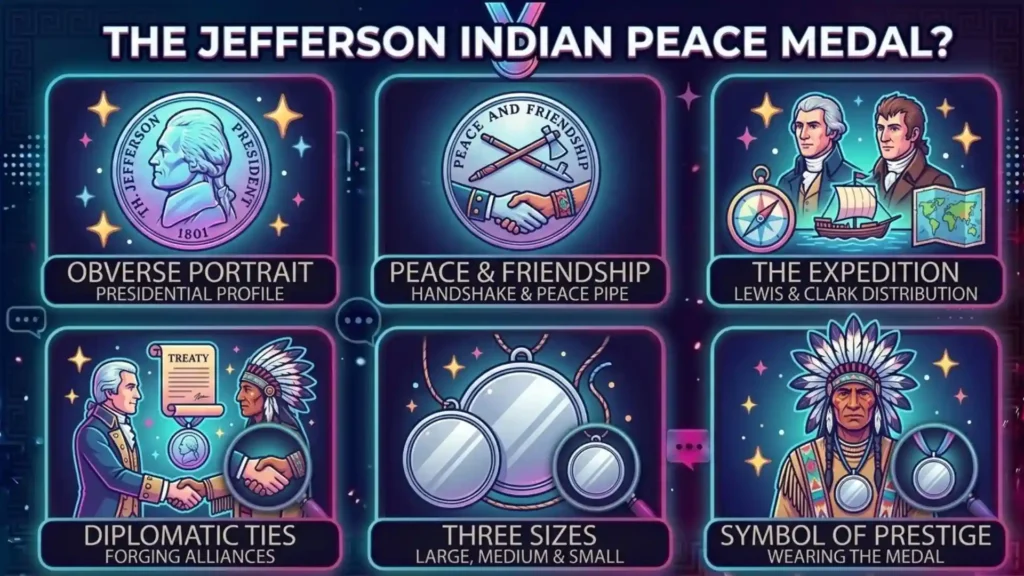
The medal was designed and engraved by John Reich and was the first U.S. peace medal to feature the image of an American president. Jefferson appears in profile on the front with the inscription identifying him as president in 1801.
The reverse includes:
- Clasped hands
- A crossed tomahawk
- A peace pipe
- The words “PEACE AND FRIENDSHIP”
Monticello notes that these medals were part of an established diplomatic tradition in relations between European powers and Native American nations and that Jefferson medals were carried west by Lewis and Clark as gifts.
What Does the Jefferson Peace Medal Represent?
The medal can represent:
- Jefferson’s presidency
- Diplomatic relations
- Government-to-government symbolism
- Peace and friendship as expressed on the medal
- Early U.S. diplomatic practices involving Native nations
It should also be studied in its full historical context rather than reduced to a simple modern symbol of friendship.
Liberty as a Thomas Jefferson Symbol
Liberty is strongly connected with Jefferson’s political vocabulary.
His writings frequently discussed liberty, rights, government, and resistance to concentrated power. The Library of Congress preserves Jefferson’s writings about liberty and resistance, including his well-known discussion of the “tree of liberty.”
Liberty is therefore a useful idea-based symbol for Jefferson.
But there is an important distinction:
Liberty is an idea strongly associated with Jefferson, not a unique personal logo created by him.
This distinction prevents broad American Revolutionary imagery from being incorrectly labeled as a personal Jefferson emblem.
The Liberty Cap and Jefferson
The liberty cap, often called a Phrygian cap in historical discussions, became a political symbol associated with freedom and revolutionary ideas.
It belongs to a much wider European and American symbolic tradition.
Therefore, the liberty cap can be included when discussing the political symbolism of Jefferson’s era, but it should not be presented as a personal Thomas Jefferson symbol unless a specific historical connection is being discussed.
Classical Architecture as a Jefferson Symbol
Classical architecture is one of the most useful visual categories for understanding Jefferson.
Jefferson had a lifelong interest in classical architecture and was strongly influenced by architectural writers and buildings he encountered in Europe. Monticello describes Andrea Palladio and other classical and Renaissance influences on Jefferson’s designs.
Common architectural features associated with Jefferson include:
- Columns
- Domes
- Porticoes
- Pediments
- Rotundas
- Symmetry
- Classical proportions
- Octagonal spaces
These features are not personal emblems in the same sense as the TJ seal. Instead, they represent Jeffersonian architecture and his intellectual engagement with classical design.
The Octagon and Thomas Jefferson
The octagon appears repeatedly in Jefferson’s architectural work.
The Dome Room at Monticello is an important example. It is an octagonal space under the dome and includes circular windows and an oculus skylight.
The octagon can therefore work as an architectural reference to Jefferson.
However, readers should not assume that Jefferson used the octagon as a formal personal symbol. It is more accurate to describe it as an architectural form found in his designs.
Thomas Jefferson’s Spherical Sundial
Another interesting object associated with Jefferson is his spherical sundial.
It reflects his interest in architecture, measurement, science, agriculture, and practical design.
Unlike the TJ seal or his tombstone, the sundial is not a general-purpose Jefferson emblem. Its value comes from showing another side of Jefferson’s interests beyond politics.
It can be especially useful in school projects about:
- Jefferson and science
- Jefferson and architecture
- Jefferson’s inventions and interests
- Life at Monticello
Which Thomas Jefferson Symbols Are Directly Connected to Him?
Not every symbol mentioned in historical discussions has the same level of connection.
Direct personal symbols
These have the closest personal connection:
- TJ personal seal
- Jefferson’s personal motto
- Coat of arms he used
Symbols of his chosen achievements
These are directly connected to his stated legacy:
- Declaration of Independence
- Virginia Statute for Religious Freedom
- University of Virginia
Architectural symbols
These are connected to his design work:
- Monticello
- Monticello dome
- Rotunda
- Classical columns
- Octagonal architectural forms
Memorial symbols
These are connected to his own instructions:
- Obelisk
- Tombstone inscription
- Three selected achievements
Great Seal proposal symbols
These are connected to his 1776 committee work:
- Eye of Providence
- E Pluribus Unum
- Moses and Pharaoh imagery
- Biblical liberation imagery
- “Rebellion to tyrants is obedience to God”
Broader American symbols
These should not be called personal Jefferson symbols:
- Bald eagle
- Liberty Bell
- Statue of Liberty
- Modern American flag
This classification is one of the easiest ways to avoid historical confusion.
Thomas Jefferson Symbols and Their Meanings
Here is a simple reference guide:
| Thomas Jefferson symbol | Meaning or historical association |
| TJ initials | Personal identity |
| Personal seal | Jefferson’s personal emblem |
| Rebellion to tyrants motto | Resistance to tyranny |
| Coat of arms | Personal and heraldic association |
| Monticello | Home, architecture, intellectual life |
| Monticello dome | Classical and Jeffersonian architecture |
| Obelisk | Chosen personal legacy |
| Declaration of Independence | Independence and political liberty |
| Virginia Statute for Religious Freedom | Religious freedom |
| University of Virginia | Education and intellectual freedom |
| Eye of Providence | Part of the first Great Seal proposal |
| E Pluribus Unum | “Out of Many, One” |
| Moses and Pharaoh | Biblical liberation imagery in early seal proposals |
| Indian Peace Medal | Presidency and diplomatic symbolism |
| Classical columns | Jefferson’s architectural interests |
| Octagon | Architectural form used in Jefferson’s designs |
Thomas Jefferson Symbols for Tattoos
People sometimes search for Thomas Jefferson symbols for tattoos because they want a small historical image representing Jefferson, independence, liberty, education, or architecture.
The right choice depends on what you want the tattoo to communicate.
TJ Initials Tattoo
The TJ monogram is the simplest option.
It has a direct connection to Jefferson’s personal identity and can work as a minimalist historical reference.
Jefferson Personal Seal Tattoo
A reproduction or adaptation of the personal seal provides a more historically specific image.
It can include:
- TJ initials
- Decorative seal design
- Jefferson’s motto
Monticello Dome Tattoo
The Monticello dome provides an instantly recognizable architectural reference.
It can represent Jefferson’s:
- Home
- Architecture
- Virginia connection
- Intellectual interests
Obelisk Tattoo
An obelisk can represent Jefferson’s chosen legacy.
This is particularly meaningful if the focus is on the three accomplishments he selected for his tombstone.
Declaration Tattoo
A small document, quill, or selected historical phrase can symbolize Jefferson’s role as the principal drafter of the Declaration.
University of Virginia Rotunda Tattoo
The Rotunda is appropriate for someone interested in Jefferson’s educational and architectural legacy.
Thomas Jefferson Symbols for a School Project
Students often need one symbol that immediately communicates their topic.
A useful choice depends on the subject.
| School-project topic | Suitable symbol |
| Thomas Jefferson himself | TJ seal |
| Jefferson’s home | Monticello |
| Jefferson’s architecture | Monticello dome |
| American independence | Declaration of Independence |
| Religious freedom | Virginia Statute |
| Education | University of Virginia Rotunda |
| Jefferson’s legacy | Obelisk |
| Great Seal history | Eye of Providence or E Pluribus Unum |
| Jefferson’s presidency and diplomacy | Indian Peace Medal |
| Jefferson’s intellectual interests | Classical architecture |
For a general biography project, Monticello or the TJ seal provides a clearer direct connection than a generic American flag.
Thomas Jefferson Symbols vs. Broader American Symbols
Some symbols are frequently associated with Jefferson simply because they are associated with the United States.
That does not make them personal Jefferson symbols.
| Symbol | Thomas Jefferson symbol? | Why |
| TJ personal seal | Yes | Directly associated with Jefferson |
| Jefferson coat of arms | Associated | Jefferson used the armorial design |
| Monticello | Yes | His home and architectural project |
| Obelisk | Yes | He specified its design |
| Declaration of Independence | Achievement | Jefferson was its principal drafter |
| University of Virginia | Achievement | Jefferson helped create and design it |
| Eye of Providence | Associated with proposal | Appeared in the first Great Seal proposal |
| E Pluribus Unum | Associated with proposal | Appeared in the first committee design |
| Bald eagle | No | Part of the later final national seal |
| Liberty Bell | No | Broader American Revolutionary symbol |
| Statue of Liberty | No | Later American symbol, not a Jefferson emblem |
| American flag | No | National symbol rather than Jefferson’s personal emblem |
This distinction is particularly important for anyone using the information in a history assignment.
Why Thomas Jefferson Symbols Have Different Meanings
A symbol’s meaning depends on its historical relationship with Jefferson.
For example, TJ primarily identifies Jefferson.
Monticello identifies his home and architectural work.
The obelisk reflects the legacy he personally selected.
The Declaration represents an important achievement.
The Eye of Providence represents something different again: it belonged to an early national-seal proposal in which Jefferson participated.
This is why there is no single list in which every item should be treated equally.
The most accurate approach is to ask:
How was this symbol actually connected to Thomas Jefferson?
Frequently Asked Questions
What is the main symbol of Thomas Jefferson?
There is no single official symbol. Jefferson’s TJ personal seal is one of the most direct personal emblems, while Monticello is his most recognizable architectural symbol.
What does the TJ symbol mean?
The TJ initials identify Thomas Jefferson. They were used in connection with his personal seal and therefore have a direct historical relationship with him.
What does Thomas Jefferson’s personal seal say?
Jefferson’s personal seal is associated with the phrase “Rebellion to tyrants is obedience to God.” The Library of Congress explains that Benjamin Franklin proposed the phrase during the 1776 Great Seal discussions and Jefferson later embraced and used it.
Did Thomas Jefferson invent “Rebellion to tyrants is obedience to God”?
No. The Library of Congress identifies Benjamin Franklin as the person who proposed the phrase during the Great Seal discussions. Jefferson adopted and used it afterward.
What does Thomas Jefferson’s coat of arms mean?
The coat of arms is a heraldic design Jefferson used and that later generations associated with him. Its motto, “Ab eo libertas a quo spiritus,” has been translated in terms of the relationship between life or spirit and liberty.
Did Thomas Jefferson have an official coat of arms?
Jefferson used armorial bearings associated with him, but the historical evidence does not establish an officially granted entitlement in the straightforward sense often assumed today.
What does Monticello symbolize?
Monticello can represent Jefferson’s home, architecture, intellectual interests, Virginia identity, and evolving ideas about design. Jefferson worked on its design and redesign for more than forty years.
What does the Monticello dome represent?
The dome is a recognizable feature of Jefferson’s architecture and reflects his interest in classical and European architectural forms. It was added during the major redesign of Monticello.
What are the three things Thomas Jefferson wanted to be remembered for?
Jefferson selected the Declaration of Independence, the Virginia Statute for Religious Freedom, and the University of Virginia for his tombstone.
Did Thomas Jefferson design the Great Seal of the United States?
Jefferson participated in the first Great Seal committee with Benjamin Franklin and John Adams in 1776. Their proposal was not adopted as the final seal. The final design was approved in 1782 after later work.
Is the Eye of Providence a Thomas Jefferson symbol?
It is more accurate to say that the Eye of Providence was part of the first Great Seal proposal involving Jefferson. It was not Jefferson’s personal emblem.
What does E Pluribus Unum have to do with Thomas Jefferson?
The phrase E Pluribus Unum, meaning “Out of Many, One,” appeared in the first Great Seal proposal created by the committee that included Jefferson, Franklin, and Adams. The phrase survived into the final national seal design.
Did Thomas Jefferson choose the bald eagle?
No. The bald eagle was part of the later development of the final Great Seal, after the first committee’s proposal. Jefferson should not be described as the person who selected the eagle.
What does the Jefferson Indian Peace Medal represent?
The medal represents an early U.S. diplomatic tradition involving Native American nations. The Jefferson medal featured his portrait on the front and “PEACE AND FRIENDSHIP” with clasped hands and a crossed tomahawk and peace pipe on the reverse.
What symbol represents Jefferson’s ideas about liberty?
Liberty is a broad idea strongly associated with Jefferson’s writings and political thought. His personal motto, the Declaration of Independence, and the Virginia Statute for Religious Freedom provide more specific historical connections to that theme.
What Thomas Jefferson symbol is best for a tattoo?
There is no single correct choice. A TJ monogram provides a simple personal reference, while a Monticello dome, personal seal, obelisk, or University of Virginia Rotunda can represent different aspects of Jefferson’s historical legacy.
What Thomas Jefferson symbol is best for a school project?
For a general project, Monticello or the TJ personal seal gives a direct visual connection to Jefferson. For a project focused on independence, the Declaration is more appropriate; for education, the University of Virginia is a strong historical connection.
Is the Liberty Bell a Thomas Jefferson symbol?
No. The Liberty Bell is an important American historical symbol, but it is not Jefferson’s personal emblem.
Is the American flag a Thomas Jefferson symbol?
No. The American flag is a national symbol. Jefferson lived during the period when early U.S. flags developed, but the flag should not be described as his personal symbol.
Is the Statue of Liberty a Thomas Jefferson symbol?
No. The Statue of Liberty is a later American symbol of liberty and immigration. It should not be presented as a personal Thomas Jefferson emblem.
Thomas Jefferson Symbols Glossary
Personal seal: A historical emblem used by an individual to identify or authenticate correspondence and documents.
TJ monogram: The initials “TJ” used to identify Thomas Jefferson.
Coat of arms: A heraldic design associated with an individual or family.
Heraldry: The historical system and traditions surrounding coats of arms and related designs.
Epitaph: An inscription written in memory of a deceased person.
Obelisk: A tall, four-sided monument that tapers toward a pyramid-shaped top.
Great Seal: The official seal of the United States.
E Pluribus Unum: Latin for “Out of Many, One.”
Monticello: Thomas Jefferson’s historic home in Virginia.
Rotunda: The domed central building at the University of Virginia.
Great Seal proposal: A proposed design created during the early effort to establish a national seal in 1776.
Conclusion
Thomas Jefferson symbols are best understood as a collection of historically connected images and objects rather than one official emblem. The TJ personal seal is one of the most direct personal symbols, while Monticello and its dome provide recognizable architectural associations.
Jefferson’s coat of arms offers another personal and heraldic connection, although its historical status requires careful wording. His obelisk tombstone is especially significant because Jefferson himself specified its design and selected the three achievements he wanted remembered.
Those three achievements the Declaration of Independence, Virginia Statute for Religious Freedom, and University of Virginia provide perhaps the clearest guide to Jefferson’s intended public legacy.
The Eye of Providence, E Pluribus Unum, and Moses imagery have a different relationship to Jefferson because they belong to the 1776 Great Seal proposals in which he participated. They should not be confused with his personal seal.
Other objects, such as the Jefferson Indian Peace Medal, add further historical context. Together, these symbols show why the answer to “What is the Thomas Jefferson symbol?” depends on whether you are asking about his personal identity, architecture, achievements, memorial, political ideas, or role in early national design.

Adam Sullivan is a dedicated writer who enjoys transforming everyday topics into engaging and informative content. His writing focuses on making complex ideas simple, practical and enjoyable for readers of all backgrounds. Adam is also the fictional author of The Lantern Beyond Autumn Hills and Where the Morning Horizon Waits. Outside of writing, he enjoys photography, traveling and discovering inspiration through new experiences. He believes great content should be both helpful and easy to connect with.
 Dylan Anderson