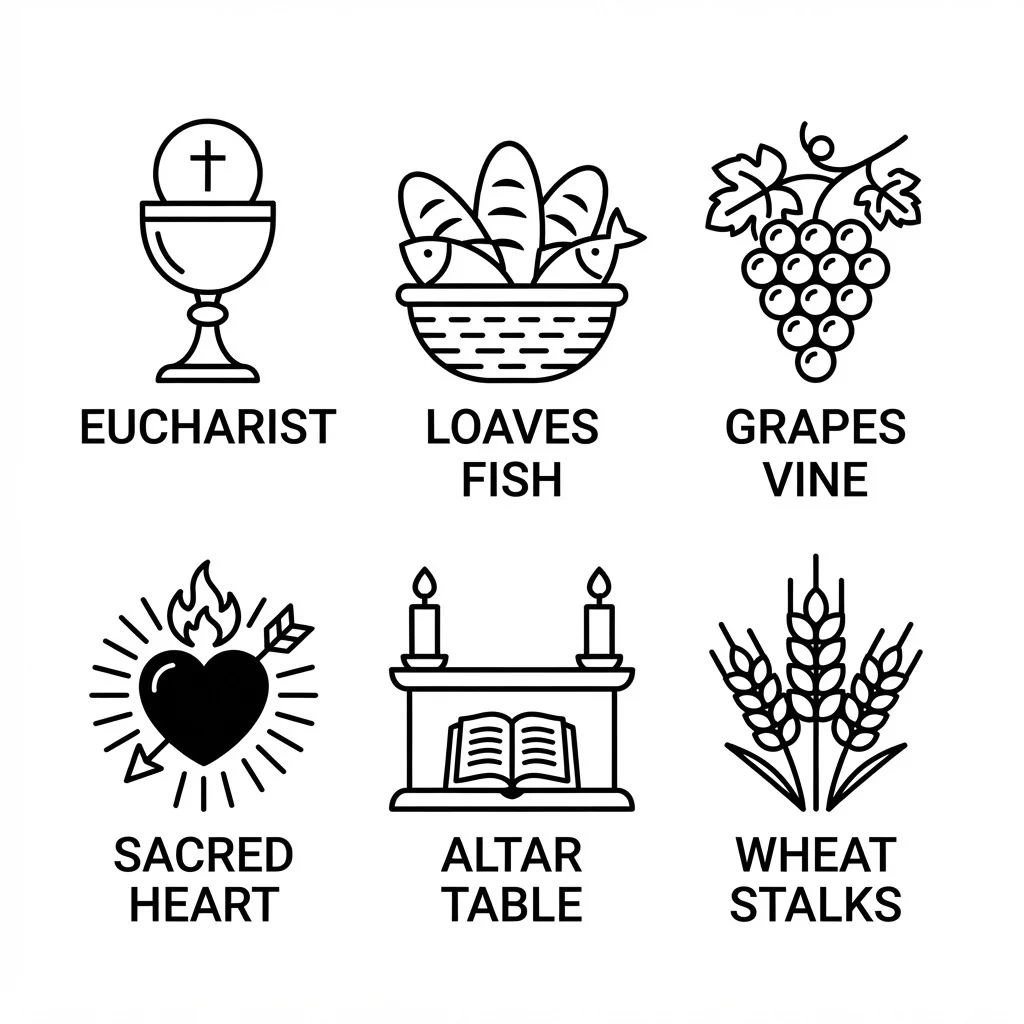
The Eucharist is one of the most important practices in Christianity. It remembers the Last Supper, celebrates Jesus Christ’s sacrifice, and expresses the spiritual bond between Christ and his followers. Its most important signs are bread and wine, but many other objects and images help explain its meaning.
Common Eucharist symbols include bread, wine, the chalice, wheat, grapes, the lamb, the fish, the host, and the altar. Churches also use objects such as the paten, ciborium, tabernacle, and monstrance during Eucharistic worship. Each has a particular purpose and meaning.
The word Eucharist comes from the Greek word eucharistia, which means thanksgiving. Christians also use names such as Holy Communion, the Lord’s Supper, and the Breaking of Bread. Although these names are related, different Christian traditions may understand the sacrament in different ways.
This guide explains the main Eucharist symbols, their biblical connections, their place in church worship, and their meanings in Christian traditions. It also distinguishes essential Eucharistic signs from general Christian images and liturgical objects.
What Are Eucharist Symbols?
Eucharist symbols are signs, objects, and images connected with the Christian celebration of the Eucharist. They help believers understand important themes such as Jesus’ sacrifice, spiritual nourishment, thanksgiving, forgiveness, unity, and eternal life.
The central Eucharistic signs are bread and wine. During the Last Supper, Jesus shared bread and a cup with his disciples and connected them with his body and blood. Christians continue to remember this event through the celebration of Communion.
Other images and objects support this central meaning. Wheat represents the grain used to make bread. Grapes connect with the wine shared at the Eucharistic table. The lamb recalls Jesus as the Lamb of God, while the fish appears in early Christian art and sometimes in Eucharistic scenes.
It is important to understand that not every Christian image is an essential Eucharistic sign. Some objects serve a practical purpose during worship, while others communicate religious ideas through art and tradition.
Quick List of Eucharist Symbols and Their Meanings
| Symbol or object | Common meaning or purpose |
| Bread | Spiritual nourishment and, in Catholic teaching, the Body of Christ after consecration |
| Wine | The new covenant and, in Catholic teaching, the Blood of Christ after consecration |
| Chalice | The cup used for the wine during the Eucharistic celebration |
| Wheat | The grain used to make Eucharistic bread |
| Grapes | The fruit associated with wine and the vine |
| Lamb | Jesus Christ’s sacrifice and redemption |
| Fish | An early Christian image associated with Jesus and Christian faith |
| Host | The Eucharistic bread used in Communion |
| Altar | The central place of the Eucharistic celebration |
| Pelican | A traditional image of Christ’s self-giving love |
| Monstrance | A vessel used to display the consecrated host |
| IHS | A Christogram representing the name of Jesus |
These meanings provide a starting point. Their exact interpretation can depend on the church, denomination, artwork, and setting in which they appear.
What Are the Essential Signs of the Eucharist?
In Catholic teaching, the essential signs of the Eucharistic sacrament are wheat bread and grape wine. These are not simply decorative objects. They are the elements Jesus used at the Last Supper when he established the sacrament.
The Catholic Church teaches that, through consecration, the bread and wine become the Body and Blood of Christ while retaining their outward appearances. This belief is called transubstantiation.
Other Christian traditions explain the presence of Christ in Communion differently. Some emphasize the real presence of Christ, while others understand the bread and cup primarily as signs of remembrance or spiritual participation.
Bread as an Essential Eucharistic Sign
Bread recalls the food Jesus shared with his disciples. It also connects the Eucharist with the biblical image of God providing nourishment for his people.
Catholic teaching specifies wheat bread for the Eucharistic celebration. In the Latin Church, the bread is unleavened. The exact liturgical requirements can differ among Catholic rites.
Wine as an Essential Eucharistic Sign
Wine recalls the cup Jesus shared at the Last Supper. In the Gospel accounts, Jesus connects the cup with his blood and the covenant between God and humanity.
Catholic teaching identifies grape wine as the required element for the sacrament. Its meaning includes sacrifice, forgiveness, the new covenant, and participation in Christ’s life.
Why Are Bread and Wine More Important Than Other Images?
Bread and wine are directly connected with Jesus’ actions and words at the Last Supper. Wheat, grapes, the lamb, fish, and other images help explain the sacrament, but they do not replace its essential signs.
This distinction makes the topic easier to understand. Bread and wine belong to the central celebration, while many other symbols provide additional biblical, historical, artistic, or liturgical meaning.
12 Important Eucharist Symbols and Their Meanings
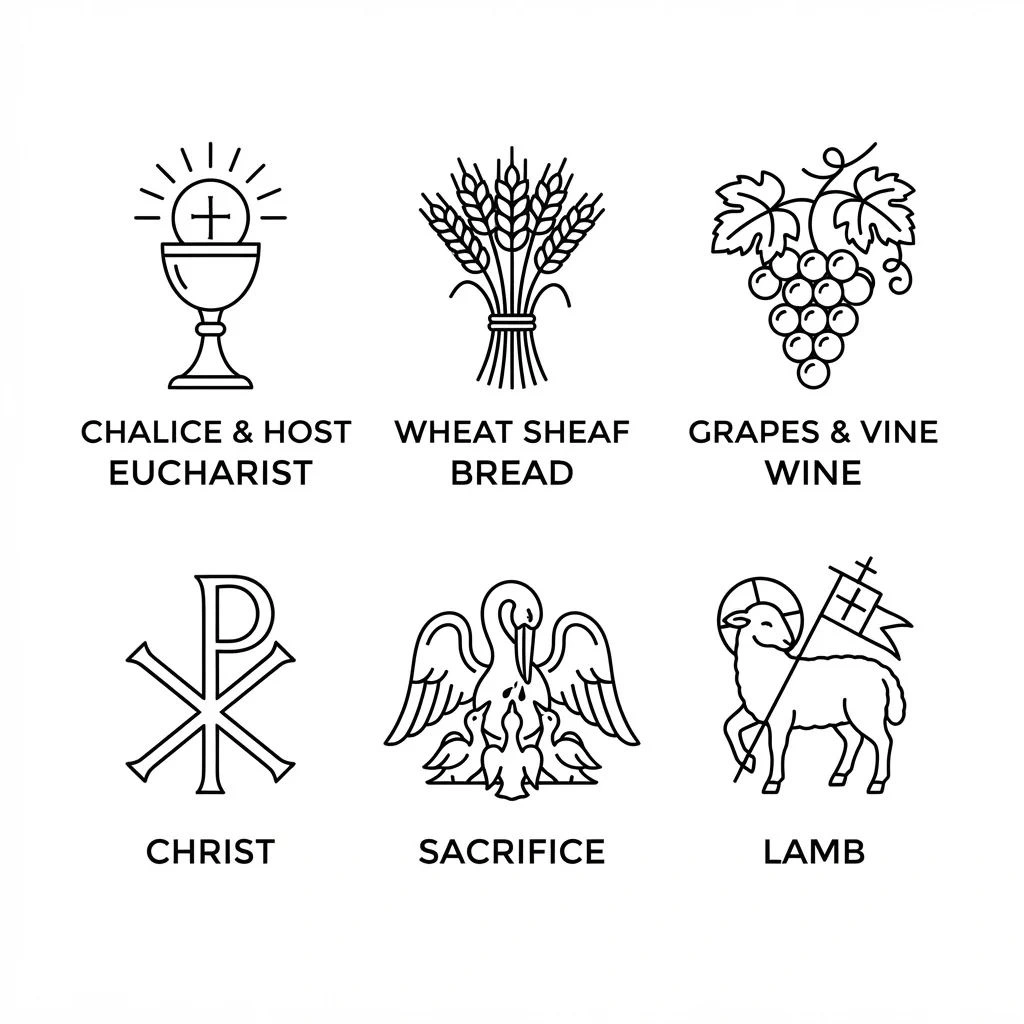
Several symbols appear in Christian churches, religious artwork, Communion services, and Eucharistic celebrations. Some come directly from biblical events, while others developed through Christian worship and artistic traditions.
1. Bread: The Body of Christ and Spiritual Nourishment
Bread is one of the most important Eucharist symbols because Jesus used it during the Last Supper. According to the Gospel accounts, he took bread, gave thanks, broke it, and shared it with his disciples.
In Catholic teaching, the consecrated bread becomes the Body of Christ. This belief gives the bread a central place in the Mass and in Catholic devotion.
Bread also represents spiritual nourishment. Just as ordinary food supports physical life, Christians understand Christ as the source of spiritual life.
The Gospel of John develops this idea through Jesus’ teaching about the Bread of Life.
Biblical connection: Matthew 26:26, Luke 22:19, John 6:35, and 1 Corinthians 11:23–24.
Main meanings of bread:
- The Body of Christ in Catholic teaching.
- Spiritual nourishment and eternal life.
- The Last Supper and Jesus’ command to remember him.
- Unity among believers who share one bread.
2. Wine: The Blood of Christ and the New Covenant
Wine is another essential Eucharistic sign. At the Last Supper, Jesus took the cup and connected it with his blood and the new covenant.
In Catholic teaching, the consecrated wine becomes the Blood of Christ. The cup therefore recalls Jesus’ sacrifice and the forgiveness associated with his death.
Wine also carries biblical associations with celebration, blessing, and abundance. In Christian Eucharistic worship, these associations point toward the hope and life offered through Christ.
Biblical connection: Matthew 26:27–28, Mark 14:23–24, Luke 22:20, and 1 Corinthians 11:25.
Main meanings of wine:
- The Blood of Christ in Catholic teaching.
- The new covenant between God and humanity.
- Jesus’ sacrifice and the promise of forgiveness.
- Joy, blessing, and spiritual life.
3. Chalice: The Cup of the Eucharist
The chalice is the cup used to hold the wine during the Eucharistic celebration. It is one of the most recognizable objects associated with Communion.
Its connection with the Last Supper gives it special religious importance. Jesus shared a cup with his disciples and described it in relation to the new covenant.
The chalice can appear in church decorations, paintings, stained-glass windows, and religious illustrations. It may be decorated with crosses, grapevines, wheat, or other Christian designs.
The chalice is also a practical liturgical vessel. It should not be confused with the paten, which is used for the bread.
Biblical connection: Luke 22:20 and 1 Corinthians 11:25.
Main meanings and associations:
- The cup shared by Jesus and his disciples.
- The wine used in the Eucharistic celebration.
- The new covenant and Christ’s sacrifice.
- Christian worship and remembrance.
4. Wheat: God’s Provision and the Source of Bread
Wheat is closely connected with Eucharistic symbolism because it is used to make bread. It reminds Christians that ordinary gifts from the earth can have a sacred place in worship.
Wheat also has wider biblical associations with harvest, food, provision, and blessing. It represents the work involved in producing bread, from planting and growing grain to harvesting and preparing food.
In Catholic teaching, wheat bread is an essential sign of the Eucharistic sacrament. This gives wheat a direct connection to the celebration.
Biblical connection: John 12:24, Matthew 13:24–30, and John 6:35.
Main meanings of wheat:
- The source of Eucharistic bread.
- God’s provision through creation.
- Harvest and gratitude.
- Spiritual growth and the gift of life.
5. Grapes and the Vine: Union With Christ
Grapes are connected with the Eucharist because grape wine is used in the sacrament. They represent the fruit of the vine and remind Christians of the cup Jesus shared at the Last Supper.
The vine also has an important meaning in the Gospel of John. Jesus describes himself as the true vine and his followers as branches. This image teaches believers about their dependence on Christ and the importance of remaining connected to him.
Grapes and the vine are related images, but they do not have exactly the same meaning. Grapes connect directly with the production of wine, while the vine can represent spiritual connection and growth.
Biblical connection: John 15:1–5, Matthew 26:29, and Luke 22:18.
Main meanings of grapes and the vine:
- The fruit used to produce Eucharistic wine.
- Union between Christ and his followers.
- Spiritual growth and dependence on God.
- Blessing, abundance, and new life.
6. Lamb: Jesus Christ as the Lamb of God
The lamb is an important Christian symbol associated with Jesus Christ. It recalls the biblical image of the Lamb of God, who takes away the sin of the world.
The lamb also connects with the Passover story in the Old Testament. In Christian interpretation, the Passover lamb becomes part of the wider biblical background for understanding Jesus’ sacrifice.
During the Catholic Mass, the congregation uses the title Lamb of God in a prayer before Communion. This makes the lamb especially relevant to Eucharistic worship.
The lamb may appear in church artwork, religious paintings, altar decorations, and Christian symbols.
Biblical connection: John 1:29, Exodus 12, and Revelation 5:6–12.
Main meanings of the lamb:
- Jesus’ sacrifice for humanity.
- Redemption and forgiveness.
- Innocence and purity.
- Victory through Christ.
7. Fish: An Early Christian Sign of Faith
The fish is one of the oldest and most recognizable Christian symbols. Early Christians used it as a sign connected with Jesus Christ and their faith.
The Greek word for fish is ichthys. Early Christians associated its letters with a phrase meaning Jesus Christ, Son of God, Savior.
The fish also appears in biblical stories involving Jesus and food. One example is the feeding of the five thousand, when Jesus multiplies bread and fish to feed a large crowd.
Some early Christian artworks combine fish with baskets of bread or meal scenes. In those settings, the fish can carry Eucharistic associations. However, it is not an essential Eucharistic sign in the same way as bread and wine.
Biblical connection: Matthew 14:13–21, John 6:1–14, and John 21:9–13.
Main meanings of the fish:
- Jesus Christ and Christian faith.
- Early Christian identity.
- The feeding miracles.
- In certain artworks, a connection with Eucharistic meals.
8. Host: The Eucharistic Bread Used in Communion
The host is the bread prepared for use during the Eucharistic celebration. In many Catholic churches, it appears as a small, round wafer.
During the Catholic Mass, the priest consecrates the bread during the Eucharistic Prayer. Catholic teaching holds that the consecrated host becomes the Body of Christ.
The word host is commonly used for the Eucharistic bread, especially in Catholic worship. Before consecration, it is bread prepared for the sacrament. After consecration, Catholics refer to it as the Blessed Sacrament or the consecrated host.
The host is not a separate symbol from bread. It is the form of Eucharistic bread used in the liturgy.
Biblical connection: Matthew 26:26 and 1 Corinthians 11:23–24.
Main meanings and associations:
- The Eucharistic bread.
- Christ’s Body in Catholic teaching.
- Communion and spiritual nourishment.
- The Last Supper and the remembrance of Jesus.
9. Altar: The Center of Eucharistic Worship
The altar is the central place where the Eucharistic celebration takes place. During Catholic Mass, the bread and wine are brought forward and prepared on the altar.
It has a connection with sacrifice, thanksgiving, prayer, and communion. The altar also reminds Christians of the relationship between the Last Supper and Jesus’ sacrifice on the cross.
In church architecture, the altar often stands in a prominent position within the sanctuary. Its appearance and decoration vary according to the building, tradition, and liturgical season.
Biblical connection: Hebrews 13:10 and Luke 22:19–20.
Main meanings and associations:
- The place of Eucharistic celebration.
- Christ’s sacrifice and the memorial of the Last Supper.
- Thanksgiving and prayer.
- The gathering of the Christian community.
10. Pelican: A Traditional Image of Christ’s Self-Giving Love
The pelican is a traditional Christian image that represents self-sacrifice and love. In older European religious symbolism, people believed that a pelican could feed its young with its own blood.
That story became a religious allegory for Jesus giving his life for humanity. Christian artists used the image to communicate Christ’s sacrifice and the gift of spiritual life.
The pelican sometimes appears in older church decorations, stained-glass windows, religious books, and Eucharistic artwork.
This is a traditional symbolic story, not a scientific description of pelican behavior.
Main meanings of the pelican:
- Christ’s self-giving love.
- Sacrifice and redemption.
- Spiritual nourishment.
- The gift of life through Jesus.
11. Monstrance: Display of the Blessed Sacrament
A monstrance is a decorated vessel used in the Catholic Church to display the consecrated host. It is especially associated with Eucharistic adoration.
The consecrated host is placed in the central viewing area of the monstrance. Its design often includes rays of light, a cross, or other religious decorations.
The rays can suggest the glory and divine presence of Christ. However, the monstrance is primarily a liturgical vessel, not an essential sign of the Eucharistic sacrament.
Catholics use it during periods of prayer and adoration outside the celebration of Mass.
Main meanings and associations:
- Display of the consecrated host.
- Eucharistic adoration.
- Reverence and worship.
- Christ’s presence according to Catholic belief.
12. IHS: A Christogram Representing the Name of Jesus
IHS is a Christian monogram associated with the name of Jesus. It comes from the first three letters of the Greek form of Jesus’ name when written in Latin letters.
The letters often appear on altars, church decorations, religious clothing, and Eucharistic objects. Sometimes they appear inside a circle or alongside a cross.
IHS is not exclusively a Eucharistic symbol. It is a broader Christian sign that may appear in places connected with Communion and Catholic worship.
Main meanings of IHS:
- The name of Jesus.
- Christ’s identity and authority.
- Christian devotion.
- The presence of Jesus in church art and worship.
What Is the Difference Between Eucharist Symbols and Christian Symbols?
Eucharist symbols and Christian symbols are related, but they are not identical. Eucharist symbols have a direct connection with the celebration of Communion, while general Christian symbols may represent wider beliefs about Jesus, salvation, the Holy Spirit, or the Church.
Understanding the difference helps prevent confusion when identifying religious artwork.
| Type | Examples | Main purpose |
| Essential Eucharistic signs | Bread and wine | Form the central sacramental signs in Catholic teaching |
| Eucharistic vessels and objects | Chalice, paten, ciborium, monstrance | Serve specific purposes during worship and devotion |
| Eucharistic imagery | Grapes, wheat, lamb, pelican | Communicate biblical and theological ideas connected with the sacrament |
| General Christian symbols | Cross, dove, Chi-Rho, fish | Represent wider Christian beliefs and identity |
The Cross: Jesus’ Sacrifice and Redemption
The cross is the central symbol of Christianity. It recalls Jesus’ crucifixion and the Christian belief that his death brings salvation.
The Eucharist has a close connection with the cross because Christians remember Jesus’ sacrifice during Communion. In Catholic teaching, the Eucharist makes Christ’s one sacrifice sacramentally present.
The cross may appear on an altar, chalice, church wall, or Eucharistic decoration. Its meaning is broader than the Eucharist itself.
Biblical connection: John 19:16–30 and 1 Corinthians 1:18.
The Dove: The Holy Spirit and Peace
The dove is a Christian symbol often associated with the Holy Spirit, peace, purity, and God’s presence.
In the Gospel accounts, the Holy Spirit descends like a dove during Jesus’ baptism. This image gives the dove a strong place in Christian art and teaching.
The Holy Spirit also has an important role in Catholic Eucharistic worship. During the Eucharistic Prayer, the Church invokes the Holy Spirit over the gifts of bread and wine.
The dove is therefore relevant to the wider meaning of the Eucharist, although it is not one of its essential signs.
Biblical connection: Matthew 3:16 and John 1:32.
Chi-Rho: An Ancient Sign of Christ
The Chi-Rho is an early Christian monogram made by combining the Greek letters Chi and Rho. These are the first two letters of the Greek word Christos, meaning Christ.
The symbol became widely recognized in Christian art and historical religious decoration. It may appear on church objects, vestments, and other Christian designs.
The Chi-Rho represents Christ and his identity. It is a general Christian symbol rather than a specific sign of Communion.
Main meanings:
- Jesus Christ.
- Christian identity.
- Faith and devotion.
- The historical use of Christian monograms.
Basket of Loaves: God’s Provision and Spiritual Nourishment
A basket of bread can recall the biblical feeding miracles in which Jesus provides food for large crowds.
The feeding of the five thousand is especially important because Jesus multiplies five loaves and two fish to feed the people. Early Christian artists sometimes used images of bread baskets and fish in religious artwork.
These images can carry Eucharistic associations because they connect physical food with Christ’s power to provide spiritual life. They should not be treated as essential sacramental signs.
Biblical connection: Matthew 14:13–21, Mark 6:30–44, and John 6:1–14.
What Are the Three Main Meanings of the Eucharist?
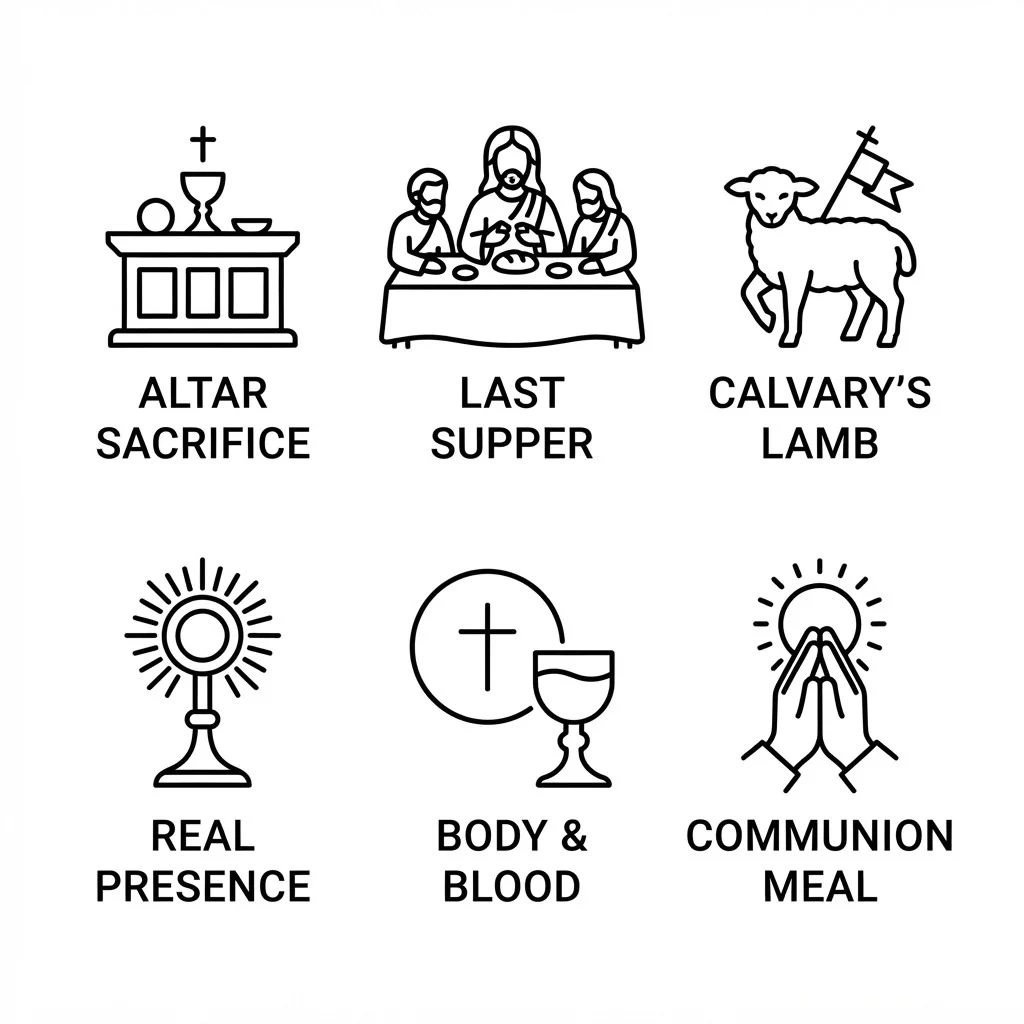
The Eucharist has several connected meanings in Christian worship. Catholic teaching especially emphasizes thanksgiving, memorial and sacrifice, and the presence of Christ. Communion also expresses unity among believers.
These themes explain why the Eucharist is more than a ceremony involving bread and wine.
1. Thanksgiving
The word Eucharist comes from the Greek eucharistia, which means thanksgiving.
During the Eucharistic celebration, Christians give thanks to God for creation, salvation, and the gift of Jesus Christ. Bread and wine also remind believers of the gifts of the earth and the work of human hands.
Thanksgiving is therefore part of the central meaning of the sacrament. It encourages believers to recognize God’s goodness and respond with gratitude.
2. Memorial and Sacrifice
The Eucharist recalls the Last Supper and Jesus’ death and resurrection. Jesus told his disciples to continue the practice in remembrance of him.
Catholic teaching understands this memorial as more than simply thinking about a past event. It teaches that Christ’s one sacrifice is made sacramentally present during the Eucharistic celebration.
This does not mean that Jesus is sacrificed again. Catholic doctrine teaches that his sacrifice on the cross happened once, while the Eucharist makes that one sacrifice present in the liturgy.
Other Christian traditions may explain the memorial and sacrificial language differently.
3. Communion and Unity
The word communion refers to sharing and participation. During the Eucharist, Christians express their relationship with Christ and their connection with the wider Church.
The image of one bread shared by many believers is especially meaningful. It communicates unity, fellowship, and a common faith.
For Catholic Christians, Holy Communion also deepens their union with Christ. The shared celebration reminds believers that Christian life involves love, service, forgiveness, and care for others.
Biblical connection: 1 Corinthians 10:16–17.
What Are the Symbols and Objects Used During Catholic Mass?
Catholic Mass includes several objects that support the celebration of the Eucharist. Some hold the bread and wine, while others are used to prepare the altar, reserve the consecrated host, or support prayer.
These objects are important, but they should not all be described as sacramental signs. Many are liturgical tools with a particular function.
Chalice
The chalice is the cup used for the wine during the Eucharistic celebration. It is one of the sacred vessels used at Mass.
Its practical role connects with the cup Jesus shared with his disciples at the Last Supper.
Paten
A paten is a small plate or shallow dish used to hold the bread or host during the Eucharistic celebration.
It is commonly made from a suitable metal and may be designed to match the chalice. Its role is practical, but it also belongs to the important group of vessels used in the liturgy.
Ciborium
A ciborium is a covered vessel used to hold consecrated hosts. It may be used when preparing Communion for distribution to the congregation.
After Mass, remaining consecrated hosts may be placed in a ciborium and reserved in the tabernacle.
Tabernacle
The tabernacle is a secure and dignified place in a Catholic church where the consecrated Eucharist is reserved.
It allows consecrated hosts to be kept for Communion outside Mass, including for people who are sick or unable to attend church.
The tabernacle is often placed in a prominent and suitable area of the church. Catholics show reverence toward it because of their belief in Christ’s Real Presence in the reserved Eucharist.
Sanctuary Lamp
A sanctuary lamp is a light placed near the tabernacle when the Blessed Sacrament is reserved there.
In Catholic churches, it indicates the presence of the consecrated Eucharist. The lamp may use a candle or another approved light source, depending on the church’s practice.
It reminds worshippers to approach the area with reverence.
Corporal
A corporal is a square white cloth placed on the altar beneath the sacred vessels during Mass.
The chalice, paten, and other vessels may rest on it during the Eucharistic celebration. It helps keep the altar area prepared for the liturgy.
Purificator
A purificator is a small cloth used to clean the chalice and other sacred vessels after Communion.
It is usually placed near the chalice during the celebration. Its role is practical and connected with the careful handling of the vessels.
Cruets
Cruets are small containers that hold the wine and water used during Mass.
The wine is prepared for the Eucharistic celebration, while a small amount of water is traditionally added to it in the Latin Catholic rite. The mixing of water and wine has also received spiritual interpretations in Christian tradition.
Monstrance
A monstrance is used to display the consecrated host during Eucharistic adoration. It is not normally used to hold the host for ordinary distribution during Communion.
Its purpose is to allow worshippers to pray before the Blessed Sacrament.
What Is the Difference Between Eucharist, Communion, and the Lord’s Supper?
The terms Eucharist, Communion, and the Lord’s Supper refer to closely related Christian practices. However, their meanings and preferred use can vary between denominations.
Eucharist
The word Eucharist means thanksgiving. It is commonly used by Catholic, Orthodox, Anglican, and other Christian communities to describe the sacrament or sacred celebration involving bread and wine.
In Catholic teaching, it refers to the sacrament in which Christ is truly present under the appearances of bread and wine.
Holy Communion
Holy Communion often refers to receiving the consecrated bread and, in traditions that offer it, the cup during the service.
The term also expresses the spiritual relationship between believers and Christ. In Catholic usage, it can refer to the reception of the Eucharist.
The Lord’s Supper
The Lord’s Supper emphasizes the meal Jesus shared with his disciples before his crucifixion.
Many Protestant churches use this name for their Communion service. It highlights Jesus’ instruction to remember him through the bread and cup.
The Breaking of Bread
The Breaking of Bread is an early Christian expression connected with sharing the Eucharistic meal.
The phrase recalls Jesus breaking bread with his disciples and the early Christian community gathering for worship and fellowship.
These terms overlap, but they may carry different theological emphasis depending on the Christian tradition.
How Do Different Christian Denominations Understand the Eucharist?
Christian communities share a connection with the Last Supper, but they do not all explain the Eucharist in exactly the same way.
Some traditions teach that Christ is truly present in the bread and wine. Others emphasize spiritual participation, remembrance, or the symbolic meaning of the meal.
The following overview is general. Individual churches and communities may explain their beliefs in more detail.
Catholic Understanding
The Catholic Church teaches that the bread and wine become the Body and Blood of Jesus Christ through consecration. This change is called transubstantiation.
Catholics believe Christ is truly and substantially present in the Eucharist. For this reason, the consecrated host is treated with special reverence and may be reserved in the tabernacle for prayer and Communion.
Eastern Orthodox Understanding
Eastern Orthodox Christians also believe in the real presence of Christ in the Eucharist. The Divine Liturgy is central to Orthodox worship, and the bread and wine are treated as holy gifts.
Orthodox teaching emphasizes the mystery of the sacrament and the work of the Holy Spirit. It does not require the same detailed explanation of the change used in Catholic discussions of transubstantiation.
Anglican Understanding
Anglican beliefs about the Eucharist include a range of theological explanations.
Many Anglicans affirm that Christ is truly present in the sacrament, although different Anglican communities explain this presence in different ways. The Eucharist is also understood as a memorial of Jesus’ death and a celebration of Christian unity.
Lutheran Understanding
Lutheran churches generally teach that Christ’s Body and Blood are truly present in the Lord’s Supper, received with the bread and wine.
This belief is often called sacramental union. It differs from the Catholic explanation of transubstantiation, even though both traditions affirm a real presence of Christ.
Reformed and Other Protestant Understandings
Reformed churches do not all explain Communion in the same way. Many emphasize spiritual participation in Christ through faith, while some Protestant communities place greater emphasis on remembrance and the symbolic meaning of the bread and cup.
Other churches combine remembrance with a strong understanding of spiritual presence.
It is therefore inaccurate to say that every Protestant church views Communion as only a symbol. Beliefs differ across denominations and individual congregations.
What Do Eucharist Symbols Mean for Children?
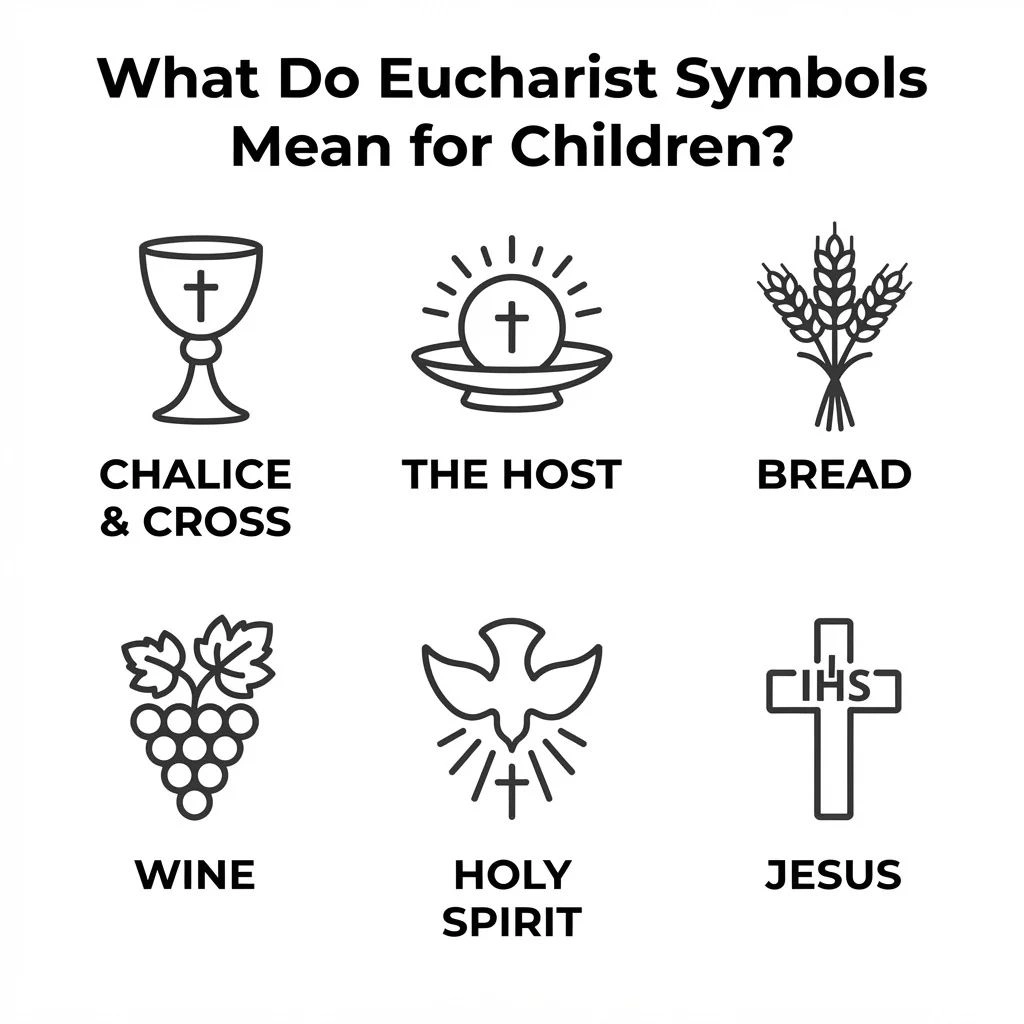
Eucharist symbols can help children understand important Christian teachings through familiar objects and simple ideas.
For children preparing for First Communion or learning about the Last Supper, it is helpful to explain each symbol in clear language.
| Symbol | Simple meaning for children |
| Bread | Jesus gives his followers spiritual nourishment |
| Wine | Jesus shared the cup with his disciples |
| Chalice | The special cup used during Communion |
| Wheat | The grain used to make bread |
| Grapes | The fruit used to make wine |
| Lamb | Jesus, the Lamb of God |
| Fish | An early sign of Christian faith |
| Cross | Jesus’ love and sacrifice |
| Altar | The special table used during the Eucharistic celebration |
| Host | The bread used during Holy Communion |
Why Is Bread Important in First Communion?
Bread is important because Jesus used it at the Last Supper. In Catholic teaching, the consecrated bread becomes the Body of Christ.
Children can learn that the bread is not treated as ordinary food after consecration. It has a special meaning in the Catholic celebration of the Eucharist.
Why Is the Chalice Important?
The chalice holds the wine used during the Eucharistic celebration. It reminds children of the cup Jesus shared with his disciples.
It also helps them recognize one of the most familiar objects used during Mass.
What Does the Cross Teach Children?
The cross reminds children that Jesus showed love through his sacrifice. It connects the Eucharist with the story of Jesus’ death and resurrection.
Children can understand it as a sign of love, hope, forgiveness, and faith.
How Can Teachers Explain Eucharist Symbols?
Teachers and parents can use pictures, simple charts, Bible stories, and church visits to explain these symbols.
For example, they can show a picture of the Last Supper and ask children to identify the bread and cup. They can also explain how wheat becomes bread and grapes become wine.
When teaching Catholic doctrine, adults should explain the Church’s belief in the Real Presence in age-appropriate language. Other Christian traditions may teach Communion differently.
What Is the Biblical Meaning of Eucharist Symbols?
The Eucharist has deep connections with the Bible. Its central signs, bread and wine, appear in the Last Supper accounts and connect with earlier biblical themes of food, sacrifice, thanksgiving, and God’s provision.
Several important passages help explain why these signs matter to Christians.
The Last Supper: The Foundation of the Eucharist
The Last Supper is the central biblical event behind the Christian celebration of the Eucharist.
Jesus gathered with his disciples before his crucifixion. During the meal, he took bread, gave thanks, broke it, and shared it with them. He also took the cup and connected it with the new covenant.
The Gospel accounts of Matthew, Mark, and Luke describe this event. Paul also refers to the tradition in 1 Corinthians.
The bread and cup therefore remind Christians of Jesus’ instructions and his sacrifice.
Key passages: Matthew 26:26–29, Mark 14:22–25, Luke 22:14–20, and 1 Corinthians 11:23–26.
Bread of Life: Jesus as Spiritual Nourishment
In John 6, Jesus describes himself as the Bread of Life. He teaches that those who come to him will not hunger and those who believe in him will not thirst.
This passage has a strong connection with Eucharistic teaching, especially in Catholic and Orthodox traditions.
The image of bread communicates dependence on Christ. Just as people need food to sustain physical life, Christians look to Christ for spiritual life.
Key passage: John 6:32–58.
Feeding of the Five Thousand: God’s Abundant Provision
The feeding of the five thousand is one of the best-known miracles in the Gospels.
Jesus takes five loaves and two fish, gives thanks, and distributes the food to the crowd. Everyone eats, and baskets of leftovers remain.
The story demonstrates Jesus’ compassion and power to provide. It also connects with Eucharistic themes because it involves bread, thanksgiving, and a meal shared among many people.
Early Christian artwork sometimes used bread baskets and fish to recall this miracle.
Key passages: Matthew 14:13–21, Mark 6:30–44, Luke 9:10–17, and John 6:1–14.
Road to Emmaus: Recognizing Jesus in the Breaking of Bread
After the resurrection, two disciples travel toward Emmaus. Jesus joins them, but they do not recognize him at first.
They later recognize him when he takes bread, blesses it, breaks it, and gives it to them.
This scene is important in Christian reflection because it connects the risen Christ with the breaking of bread. It also helps explain why early Christians used this expression for their gatherings.
Key passage: Luke 24:13–35.
The Vine and Branches: Remaining Connected to Christ
In John 15, Jesus describes himself as the true vine and his followers as branches.
The image teaches that spiritual life depends on remaining connected to Christ. Branches cannot produce fruit on their own when separated from the vine.
This passage is often connected with Eucharistic reflections because grapes and wine are among the sacrament’s central signs.
Key passage: John 15:1–5.
One Bread and One Body: Christian Unity
In 1 Corinthians 10:16–17, Paul connects the shared bread and cup with participation in Christ.
He also explains that the many believers become one body because they share the one bread.
This passage provides a clear biblical foundation for the Eucharist’s connection with unity and fellowship.
Key passage: 1 Corinthians 10:16–17.
How Did Eucharistic Symbols Develop in Early Christian Art?
Early Christians used images to express their beliefs, remember biblical events, and decorate places of worship and burial. Some of these images later became closely associated with Eucharistic themes.
The meaning of an image depends on its historical setting. A fish, loaf, or vine may have more than one Christian meaning, so it is important not to assume that every example represents the Eucharist.
Bread and Fish in Early Christian Images
Early Christian art sometimes showed baskets of bread alongside fish. These scenes are often connected with the feeding miracles in the Gospels.
In certain historical settings, the combination of bread, fish, and other meal imagery has been interpreted as Eucharistic. These images connect Jesus’ provision of food with the Christian celebration of Communion.
Banquet Scenes
Some early Christian artworks show people gathered around a meal.
These scenes have been interpreted in different ways, including as images of fellowship, the heavenly banquet, or the reception of Communion.
The context and details of each artwork matter. Not every ancient meal scene should automatically be identified as a Eucharistic celebration.
Grapes and the Vine
Grapes and vines became familiar images in Christian decoration.
They connect with biblical passages about the true vine and with the wine used in the Eucharist. Vine imagery can also communicate life, growth, abundance, and the relationship between Christ and his followers.
The Lamb in Christian Art
The lamb became an important image of Jesus Christ, especially through the title Lamb of God.
Christian artists used the lamb to communicate sacrifice, innocence, and victory. It appears in religious paintings, church decoration, and later Christian designs connected with worship.
The Pelican in Medieval Religious Art
The pelican became a traditional image of Christ’s sacrifice in medieval Christian art.
Its symbolic meaning developed from an old story about a parent pelican feeding its young with its own blood. Christian writers and artists used this image as an illustration of Christ giving himself for humanity.
The story should be understood as religious allegory rather than a description of actual bird behavior.
Why Are Eucharist Symbols Important in Christian Worship?
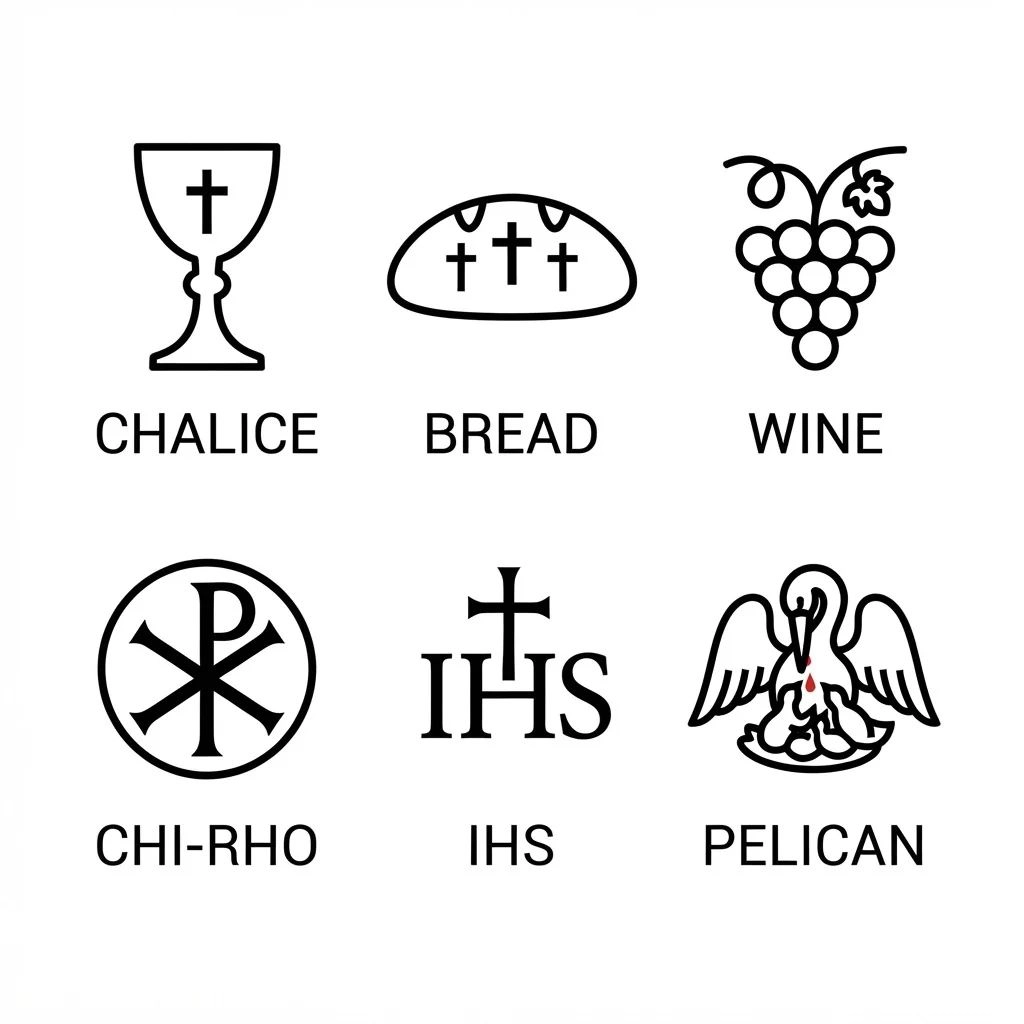
Eucharist symbols help Christians understand the meaning of Communion and remember the events behind the sacrament. They connect the visible actions of worship with important beliefs about Jesus, salvation, thanksgiving, and Christian unity.
They Help Christians Remember the Last Supper
Bread and wine recall the meal Jesus shared with his disciples before his crucifixion.
Through Communion, Christians remember his words and actions. The celebration keeps the Last Supper connected with Christian worship.
They Explain Important Christian Beliefs
The symbols communicate ideas that can sometimes be difficult to explain through words alone.
Bread expresses nourishment, wine recalls the new covenant, and the lamb points toward Christ’s sacrifice. Together, these images help explain the Christian understanding of Jesus’ life and mission.
They Encourage Unity and Fellowship
The Eucharist brings believers together around a shared act of worship.
The image of one bread shared by many people reminds Christians that faith is not only personal. It also involves belonging to a community and caring for others.
They Connect Worship With Biblical History
Eucharistic imagery brings together several biblical themes, including the Last Supper, the feeding miracles, the Bread of Life, the Passover, and the new covenant.
These connections help Christians understand Communion as part of the wider biblical story.
They Make Religious Teaching Easier to Understand
Objects and images can help people remember religious ideas. A child may recognize a chalice or a loaf of bread more easily than an abstract theological explanation.
The same is true for church visitors, students, and people learning about Christian traditions for the first time.
Is the Eucharist a Symbol or the Real Presence of Christ?
Christians do not all answer this question in the same way. The answer depends on their church tradition and its understanding of Communion.
In Catholic teaching, the Eucharist is not merely a symbol. The Church teaches that Christ is truly and substantially present under the appearances of consecrated bread and wine. The change is called transubstantiation.
Eastern Orthodox Christians also affirm the real presence of Christ in the Eucharist, although they generally approach the mystery without using the same detailed explanation of transubstantiation.
Many Anglicans and Lutherans also affirm a form of Christ’s real presence, but their explanations differ from Catholic teaching.
Some Reformed and other Protestant communities emphasize spiritual participation in Christ, remembrance, or the symbolic meaning of the bread and cup. Their beliefs are not all identical.
What Does Real Presence Mean in Catholic Teaching?
The Catholic Church teaches that the whole Christ is present in the Eucharist: Body, Blood, soul, and divinity.
The outward appearances of bread and wine remain, but their substance changes through consecration. This is why Catholics treat the consecrated host and wine with special reverence.
Why Do Some Christians Call Communion a Symbol?
Some Christian communities place greater emphasis on the bread and cup as signs that help believers remember Jesus’ sacrifice.
For these traditions, Communion remains a meaningful act of worship, faith, and fellowship. However, their explanation of Christ’s presence may differ from Catholic and Orthodox teaching.
Are Eucharistic Symbols the Same in Every Church?
No. Many Christian communities share the bread-and-cup tradition, but their worship practices, theological explanations, and use of religious objects vary.
For this reason, it is best to identify the tradition before explaining the meaning of a particular Eucharistic image or practice.
Frequently Asked Questions About Eucharist Symbols
What Are the Main Symbols of the Eucharist?
The main Eucharistic signs are bread and wine. Other familiar symbols and images include the chalice, wheat, grapes, host, lamb, fish, altar, pelican, and monstrance. Their meanings vary according to their role in worship and Christian tradition.
What Are the Two Essential Signs of the Eucharist?
In Catholic teaching, the two essential signs are wheat bread and grape wine. They are the elements used in the sacrament and are connected with Jesus’ actions at the Last Supper.
What Does Bread Represent in the Eucharist?
Bread represents the Body of Christ in Catholic teaching after consecration. It also communicates spiritual nourishment and recalls the bread Jesus shared with his disciples.
What Does Wine Represent in the Eucharist?
Wine represents the Blood of Christ in Catholic teaching after consecration. It also recalls the new covenant and Jesus’ sacrifice.
What Does the Chalice Symbolize?
The chalice is the cup used for the wine during the Eucharistic celebration. It recalls the cup Jesus shared with his disciples at the Last Supper and is associated with the new covenant.
What Is the Difference Between a Chalice and a Ciborium?
A chalice is a cup used for the wine during Mass. A ciborium is a covered vessel used to hold consecrated hosts. Both are sacred vessels, but they serve different purposes.
What Is a Paten Used for in the Eucharist?
A paten is a small plate or shallow vessel used to hold the bread or host during the Eucharistic celebration. It is commonly used alongside the chalice.
Why Is the Lamb a Symbol of the Eucharist?
The lamb represents Jesus Christ as the Lamb of God. It connects the Eucharist with Jesus’ sacrifice, redemption, and the biblical Passover imagery.
What Does the Fish Symbol Mean in Christianity?
The fish is an early Christian sign associated with Jesus Christ and Christian identity. It can also appear in Eucharistic artwork, particularly in scenes involving bread and the feeding miracles.
What Does the Pelican Symbolize in Christianity?
The pelican is a traditional image of Christ’s self-giving love. An old religious story about a pelican feeding its young with its blood became an allegory for Jesus giving his life for humanity.
What Is the Monstrance Used For?
A monstrance is a vessel used in the Catholic Church to display the consecrated host during Eucharistic adoration. It allows worshippers to pray before the Blessed Sacrament.
What Is the Difference Between Eucharist and Communion?
Eucharist usually refers to the sacrament or celebration involving bread and wine. Communion can refer to receiving the Eucharist and to the spiritual unity of believers. Their exact use varies across Christian traditions.
What Are the Symbols Used During Catholic Mass?
Important objects include the chalice, paten, ciborium, altar, tabernacle, corporal, purificator, and cruets. The monstrance is especially associated with Eucharistic adoration outside Mass.
What Do Eucharist Symbols Mean for Children?
For children, bread can represent spiritual nourishment, wine recalls the cup Jesus shared, and the chalice represents the cup used during Communion. The cross teaches about Jesus’ love and sacrifice, while the lamb represents Jesus as the Lamb of God.
Is the Eucharist Only a Symbol?
Christian traditions differ. Catholic and Eastern Orthodox churches teach that Christ is truly present in the Eucharist. Many Anglican and Lutheran communities also affirm a form of real presence. Some other Protestant churches emphasize remembrance or spiritual participation.
Conclusion
Eucharist symbols help Christians understand the meaning of Communion and remember Jesus’ sacrifice. Bread and wine are the central signs, connecting the sacrament with the Last Supper, the new covenant, and spiritual nourishment.
Other images, such as wheat, grapes, the lamb, fish, and pelican, add biblical and historical meaning. Objects like the chalice, paten, ciborium, tabernacle, and monstrance support worship and Eucharistic devotion.
Although Christian traditions explain the Eucharist in different ways, these signs remain important parts of Christian worship and teaching. Understanding their meanings helps readers appreciate the connection between Scripture, faith, and the celebration of Communion.

Dylan Anderson is a writer who enjoys turning complex topics into simple, engaging content that readers can actually use. His work focuses on clear explanations, practical insights and storytelling that feels natural and relatable. He is also the fictional author of The Quiet Compass of Ashford and Where the Cedar Lantern Glows. When he’s away from his keyboard, Dylan enjoys hiking, reading, and discovering inspiration in everyday life. He believes great writing should be informative, easy to understand and enjoyable from beginning to end.
 Adam Sullivan