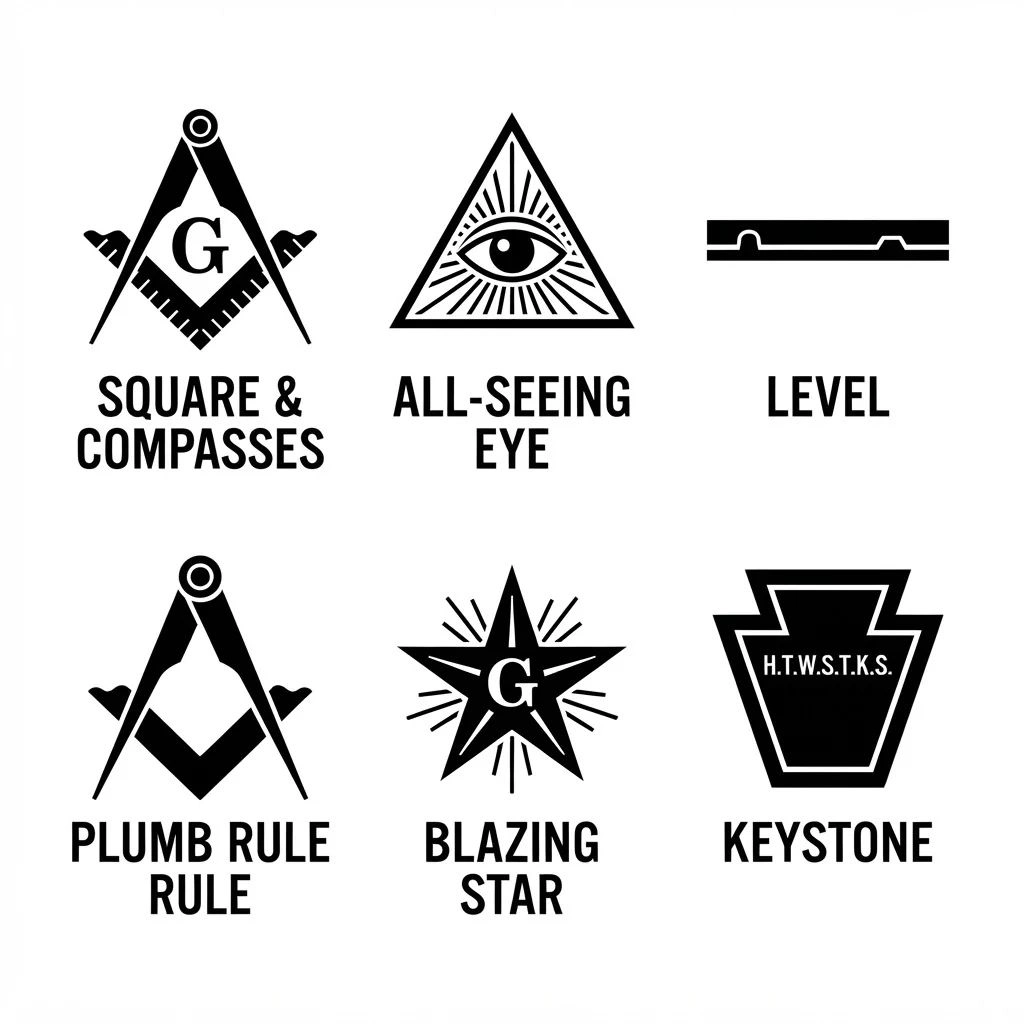
Masonic symbols appear on rings, aprons, buildings, jewelry, historical paintings, and lodge decorations. Some are easy to recognize, while others look like ordinary building tools, religious designs, or geometric patterns. If you are searching for Masonic symbols images, you may want to identify a particular emblem, understand its meaning, or discover why Freemasons use these designs.
Freemasonry has a long tradition of teaching through symbols. Many of its best-known emblems come from the tools of stonemasons. The Square and Compasses, level, plumb rule, gavel, and trowel turn practical objects into lessons about character, fairness, discipline, and cooperation.
Other Masonic images draw on architecture, geometry, biblical stories, and traditional lodge ceremonies. You may find them together on tracing boards, aprons, officer jewels, and historic objects.
This guide explores the most recognizable Masonic symbols and explains what they commonly represent. It also covers the Three Great Lights, Masonic floor designs, tracing boards, rings, aprons, antiques, and ways to identify unfamiliar symbols. Because Masonic customs differ across countries and organizations, the explanations distinguish widely recognized meanings from interpretations that vary by tradition.
Masonic Symbols Images and Meanings at a Glance
Use this chart to identify common Masonic symbols before exploring their meanings in detail. The descriptions explain their usual appearance and traditional associations, but not every lodge uses every design.
| Masonic symbol | What it looks like | Common meaning or association |
| Square and Compasses | A builder’s square joined with a pair of compasses | Moral conduct and self-control |
| Letter G | A capital G, often inside the Square and Compasses | Geometry; also associated with God in some interpretations |
| All-Seeing Eye | An eye surrounded by rays, sometimes inside a triangle | Divine watchfulness and providence |
| Masonic Apron | A white waist garment, sometimes decorated | Honest labor and the Masonic tradition |
| Boaz and Jachin | Two pillars or columns | Strength and stability |
| Level | A horizontal measuring tool | Equality |
| Plumb Rule | A cord with a hanging weight | Upright conduct |
| Gavel | A small ceremonial hammer | Discipline and self-improvement |
| Trowel | A masonry tool with a flat blade | Brotherhood and unity |
| Beehive | A hive, often surrounded by bees | Industry and cooperation |
| Blazing Star | A radiant star | Light and knowledge |
| Sun and Moon | Images of the sun and crescent moon | Celestial light and time |
| Acacia | A leafy branch or sprig | Remembrance and immortality |
| Rough and Perfect Ashlar | Two stone blocks with different finishes | Personal development |
| Tessellated Pavement | A black-and-white checkerboard floor | Contrasting experiences in life |
| Three Great Lights | A sacred book, square, and compasses | Important principles of Masonic lodge work |
| Three Steps | A short staircase in symbolic artwork | Progress and advancement in some traditions |
| 47th Proposition of Euclid | A geometric right-triangle diagram | Geometry and mathematical knowledge |
| Hourglass | A glass container with flowing sand | The passage of time |
| Scythe | A curved-blade harvesting tool | Mortality and the limits of life |
What Are Masonic Symbols?
Masonic symbols are images, objects, and designs used in Freemasonry to communicate moral lessons and traditional teachings. Many come from the tools and working methods of historical stonemasons.
Freemasonry developed from traditions connected with operative masonry, the practical craft of building with stone. Over time, its members used the language of construction as a way to discuss personal character and community responsibilities.
For example, a builder uses a square to check an angle. In Masonic teaching, the same tool can remind a person to act fairly and honestly. A level checks a horizontal surface, while its symbolic meaning commonly relates to equality.
This approach allows a familiar object to communicate an idea without requiring a long explanation.
Why Does Freemasonry Use Symbols?
Symbols make abstract lessons easier to remember. A tool, building feature, or geometric shape can represent a principle that members consider during meetings and ceremonies.
Masonic symbolism commonly addresses themes such as:
- Honesty and fairness.
- Self-control and discipline.
- Knowledge and learning.
- Brotherhood and cooperation.
- Personal improvement.
- Responsibility toward others.
- Awareness of mortality and time.
Not all symbols carry the same meaning in every Masonic organization. Their interpretation can depend on the country, lodge, degree, and historical period.
1. Square and Compasses: The Most Recognizable Masonic Symbol
The Square and Compasses is the best-known emblem of Freemasonry. It combines two traditional building tools: a square and a pair of compasses.
The square usually appears beneath or around the compasses. Some designs include a capital G in the center, while others leave the middle empty.
The two tools have practical purposes in construction. A square helps builders check right angles, while compasses draw circles and measure distances. Their symbolic meanings turn those practical functions into lessons about behavior.
The square commonly represents fairness, honesty, and moral conduct. It reminds members to treat others properly and make responsible decisions.
The compasses often represent self-control and moderation. They encourage people to keep their desires and actions within reasonable limits.
Together, the tools provide a reminder to live with integrity and discipline.
Image suggestion: A traditional Square and Compasses emblem with the two tools clearly visible against a plain background.
Suggested alt text: Masonic Square and Compasses emblem representing moral conduct and self-control.
Why Do Some Square and Compasses Symbols Have a Letter G?
The letter G appears in many American Masonic designs. It commonly stands for Geometry, a subject closely connected with the historical work of stonemasons and builders.
Geometry helps people measure distances, understand angles, and create accurate structures. Its connection with Freemasonry reflects the fraternity’s use of building traditions as symbolic lessons.
Some interpretations also associate G with God or the Great Architect of the Universe. However, the Museum of Freemasonry explains that Geometry is the original meaning of the letter in this emblem’s historical context. The letter’s use differs between countries, and it does not appear in every version. https://museumfreemasonry.org.uk/node/1111
Why Do Masonic Emblems Look Different?
You may see the Square and Compasses with different angles, decorative details, or lettering. These variations do not automatically indicate that one design is incorrect.
The appearance can depend on the Masonic jurisdiction, lodge, artistic period, or organization. Some versions include the letter G, while others do not.
When identifying an emblem, examine the complete design rather than relying on one small detail.
2. The Letter G in Masonic Symbols
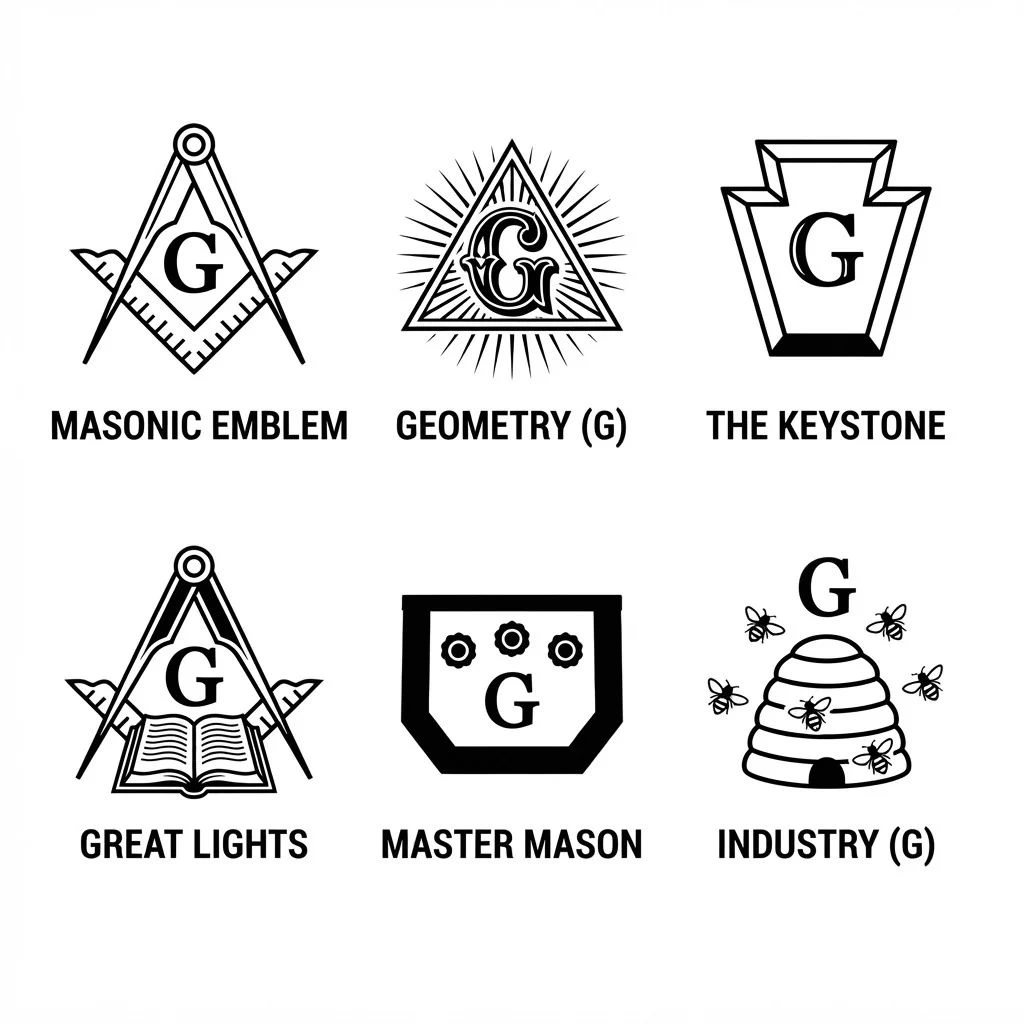
The letter G is one of the most recognizable details in certain Masonic emblems. It usually appears inside the Square and Compasses or as a separate decorative feature.
Its strongest historical association is with Geometry. This subject played an important role in the work of stonemasons because builders needed accurate measurements and geometric knowledge to construct buildings.
Some Masonic interpretations also connect the letter with God. This reflects the spiritual language used in certain Masonic traditions.
However, the meaning should not be treated as identical everywhere. The Museum of Freemasonry notes that the letter G appears in many countries but is not a standard feature of English Masonic versions of the emblem. It remains common in some Scottish, Irish, and American designs.
Image suggestion: A close-up of the Square and Compasses with a capital G in the center.
Suggested alt text: Capital G inside a traditional Masonic Square and Compasses emblem.
3. The All-Seeing Eye or Eye of Providence
The All-Seeing Eye is usually shown as a single eye surrounded by rays of light. Some versions place the eye inside a triangle.
It is also called the Eye of Providence. In Masonic settings, the image can represent divine watchfulness, moral accountability, and the belief that a higher power observes human actions.
The symbol is not exclusive to Freemasonry. It also appears in religious artwork, architecture, and other historical visual traditions.
That distinction matters because people sometimes label every eye inside a triangle as a Masonic emblem. The surrounding design and historical context are more useful than the eye alone.
Is the All-Seeing Eye on the Dollar Bill a Masonic Symbol?
The reverse of the United States one-dollar bill displays the Great Seal of the United States. Its design includes an unfinished pyramid and an eye above it.
People often connect this image with Freemasonry because the Eye of Providence also appears in some Masonic artwork. However, the Great Seal is an American national emblem, and the eye has a much broader history.
Its presence on the dollar bill does not prove that the design is an exclusive Masonic symbol or evidence of a hidden organizational connection.
Image suggestion: An Eye of Providence inside a triangle, shown separately from the pyramid and eye on the Great Seal.
Suggested alt text: Eye of Providence symbol with a single eye surrounded by rays of light.
4. The Masonic Apron
The Masonic apron is a traditional garment worn around the waist during lodge meetings and certain public events. Its origins connect with the protective aprons used by working stonemasons.
In Freemasonry, the apron represents the fraternity’s connection with honest labor and the building trade. It also carries symbolic associations with purity and a member’s Masonic journey.
Many aprons are white, although their decorations can include embroidered symbols, colored borders, ribbons, and other details.
Why Do Freemasons Wear Aprons?
The apron links modern Freemasonry with the practical work of historical stonemasons. It reminds members of the value of honest effort and responsible behavior.
Its white color is commonly associated with purity in Masonic explanations. However, the exact design and decorative features depend on the tradition, degree, office, and jurisdiction.
Different Types of Masonic Aprons
Masonic aprons can look very different from one another.
- Plain white apron: A simple design with little or no decoration.
- Decorated apron: May include embroidered borders, symbols, or colored details.
- Officer apron: Can feature designs associated with a particular lodge office.
- Historical apron: May include older materials, handmade embroidery, or period-specific artwork.
- Degree-related apron: May follow the customs of a particular Masonic tradition.
Do not assume that every decorative feature indicates a specific rank. Some details are traditional, while others reflect local rules or historical fashion.
Image suggestion: A white Masonic apron with a clearly visible embroidered Square and Compasses.
Suggested alt text: Traditional white Freemason apron decorated with Masonic embroidery.
5. The Two Pillars: Boaz and Jachin
Two pillars are common in Masonic artwork and lodge decorations. They are traditionally associated with Boaz and Jachin, the two pillars described in the biblical account of Solomon’s Temple.
Masonic imagery often shows them as tall columns with decorative capitals. Some designs include globes or other objects on top.
The pillars connect Freemasonry with the architectural symbolism of Solomon’s Temple. Their traditional associations include strength and stability.
You may also find the pillars on tracing boards, lodge decorations, illustrations, and ceremonial objects.
Their exact placement and interpretation can vary. Some designs show the pillars as architectural features, while others use them as part of a larger symbolic scene.
Image suggestion: Two classical columns representing Boaz and Jachin.
Suggested alt text: Masonic pillars of Boaz and Jachin inspired by the biblical account of Solomon’s Temple.
6. The Masonic Level
The level is a builder’s tool used to check whether a surface is horizontal. It helps construction workers make sure that floors, walls, and other structures are properly aligned.
In Masonic symbolism, the level commonly represents equality. It reminds members that people should meet on fair terms, regardless of wealth, social position, or background.
The level is also associated with lodge traditions and certain officer roles. It can appear on ceremonial jewelry, collars, and tracing boards.
Image suggestion: A traditional builder’s level shown as a standalone emblem.
Suggested alt text: Masonic level symbol representing equality and fairness.
7. The Plumb Rule or Plumb Line
The plumb rule is a vertical measuring tool. It uses a cord and hanging weight to show a true vertical line.
Builders use it to check whether a wall or structure stands straight. In Masonic symbolism, it commonly represents upright behavior, honesty, and moral consistency.
The image reminds members to remain steady in their principles. Just as a builder checks a wall for alignment, a person can examine their own actions and decisions.
The plumb line also appears in lodge jewelry and historical tracing boards.
Image suggestion: A plumb line with a pointed weight hanging from a cord.
Suggested alt text: Masonic plumb rule symbol representing upright conduct and integrity.
8. The Masonic Gavel
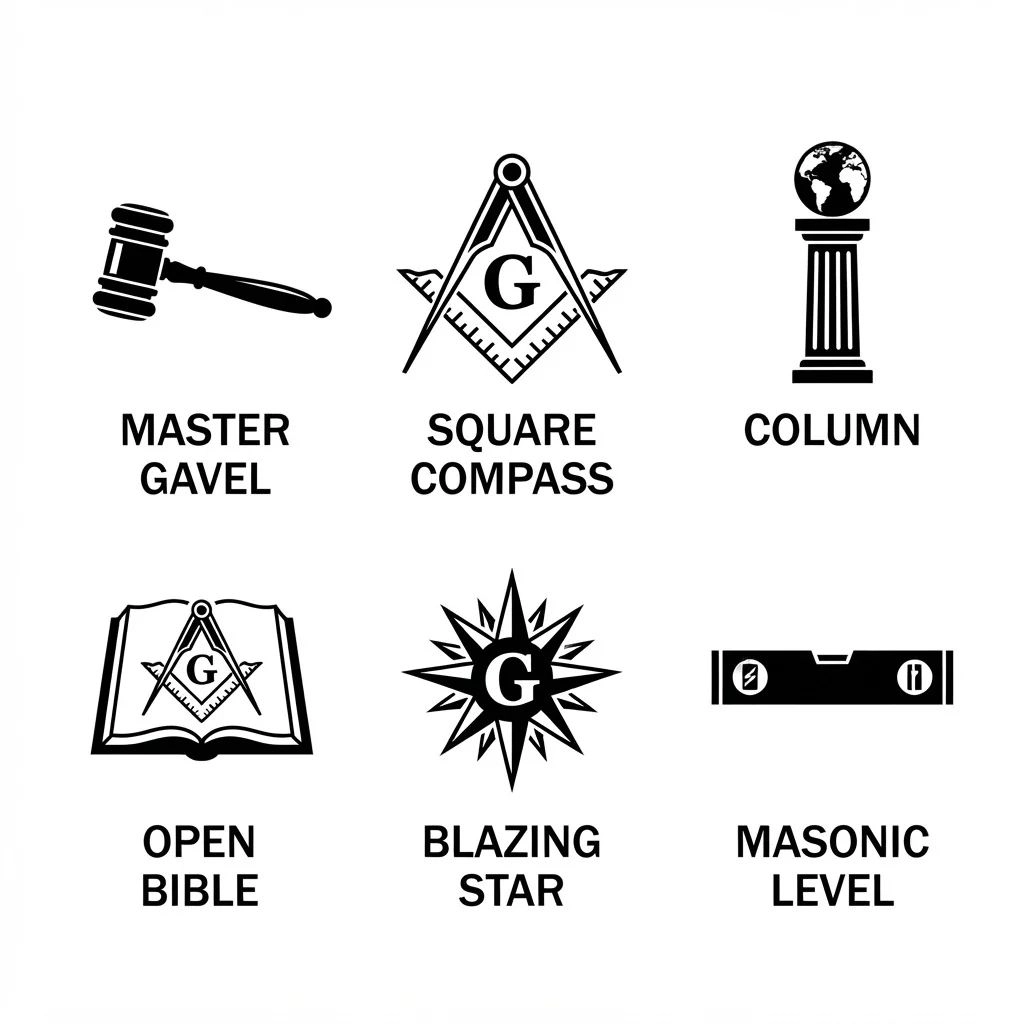
A gavel is a small ceremonial hammer used by a lodge’s presiding officer. It helps maintain order and signals when a meeting should begin, pause, or end.
Its symbolic meaning often relates to discipline, authority, and self-improvement.
The gavel also connects with the work of a stonemason. A builder uses tools to shape stone into a suitable form. In symbolic teaching, this process can represent the effort to improve personal character.
Image suggestion: A wooden ceremonial gavel displayed beside a Masonic emblem.
Suggested alt text: Masonic gavel representing discipline and personal improvement.
9. The Masonic Trowel
The trowel is a masonry tool used to spread mortar between bricks or stones. It helps connect separate building materials into a stable structure.
In Masonic symbolism, the trowel commonly represents brotherly love, friendship, and unity. It provides a comparison between joining stones and bringing people together through mutual respect.
The symbol can appear on lodge decorations, historical objects, and Masonic jewelry.
Image suggestion: A traditional masonry trowel beside a small stone wall.
Suggested alt text: Masonic trowel symbol representing brotherhood and unity.
10. The Three Great Lights of Freemasonry
The Three Great Lights are important symbols in many Craft Masonic traditions. They are commonly identified as the Volume of Sacred Law, the Square, and the Compasses.
Their arrangement and interpretation can differ between Masonic jurisdictions, but they are widely recognized as central lodge symbols.
The Volume of Sacred Law
The Volume of Sacred Law is a sacred text used in a lodge according to its tradition and rules. It represents spiritual guidance and the importance of moral principles.
The specific book can vary depending on the religious and cultural context of the lodge. Avoid assuming that every lodge uses the same text.
The Square
The square represents fairness and moral conduct. Its practical purpose is to help builders create accurate right angles, while its symbolic use encourages honest behavior.
The Compasses
The compasses commonly represent moderation and self-restraint. They remind members to manage their actions and desires responsibly.
Image suggestion: A traditional display showing the Volume of Sacred Law, Square, and Compasses together.
Suggested alt text: Three Great Lights of Freemasonry represented by a sacred book, square, and compasses.
11. The Lesser Lights of Freemasonry
The Lesser Lights are another group of symbols found in many Masonic Craft traditions. They are commonly associated with the sun, moon, and Master of the Lodge.
The sun and moon are natural sources of light and appear in traditional lodge explanations. The Master represents the lodge’s leadership and guidance.
These symbols should not be confused with the Three Great Lights. They are separate symbolic groupings, although their names and explanations may vary between jurisdictions.
Image suggestion: A traditional Masonic illustration showing the sun, moon, and Master-related symbolism.
Suggested alt text: Masonic Lesser Lights represented by the sun, moon, and Master of the Lodge.
12. The Beehive Symbol
The beehive is a recognizable but less universal Masonic emblem. It commonly represents industry, cooperation, and organized effort.
A hive provides a comparison for a community in which individuals contribute to a shared purpose. Each bee has a role, and the colony depends on cooperation.
In Masonic explanations, the beehive can encourage members to work diligently, support their communities, and contribute something useful to society.
The symbol appears in some Masonic illustrations, historical objects, and decorative designs. It is not necessary to find it in every lodge.
Image suggestion: A traditional beehive surrounded by bees.
Suggested alt text: Masonic beehive symbol representing industry and cooperation.
13. The Blazing Star
The Blazing Star appears in some Masonic designs as a bright star surrounded by rays. It may have five or more points, depending on the illustration and tradition.
The symbol is commonly associated with light, knowledge, and guidance. It can represent the search for wisdom and the desire to understand the world.
Some historical tracing boards place the letter G inside a radiant star. Other designs use a star without a letter.
Do not assume that every star in a Masonic image has one fixed meaning. Its interpretation depends on the design and the tradition that uses it.
Image suggestion: A radiant star with light rays surrounding its center.
Suggested alt text: Masonic Blazing Star symbol representing light and knowledge.
14. The Sun and Moon Symbols
The sun and moon appear together in some Masonic lodge decorations and tracing boards.
The sun is commonly associated with daylight and the natural cycle of time. The moon represents the night and appears in traditional images of the celestial world.
Together, they can illustrate the passage of time and the natural order. Their meaning depends on the lodge’s symbolism and the design in which they appear.
The sun and moon may also appear alongside stars, pillars, or other architectural details.
Image suggestion: A decorative Masonic sun and crescent moon displayed side by side.
Suggested alt text: Masonic sun and moon imagery representing celestial light and time.
15. Acacia Branch or Sprig
Acacia is a plant with a special place in some Masonic traditions, particularly those connected with the Master Mason degree.
The sprig is commonly associated with remembrance, immortality, and the idea that life continues beyond physical death.
Its symbolic role connects with the traditional Masonic story of Hiram Abiff. The story forms part of Master Mason teachings, and the acacia branch appears as an important image within that symbolic tradition.
Acacia can appear in tracing boards, ceremonial illustrations, memorial designs, and historical Masonic artwork.
Image suggestion: A small green acacia branch with delicate leaves.
Suggested alt text: Acacia sprig used in Masonic symbolism to represent remembrance and immortality.
16. Rough Ashlar and Perfect Ashlar
The rough ashlar and perfect ashlar are two stone blocks used to represent personal development.
A rough ashlar is an unfinished stone with an uneven surface. It symbolizes a person at the beginning of a process of learning and self-improvement.
A perfect ashlar is a stone shaped into a regular form. It represents the goal of developing better judgment, discipline, and moral character.
The two stones create a simple comparison: people can work to improve themselves through knowledge, experience, and responsible choices.
Historical tracing boards often show the two stones together to illustrate this lesson.
Image suggestion: Two stone blocks, one rough and one smoothly finished.
Suggested alt text: Rough and perfect ashlar stones representing personal improvement in Freemasonry.
17. Tessellated Pavement: The Black and White Masonic Floor
The tessellated pavement is a checkerboard-style floor design made of alternating black and white squares. It is a recognizable feature in many Masonic lodge illustrations and interiors.
The pattern creates a visual contrast between two colors. Masonic explanations often connect it with the contrasting experiences people encounter in life, including happiness and difficulty.
The floor can also remind members that life includes different conditions and experiences. Its symbolic interpretation is not identical in every Masonic tradition.
The design appears on tracing boards and in lodge rooms. It can also be reproduced in decorative artwork and Masonic collectibles.
Image suggestion: A black-and-white checkerboard floor in a traditional Masonic lodge setting.
Suggested alt text: Tessellated black and white pavement used in Masonic lodge symbolism.
18. The Three Steps in Masonic Symbolism
Three steps sometimes appear in Masonic tracing boards and symbolic illustrations. They may form part of a staircase leading toward a building or another symbolic feature.
The steps are commonly interpreted as representing progress, learning, and advancement. They can suggest that personal development takes place gradually rather than all at once.
However, their meaning and arrangement vary across Masonic designs. Some tracing boards include a staircase with more than three steps, so avoid treating every staircase image as the same symbol.
Image suggestion: Three stone steps leading toward a symbolic entrance.
Suggested alt text: Three steps in Masonic imagery representing progress and advancement.
19. The 47th Proposition of Euclid
The 47th Proposition of Euclid is a geometric theorem associated with right triangles. It is also widely known as the Pythagorean theorem.
The theorem explains the relationship between the sides of a right-angled triangle. In its familiar mathematical form, the square of the hypotenuse equals the sum of the squares of the other two sides.
Geometry has a strong historical connection with the craft of building. Stonemasons needed mathematical knowledge to measure, design, and construct structures.
The 47th Proposition appears in some Masonic artwork and is associated with the jewel of a Past Master in certain traditions. It should not be presented as a universal emblem worn by every Freemason.
Image suggestion: A right triangle with squares drawn along its three sides.
Suggested alt text: 47th Proposition of Euclid shown as a geometric right-triangle diagram.
20. Hourglass and Scythe Symbols
An hourglass and scythe sometimes appear in Masonic artwork connected with mortality and the passage of time.
The hourglass contains sand that gradually moves from one chamber to another. It provides a visual reminder that time passes and human life is limited.
The scythe is a harvesting tool with a curved blade. In symbolic artwork, it can represent mortality and the end of life.
These images are not as universally recognizable as the Square and Compasses. They may appear in particular tracing boards, degree-related illustrations, and historical collections.
Image suggestion: A traditional hourglass and scythe shown as separate symbolic objects.
Suggested alt text: Hourglass and scythe in historical Masonic symbolism representing time and mortality.
What Are Masonic Tracing Boards?
Masonic tracing boards are illustrated boards or cloths used in lodge teaching. They bring several symbols together in one visual composition.
Historical tracing boards may show pillars, stairs, stones, stars, building tools, geometric designs, and other images. Their arrangements can help members understand lessons connected with Masonic ceremonies and degrees.
In earlier periods, some lodges used painted floor cloths. These could be rolled up and stored when meetings ended. Other boards were mounted on wood or displayed on lodge walls.
The Museum of Freemasonry explains that tracing boards serve as visual aids for teaching the symbolism associated with Masonic ceremonies. Its collection includes boards connected with different periods and traditions. https://museumfreemasonry.org.uk/blog/learn-about-freemasonry-what-are-masonic-tracing-boards
Entered Apprentice Tracing Boards
Entered Apprentice tracing boards are associated with the first Craft degree. They may include working tools, stones, pillars, and other images used in the degree’s instruction.
The exact arrangement differs between traditions. Historical examples can help readers understand how Masonic symbolism developed over time.
Fellow Craft Tracing Boards
Fellow Craft tracing boards commonly include architectural and geometric imagery. Some designs show Solomon’s Temple, pillars, stairs, and other symbols connected with learning and building.
Master Mason Tracing Boards
Master Mason tracing boards can include imagery associated with the traditional Hiram Abiff story, remembrance, and mortality.
Some historical designs show a coffin, acacia, or other symbolic objects. Their interpretation belongs to the relevant Masonic tradition and should not be treated as universal across all organizations.
Why Are Tracing Boards Important?
Tracing boards preserve the visual history of Freemasonry. They show how artists and lodges used pictures to communicate ideas before modern presentation tools existed.
They are also useful for historical research. A tracing board can reveal the symbols, artistic styles, and teaching methods used by a particular lodge during a specific period.
Image suggestion: A historical Masonic tracing board showing several symbols in one composition.
Suggested alt text: Antique Masonic tracing board displaying traditional lodge symbols and geometric designs.
What Are Masonic Officer Jewels?
Masonic officer jewels are decorative badges associated with positions in a lodge. They often display a working tool or another emblem connected with the officer’s responsibilities.
The design may appear on a collar, pendant, or other piece of lodge regalia.
Some commonly documented examples include:
| Lodge office | Common jewel |
| Worshipful Master | Square |
| Senior Warden | Level |
| Junior Warden | Plumb rule |
These associations are common in many Craft Masonic traditions, although details can vary by jurisdiction.
Other lodge officers may have different jewels connected with their duties. Some designs include a key, quill, book, or other object.
A jewel is not simply decoration. It can identify an office and connect the role with a symbolic lesson.
Image suggestion: A collection of Masonic officer jewels displayed together.
Suggested alt text: Masonic officer jewels showing traditional square, level, and plumb rule designs.
Different Types of Masonic Rings and Their Symbols
Masonic rings are among the most familiar personal items associated with Freemasonry. Many feature the Square and Compasses, sometimes with the letter G in the center.
Other designs include stars, engraved lettering, lodge names, and decorative geometric details.
A ring can express a member’s connection with the fraternity or serve as a personal reminder of Masonic principles. However, its appearance alone cannot verify someone’s membership, degree, or office.
Square and Compasses Masonic Rings
These rings display the best-known Masonic emblem. The design may appear on a flat signet surface or as a raised metal decoration.
Some versions include a letter G, while others show only the two tools.
Gold and Silver Masonic Rings
Masonic rings can be made from different metals, including gold and silver. Some have a plain band, while others include enamel or engraved details.
The material does not establish a person’s Masonic rank or status.
Vintage and Antique Masonic Rings
Older rings can include designs that differ from modern jewelry. Their lettering, metalwork, and decorative patterns may reflect the period in which they were made.
If you are trying to identify an antique ring, examine its markings, construction, inscriptions, and documented ownership where available. A Masonic-looking design alone cannot establish its age or original owner.
Masonic Signet Rings
A signet ring has a flat or raised surface that can display an emblem or inscription. Some Masonic signet rings use the Square and Compasses as their main design.
Others may show lodge-related details or decorative symbols.
Image suggestion: A selection of Masonic rings showing different Square and Compasses designs.
Suggested alt text: Different Masonic rings featuring Square and Compasses emblems and decorative details.
Masonic Apron Images and Their Different Designs
Masonic apron images can help readers recognize the traditional clothing worn in lodge settings.
A simple white apron may look very different from an ornate historical apron. Some have embroidered borders, colored ribbons, or decorative symbols.
When comparing apron designs, pay attention to:
- Shape and size.
- Color and fabric.
- Embroidered symbols.
- Decorative borders.
- Ribbons and rosettes.
- Any lodge or office markings.
These details can help identify a particular style, but they should not be used alone to determine a person’s degree or status.
Historical apron designs are especially useful for understanding how Masonic regalia changed over time.
Image suggestion: Three examples of Masonic aprons, including a plain white design, an embroidered apron, and a historical apron.
Suggested alt text: Examples of Masonic apron designs with different embroidery and decorative details.
Masonic Symbols on Buildings and Lodge Interiors
Masonic symbols can appear on lodge entrances, building facades, interior walls, ceremonial rooms, and memorial structures.
The Square and Compasses is one of the clearest visual signs of a Masonic connection. It may identify a lodge building or commemorate a member or historical event.
Other common designs include:
- Boaz and Jachin: Two pillars associated with the Temple of Solomon.
- Tessellated pavement: A black-and-white floor pattern.
- The All-Seeing Eye: An emblem used in some Masonic settings.
- The Blazing Star: A radiant star found in certain lodge designs.
- Working tools: Square, level, plumb rule, gavel, or trowel.
- Tracing board imagery: A collection of symbols arranged for instruction.
However, a single symbol does not always prove that a building belongs to Freemasons. Columns, stars, geometric shapes, and eyes also appear in other architectural and artistic traditions.
Consider the full design and historical context before identifying a building as Masonic.
Masonic Symbols on Antiques, Furniture, and Collectibles
Masonic imagery appears on more than rings, aprons, and lodge buildings. Historical objects can carry engraved, painted, carved, or printed emblems.
You may find these designs on:
- Decorative plates and ceramics.
- Wooden furniture.
- Cast-iron doorstops and bookends.
- Pocket watches and clocks.
- Painted chests.
- Memorial objects.
- Engraved glassware.
- Lodge chairs and tables.
- Historical paintings and prints.
- Ceremonial boxes and storage chests.
The Scottish Rite Masonic Museum and Library documents historical objects decorated with Masonic imagery, including furniture, tracing boards, and lodge-related objects. https://srmmlonlineexhibitions.omeka.net/exhibits/show/every-variety-of-paintings/a-rare-glimpse
How to Identify a Masonic Antique
Start by examining the object as a whole. Look for recognizable combinations of symbols rather than relying on one shape.
For example, a chair decorated with a Square and Compasses, a level, and a lodge-related inscription may provide stronger evidence of a Masonic connection than a chair with a single star.
Check for maker’s marks, dates, inscriptions, ownership records, and historical descriptions. Museum catalogs can help identify similar objects and their original uses.
Avoid assuming that an object belonged to a particular Freemason simply because it carries a familiar emblem.
Image suggestion: An antique wooden chest or lodge chair decorated with Masonic symbols.
Suggested alt text: Historical Masonic furniture decorated with Square and Compasses and other lodge emblems.
Are Masonic Symbols Different in Each Degree?
Yes. Masonic symbols can differ according to degree, jurisdiction, and Masonic organization.
In many Craft traditions, the first three degrees are:
- Entered Apprentice.
- Fellow Craft.
- Master Mason.
Different tools, illustrations, and ceremonial objects can appear in connection with these degrees. Tracing boards may also show different combinations of symbols.
Some symbols are widely recognized throughout Freemasonry. Others belong to a particular degree, lodge office, or Masonic body.
Symbols Associated With the Craft Degrees
Working tools and building imagery appear throughout Craft Freemasonry. Historical tracing boards may organize these images around lessons connected with the different degrees.
The exact selection and arrangement depend on the ritual tradition. A symbol found on one country’s tracing board may not appear in the same way elsewhere.
Symbols Used by Other Masonic Bodies
Freemasonry includes organizations and additional systems beyond the three Craft degrees. Some use their own regalia, artwork, and ceremonial symbols.
For example, the Scottish Rite and Royal Arch traditions have distinct histories and imagery. Their emblems should not automatically be treated as universal symbols used by every Freemason.
How Are Masonic Symbols Different From Other Fraternal Symbols?
Several fraternal organizations use emblems, ceremonial clothing, geometric designs, and historical symbols. Some may share visual themes or have connections with Freemasonry, but they are not interchangeable.
Freemasonry and the Knights Templar
The Knights Templar is a historical religious military order. Modern Masonic Knights Templar organizations belong to a separate fraternal context and are associated with particular Masonic systems.
Their imagery may include crosses, swords, shields, and other medieval-inspired designs. These symbols are not the same as the standard Square and Compasses emblem.
Freemasonry and the Shriners
The Shriners are a fraternal organization with a historical connection to Freemasonry. Their distinctive emblem is commonly known as the scimitar, crescent, and star.
It is different from the Square and Compasses, even though the organizations have a relationship.
Freemasonry and the Odd Fellows
The Independent Order of Odd Fellows is a separate fraternal organization. Its best-known emblem includes three links, often interpreted as Friendship, Love, and Truth.
A three-link design should not automatically be identified as a Masonic symbol.
Freemasonry and the Illuminati
The historical Bavarian Illuminati and Freemasonry were separate organizations. The All-Seeing Eye appears in several artistic and religious traditions and is not exclusive to either group.
Online images sometimes combine eyes, pyramids, stars, and geometric shapes and label the entire design as Masonic or Illuminati. Such labels require historical evidence.
How to Identify a Masonic Symbol From a Picture
A single shape may have several meanings. Use the following steps to examine an unfamiliar image before deciding whether it shows a Masonic emblem.
1. Look for the Square and Compasses
Start by checking whether the image includes a builder’s square and a pair of compasses arranged together.
This is the most recognizable emblem associated with Freemasonry.
2. Check for the Letter G
A capital G inside the Square and Compasses can be a useful clue, especially in American Masonic designs.
Remember that the letter does not appear in every version.
3. Examine Other Objects
Look for a level, plumb rule, gavel, trowel, apron, pillars, or tracing board.
A combination of recognizable symbols may provide stronger evidence than one isolated shape.
4. Consider the Object or Location
Ask where the symbol appears. Is it on a lodge building, ceremonial apron, historical ring, old painting, or decorative object?
The setting can help narrow down its possible meaning.
5. Look for Inscriptions and Dates
Some Masonic objects include lodge names, dates, initials, or other inscriptions. These details can help researchers identify the object and its historical background.
6. Compare It With Reliable Collections
Museum catalogs and official Masonic educational resources can help you compare unfamiliar designs with documented examples.
Avoid relying only on social media captions or unexplained image collections. A caption may identify a symbol incorrectly or repeat an unsupported claim.
Where to Find Free and Historically Accurate Masonic Symbols Images
If you want to study Masonic imagery, historical museum collections and educational archives are useful starting points.
They can provide photographs of actual objects, tracing boards, jewelry, aprons, and lodge decorations.
Museum of Freemasonry
The Museum of Freemasonry in London provides educational articles and collection information about Masonic history, tracing boards, symbols, and regalia.
Its resources are useful when you want to understand how a symbol appeared in a particular historical setting.
Website: https://museumfreemasonry.org.uk/
Scottish Rite Masonic Museum and Library
The Scottish Rite Masonic Museum and Library holds historical objects connected with American Freemasonry and fraternal organizations.
Its collections and online exhibitions include tracing boards, furniture, artwork, and ceremonial objects.
Website: https://www.srmml.org/
Library of Congress
The Library of Congress provides access to historical books, prints, photographs, and other archival materials.
Search its collections for historical publications and illustrations related to Freemasonry.
Website: https://www.loc.gov/
Wikimedia Commons
Wikimedia Commons contains images that may be available under public-domain or Creative Commons licenses.
However, you must check the individual file page. Not every image is free for every purpose, and some licenses require attribution or restrict certain uses.
Website: https://commons.wikimedia.org/
How to Use Masonic Symbols Images Without Copyright Problems
Finding an image online does not automatically give you permission to publish it. Museum photographs, illustrations, and modern digital artwork may have different copyright conditions.
Before using an image, check its license and the source’s reuse policy.
Check the Image License
Look for a public-domain notice, Creative Commons license, or explicit permission for reuse.
Read the conditions carefully. Some licenses allow personal use but restrict commercial use or modifications.
Give Attribution When Required
If the license requires attribution, include the creator’s name, source, and license information in the format requested.
Do not remove a photographer’s credit or copyright notice.
Do Not Assume Museum Images Are Free
A museum may allow visitors to view an image online without allowing them to reproduce it in a commercial article.
The Scottish Rite Masonic Museum and Library explains that users may need to contact the museum about image use for publications, websites, and other projects.
Use Original Illustrations When Appropriate
You can also create your own diagrams of common symbols. Keep them historically respectful and avoid presenting a modern illustration as an authentic antique object.
For historical claims, identify the original source separately from your illustration.
Image SEO Tips for a Masonic Symbols Article
A page targeting Masonic symbols images should make its visual content useful to both readers and search engines.
Images need accurate descriptions, relevant placement, and good technical quality.
Use Descriptive Image Filenames
Choose filenames that describe the image instead of using random numbers or generic labels.
Examples:
- masonic-square-and-compasses.jpg
- masonic-letter-g-symbol.jpg
- masonic-apron-design.jpg
- masonic-tracing-board.jpg
- tessellated-masonic-floor.jpg
- masonic-officer-jewels.jpg
Use clear names that match the actual image.
Write Accurate Alt Text
Alt text should explain what an image shows. It should not repeat the same keyword phrase for every picture.
For example:
Image: A Square and Compasses emblem with the letter G.
Alt text: Masonic Square and Compasses symbol with a capital G in the center.
Another example:
Image: A historical Masonic tracing board.
Alt text: Antique Masonic tracing board showing pillars, stones, and geometric symbols.
Add Helpful Captions
Captions give readers context without forcing them to search through the article.
For example:
The Square and Compasses is the best-known emblem associated with Freemasonry. Some versions include the letter G.
For historical objects, include the date and collection information when that information is documented.
Optimize Image Size
Large image files can slow down a page. Resize images to fit their display area and use an appropriate modern image format when supported by your website.
Keep images clear enough for readers to recognize small details. Avoid compressing historical symbols until their important features become difficult to see.
Place Images Beside Relevant Explanations
A picture of the Masonic apron belongs beside the apron section. A tracing board image belongs in the tracing board section.
This simple approach helps readers connect each visual example with the correct explanation.
Frequently Asked Questions About Masonic Symbols Images
What Is the Most Recognizable Masonic Symbol?
The Square and Compasses is the most recognizable Masonic symbol. It combines two traditional building tools and commonly represents moral conduct, fairness, and self-control.
What Does the G Mean in the Masonic Symbol?
The letter G is historically associated with Geometry. Some Masonic interpretations also connect it with God or the Great Architect of the Universe. Its use varies across countries and traditions.
What Does the Masonic Eye Symbol Mean?
The All-Seeing Eye, also called the Eye of Providence, can represent divine watchfulness and moral accountability in Masonic settings. However, the symbol also appears in wider religious and artistic traditions.
What Are the Three Great Lights of Freemasonry?
The Three Great Lights are commonly identified as the Volume of Sacred Law, Square, and Compasses. They are important symbols in many Craft Masonic traditions.
What Does the Black and White Masonic Floor Mean?
The black-and-white tessellated pavement commonly represents contrasting experiences in life. It appears in many Masonic lodge settings and historical illustrations.
What Are Masonic Tracing Boards?
Masonic tracing boards are illustrated boards or cloths used as visual aids in lodge teaching. They bring together symbols connected with Masonic ceremonies and degrees.
What Does the Masonic Apron Represent?
The Masonic apron connects the fraternity with the historical work of stonemasons. It commonly represents honest labor, purity, and a member’s Masonic journey.
What Do Masonic Officer Jewels Represent?
Officer jewels are badges associated with lodge positions. Common examples include the square for the Master, level for the Senior Warden, and plumb rule for the Junior Warden in many Craft traditions.
Are Masonic Symbols Different in Each Degree?
Yes. Some symbols are widely recognized across Freemasonry, while others are connected with particular degrees, offices, or Masonic organizations. Their appearance and interpretation can vary.
Can a Masonic Symbol Identify an Antique Object?
A Masonic emblem can provide a clue about an object’s history, but it does not prove its age, ownership, or original purpose. Examine inscriptions, maker’s marks, records, and historical context.
Are Masonic Symbols Secret?
Many Masonic symbols are publicly visible on buildings, jewelry, books, and historical objects. Some ceremonies and traditions are private, but recognizable symbols are widely documented.
Are Masonic Symbols Copyrighted?
Traditional symbols and historical designs may be old, but individual photographs, illustrations, and modern artwork can still be protected by copyright. Always check the rights attached to the specific image you want to use.
Where Can I Find Historically Accurate Masonic Symbols Images?
Museum collections, historical archives, and official Masonic educational resources are useful starting points. Check each image’s source and reuse conditions before publishing it.
Conclusion
Masonic symbols images offer a visual introduction to the history, values, and traditions of Freemasonry. The Square and Compasses remains the best-known emblem, while the letter G, All-Seeing Eye, apron, pillars, working tools, and tracing boards add other layers of meaning.
Many symbols come from the practical tools of historical stonemasons. Others draw on architecture, geometry, religious imagery, and traditional lodge teachings. Their meanings can differ between countries, degrees, and Masonic organizations.
If you are identifying a symbol in a photograph or on an old object, look beyond its appearance. Consider its design, location, history, and documented use. That context will help you understand the image without confusing traditional Masonic symbolism with popular speculation.

Dylan Anderson is a writer who enjoys turning complex topics into simple, engaging content that readers can actually use. His work focuses on clear explanations, practical insights and storytelling that feels natural and relatable. He is also the fictional author of The Quiet Compass of Ashford and Where the Cedar Lantern Glows. When he’s away from his keyboard, Dylan enjoys hiking, reading, and discovering inspiration in everyday life. He believes great writing should be informative, easy to understand and enjoyable from beginning to end.
 Adam Sullivan