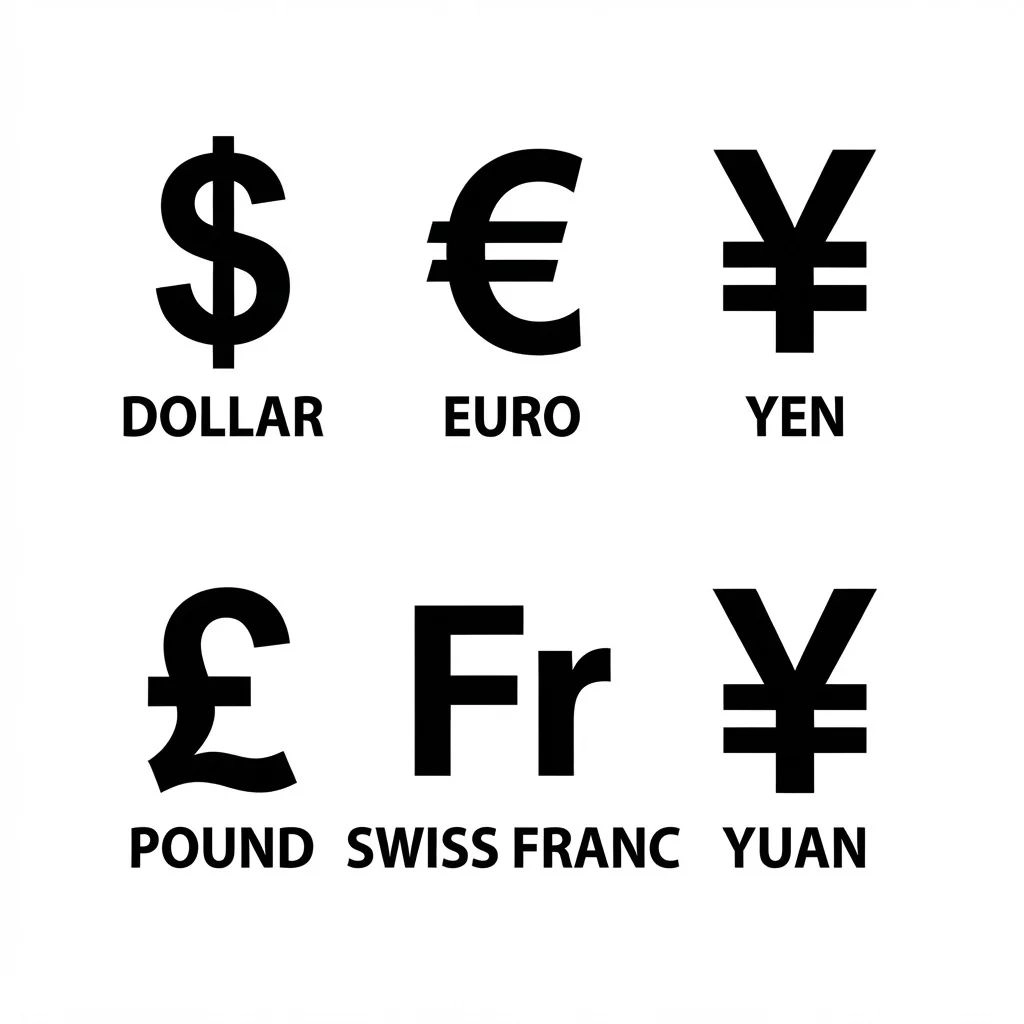
Foreign currency symbols help people recognize money used in different countries. You see them when shopping online, checking international prices, traveling abroad, reading financial reports, or exchanging money. Some signs are easy to recognize, such as the dollar ($), euro (€), and British pound (£). Others may look unfamiliar, including the Indian rupee (₹), Nigerian naira (₦), Turkish lira (₺), and Ukrainian hryvnia (₴).
Every currency does not have a unique symbol. Several countries use similar signs, while others display their money with letters or abbreviations. For example, the dollar sign ($) can represent the US dollar, Canadian dollar, Australian dollar, and several other currencies.
International currency codes help solve this problem. The US dollar uses USD, the euro uses EUR, and the Japanese yen uses JPY. These three-letter codes follow the ISO 4217 international standard.
This guide explains common foreign currency symbols, their names, countries, and codes. You will also find regional currency lists, copy-and-paste signs, Unicode codes, and tips for identifying similar-looking symbols.
What Are Foreign Currency Symbols?
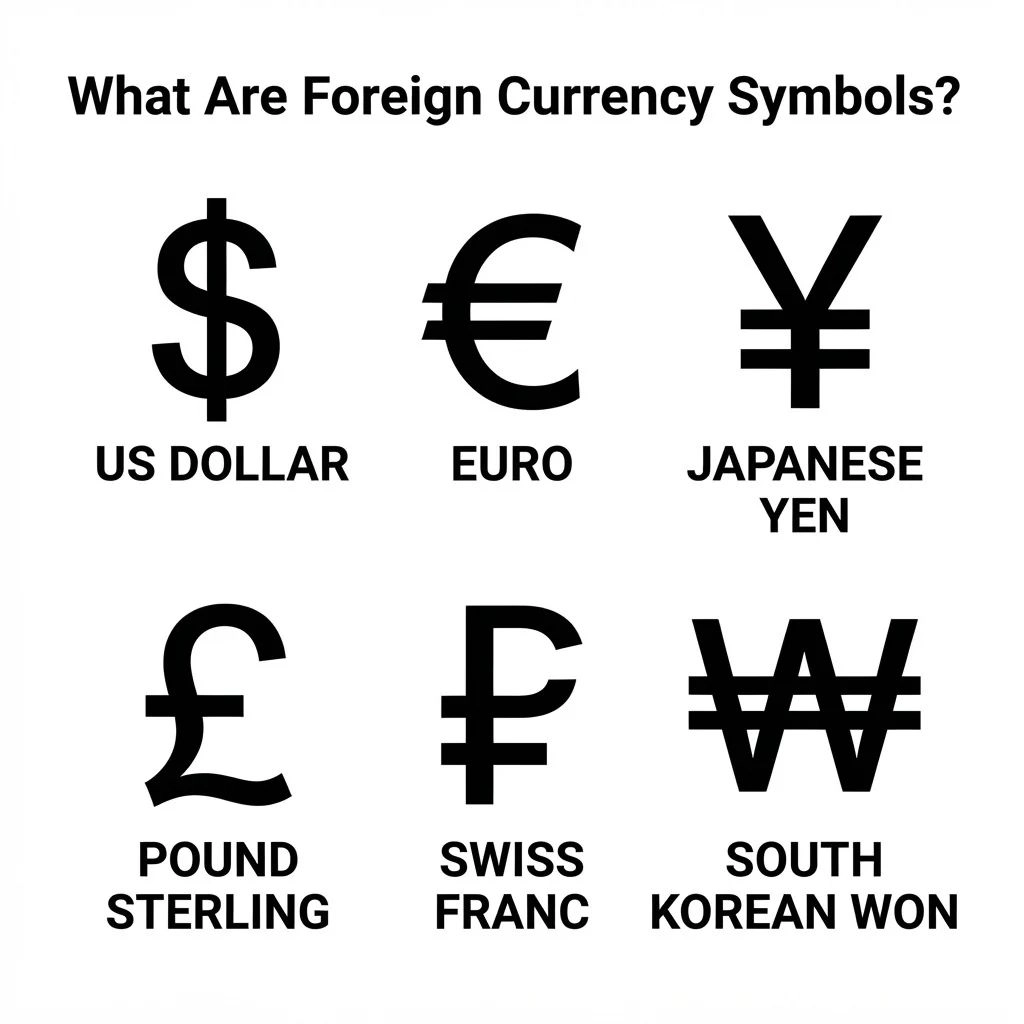
Foreign currency symbols are characters or short forms used to identify money from different countries. They appear before or after a monetary amount and help readers understand which currency a price represents.
For example:
- $25 represents 25 dollars, although the country may need clarification.
- €50 represents 50 euros.
- £100 represents 100 pounds sterling.
- ₹500 represents 500 Indian rupees.
- ¥1,000 represents 1,000 yen or yuan, depending on the context.
A currency symbol is usually shorter than writing the complete currency name. It also makes prices easier to read in advertisements, receipts, menus, invoices, and financial documents.
However, a symbol alone does not always identify a currency precisely. The dollar sign is a good example because many countries use dollar-denominated currencies.
For accurate identification, use the currency’s full name and ISO code along with its symbol.
Foreign Currency Symbols List With Names, Countries, and Codes
The following table provides a practical reference to widely used currencies and their common display forms. It includes dedicated signs and familiar local abbreviations.
The display forms can vary by country, language, software, and financial institution. Therefore, the table should not be treated as a list of unique Unicode symbols.
| Symbol or common form | Currency name | Country or territory | ISO code |
| $ | US Dollar | United States | USD |
| € | Euro | Euro area countries | EUR |
| £ | Pound Sterling | United Kingdom | GBP |
| ¥ | Japanese Yen | Japan | JPY |
| ¥ | Chinese Yuan Renminbi | China | CNY |
| ₹ | Indian Rupee | India | INR |
| ₩ | South Korean Won | South Korea | KRW |
| ₩ | North Korean Won | North Korea | KPW |
| ₦ | Nigerian Naira | Nigeria | NGN |
| ₱ | Philippine Peso | Philippines | PHP |
| ₺ | Turkish Lira | Türkiye | TRY |
| ₴ | Ukrainian Hryvnia | Ukraine | UAH |
| ₫ | Vietnamese Dong | Vietnam | VND |
| ฿ | Thai Baht | Thailand | THB |
| ₸ | Kazakhstani Tenge | Kazakhstan | KZT |
| ₼ | Azerbaijani Manat | Azerbaijan | AZN |
| ₾ | Georgian Lari | Georgia | GEL |
| ₽ | Russian Ruble | Russia | RUB |
| ₿ | Bitcoin | Digital currency | BTC |
| CHF | Swiss Franc | Switzerland and Liechtenstein | CHF |
| C$ | Canadian Dollar | Canada | CAD |
| A$ | Australian Dollar | Australia | AUD |
| NZ$ | New Zealand Dollar | New Zealand | NZD |
| S$ | Singapore Dollar | Singapore | SGD |
| HK$ | Hong Kong Dollar | Hong Kong | HKD |
| NT$ | New Taiwan Dollar | Taiwan | TWD |
| R$ | Brazilian Real | Brazil | BRL |
| Mex$ | Mexican Peso | Mexico | MXN |
| kr | Swedish Krona | Sweden | SEK |
| kr | Norwegian Krone | Norway | NOK |
| kr | Danish Krone | Denmark | DKK |
| Kč | Czech Koruna | Czechia | CZK |
| zł | Polish Złoty | Poland | PLN |
| Ft | Hungarian Forint | Hungary | HUF |
| lei | Romanian Leu | Romania | RON |
| L | Albanian Lek | Albania | ALL |
| din. | Serbian Dinar | Serbia | RSD |
| RM | Malaysian Ringgit | Malaysia | MYR |
| Rp | Indonesian Rupiah | Indonesia | IDR |
| ฿ | Thai Baht | Thailand | THB |
| ₨ | Pakistani Rupee | Pakistan | PKR |
| Rs | Nepalese Rupee | Nepal | NPR |
| ৳ | Bangladeshi Taka | Bangladesh | BDT |
| ₨ | Sri Lankan Rupee | Sri Lanka | LKR |
| ؋ | Afghan Afghani | Afghanistan | AFN |
| ₪ | Israeli New Shekel | Israel | ILS |
| ﷼ | Iranian Rial | Iran | IRR |
| | Saudi Riyal | Saudi Arabia | SAR |
| د.إ | UAE Dirham | United Arab Emirates | AED |
| د.ك | Kuwaiti Dinar | Kuwait | KWD |
| ر.ع. | Omani Rial | Oman | OMR |
| د.ب | Bahraini Dinar | Bahrain | BHD |
| ر.ق | Qatari Riyal | Qatar | QAR |
| E£ | Egyptian Pound | Egypt | EGP |
| R | South African Rand | South Africa | ZAR |
| KSh | Kenyan Shilling | Kenya | KES |
| TSh | Tanzanian Shilling | Tanzania | TZS |
| USh | Ugandan Shilling | Uganda | UGX |
| GH₵ | Ghanaian Cedi | Ghana | GHS |
| Br | Ethiopian Birr | Ethiopia | ETB |
| D | Gambian Dalasi | The Gambia | GMD |
| Ar | Malagasy Ariary | Madagascar | MGA |
| MK | Malawian Kwacha | Malawi | MWK |
| ZK | Zambian Kwacha | Zambia | ZMW |
| NLe | Sierra Leonean Leone | Sierra Leone | SLE |
| F.CFA | Central African CFA Franc | Several Central African countries | XAF |
| F.CFA | West African CFA Franc | Several West African countries | XOF |
| G | Haitian Gourde | Haiti | HTG |
| Bds$ | Barbadian Dollar | Barbados | BBD |
| CI$ | Cayman Islands Dollar | Cayman Islands | KYD |
| G$ | Guyanese Dollar | Guyana | GYD |
| $ | Surinamese Dollar | Suriname | SRD |
Important: This is a broad practical selection, not an exhaustive list of every active national and territorial currency. Some entries show conventional abbreviations rather than dedicated currency characters. For financial transactions, use the ISO code.
Foreign Currency Symbols by Region
Currency symbols become easier to understand when you organize them by geographic region. Countries may share a currency, use similar signs, or follow different writing conventions.
European Currency Symbols
Europe uses several currencies. Many countries use the euro, while others maintain their national currencies.
| Currency symbol or form | Currency | Country | Code |
| € | Euro | Germany, France, Italy, Spain, and other euro-area countries | EUR |
| £ | Pound Sterling | United Kingdom | GBP |
| CHF | Swiss Franc | Switzerland | CHF |
| kr | Swedish Krona | Sweden | SEK |
| kr | Norwegian Krone | Norway | NOK |
| kr | Danish Krone | Denmark | DKK |
| zł | Polish Złoty | Poland | PLN |
| Kč | Czech Koruna | Czechia | CZK |
| Ft | Hungarian Forint | Hungary | HUF |
| lei | Romanian Leu | Romania | RON |
| L | Albanian Lek | Albania | ALL |
| din. | Serbian Dinar | Serbia | RSD |
| ₴ | Ukrainian Hryvnia | Ukraine | UAH |
| ₽ | Russian Ruble | Russia | RUB |
| ₺ | Turkish Lira | Türkiye | TRY |
| ден. | Macedonian Denar | North Macedonia | MKD |
| лв. | Bulgarian Lev | Former Bulgarian currency | BGN |
The Bulgarian lev is included only as a historical reference. Bulgaria adopted the euro on January 1, 2026, so it should not be presented as the country’s current currency. The Bulgarian National Bank provides information about the transition and the euro’s ISO code, EUR.
The euro is the official currency of the euro area. It is shared by multiple European countries, so the euro symbol does not identify one particular country.
Asian Currency Symbols
Asia has many different currencies, including the yen, yuan, rupee, won, baht, and ringgit.
| Symbol or common form | Currency | Country | Code |
| ¥ | Japanese Yen | Japan | JPY |
| ¥ | Chinese Yuan | China | CNY |
| ₹ | Indian Rupee | India | INR |
| ₩ | South Korean Won | South Korea | KRW |
| ₩ | North Korean Won | North Korea | KPW |
| ৳ | Bangladeshi Taka | Bangladesh | BDT |
| ₨ | Pakistani Rupee | Pakistan | PKR |
| Rs / रू | Nepalese Rupee | Nepal | NPR |
| ₨ / Rs | Sri Lankan Rupee | Sri Lanka | LKR |
| Rp | Indonesian Rupiah | Indonesia | IDR |
| RM | Malaysian Ringgit | Malaysia | MYR |
| S$ | Singapore Dollar | Singapore | SGD |
| ฿ | Thai Baht | Thailand | THB |
| ₫ | Vietnamese Dong | Vietnam | VND |
| ₸ | Kazakhstani Tenge | Kazakhstan | KZT |
| ₼ | Azerbaijani Manat | Azerbaijan | AZN |
| ؋ | Afghan Afghani | Afghanistan | AFN |
| ֏ | Armenian Dram | Armenia | AMD |
| ₪ | Israeli New Shekel | Israel | ILS |
| | Saudi Riyal | Saudi Arabia | SAR |
| د.إ | UAE Dirham | United Arab Emirates | AED |
| د.ك | Kuwaiti Dinar | Kuwait | KWD |
| ﷼ | Iranian Rial | Iran | IRR |
Some Asian currencies have distinctive Unicode characters. Others commonly appear as abbreviations or Arabic-script forms.
The Saudi riyal deserves special attention. Saudi Arabia officially adopted a dedicated riyal sign on February 20, 2025. Its Unicode code point is U+20C1. The sign is different from the older rial sign, ﷼, which is associated with the Iranian rial. Older software may not display the new character correctly.
North and South American Currency Symbols
The Americas use dollars, pesos, reals, and several other currencies. The same dollar sign appears in many countries, so a country name or ISO code is important.
| Symbol or common form | Currency | Country or territory | Code |
| $ | US Dollar | United States | USD |
| C$ | Canadian Dollar | Canada | CAD |
| Mex$ | Mexican Peso | Mexico | MXN |
| R$ | Brazilian Real | Brazil | BRL |
| $ | Argentine Peso | Argentina | ARS |
| $ | Chilean Peso | Chile | CLP |
| $ | Colombian Peso | Colombia | COP |
| $ | Uruguayan Peso | Uruguay | UYU |
| G | Haitian Gourde | Haiti | HTG |
| Bds$ | Barbadian Dollar | Barbados | BBD |
| CI$ | Cayman Islands Dollar | Cayman Islands | KYD |
| G$ | Guyanese Dollar | Guyana | GYD |
| $ | Surinamese Dollar | Suriname | SRD |
| B/. | Panamanian Balboa | Panama | PAB |
| $ | Cuban Peso | Cuba | CUP |
The US, Canadian, and Mexican currencies are not interchangeable. A price written as 100couldrefertoseveraldifferentcurrencies.FormatssuchasUS, C,andMex help readers identify the intended money.
African Currency Symbols
African countries use a wide range of currencies. Some have recognizable signs, while others rely on abbreviations or international codes.
| Symbol or common form | Currency | Country | Code |
| ₦ | Nigerian Naira | Nigeria | NGN |
| R | South African Rand | South Africa | ZAR |
| KSh | Kenyan Shilling | Kenya | KES |
| TSh | Tanzanian Shilling | Tanzania | TZS |
| USh | Ugandan Shilling | Uganda | UGX |
| GH₵ | Ghanaian Cedi | Ghana | GHS |
| Br | Ethiopian Birr | Ethiopia | ETB |
| E£ | Egyptian Pound | Egypt | EGP |
| D | Gambian Dalasi | The Gambia | GMD |
| FG | Guinean Franc | Guinea | GNF |
| Ar | Malagasy Ariary | Madagascar | MGA |
| MK | Malawian Kwacha | Malawi | MWK |
| NLe | Sierra Leonean Leone | Sierra Leone | SLE |
| ZK | Zambian Kwacha | Zambia | ZMW |
| MUR / ₨ | Mauritian Rupee | Mauritius | MUR |
| د.ت | Tunisian Dinar | Tunisia | TND |
| SDG | Sudanese Pound | Sudan | SDG |
| SSP | South Sudanese Pound | South Sudan | SSP |
| F.CFA | Central African CFA Franc | Central African Economic and Monetary Community | XAF |
| F.CFA | West African CFA Franc | West African Economic and Monetary Union | XOF |
The two CFA franc currencies have separate ISO codes. The West African CFA franc uses XOF, while the Central African CFA franc uses XAF. Although their names and some display forms are similar, they are separate currencies.
Australian and Pacific Currency Symbols
Australia and several Pacific economies use dollar-denominated currencies.
| Symbol or common form | Currency | Country or territory | Code |
| A$ | Australian Dollar | Australia | AUD |
| NZ$ | New Zealand Dollar | New Zealand | NZD |
| FJ$ | Fiji Dollar | Fiji | FJD |
| K | Papua New Guinean Kina | Papua New Guinea | PGK |
| T$ | Tongan Paʻanga | Tonga | TOP |
| Vt | Vanuatu Vatu | Vanuatu | VUV |
| WS$ | Samoan Tala | Samoa | WST |
| SI$ | Solomon Islands Dollar | Solomon Islands | SBD |
Not every Pacific currency uses a dollar sign. For example, Papua New Guinea uses the kina, while Vanuatu uses the vatu.
What Are the Most Common Foreign Currency Symbols?
Some currency signs appear frequently in international shopping, travel, banking, and online transactions. Learning these symbols helps you recognize prices more quickly.
Dollar Sign ($)
The dollar sign is one of the most widely recognized currency signs. It represents the US dollar and several other dollar-denominated currencies.
Examples include:
- United States dollar — USD
- Canadian dollar — CAD
- Australian dollar — AUD
- New Zealand dollar — NZD
- Singapore dollar — SGD
- Mexican peso — MXN
The symbol can look identical across currencies. Use a country label or ISO code when the exact currency matters.
Euro Sign (€)
The euro sign represents the euro, which is used by countries in the euro area.
For example:
- €10 means ten euros.
- €75 means seventy-five euros.
- €1,000 means one thousand euros.
The ISO code for the euro is EUR. The sign is widely recognized in international shopping and financial documents.
British Pound Sign (£)
The pound sign represents pound-denominated currencies. The best-known example is the British pound sterling.
Its international code is GBP.
Do not assume that every currency using a pound sign is the British pound. Some other countries also use pound-denominated currencies, such as Egypt.
Yen and Yuan Sign (¥)
The yen sign represents the Japanese yen. A similar sign is also used for the Chinese yuan.
The Japanese yen uses JPY, while the Chinese yuan uses CNY.
The country and code help distinguish these two currencies when the same sign appears.
Indian Rupee Sign (₹)
The Indian rupee sign is used for India’s currency. Its international code is INR.
You may see it in shops, price tags, bank documents, and online payment pages.
For example, ₹2,500 represents 2,500 Indian rupees.
Won Sign (₩)
The won sign represents the currencies of North Korea and South Korea.
- KRW — South Korean won.
- KPW — North Korean won.
The same character is associated with both currencies. Use the code to identify the correct one.
Naira Sign (₦)
The naira sign represents Nigeria’s currency. Its ISO code is NGN.
You may see it in Nigerian financial publications, local stores, invoices, and digital payment displays.
Lira Sign (₺)
The Turkish lira sign represents Türkiye’s currency. Its international code is TRY.
For example, ₺500 represents 500 Turkish lira.
Hryvnia Sign (₴)
The hryvnia sign represents Ukraine’s currency. Its ISO code is UAH.
It appears in Ukrainian prices, financial information, and currency-related documents.
What Is the Difference Between Currency Symbols, Abbreviations, and Codes?
Currency symbols, abbreviations, and international codes serve similar purposes, but they are not identical.
Understanding their differences helps you read prices and financial information correctly.
Currency Symbols
A currency symbol is a sign used to represent a currency alongside a monetary amount.
Examples include:
- $ — dollar sign.
- € — euro sign.
- £ — pound sign.
- ₹ — Indian rupee sign.
- ₦ — Nigerian naira sign.
- ₺ — Turkish lira sign.
These signs are convenient for everyday prices and financial displays.
Currency Abbreviations
An abbreviation uses letters or a shortened form to identify money.
Examples include:
- CHF — Swiss franc.
- RM — Malaysian ringgit.
- Rp — Indonesian rupiah.
- KSh — Kenyan shilling.
- S$ — Singapore dollar.
- HK$ — Hong Kong dollar.
Some abbreviations are widely used in everyday displays. Others help distinguish currencies that share a similar symbol.
International Currency Codes
International currency codes follow ISO 4217. The standard provides three-letter alphabetic codes and three-digit numeric codes for currencies.
Examples include:
| Currency | Three-letter code |
| US Dollar | USD |
| Euro | EUR |
| British Pound Sterling | GBP |
| Japanese Yen | JPY |
| Indian Rupee | INR |
| Swiss Franc | CHF |
| Canadian Dollar | CAD |
| Australian Dollar | AUD |
| Nigerian Naira | NGN |
| Saudi Riyal | SAR |
The first two letters of many ISO codes relate to the country code, while the final letter often identifies the currency. USD, for example, uses US for the United States and D for dollar.
These codes are useful in international banking, accounting, travel bookings, payment systems, and financial records. ISO 4217 also includes numeric codes and information about minor currency units.
For precise transactions, an ISO code is generally more reliable than a symbol alone.
Currency Symbols That Look Similar

Some currency symbols look identical or nearly identical. This can create confusion when you read prices from international websites or financial documents.
Dollar Sign ($)
Many countries use the dollar sign. It can represent:
- US dollar (USD).
- Canadian dollar (CAD).
- Australian dollar (AUD).
- New Zealand dollar (NZD).
- Singapore dollar (SGD).
- Mexican peso (MXN).
- Several Caribbean and South American currencies.
A price written as $50 does not always tell you which currency is intended.
Yen and Yuan (¥)
The Japanese yen and Chinese yuan both use the ¥ sign in many contexts.
Their ISO codes are different:
- JPY — Japanese yen.
- CNY — Chinese yuan.
A country label or currency code removes the uncertainty.
Won (₩)
The won sign can represent either the South Korean won or the North Korean won.
Use KRW for South Korea and KPW for North Korea.
Rupee Abbreviations (Rs and ₨)
Several countries use rupee currencies. Their local abbreviations may look similar.
Examples include:
- INR — Indian rupee.
- PKR — Pakistani rupee.
- NPR — Nepalese rupee.
- LKR — Sri Lankan rupee.
- MUR — Mauritian rupee.
The exact sign and abbreviation can vary between local writing systems and display conventions.
Krona and Krone (kr)
Several European currencies use the letters kr.
Examples include:
- SEK — Swedish krona.
- NOK — Norwegian krone.
- DKK — Danish krone.
- ISK — Icelandic króna.
The shared abbreviation does not mean these currencies have the same value or are interchangeable.
How to Identify a Foreign Currency From Its Symbol
You may find an unfamiliar currency sign on an invoice, website, receipt, or travel document. A few simple checks can help you identify it.
1. Look at the Currency Symbol
Start by examining the sign beside the amount.
A euro sign usually identifies EUR, while a distinctive symbol such as ₹ usually points to the Indian rupee.
However, do not rely on the symbol alone when it is shared by multiple currencies.
2. Check the Country or Website Location
The country where a price is displayed can provide useful context.
For example, a price marked with $ on a US shopping website is likely to refer to US dollars. The same sign on an Australian website may refer to Australian dollars.
3. Find the Currency Code
Look for a three-letter code near the price, payment details, or checkout information.
Examples include USD, EUR, CAD, AUD, and JPY.
The ISO code is especially helpful when two currencies use similar signs.
4. Check the Full Currency Name
Some websites display the full currency name in addition to the symbol.
For example, a price may appear as:
- $100 USD.
- $100 CAD.
- ¥5,000 JPY.
- ¥5,000 CNY.
These labels make the currency much easier to identify.
5. Confirm the Information Before Making a Payment
Always check the currency code on invoices, bank transfers, and international purchases.
A number without a currency code can be misunderstood. A payment of 500 could mean 500 dollars, euros, rupees, or another currency.
Foreign Currency Symbols in Alphabetical Order
Some readers know the currency name but do not know its country or region. An alphabetical reference can make those signs easier to find.
The following examples cover a selection of commonly encountered currencies.
| Currency name | Common symbol or form | ISO code |
| Australian Dollar | A$ | AUD |
| Brazilian Real | R$ | BRL |
| British Pound Sterling | £ | GBP |
| Canadian Dollar | C$ | CAD |
| Chinese Yuan | ¥ | CNY |
| Euro | € | EUR |
| Indian Rupee | ₹ | INR |
| Japanese Yen | ¥ | JPY |
| Malaysian Ringgit | RM | MYR |
| Mexican Peso | Mex$ | MXN |
| Nigerian Naira | ₦ | NGN |
| Norwegian Krone | kr | NOK |
| Philippine Peso | ₱ | PHP |
| Polish Złoty | zł | PLN |
| Russian Ruble | ₽ | RUB |
| Saudi Riyal | | SAR |
| Singapore Dollar | S$ | SGD |
| South African Rand | R | ZAR |
| South Korean Won | ₩ | KRW |
| Swiss Franc | CHF | CHF |
| Thai Baht | ฿ | THB |
| Turkish Lira | ₺ | TRY |
| Ukrainian Hryvnia | ₴ | UAH |
| US Dollar | $ | USD |
| Vietnamese Dong | ₫ | VND |
This is a quick alphabetical-style reference, not a complete directory of every currency. The regional tables provide additional examples.
What Are the Unicode Codes for Foreign Currency Symbols?
Unicode assigns character codes to many currency signs. These codes help computers, websites, mobile devices, and software display special characters consistently.
A Unicode code point identifies a character independently of its appearance in a particular font.
Here are useful Unicode codes for common currency symbols.
| Symbol | Currency or character name | Unicode code point |
| $ | Dollar Sign | U+0024 |
| £ | Pound Sign | U+00A3 |
| ¥ | Yen Sign | U+00A5 |
| € | Euro Sign | U+20AC |
| ₩ | Won Sign | U+20A9 |
| ₫ | Dong Sign | U+20AB |
| ₦ | Naira Sign | U+20A6 |
| ₱ | Peso Sign | U+20B1 |
| ₹ | Indian Rupee Sign | U+20B9 |
| ₺ | Turkish Lira Sign | U+20BA |
| ₴ | Ukrainian Hryvnia Sign | U+20B4 |
| ₸ | Tenge Sign | U+20B8 |
| ₼ | Manat Sign | U+20BC |
| ₾ | Lari Sign | U+20BE |
| ₽ | Ruble Sign | U+20BD |
| ฿ | Thai Baht Sign | U+0E3F |
| ₿ | Bitcoin Sign | U+20BF |
| | Saudi Riyal Sign | U+20C1 |
Not every currency abbreviation has a dedicated Unicode code point. CHF, RM, Rp, and KSh are examples of letter-based forms rather than single currency characters.
The Saudi riyal sign has its own Unicode character, U+20C1. Unicode 18 identifies it separately from the older rial sign, U+FDFC.
Why Some Currency Symbols Appear as Empty Boxes
A currency symbol may display as a square, question mark, or missing character on some devices.
This usually happens because the selected font or software does not support that character.
For example, a recently added sign may not appear correctly on an older device. Updating the operating system, application, or font may solve the problem.
When a symbol is not supported, using the three-letter currency code is a practical alternative.
How to Copy and Paste Foreign Currency Symbols
You can copy currency symbols directly from this guide and paste them into documents, spreadsheets, websites, emails, or messages.
Common Currency Symbols to Copy
| Currency | Copyable symbol |
| US Dollar | $ |
| Euro | € |
| British Pound | £ |
| Japanese Yen | ¥ |
| Indian Rupee | ₹ |
| South Korean Won | ₩ |
| Nigerian Naira | ₦ |
| Philippine Peso | ₱ |
| Turkish Lira | ₺ |
| Ukrainian Hryvnia | ₴ |
| Vietnamese Dong | ₫ |
| Thai Baht | ฿ |
| Kazakhstani Tenge | ₸ |
| Russian Ruble | ₽ |
| Bitcoin | ₿ |
| Saudi Riyal | |
Select the character you need, copy it, and paste it into your chosen application.
For currencies with letter-based abbreviations, copy the full display form instead. Examples include CHF, RM, Rp, and KSh.
How to Type Currency Symbols on Windows
Windows offers several ways to enter currency characters.
You can use the Character Map application to find and copy special signs. Some applications also support Unicode entry or character shortcuts.
The exact method depends on your keyboard layout and software.
How to Type Currency Symbols on Mac
Mac users can open the Character Viewer to search for currency characters.
To access it, use the keyboard shortcut Control + Command + Space in applications that support the Character Viewer.
Search for the currency name or symbol, then insert the character.
How to Use Currency Symbols in Microsoft Word and Excel
Microsoft Word and Excel provide options for inserting and formatting currency signs.
In Word, you can use the Insert Symbol menu to locate special characters.
In Excel, you can apply a currency or accounting number format. Choose the appropriate currency and regional settings rather than manually inserting a symbol into every cell.
For financial spreadsheets, keep the currency code or a separate currency field when different currencies appear in the same dataset.
How Are Foreign Currency Symbols Written With Numbers?
Currency formatting differs between countries and languages. Some places put the symbol before the amount, while others place it after the number.
The use of commas, periods, spaces, and decimal places can also change.
Currency Symbols Before the Amount
In many English-language formats, the symbol appears before the number.
Examples:
- $25.00
- €25.00
- £25.00
- ₹500.00
The symbol comes first, followed by the amount.
Currency Symbols After the Amount
Some languages and regional formats place the currency sign after the number.
Examples include:
- 100 kr
- 100 zł
- 100 Kč
The placement depends on local formatting conventions.
Decimal and Thousands Separators
Countries do not all use commas and periods in the same way.
For example:
| Format | Example | Common usage |
| Decimal point and comma grouping | 1,234.56 | United States |
| Decimal comma and period grouping | 1.234,56 | Common in Germany |
| Decimal comma and space grouping | 1 234,56 | Used in some European formats |
These differences can cause mistakes when reading international prices.
For example, 1.234,56 in a decimal-comma format represents one thousand two hundred thirty-four and fifty-six hundredths. It does not mean the same thing as 1,234.56 in a format that uses a decimal point.
Why Currency Formatting Matters
Correct formatting makes prices easier to understand and reduces confusion in financial records.
International software often uses regional data to decide where symbols, decimal separators, and grouping separators appear. Unicode CLDR provides guidance and data for localized number and currency formatting.
If you prepare invoices or international reports, use the appropriate regional format and always include the currency code when necessary.
Why Do Some Countries Use Letters Instead of Currency Symbols?
Not every currency has a distinctive character. Some use letters because a short abbreviation is more practical or more recognizable in local financial writing.
For example:
- CHF identifies the Swiss franc.
- RM identifies the Malaysian ringgit.
- Rp identifies the Indonesian rupiah.
- KSh identifies the Kenyan shilling.
- S$ identifies the Singapore dollar.
- HK$ identifies the Hong Kong dollar.
These forms help readers distinguish currencies, especially when several countries use similar signs.
A country may also have a local display convention that differs from the format used in international banking systems.
There is no requirement for every currency to have a unique decorative sign. The main purpose is clear identification.
What Is the Difference Between a Currency Symbol and an Exchange Rate?
A currency symbol identifies money. An exchange rate tells you how much one currency is worth in relation to another.
These terms are related, but they do not mean the same thing.
Currency Symbol
A currency symbol is a character or display form used with an amount.
Examples include:
- $ for a dollar-denominated currency.
- € for the euro.
- £ for pound-denominated currencies.
- ₹ for the Indian rupee.
Currency Code
A currency code is a standardized identifier, such as USD, EUR, GBP, or INR.
It helps financial systems distinguish currencies that may use similar symbols.
Exchange Rate
An exchange rate compares the value of two currencies.
For example, an exchange-rate quote might show how many US dollars are required to buy one euro. The actual rate changes over time and may differ between banks, exchange services, and payment providers.
A symbol cannot tell you the exchange rate. You need a current financial source for that information.
Currency Conversion
Currency conversion calculates the value of an amount in another currency using an exchange rate.
For example, converting 100 euros into US dollars requires the current EUR-to-USD rate.
Always check the rate and any service fees before exchanging money.
Frequently Asked Questions
What Are the Most Common Foreign Currency Symbols?
Some widely recognized currency symbols include $, €, £, ¥, ₹, ₩, ₦, ₱, ₺, and ₫. They represent currencies such as the US dollar, euro, pound sterling, yen, rupee, won, naira, peso, lira, and dong.
What Is the Symbol for Every Country’s Currency?
There is no single unique symbol for every country. Some countries share a currency, while others use similar signs or letter-based abbreviations. A three-letter ISO code is the most reliable way to identify a currency.
Which Currency Symbols Look Alike?
The dollar sign ($), yen and yuan sign (¥), won sign (₩), rupee abbreviations (Rs), and Scandinavian krone or krona abbreviation (kr) can represent different currencies. Their ISO codes help distinguish them.
What Is the Difference Between $ and US$?
The dollar sign ()isusedbyseveralcurrenciesaroundtheworld.US specifically identifies the United States dollar and helps distinguish it from Canadian, Australian, and other dollar currencies.
What Is the New Symbol for the Saudi Riyal?
Saudi Arabia adopted a dedicated Saudi riyal sign on February 20, 2025. Unicode identifies it as U+20C1. Its ISO currency code remains SAR. The sign is different from the older rial character, ﷼.
Does Every Currency Have a Unicode Symbol?
No. Some currencies have dedicated Unicode characters, while others use abbreviations or letter combinations. Examples of letter-based forms include CHF, RM, Rp, and KSh.
How Can I Find a Currency Symbol by Country?
Find the country in a currency reference table and check its official currency name, common display form, and ISO code. For financial transactions, use the three-letter code to avoid confusion.
Are Currency Symbols the Same in Every Language?
No. Currency formatting depends on regional and language conventions. A currency may have different display forms depending on the user’s location, software, or language settings.
Conclusion
Foreign currency symbols make international prices and financial information easier to recognize. Common signs include the dollar ($), euro (€), pound (£), yen (¥), Indian rupee (₹), and Nigerian naira (₦). However, not every currency has a unique symbol, and some signs represent more than one currency.
The best way to identify money accurately is to check its name, country, and ISO 4217 code. You can also use Unicode codes to find and copy special currency characters. Whether you are traveling, shopping online, preparing financial documents, or learning about world currencies, understanding these signs helps you avoid confusion and read international prices with confidence.

Dylan Anderson is a writer who enjoys turning complex topics into simple, engaging content that readers can actually use. His work focuses on clear explanations, practical insights and storytelling that feels natural and relatable. He is also the fictional author of The Quiet Compass of Ashford and Where the Cedar Lantern Glows. When he’s away from his keyboard, Dylan enjoys hiking, reading, and discovering inspiration in everyday life. He believes great writing should be informative, easy to understand and enjoyable from beginning to end.
 Adam Sullivan