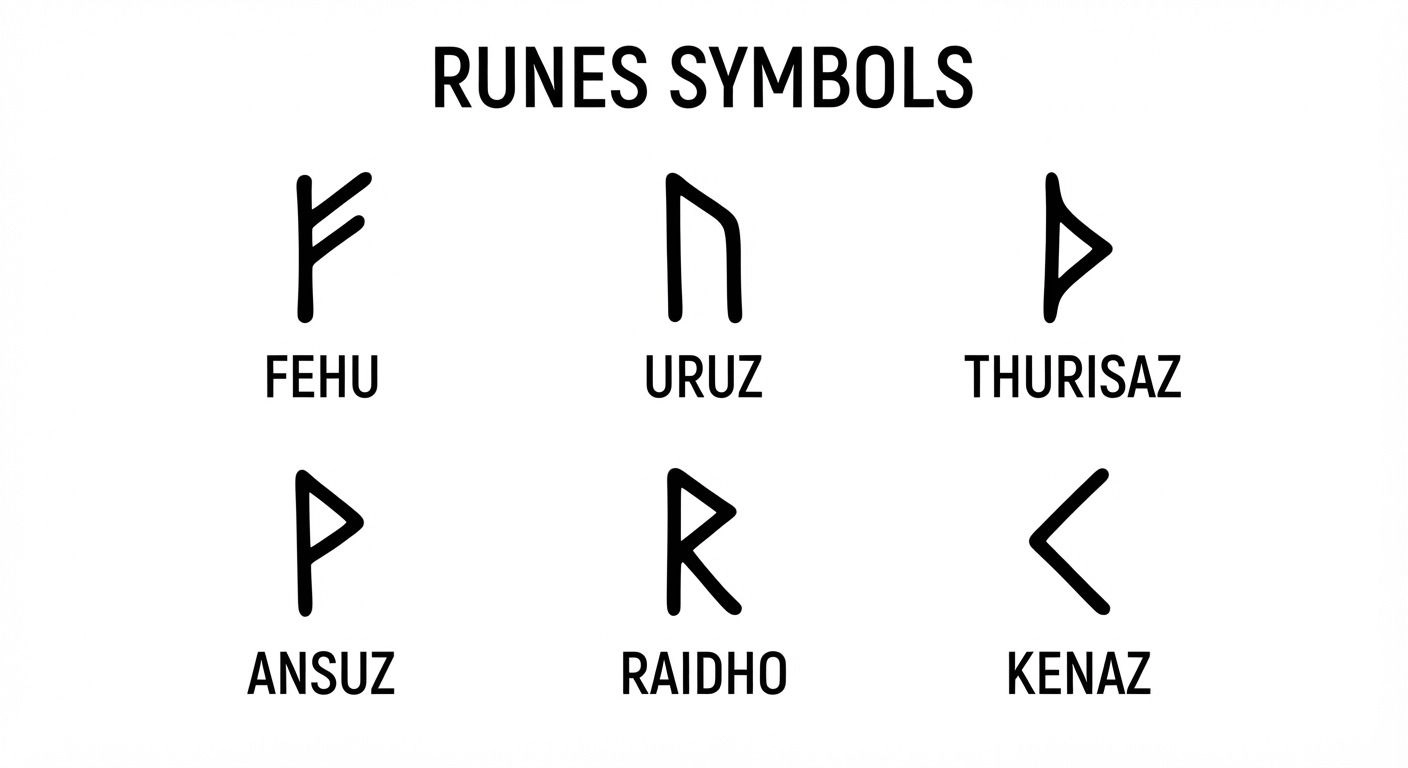
Runes symbols are ancient characters that connect language, history, mythology, and cultural traditions. Used by Germanic and Scandinavian communities for centuries, these distinctive markings appeared on stones, weapons, jewelry, tools, and everyday objects. Today, people explore runes to understand Viking history, discover ancient alphabets, find meaningful tattoo designs, and learn about spiritual interpretations.
ach rune has a recognizable shape and a sound value. . Understanding these writing systems helps you identify authentic historical runes and avoid confusing them with modern decorative symbols.
What Are Runes Symbols?
Runes are characters from ancient writing systems used by Germanic-speaking communities across Northern Europe. They represent sounds and were used to write personal names, words, messages, memorial inscriptions, and other information.
The runic alphabet is called the Futhark, a name formed from the sounds of its first six characters: F, U, TH, A, R, and K. This arrangement differs from the familiar A-to-Z order of the modern English alphabet.
The earliest surviving runic inscriptions date to approximately the second century CE Its exact origins remain a subject of scholarly discussion.
Runes have distinctive angular shapes.
What Were Runes Originally Used For?
Runes served practical communication purposes long before their modern spiritual associations became popular.
People used them in several ways:
- Writing names: Individuals sometimes carved their names or the names of others onto personal belongings.
- Marking ownership: Runes could identify the owner or maker of an object.
- Creating memorials: Families and communities used runestones to remember deceased relatives and important individuals.
- Recording messages: Short inscriptions appeared on wooden sticks, weapons, tools, and other everyday objects.
- Religious expression: Some inscriptions contain references to gods, religious beliefs, and protective language.
- Decorative purposes: Craftspeople incorporated runic characters into jewelry, ornaments, and other designs.
Runes were not exclusively magical symbols. Their primary historical function was writing. Some inscriptions may have had ritual or symbolic purposes, but their exact significance depends on the individual object and its historical context.
Why Are Runes Associated With Mystery and Magic?
The association between runes and mystery comes partly from their place in Germanic mythology and Old Norse literature.
In the Old Norse poem Hávamál, Odin describes obtaining knowledge of runes through a dramatic act of self-sacrifice. This story became an important part of later interpretations of runic knowledge.
However, mythology should not be confused with archaeological evidence. Historical runes were used for ordinary writing as well as occasional religious or symbolic purposes.
Modern rune reading, spiritual interpretations, and personalized rune combinations developed through different traditions over time.
Runes Symbols Copy and Paste (ᚠ ᚢ ᚦ ᚨ)
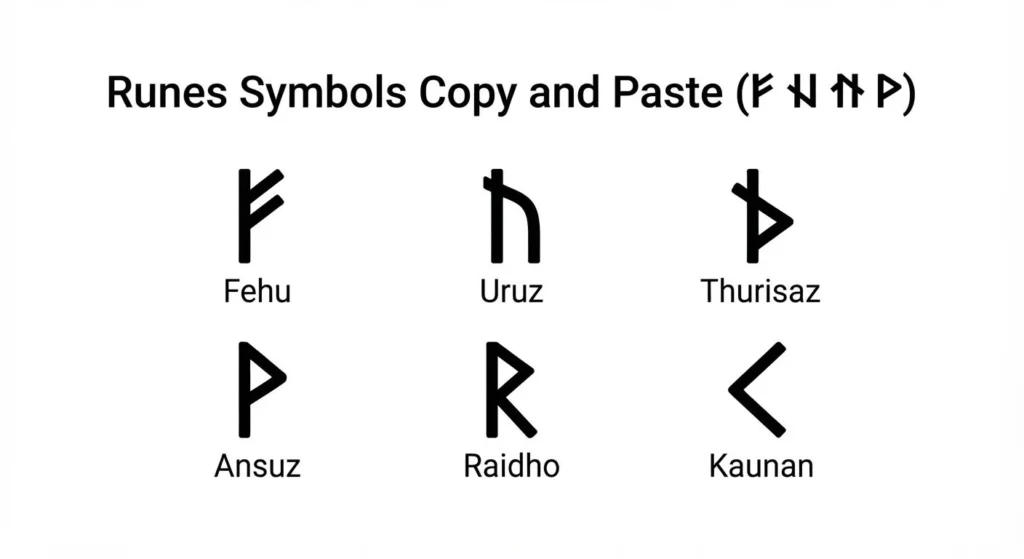
If you want runes symbols for social media, messages, artwork, usernames, or personal projects, you can copy the characters directly from this reference.
The following collection contains all 24 characters of the Elder Futhark.
Complete Elder Futhark Symbols
Copyable rune collection:
ᚠ ᚢ ᚦ ᚨ ᚱ ᚲ ᚷ ᚹ
ᚺ ᚾ ᛁ ᛃ ᛇ ᛈ ᛉ ᛊ
ᛏ ᛒ ᛖ ᛗ ᛚ ᛜ ᛞ ᛟ
Individual Rune Symbols and Unicode Values
| Rune | Name | Unicode |
| ᚠ | Fehu | U+16A0 |
| ᚢ | Uruz | U+16A2 |
| ᚦ | Thurisaz | U+16A6 |
| ᚨ | Ansuz | U+16A8 |
| ᚱ | Raidho | U+16B1 |
| ᚲ | Kenaz | U+16B2 |
| ᚷ | Gebo | U+16B7 |
| ᚹ | Wunjo | U+16B9 |
| ᚺ | Hagalaz | U+16BA |
| ᚾ | Nauthiz | U+16BE |
| ᛁ | Isa | U+16C1 |
| ᛃ | Jera | U+16C3 |
| ᛇ | Eihwaz | U+16C7 |
| ᛈ | Perthro | U+16C8 |
| ᛉ | Algiz | U+16C9 |
| ᛊ | Sowilo | U+16CA |
| ᛏ | Tiwaz | U+16CF |
| ᛒ | Berkano | U+16D2 |
| ᛖ | Ehwaz | U+16D6 |
| ᛗ | Mannaz | U+16D7 |
| ᛚ | Laguz | U+16DA |
| ᛜ | Ingwaz | U+16DC |
| ᛞ | Dagaz | U+16DE |
| ᛟ | Othala | U+16DF |
These Unicode values identify the corresponding digital characters in the Unicode Runic block. They are useful for developers, designers, writers, and anyone creating digital content.
You can also visit the official Unicode Runic character chart to explore additional runic characters.
Do Rune Symbols Work on Every Device?
Most modern devices support many Unicode runic characters, but the appearance can vary.
A computer, smartphone, website, or application may display a rune differently depending on its installed font and operating system.
If a character appears as an empty box, question mark, or missing symbol, the device probably does not have a suitable font.
For reliable display:
- Use a font that supports the Unicode Runic block.
- Test the characters on different devices.
- Check the appearance before publishing a design.
- Avoid assuming that every decorative rune font uses historically accurate shapes.
Remember that Unicode provides digital character representation. It does not automatically make a modern rune translation historically accurate.
Different Types of Runes Symbols
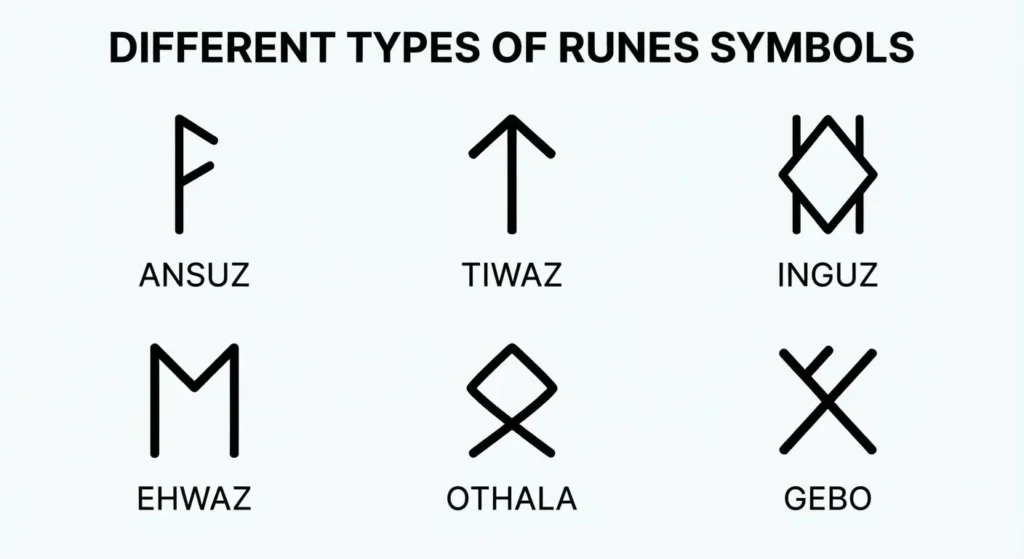
Runic writing changed over time. Different communities adapted its characters to represent the sounds of their languages.
The three major historical systems are Elder Futhark, Younger Futhark, and Anglo-Saxon Futhorc.
Elder Futhark Runes
Elder Futhark is the earliest widely recognized runic alphabet. It contains 24 characters and was used approximately from the second through the eighth centuries CE.
Its name comes from its first six characters:
- Fehu (ᚠ)
- Uruz (ᚢ)
- Thurisaz (ᚦ)
- Ansuz (ᚨ)
- Raidho (ᚱ)
- Kenaz (ᚲ)
Elder Futhark appeared across Germanic-speaking areas of Northern and Central Europe. Inscriptions have been discovered on jewelry, weapons, combs, buckles, and other archaeological objects.
The alphabet is especially popular today because its 24-character arrangement is widely used in modern rune books, tattoos, spiritual artwork, and introductory guides.
Younger Futhark Runes
Younger Futhark developed from earlier runic writing and became the main runic alphabet of Viking Age Scandinavia.
It contains 16 characters rather than 24.
This change did not mean that the spoken language suddenly had fewer sounds. Instead, individual runes came to represent several related sounds.
For example, one rune could represent different vowel sounds depending on the word and context.
Younger Futhark had two important writing styles:
- Long-branch runes: These have longer main strokes and are commonly found on formal inscriptions and runestones.
- Short-twig runes: These use simplified forms and appear in different everyday writing contexts.
The Younger Futhark is essential for anyone researching authentic Viking Age inscriptions.
Anglo-Saxon Futhorc
Anglo-Saxon Futhorc developed in England from earlier runic traditions. Its character collection expanded to represent additional sounds in Old English.
Different historical versions contain approximately 28 to 33 characters.
Anglo-Saxon runes appeared on objects such as weapons, jewelry, monuments, and manuscripts. They also appear in literary material, including the Old English Rune Poem.
The system demonstrates how runic writing adapted when it entered a different linguistic environment.
Unlike Younger Futhark, which reduced the number of characters, Anglo-Saxon Futhorc expanded the alphabet to accommodate the needs of Old English.
24 Elder Futhark Runes Symbols and Their Meanings

The Elder Futhark is an excellent starting point for anyone interested in rune names, historical sound values, and modern symbolic interpretations.
One important detail deserves attention: the names commonly assigned to the 24 Elder Futhark characters are reconstructed through comparative linguistic research and later runic traditions. They are not all directly recorded in surviving inscriptions from the period when Elder Futhark was used.
The descriptions below distinguish the historical or reconstructed name associations from common modern interpretations.
First Aett: Fehu to Wunjo
The first eight runes are traditionally grouped together as an aett. Modern rune traditions often call this Freyr’s aett, although the historical status of that group name should not be confused with an ancient universal classification.
1. Fehu (ᚠ) – Wealth and Resources
Fehu is associated with cattle and movable wealth. In early Germanic societies, livestock represented an important source of economic value.
Its historical association with property and resources helps explain why modern spiritual interpretations connect it with prosperity, abundance, and financial success.
Modern symbolic associations:
- Wealth and prosperity
- Financial opportunities
- Material resources
- Responsibility
- Personal ambition
Fehu can also encourage people to think carefully about how they earn, manage, and share their resources.
2. Uruz (ᚢ) – Strength and Vitality
Uruz is associated with the aurochs, a powerful wild cattle species that once lived across Europe and parts of Asia.
The animal’s strength and physical presence influenced later symbolic interpretations of this rune.
Modern readers commonly connect Uruz with courage, endurance, determination, and natural energy.
Modern symbolic associations:
- Physical strength
- Endurance
- Vitality
- Confidence
- Personal resilience
It is often selected by people who want a reminder to remain determined during difficult situations.
3. Thurisaz (ᚦ) – Giants and Powerful Forces
Thurisaz is connected with the Old Norse word þurs, associated with a giant or powerful mythological being.
Its traditional associations involve forces that can be dangerous, unpredictable, or difficult to control.
Modern spiritual interpretations frequently connect it with protection, confrontation, boundaries, and caution.
Modern symbolic associations:
- Defense
- Challenges
- Personal boundaries
- Confrontation
- Caution
Thurisaz can represent the importance of recognizing danger and responding thoughtfully rather than acting impulsively.
4. Ansuz (ᚨ) – Communication and Divine Inspiration
Ansuz is associated with a divine being or god. Its historical linguistic connections are related to the Germanic word family for divine beings.
Modern Norse-inspired interpretations frequently connect Ansuz with Odin, although the historical and linguistic layers should be distinguished.
Modern symbolic associations:
- Communication
- Knowledge
- Wisdom
- Inspiration
- Learning
This rune is popular in modern artwork representing education, thoughtful speech, and the search for knowledge.
5. Raidho (ᚱ) – Riding and Journeys
Raidho is associated with riding or traveling. Its name has a connection with movement, transportation, and journeys.
In modern symbolic interpretations, the meaning often extends beyond physical travel to personal development and life direction.
Modern symbolic associations:
- Travel
- Movement
- Progress
- Direction
- Personal development
Raidho can serve as a reminder that reaching an important destination requires preparation and a clear sense of direction.
6. Kenaz (ᚲ) – Torch and Illumination
Kenaz is commonly reconstructed with a connection to a torch or source of light.
A torch helps people see what would otherwise remain hidden. This association has inspired modern interpretations involving creativity, learning, knowledge, and discovery.
Modern symbolic associations:
- Creativity
- Illumination
- Knowledge
- Artistic expression
- Inspiration
Kenaz is particularly meaningful in contemporary designs connected with education and creative thinking.
7. Gebo (ᚷ) – Gifts and Giving
Gebo means gift. Its historical name is connected with the idea of giving and receiving.
Gifts played an important role in relationships and social obligations in many historical Germanic communities.
Modern interpretations frequently associate Gebo with love, generosity, friendship, and mutual respect.
Modern symbolic associations:
- Generosity
- Relationships
- Love
- Partnership
- Mutual respect
Gebo is especially suitable for symbolic designs that express the importance of balanced relationships.
8. Wunjo (ᚹ) – Joy and Happiness
Its modern interpretation often focuses on harmony, friendship, emotional satisfaction, and a sense of belonging.
Modern symbolic associations:
- Happiness
- Harmony
- Friendship
- Celebration
- Emotional satisfaction
Wunjo can represent appreciation for meaningful relationships and positive experiences.
Second Aett: Hagalaz to Sowilo
The next eight characters form the second traditional aett. Modern traditions commonly associate this group with Heimdall.
Its members include runes connected with hardship, natural forces, patience, uncertainty, and sunlight.
9. Hagalaz (ᚺ) – Hail and Disruption
Hagalaz means hail. Hail can damage crops and interrupt everyday activities, making it a natural association for sudden disruption.
Modern interpretations connect the rune with unexpected change, difficult experiences, and transformation.
Modern symbolic associations:
- Sudden changes
- Disruption
- Difficult situations
- Transformation
- Uncertainty
Hagalaz can represent the reality that unexpected events sometimes force people to reconsider their plans.
10. Nauthiz (ᚾ) – Need and Necessity
Nauthiz is associated with need, distress, and necessity.
Its historical word association reflects situations where resources are limited or circumstances require patience and discipline.
Modern symbolic associations:
- Patience
- Discipline
- Survival
- Self-control
- Perseverance
The rune can remind people that difficult periods often require careful choices rather than immediate solutions.
11. Isa (ᛁ) – Ice and Stillness
Isa means ice. Its historical association is straightforward, while its modern symbolic interpretation often focuses on stillness and temporary pauses.
Ice can stop movement and preserve what lies beneath its surface.
Modern symbolic associations:
- Stillness
- Patience
- Concentration
- Calmness
- Reflection
Isa can represent the importance of slowing down before making an important decision.
12. Jera (ᛃ) – Year and Harvest
Jera is connected with the year and seasonal cycles.
Agricultural communities depended on changing seasons and the results of consistent work. This provides the background for modern interpretations involving harvest, rewards, and natural timing.
Modern symbolic associations:
- Harvest
- Growth
- Rewards
- Cycles
- Patience
Jera can represent the idea that meaningful achievements often develop gradually.
13. Eihwaz (ᛇ) – Yew Tree and Endurance
Eihwaz is associated with the yew tree. This tree has a long cultural history in Northern Europe and is known for its durable wood and evergreen appearance.
Modern interpretations frequently connect the rune with endurance, resilience, and transitions.
Modern symbolic associations:
- Resilience
- Endurance
- Stability
- Transformation
- Perseverance
Its meaning can be used as a personal reminder to remain steady when circumstances become uncertain.
14. Perthro (ᛈ) – An Uncertain and Debated Meaning
Perthro is one of the most difficult Elder Futhark runes to interpret confidently.
Its original name and meaning remain uncertain. Modern spiritual traditions often associate it with mystery, chance, hidden knowledge, and unexpected possibilities.
These interpretations should not be presented as established historical definitions.
Modern symbolic associations:
- Mystery
- Uncertainty
- Chance
- Hidden information
- Discovery
Perthro is an excellent example of why historical evidence and modern spiritual interpretations should be explained separately.
15. Algiz (ᛉ) – Protection and Awareness
Algiz is commonly associated with protection in contemporary rune interpretations. Its historical linguistic background is more complicated, and the modern meaning should not be treated as a universally proven ancient definition.
The rune’s recognizable shape has made it popular in jewelry, artwork, and tattoos.
Modern symbolic associations:
- Protection
- Awareness
- Defense
- Caution
- Personal boundaries
Algiz can serve as a reminder to remain aware of your surroundings and make thoughtful decisions.
16. Sowilo (ᛊ) – Sun and Light
Sowilo is associated with the sun. Its historical word association is connected with sunlight and the natural world.
Modern interpretations frequently extend this idea to energy, achievement, confidence, and personal vitality.
Modern symbolic associations:
- Sunlight
- Energy
- Success
- Confidence
- Clarity
Sowilo is often selected for artwork representing optimism, motivation, and achievement.
Third Aett: Tiwaz to Othala
The final eight Elder Futhark runes form the third traditional aett. Modern rune traditions commonly associate this group with Týr.
Its characters have names and associations connected with justice, growth, partnership, humanity, water, ancestry, and new beginnings.
17. Tiwaz (ᛏ) – Týr, Justice, and Courage
Tiwaz is named after Týr, a Germanic god associated with courage and the law.
Its connection with Týr provides the foundation for many modern interpretations involving justice, honor, and responsibility.
Modern symbolic associations:
- Courage
- Justice
- Honor
- Leadership
- Responsibility
Tiwaz can represent standing up for your beliefs and accepting responsibility for your decisions.
18. Berkano (ᛒ) – Birch and Growth
Berkano is associated with the birch tree. Birch trees have cultural connections with renewal and the arrival of spring.
Modern spiritual interpretations often connect this rune with growth, fertility, nurturing, and fresh beginnings.
Modern symbolic associations:
- Growth
- Renewal
- Fertility
- Family
- Nurturing
It is sometimes chosen for designs representing motherhood, family life, and personal development.
19. Ehwaz (ᛖ) – Horse and Partnership
Ehwaz is associated with a horse. Horses were important in transportation, agriculture, and everyday life across historical Germanic societies.
Modern interpretations often focus on movement, trust, teamwork, and cooperation.
Modern symbolic associations:
- Trust
- Partnership
- Loyalty
- Cooperation
- Progress
Ehwaz can represent the value of working together and building dependable relationships.
20. Mannaz (ᛗ) – Humanity and Community
Mannaz is associated with humanity or human beings.
Its modern symbolism frequently explores identity, relationships, social responsibility, and the connection between individuals and their communities.
Modern symbolic associations:
- Humanity
- Identity
- Friendship
- Community
- Self-awareness
This rune can serve as a reminder that personal development is influenced by the people around us.
21. Laguz (ᛚ) – Water and Flow
Laguz is associated with water. Water is essential for life and has long been connected with movement and natural change.
Modern spiritual interpretations often extend this association to emotions, intuition, adaptability, and personal reflection.
Modern symbolic associations:
- Water
- Emotions
- Intuition
- Adaptability
- Natural flow
Laguz can represent the importance of understanding your emotions and adapting to changing circumstances.
22. Ingwaz (ᛜ) – Ing and Potential
Ingwaz is connected with Ing, a figure associated with Germanic religious traditions.
Modern interpretations often focus on potential, fertility, inner development, and completion.
Modern symbolic associations:
- Potential
- Fertility
- Development
- Growth
- Completion
It can represent an idea or opportunity developing before it becomes visible to others.
23. Dagaz (ᛞ) – Daylight and Change
Dagaz means day. Its historical association connects it with daylight and the natural cycle between darkness and light.
Modern spiritual interpretations often associate the rune with awakening, clarity, and fresh beginnings.
Modern symbolic associations:
- Daylight
- Hope
- Clarity
- Transformation
- New beginnings
Dagaz can symbolize a change in perspective or a new stage of personal development.
24. Othala (ᛟ) – Inheritance and Heritage
Othala is associated with inherited property, ancestral land, and heritage.
Its historical meaning provides the foundation for modern interpretations involving family, home, belonging, and cultural identity.
Modern symbolic associations:
- Ancestry
- Heritage
- Home
- Family
- Belonging
Othala requires additional cultural context because its shape has also been appropriated by extremist organizations. Its historical use in runic writing should be distinguished from its later political uses.
What Do the Three Aetts of Elder Futhark Mean?
The 24 Elder Futhark runes are traditionally arranged into three groups of eight characters called aetts. The word aett is commonly understood as a family or group.
The three groups are useful for learning and organizing the alphabet. Modern esoteric traditions also assign them broader symbolic themes.
| Aett | Runes | Common modern theme |
| First aett | Fehu to Wunjo | Resources, growth, relationships |
| Second aett | Hagalaz to Sowilo | Challenges, change, awareness |
| Third aett | Tiwaz to Othala | Responsibility, identity, heritage |
First Aett: Freyr’s Group
The first group begins with Fehu and ends with Wunjo.
Its modern interpretations frequently explore material resources, strength, communication, journeys, creativity, relationships, and happiness.
Second Aett: Heimdall’s Group
The second group begins with Hagalaz and ends with Sowilo.
Modern spiritual traditions often interpret this group through challenges, patience, disruption, endurance, and personal clarity.
Third Aett: Týr’s Group
The final group begins with Tiwaz and ends with Othala.
Its modern interpretations frequently focus on justice, growth, partnership, identity, and ancestry.
Historical note: The three-group arrangement is a traditional way to organize the Elder Futhark.
Viking Runes Symbols and Their Meanings

Viking runes are closely connected with Scandinavian history and the Viking Age, generally dated from the late eighth to the eleventh centuries.
The most important distinction is that Vikings primarily used the Younger Futhark, not the 24-character Elder Futhark.
Runic writing was part of everyday life. People carved inscriptions into stones, wooden sticks, weapons, jewelry, and personal belongings.
How Did Vikings Use Runes?
Viking Age inscriptions had several practical purposes.
Memorial inscriptions: Families used runestones to remember relatives and describe their achievements.
Ownership markings: Runes sometimes identified the owner of an object or the person who made it.
Travel records: Some inscriptions mention journeys, expeditions, and people who traveled far from home.
Messages: Wooden objects and other everyday materials could carry short written messages.
Religious references: Some inscriptions contain Christian prayers, references to Norse gods, or other religious expressions.
Small everyday objects provide important evidence of how people used the alphabet.
Famous Viking Runestones and Inscriptions
Runestones are among the most recognizable examples of Viking Age runic writing.
Sweden has thousands of surviving runestones, with a particularly large concentration in the Uppland region.
These monuments often commemorate deceased relatives or describe the people who commissioned them.
One important feature of Viking inscriptions is that they frequently record real relationships and events rather than simply presenting decorative symbols.
The Rök Runestone in Sweden is another famous example. Its lengthy inscription contains complicated references to legendary stories, historical traditions, and poetic language.
What Makes Viking Runes Different From Modern Rune Symbols?
Modern rune artwork often uses Elder Futhark characters because the 24-rune alphabet is popular in contemporary books and spiritual practices.
Authentic Viking Age inscriptions, however, generally use Younger Futhark.
The difference matters when choosing a historically accurate tattoo, creating a replica inscription, or translating an Old Norse phrase.
A design can be inspired by Viking culture without being an authentic Viking Age writing system. Understanding the distinction helps avoid misleading historical claims.
Elder Futhark vs. Younger Futhark: Key Differences
Elder Futhark and Younger Futhark are related writing systems, but they belong to different historical periods and contain different numbers of characters.
| Feature | Elder Futhark | Younger Futhark |
| Number of runes | 24 | 16 |
| Main period | Approximately 150–750 CE | Approximately 725–1075 CE |
| Main historical context | Early Germanic communities | Viking Age Scandinavia |
| Language context | Early Germanic languages | Primarily Old Norse |
| Character system | More characters for sound distinctions | Fewer characters representing multiple sounds |
| Modern popularity | Spiritual guides and tattoos | Viking historical reconstructions |
Why Did the Alphabet Change From 24 to 16 Runes?
The runic alphabet gradually changed as spoken languages and writing practices developed.
By the Viking Age, Scandinavian runic writing used a simplified set of 16 characters.
This created a writing system in which one rune could represent several different sounds.
For example, a single character could represent related vowel sounds, depending on the word.
This system required readers to understand the language and context of the inscription.
The reduction in characters did not make Younger Futhark an inferior alphabet. It reflected a different writing convention that worked within the linguistic environment of the period.
Which Alphabet Should You Use?
Your choice depends on what you want to accomplish.
- Choose Elder Futhark when studying early Germanic inscriptions or using the commonly recognized 24-rune reference.
- Choose Younger Futhark when researching authentic Viking Age Scandinavian writing.
- Choose Anglo-Saxon Futhorc when exploring Old English inscriptions and literature.
If you are creating a historical reconstruction, always select the alphabet that matches the period and language.
Younger Futhark Runes and Their Meanings
The Younger Futhark contains 16 characters. It was widely used in Scandinavia during the Viking Age and continued to influence medieval Scandinavian writing.
Its characters are generally divided into long-branch and short-twig forms.
Unlike the Elder Futhark, its rune names are better supported by medieval Scandinavian rune poems and linguistic evidence.
| Rune | Traditional name | Main historical association |
| ᚠ | Fé | Wealth or cattle |
| ᚢ | Úr | Aurochs |
| ᚦ | Þurs | Giant or troll |
| ᚬ | Áss | God |
| ᚱ | Reið | Riding or journey |
| ᚴ | Kaun | Sore or ulcer |
| ᚼ | Hagall | Hail |
| ᚾ | Nauð | Need or distress |
| ᛁ | Íss | Ice |
| ᛅ | Ár | Year or harvest |
| ᛋ | Sól | Sun |
| ᛏ | Týr | The god Týr |
| ᛒ | Bjarkan | Birch |
| ᛘ | Maðr | Human being |
| ᛚ | Lögr | Water |
| ᛦ | Ýr | Yew |
The forms shown here are representative long-branch or standard Unicode characters. Historical inscriptions include regional and stylistic variations.
Long-Branch Runes
They appear on many surviving Viking Age runestones.
Short-Twig Runes
Short-twig runes use simpler shapes.
Why Do Younger Futhark Runes Have Multiple Sounds?
The 16-character alphabet had fewer symbols than the sounds found in Old Norse.
Consequently, one rune could represent several sounds.
For example, the Younger Futhark U-rune could represent different related vowel sounds, while the K-rune could represent both K and G in appropriate contexts.
This is why translating modern English into Viking runes requires more than replacing each English letter with a similar-looking character.
Anglo-Saxon Futhorc Runes and Their Meanings
Anglo-Saxon Futhorc developed in England after runic writing spread among Germanic-speaking communities.
Its alphabet expanded beyond the original Elder Futhark characters because Old English contained sounds that required additional symbols.
Different versions of the Futhorc contain approximately 28 to 33 characters.
Why Did Anglo-Saxon Runes Expand?
Languages change, and alphabets must often adapt to represent their sounds.
Old English included vowel and consonant distinctions that required additional runic characters.
The expanded Futhorc provided a practical writing system for the language.
Where Were Anglo-Saxon Runes Found?
Anglo-Saxon runes appear on several types of historical objects:
- Weapons and sword fittings.
- Jewelry and decorative objects.
- Memorial stones.
- Coins and personal belongings.
- Manuscripts and literary material.
One well-known example is the Franks Casket, an early medieval carved box containing inscriptions in runes and scenes from different cultural traditions.
The Anglo-Saxon Rune Poem is another important source for understanding later runic names and their associations.
It is especially useful when studying the historical background behind some reconstructed Elder Futhark rune names.
How Were the Meanings of Ancient Runes Determined?
Rune meanings are not all based on the same type of historical evidence.
Some associations come from actual inscriptions, while others come from linguistic reconstruction, medieval rune poems, mythology, and modern spiritual traditions.
Understanding these sources helps readers separate established facts from later interpretations.
Reconstructed Rune Names
The surviving Elder Futhark inscriptions do not provide a complete contemporary list of the 24 rune names.
Researchers reconstruct many of these names through comparative linguistics and evidence from later Germanic languages.
A reconstructed form is not automatically incorrect. It means scholars have used evidence from related languages to work backward toward an earlier form.
Medieval Rune Poems
Rune poems are important sources for studying rune names and their associations.
Three major traditions are especially relevant:
- The Old English Rune Poem.
- The Norwegian Rune Poem.
- The Icelandic Rune Poem.
These poems describe runes through short versesand provide clues about their names and cultural associations
Archaeological Inscriptions
Actual inscriptions provide some of the strongest evidence about how people used runes.
Archaeologists study the materials, locations, lettering styles, language, and surrounding objects to understand their purpose.
An inscription on a comb may identify its maker or owner. A runestone may commemorate a family member.
The object and its context are essential to interpretation.
Modern Spiritual Interpretations
Modern rune traditions frequently connect characters with ideas such as protection, abundance, personal growth, relationships, and transformation.
These interpretations may be meaningful to contemporary practitioner
For example, interpreting Algiz as a protective symbol is common in modern rune spirituality. Its historical linguistic background requires a more cautious explanation.
The most accurate approach is to distinguish three layers:
- The historical rune character and its sound.
- The reconstructed or documented name and linguistic association.
- The modern spiritual interpretation.
Most Popular Runes Symbols and Their Meanings
Some runes receive more attention than others in contemporary jewelry, tattoos, artwork, and spiritual discussions.
The following characters are particularly recognizable.
Fehu (ᚠ) – Wealth and Abundance
Fehu is commonly selected to represent prosperity, resources, and financial ambition.
Its historical connection with cattle and movable wealth provides the foundation for its modern associations.
Algiz (ᛉ) – Protection
Algiz is frequently used in modern designs connected with protection and awareness.
It appears in minimalist jewelry, personal artwork, and tattoos.
Gebo (ᚷ) – Love and Generosity
Gebo is associated with gifts and giving.
Modern interpretations frequently connect it with friendship, romantic relationships, generosity, and mutual respect.
Tiwaz (ᛏ) – Courage and Justice
Tiwaz is named after the Germanic god Týr.
It is often chosen to represent bravery, honor, responsibility, and fairness.
Wunjo (ᚹ) – Happiness
Wunjo is associated with joy and well-being.
Its modern symbolic interpretations include harmony, positive relationships, and emotional satisfaction.
Sowilo (ᛊ) – Sun and Success
Sowilo is connected with the sun.
Modern interpretations often associate it with energy, clarity, confidence, and achievement.
Runes Symbols for Protection
Protection is one of the most popular themes in modern rune spirituality.
People interested in this subject often explore runes for jewelry, personal artwork, meditation, and tattoos.
Three characters frequently appear in modern protective interpretations.
Algiz (ᛉ)
Algiz is commonly associated with protection, awareness, and defense.
It is a recognizable character that appears in many contemporary rune designs.
Thurisaz (ᚦ)
Thurisaz is connected with giants and powerful forces.
Modern interpretations sometimes associate it with defending personal boundaries and confronting challenges.
Eihwaz (ᛇ)
Eihwaz is associated with the yew tree.
Its modern symbolic meaning frequently focuses on endurance, resilience, and navigating difficult transitions.
These associations can have personal meaning. However, there is no scientific evidence that wearing a rune physically prevents danger or guarantees supernatural protection.
Runes Symbols for Love and Relationships
Runes also appear in modern spiritual practices and artwork connected with romantic relationships, family, and friendship.
Three Elder Futhark characters are especially common in this context.
Gebo (ᚷ)
Gebo means gift and is commonly associated with giving, receiving, generosity, and balanced relationships.
Its historical name makes it a natural choice for artwork representing mutual respect.
Wunjo (ᚹ)
Wunjo is associated with joy and well-being.
Modern interpretations connect it with happiness, harmony, friendship, and emotional satisfaction.
Berkano (ᛒ)
Berkano is associated with the birch tree.
Its modern symbolism often includes nurturing, growth, fertility, and family.
These characters can represent personal values and relationship goals, but they cannot guarantee romantic attraction or a successful relationship.
Runes Symbols for Strength, Courage, and Power
Some people choose runes because they want a symbol that reflects determination, courage, or personal resilience.
The following characters are commonly associated with these themes.
Uruz (ᚢ)
Uruz is connected with the aurochs, a powerful wild animal.
Modern interpretations associate it with physical strength, stamina, vitality, and determination.
Tiwaz (ᛏ)
Tiwaz is connected with Týr and commonly represents courage, justice, honor, and responsibility.
Sowilo (ᛊ)
Sowilo is associated with the sun.
Modern symbolic interpretations frequently connect it with energy, confidence, clarity, and achievement.
Raidho (ᚱ)
Raidho is connected with riding and journeys.
Its modern associations include progress, movement, direction, and personal development.
These characters can be used as visual reminders of personal goals and qualities.
Runes Symbols for Tattoos
Runic tattoos appeal to people interested in Norse mythology, ancient writing systems, Scandinavian heritage, and Viking-inspired artwork.
Some choose one character because of its name or association. Others combine multiple runes into a personal design.
Popular Rune Tattoo Ideas
1. Algiz tattoo: Often selected for modern designs representing protection and awareness.
2. Uruz tattoo: A common choice for artwork associated with strength and endurance.
3. Tiwaz tattoo: Frequently chosen to express courage, justice, and personal principles.
4. Gebo tattoo: Can represent generosity, friendship, and balanced relationships.
5. Fehu tattoo: Often selected for designs connected with resources, prosperity, and ambition.
6. Wunjo tattoo: A modern symbol of joy, harmony, and happiness.
Things to Check Before Getting a Rune Tattoo
A permanent tattoo deserves careful research.
Before choosing a design:
- Verify the historical alphabet.
- Check the character’s correct shape.
- Understand its sound and name.
- Research modern political or extremist associations.
- Confirm whether a combined design is historically documented or newly created.
- Ask a knowledgeable specialist to review a translation.
A tattoo that looks attractive may not communicate the intended word or message.
If you want to write a name or phrase in runes, transliteration is more accurate than simply replacing English letters with similar-looking symbols.
How to Write Your Name in Runes Symbols
Writing a modern name in runes can be an interesting way to explore ancient alphabets.
However, there is an important rule: runes represent sounds, not necessarily the exact letters used in modern English.
For this reason, you should begin with pronunciation rather than spelling.
Step 1: Choose Your Runic Alphabet
Decide whether you want to use Elder Futhark, Younger Futhark, or Anglo-Saxon Futhorc.
For a general modern introduction, Elder Futhark is commonly used. For a historically Viking-inspired reconstruction, Younger Futhark is usually more appropriate.
Step 2: Break Your Name Into Sounds
Say your name slowly and identify the sounds.
For example, the name Emma contains two spoken syllables but a repeated M sound in its conventional spelling.
The Viking Ship Museum explains that repeated runes and modern spelling conventions do not always transfer directly into historical runic writing.
Step 3: Match Sounds to Runes
Find characters that represent the sounds in your chosen alphabet.
Some English sounds do not have exact equivalents in historical runic systems.
You may need to make an approximation and explain that it is a modern transliteration.
Step 4: Check the Result
Read the runic version aloud and compare it with the original pronunciation.
For a historical reconstruction, check the language and period rather than relying on an automatic English-to-rune converter.
Example: Writing TOR in Younger Futhark
The modern English name or word TOR can be represented approximately using the Younger Futhark characters:
ᛏᚢᚱ
Here:
- ᛏ represents T.
- ᚢ can represent a relevant O sound.
- ᚱ represents R.
This is an illustrative sound-based transliteration, not a claim that every modern name has one universally correct runic spelling.
How to Identify Different Runes Symbols
Recognizing runes becomes easier when you understand the main alphabets and their distinctive shapes.
A single character may look different across historical inscriptions because carvers used different styles and materials.
Look at the Number of Characters
If you see a complete 24-character reference chart, it may represent Elder Futhark.
A 16-character chart is likely to represent Younger Futhark.
An expanded chart with additional characters may represent Anglo-Saxon Futhorc.
Compare Similar-Looking Runes
Some runes have shapes that can be confused with one another.
For example, different forms of the A, S, and H runes can look similar in certain writing styles.
Do not identify a rune by shape alone. Check the alphabet, inscription date, surrounding characters, and linguistic context.
Look for Historical Context
An inscription on a Viking Age runestone is more likely to use Younger Futhark than Elder Futhark.
An inscription on an early Germanic object may use Elder Futhark.
An English manuscript containing Old English writing may include Anglo-Saxon runes.
The location and date of an object can be just as important as its appearance.
What Are Bindrunes?
A bindrune is a design that combines two or more runic characters into a single joined form.
Historical inscriptions sometimes contain runes that share strokes or overlap. Modern spiritual communities also create personalized bindrunes to represent particular intentions.
Historical Bindrunes
Some historical inscriptions show combined or joined rune forms.
These could save space, create decorative effects, or represent particular writing conventions.
Their meanings depend on the inscription and historical context.
Modern Bindrunes
Contemporary bindrunes are often created by combining characters associated with different personal values.
For example:
- Fehu and Uruz may be combined to represent prosperity and strength.
- Gebo and Wunjo may represent generosity and happiness.
- Algiz and Tiwaz may symbolize protection and courage in a modern design.
These are contemporary interpretations, not established universal ancient formulas.
How to Create a Personal Bindrune
If you want to design a personal bindrune:
- Decide what idea or value you want to express.
- Select runes whose names or associations match that idea.
- Research their historical shapes.
- Sketch different combinations.
- Keep the final design readable.
- Clearly identify it as a modern creation if it has no documented historical equivalent.
A personal bindrune can be meaningful without being an ancient artifact.
Bindrunes vs. Icelandic Magical Staves
Bindrunes and Icelandic magical staves are often confused in modern Norse-inspired artwork.
However, they are different types of symbols.
Bindrunes
Bindrunes combine two or more runic characters.
Their forms can appear in historical inscriptions, although many modern bindrune designs are newly created.
Vegvísir
Vegvísir is an Icelandic magical stave commonly associated with guidance and finding one’s way.
It is not one of the Elder Futhark runes.
Its surviving documentary history belongs to much later Icelandic magical manuscript traditions, particularly the early modern period.
Ægishjálmur
Ægishjálmur, also called the Helm of Awe, is another Icelandic magical stave.
It is commonly associated with protection, fear, and power in later Icelandic magical traditions.
It is not an individual runic letter or a standard Elder Futhark character.
Why Is the Difference Important?
The popularity of Viking-inspired artwork sometimes leads people to label every Nordic-looking symbol as a rune.
Understanding the difference helps readers identify actual writing systems and avoid incorrect historical claims.
Are Runes Symbols Used for Magic and Divination?
Runes have connections with Germanic mythology and some historical religious or ritual practices.
Modern rune divination is a separate spiritual practice in which people select or cast rune pieces and interpret their symbolic associations.
How Does a Modern Rune Reading Work?
A simple contemporary reading may involve:
- Choosing a subject for reflection.
- Selecting one rune or several rune pieces.
- Identifying each character.
- Considering its modern symbolic associations.
- Reflecting on how the interpretation relates to the question.
Some readers prefer a single-rune reading. Others use three-rune arrangements to explore a situation, its challenges, and possible directions.
What Is a Three-Rune Reading?
A common modern arrangement uses three selected runes.
They may be interpreted as:
- The current situation.
- The main challenge.
- A possible direction or consideration.
Different practitioners use different layouts, so there is no single universal method.
Did Vikings Use Rune Stones to Predict the Future?
There is evidence that runes had religious and ritual associations. However, the familiar modern practice of drawing rune stones from a bag for fortune-telling is not clearly documented as a standard Viking Age activity.
Modern divination should therefore be described as a contemporary spiritual practice rather than an established universal Viking custom.
It can be used for reflection, but it is not a scientifically proven method of predicting future events.
How to Read and Understand Runes Symbols
Learning runes requires more than memorizing their modern meanings.
You should understand their historical writing systems, sounds, and linguistic backgrounds.
Learn the Alphabet First
Start with the Elder Futhark if you want to understand the 24 characters commonly presented in modern rune references.
Afterward, study Younger Futhark and Anglo-Saxon Futhorc.
Understand Rune Names
Learn the names and historical associations of individual characters.
Remember that many Elder Futhark names are reconstructed rather than directly recorded in surviving inscriptions from their original period.
Study the Sound Values
Runes represent sounds.
Understanding their phonetic values helps you recognize words and understand why modern English translations are not always straightforward.
Explore Real Inscriptions
Historical inscriptions are among the best ways to learn how people actually used runes.
Study museum collections, archaeological examples, and academic publications.
Pay attention to the date, material, language, and surrounding context.
Separate History From Spiritual Interpretation
If you are interested in modern spiritual meanings, explore them separately from historical evidence.
This allows you to appreciate both subjects without confusing contemporary beliefs with documented ancient practices.
Are Any Rune Symbols Associated With Extremist Groups?
Some historical runic characters have been appropriated by Nazi organizations and later white supremacist movements.
This is an important subject for anyone researching Viking-inspired tattoos, jewelry, flags, or decorative designs.
The Othala Rune
Othala (ᛟ) is historically associated with inheritance, ancestral property, and heritage.
However, Nazi organizations adopted versions of the rune during the twentieth century. Some postwar white supremacist groups have continued using it.
The Anti-Defamation League documents these associations and emphasizes the importance of context.
Other Appropriated Runic Symbols
Other runic imagery, including versions of Sowilo and Tiwaz, has also appeared in extremist organizations’ visual identities.
The meaning of a symbol depends partly on how and where it appears.
A historical inscription, a museum display, and a modern extremist banner do not communicate the same thing simply because they contain a similar shape.
How Should You Evaluate a Rune Design?
Before using a rune in a tattoo or public design:
- Research its historical background.
- Check whether extremist organizations have appropriated it.
- Look at the surrounding symbols and imagery.
- Consider the message your overall design communicates.
- Avoid reproducing extremist logos or combinations without understanding their associations.
Ordinary historical interest in runes does not automatically indicate extremist beliefs. Context is essential.
What Is the Difference Between Runes and Norse Symbols?
Runes and Norse symbols are related through Scandinavian history and mythology, but they are not interchangeable.
Runes are characters from a writing system. Norse symbols include a wider collection of images associated with mythology, religion, stories, and cultural traditions.
Mjölnir: Thor’s Hammer
Mjölnir is the hammer associated with Thor, a major god in Norse mythology.
It is commonly connected with strength, protection, and Thor’s power.
It is a mythological object represented through artwork, not a runic letter.
Valknut
The Valknut is a three-interlocking-triangle design associated with Norse archaeological material.
Its exact historical meaning remains debated. Scholars have proposed connections with Odin, death, and the afterlife, but no single interpretation is universally accepted.
It is not part of the runic alphabet.
Yggdrasil
Yggdrasil is the World Tree in Norse mythology.
It connects different parts of the mythological cosmos and appears in Old Norse literary traditions.
It is often represented in modern artwork as a large tree with branches and roots.
It is not a runic character.
Runes vs. Ogham
Ogham is another historical writing system, mainly associated with early medieval Ireland and parts of Britain.
Its characters are formed from groups of strokes arranged along a central line.
Runes and Ogham are separate writing systems with different historical origins, structures, and linguistic contexts.
Confusing the two can lead to incorrect cultural and historical descriptions.
Are Runes Symbols Still Used Today?
Yes. Runes remain important in historical research, language studies, artwork, cultural heritage, and modern spiritual communities.
Their modern uses include:
Jewelry and Accessories
Rune pendants, rings, and bracelets often feature individual characters or decorative combinations.
Some people select a rune because of its name or modern symbolic association.
Tattoos and Body Art
Runic tattoos appeal to people interested in ancient languages, Scandinavian history, and Norse mythology.
A single character can create a simple design, while combined forms can express more personal ideas.
Education and Historical Research
Universities, museums, and researchers study runes to understand early Germanic languages and Scandinavian history.
Runology is the academic study of runes and runic inscriptions.
Digital Communication
Unicode supports a dedicated Runic character block.
This allows many runes to appear in digital documents, websites, and applications when the required font support is available.
Modern Spiritual Practices
Some people use runes for meditation, personal reflection, symbolic artwork, and divination.
These practices have contemporary meanings and should not automatically be described as direct continuations of a single ancient Viking tradition.
Frequently Asked Questions About Runes Symbols
1. What Are the 24 Runes Symbols?
The 24 Elder Futhark runes are Fehu, Uruz, Thurisaz, Ansuz, Raidho, Kenaz, Gebo, Wunjo, Hagalaz, Nauthiz, Isa, Jera, Eihwaz, Perthro, Algiz, Sowilo, Tiwaz, Berkano, Ehwaz, Mannaz, Laguz, Ingwaz, Dagaz, and Othala.
Each has a historical sound value and a name reconstructed through linguistic evidence. Modern traditions also associate these characters with symbolic meanings.
2. What Rune Symbol Means Protection?
Algiz (ᛉ) is commonly associated with protection and awareness in modern rune spirituality. Thurisaz (ᚦ) and Eihwaz (ᛇ) are also sometimes connected with protective themes.
These are symbolic associations, not scientifically proven protective powers.
3. Which Rune Represents Love?
Gebo (ᚷ) is commonly associated with gifts, generosity, and balanced relationships. Wunjo (ᚹ) is connected with joy, while Berkano (ᛒ) is often associated with nurturing and growth.
These characters are popular in modern relationship-inspired artwork.
4. Are Runes Symbols Viking or Celtic?
Runes are associated with Germanic peoples, including Scandinavian communities during the Viking Age. They are not originally a Celtic alphabet.
Celtic communities used other writing traditions, including Ogham, which has a different structure and history.
5. What Is the Most Powerful Rune Symbol?
There is no historically established ranking of the most powerful runes.
Modern spiritual traditions assign different meanings to different characters. For example, Uruz is often associated with strength, Algiz with protection, and Tiwaz with courage and justice.
6. Can You Write Your Name Using Runes?
Yes. You can transliterate a modern name into runic characters by matching its sounds to a particular runic alphabet.
However, there is no universal one-to-one replacement for every English letter. Choose an alphabet and consider pronunciation before creating a translation.
7. Can You Copy and Paste Rune Symbols?
Yes. Many runic characters are included in Unicode and can be copied into digital documents, messages, and designs.
The characters may display differently depending on your device and font support.
8. What Are the 16 Younger Futhark Runes?
The Younger Futhark contains 16 characters: Fé, Úr, Þurs, Áss, Reið, Kaun, Hagall, Nauð, Íss, Ár, Sól, Týr, Bjarkan, Maðr, Lögr, and Ýr.
It was the main runic writing system used in Scandinavia during the Viking Age.
9. Are Elder Futhark Runes Actually Viking Runes?
Elder Futhark predates the Viking Age and was used by earlier Germanic communities.
The Vikings primarily used Younger Futhark, which contained 16 characters.
Elder Futhark remains popular in modern Viking-inspired artwork, but it should not be confused with the main historical Viking Age alphabet.
10. What Is the Difference Between a Rune and a Bindrune?
A rune is an individual character from a runic writing system. A bindrune combines two or more runic characters into one design.
Historical inscriptions sometimes contain joined characters, while many modern bindrunes are created for personal or spiritual purposes.
11. Are Runes Written From Left to Right?
Many runic inscriptions are written from left to right, but historical examples also include right-to-left writing and other arrangements.
Some inscriptions use unusual layouts or follow the shape of the object being carved.
Always examine the specific inscription rather than assuming one writing direction applies to every historical example.
12. Do Reversed Runes Have Different Meanings?
Some modern rune readers interpret reversed or upside-down characters differently from their normal forms.
However, reversed-rune meanings are part of particular contemporary divination traditions. They are not a universal historical rule for reading runic inscriptions.
13. Are Runes and Icelandic Magical Staves the Same?
No. Runes are characters from historical writing systems. Icelandic magical staves, such as Vegvísir and Ægishjálmur, are separate symbolic designs associated with later Icelandic magical traditions.
They should not be presented as individual Elder Futhark runes.
14. What Is the Difference Between Runes and Ogham?
Runes are characters from Germanic writing systems, while Ogham is a separate historical script mainly associated with early medieval Ireland.
Ogham characters are represented through strokes arranged around a central line. Runes have their own individual angular letter forms.
Conclusion
Runes symbols provide a fascinating connection to ancient writing, Germanic languages, Scandinavian history, and Norse mythology. From Fehu and its association with cattle and wealth to Tiwaz and its connection with the god Týr, every character offers a different glimpse into historical language and culture.
The Elder Futhark is a useful starting point because its 24 characters are widely recognized in modern rune references. However, the Younger Futhark is especially important when studying authentic Viking Age inscriptions, while Anglo-Saxon Futhorc reveals how runic writing adapted to Old English.
You can explore runes through copyable symbols, historical inscriptions, pronunciation guides, tattoos, and modern spiritual interpretations. The most important thing is to understand the difference between documented history and later symbolic beliefs.
Whether you are researching ancient alphabets, writing your name in runes, or choosing a meaningful design, learning their historical background will help you appreciate these remarkable characters more accurately.

Adam Sullivan is a dedicated writer who enjoys transforming everyday topics into engaging and informative content. His writing focuses on making complex ideas simple, practical and enjoyable for readers of all backgrounds. Adam is also the fictional author of The Lantern Beyond Autumn Hills and Where the Morning Horizon Waits. Outside of writing, he enjoys photography, traveling and discovering inspiration through new experiences. He believes great content should be both helpful and easy to connect with.
 Dylan Anderson