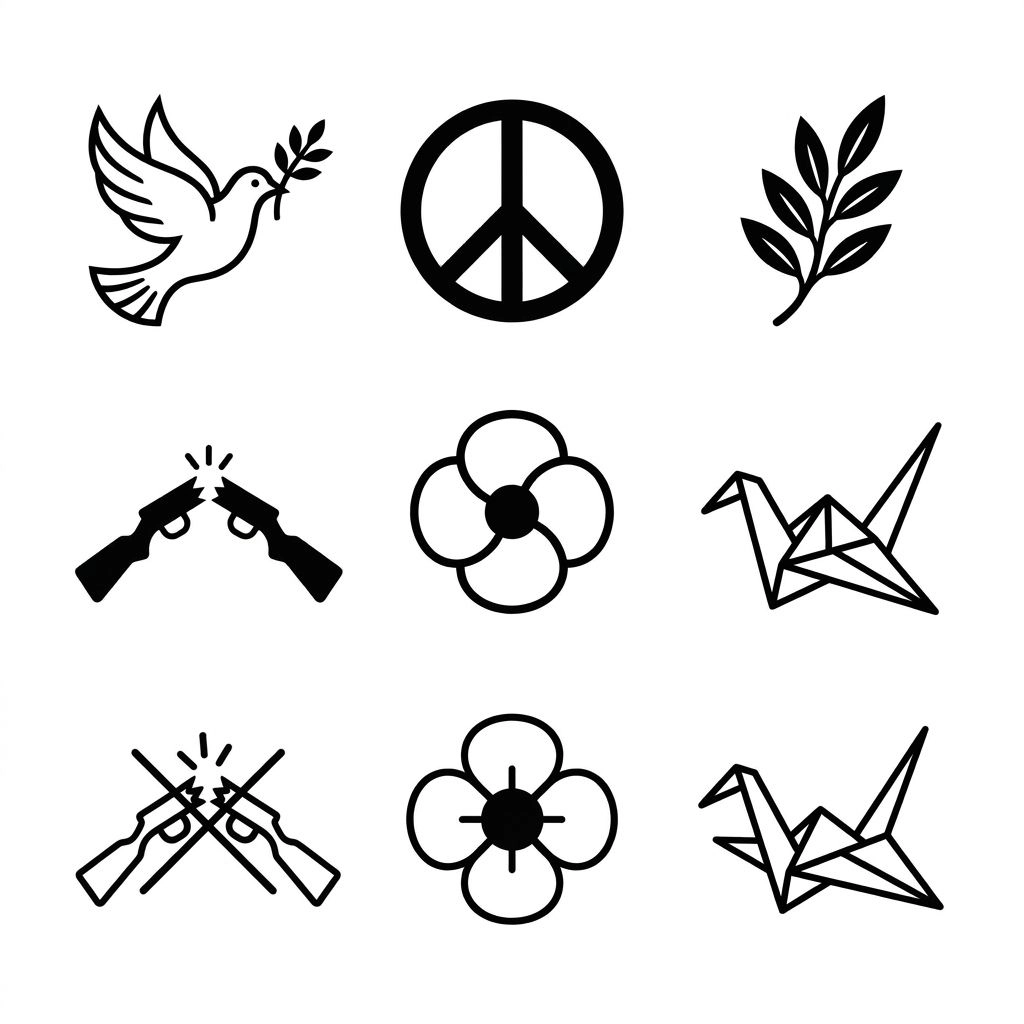
Peace has been represented through art, gestures, objects, animals, and signs for centuries. Some peace symbols come from ancient traditions, while others developed from modern anti-war movements, historical events, or campaigns for nuclear disarmament.
If you’re looking for the 7 symbols of peace, commonly recognized examples include the dove, olive branch, peace sign, white flag, broken rifle, paper crane, and V-sign. However, there isn’t one official worldwide list of exactly seven peace symbols. Different cultures and organizations recognize additional symbols, so the seven discussed here are best understood as important and widely used examples.
Each symbol also communicates something slightly different. A dove can suggest hope and reconciliation, an olive branch can represent an offer of peace, the ☮ sign is strongly associated with anti-war and nuclear-disarmament movements, while a white flag has a more specific meaning connected with truce or surrender.
Understanding these differences makes it easier to choose the right symbol for art, jewelry, tattoos, memorials, educational projects, or simply understanding its history.
What Are the 7 Symbols of Peace?
The seven symbols covered in this guide are:
| Symbol | Main Meaning | Common Association |
| 🕊️ Dove | Peace, hope, reconciliation | Religious and modern peace imagery |
| 🫒 Olive branch | Reconciliation and agreement | Ancient Mediterranean traditions |
| ☮️ Peace sign | Peace and anti-war activism | Nuclear disarmament and peace movements |
| 🏳️ White flag | Truce or surrender | Ending or pausing hostilities |
| Broken rifle | Opposition to war | Antimilitarist movements |
| Paper crane | Hope, remembrance, and peace | Hiroshima and Japanese peace symbolism |
| ✌️ V-sign | Peace, victory, or solidarity | Protest and popular culture |
These symbols shouldn’t be treated as having exactly the same meaning. Their histories are different, and context can change how people interpret them.
Is There an Official List of Seven Peace Symbols?
There is no universally official list containing exactly seven symbols of peace.
The meaning of a peace symbol develops through cultural traditions, historical events, religious imagery, political movements, art, and public use. As a result, different lists may include the white poppy, rainbow, peace lily, peace flag, peace bell, lotus, or other symbols.
The seven symbols in this article are selected because they provide a useful range of meanings and histories.
Some are associated with reconciliation, some with anti-war activism, some with truce, and others with hope and remembrance.
This distinction is important because calling every peace-related image an identical universal symbol can make the history of symbolism seem much simpler than it really is.
1. Dove 🕊️
The dove is one of the most familiar images associated with peace. A white dove may symbolize peace, hope, gentleness, reconciliation, and the desire to end conflict.
The bird’s peaceful image has deep historical and religious associations, and its connection with the olive branch helped strengthen its modern interpretation.
What Does the Dove Symbolize?
A dove can represent:
- Peace
- Hope
- Reconciliation
- Gentleness
- Renewal
- Freedom from conflict
- A peaceful future
The meaning can change slightly depending on the artwork or context.
A dove flying with an olive branch, for example, communicates a more specific message of peace and reconciliation than a dove by itself.
Why Did the Dove Become a Symbol of Peace?
One important source of the dove’s peace symbolism is the biblical story of Noah.
In the story, a dove returns carrying an olive leaf, providing a sign that the floodwaters had receded. Over time, the combination of a dove and olive branch became strongly associated with peace and the end of hardship.
The image was later adopted and reinterpreted in modern peace art.
Pablo Picasso’s famous dove imagery also helped establish the bird as an internationally recognizable peace image during the 20th century.
Dove With an Olive Branch vs. Dove Alone
These two images are closely related but can communicate slightly different ideas.
Dove alone: peace, hope, gentleness, or renewal.
Dove with olive branch: peace, reconciliation, agreement, and the desire to end conflict.
This distinction is useful when interpreting paintings, logos, tattoos, memorials, or other artwork.
2. Olive Branch 🫒
The olive branch is another ancient and enduring symbol associated with peace.
Unlike some modern peace symbols, its meaning developed long before contemporary peace movements. Olive trees and branches had important cultural meanings in the ancient Mediterranean world.
What Does the Olive Branch Symbolize?
An olive branch can represent:
- Peace
- Reconciliation
- Agreement
- Goodwill
- Truce
- The end of conflict
- A peaceful settlement
The phrase “extending an olive branch” still means offering reconciliation or attempting to resolve a disagreement.
Why Is the Olive Branch a Symbol of Peace?
Olive branches had positive associations in ancient Mediterranean cultures, and the branch became linked with peace and goodwill in historical and religious traditions.
Its symbolism was also reinforced by the biblical story of Noah, where a dove returns with an olive leaf after the flood.
The image therefore became associated with the idea that danger or destruction was ending and that a safer future was beginning.
What Does Extending an Olive Branch Mean?
When someone says they are extending an olive branch, they usually mean they are making an effort to repair a relationship or resolve a conflict.
For example:
“She extended an olive branch after their disagreement.”
Here, the phrase doesn’t necessarily mean political peace. It can describe reconciliation between friends, family members, coworkers, communities, or nations.
3. Peace Sign ☮️
The ☮ peace sign is one of the most recognizable modern symbols associated with peace and anti-war activism.
Unlike the dove and olive branch, which have ancient roots, this symbol has a clearly documented 20th-century origin.
Who Created the Peace Sign?
The modern peace sign was designed by Gerald Holtom in 1958 for the British Campaign for Nuclear Disarmament (CND).
It was created in connection with demonstrations opposing nuclear weapons.
The design incorporated semaphore signals representing the letters N and D, standing for nuclear disarmament.
What Does the Peace Sign Mean?
Today, ☮ can represent:
- Peace
- Anti-war activism
- Nuclear disarmament
- Nonviolence
- Social protest
- Solidarity
- Opposition to military conflict
Its meaning expanded beyond its original campaign as the symbol became associated with wider peace and anti-war movements.
Why Is the Peace Sign Important?
The history of ☮ shows how a symbol can move from a specific political campaign into broader popular culture.
During the 1960s and later decades, the peace sign became strongly associated with demonstrations, anti-war movements, posters, clothing, jewelry, artwork, and youth culture.
It is now often understood simply as a general symbol of peace, even though its original purpose was more specific.
4. White Flag 🏳️
The white flag is commonly associated with peace, but its meaning is more specific than simply “peace.”
It is primarily connected with truce, surrender, or a request to stop fighting.
What Does a White Flag Symbolize?
Depending on the situation, a white flag can communicate:
- Truce
- Surrender
- A request to negotiate
- A desire to stop fighting
- Temporary cessation of hostilities
- Peaceful communication during conflict
Because of this, it is important not to describe the white flag as though it always means peaceful living or harmony.
Is a White Flag a Peace Symbol?
Yes, it can function as a peace-related symbol, but its historical meaning is strongly connected with conflict.
A person displaying a white flag may be communicating a desire to stop fighting or to establish communication.
That makes the white flag different from an olive branch.
An olive branch commonly suggests an offer of reconciliation.
A white flag communicates a much more immediate message connected with an active conflict.
White Flag vs. Olive Branch
The distinction is simple:
Olive branch: “Let’s make peace.”
White flag: “Let’s stop fighting or communicate.”
This difference makes both symbols useful, but in different contexts.
5. Broken Rifle
The broken rifle is an anti-war symbol associated with opposition to armed conflict and militarism.
It is less universally recognized than the dove or peace sign, but it has a significant place in the history of antimilitarist and peace movements.
What Does the Broken Rifle Symbolize?
The broken rifle can represent:
- Opposition to war
- Rejection of violence
- Antimilitarism
- Disarmament
- Resistance to military conflict
- A desire to end armed violence
The visual message is direct: a weapon that has been broken can no longer be used for its intended purpose.
How Is the Broken Rifle Different From the Peace Sign?
Both can be used in anti-war contexts, but their visual messages are different.
The peace sign has become a broad symbol of peace, protest, and nuclear disarmament.
The broken rifle makes the rejection of armed conflict much more explicit.
This makes it particularly relevant to discussions of anti-war activism and disarmament.
Why Is It Considered a Peace Symbol?
The symbol developed within antimilitarist movements and communicates opposition to the use of weapons in warfare.
It therefore represents a specific kind of peace: peace achieved through rejecting or ending armed conflict.
6. Paper Crane
The paper crane, especially the folded origami crane, has become a powerful modern symbol of peace, hope, remembrance, and healing.
Its modern international peace symbolism is particularly connected with Hiroshima, Japan, and the story of Sadako Sasaki.
Why Is the Paper Crane a Symbol of Peace?
Cranes already held positive symbolic associations in Japanese culture, including ideas related to longevity and good fortune.
The modern peace association developed through the history of Hiroshima and the story of Sadako Sasaki, a young girl who developed leukemia after the atomic bombing of Hiroshima.
Sadako became associated with the tradition of folding paper cranes, and the crane later became an international image of hope and peace.
What Does a Paper Crane Symbolize?
A paper crane can represent:
- Peace
- Hope
- Healing
- Remembrance
- Resilience
- A world without nuclear war
- Hope for future generations
Its meaning is therefore different from the olive branch or peace sign.
The olive branch has ancient associations with reconciliation, while the paper crane carries a particularly strong connection with war remembrance, Hiroshima, nuclear weapons, and hope for peace.
Paper Cranes and Hiroshima
The Hiroshima peace tradition has helped make folded cranes recognizable around the world.
People may fold or display cranes at:
- Peace memorials
- Schools
- Museums
- Memorial ceremonies
- Cultural events
- Anti-nuclear demonstrations
The crane can therefore communicate both remembrance of past suffering and hope for a peaceful future.
7. V-Sign ✌️
The V-sign is a hand gesture that can mean victory, peace, solidarity, or protest depending on the context.
It should not be interpreted as exclusively meaning peace.
What Does the V-Sign Mean?
The gesture can communicate:
- Victory
- Peace
- Solidarity
- Celebration
- Protest
- Hope
Its meaning depends on the historical period, culture, hand position, and surrounding context.
How Did the V-Sign Become Associated With Peace?
The V-sign was famously used as a symbol of victory during World War II.
Later, particularly during the 1960s, the gesture became strongly associated with peace and anti-war movements.
This gave it a second major interpretation.
Today, someone making a V-sign in a photograph might simply mean “peace,” while another person may use the same gesture to mean victory.
Why Does Context Matter?
Unlike the olive branch or peace sign, the V-sign is a general hand gesture with multiple meanings.
Its interpretation can depend on:
- Where it is used
- How it is displayed
- The surrounding message
- Historical context
- Cultural conventions
For that reason, it is best described as a peace-associated gesture, rather than a symbol that always means peace.
How the 7 Peace Symbols Compare
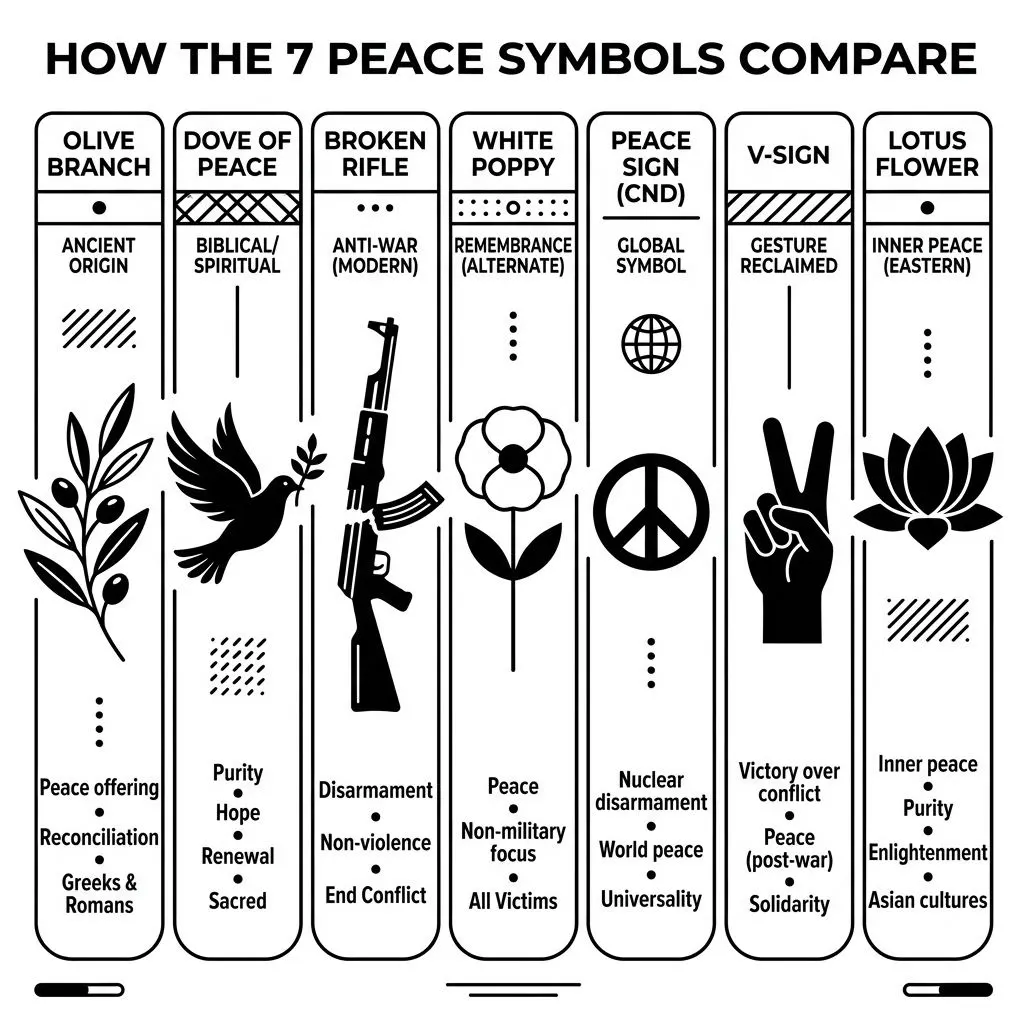
The seven symbols have different historical backgrounds and communicate different forms of peace.
| Symbol | Main Meaning | Type of Peace |
| Dove | Peace and hope | General peace and reconciliation |
| Olive branch | Reconciliation | Agreement and ending conflict |
| ☮ Peace sign | Peace and disarmament | Anti-war and nuclear disarmament |
| White flag | Truce or surrender | Stopping active conflict |
| Broken rifle | Opposition to war | Antimilitarism and disarmament |
| Paper crane | Hope and remembrance | Peace after war and nuclear destruction |
| ✌️ V-sign | Peace or victory | Solidarity and peace activism |
This comparison shows why it is inaccurate to assume that all seven symbols have exactly the same meaning.
Peace Symbols by Meaning
If you’re trying to understand which symbol communicates a particular idea, looking at the intended message can be more useful than simply memorizing a list.
Symbol for Reconciliation
The olive branch is particularly associated with reconciliation.
It can communicate an effort to repair a relationship, settle a disagreement, or establish goodwill.
Symbol for General Peace
The dove and ☮ peace sign are widely used to communicate a broad message of peace.
The dove tends to feel more gentle and symbolic, while the peace sign often has a stronger connection with activism.
Symbol for Anti-War Activism
The ☮ peace sign and broken rifle are especially relevant to anti-war messages.
The peace sign has a documented connection to nuclear disarmament, while the broken rifle communicates rejection of armed warfare.
Symbol for Truce
The white flag is the clearest choice when the intended meaning is a truce or stopping active hostilities.
It should not automatically be interpreted as a permanent peace agreement.
Symbol for Remembrance and Hope
The paper crane is strongly connected with remembrance, Hiroshima, nuclear-war awareness, and hope for peace.
It can therefore carry a memorial meaning that isn’t necessarily present in a generic peace sign.
Symbol for Peace Through a Gesture
The V-sign can communicate peace or solidarity when used in the appropriate context.
Because it also means victory, the surrounding context is important.
Dove vs. Olive Branch: What’s the Difference?
The dove and olive branch are frequently displayed together, but their meanings can be separated.
| Dove | Olive Branch |
| Peace | Reconciliation |
| Hope | Agreement |
| Gentleness | Goodwill |
| Renewal | Ending conflict |
| Peaceful future | Offer of peace |
A dove may communicate the idea of peace itself, while an olive branch can suggest an active attempt to establish peace.
When combined, they create a particularly recognizable peace image.
Peace Sign vs. Broken Rifle: What’s the Difference?
Both symbols can appear in anti-war movements, but they emphasize different messages.
The peace sign has a specific history connected with nuclear disarmament and later became a broader peace symbol.
The broken rifle focuses more directly on rejecting weapons and warfare.
So if an image contains a peace sign, the message may be broadly about peace or activism.
If it contains a broken rifle, the message is more explicitly about opposition to war and militarism.
Ancient vs. Modern Peace Symbols
Not all peace symbols originated in the same period.
Ancient and Traditional Associations
The olive branch and dove have very old cultural and religious associations.
Their modern peace meanings developed through layers of historical interpretation.
Modern Peace Movements
The ☮ peace sign has a specific 20th-century origin tied to nuclear disarmament.
The broken rifle became associated with organized antimilitarist movements.
Peace Symbols Shaped by Modern History
The paper crane became an international peace image through the history of Hiroshima and nuclear-war remembrance.
The V-sign developed different meanings across the 20th century, including victory and later peace activism.
The white flag has a long association with communication during armed conflict.
This historical variety is one reason there isn’t a single universal definition of a peace symbol.
Peace Symbols Across Different Cultures
Peace symbolism is not identical in every culture.
A symbol’s meaning can change depending on:
- Religion
- Historical events
- Art
- Political movements
- Local traditions
- Social context
For example, the paper crane has a particularly strong connection with Japanese culture and Hiroshima. The olive branch has much older Mediterranean and religious associations. The modern peace sign developed within a British nuclear-disarmament campaign before becoming internationally recognized.
This means you should consider the cultural context before assuming that every peace symbol has one universal meaning.
World Peace vs. Inner Peace Symbols
The phrase “symbols of peace” can refer to more than one type of peace.
World Peace
The seven symbols discussed in this article are primarily connected with:
- Ending conflict
- Reconciliation
- Anti-war movements
- Truce
- Disarmament
- Peace activism
- Remembrance after war
Inner or Spiritual Peace
People searching for inner peace symbols may be looking for imagery from religious or spiritual traditions, such as the lotus, Om, yin-yang, or meditation-related symbols.
These belong to a somewhat different category.
A symbol associated with spiritual calm isn’t automatically the same thing as a historical symbol of peace between people or nations.
Keeping these categories separate makes the meaning much clearer.
Peace Symbols for Tattoos
Peace symbols are popular choices for tattoos because many of them can communicate a personal value in a simple visual form.
Dove Tattoo Meaning
A dove tattoo can represent:
- Peace
- Hope
- Freedom
- Renewal
- Reconciliation
Olive Branch Tattoo Meaning
An olive branch tattoo may represent:
- Forgiveness
- Reconciliation
- Peace
- Moving beyond conflict
- Choosing goodwill
Peace Sign Tattoo Meaning
A ☮ tattoo is often associated with:
- Peace
- Nonviolence
- Anti-war beliefs
- Activism
- Social solidarity
Paper Crane Tattoo Meaning
A paper crane tattoo can symbolize:
- Hope
- Healing
- Remembrance
- Hiroshima
- Peace
- A wish for a safer future
The personal meaning of a tattoo can differ from its historical meaning, so the surrounding design and the person’s own intention also matter.
Peace Symbols in Jewelry and Art
Peace symbols are also commonly used in jewelry, posters, paintings, memorials, sculptures, and decorative art.
A dove pendant may emphasize hope or peace.
An olive branch necklace can suggest reconciliation.
A peace sign bracelet may communicate general peace or anti-war values.
A paper crane artwork may carry a message of remembrance and hope.
The same symbol can therefore appear in very different settings while retaining a related central idea.
What Makes a Symbol a Peace Symbol?
A peace symbol generally becomes recognized through repeated cultural or historical use.
There isn’t a single authority that decides which image qualifies.
A symbol may become associated with peace because it has:
- A long cultural tradition
- Religious significance
- A historical connection with reconciliation
- A role in peace movements
- A connection with anti-war activism
- A recognized relationship with diplomacy or truce
- Strong public recognition
This is why peace symbolism continues to evolve.
Frequently Asked Questions
What are the 7 symbols of peace?
Seven commonly discussed examples are the dove, olive branch, peace sign, white flag, broken rifle, paper crane, and V-sign. There is no universal official list containing exactly seven peace symbols.
What is the most common symbol of peace?
The dove and ☮ peace sign are among the most widely recognized symbols associated with peace. Their histories are different: the dove has ancient and religious associations, while the modern peace sign originated with the 1958 nuclear-disarmament movement.
Why is the dove a symbol of peace?
The dove became strongly associated with peace through religious and historical traditions, particularly imagery involving a dove carrying an olive branch. Modern peace art further strengthened its international association with peace and hope.
Why is the olive branch a symbol of peace?
The olive branch has ancient Mediterranean associations and became linked with peace, goodwill, and reconciliation. The expression “extending an olive branch” continues to mean making an effort to settle a disagreement.
What does the ☮ peace sign mean?
The ☮ peace sign represents peace, anti-war activism, and nuclear disarmament. Gerald Holtom designed it in 1958 for the British Campaign for Nuclear Disarmament.
Is a white flag a symbol of peace?
A white flag can be considered a peace-related symbol, but its more specific meanings are truce, surrender, or a request to stop fighting. It should not automatically be interpreted as permanent peace.
Why is a paper crane a symbol of peace?
The paper crane became an international peace symbol through its connection with Hiroshima, Sadako Sasaki, remembrance, and hopes for a world without nuclear war. It can represent hope, healing, and peace.
What does a broken rifle symbolize?
A broken rifle represents opposition to war, militarism, and armed violence. It is particularly associated with antimilitarist and disarmament movements.
What does the V-sign mean?
The V-sign can mean victory, peace, solidarity, or celebration. Its meaning depends on historical and cultural context. It became strongly associated with peace and anti-war activism during the 20th century.
What symbol represents reconciliation?
The olive branch is one of the clearest symbols associated with reconciliation. Offering an olive branch suggests a willingness to settle a disagreement and establish goodwill.
What symbol represents anti-war activism?
The ☮ peace sign is strongly associated with anti-war activism, while the broken rifle more directly communicates opposition to warfare and militarism.
Is there an official universal list of seven peace symbols?
No. There is no universally accepted official list of exactly seven peace symbols. Different sources and cultures include different images depending on historical and cultural context.
What is the difference between a peace symbol and an anti-war symbol?
A peace symbol may communicate harmony, reconciliation, or peaceful coexistence. An anti-war symbol specifically expresses opposition to warfare, weapons, or military violence. Some symbols, such as the peace sign, can communicate both ideas.
Conclusion
The 7 symbols of peace discussed here show how different cultures and historical movements have expressed the desire for peace. The dove represents peace and hope, while the olive branch is closely connected with reconciliation and goodwill.
The ☮ peace sign carries a modern history rooted in nuclear disarmament and anti-war activism. The white flag communicates truce or surrender, while the broken rifle represents opposition to warfare and militarism.
The paper crane connects peace with Hiroshima, remembrance, and hope for the future. The V-sign can express peace or solidarity, although it also has important associations with victory.
There is no single official list of seven peace symbols, and their meanings can change with culture and context. Understanding those differences gives each symbol more meaning than simply calling it a “sign of peace.” Whether used in art, jewelry, tattoos, memorials, education, or activism, these symbols continue to communicate the human hope for reconciliation, safety, and a more peaceful future.

Adam Sullivan is a dedicated writer who enjoys transforming everyday topics into engaging and informative content. His writing focuses on making complex ideas simple, practical and enjoyable for readers of all backgrounds. Adam is also the fictional author of The Lantern Beyond Autumn Hills and Where the Morning Horizon Waits. Outside of writing, he enjoys photography, traveling and discovering inspiration through new experiences. He believes great content should be both helpful and easy to connect with.
 Dylan Anderson