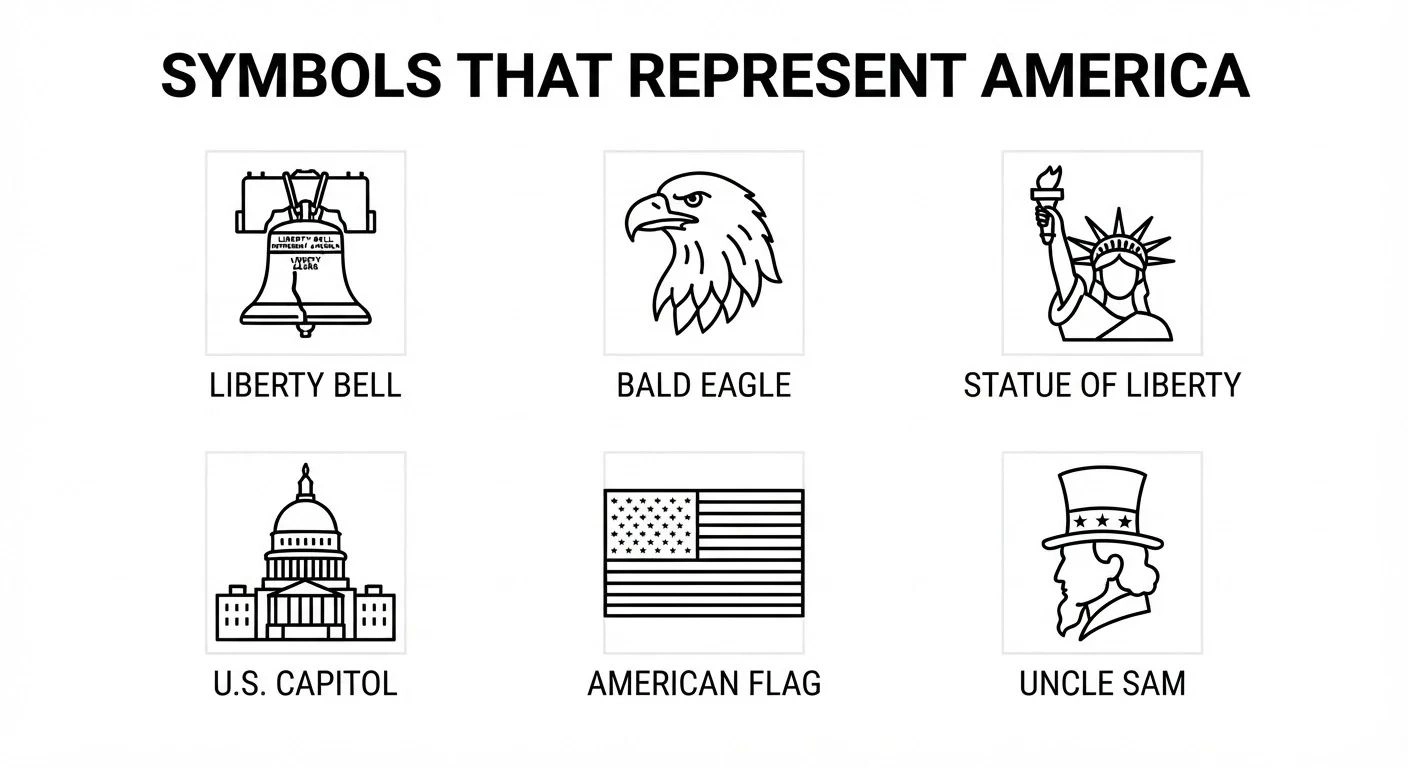
America is represented by symbols that tell stories about freedom, independence, courage, democracy, and national identity. Some are official national emblems, while others come from American history, government, popular culture, and everyday life.
The American flag, bald eagle, Statue of Liberty, Liberty Bell, and Great Seal are among the most recognizable symbols of the United States. Each represents a different part of the country’s identity. The flag represents the nation itself. The bald eagle suggests strength and independence. The Statue of Liberty has become an international image of freedom and hope.
However, America’s identity cannot be explained through a handful of patriotic images. Its symbols also include historical documents, national monuments, music, sports, food, and cultural traditions. Some reflect national achievements, while others remind people of difficult chapters in American history.
In this article, the word “America” refers to the United States of America. You’ll discover official national symbols, famous American icons, their meanings, historical backgrounds, and the values they represent.
What Are the Main Symbols That Represent America?
The most recognizable symbols that represent America include the American flag, bald eagle, Statue of Liberty, Liberty Bell, Great Seal, and Uncle Sam. Other important symbols include the Constitution, White House, North American bison, American rose, oak tree, and national anthem.
Some of these symbols have official recognition under federal law. Others became important through historical events, public traditions, and popular culture.
Here is a quick overview:
| American Symbol | Meaning or Association |
| American flag | National identity, independence, and unity |
| Bald eagle | Strength, freedom, and independence |
| Statue of Liberty | Liberty, hope, and opportunity |
| Liberty Bell | Freedom and the pursuit of equality |
| Great Seal | National authority, peace, and defense |
| Uncle Sam | The United States and its federal government |
| Declaration of Independence | Self-government and independence |
| U.S. Constitution | Constitutional government and individual rights |
| White House | The presidency and executive government |
| U.S. Capitol | Congress and representative government |
| North American bison | American wildlife, heritage, and conservation |
| Rose | National floral identity |
| Oak tree | Strength, endurance, and national heritage |
| Star-Spangled Banner | American history and national identity |
| The Stars and Stripes Forever | American musical and patriotic tradition |
| Hollywood sign | American entertainment and filmmaking |
| Route 66 | Road travel and American popular culture |
| Baseball | American sports history and community traditions |
The list includes different kinds of symbols. Understanding their categories helps explain why each one matters.
Official National Symbols of the United States
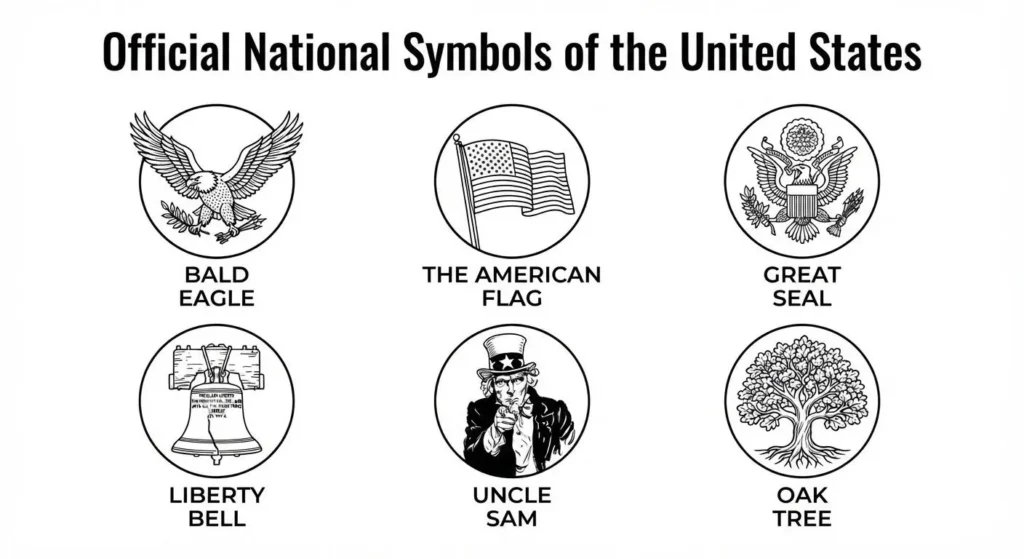
The United States has several symbols formally designated by Congress. These include its national bird, mammal, floral emblem, tree, anthem, motto, and march.
The Congressional Research Service identifies these seven designations in its report on United States national symbols. The bald eagle became the official national bird in December 2024, making it the newest addition to this group.
National Bird: Bald Eagle
The bald eagle is the national bird of the United States. Congress formally gave it this designation through Public Law 118-206 on December 23, 2024.
The bird had already represented America for more than two centuries. The Continental Congress adopted it for the Great Seal in 1782.
National Mammal: North American Bison
The North American bison became the national mammal in 2016. It represents American wildlife, conservation, and the country’s natural heritage.
Its history is also closely connected with many Indigenous communities.
National Floral Emblem: Rose
The rose became the national floral emblem in 1986. Congress selected it because of its place in American heritage and its widespread presence.
The designation does not favor one particular rose variety.
National Tree: Oak
The oak tree became the national tree in 2004. Its strength, durability, and presence across the country make it a fitting emblem of American natural heritage.
National Anthem: The Star-Spangled Banner
“The Star-Spangled Banner” became the national anthem in 1931. Francis Scott Key wrote its lyrics in 1814 after witnessing the British attack on Fort McHenry during the War of 1812.
National Motto: In God We Trust
“In God We Trust” became the national motto in 1956. The phrase appears on U.S. currency and reflects a historical religious tradition in American public life.
Americans have different religious and nonreligious beliefs, so the motto should not be understood as a description of every individual’s personal views.
National March: The Stars and Stripes Forever
John Philip Sousa composed “The Stars and Stripes Forever,” which became the national march in 1987.
The lively piece is closely associated with American patriotic celebrations, public performances, and marching bands.
These official designations are different from famous landmarks or popular cultural images. A symbol can be important to American identity without having a formal national designation.
Most Recognizable Symbols of America
Some American symbols are known around the world. They appear on flags, currency, government documents, monuments, clothing, advertisements, and educational materials.
The American Flag: A Symbol of Independence and Unity
The American flag, also known as the Stars and Stripes or Old Glory, is one of the most recognizable national symbols in the world.
It has 13 alternating red and white stripes and 50 white stars on a blue field. The stars represent the 50 states, while the stripes represent the 13 original colonies.
The Continental Congress adopted the first official national flag design on June 14, 1777. As the country grew, stars were added to reflect new states. The 13 stripes remained constant.
The current 50-star flag became official on July 4, 1960, following Hawaii’s admission as the fiftieth state.
What Do the American Flag Colors Mean?
The flag’s colors have traditional symbolic associations:
- Red: Valor and bravery.
- White: Purity and innocence.
- Blue: Vigilance, perseverance, and justice.
These meanings come from the traditional explanations associated with American national symbolism. They are not a separate list of meanings written into the original 1777 Flag Resolution.
The flag represents the country as a whole. People display it during Independence Day, Memorial Day, Veterans Day, sporting events, and public ceremonies.
Why Is the American Flag Called Old Glory?
Old Glory is a popular nickname for the American flag. The name became widely associated with the flag through nineteenth-century American maritime history and patriotic traditions.
It expresses respect for the flag and the country’s national identity.
What Is the Story Behind the Betsy Ross Flag?
The Betsy Ross story says that Philadelphia seamstress Betsy Ross made the first American flag at George Washington’s request.
It is a familiar part of American folklore, but historians have not established that she created the first flag adopted under the 1777 resolution.
The story should therefore be described as a popular tradition rather than a confirmed historical fact.
The Bald Eagle: A Symbol of Strength and Freedom
The bald eagle is one of America’s most familiar national emblems. Its powerful wings, sharp eyesight, and ability to soar high have made it a popular image of strength and independence.
Its connection with the United States began in 1782, when Congress adopted the Great Seal featuring the eagle. However, it did not become the formally designated national bird until 2024.
The bald eagle commonly represents:
- Freedom: Its flight suggests independence and liberty.
- Strength: Its powerful appearance makes it an emblem of resilience.
- National identity: It appears on official government imagery and military insignia.
- Independence: Its historical connection with the founding period links it to the country’s identity.
The bald eagle also has deep cultural and spiritual significance for many Indigenous peoples. Its meaning within those traditions is not limited to American national symbolism.
The Statue of Liberty: A Symbol of Hope and Opportunity
The Statue of Liberty stands on Liberty Island in New York Harbor. France gave the monument to the United States as a gift of friendship, and it was dedicated in 1886.
Its formal name is “Liberty Enlightening the World.” The statue depicts Libertas, the Roman goddess of liberty.
For generations, the monument has been associated with freedom, hope, immigration, and the possibility of a new beginning.
Its main features have recognizable meanings:
- Torch: Enlightenment and the spread of liberty.
- Tablet: Law and independence, carrying the date July 4, 1776.
- Broken chain: Freedom from oppression.
- Crown: Seven rays commonly associated with the seven seas and continents.
The Statue of Liberty became especially meaningful to immigrants arriving through New York Harbor. It remains one of the strongest international images of the United States.
The Liberty Bell: A Symbol of American Freedom
The Liberty Bell is a historic bell in Philadelphia, Pennsylvania. It is closely connected with American independence and the country’s founding ideals.
The bell was commissioned in 1752 for the Pennsylvania State House, now known as Independence Hall.
Its famous inscription reads:
“Proclaim Liberty Throughout All the Land Unto All the Inhabitants Thereof.”
The words come from Leviticus 25:10 and helped give the bell its lasting association with freedom.
The bell’s large crack is now part of its identity. It cannot ring normally, but its image continues to represent the unfinished pursuit of liberty and equality.
A popular story says that the bell rang on July 4, 1776, to announce the Declaration of Independence. However, reliable historical evidence does not establish that event.
The Liberty Bell also became an important symbol for abolitionists and later civil rights advocates. Its message of liberty connected the founding generation’s ideals with later demands for equal rights.
The Great Seal of the United States: A Symbol of National Authority
The Great Seal of the United States is an official emblem used to authenticate important government documents. Its design was approved in 1782.
The front of the seal features a bald eagle holding an olive branch in one talon and a bundle of arrows in the other.
The main design elements communicate several ideas:
- Bald eagle: National identity and strength.
- Olive branch: Peace.
- Arrows: The ability to defend the country.
- Shield: The union of the states.
- Stars: The original thirteen states in the seal’s design.
- E Pluribus Unum: A Latin phrase meaning “Out of many, one.”
The eagle’s position and objects express the idea that the country seeks peace while retaining the ability to defend itself.
The Great Seal appears on official documents and is closely connected with American government, diplomacy, and national authority.
Uncle Sam: A Symbol of the United States Government
Uncle Sam is a familiar personification of the United States. Artists usually portray him as an older man with white hair, a pointed beard, and clothing inspired by the American flag.
The character became popular during the War of 1812. Over time, Uncle Sam developed into a recognizable image of the federal government and the country.
His most famous appearance came through a World War I recruitment poster by artist James Montgomery Flagg.
The poster shows Uncle Sam pointing toward the viewer with the words “I Want YOU for the U.S. Army.”
Uncle Sam commonly represents government authority, military recruitment, public service, and American national identity.
Unlike the national bird or anthem, Uncle Sam is an unofficial personification rather than a formally designated national symbol.
Historical Symbols of American Independence

America’s founding period produced important documents, objects, and figures that still represent independence and self-government.
These symbols help explain how the United States developed from thirteen British colonies into an independent nation.
Declaration of Independence: A Symbol of Self-Government
The Declaration of Independence is one of the most important documents in American history. The Continental Congress adopted it on July 4, 1776.
It announced that the thirteen colonies considered themselves independent from Great Britain.
The document expressed ideas about natural rights, equality, and government by consent. Its language later became an important reference point for movements seeking freedom and equal treatment.
The Declaration represents:
- Independence from colonial rule.
- The right to self-government.
- Individual liberty.
- Equality as a founding ideal.
- Government based on the consent of the governed.
Its promise of equality was not applied to everyone when the document was written. Slavery continued, and many people lacked basic political rights.
Later generations used the Declaration’s language to challenge those contradictions and demand a broader application of its ideals.
United States Constitution: A Symbol of Democracy and Law
The U.S. Constitution established the structure of the federal government. It was signed in 1787 and later ratified by the states.
It divides federal power among three branches: legislative, executive, and judicial.
The Constitution represents the principle that government must operate within a legal framework.
Its central ideas include:
- Separation of powers.
- Checks and balances.
- Representative government.
- Federalism.
- Constitutional rights and responsibilities.
The Bill of Rights, which contains the first ten amendments, protects important freedoms such as speech, religion, press, and peaceful assembly.
Together, the Constitution and its amendments represent the country’s commitment to constitutional government and the rule of law.
The Minuteman: A Symbol of Revolutionary Courage
The Minuteman represents colonial militia members who prepared to respond quickly during the American Revolution.
The name refers to their expected readiness to assemble at short notice. The image became associated with local resistance and the struggle against British rule.
The Minuteman commonly represents courage, preparedness, independence, and community participation in the Revolution.
Today, the figure appears in monuments, historical artwork, and military-related imagery.
It reminds people that the American Revolution involved local communities as well as political leaders and organized military forces.
American Government Buildings and Monuments
American landmarks represent more than architecture. Many connect directly with the country’s political institutions, historical leaders, and important national events.
The White House: A Symbol of the Presidency
The White House is the official residence and workplace of the president of the United States. It stands in Washington, D.C.
It represents the executive branch of the federal government and the office of the presidency.
The building is associated with presidential leadership, diplomacy, national decision-making, and the peaceful transfer of political power.
Its image appears regularly in news coverage, political discussions, and educational materials.
The U.S. Capitol: A Symbol of Representative Government
The United States Capitol is where Congress meets to debate and pass federal legislation.
Its familiar dome is one of the most recognizable features of Washington, D.C.
The Capitol represents the legislative branch, representative democracy, public debate, and lawmaking.
It is different from the White House, which represents the executive branch. Together, these institutions help explain how American federal government is organized.
The Washington Monument: A Symbol of Founding Leadership
The Washington Monument honors George Washington, the first president of the United States and a leading figure in the American Revolution.
The tall obelisk stands on the National Mall in Washington, D.C.
It represents national remembrance, leadership, public service, and the founding of the republic.
Its location near other major monuments makes it an important part of the capital’s national landscape.
The Lincoln Memorial: A Symbol of Equality and Civil Rights
The Lincoln Memorial honors Abraham Lincoln, the sixteenth president of the United States.
Lincoln led the country during the Civil War and issued the Emancipation Proclamation in 1863.
The memorial is associated with freedom, national unity, emancipation, and the continuing struggle for civil rights.
It also became an important location for the civil rights movement. Martin Luther King Jr. delivered his “I Have a Dream” speech near the memorial during the 1963 March on Washington.
For many visitors, the monument represents the work still required to make the country’s founding ideals meaningful for everyone.
Mount Rushmore: A Symbol of Presidential History
Mount Rushmore is a monument in the Black Hills of South Dakota. It features the carved faces of four American presidents:
- George Washington.
- Thomas Jefferson.
- Theodore Roosevelt.
- Abraham Lincoln.
The monument commemorates these presidents and their roles in American history.
It is commonly associated with national heritage, presidential leadership, and tourism.
However, Mount Rushmore’s location also carries important Indigenous history. The Black Hills are sacred to the Lakota people, and the monument’s presence has been part of broader disputes over land, sovereignty, and historical memory.
A complete explanation of this landmark should recognize both its national significance and the history of the land.
Cultural Symbols That Represent America

Not every American symbol comes from a government building or historical document. Many familiar icons developed through entertainment, sports, food, fashion, travel, and everyday traditions.
These cultural symbols are not official national emblems. Instead, they represent aspects of American life that have become recognizable across the country and around the world.
The Cowboy Hat: A Symbol of the American West
The cowboy hat is strongly associated with ranching, western landscapes, and frontier culture.
Its familiar shape developed from practical headwear used by people working outdoors. Over time, it became an icon in western films, country music, rodeos, and American fashion.
The cowboy hat commonly represents independence, hard work, rural traditions, and the American West.
Its meaning is cultural rather than official. It also reflects a romanticized image of western history, which was more complex than many movies suggest.
The Hollywood Sign: A Symbol of American Entertainment
The Hollywood sign stands on Mount Lee in Los Angeles, California. It is one of the world’s most recognizable images of the American entertainment industry.
The sign originally appeared in 1923 as a real-estate advertisement reading “Hollywoodland.” The final four letters were removed in 1949.
Today, the Hollywood sign is closely associated with movies, celebrity culture, filmmaking, and the global influence of American entertainment.
It represents an important part of the country’s creative and commercial identity.
Route 66: A Symbol of American Road Travel
Route 66 is one of the most famous historic highways in the United States. Established in 1926, it connected Chicago with Santa Monica, California.
The road became associated with long-distance travel, roadside businesses, family vacations, migration, and the open road.
Its image appears in music, films, travel posters, restaurants, and souvenirs.
Route 66 commonly represents exploration, independence, adventure, and the freedom to travel.
It is a cultural icon rather than an official national emblem.
Baseball: A Symbol of American Sports Culture
Baseball has played a major role in American sports history for generations.
Professional leagues, local teams, school competitions, and community games have helped make it a familiar part of American life.
Baseball is commonly associated with teamwork, competition, tradition, and community identity.
Its connection with America is also historical and cultural. The sport developed through a wider history of bat-and-ball games, and its development involved many communities and influences.
Jazz: A Symbol of American Musical Heritage
Jazz is one of America’s most influential musical traditions. It developed through African American communities, especially in New Orleans, during the late nineteenth and early twentieth centuries.
Its history connects blues, ragtime, improvisation, spiritual traditions, and other musical influences.
Jazz commonly represents creativity, experimentation, cultural exchange, and artistic freedom.
Its development also highlights the contributions of Black American musicians to music around the world.
Apple Pie: A Symbol of Traditional American Food Culture
Apple pie is often described as an American comfort food. It appears in family celebrations, diners, holiday meals, and popular expressions.
The dessert is not originally unique to the United States. Similar pies existed in European food traditions before becoming part of American cooking.
However, apple pie developed a strong cultural association with home, family, hospitality, and traditional American life.
The phrase “as American as apple pie” reflects that cultural connection.
Blue Jeans: A Symbol of American Fashion
Blue jeans became an important part of American clothing history.
Their modern popularity is closely connected with workwear, western culture, Hollywood films, and later youth fashion.
Jeans are now worn around the world. Their cultural associations include practicality, individuality, casual style, and American fashion influence.
The American Diner: A Symbol of Everyday Life
The American diner is a familiar part of popular culture. Its image often includes counter seating, booths, coffee, breakfast plates, and roadside locations.
Diners became especially recognizable through twentieth-century American life and entertainment.
They are commonly associated with informal dining, road travel, community gatherings, and small-business culture.
Although diners are not unique to the United States, their familiar appearance has become a recognizable American cultural image.
Symbols That Represent American Values
American symbols often communicate values that people connect with the country’s founding ideals and national identity.
These values are not always achieved equally or understood in the same way. They are ideals that have shaped political debates, public movements, and national traditions.
Freedom and Liberty
Freedom is one of the most familiar ideas associated with America.
The Statue of Liberty, Liberty Bell, and Declaration of Independence all connect with the country’s history of independence and the pursuit of liberty.
The Constitution and Bill of Rights add a legal dimension by protecting specific freedoms and establishing limits on government power.
These symbols appear in public ceremonies, historical education, and discussions about civil rights.
Democracy and Equality
The U.S. Capitol, Constitution, and Declaration of Independence are closely connected with representative government and equality as a national ideal.
The Capitol represents elected lawmakers. The Constitution establishes the framework of government. The Declaration expresses the principle that people possess fundamental rights.
However, the history of American democracy includes exclusion and unequal access to political power.
Women, enslaved people, Indigenous communities, and many other groups faced restrictions that took generations of struggle to challenge.
The symbols of democracy therefore represent both the country’s founding principles and the ongoing effort to apply them more fairly.
Opportunity and the American Dream
The American Dream is the belief that people can improve their lives through opportunity, effort, education, and personal goals.
It does not have one official symbol. Instead, several cultural and historical images are commonly connected with it.
Examples include:
- The open road: The possibility of exploring new paths.
- The Statue of Liberty: Hope and the chance to begin again.
- A family home: Security, stability, and personal achievement.
- The American flag: National identity and shared opportunity.
- A school or university: Education and personal development.
The American Dream means different things to different people. For some, it involves homeownership or career success. For others, it means freedom, safety, education, or a better future for their children.
Courage and National Unity
The bald eagle, Minuteman, American flag, and military memorials are often associated with courage and national service.
They remind people of the sacrifices made during wars and periods of national crisis.
Unity is another common theme. The Great Seal’s motto, “E Pluribus Unum,” expresses the idea of forming one nation from many parts.
This idea is particularly important in a country with many cultural, regional, and family backgrounds.
American Symbols and Their Meanings at a Glance
Different symbols communicate different aspects of American identity. This comparison helps separate national emblems, historical objects, government institutions, and cultural icons.
| Category | Symbol | Main Association |
| National identity | American flag | The United States and its states |
| National identity | Great Seal | Federal authority and national unity |
| National bird | Bald eagle | Strength and independence |
| National mammal | North American bison | Wildlife and heritage |
| National flower | Rose | National floral identity |
| National tree | Oak | Strength and endurance |
| National anthem | The Star-Spangled Banner | National history |
| National motto | In God We Trust | Historical religious tradition |
| National march | The Stars and Stripes Forever | Patriotic music |
| Independence | Declaration of Independence | Self-government |
| Law | Constitution | Constitutional government |
| Liberty | Liberty Bell | Freedom and equality |
| Hope | Statue of Liberty | Opportunity and liberty |
| Government | White House | Presidency |
| Government | U.S. Capitol | Congress |
| American West | Cowboy hat | Ranching and western culture |
| Entertainment | Hollywood sign | Film and television |
| Travel | Route 66 | Road trips and exploration |
| Sports | Baseball | American sporting traditions |
| Music | Jazz | African American musical heritage |
This distinction matters because a cultural icon is not automatically an official national symbol. Both categories are important, but they represent different parts of American identity.
What Colors Represent America?
Red, white, and blue are the main colors associated with the United States because they appear on the national flag.
They are used in patriotic clothing, decorations, public ceremonies, national celebrations, and American-themed designs.
| Color | Traditional Association |
| Red | Valor and bravery |
| White | Purity and innocence |
| Blue | Vigilance, perseverance, and justice |
These traditional meanings are often used to explain the flag’s design. They should not be treated as universal meanings for every American use of these colors.
Gold, green, and other colors also appear in American artwork and national imagery. Gold may suggest achievement or honor, while green can represent nature, forests, and environmental protection.
However, these broader associations are not official national color designations.
What Animals Represent America?
Several animals are connected with American wildlife, history, and cultural identity.
The bald eagle and North American bison have formal national recognition. Other animals are popular because of their regional importance or place in American traditions.
| Animal | Meaning or Cultural Connection |
| Bald eagle | Freedom, strength, and national identity |
| North American bison | American wildlife and Indigenous heritage |
| Wild turkey | American wildlife and Thanksgiving traditions |
| White-tailed deer | Forests and wildlife |
| American alligator | Southeastern wildlife |
| Horse | Ranching, transportation, and western history |
The bald eagle is the national bird, while the bison is the national mammal.
The wild turkey is strongly connected with Thanksgiving, but it is not the official national bird. The white-tailed deer, alligator, and horse are culturally or regionally important rather than official national animal symbols.
American Symbols and Indigenous History
American national identity includes histories that existed long before the founding of the United States.
Indigenous nations have distinct languages, traditions, governments, and cultural practices. Their relationships with animals, land, and national monuments cannot be reduced to one shared perspective.
Understanding this history makes discussions of American symbols more complete.
The Bison and Indigenous Communities
The North American bison was central to the lives of many Indigenous communities across the Great Plains and other regions.
Bison provided food, clothing materials, tools, and other resources. They also held cultural, spiritual, and economic importance for numerous Tribal nations.
During the nineteenth century, bison populations declined dramatically. This decline harmed Indigenous communities whose lives and traditions were closely connected with the animals.
Today, Tribal nations participate in bison restoration and conservation efforts.
The bison therefore represents more than American wildlife. It also connects with Indigenous heritage, environmental recovery, and cultural continuity.
The Bald Eagle and Indigenous Traditions
The bald eagle has important cultural and spiritual meanings for many Indigenous peoples.
Its feathers and other aspects of eagle traditions may be associated with honor, prayer, ceremonies, and relationships with the natural world.
Practices differ among Tribal nations. It would be inaccurate to suggest that all Indigenous communities understand the eagle in exactly the same way.
Its role as a national American emblem exists alongside these older and continuing Indigenous traditions.
The Black Hills and Mount Rushmore
Mount Rushmore stands in the Black Hills of South Dakota, an area sacred to the Lakota people.
The history of the Black Hills includes treaties, land disputes, forced displacement, and continuing questions about sovereignty and historical recognition.
For many visitors, Mount Rushmore represents American presidents and national history. For many Lakota people, the location also raises difficult questions about land, identity, and the treatment of Indigenous nations.
Recognizing both perspectives provides a more complete understanding of the monument.
American Symbols Used in Tattoos and Artwork
American symbols appear in tattoos, paintings, clothing, logos, posters, and decorative designs.
People choose these images for different reasons. Some express patriotism or military service, while others connect them with family history, freedom, personal identity, or cultural interests.
American Flag Tattoos
An American flag tattoo can represent patriotism, national pride, military service, or a personal connection to the United States.
Some people choose a complete flag design, while others use a few stars or stripes.
The meaning depends on the person wearing it and the style of the artwork.
Bald Eagle Tattoos
A bald eagle tattoo often represents strength, independence, courage, and freedom.
Common designs show the eagle flying, spreading its wings, or appearing alongside the American flag.
Statue of Liberty Tattoos
The Statue of Liberty can represent hope, opportunity, freedom, and a new beginning.
It may be especially meaningful to people with immigration stories or personal connections to New York.
Liberty Bell Tattoos
A Liberty Bell tattoo can express independence, equality, and the historical pursuit of freedom.
Its distinctive crack may also suggest that liberty is an ongoing ideal rather than a finished achievement.
Patriotic American Designs
Some tattoos and artwork combine several American symbols into one composition.
Popular combinations include:
- Bald eagle with the American flag.
- Statue of Liberty with stars and stripes.
- Liberty Bell with the Declaration of Independence.
- Great Seal with patriotic lettering.
- American flag with military insignia.
A good design should reflect the meaning the person wants to communicate rather than rely only on familiar imagery.
American Symbols for Kids and Students
American symbols are often taught in schools because they make the country’s history and government easier to understand.
Students can use these examples for classroom assignments, posters, presentations, and history projects.
| Symbol | Simple Meaning |
| American flag | Represents the United States |
| Bald eagle | America’s national bird |
| Statue of Liberty | Represents freedom and hope |
| Liberty Bell | Represents liberty |
| Great Seal | An official emblem of the United States |
| Uncle Sam | Represents the U.S. government |
| White House | The president’s official residence and workplace |
| U.S. Capitol | Where Congress meets |
| Declaration of Independence | Announced American independence |
| Constitution | Establishes the federal government |
| Rose | America’s national floral emblem |
| Oak tree | America’s national tree |
| Bison | America’s national mammal |
| Star-Spangled Banner | America’s national anthem |
| The Stars and Stripes Forever | America’s national march |
How to Explain American Symbols in a School Project
A simple school project can include the symbol’s name, a picture, its meaning, and one interesting historical fact.
For example:
Symbol: Statue of Liberty
Meaning: Freedom and hope.
Historical fact: France gave the statue to the United States, and it was dedicated in 1886.
This format helps students explain both what a symbol represents and why it became important.
Why Are Symbols Important to American Culture?
Symbols help people understand a country’s identity through recognizable images, objects, places, and traditions.
The American flag communicates national identity. The Constitution represents the country’s legal framework. The Statue of Liberty connects with liberty and immigration. Jazz and baseball reflect important parts of American cultural history.
These symbols also preserve memories. A monument can remind people of a historical leader, while a national song can connect modern audiences with an event from the past.
However, symbols do not mean exactly the same thing to everyone. A monument may inspire pride in one person and raise difficult historical questions for another.
That difference is important. American identity has been shaped by many communities, movements, traditions, and disagreements.
Some symbols celebrate national achievements. Others remind people of struggles that remain unfinished. Together, they provide a richer picture of the country’s history and culture.
Frequently Asked Questions About Symbols That Represent America
What are the five most important symbols of America?
Five of the most recognizable American symbols are the American flag, bald eagle, Statue of Liberty, Liberty Bell, and Great Seal. They represent national identity, freedom, strength, independence, and government authority.
What is the most recognizable symbol of the United States?
The American flag is one of the most recognizable symbols of the United States. Its stars and stripes represent the states and the original thirteen colonies. The bald eagle and Statue of Liberty are also internationally famous.
What are the seven official national symbols of America?
The seven national designations identified in Title 36 of the U.S. Code are the national bird, mammal, floral emblem, tree, anthem, motto, and march. They are the bald eagle, North American bison, rose, oak, “The Star-Spangled Banner,” “In God We Trust,” and “The Stars and Stripes Forever.”
What animal represents the United States?
The bald eagle is the national bird of the United States, and the North American bison is its national mammal. Both have important connections with American history, wildlife, and national identity.
Why is the bald eagle a symbol of America?
The bald eagle became part of the Great Seal in 1782. Its strength and flight made it a familiar image of independence and freedom. Congress formally designated it as the national bird in December 2024.
What does the Statue of Liberty symbolize?
The Statue of Liberty represents liberty, hope, and opportunity. Its torch suggests enlightenment, while its tablet carries the date of American independence. It also became an important symbol for generations of immigrants arriving in New York Harbor.
What does the Liberty Bell stand for?
The Liberty Bell represents freedom and the pursuit of equality. Its inscription calls for liberty throughout the land. The bell also became an important symbol for abolitionist and civil rights movements.
What do the 50 stars and 13 stripes on the American flag mean?
The 50 stars represent the 50 states, while the 13 stripes represent the original thirteen colonies. The current 50-star design became official on July 4, 1960.
What symbols represent American independence?
The Declaration of Independence, American flag, Liberty Bell, Minuteman, and Constitution are important symbols connected with American independence. Each represents a different part of the country’s founding history.
What are some cultural symbols of the United States?
Cultural symbols include the cowboy hat, Hollywood sign, Route 66, baseball, jazz, blue jeans, apple pie, and American diners. These represent popular traditions, entertainment, food, travel, sports, and fashion.
What are America’s national flower, tree, and mammal?
The rose is the national floral emblem, the oak is the national tree, and the North American bison is the national mammal. Congress formally recognized these symbols through federal legislation.
What is the difference between the Great Seal and the American flag?
The American flag represents the United States through its stars and stripes. The Great Seal is an official emblem used to authenticate government documents. Its design includes a bald eagle, shield, olive branch, arrows, and national motto.
What symbols represent American democracy?
The Constitution, U.S. Capitol, Declaration of Independence, and Great Seal are closely connected with American democracy and government. They represent constitutional law, representative government, independence, and national authority.
What are some American symbols for a school project?
Good examples include the American flag, bald eagle, Statue of Liberty, Liberty Bell, White House, Constitution, rose, oak tree, and bison. Students can explain each symbol’s meaning and include one historical fact.
Is the cowboy hat an official symbol of America?
No. The cowboy hat is a cultural icon rather than an officially designated national symbol. It is strongly associated with western history, ranching, country music, and American popular culture.
Conclusion
The symbols that represent America tell a broad story about the country’s history, values, government, and culture. The American flag, bald eagle, Statue of Liberty, Liberty Bell, and Great Seal remain among its most recognizable emblems.
Other symbols, such as the Constitution, White House, bison, rose, oak tree, Hollywood sign, Route 66, and jazz, represent different parts of American life.
Some have formal recognition under federal law. Others became meaningful through historical events, cultural traditions, and popular imagination.
Together, these symbols reflect a country shaped by independence, diversity, creativity, and ongoing debates about freedom and equality. Understanding their meanings helps explain not only what America represents, but also how its identity continues to evolve.

Adam Sullivan is a dedicated writer who enjoys transforming everyday topics into engaging and informative content. His writing focuses on making complex ideas simple, practical and enjoyable for readers of all backgrounds. Adam is also the fictional author of The Lantern Beyond Autumn Hills and Where the Morning Horizon Waits. Outside of writing, he enjoys photography, traveling and discovering inspiration through new experiences. He believes great content should be both helpful and easy to connect with.
 Dylan Anderson