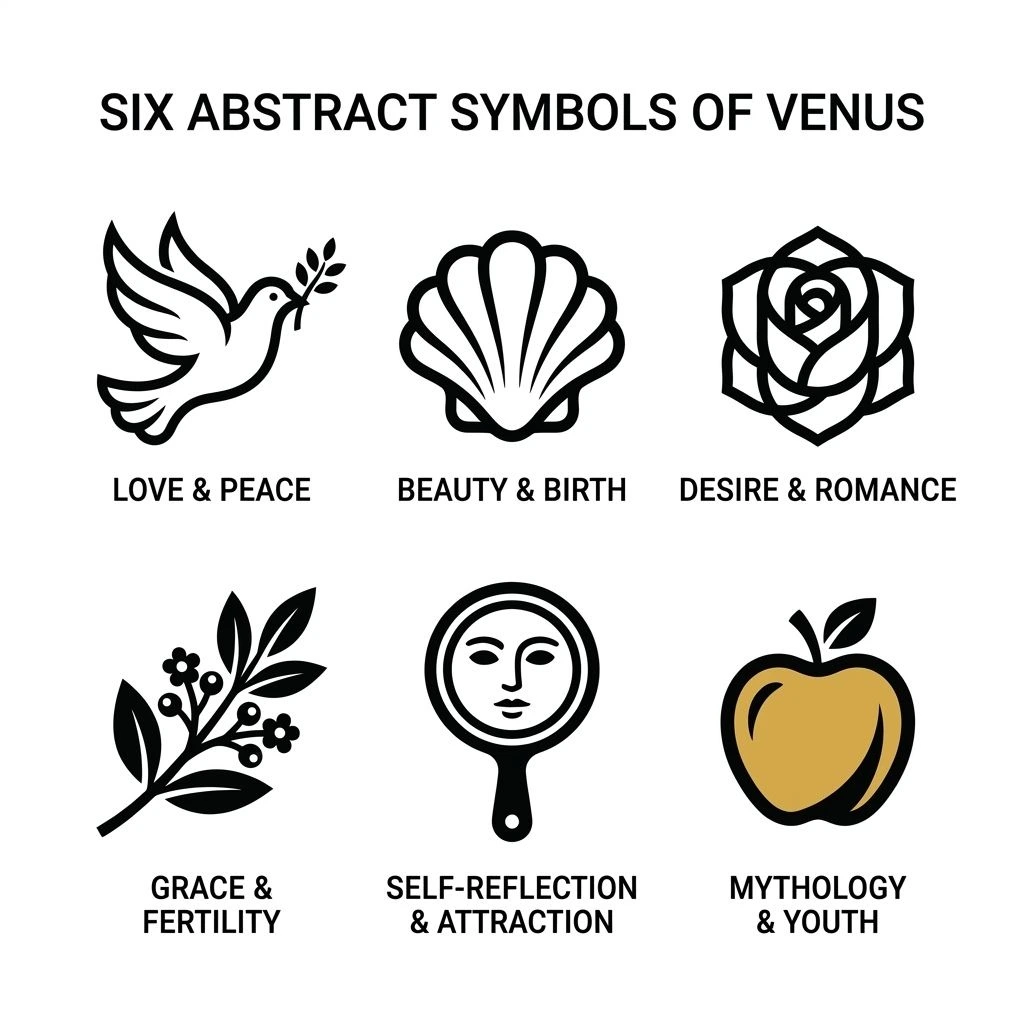
Venus goddess symbols are closely connected with love, beauty, desire, fertility, femininity, and attraction, but her symbolism goes much deeper than these familiar ideas. The Roman goddess Venus was strongly identified with the Greek Aphrodite, and ancient as well as later artists represented her through objects, animals, plants, and celestial imagery.
Some of the best-known Venus symbols include the dove, rose, myrtle, apple, seashell, mirror, Cupid, and the Venus symbol ♀. Each has a different history. Some were associated with Aphrodite in ancient traditions, while others became especially popular through Roman, Renaissance, Neoclassical, or modern art. The British Museum, for example, identifies doves, roses, and myrtles among Aphrodite’s symbols, while Roman artworks frequently show Venus with an apple or Cupid.
Understanding these differences makes Venus symbolism much easier to interpret. A rose may suggest romantic love today, while the apple can point specifically to the Judgment of Paris. A shell connects strongly with the goddess’s sea-born imagery, while a mirror became an important visual sign of beauty and self-adornment.
What Are the Main Venus Goddess Symbols?
The most recognizable Venus goddess symbols include the following:
| Symbol | Main Association | Why It Is Connected With Venus |
| Dove | Love and affection | A sacred or associated bird of Aphrodite/Venus |
| Rose | Love and beauty | Traditionally associated with Aphrodite |
| Myrtle | Love and marriage | An important plant associated with Aphrodite |
| Apple | Beauty and desire | Connected with the Judgment of Paris |
| Seashell | Birth and beauty | Became strongly associated with Aphrodite’s sea imagery |
| Mirror | Beauty and adornment | Frequently used in Venus imagery |
| Cupid | Love and desire | Venus’s Roman son and companion |
| Swan, goose, or sparrow | Beauty and attraction | Birds associated with Aphrodite in ancient traditions |
| Pomegranate | Fertility and sexuality | Appears among plants associated with Aphrodite |
| ♀ | Venus and femininity | Traditional planetary symbol of Venus, later used for female identity |
| Planet Venus | Beauty and celestial influence | The goddess shares her name with the bright planet |
| Girdle or jewelry | Attraction and adornment | Connected with the goddess’s beauty and allure |
Not every item on this list has the same historical status.
That distinction is important when interpreting Venus goddess symbols accurately.
What Does Venus Symbolize?
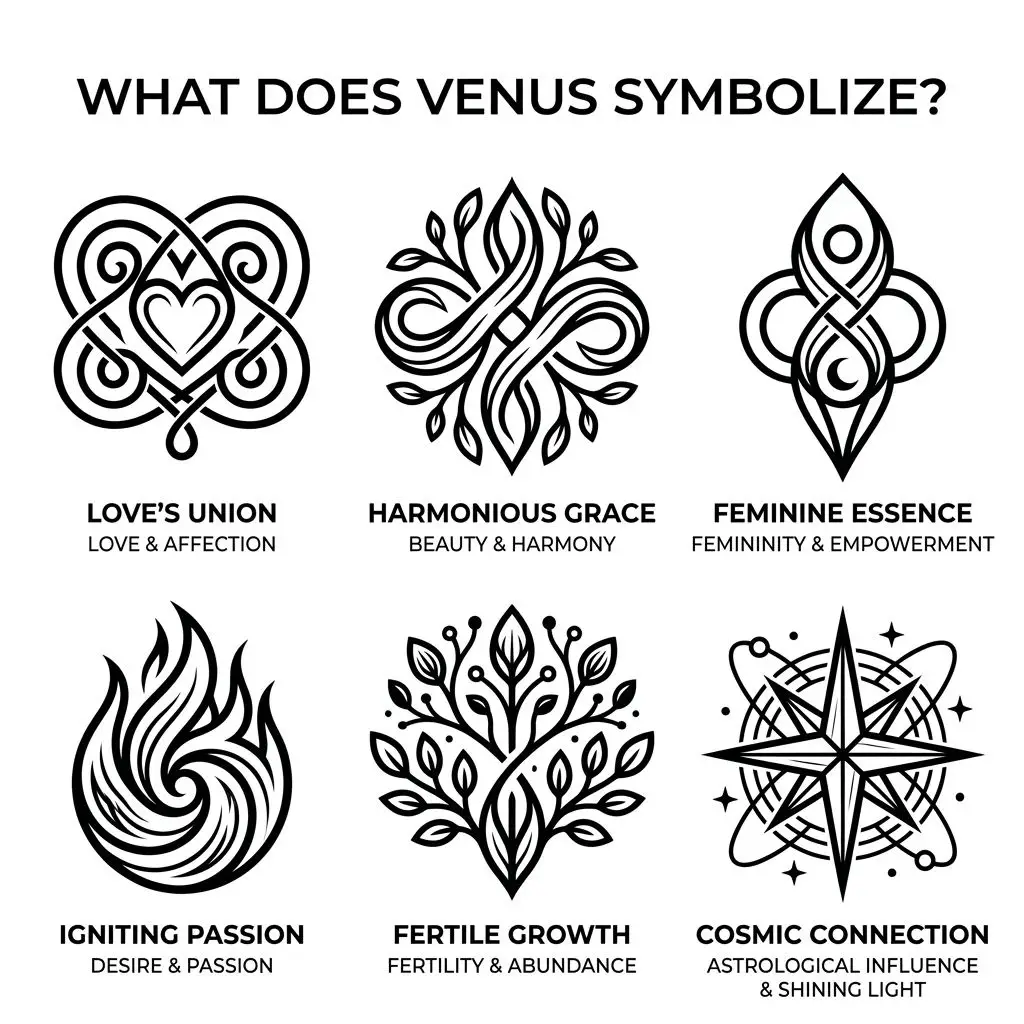
Love and Desire
Venus represents romantic and erotic love in much of Roman tradition.
This explains why roses, doves, Cupid, mirrors, jewelry, and other attractive objects frequently appear in Venus imagery.
However, Venus does not simply symbolize modern romantic love. Her mythology also deals with passion, attraction, relationships, sexuality, and the power of desire.
Beauty and Attraction
Beauty is one of the central themes of Venus symbolism.
The famous story of the Judgment of Paris places beauty at the center of a competition between goddesses. Paris ultimately awards the golden apple to Aphrodite/Venus, establishing the apple as an important attribute in later representations. The Metropolitan Museum notes that Roman images of Venus holding an apple refer to this legendary beauty contest.
For this reason, Venus can symbolize not only physical beauty but also desirability, charm, attraction, and the social power associated with beauty.
Fertility and Procreation
Venus can also have associations with fertility and procreation.
These ideas should not be confused with the roles of every fertility goddess in the ancient Mediterranean world. Venus’s meaning changed according to time, place, and religious context.
In Roman tradition, Venus could be connected with motherhood and ancestry as well as erotic love. Her identity as Venus Genetrix emphasized her role as a mother and ancestral figure. The Metropolitan Museum explains that Venus became connected with the ancestry of the Julian family through Aeneas and was honored as Venus Genetrix, associated with motherhood and domesticity.
Motherhood and Ancestry
This is one of the most important meanings that a simple Venus symbol list often leaves out.
Through Aeneas, Roman political traditions connected Venus with Roman ancestry.
Under the title Venus Genetrix, she could therefore represent motherhood, family, ancestry, and the continuation of a lineage.
This gives Venus a very different dimension from the modern image of a goddess concerned only with romance.
Vegetation and Gardens
Roman Venus also had earlier Italic connections that extended beyond the Greek Aphrodite tradition. Roman religious traditions associated Venus with vegetation and gardens before and alongside her strong identification with Aphrodite.
This is one reason flowers and plants fit naturally into later Venus imagery.
Her symbolism therefore includes aspects of growth, fertility, natural beauty, and renewal, although these meanings should be understood in their historical context rather than treated as a single universal definition.
Venus Goddess Symbols and Their Meanings
The individual symbols associated with Venus tell different parts of her story.
Dove
The dove is one of the best-known animal symbols connected with Venus.
Ancient traditions associate the dove with Aphrodite, and the British Museum specifically identifies doves among her symbols. Ancient and later artistic representations can show Venus accompanied by doves or with a dove nearby.
The dove can therefore suggest:
- Love
- Affection
- Attraction
- Companionship
- Gentleness
- Divine beauty
In modern symbolism, people may also connect a dove with peace, but that broader meaning should not automatically be treated as the specific ancient meaning of Venus.
Rose
The rose is another important Venus-associated flower.
Roses became strongly connected with Aphrodite and Venus through mythology, poetry, and later art. The British Museum lists roses among Aphrodite’s symbols.
For modern readers, the rose naturally suggests:
- Romantic love
- Beauty
- Passion
- Desire
- Femininity
- Devotion
The red rose in particular has become a powerful modern image of romantic love.
Still, it is useful to distinguish ancient association from modern flower symbolism. The rose has accumulated many meanings over centuries, so not every modern interpretation should be projected backward onto ancient worship.
Myrtle
The myrtle is sometimes overlooked because the rose is more familiar today.
In ancient traditions, however, myrtle had an important association with Aphrodite. The British Museum identifies myrtle among her symbols.
Myrtle can therefore represent:
- Love
- Beauty
- Marriage
- Fertility
- Celebration
- Sacred association with Aphrodite/Venus
Its connection with love and marriage also makes it useful for understanding why Venus symbolism extends beyond romantic attraction into relationships and family life.
Apple
The apple has one of the clearest mythological explanations among Venus symbols.
In the Judgment of Paris, Paris is asked to decide which of three goddesses is the fairest. Aphrodite offers him a reward connected with the most beautiful woman, and Paris awards her the golden apple.
Later Roman images of Venus frequently show her holding an apple. The Metropolitan Museum specifically identifies the apple held by a Roman Venus as a reference to her victory in the beauty contest.
The apple can therefore symbolize:
- Beauty
- Desire
- Competition
- Attraction
- Victory in beauty
- The consequences of desire
This is more specific than simply saying “the apple means love.”
Seashell
The seashell is probably one of the most recognizable visual symbols of Venus.
Aphrodite is famously associated with the sea and with a tradition of being born from sea foam. Later artistic representations frequently show her emerging from or standing upon a shell.
The British Museum describes Venus as being represented in a large shell carrying her toward shore, while later artworks repeatedly use shell imagery in depictions of Venus.
The shell can therefore suggest:
- Birth
- The sea
- Beauty
- Femininity
- Transformation
- The emergence of the goddess
It is important to remember that the shell’s prominence varies by period. It became especially famous through later artistic representations rather than functioning as an equally dominant attribute in every ancient context.
Mirror
The mirror is closely associated with Venus’s beauty and self-adornment.
A mirror appears naturally in artistic scenes showing Venus preparing herself or contemplating her appearance. Roman visual culture also used mirrors in Venus-related imagery. A Metropolitan Museum study describes a Roman object decorated with Venus seated on a shell and holding a mirror, surrounded by sea creatures and Cupids.
The mirror can represent:
- Beauty
- Self-adornment
- Appearance
- Attraction
- Vanity
- Self-reflection
Some of these meanings are especially strong in later art. It is better to say that later artists used the mirror to explore ideas of beauty and appearance than to claim that every one of these interpretations was an ancient religious doctrine.
Cupid
Cupid, known as Eros in Greek tradition, is strongly connected with Venus.
In Roman mythology, Cupid is commonly presented as Venus’s son. He became one of the most recognizable companions of the goddess in European art.
The British Museum notes that Aphrodite/Venus is frequently accompanied by Eros or Cupid.
Cupid therefore reinforces themes of:
- Romantic love
- Desire
- Attraction
- Passion
- Playfulness
- Emotional longing
Cupid is not simply an object or attribute of Venus. He is a separate mythological figure whose relationship with Venus helps communicate the goddess’s connection with love and desire.
Swan, Goose, and Sparrow
The dove is the best-known bird connected with Aphrodite, but it is not the only one.
Ancient traditions also connect Aphrodite with other birds, including sparrows and geese. Different texts and artistic traditions emphasize different animals.
These birds can contribute to the wider symbolic world of:
- Beauty
- Desire
- Grace
- Courtship
- Attraction
Because these associations are less universally recognizable than the dove, they should be treated as secondary Venus symbols rather than presented as equally important.
Pomegranate
The pomegranate appears in traditions associated with Aphrodite and can be connected with fertility, sexuality, and marriage.
However, the pomegranate also has important associations with other figures and myths, especially Persephone and the underworld. Therefore, it should not be presented as an exclusively Venusian symbol.
A careful interpretation is that the pomegranate can contribute to Venus’s wider themes of fertility, sexuality, and reproduction in particular mythological contexts.
Girdle and Jewelry
Venus’s beauty is also expressed through adornment.
Jewelry, clothing, belts, necklaces, and other decorative objects appear in artistic representations of the goddess. The idea of an attractive or magical girdle is particularly connected with Aphrodite’s ability to inspire desire.
These objects can symbolize:
- Charm
- Attraction
- Seduction
- Beauty
- Luxury
- Personal adornment
This is especially useful when interpreting paintings or sculptures in which Venus is surrounded by decorative objects rather than holding a single obvious symbol.
Venus, Aphrodite, and Their Shared Symbols
Venus and Aphrodite are closely related, but understanding the difference makes the symbolism clearer.
Is Venus the Same as Aphrodite?
Venus is the Roman goddess, while Aphrodite is the Greek goddess.
The Romans eventually identified Venus closely with Aphrodite, and many of their attributes and artistic representations overlap. The Metropolitan Museum describes Venus as having been assimilated to the Greek Aphrodite, while Roman representations were heavily influenced by Greek depictions.
However, Venus had her own Roman religious history and significance.
So it is accurate to say:
Venus and Aphrodite became closely identified with one another, but Venus was not simply a Roman name with no additional history.
How Roman Venus Developed
Roman Venus had important associations with love and beauty, but she also became connected with Roman ancestry and political identity.
Her relationship with Aeneas was especially important. Aeneas was presented as the son of Venus and the Trojan ancestor of the Roman people.
This helped make Venus important to Roman ideas of ancestry and legitimacy.
The title Venus Genetrix, meaning Venus as a mother or ancestral figure, reflects this broader role. The Metropolitan Museum notes her connection with motherhood, domesticity, Aeneas, and the Julian family.
The Mythology Behind Venus Symbols
Symbols become easier to remember when you understand the stories behind them.
The Judgment of Paris and the Golden Apple
The golden apple is connected with one of the most famous episodes involving Aphrodite.
Paris is asked to determine which goddess is the fairest among Hera, Athena, and Aphrodite. Aphrodite offers him a reward, and Paris chooses her.
The apple consequently became an important visual attribute of Venus.
Roman artworks sometimes show Venus holding the apple to identify her or recall her victory. The British Museum has a Roman bronze figure explicitly catalogued as Venus with an apple, while the Metropolitan Museum describes the apple as a reference to her victory in the beauty contest.
Venus and Adonis
The story of Venus and Adonis adds another layer to Venus symbolism.
Their myth has influenced the association between the goddess and certain flowers and themes of beauty, desire, loss, and renewal.
This tradition is particularly useful when interpreting floral symbolism. Rather than treating every flower as a simple code for “love,” the Adonis story shows how flowers can become connected with the emotional and tragic dimensions of desire.
The Sea-Born Aphrodite and the Shell
One famous tradition describes Aphrodite as emerging from the sea.
This sea-born imagery became a foundation for later representations of the goddess as a beautiful nude figure arriving on a shell.
The shell therefore became a visual shorthand for Aphrodite/Venus and her connection with the sea.
The British Museum describes Venus in shell imagery, and the Metropolitan Museum records numerous later artistic representations in which Venus stands or sits on a shell.
Venus and Cupid
Cupid’s presence is another easy way to identify Venus in art.
Because Cupid represents love and desire and is traditionally connected to Venus as her son, an artist can place Cupid beside Venus to reinforce the subject.
This explains why Venus paintings frequently include:
- Cupid
- Bow and arrows
- Doves
- Flowers
- Mirrors
- Jewelry
Together, these elements create a visual language of attraction and desire.
Venus Symbols in Ancient Roman Religion
Venus had a wider religious identity in Rome than the modern phrase “goddess of love” suggests.
The title emphasizes her role as a mother and ancestor. Her connection with Aeneas allowed Roman traditions to link her with the origins of Rome and the ancestry of the Julian family.
This means Venus can symbolize:
- Motherhood
- Family
- Ancestry
- Continuity
- Protection of a lineage
- Roman identity
A reader interested in Venus mythology should therefore avoid thinking of her only as a goddess of romance.
Venus and Roman Ancestry
The connection between Venus and Aeneas gave the goddess political and cultural importance.
According to Roman tradition, Aeneas was the son of Venus and became an ancestor of the Roman people. The association was especially significant for the Julian family, including Julius Caesar and the Julio-Claudian dynasty.
This is one reason Venus could symbolize heritage and ancestry, as well as beauty and desire.
Venus as a Goddess of Vegetation
Venus also had earlier Roman and Italic associations connected with vegetation and gardens.
This provides useful context for her connection with flowers and natural beauty.
It also shows why describing Venus solely as a Roman version of a Greek love goddess leaves out part of her development.
Venus Symbols in Classical and Renaissance Art
Venus became one of the most frequently represented classical goddesses in European art.
The Mirror
Artists used the mirror to emphasize Venus’s beauty and her awareness of appearance.
A woman holding a mirror can therefore be identified as Venus even when the artist does not include a large amount of mythological storytelling.
The mirror also created opportunities for artists to explore ideas about beauty, vanity, self-image, and visual perception.
The Shell
The shell became particularly powerful in later European art.
Artists could immediately communicate the identity of Venus by placing her on a shell surrounded by water.
The Metropolitan Museum’s collection includes multiple later works depicting Venus with a shell, demonstrating how durable this visual convention became.
The Dove and Cupid
Doves and Cupid often make Venus easier to recognize.
The British Museum specifically identifies doves as symbols of Aphrodite and notes the frequent presence of Eros or Cupid.
When these figures appear together, the intended themes are usually connected with love, attraction, and beauty.
Flowers and Jewelry
Flowers, pearls, necklaces, bracelets, and other decorative elements reinforce Venus’s connection with beauty and adornment.
Later European artists expanded this visual vocabulary considerably. As a result, some Venus symbols that seem ancient today are actually especially prominent in Renaissance, Baroque, and Neoclassical art.
What Does the Venus Symbol ♀ Mean?
The familiar ♀ symbol is one of the most recognizable symbols associated with Venus.
Venus and the Planetary Symbol
The symbol is traditionally associated with the planet Venus and, through that planetary association, with the Roman goddess.
Over time, the same symbol became widely used to represent the female sex and femininity.
Therefore, when you see ♀ today, it can have several related meanings depending on context:
- Venus
- The planet Venus
- Femininity
- Womanhood
- Female sex
- Feminine identity
- Astrology
It is important not to assume that all modern uses have exactly the same meaning as the ancient goddess.
Venus, Femininity, and Modern Symbolism
Modern culture often uses Venus as a broad symbol of femininity.
This can include ideas such as:
- Beauty
- Grace
- Sensuality
- Creativity
- Romantic attraction
- Feminine identity
- Self-expression
These are modern interpretations built partly from the long history of Venus imagery. They should not automatically be described as a single set of beliefs held by all ancient Greeks or Romans.
Venus Goddess Symbols in Astrology
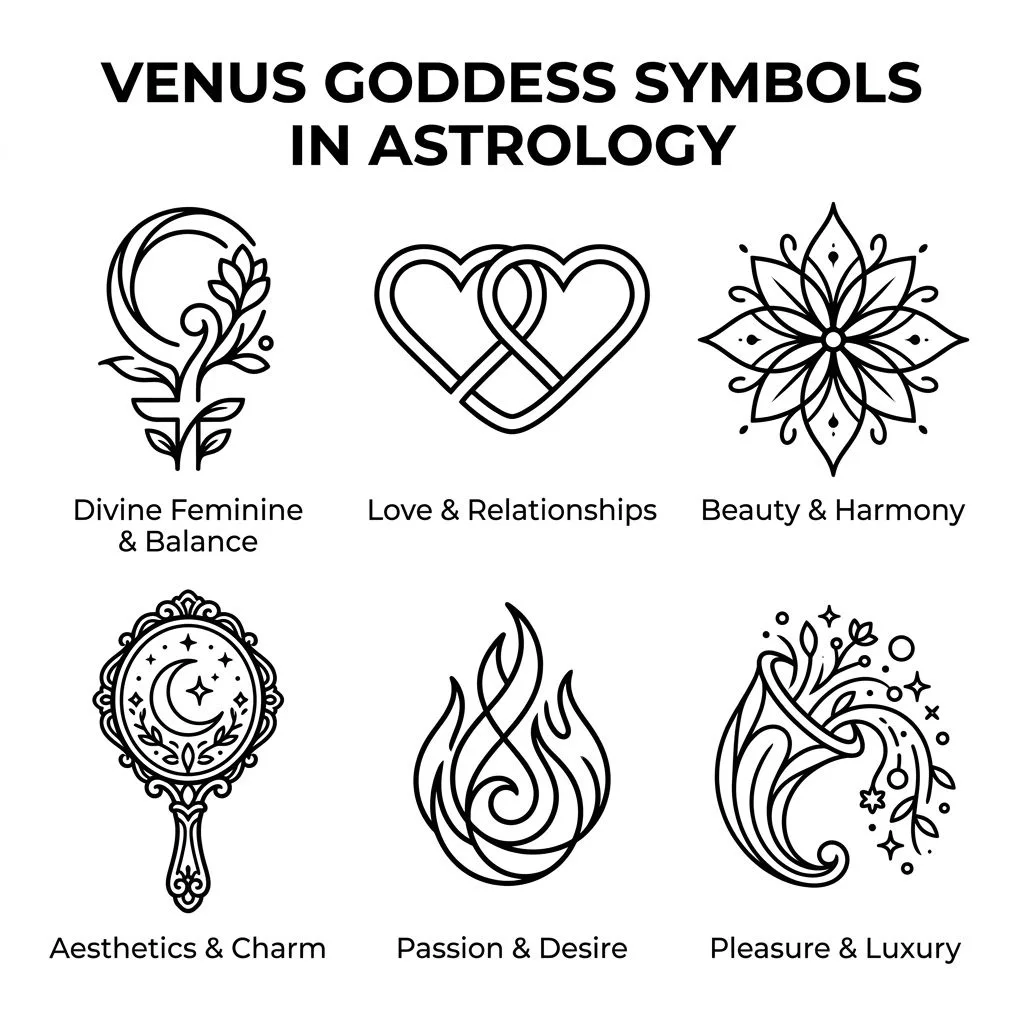
Venus also has a major role in astrology, which creates another layer of symbolism.
The Planet Venus
Venus is one of the brightest objects visible in the sky and has been associated with the goddess for centuries.
In astrology, Venus is commonly connected with subjects such as:
- Love
- Relationships
- Beauty
- Pleasure
- Attraction
- Art
- Harmony
- Personal values
These are astrological interpretations, not the same thing as historical claims about ancient Roman religion.
Keeping these categories separate makes Venus symbolism easier to understand.
Taurus and Libra
In Western astrology, Venus is traditionally associated with Taurus and Libra.
This is part of astrological symbolism rather than a direct description of the religious worship of Venus in ancient Rome.
The distinction matters because readers often encounter Venus in both mythology and astrology and assume that every modern astrological association comes directly from ancient Roman beliefs.
Venus Symbol vs Venus Goddess
These terms can be confusing.
Venus goddess: The Roman divine figure associated with love, beauty, desire, fertility, and ancestry.
Planet Venus: The celestial body named after the goddess.
Astrological Venus: The planet as interpreted within astrology.
♀ symbol: The traditional sign associated with Venus and later widely used for female identity.
These concepts are connected historically, but they are not interchangeable.
Venus Goddess Symbols for Tattoos
Venus symbols are popular choices for tattoos because they can combine mythology with personal meanings.
Rose Tattoo
A Venus rose tattoo may suggest:
- Love
- Beauty
- Passion
- Romance
- Femininity
A person may also choose the rose simply because of its connection with classical mythology.
Dove Tattoo
A Venus dove tattoo can suggest:
- Love
- Devotion
- Affection
- Grace
- Companionship
The dove has a particularly useful connection with Aphrodite because it is an established ancient association rather than only a modern romantic symbol.
Shell Tattoo
A shell can represent:
- Venus
- Aphrodite
- Beauty
- Birth
- The sea
- Transformation
- Femininity
The shell is especially recognizable in designs inspired by classical or Renaissance Venus imagery.
Mirror Tattoo
A mirror-inspired Venus tattoo can have a more personal meaning.
It might represent:
- Beauty
- Self-reflection
- Self-knowledge
- Appearance
- Confidence
- Vanity
- Personal transformation
The exact meaning depends on the design and the person using it.
♀ Venus Symbol Tattoo
The ♀ symbol is a simple choice for someone who wants a connection with Venus without using a detailed mythological image.
It may represent:
- Venus
- Femininity
- Womanhood
- Female identity
- Beauty
- Strength
- Self-expression
Modern tattoo meanings are personal, so there is no single interpretation that applies to every design.
Venus Symbols in Modern Spirituality
Modern spiritual practices sometimes use Venus imagery to represent love, sensuality, beauty, creativity, femininity, fertility, and attraction.
A rose may be used as a symbol of love. A shell may suggest birth or transformation. The mirror may represent self-reflection. The ♀ symbol may be used for feminine energy or identity.
However, these modern spiritual interpretations should be distinguished from documented ancient religious practices.
Ancient Greeks and Romans lived in very different religious and cultural contexts. Modern people can use Venus imagery in new ways without those interpretations necessarily being ancient beliefs.
Venus Symbols by Category
Grouping the symbols makes them easier to remember.
Animals
Important animal associations include:
- Dove
- Sparrow
- Goose
- Swan
- Dolphin in sea-related imagery
The dove has one of the strongest and most recognizable connections with Aphrodite/Venus. The British Museum specifically identifies doves among her symbols.
Flowers and Plants
Important plant associations include:
- Rose
- Myrtle
- Anemone
- Apple
- Pomegranate
Some of these have connections to specific myths, while others developed through broader religious and artistic traditions.
Objects
Important objects include:
- Apple
- Mirror
- Seashell
- Girdle
- Jewelry
- Flowers
- Cosmetic or adornment items
The apple and mirror are especially useful for identifying Venus in classical and later art.
Mythological Figures
Venus is commonly connected with:
- Cupid
- Aeneas
- Adonis
- Mars
- Vulcan
These relationships reveal different sides of her mythology.
Cupid emphasizes love and desire, Aeneas connects Venus with ancestry, and Adonis connects her with desire, beauty, loss, and renewal.
Celestial Symbols
Venus also has a celestial dimension:
- Planet Venus
- ♀ symbol
- Taurus
- Libra
- Morning and evening appearances of the planet
These associations are particularly relevant when discussing astrology rather than ancient Roman worship.
Venus Goddess Symbols vs Other Love Goddesses
Venus is sometimes confused with other goddesses because many ancient cultures had divine figures associated with love, fertility, or marriage.
| Goddess | Tradition | Major Associations |
| Venus | Roman | Love, beauty, desire, fertility, motherhood, ancestry |
| Aphrodite | Greek | Love, beauty, desire, sexuality |
| Hera | Greek | Marriage, queenship, family |
| Juno | Roman | Marriage, women, family, state |
| Athena | Greek | Wisdom, strategy, crafts |
| Minerva | Roman | Wisdom, crafts, strategic warfare |
Venus should not be treated as interchangeable with every goddess connected with marriage or fertility.
Her strongest identity is built around love, beauty, desire, attraction, and—within Roman traditions—motherhood and ancestry.
Common Misunderstandings About Venus Symbols
Several common assumptions can make Venus symbolism confusing.
“Every Venus symbol has one fixed meaning.”
Not necessarily.
A symbol can have several meanings depending on historical period and context.
For example, the apple can point toward the Judgment of Paris, while the rose may carry both ancient associations and modern romantic meanings.
“Venus and Aphrodite are completely identical.”
They are closely identified, but Venus developed within Roman religious culture and gained meanings connected with Roman ancestry and political identity.
“The shell was the only symbol of Venus.”
No.
The shell is one of the most recognizable modern artistic symbols, but doves, roses, myrtle, apples, mirrors, and Cupid are also important parts of Venus’s visual vocabulary.
“The mirror only means vanity.”
Not necessarily.
In Venus imagery, it can relate to beauty and self-adornment. Later viewers may also interpret it through ideas of vanity, self-awareness, or self-reflection.
“Venus only represents romantic relationships.”
Her symbolism is broader.
Roman Venus could also represent fertility, motherhood, ancestry, vegetation, and aspects of Roman identity.
“Modern spiritual meanings are ancient facts.”
They should not automatically be treated that way.
A modern person may interpret a Venus symbol as feminine energy, self-love, or personal empowerment, but those interpretations belong to modern symbolic practice unless supported by historical evidence.
Quick Venus Symbol Cheat Sheet
If you need a simple reference, remember these associations:
- Dove: love and affection
- Rose: love and beauty
- Myrtle: love and marriage
- Apple: beauty and the Judgment of Paris
- Shell: sea, birth, and beauty
- Mirror: beauty and self-adornment
- Cupid: love and desire
- Pomegranate: fertility and sexuality in certain traditions
- Swan/goose/sparrow: associated birds of Aphrodite
- ♀: Venus, femininity, and the female symbol
- Planet Venus: celestial and astrological association
- Aeneas: Venus’s connection with Roman ancestry
- Adonis: desire, beauty, loss, and renewal
- Myrtle and rose: important floral associations
- Jewelry and adornment: beauty, attraction, and sensuality
Frequently Asked Questions
What are the main symbols of Venus?
The main recognizable Venus symbols include the dove, rose, myrtle, apple, seashell, mirror, Cupid, and the ♀ symbol. Venus can also be associated with other birds, flowers, jewelry, and the planet Venus.
What flower represents Venus?
The rose and myrtle are two of the most important flowers associated with Venus/Aphrodite. The rose is strongly connected with love and beauty, while myrtle has an important ancient association with Aphrodite. The British Museum identifies both among Aphrodite’s symbols.
What animal represents Venus?
The dove is one of the strongest animal associations of Venus/Aphrodite. Sparrows, geese, and other birds also appear in traditions connected with the goddess.
What does the dove symbolize for Venus?
The dove can represent love, affection, attraction, and the goddess’s sacred association with the bird. It is one of the clearest animal symbols connected with Aphrodite/Venus.
Why is the shell associated with Venus?
The shell is connected with Aphrodite’s sea-born imagery. Later artists frequently represented Venus arriving on a shell, making it one of the most recognizable visual symbols of the goddess.
What does the apple symbolize for Venus?
The apple refers primarily to the Judgment of Paris, in which Paris chooses Aphrodite as the fairest of the goddesses. In Roman art, Venus is sometimes shown holding the apple as a reference to this victory.
Why does Venus hold a mirror?
The mirror emphasizes Venus’s connection with beauty and self-adornment. It became a particularly effective artistic device for showing the goddess preparing herself or contemplating her appearance.
Is Venus the same as Aphrodite?
Venus is the Roman goddess who became closely identified with the Greek Aphrodite. Their attributes overlap considerably, but Venus also developed important Roman associations with motherhood, ancestry, and Roman identity.
What does the Venus symbol ♀ mean?
The ♀ symbol is traditionally associated with the planet Venus and the goddess Venus. In modern use, it is also widely used to represent the female sex, women, and femininity.
What does Venus symbolize spiritually?
In modern spiritual contexts, Venus imagery may symbolize love, beauty, sensuality, creativity, femininity, fertility, attraction, or self-expression. These are modern interpretations and should be distinguished from documented beliefs of ancient Greek and Roman religion.
What does a Venus tattoo symbolize?
A Venus tattoo can symbolize love, beauty, femininity, desire, self-expression, fertility, mythology, or admiration for classical art. The meaning depends on the specific symbol and the person wearing it.
What is Venus Genetrix?
Venus Genetrix is a Roman form of Venus emphasizing her role as a mother and ancestral figure. Her relationship with Aeneas connected her with Roman ancestry and the Julian family.
What does Venus represent in Roman mythology?
Venus represents love and beauty but also has associations with desire, fertility, motherhood, vegetation, ancestry, and Roman identity. Her Roman role became broader than the simplified modern image of a love goddess.
Conclusion
Venus goddess symbols form a rich visual language built around love, beauty, desire, fertility, attraction, motherhood, and ancestry. The dove, rose, myrtle, apple, shell, mirror, and Cupid are among the most recognizable symbols connected with Venus and her Greek counterpart Aphrodite.
Each symbol tells a different part of the story. The apple recalls the Judgment of Paris, the shell evokes sea-born Aphrodite imagery, the dove connects the goddess with a sacred bird, and the mirror emphasizes beauty and adornment. The rose and myrtle bring flowers into her symbolic world, while Cupid reinforces her connection with love and desire.
Roman Venus also had meanings that go beyond romance. Through Venus Genetrix and her relationship with Aeneas, she became connected with motherhood, ancestry, and Roman identity.
Today, Venus symbols can have additional meanings in tattoos, jewelry, astrology, art, and modern spirituality. The most accurate way to understand them is to separate ancient mythology from later artistic traditions and modern interpretations. That approach reveals why Venus remains one of the most recognizable and adaptable figures in classical symbolism.

Adam Sullivan is a dedicated writer who enjoys transforming everyday topics into engaging and informative content. His writing focuses on making complex ideas simple, practical and enjoyable for readers of all backgrounds. Adam is also the fictional author of The Lantern Beyond Autumn Hills and Where the Morning Horizon Waits. Outside of writing, he enjoys photography, traveling and discovering inspiration through new experiences. He believes great content should be both helpful and easy to connect with.
 Dylan Anderson