
Frat symbols are visual marks used to identify fraternities and other Greek-letter organizations. They can include Greek letters, badges, crests, coats of arms, colors, mascots, flowers, flags, hand signs, mottos, and chapter symbols.
If you have seen a combination such as ΑΦΑ, ΚΑΨ, ΩΨΦ, ΦΒΣ, or ΙΦΘ and wondered what it means, the Greek letters are usually the first clue. However, a fraternity’s identity is rarely limited to its letters. Many organizations have additional insignia with their own official meanings and rules.
This guide explains the major types of frat symbols, provides Greek letters you can copy and paste, explains how to identify an unfamiliar fraternity symbol, and separates general Greek alphabet characters from official fraternity logos and insignia.
What Are Frat Symbols?
Frat symbols are visual elements associated with a fraternity’s identity, membership, history, or traditions.
The most recognizable examples are combinations of Greek letters. A fraternity may use two or three Greek letters as a short form of its name, and members may display those letters on clothing, jewelry, flags, chapter materials, or other items.
But Greek letters are only one category.
A fraternity may also have:
- An official badge
- A crest
- A coat of arms
- A seal
- Official colors
- A mascot or animal
- A flower
- A flag
- A motto
- A chapter emblem
- A hand sign or gesture
- A founding date
- Organization-specific jewelry
The exact collection differs from one fraternity to another. For example, Kappa Kappa Psi documents separate symbols including its badge, crest, flag, key, flower, colors, motto, and other insignia.
Why Do Fraternities Use Symbols?
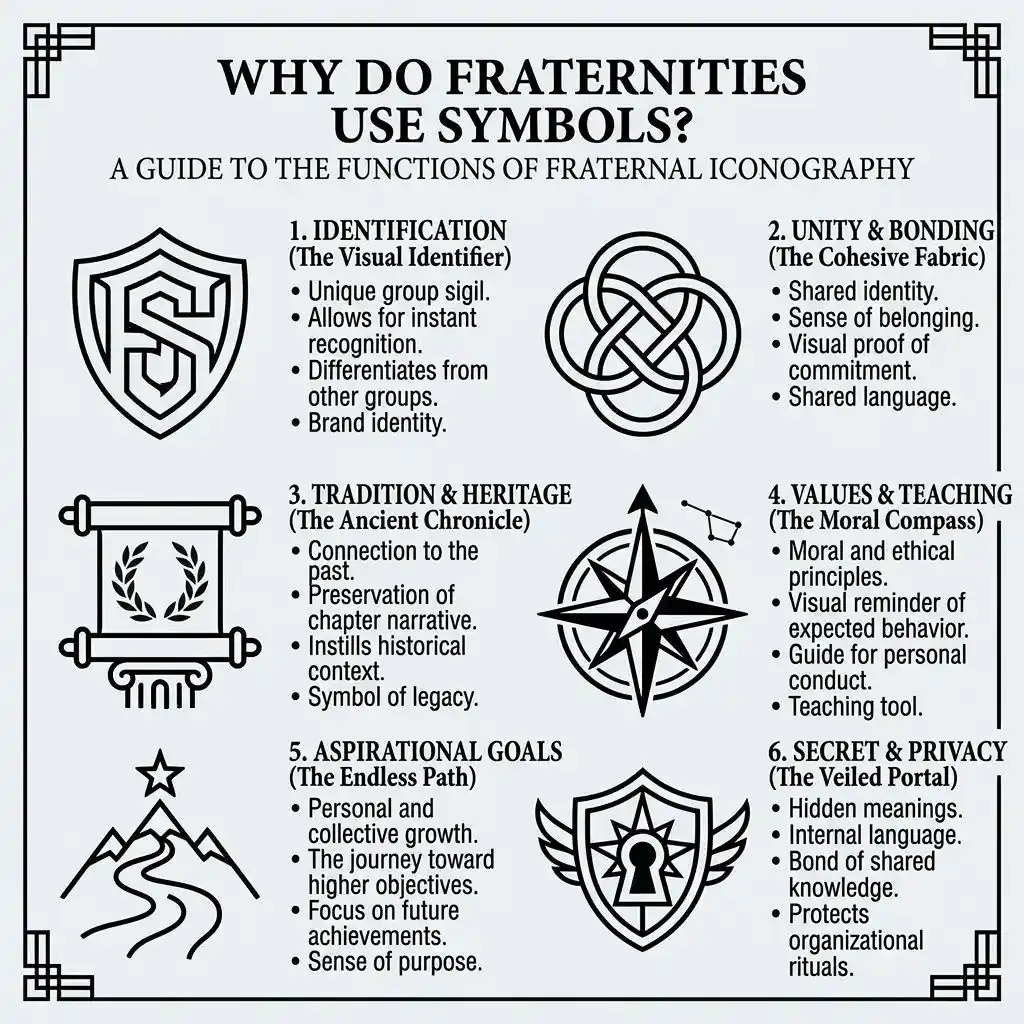
Symbols give an organization a recognizable visual identity.
A fraternity can have members at many colleges and alumni spread across different locations. A common set of letters, colors, and insignia provides a way to connect the organization across those places.
Depending on the organization, symbols can communicate:
- The fraternity’s name
- Membership
- Chapter affiliation
- Organizational history
- Values
- Traditions
- Alumni connections
- Events
- Formal recognition
A symbol may also have a different meaning for the organization as a whole and for an individual member.
Quick Answer: What Do Frat Symbols Mean?
Frat symbols do not have one universal meaning. Their interpretation depends on the organization using them.
In general:
- Greek letters identify a fraternity or Greek-letter organization.
- Badges can serve as formal membership insignia.
- Crests and coats of arms can represent history, values, and organizational identity.
- Colors provide a recognizable visual identity.
- Mascots and animals may have organization-specific meanings.
- Flowers can be official symbols connected with an organization’s history.
- Flags and seals may provide formal organizational identification.
- Hand signs may be used for recognition or tradition by some organizations.
- Mottos communicate an organization’s stated ideals or principles.
The important point is that you should not assign the same meaning to a symbol simply because another fraternity uses a similar design.
For example, a dragon, star, flower, or shield may have a very specific meaning within one fraternity. Beta Theta Pi’s official heraldry includes a dragon, shield, stars, rose, colors, badge, and other symbols, each connected to its own organizational history.
Frat Symbols Copy and Paste
If you are looking for Greek letters that you can copy and paste, the Greek alphabet provides the basic characters used in many fraternity names.
Greek Letters Copy and Paste
| Name | Uppercase | Lowercase |
| Alpha | Α | α |
| Beta | Β | β |
| Gamma | Γ | γ |
| Delta | Δ | δ |
| Epsilon | Ε | ε |
| Zeta | Ζ | ζ |
| Eta | Η | η |
| Theta | Θ | θ |
| Iota | Ι | ι |
| Kappa | Κ | κ |
| Lambda | Λ | λ |
| Mu | Μ | μ |
| Nu | Ν | ν |
| Xi | Ξ | ξ |
| Omicron | Ο | ο |
| Pi | Π | π |
| Rho | Ρ | ρ |
| Sigma | Σ | σ / ς |
| Tau | Τ | τ |
| Upsilon | Υ | υ |
| Phi | Φ | φ |
| Chi | Χ | χ |
| Psi | Ψ | ψ |
| Omega | Ω | ω |
You can copy the uppercase Greek characters directly:
Α Β Γ Δ Ε Ζ Η Θ Ι Κ Λ Μ Ν Ξ Ο Π Ρ Σ Τ Υ Φ Χ Ψ Ω
Common Greek-Letter Combinations
Some commonly encountered fraternity letter combinations include:
ΑΦΑ
ΚΑΨ
ΩΨΦ
ΦΒΣ
ΙΦΘ
These combinations are examples of Greek-letter organization names and should not be confused with generic Greek words.
Also remember that plain Unicode letters are not automatically the official logo or artwork of a fraternity.
Fraternity Symbols and Names
A complete Greek-letter combination is usually much more useful than a single Greek letter when identifying a fraternity.
For example, seeing Alpha alone does not necessarily identify one particular organization. Multiple organizations can include Alpha in their names.
The combination provides a much stronger clue.
Examples of Greek-Letter Fraternity Symbols
Some widely recognized examples include:
| Greek Letters | Fraternity |
| ΑΦΑ | Alpha Phi Alpha Fraternity, Inc. |
| ΚΑΨ | Kappa Alpha Psi Fraternity, Inc. |
| ΩΨΦ | Omega Psi Phi Fraternity, Inc. |
| ΦΒΣ | Phi Beta Sigma Fraternity, Inc. |
| ΙΦΘ | Iota Phi Theta Fraternity, Inc. |
These five fraternities are among the nine organizations that make up the National Pan-Hellenic Council. The NPHC is composed of five fraternities and four sororities.
This is an example list, not a complete directory of every fraternity in existence.
Why the Complete Combination Matters
Consider the letter Φ.
By itself, it only identifies the Greek letter Phi.
It does not tell you which fraternity is being represented.
Once Phi is combined with other letters, however, the combination can become an organizational identifier.
That is why someone trying to identify a shirt, necklace, pin, or tattoo should record every Greek letter in the correct order.
What Do Frat Letters Mean?
Fraternity letters can have several layers of meaning.
At the simplest level, they identify the organization’s Greek-letter name.
At a deeper level, the organization may have a historical explanation for its name, initials, motto, or traditions.
However, Greek letters should not automatically be assigned generic meanings.
For example, it would be misleading to claim that Alpha always means leadership or Omega always means completion in fraternity symbolism.
Alpha is the name of a Greek letter. Omega is another Greek letter. Their significance inside a particular fraternity depends on that organization’s own history and traditions.
Greek Letter vs. Fraternity Meaning
| Level | Meaning |
| Greek alphabet | The individual letter’s standard name |
| Greek-letter combination | Organization identifier |
| Fraternity history | Possible deeper organizational significance |
| Crest or badge | Additional organization-specific symbolism |
| Chapter symbol | Local or campus-specific identification |
This distinction keeps fraternity symbolism separate from broad symbolic interpretations of the Greek alphabet.
Common Types of Fraternity Symbols
Fraternities can use several different forms of insignia.
Greek Letters
Greek letters are usually the easiest symbol to recognize.
They may appear on:
- Shirts
- Hoodies
- Jackets
- Hats
- Jewelry
- Rings
- Pins
- Flags
- House signs
- Social media graphics
The letters can identify the national organization, chapter, or both.
Fraternity Badges
A badge is a formal piece of fraternity insignia.
The design can contain Greek letters, symbols, gemstones, shapes, dates, or other elements.
Beta Theta Pi, for example, describes its badge as an eight-sided Grecian shield containing stars, a diamond surrounded by a laurel wreath, Greek letters, and its founding date.
Badges can therefore contain much more information than the fraternity’s letters alone.
Fraternity Crests and Coats of Arms
A crest or coat of arms is often more elaborate than a simple logo.
It may include:
- A shield
- A crest
- Stars
- Animals
- Plants
- Greek letters
- A motto
- A date
- Heraldic elements
Beta Theta Pi’s official heraldry includes a coat of arms, Great Seal, flag, colors, flower, badge, and other organizational symbols.
Kappa Kappa Psi likewise identifies its official crest or coat of arms as a major part of its fraternity symbolism.
Fraternity Colors
Official colors are another important part of fraternity identity.
Colors can appear on:
- Clothing
- Flags
- Badges
- House decorations
- Event materials
- Digital graphics
- Jewelry
The meaning of colors varies by organization.
For example, Beta Theta Pi identifies pink and blue as its official colors and provides an organization-specific explanation of their historical selection.
This shows why it is better to use an individual fraternity’s official information rather than assuming that every color has a universal fraternity meaning.
Fraternity Mascots and Animals
Some fraternities use animals as mascots or important symbols.
Possible examples include:
- Dragons
- Lions
- Owls
- Wolves
- Dogs
- Bears
- Snakes
- Birds
An animal does not have one universal fraternity meaning.
The organization itself may connect the animal to its history, values, founders, mythology, or traditions.
For instance, the Beta dragon is part of Beta Theta Pi’s official heraldry.
Fraternity Flowers
Flowers can also become official fraternity symbols.
The choice may have a historical or personal connection to founders or early members.
Kappa Kappa Psi identifies the red carnation as its official flower and explains its connection to founder William A. Scroggs.
This is a good example of why readers should verify the meaning of a flower with the fraternity itself.
Fraternity Flags
A fraternity flag can combine several symbols into one design.
It may contain:
- Greek letters
- Official colors
- Stars
- A crest
- A mascot
- Other organization-specific elements
Beta Theta Pi’s official flag, for example, incorporates its colors, stars, and Beta dragon.
Fraternity Mottos
A motto is not necessarily a symbol in the same visual sense as a Greek letter or crest, but it can be an important part of a fraternity’s identity.
It may appear alongside:
- A crest
- Badge
- Flag
- Seal
- Jewelry
- Printed materials
The motto can communicate an organization’s stated ideals or principles.
Black Fraternity Symbols and the Divine Nine
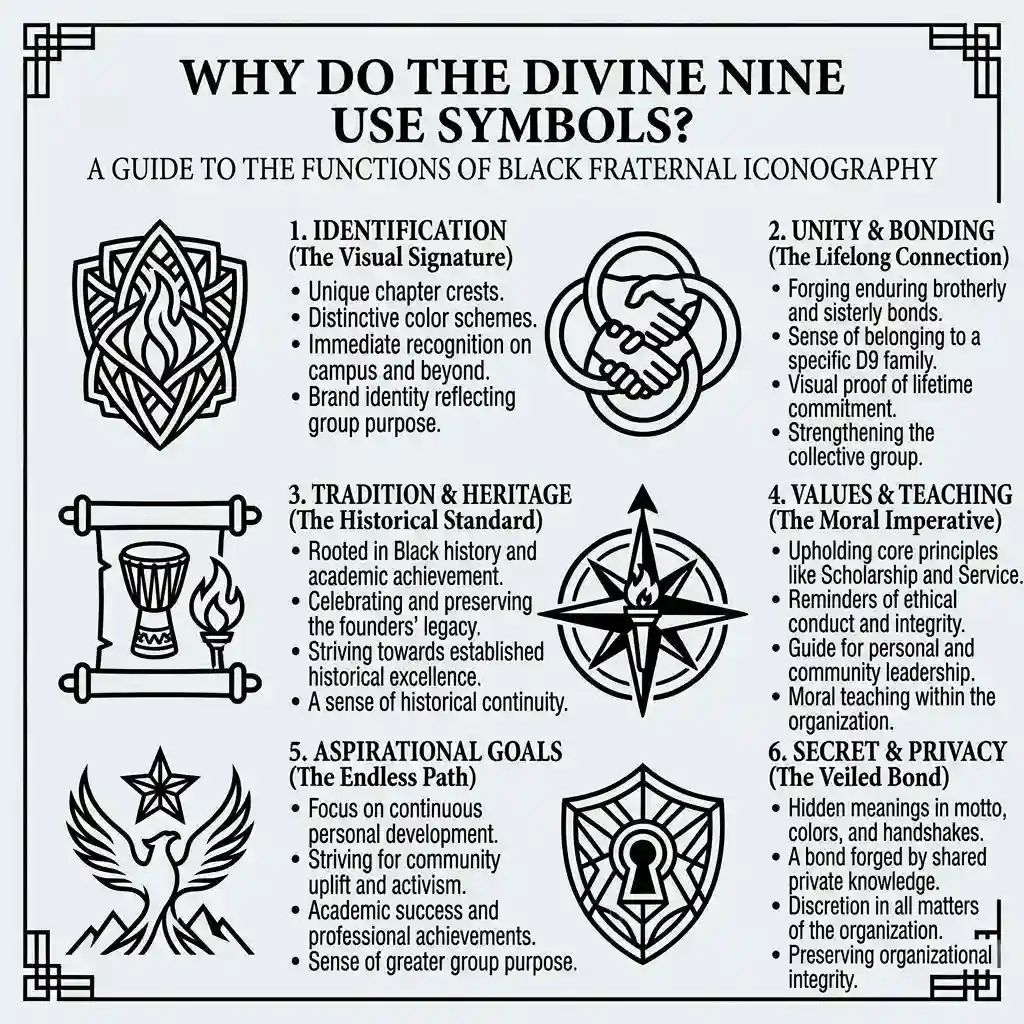
One of the most important subtopics related to frat symbols is Black Greek-letter fraternities, particularly the fraternities associated with the National Pan-Hellenic Council.
The NPHC currently consists of nine historically Black Greek-letter sororities and fraternities, commonly referred to collectively as the Divine Nine. Its nine organizations include five fraternities and four sororities.
Alpha Phi Alpha — ΑΦΑ
Alpha Phi Alpha Fraternity, Inc. is one of the NPHC fraternities.
Its Greek-letter abbreviation is commonly written as ΑΦΑ.
Kappa Alpha Psi — ΚΑΨ
Kappa Alpha Psi Fraternity, Inc. is another NPHC fraternity.
Its Greek-letter combination is ΚΑΨ.
Omega Psi Phi — ΩΨΦ
Omega Psi Phi Fraternity, Inc. uses the Greek-letter combination ΩΨΦ.
Omega Psi Phi is also one of the nine NPHC organizations.
Phi Beta Sigma — ΦΒΣ
Phi Beta Sigma Fraternity, Inc. uses the Greek letters ΦΒΣ.
It is one of the five fraternities within the NPHC’s nine organizations.
Iota Phi Theta — ΙΦΘ
Iota Phi Theta Fraternity, Inc. uses ΙΦΘ.
It is the fifth fraternity among the nine NPHC organizations.
The Other Four Divine Nine Organizations
The remaining four NPHC organizations are sororities:
- Alpha Kappa Alpha Sorority, Inc.
- Delta Sigma Theta Sorority, Inc.
- Zeta Phi Beta Sorority, Inc.
- Sigma Gamma Rho Sorority, Inc.
The distinction matters because not every Greek-letter organization is a fraternity. The NPHC itself describes its membership as nine Greek-letter sororities and fraternities.
Fraternity Symbols vs. Sorority Symbols
Fraternities and sororities can use similar types of symbolism.
Both may have:
- Greek letters
- Colors
- Badges
- Crests
- Flowers
- Mascots
- Mottos
- Jewelry
- Chapter symbols
The letters alone may not tell you whether you are looking at a fraternity or sorority.
The safest approach is to identify the complete organization.
| Feature | Fraternity | Sorority |
| Greek letters | Common | Common |
| Official colors | Common | Common |
| Badges | Common | Common |
| Crests or emblems | Some organizations | Some organizations |
| Flowers | Some organizations | Some organizations |
| Mascots | Some organizations | Some organizations |
| Chapter identifiers | Common | Common |
Are All Greek-Letter Organizations Fraternities?
No.
Greek letters are used by several types of organizations.
They may include:
- Social fraternities
- Sororities
- Professional organizations
- Academic organizations
- Honor societies
- Service organizations
- Other Greek-letter groups
Therefore, seeing Greek letters should not automatically lead you to call an organization a fraternity.
The organization’s full name is the better identifier.
Fraternity Symbol vs. Logo, Badge, Crest, and Seal
These terms are related but should not automatically be treated as synonyms.
| Term | Basic Meaning |
| Greek letters | Textual representation of an organization’s name |
| Symbol | Broad term for an identifying visual element |
| Logo | Visual brand mark |
| Badge | Formal insignia associated with an organization or membership |
| Crest | Heraldic or emblematic design |
| Coat of arms | Formal heraldic composition |
| Seal | Formal organizational mark |
| Mascot | Animal, character, or figure associated with an organization |
| Colors | Official visual identity elements |
A fraternity may have all or only some of these.
Beta Theta Pi, for example, separately provides graphic identities for its logo, wordmark, shield logomark, coat of arms, crest, Great Seal, Greek letters, and dragon.
That demonstrates why calling every fraternity image a “logo” can be inaccurate.
What Is the Difference Between Greek Letters and an Official Fraternity Logo?
This distinction is particularly important when copying or designing fraternity-related material.
Greek letters are ordinary characters from the Greek alphabet.
For example:
ΑΦΑ
is a sequence of Greek Unicode characters.
An official logo may contain custom artwork, typography, colors, proportions, and other design elements.
An organization may also have rules governing how its official artwork can be reproduced.
For example, Beta Theta Pi states that its graphic identities are trademarked and that third parties may not use its graphics without permission.
Kappa Kappa Psi also provides official branding and graphics standards and distinguishes different approved versions of its crest.
So copying Greek characters is not the same thing as reproducing an organization’s official logo.
How to Identify an Unknown Frat Symbol
If you see an unfamiliar symbol on a shirt, necklace, ring, house, flag, or social media post, you can identify it systematically.
Step 1: Identify Every Greek Letter
Look closely at the design.
Try to determine whether the letters are:
- Alpha
- Beta
- Gamma
- Delta
- Kappa
- Lambda
- Phi
- Sigma
- Psi
- Omega
- Or another Greek letter
Do not identify the organization from one letter if several are visible.
Step 2: Record the Letters in Order
Letter order matters.
Write the complete combination exactly as you see it.
For example:
ΩΨΦ
is different from:
ΨΦΩ
Even though both use the same three Greek characters.
Step 3: Check the Colors
Look for the organization’s color combination.
Colors can narrow down possible matches when several organizations have similar-looking Greek-letter combinations.
However, colors should be treated as a clue rather than final proof.
Step 4: Look for a Mascot or Animal
An animal, flower, star, shield, or other object may help identify the organization.
Do not assume its meaning without verification.
Step 5: Look for Chapter Information
A shirt or sign may contain:
- University initials
- Chapter Greek letters
- Campus name
- Founding year
- Event name
- Location
This information can help identify the specific chapter.
Step 6: Compare With Official Sources
Once you have a likely organization, check its official website.
This is the best way to verify:
- Official name
- Greek letters
- Colors
- Crest
- Badge
- Mascot
- Flower
- Motto
- Branding rules
Official sources are especially important because online symbol lists can mix different organizations or provide interpretations without evidence.
What Frat Is This Symbol?
If you’re asking “What frat is this symbol?”, the most useful information is usually the complete Greek-letter combination.
For example:
| Symbol | Organization |
| ΑΦΑ | Alpha Phi Alpha Fraternity, Inc. |
| ΚΑΨ | Kappa Alpha Psi Fraternity, Inc. |
| ΩΨΦ | Omega Psi Phi Fraternity, Inc. |
| ΦΒΣ | Phi Beta Sigma Fraternity, Inc. |
| ΙΦΘ | Iota Phi Theta Fraternity, Inc. |
These examples are especially relevant to searches about NPHC fraternity symbols. The five organizations listed are identified by the NPHC’s current membership information as its fraternity members.
For another organization, the same process applies: identify the letters, compare the complete combination, and verify the result through an authoritative source.
What Do Fraternity Colors and Animals Mean?
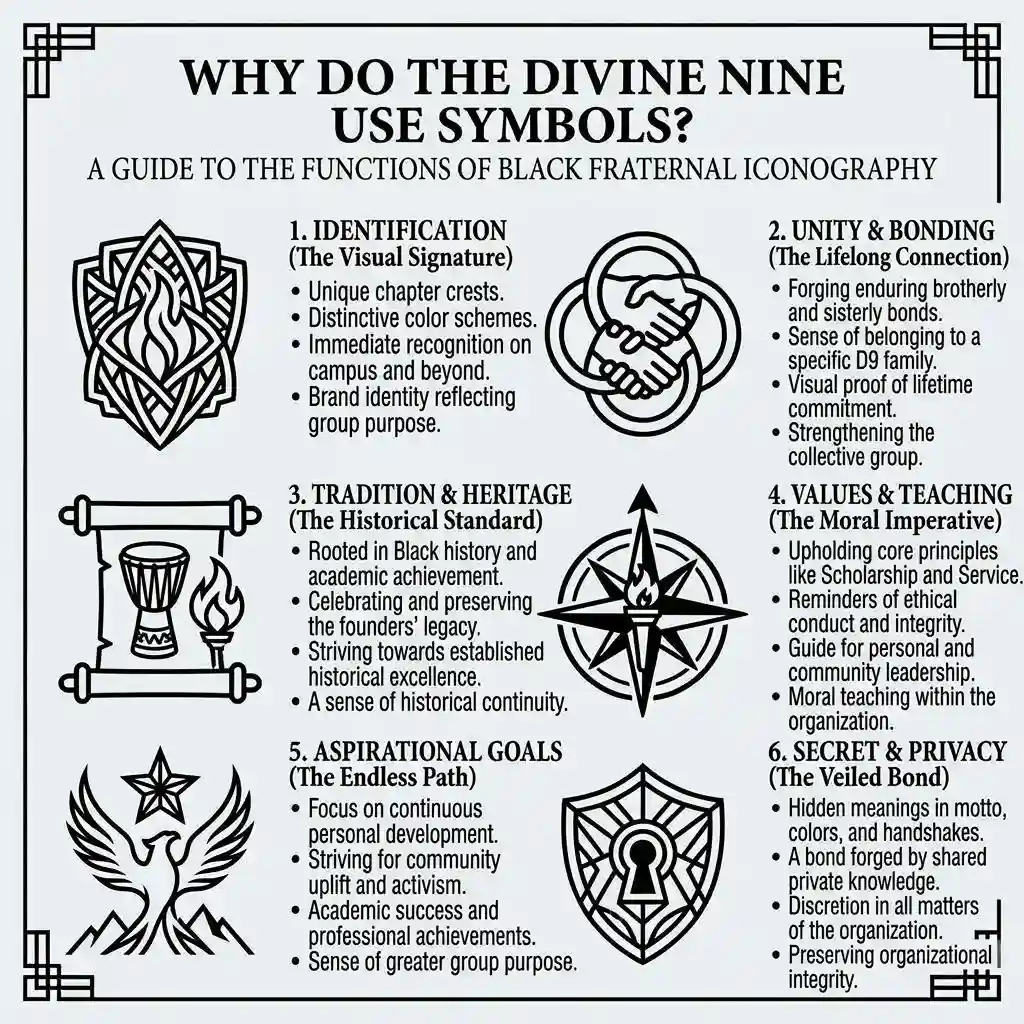
There is no universal dictionary for fraternity colors and animals.
The meaning comes from the individual organization.
Colors
A fraternity may select colors because of:
- Founding history
- Early organizational decisions
- Symbolic ideals
- Practical or historical circumstances
- Traditions established by members
For example, Beta Theta Pi officially identifies pink and blue as its colors and gives a specific historical explanation for them.
Animals
Animals can have equally specific meanings.
An animal may represent:
- A founder
- A historical event
- A particular quality
- A story or tradition
- A heraldic element
- An organizational nickname
For example, Beta Theta Pi’s dragon is an established part of its official heraldry.
Therefore, avoid assuming that every fraternity uses an animal in the same symbolic way.
What Do Fraternity Flowers Mean?
Fraternity flowers are usually organization-specific.
A flower may have been selected because of:
- A founder’s preference
- A historical event
- A chapter tradition
- A symbolic association
- A decision made during the organization’s early years
Kappa Kappa Psi’s official history explains that its red carnation was connected to founder William A. Scroggs’s favorite flower.
This is a useful example of why the correct meaning should come from the fraternity itself.
Are Frat Hand Signs Official Symbols?
Some fraternities and Greek-letter organizations use distinctive hand gestures or signs.
Depending on the organization, these may be connected with:
- Member recognition
- Organization initials
- Chapter identity
- Group traditions
- Public events
However, not every hand gesture associated with college Greek life is an official fraternity symbol.
Some organizational traditions may also be intended for members rather than the general public.
Therefore, an unfamiliar hand sign should not be interpreted from appearance alone.
Are Frat Symbols Secret?
Some fraternity symbols are completely public.
You may see Greek letters, colors, flags, logos, or other insignia on campus or online.
However, organizations can have different rules concerning particular symbols and how they may be displayed.
Kappa Kappa Psi, for example, states that wearing its crest, symbols, and letters is restricted to initiated members, with specified exceptions for candidates, colonies, and certain sponsored events.
This means that you should not assume every fraternity has identical rules.
If an organization provides specific instructions for its insignia, those rules should take priority over a general symbol guide.
Frat Symbols on Clothing
Fraternity symbols frequently appear on clothing.
Common examples include:
- T-shirts
- Hoodies
- Sweatshirts
- Jackets
- Hats
- Jerseys
- Patches
- Polos
A simple design may contain only Greek letters.
A more detailed design may combine:
Greek letters + colors + mascot + chapter + founding year
This can turn a basic piece of clothing into a highly specific representation of an organization or chapter.
What Does a Fraternity Shirt Symbol Mean?
A shirt symbol may indicate:
- Current membership
- Alumni affiliation
- Chapter affiliation
- Event participation
- Organizational support
- Recruitment
- A commemorative event
But clothing alone does not necessarily prove that the wearer is a current member.
Frat Symbols on Jewelry
Greek-letter jewelry is another common form of fraternity symbolism.
It may include:
- Rings
- Necklaces
- Pendants
- Pins
- Bracelets
- Tie clips
- Cufflinks
Some organizations have formal badges or jewelry with specific rules concerning their use.
For example, Kappa Kappa Psi describes its Crown Pearl Badge, official key, recognition pins, and fraternity ring as distinct forms of official jewelry.
This illustrates the difference between simply printing Greek letters and using an organization’s formal insignia.
Frat Symbols and Tattoos
Some people incorporate fraternity letters or symbols into tattoos.
Possible designs include:
- Greek letters
- A crest
- A mascot
- Official colors
- A founding year
- Chapter letters
- A personal design inspired by fraternity membership
Because tattoos are permanent, anyone considering one should verify the exact letters and design first.
This is particularly important with Greek characters because several letters can look unfamiliar to people who do not regularly read Greek.
It is also worth checking whether the organization has specific rules about its official insignia.
Common Mistakes When Identifying Frat Symbols
Mistake 1: Identifying a Fraternity From One Letter
A single Greek letter rarely identifies one organization.
Look at the entire combination.
Mistake 2: Confusing Greek Letters With a Logo
ΑΦΑ is text.
An organization’s official logo may be a separate graphic.
Mistake 3: Assuming Every Greek-Letter Group Is a Fraternity
Sororities, honor societies, professional groups, and other organizations can also use Greek letters.
Mistake 4: Guessing Symbol Meanings
A star, flower, animal, or color can have an organization-specific meaning.
Mistake 5: Treating a Random Online List as Official
Online lists can contain errors or outdated information.
For important identification questions, use the organization’s own website or official materials.
Mistake 6: Confusing Chapter Symbols With National Symbols
A chapter may have its own local imagery while still belonging to a larger fraternity.
Beta Theta Pi, for example, documents chapter-specific coats of arms and chapter graphics in addition to its broader fraternity identity.
Frat Symbol Identification Checklist
When trying to identify a symbol, check these details:
- Greek letters
- Letter order
- Number of letters
- Colors
- Mascot or animal
- Flower
- Badge
- Crest
- Shield
- Motto
- Founding year
- Chapter designation
- College or university
- Flag design
- Official organization website
The more of these details you have, the easier it becomes to distinguish similar organizations.
Why Frat Symbols Matter
Fraternity symbols can connect an organization with its members, history, chapters, and traditions.
A simple set of Greek letters can identify the organization, while a crest can preserve historical imagery. Colors can create visual recognition, and a badge can function as formal insignia.
The symbols may therefore operate at several levels:
Identification: Who is the organization?
Affiliation: Which chapter or group is involved?
History: What traditions or events are connected with the organization?
Recognition: How can members identify the organization or one another?
Identity: What visual elements consistently represent the group?
The meaning of those elements depends on the individual fraternity.
Frequently Asked Questions About Frat Symbols
What are frat symbols?
Frat symbols are visual elements associated with fraternities. They commonly include Greek letters, badges, crests, colors, mascots, flowers, flags, mottos, and chapter insignia.
What do frat letters mean?
Frat letters usually identify a Greek-letter organization. Their specific significance depends on the fraternity and its history rather than on a universal meaning assigned to each Greek letter.
What are the Greek letters used by fraternities?
Fraternities can use combinations of the 24 letters in the Greek alphabet. Commonly encountered letters include Alpha, Beta, Gamma, Delta, Kappa, Lambda, Phi, Sigma, Psi, and Omega.
Can I copy and paste frat symbols?
Yes. You can copy ordinary Greek Unicode characters such as Α Β Γ Δ Ε Ζ Η Θ Ι Κ Λ Μ Ν Ξ Ο Π Ρ Σ Τ Υ Φ Χ Ψ Ω. These characters are not necessarily the same as an organization’s official logo or trademarked artwork.
What fraternity uses ΑΦΑ?
ΑΦΑ is the Greek-letter abbreviation associated with Alpha Phi Alpha Fraternity, Inc.
What fraternity uses ΚΑΨ?
ΚΑΨ is associated with Kappa Alpha Psi Fraternity, Inc.
What fraternity uses ΩΨΦ?
ΩΨΦ is associated with Omega Psi Phi Fraternity, Inc.
What fraternity uses ΦΒΣ?
ΦΒΣ is associated with Phi Beta Sigma Fraternity, Inc.
What fraternity uses ΙΦΘ?
ΙΦΘ is associated with Iota Phi Theta Fraternity, Inc.
These five fraternities are among the nine organizations that make up the National Pan-Hellenic Council.
What are Black fraternity symbols?
Black fraternity symbols commonly refers to the Greek letters and other insignia associated with historically Black Greek-letter fraternities. Among the NPHC fraternities are Alpha Phi Alpha, Kappa Alpha Psi, Omega Psi Phi, Phi Beta Sigma, and Iota Phi Theta.
What are Divine Nine fraternity symbols?
The Divine Nine refers collectively to the nine NPHC Greek-letter organizations. Five are fraternities and four are sororities. Each organization has its own Greek letters, colors, symbols, traditions, and insignia.
Are fraternity symbols and sorority symbols the same?
They can use similar types of symbols, including Greek letters, colors, badges, flowers, and crests. However, each organization has its own identity and insignia.
What is a fraternity crest?
A fraternity crest is an emblematic or heraldic design associated with an organization. It may contain shields, animals, stars, Greek letters, dates, mottos, and other organization-specific elements.
What is the difference between a fraternity badge and a crest?
A badge is generally a formal piece of insignia associated with membership, while a crest or coat of arms is an emblematic design. An organization can have both, and their exact functions vary.
Do fraternity colors have universal meanings?
No. A color may have a particular meaning or historical significance within one fraternity, but that meaning should not automatically be applied to another organization.
Are fraternity hand signs secret?
Not necessarily. Some hand signs may be publicly recognizable, while other traditions or practices may be intended for members. The rules vary by organization.
Can I use a fraternity logo on a shirt?
Not necessarily. An organization’s official logo, crest, badge, or other artwork may be protected by its branding or trademark rules. For example, Beta Theta Pi states that its graphic identities are trademarked and restricts third-party use without permission.
How can I identify an unknown fraternity symbol?
Start with the complete Greek-letter combination. Then check the colors, crest, mascot, chapter information, college connection, and other visual elements. Finally, verify the identification through the fraternity’s official information.
Conclusion
Frat symbols are a broad category that includes much more than Greek letters. Greek-letter combinations, badges, crests, coats of arms, colors, mascots, flowers, flags, mottos, and chapter insignia can all contribute to a fraternity’s visual identity.
If you are trying to identify an unfamiliar symbol, begin with the complete Greek-letter combination rather than one individual character. Then compare colors, animals, crests, chapter information, and other details before checking an official fraternity source.
For copy-and-paste purposes, ordinary Greek Unicode characters are easy to use, but they should not be confused with official fraternity logos or artwork. Likewise, a Greek-letter organization is not automatically a fraternity because sororities, honor societies, professional organizations, and other groups can also use Greek letters.
The most reliable rule is simple: identify the complete organization first, then learn what its specific symbols mean. Fraternity symbolism is organization-specific, so official sources should take priority whenever a particular badge, crest, color, hand sign, or tradition needs to be identified accurately.

Dylan Anderson is a writer who enjoys turning complex topics into simple, engaging content that readers can actually use. His work focuses on clear explanations, practical insights and storytelling that feels natural and relatable. He is also the fictional author of The Quiet Compass of Ashford and Where the Cedar Lantern Glows. When he’s away from his keyboard, Dylan enjoys hiking, reading, and discovering inspiration in everyday life. He believes great writing should be informative, easy to understand and enjoyable from beginning to end.
 Adam Sullivan