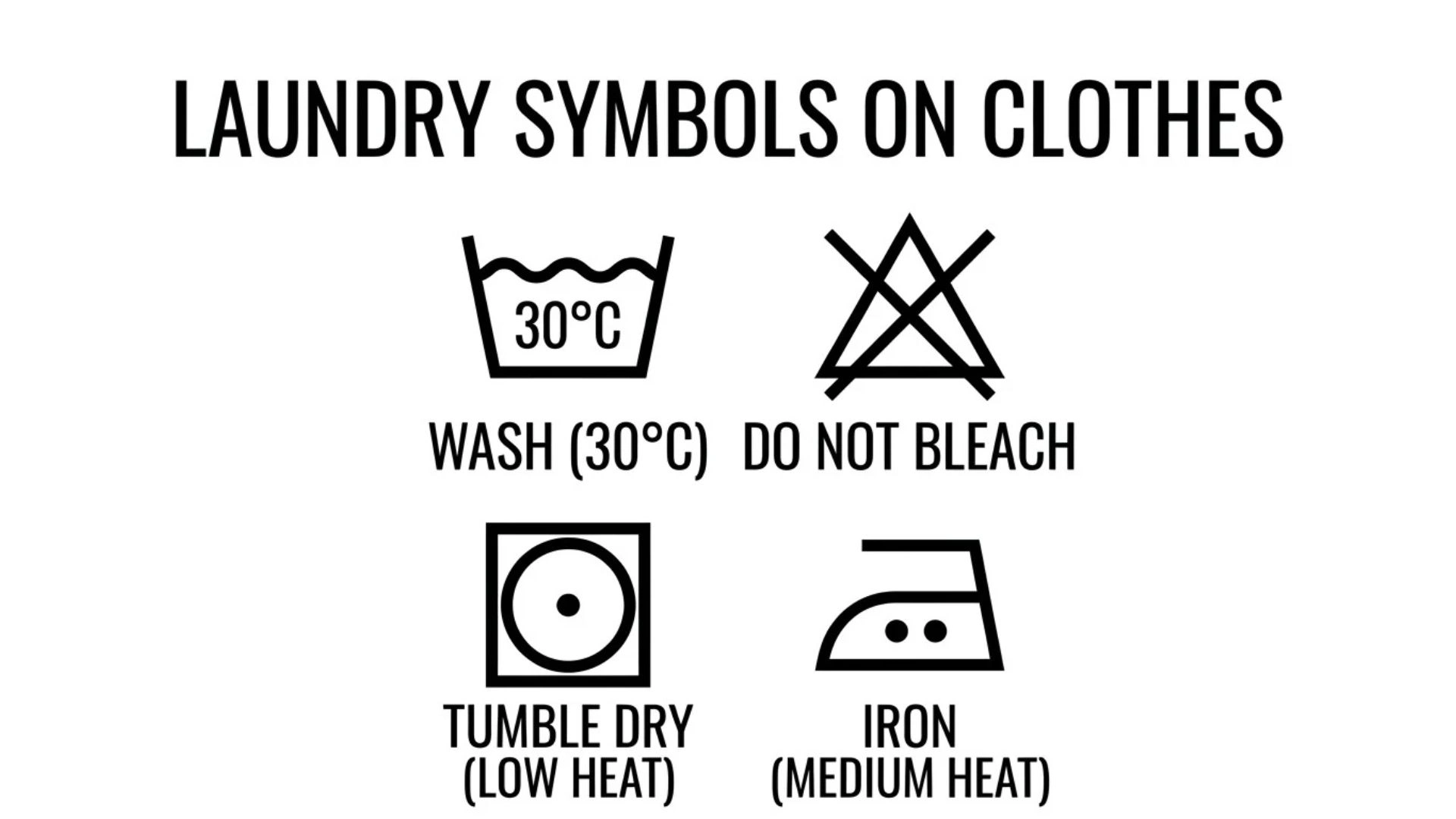
Have you ever picked up a shirt, turned it inside out, and found a tiny label filled with unfamiliar symbols? One looks like a bucket of water, another resembles a triangle, and a third looks like a small iron. You know these marks are important, but what do they actually tell you?
Laundry symbols on clothes explain how to wash, bleach, dry, iron, and professionally clean your garments. Understanding them helps you choose the right washing temperature, avoid unnecessary heat, protect delicate fabrics, and reduce the risk of shrinking or fading your favorite clothes.
These symbols may look complicated at first, but they follow a logical system. A washing tub relates to washing, a triangle relates to bleaching, a square relates to drying, an iron relates to ironing, and a circle relates to professional textile care. Small details such as dots, lines, numbers, and crosses change the instructions.
This guide explains the most common laundry symbols, how to recognize them, and what to do when you see them on a clothing label. You’ll also learn how to read an entire care label, understand symbols used for delicate garments, and avoid common laundry mistakes.
What Are Laundry Symbols on Clothes?
Laundry symbols are graphic instructions printed on clothing care labels. They tell you which cleaning and finishing treatments a garment can tolerate without suffering irreversible damage when the instructions are followed correctly.
You may find these labels inside a shirt’s side seam, near the waistband of pants, inside a jacket, or along the edge of a dress. Towels, bedding, and other textile products may also carry care instructions.
The symbols are useful because different fabrics and garment constructions respond differently to water, heat, agitation, bleach, and pressure. A cotton T-shirt may tolerate a treatment that damages a delicate blouse. A wool sweater may stretch when hung wet, while a structured jacket may need professional cleaning.
International care symbols are covered by ISO 3758:2023, which organizes instructions into five main categories: washing, bleaching, drying, ironing, and professional textile care.
The Five Main Laundry Symbol Categories
| Symbol category | How to recognize it | What it tells you |
| Washing | A tub filled with water | Whether washing is allowed and the permitted temperature or cycle |
| Bleaching | A triangle | Whether bleach can be used |
| Drying | A square | Whether tumble drying or natural drying is appropriate |
| Ironing | An iron | Whether ironing is permitted and the maximum temperature |
| Professional care | A circle, sometimes with letters or lines | Which professional dry-cleaning or wet-cleaning processes are suitable |
These descriptions help you recognize the shapes, but the complete symbol matters. For example, a square with a circle means something different from a square containing a horizontal line.
Where Can You Find Clothing Care Labels?
Care labels are commonly attached to the inside of garments. Check these areas if you cannot find one:
- The inside seam of a T-shirt or blouse.
- The waistband of trousers, jeans, or skirts.
- The inner lining of a jacket or coat.
- The side seam of a dress.
- The inside collar or lower seam of some garments.
Some items also include printed care instructions on a hangtag or packaging. Keep useful instructions if the permanent label is missing or difficult to read.
Laundry Symbols Chart: Quick Reference Guide
Use this chart to identify common laundry symbols quickly. The descriptions explain the appearance of each mark without requiring you to memorize the entire care-label system.
| Symbol appearance | Name | Meaning | What you should do |
| Tub with a temperature number | Maximum wash temperature | The number specifies the maximum permitted washing temperature in the international system | Do not exceed the stated temperature |
| Tub with one underline | Mild wash | Reduced mechanical action is required | Choose a mild washing cycle |
| Tub with two underlines | Very mild wash | A particularly gentle washing process is required | Use a suitable very gentle cycle |
| Hand inside a tub | Hand wash | The garment requires gentle hand washing under the stated conditions | Wash gently by hand |
| Crossed-out tub | Do not wash | Domestic washing is prohibited | Check the other care instructions |
| Empty triangle | Bleaching permitted | Bleaching is allowed under the applicable care system | Follow the product and garment instructions |
| Triangle with two diagonal lines | Non-chlorine bleaching only | Oxygen-based bleaching is permitted, but chlorine bleach is not | Avoid chlorine bleach |
| Crossed-out triangle | Do not bleach | Bleaching is prohibited | Use bleach-free care methods |
| Square with a circle | Tumble drying | The garment may be suitable for machine drying | Check the dots and any crosses |
| Square with a circle and one dot | Low-heat tumble drying | A mild dryer temperature is required | Use the appropriate low-heat setting |
| Crossed-out square with a circle | Do not tumble dry | Machine tumble drying is prohibited | Use a permitted natural-drying method |
| Square with a horizontal line | Dry flat | The garment should dry horizontally | Lay it flat and reshape it as needed |
| Square with vertical lines | Line or drip drying | The garment should dry hanging vertically | Follow the specific line and drip markings |
| Iron with one dot | Low-temperature ironing | A low ironing temperature is permitted | Use a low setting |
| Iron with two dots | Medium-temperature ironing | A medium ironing temperature is permitted | Stay within the permitted temperature |
| Iron with three dots | Higher-temperature ironing | A higher ironing temperature is permitted | Follow the label’s maximum |
| Crossed-out iron | Do not iron | Ironing is prohibited | Avoid direct ironing |
| Circle with a letter | Professional-care instruction | The letter identifies a permitted professional cleaning process | Show the label to your cleaner |
| Crossed-out circle | Do not dry clean | Professional dry cleaning is prohibited | Ask about another permitted cleaning method |
Important: The chart is a quick guide, not a replacement for the complete care label. Some symbols include additional marks for shade drying, drip drying, or specialized professional care. Those details can change the correct method.
Washing Symbols on Clothes and Their Meanings
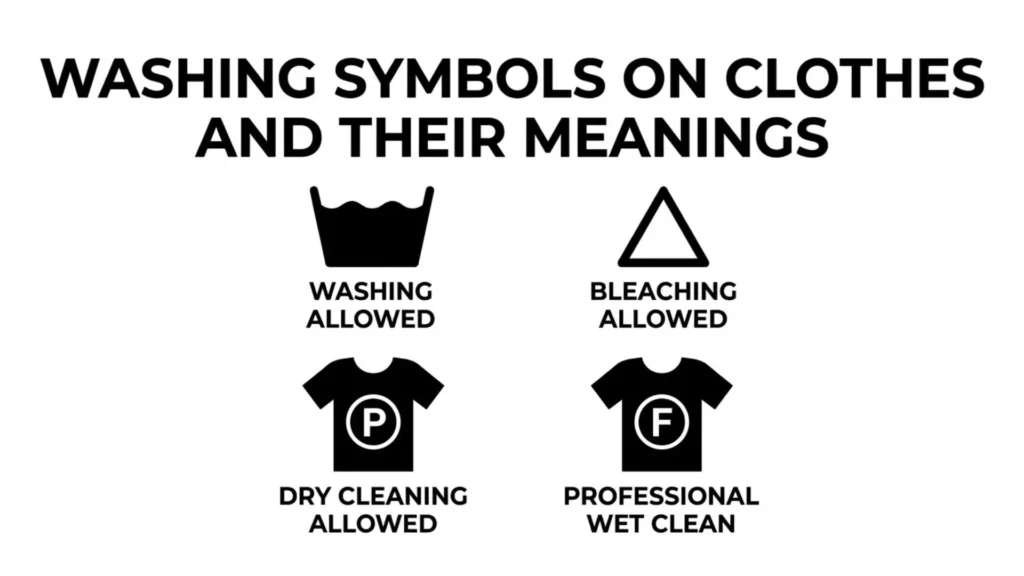
The washing symbol looks like a tub filled with water. It tells you whether a garment can be washed and how carefully you should treat it.
Machine-Washing Symbols and Temperature Numbers
A washing tub containing a number indicates the maximum washing temperature in degrees Celsius under the international care-symbol system.
| Symbol description | Maximum temperature | Practical guidance |
| Tub marked 30°C | 30°C / 86°F | Use a cold or cool wash setting |
| Tub marked 40°C | 40°C / 104°F | Use a suitable setting that does not exceed 40°C |
| Tub marked 60°C | 60°C / 140°F | Use this temperature only when the garment label permits it |
| Tub marked 95°C | 95°C / 203°F | This high-temperature treatment is suitable only for garments specifically labeled for it |
The number is a maximum, not a requirement to wash at that exact temperature. A garment labeled for 40°C can generally be washed at a lower suitable temperature.
Lower temperatures may help preserve colors and reduce unnecessary heat exposure. However, the best temperature also depends on the garment, the type of soil, the detergent, and the cleaning result you need.
Don’t assume that all cotton clothes can tolerate hot water. Fabric blends, dyes, finishes, and construction can change how a garment responds to washing.
What Does One Line Under the Washing Tub Mean?
One line underneath the washing tub indicates a mild washing process with reduced mechanical action.
Choose a mild cycle rather than a standard heavy-duty program. This instruction commonly appears on garments that need gentler treatment to protect their structure or finish.
What Do Two Lines Under the Washing Tub Mean?
Two lines under the washing tub indicate a very mild washing process. This is a stronger warning to reduce mechanical action than a single underline.
A wool garment, for example, may need a very gentle program designed for wool or other delicate textiles. Use a detergent suitable for the fabric and follow the garment’s full instructions.
A gentle cycle is not automatically safe for every delicate item. If the label prohibits machine washing, do not use a gentle setting as a substitute.
What Does the Hand-Wash Symbol Mean?
The hand-wash symbol shows a hand reaching into a tub of water. It indicates that the garment requires a hand-washing process under the specified conditions.
To hand-wash clothing carefully:
- Fill a clean basin with water at a suitable temperature.
- Add a detergent appropriate for the fabric.
- Gently move the garment through the water without harsh rubbing.
- Rinse according to the detergent and garment instructions.
- Press out excess water without twisting or wringing the fabric.
- Follow the label’s drying instructions.
Some washing machines offer a hand-wash or delicate program. Don’t assume that it is suitable for every hand-wash-only garment. Check the manufacturer’s instructions before using the machine.
What Does the Crossed-Out Washing Tub Mean?
A crossed-out washing tub means the garment must not be washed using the indicated domestic washing process.
The garment may be sensitive to wet treatment or unsuitable for ordinary washing. Check the other care symbols for professional-cleaning instructions.
Do not try to work around this instruction by using cold water, a short cycle, or a small amount of detergent. The problem may be the effect of water or agitation itself.
Bleaching Symbols on Clothing Labels
Bleaching symbols use a triangle. They tell you whether a bleaching treatment is permitted and, in some cases, which type is allowed.
Bleach can help with certain stains, but the wrong product can damage fabric, remove color, or weaken fibers. Always check the triangle before adding bleach to a load.
What Does an Empty Triangle Mean?
An empty triangle indicates that bleaching is permitted under the international care-symbol system.
It does not mean you must bleach the garment. It simply indicates that the treatment is allowed under the relevant care instructions.
Choose a suitable product, follow its directions, and check whether it is appropriate for the fabric and the stain you want to treat.
What Does a Triangle With Two Diagonal Lines Mean?
A triangle with two diagonal lines indicates that non-chlorine, oxygen-based bleaching is permitted, while chlorine bleach is not.
Check the active ingredients and directions on your bleaching product. Do not rely solely on a product’s marketing name to decide whether it is suitable.
If you are uncertain, choose a bleach-free method rather than risking permanent discoloration.
What Does a Crossed-Out Triangle Mean?
A crossed-out triangle means do not bleach.
Avoid chlorine bleach and oxygen-based bleaching products on the garment. This instruction can matter even when the fabric is white because dyes, elastic, decorative elements, and finishes may still be damaged.
For a stain, use a fabric-appropriate detergent or stain remover whose directions allow the intended use. Test an inconspicuous area when appropriate.
Drying Symbols on Clothes Explained
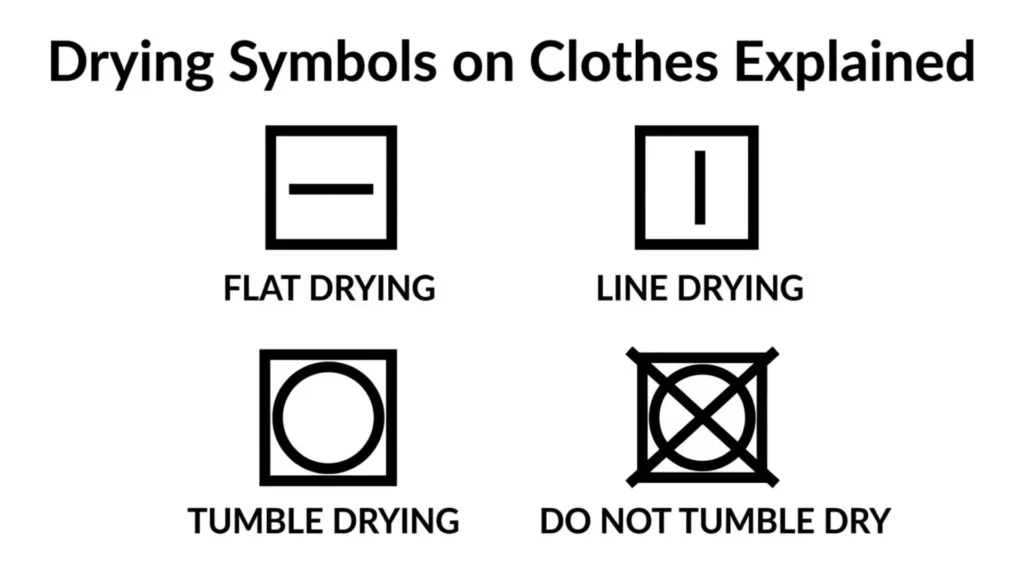
Drying symbols use a square. A circle inside the square refers to tumble drying, while lines inside the square describe different natural-drying methods.
These symbols are particularly important for wool, delicate garments, stretchy fabrics, and clothing that may shrink or lose its shape under heat.
Tumble-Drying Symbols and Dots
The circle inside a square represents tumble drying. Dots inside the circle indicate the permitted heat level in the international system.
| Symbol description | Meaning | What to do |
| Square with a circle and one dot | Low-temperature tumble drying | Use an appropriate low-heat dryer setting |
| Square with a circle and two dots | Higher permitted heat than the one-dot symbol | Follow the garment’s permitted heat level |
| Square with a circle and three dots, where used | Higher permitted drying temperature | Use only if the label and dryer settings support it |
| Crossed-out square with a circle | Do not tumble dry | Choose an allowed natural-drying method |
The available symbols and temperature categories depend on the care-label system being used. Always follow the exact mark on the garment.
What Does “Do Not Tumble Dry” Mean?
A crossed-out square containing a circle means that the garment must not be tumble-dried.
Heat and mechanical movement may damage the fabric, alter its shape, or cause shrinkage. Check the remaining drying instructions to determine whether the garment should be dried flat, hung to dry, or handled in another permitted way.
What Does Dry Flat Mean?
A square containing a horizontal line indicates flat drying. The garment should lie horizontally rather than hang vertically while it dries.
This method can help prevent heavy or stretchy clothing from becoming distorted under its own weight.
For example, if a wool sweater is labeled for flat drying, gently remove excess water without wringing it. Arrange the sweater in its original shape on a clean, dry surface or suitable drying rack.
Avoid placing it directly on a hot radiator unless the care instructions specifically allow that treatment.
What Does Line Dry Mean?
A square containing a vertical line indicates line drying. Hang the garment on a suitable clothesline or drying rack.
Choose a hanger or support that will not stretch the shoulders or leave marks. Some garments may need to be reshaped before hanging.
What Does Drip Dry Mean?
Vertical lines inside the drying square indicate a natural-drying method, while additional marks distinguish specific variations. Drip drying means allowing the garment to dry while water drains from it rather than removing all the moisture first.
This method can be useful for some delicate textiles that should not be wrung or subjected to heavy mechanical action.
Follow the exact symbol because line drying and drip line drying are not necessarily interchangeable.
What Does the Diagonal Line in a Drying Symbol Mean?
A diagonal line in a natural-drying symbol indicates that the garment should be dried in the shade.
This matters for clothing that may be affected by direct sunlight. Follow the rest of the symbol to determine whether the garment should be hung, drip-dried, or laid flat.
Drying Symbols at a Glance
| Symbol feature | General instruction |
| Square | Natural drying category |
| Circle inside a square | Tumble drying |
| Horizontal line inside a square | Flat drying |
| Vertical line or lines inside a square | Hanging or drip-drying method |
| Diagonal line inside a natural-drying symbol | Dry in the shade |
| Cross over the tumble-drying symbol | Do not tumble dry |
| Dots inside the dryer circle | Indicate the permitted heat category |
The square’s contents matter. Read the complete symbol rather than assuming every square describes the same drying method.
Ironing Symbols on Clothing Labels
The ironing symbol resembles a small iron. Dots inside the iron indicate the permitted temperature category.
Excessive heat can scorch fabric, leave shiny marks, melt some synthetic materials, or damage prints and decorative details.
What Do the Dots on an Iron Mean?
| Symbol description | General meaning | Practical action |
| Iron with one dot | Low-temperature ironing | Use a low setting |
| Iron with two dots | Medium-temperature ironing | Use a moderate setting within the label’s limit |
| Iron with three dots | Higher-temperature ironing | Use only when the garment permits it |
| Crossed-out iron | Do not iron | Avoid ironing the garment |
| Iron with crossed-out steam marks, where shown | Do not use steam | Avoid steam treatment |
The dots represent temperature categories, not a promise that every fabric in a category reacts identically. The fabric blend, dye, finish, and construction can affect heat sensitivity.
What Does Low-Temperature Ironing Mean?
A one-dot iron indicates a low-temperature ironing process. Use the lowest permitted setting that is suitable for the garment.
If you are unsure, check the fabric composition and manufacturer’s instructions. Avoid pressing directly onto heat-sensitive prints or decorative elements.
What Does the Crossed-Out Iron Mean?
A crossed-out iron means that ironing is not permitted.
Do not assume that a garment labeled “do not iron” can safely be steamed. A steamer also applies heat and moisture, which may damage certain finishes and materials. Check the manufacturer’s instructions before trying an alternative.
Dry-Cleaning and Professional-Care Symbols
Professional-care symbols generally use a circle. Letters or other marks inside or around the circle provide instructions for professional cleaners.
These symbols are particularly relevant to tailored clothing, formalwear, lined jackets, and delicate garments that may not tolerate household laundering.
What Does a Circle With a Letter Mean?
A circle containing a letter indicates a permitted professional-care process under the applicable symbol system.
Letters such as P or F provide technical information about the type of professional dry-cleaning process. They are not settings for a household washing machine.
If the garment is valuable or delicate, show the entire label to a qualified cleaner rather than trying to interpret one letter in isolation.
What Does a Crossed-Out Circle Mean?
A crossed-out circle means that the garment should not be dry-cleaned under the indicated system.
Check the remaining care instructions to determine which other cleaning method is permitted. Do not assume that a different professional process is suitable without checking the label.
What Is Professional Wet Cleaning?
Professional wet cleaning is a specialized water-based process performed by trained cleaners using suitable equipment, detergents, and controlled handling.
It is not the same as placing a delicate garment in an ordinary household washing machine.
If a label specifies professional wet cleaning, ask the cleaner whether they can provide the required treatment. Explain any stains or previous attempts at stain removal before the garment is cleaned.
How to Read a Complete Clothing Care Label
Reading a care label becomes easier when you follow the symbols in order. Many international labels use the sequence washing, bleaching, drying, ironing, and professional care.
Step 1: Check the Washing Instructions
Start with the tub symbol. Determine whether the garment can be machine-washed, needs hand washing, or must not be washed. If a temperature is shown, treat it as the maximum permitted temperature.
Step 2: Check Whether Bleach Is Allowed
Look at the triangle. An empty triangle, a triangle with diagonal lines, and a crossed-out triangle have different meanings.
If the label prohibits bleaching, do not add bleach simply because the garment is white or heavily stained.
Step 3: Choose the Permitted Drying Method
Check whether tumble drying is allowed. If the square contains a circle, examine the dots and any crosses.
If the label shows a natural-drying method, identify whether the garment should be hung, drip-dried, or laid flat. Also check for shade-drying instructions.
Step 4: Read the Ironing Symbol
Look at the iron and its dots. If the iron is crossed out, do not iron the garment. If ironing is permitted, stay within the indicated temperature category.
Step 5: Check the Professional-Care Symbol
Finally, examine the circle symbol. If it indicates professional dry cleaning or wet cleaning, follow that instruction rather than assuming ordinary home washing is safe.
Example 1: An Everyday T-Shirt
Imagine a T-shirt label contains these instructions:
- A washing tub marked 30°C.
- A crossed-out triangle.
- A tumble-drying symbol with one dot.
- An iron with two dots.
- A crossed-out professional-care circle.
Here is how to read the label:
- Washing: Wash at a maximum of 30°C using a suitable cycle.
- Bleaching: Do not bleach.
- Drying: Use the permitted low-temperature tumble-drying setting.
- Ironing: Iron within the medium-temperature limit.
- Professional care: Do not dry-clean.
This is an illustrative example. When handling a real garment, follow the exact symbols printed on its label.
Example 2: A Wool Sweater
Imagine a wool sweater has a very mild washing symbol, a crossed-out bleach triangle, a flat-drying symbol, and a low-temperature ironing symbol.
The instructions suggest a very gentle washing process, no bleaching, flat drying, and low-temperature ironing if needed.
After washing, avoid twisting or wringing the sweater. Gently remove excess water, arrange the garment in its original shape, and let it dry flat. This helps reduce stretching while the fabric is wet.
If the label prohibits washing or requires professional care, follow that instruction instead.
Example 3: A Structured Jacket
Imagine a jacket has a professional-care symbol and restrictive washing or drying instructions.
Do not assume that the outer fabric tells the whole story. The lining, shoulder structure, interfacing, buttons, and other components may respond differently to water or heat.
Show the complete label to a qualified cleaner. Point out stains and mention any treatment you’ve already tried. This gives the cleaner more information to select an appropriate process.
Laundry Symbols in Different Countries
Laundry care labels are not presented identically in every country. Many international labels use the ISO 3758 system, while US labels may also provide written instructions such as “machine wash cold,” “tumble dry low,” or “do not bleach.”
International Care Symbols
The international system uses the five main symbol categories to communicate washing, bleaching, drying, ironing, and professional-care instructions.
Numbers in the washing tub indicate maximum washing temperatures in degrees Celsius. Lines under the tub indicate milder washing processes, and dots in the tumble-drying and ironing symbols indicate permitted temperature categories.
US Clothing Care Labels
US clothing labels may use written instructions alongside symbols. The Federal Trade Commission’s Care Labeling Rule addresses care instructions for covered textile wearing apparel and certain piece goods.
If you see written directions that differ in appearance from an international symbol chart, read the entire label instead of trying to force every instruction into one visual convention.
What Should You Do if a Symbol Looks Different?
If a mark does not match the examples in a general guide:
- Check the complete care label for written instructions.
- Look for the garment’s brand and model information.
- Consult the manufacturer’s care guidance if available.
- Ask a professional cleaner when the garment is delicate, expensive, or difficult to replace.
Avoid guessing when the wrong treatment could permanently damage the item.
Common Laundry Symbol Mistakes to Avoid
Assuming Every Machine-Washable Garment Can Go in the Dryer
Washing and drying are separate processes. A garment may tolerate machine washing but still require flat drying or line drying.
Always check the drying symbol before using a tumble dryer.
Treating the Washing Temperature as a Required Setting
A number in the washing tub is a maximum temperature in the international system. It does not mean you must use that exact temperature.
Choose a lower suitable setting when appropriate for the fabric and cleaning task.
Using Bleach on White Clothing Without Checking the Label
White garments can still contain dyes, elastic, finishes, and decorative components that react badly to bleach.
Check the triangle symbol and the product directions before applying a bleaching agent.
Ignoring Lines Under the Washing Tub
One line indicates a mild process, while two lines indicate a very mild process. A regular cycle may use more mechanical action than the garment is intended to tolerate.
Choose a suitable gentle program when the label permits machine washing.
Confusing Flat Drying With Line Drying
Flat drying means laying the garment horizontally. Line drying means hanging it vertically.
This difference matters for knitwear and other clothing that may stretch under its own weight while wet.
Assuming a Circle With a Letter Is a Home-Washing Instruction
Professional-care letters provide information for cleaners. They are not ordinary washing-machine settings.
If you are unsure, show the full label to a qualified professional.
Ignoring the Garment’s Other Components
A care label applies to the garment as a whole. The lining, seams, buttons, elastic, prints, and decorative elements may all influence which treatment is suitable.
Don’t choose a cleaning method based only on the fabric you can see.
Practical Tips for Taking Better Care of Clothes
Understanding laundry symbols is the foundation of good clothing care. These everyday habits can also help keep garments looking better for longer.
- Sort clothing sensibly: Separate colors when appropriate and keep delicate items away from rough fabrics that may cause friction.
- Use a suitable detergent: Follow the product instructions and choose a formulation appropriate for the garment.
- Avoid overloading the washer: Clothes need enough room for water and detergent to circulate.
- Follow the temperature limit: Do not exceed the maximum temperature shown on the label.
- Treat stains carefully: Check the garment and stain-remover instructions before applying a product. Test a hidden area when appropriate.
- Fasten zippers and closures: This can reduce snagging and help protect other items in the load.
- Remove laundry promptly: Avoid leaving damp clothing in the washer for extended periods.
- Store garments when fully dry: Proper drying helps reduce musty odors during storage.
- Keep care labels readable: If a label is fading, record the instructions while they are still clear or consult the manufacturer.
These habits cannot prevent every laundry problem, but they can reduce avoidable mistakes.
Frequently Asked Questions About Laundry Symbols on Clothes
What Are the Five Basic Laundry Symbols?
The five main categories are washing, bleaching, drying, ironing, and professional care. Their main shapes are a water tub, triangle, square, iron, and circle.
Each category provides different information, so read the entire label before cleaning a garment.
What Does a Number Inside a Washing Tub Mean?
The number indicates the maximum washing temperature in degrees Celsius in the international care-symbol system. For example, 30°C means the washing temperature must not exceed 30 degrees Celsius.
It is a maximum rather than a requirement to use that exact temperature.
What Does One Line Under a Washing Symbol Mean?
One line underneath the washing tub indicates a mild washing process with reduced mechanical action. Two lines indicate a very mild process.
Choose the corresponding gentle cycle if machine washing is permitted.
What Does a Square With a Circle and One Dot Mean?
A square with a circle represents tumble drying. One dot inside the circle indicates a low-temperature tumble-drying process in the international system.
Use an appropriate low-heat setting and follow the garment’s complete care instructions.
What Does a Crossed-Out Triangle Mean?
A crossed-out triangle means do not bleach. Avoid chlorine and oxygen-based bleaching products on that garment.
Use an appropriate bleach-free cleaning method instead.
What Does a Circle With a Letter Mean on a Clothing Label?
A circle with a letter gives professional-care information. The letter helps identify the permitted cleaning process under the applicable symbol system.
It is not a setting for a home washing machine. Show the full label to a qualified cleaner if you need help.
Can I Tumble Dry Clothes That Are Machine-Washable?
Not necessarily. The washing and drying symbols provide separate instructions.
Check the square symbol to determine whether tumble drying is permitted and whether a specific heat level is required.
Are Laundry Symbols the Same in Every Country?
Not always. Many countries use the international ISO 3758 system, but regional labeling practices and written instructions can differ.
Read the garment’s full label and consult the manufacturer if a symbol is unclear.
What Should I Do if the Laundry Symbols Have Faded?
Check the garment’s brand website or contact the manufacturer if you can identify the item. Look for remaining written instructions and the garment’s fabric composition.
If the item is expensive, delicate, or structured, ask a professional cleaner rather than guessing.
What Is the Difference Between Dry Flat and Drip Dry?
Dry flat means the garment should lie horizontally while drying. Drip drying means allowing water to drain from the garment during natural drying.
The precise instruction depends on the complete symbol, including its lines and any additional marks.
Do Laundry Symbols Guarantee That a Stain Will Come Out?
No. Care symbols indicate permitted care treatments; they do not guarantee that every stain can be removed.
A stain may need a suitable treatment before washing. Always check the fabric’s care instructions and the stain-remover directions before applying a product.
Conclusion
Laundry symbols on clothes make garment care easier once you understand the shapes and markings. The washing tub explains washing conditions, the triangle covers bleaching, the square describes drying, the iron indicates ironing limits, and the circle provides professional-care information.
Pay attention to the numbers, dots, lines, and crossed-out marks. These small details can help you avoid unnecessary heat, unsuitable chemicals, and washing methods that may damage your clothing.
Most importantly, read the complete care label before washing, drying, or ironing an item. When a symbol is unclear, check the manufacturer’s instructions or ask a qualified cleaner rather than guessing. With a little practice, you’ll be able to understand laundry symbols confidently and take better care of the clothes you wear every day.

Dylan Anderson is a writer who enjoys turning complex topics into simple, engaging content that readers can actually use. His work focuses on clear explanations, practical insights and storytelling that feels natural and relatable. He is also the fictional author of The Quiet Compass of Ashford and Where the Cedar Lantern Glows. When he’s away from his keyboard, Dylan enjoys hiking, reading, and discovering inspiration in everyday life. He believes great writing should be informative, easy to understand and enjoyable from beginning to end.
 Adam Sullivan