Dreams can leave you with questions long after you wake up. You might dream about a snake, a bright light, a locked door, a flood, or someone who has passed away.
Some dreams feel peaceful and encouraging, while others leave you worried, confused, or afraid. If you are a Christian, you may wonder whether the dream has a spiritual message or whether it reflects something happening in your everyday life.
The Bible includes several important dreams. God communicates through dreams in particular biblical accounts, including the stories of Joseph, Pharaoh, and Daniel.
In the New Testament, Joseph receives guidance in dreams, and the Book of Acts describes dreams and visions in the early Christian community.
These accounts show that dreams have a place in biblical history.
However, an important distinction often gets lost in online dream dictionaries: the Bible does not give one fixed meaning for every symbol that appears in a dream. A snake does not automatically mean an enemy is near. Water does not always represent spiritual cleansing. Dreaming about death does not prove that someone will die.
Instead, Christians can explore dream imagery through Scripture, prayer, personal reflection, and wise counsel without assuming every dream is a message from God. The goal is not to predict the future from mysterious images. It is to seek wisdom, remain grounded in biblical teaching, and respond thoughtfully to what you experienced.
This guide explores common Christian dream symbols, the biblical passages connected with them, and questions you can ask when trying to understand a dream. It also explains what Scripture does and does not establish about dream interpretation.
What Are Christian Dream Symbols?
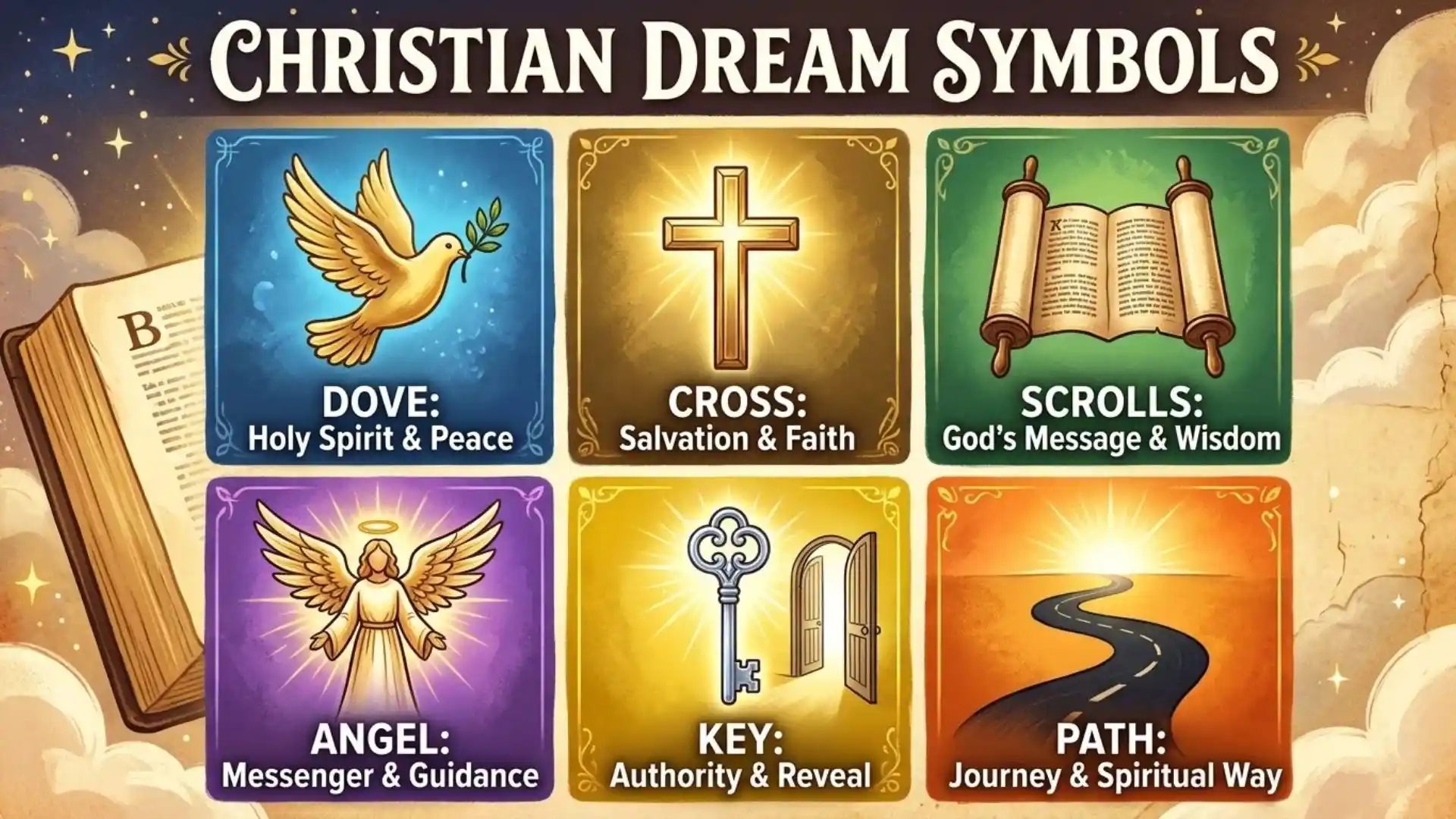
Christian dream symbols are images, people, objects, places, or experiences that people examine through a Christian understanding of Scripture and faith. These might include light, darkness, water, animals, houses, angels, roads, or unusual events.
Some symbols have clear associations in particular Bible passages. Light, for example, is associated with God’s presence, truth, and guidance in several biblical contexts. Sheep can illustrate the relationship between a shepherd and those under his care. Yet a biblical association does not automatically establish what an image means in every person’s dream.
Imagine dreaming about a house. In one situation, the house might remind you of family, safety, or a childhood memory. In another, a damaged house might reflect worries about your living situation. A third person might have no strong emotional association with houses at all.
The image alone cannot tell you which explanation is correct.
How Dreams Appear in the Bible
Several biblical accounts describe dreams that have a specific role in the story.
- Joseph’s dreams: In Genesis 37, Joseph dreams about sheaves of grain and celestial bodies that bow to him. These dreams relate to events involving his family later in the biblical narrative.
- Pharaoh’s dreams: In Genesis 41, Pharaoh dreams about healthy and thin cows, followed by healthy and withered grain. Joseph explains that the dreams concern seven years of abundance followed by seven years of famine in Egypt.
- Daniel’s interpretation: In Daniel 2, Daniel explains King Nebuchadnezzar’s dream of a great statue. The dream concerns kingdoms and God’s sovereignty over human power.
- Joseph’s guidance: In Matthew 1–2, Joseph receives dreams that guide him in responding to the circumstances surrounding Jesus’ birth and safety.
- Dreams and visions in Acts: Acts 2:17 describes dreams and visions in the context of the Spirit’s work among God’s people.
These stories do not function as a universal symbol dictionary. Their meaning becomes clear through the specific message and circumstances described in the biblical text.
For example, Pharaoh’s cows represent years within the interpretation Joseph gives Pharaoh. That does not mean every cow in every dream represents a period of time.
Does Every Dream Have a Spiritual Meaning?
No biblical rule requires Christians to treat every dream as a divine message.
Dreams may reflect recent experiences, memories, stress, hopes, fears, or concerns that occupy your thoughts. A dream about an examination might follow a stressful day at school. A dream about losing your way might occur during a period of uncertainty. Such experiences do not automatically carry a supernatural meaning.
Some Christians believe God can use dreams to communicate. Others take a more cautious approach to modern dream interpretation. Christians can differ on this subject while agreeing that Scripture should not be contradicted and that people should exercise discernment.
A useful starting point is to ask what the dream brought to mind without immediately deciding what it means. Treat any possible interpretation as something to examine, not as a proven message or prediction.
Christian Dream Symbols: Quick Reference Guide
The following table connects common dream images with biblical themes and careful reflection questions. It is a starting point for study, not a list of guaranteed meanings.
| Dream symbol | Biblical context or association | Question for reflection |
| Water | Creation, life, cleansing, danger, or deliverance in different passages | Did the water feel peaceful, threatening, or refreshing? |
| Snake | The serpent in Genesis 3 is associated with deception and temptation | Am I dealing with a concern about honesty, temptation, or trust? |
| Light | Truth, guidance, life, and God’s presence in several passages | Is there an area where I need clarity or wisdom? |
| Darkness | Can describe danger, uncertainty, judgment, or the absence of light | Am I feeling uncertain, afraid, or overwhelmed? |
| Fire | Can signify God’s presence, judgment, testing, or destruction depending on context | What was the fire doing in the dream? |
| Angel | Angels appear as messengers in particular biblical accounts | Am I seeking reassurance, or am I assuming too much from the image? |
| Door or gate | Can relate to access, entry, protection, or opportunity in particular passages | What does this doorway mean to me in my current circumstances? |
| House | Houses appear in biblical stories and teachings, but have no single dream meaning | Does the house remind me of family, security, or a current concern? |
| Mountain | Can be a place of revelation, worship, refuge, or challenge | Did climbing or standing on the mountain feel difficult or peaceful? |
| Road or path | Scripture uses paths to discuss conduct, wisdom, and direction | What decision or direction am I thinking about? |
| Tree | Trees can be associated with growth, fruitfulness, life, or judgment in specific contexts | What details made the tree seem healthy or damaged? |
| Lion | Can represent danger, strength, royalty, or an adversary depending on context | What did the lion do, and how did I respond? |
| Sheep | Often used in Scripture to illustrate care, dependence, and the shepherd’s role | Am I thinking about belonging, guidance, or responsibility? |
| Bread | Food, provision, fellowship, and spiritual teaching appear in biblical passages | Am I concerned about provision or feeling spiritually hungry? |
| Gold or money | Wealth, value, generosity, and the dangers of loving riches appear in Scripture | What does money represent in my present life? |
| Baby or child | Children appear in passages about family, care, humility, and new life | Is a new responsibility or change on my mind? |
| Death | Biblical passages discuss physical death, grief, hope, and resurrection | Am I processing loss, change, or fear? |
| Storm or flood | Storms and floods can be literal dangers or illustrations in biblical teaching | What feels beyond my control right now? |
| Flying or falling | Scripture does not give a universal interpretation for these dream experiences | Did the experience reflect freedom, fear, or loss of control? |
| Key | Keys can symbolize authority or access in specific biblical contexts | Am I thinking about access, responsibility, or a decision? |
| White clothing | White garments appear in passages involving purity, celebration, and heavenly imagery | What was happening in the scene, and what did the clothing mean to me? |
| Teeth falling out | No fixed biblical dream meaning is established | Have I been worried about appearance, health, change, or embarrassment? |
| Being chased | No universal biblical interpretation is given for this dream scenario | Is there a problem or responsibility I feel pressured by? |
| Wedding or marriage | Marriage has several roles in biblical teaching, including covenant and celebration | Is a relationship, commitment, or family event on my mind? |
| Pregnancy | Pregnancy and birth appear in biblical narratives, but no universal dream code is given | Am I anticipating a new responsibility or significant change? |
| Rain or rainbow | Rain can relate to provision or judgment in context; the rainbow appears in God’s covenant with Noah | What was the wider scene, and what passage am I connecting it with? |
| Bird or dove | Birds appear in many biblical settings; a dove has a particular role in the account of Jesus’ baptism | Was this simply a bird, or did the biblical scene have a clear connection? |
| Blood | Blood has different roles in biblical accounts involving life, sacrifice, covenant, and violence | Was the scene connected to fear, injury, sacrifice, or another concern? |
| Numbers such as 3, 7, or 40 | Numbers occur in particular biblical narratives, but their appearance in a dream has no guaranteed meaning | Is there a clear biblical context, or am I assigning meaning because the number stands out? |
The table deliberately distinguishes biblical associations from possible personal reflections. The first describes themes found in Scripture. The second offers questions you can consider without claiming that the dream has a confirmed spiritual meaning.
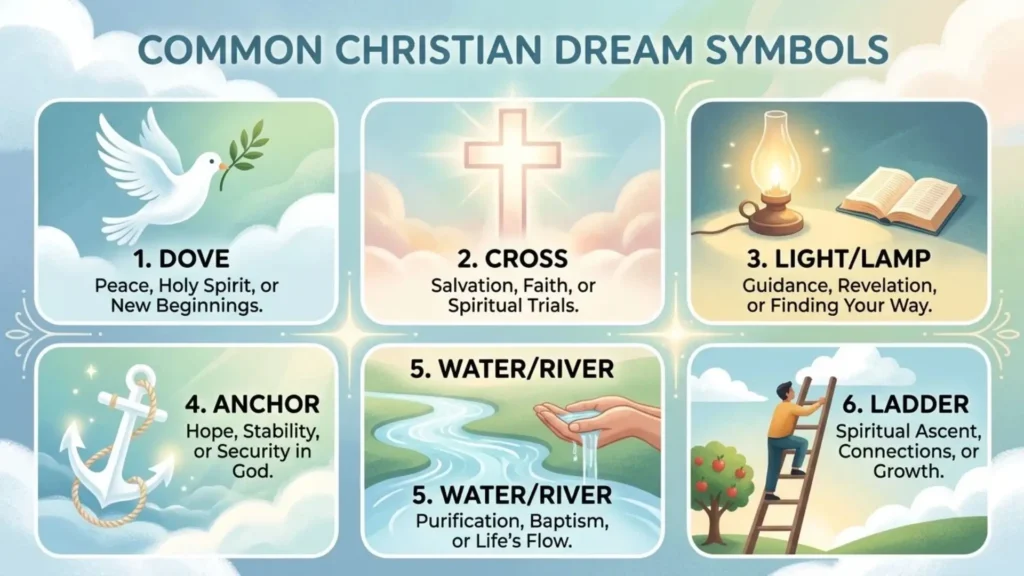
Common Christian Dream Symbols and Their Biblical Context
Water, Rivers, Oceans, and Floods
Water appears throughout the Bible in different circumstances. It is present in the creation account, the story of the flood, the Israelites’ passage through the sea, and many teachings about life and spiritual renewal.
Because water appears in so many settings, it does not have one universal meaning. Calm water in a dream may remind you of rest, while a powerful wave might bring to mind fear or uncertainty. Those personal associations are worth noticing, but they do not prove that God is sending a particular message.
Consider the scene carefully. Were you swimming, drinking, drowning, watching a river, or standing beside the ocean? What happened immediately before and after the water appeared?
Read the biblical passage that seems relevant in its full context. Avoid taking a verse about water and using it to predict what will happen in your life.
Snakes and Other Reptiles
The serpent in Genesis 3 plays a significant role in the account of temptation and deception in Eden. Because of that story, some Christians associate snakes with temptation, deceit, or danger.
However, the image must be considered in context. Scripture contains different references to serpents, and not every mention serves the same purpose. A snake appearing in a dream does not prove that a particular person is dishonest or that a spiritual attack is taking place.
If the dream unsettled you, you might reflect on whether you are concerned about trust, honesty, or a difficult decision. You should still judge real people by their actions and evidence, not by a dream.
Light, Darkness, and Fire
Light is an important biblical image. John 8:12 presents Jesus as the light of the world, while Psalm 119:105 describes God’s word as a lamp for one’s feet and a light for one’s path.
These passages can help you reflect on themes of guidance, truth, and understanding. Yet a bright light in a dream is not automatically a divine revelation.
Darkness also has several meanings across Scripture. Depending on the passage, it can describe danger, uncertainty, judgment, or the contrast between light and darkness. Fire can signify God’s presence, judgment, purification, or destruction in different accounts.
To explore one of these dreams, ask what the light, darkness, or fire was doing. Was it providing warmth, destroying something, illuminating a room, or creating fear? The surrounding details matter more than a single isolated image.
Angels and Other Spiritual Figures
Angels appear in biblical accounts as messengers and servants of God. For example, angels deliver messages in the Gospel narratives surrounding Jesus’ birth.
If you dream about an angel, it is understandable to wonder whether the experience has spiritual significance. However, the appearance of an angel-like figure in a dream does not by itself confirm that God has delivered a message.
You can reflect on the dream, pray for wisdom, and examine any message against Scripture. Be cautious about interpretations that demand unquestioning obedience, encourage harm, or claim to reveal hidden facts about other people.
The biblical role of angels should not be confused with every dream image that resembles an angel.
Houses, Rooms, Doors, and Keys
A house may remind you of family, privacy, safety, belonging, or responsibility. An unfamiliar house might bring up questions about change or uncertainty. A locked room could remind you of something you have not resolved.
These are personal possibilities, not fixed biblical definitions.
Doors and keys also appear in Scripture. In John 10:9, Jesus uses the image of a gate in a teaching about himself as the gate for the sheep. In other passages, keys relate to authority or access. Those contexts can be useful for Bible study, but they do not prove that a locked door in your dream means God has closed an opportunity.
If you dream about a door you cannot open, consider whether you are facing a real-life obstacle. Ask what practical steps are available before concluding that the dream is a divine instruction.
Roads, Mountains, and Trees
The Bible frequently uses paths and ways to discuss conduct, wisdom, and direction. Psalm 23, for example, describes God leading the psalmist along right paths. Proverbs also uses the language of paths to contrast wise and foolish choices.
Mountains appear in many settings, including worship, revelation, refuge, and challenge. Trees may illustrate life, fruitfulness, flourishing, or judgment, depending on the passage.
A dream about walking uphill might reflect a personal sense of effort, but Scripture does not establish that every mountain dream predicts a difficult season. Similarly, a green tree does not guarantee prosperity, and a dead tree does not automatically predict loss.
Start with the biblical passage, then ask whether the theme connects meaningfully to your circumstances. Do not reverse the process by deciding on a meaning first and searching for a verse to support it.
Lions, Sheep, Birds, and Other Animals
Animals have different roles throughout Scripture. A lion can be used to describe strength or royalty in one passage and danger in another. Sheep can illustrate vulnerability and the need for a shepherd. Birds appear in teachings about God’s care, in narrative scenes, and in descriptions of the natural world.
The dove is especially familiar to Christians because the Gospels describe the Spirit descending like a dove at Jesus’ baptism. That passage is a specific event, not a rule that every dove in a dream represents the Holy Spirit.
When an animal appears in your dream, notice its behavior. Was it protecting, attacking, escaping, or simply present? Then consider what the animal means to you personally and whether a particular biblical passage genuinely relates to the scene.
An animal image alone cannot establish that a person is your enemy, that a blessing is guaranteed, or that a future event will occur.
Bread, Gold, Money, and Clothing
Bread appears in biblical stories about physical provision and in teachings with spiritual significance. Gold and money are associated with wealth, value, offerings, and warnings about misplaced priorities. Clothing can relate to ordinary life, celebration, status, or spiritual imagery.
These themes may offer useful questions. Are you concerned about meeting your needs? Are you thinking about generosity, financial pressure, or what you value most? Has a major event made you think about identity or belonging?
Still, dreaming about money does not guarantee financial gain. Dreaming about torn clothing does not establish that you have lost God’s favor. Consider the broader context before drawing any conclusion.
Death, Babies, Pregnancy, and Weddings
Dreams about death can be particularly upsetting. If you dream that a loved one dies, it does not mean the person is going to die. Such a dream may occur during grief, stress, fear of separation, or a period of change. Sometimes it may simply be a disturbing dream without a clear meaning.
Likewise, a baby in a dream does not guarantee pregnancy, and a wedding does not prove that marriage is approaching. These images may bring to mind family, commitment, hope, responsibility, or change, but those are possibilities rather than biblical rules.
If a dream raises a real concern, respond to the actual circumstances. A pregnancy question belongs with appropriate medical information, while a relationship concern is best considered through honest conversation and observable behavior—not dream imagery alone.
Teeth Falling Out, Falling, Flying, or Being Chased
These are familiar dream experiences, but the Bible does not assign them universal Christian meanings.
A dream about teeth falling out may leave you feeling embarrassed or vulnerable. Falling may create a sense of danger or lost control. Flying may feel freeing, while being chased can be frightening. You can reflect on those emotions without deciding that each image has a spiritual code.
Ask yourself whether you have been under pressure, worried about a change, or struggling with a situation you cannot control. Also remember that a dream may not have an identifiable message.
It is especially important not to accept claims that these dreams automatically predict illness, betrayal, financial loss, or death. Such claims go beyond what the biblical text establishes.
Rain, Rainbows, Blood, and Numbers
Rain appears in different biblical contexts, including provision and judgment. The rainbow has a specific place in Genesis 9 as a sign of God’s covenant with Noah. Blood is connected to life, violence, covenant, and sacrifice in different passages.
Numbers such as three, seven, and forty also occur in notable biblical stories. Yet their presence in Scripture does not mean that seeing the same number in a dream carries a guaranteed message. A number’s significance in one narrative cannot automatically be transferred to a different situation.
If one of these images stands out, read the relevant passage in context. Be wary of interpretations that assign a precise prediction to every number, color, or repeated image without biblical support.
What the Bible Says About Dream Interpretation
The Bible presents dreams as significant in some accounts, but it does not encourage readers to invent meanings for every unusual image. The most helpful approach is to examine what the text actually says.
Joseph and Pharaoh’s Dreams
Genesis 40–41 describes Joseph interpreting dreams while in Egypt. Pharaoh dreams about seven healthy cows followed by seven thin cows, as well as healthy grain followed by withered grain.
Joseph explains that both dreams point to seven years of abundance followed by seven years of famine. The interpretation leads to practical preparation: Egypt stores grain during the years of plenty.
Three lessons stand out.
First, the meaning comes from the interpretation given in the story, not from a universal rule that cows always represent years. Second, Joseph gives God credit rather than presenting himself as the independent source of hidden knowledge. Third, the dream’s interpretation leads to a response suited to the circumstances.
Daniel and Nebuchadnezzar’s Dreams
In Daniel 2, King Nebuchadnezzar dreams about a large statue made of different materials. Daniel explains the dream after seeking God’s mercy with his companions.
The dream concerns kingdoms and the limits of earthly power. Daniel does not present his explanation as a technique anyone can use to decode every dream. He emphasizes God’s ability to reveal mysteries.
Daniel 4 provides another example: Nebuchadnezzar dreams about a great tree, and Daniel explains the image in relation to the king himself and what will happen to him.
These stories show why context matters. A tree has one role in Daniel 4 because the narrative explicitly identifies the king as the tree. The passage does not establish that every tree in a dream represents a ruler.
Dreams in the New Testament
Dreams appear in the New Testament as well. In Matthew 1–2, Joseph receives dreams that guide him through important events involving Mary and the child Jesus. Matthew 2 describes further dreams that warn him and direct his actions.
Acts 2:17 also mentions dreams and visions in a passage about the work of the Spirit. These references are important to Christians who believe God can communicate through dreams today.
However, biblical examples do not give every modern dream automatic authority. A dream should not be used to contradict Scripture, justify wrongdoing, or control another person. Christians differ on how they understand modern dreams, so humility and careful discernment remain important.
What the Bible Does Not Establish About Dream Symbols
The Bible does not provide a complete catalogue that assigns one permanent meaning to every animal, color, number, object, or event that appears in a dream.
It does not say that:
- Every snake dream means a hidden enemy is nearby.
- Every dream about water predicts a spiritual cleansing.
- Teeth falling out always means death or loss.
- A dream about money guarantees wealth.
- A frightening dream proves that a spiritual attack is occurring.
- Every repeated number is a direct message about the future.
Some interpretations may be meaningful to an individual, but that is different from saying Scripture explicitly teaches them. Keeping that distinction clear helps prevent fear, false certainty, and harmful decisions.
How to Interpret Christian Dreams Responsibly
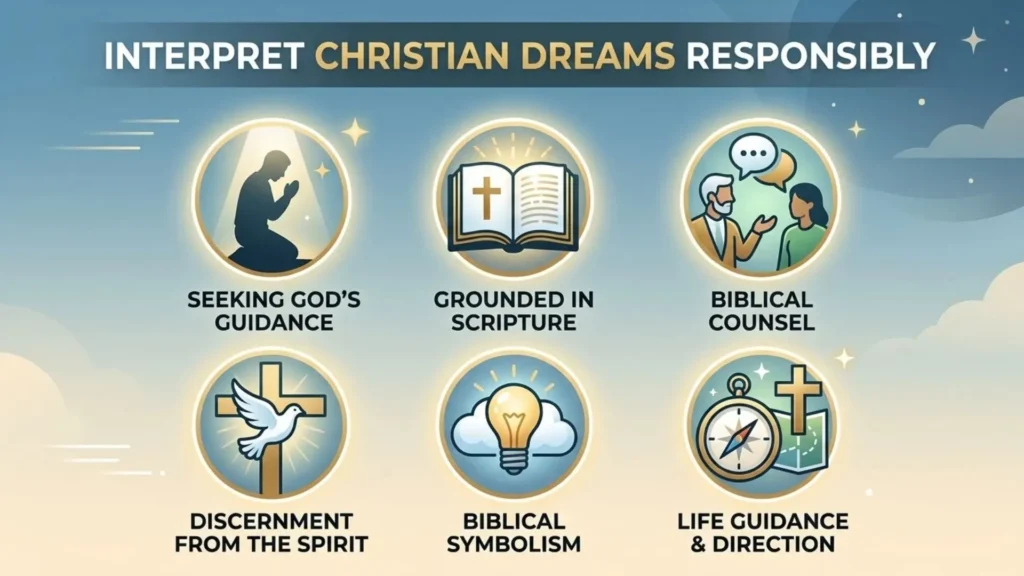
If a dream stays on your mind, you do not have to ignore it or immediately label it a divine message. You can examine it carefully and keep your conclusions proportionate to the evidence.
1. Write Down the Dream and Its Context
Record what you remember soon after waking. Include the setting, people, objects, events, and emotions. Separate the details you clearly remember from anything you are unsure about.
For example, write, “I dreamed that I was standing outside a locked door and felt frustrated.” Avoid starting with, “God told me that an opportunity is closed.” The first statement describes the experience. The second adds an interpretation that has not yet been established.
Also consider what happened recently. Have you been waiting for a decision, dealing with a family concern, or worrying about work? Recent experiences may help explain why a particular image appeared.
2. Examine Relevant Scripture in Context
If a dream reminds you of a biblical image, find the actual passage. Read the surrounding verses, identify who is speaking, and consider what happens in the story.
For example, if you dream about a path, you might read Psalm 23 or a passage in Proverbs that discusses wise conduct. Ask what the passage teaches in its original context before applying it to your own life.
Do not search only for a verse that seems to confirm the meaning you already prefer. A verse about a door, for example, does not prove that a locked door in your dream represents a closed opportunity.
3. Consider Ordinary Explanations
Faith and careful reflection do not require you to dismiss everyday explanations. Dreams can draw on memory, stress, physical sensations, recent conversations, and familiar images.
If you dream about being chased during a demanding week, you might be feeling pressured. That possibility is worth considering, but it is not a diagnosis or a definitive explanation.
Sometimes you will not find a clear connection. That is acceptable. You do not need to force a meaning onto every detail.
4. Pray for Wisdom Rather Than a Guaranteed Answer
If prayer is part of your Christian practice, you can ask God for wisdom, peace, and discernment. James 1:5 encourages those who lack wisdom to ask God. The passage is about seeking wisdom, not a promise that every dream will receive a hidden interpretation.
A simple prayer might be:
“God, help me respond to this experience with wisdom. If there is something useful for me to consider, help me examine it in a way that agrees with Your truth. Keep me from fear, assumptions, and decisions that could harm me or others. Guide me toward what is honest, loving, and wise.”
You can pray without expecting an immediate sign or a specific answer. A lack of clarity does not mean you have failed spiritually.
5. Seek Wise, Trusted Counsel When Needed
If a dream troubles you or seems connected to a serious decision, consider speaking with a mature Christian, pastor, or trusted person who will listen without increasing your fear.
A helpful adviser will allow room for uncertainty. They should not insist that a dream proves someone is evil, demand money to reveal its meaning, or pressure you into a major decision.
If recurring nightmares interfere with sleep or daily life, a qualified mental health professional may also help. Seeking professional support does not prevent you from drawing on your faith.
6. Avoid Making Major Decisions Based Only on a Dream
Do not make a medical, financial, legal, relationship, or safety decision solely because of a dream.
If you are considering changing jobs, ending a relationship, moving home, or spending a large amount of money, examine the real-world facts. Seek appropriate advice and consider the consequences.
A dream may prompt you to think about a concern you have neglected. It should not replace evidence, responsible judgment, or a careful decision-making process.
A Worked Example: Dreaming About a Locked Door
Suppose you dream that you are trying to open a locked door. You pull the handle several times, but the door will not move. You wake up feeling disappointed.
Here is a responsible way to explore the experience.
Step 1: Describe the details. You were outside a locked door, you wanted to enter, and you felt frustrated. You do not yet know why the door was locked.
Step 2: Consider your circumstances. Perhaps you are waiting for a job offer, struggling to resolve a disagreement, or unsure about your next step. You can ask whether any of those situations connect with your feelings in the dream.
Step 3: Examine Scripture carefully. You might study a passage that uses door imagery, such as John 10:9. Read the passage to understand its message about Jesus as the gate for the sheep. Do not treat it as a direct explanation of your dream.
Step 4: Consider practical action. If you are waiting for a job response, you could follow up professionally or explore other opportunities. If you are facing a disagreement, you might seek a calm conversation.
Step 5: Leave room for uncertainty. You cannot conclude that God has permanently closed a door, that an opportunity is guaranteed, or that the dream predicts the future.
The value of this process is not that it unlocks a secret code. It helps you reflect thoughtfully while keeping Scripture, real circumstances, and responsible action in view.
Can Christian Dreams Predict the Future or Warn of Danger?
The Bible includes particular dreams that reveal future events or provide warnings. Pharaoh’s dreams in Genesis 41 are one example, and the dreams in Matthew 1–2 guide Joseph during important events.
Those accounts do not prove that every modern dream predicts what will happen next. They also do not provide a reliable method for turning frightening dream images into forecasts.
If you dream that a loved one is in danger, remember that the dream is not evidence that the person will be harmed. If you dream that a friend betrays you, do not accuse that person without real-world reasons. If you dream about illness, the dream cannot diagnose a medical condition.
A frightening dream may leave you emotionally shaken. You can pray, speak with someone you trust, and take reasonable steps if an actual concern exists. For example, if you have a genuine reason to worry about a loved one’s safety, contact them normally rather than treating the dream as proof of an emergency.
What If a Dream Feels Extremely Real?
Some dreams feel unusually vivid. You may remember specific words, colors, faces, or sensations. The intensity of the experience can make it seem important, but vividness alone does not establish its source or meaning.
Give yourself time to settle. Write down what you remember, consider recent events, and avoid making immediate decisions while frightened.
If nightmares recur, affect your sleep, or cause ongoing distress, seek suitable support. You can take your emotional experience seriously without assuming that it predicts a disaster.
Common Mistakes to Avoid When Interpreting Christian Dreams
Treating Every Symbol as a Fixed Code
The biggest mistake is assuming that each dream image has one permanent meaning. The same image can appear in very different contexts, even within the Bible.
Read the relevant passage rather than relying on a short list that claims every snake, river, or number means the same thing.
Confusing Personal Reflection With Biblical Teaching
It is reasonable to ask whether a dream about a road connects with a decision you are facing. It is not accurate to claim that the Bible guarantees this meaning for every road dream.
Use clear language. Say, “This image might remind you of a decision,” rather than, “This dream means God is telling you to change direction.”
Using Fear to Reach a Conclusion
Fear can make an uncertain interpretation feel convincing. A dream about darkness does not prove that evil is approaching, and a dream about death does not establish that a tragedy is coming.
Pause before accepting frightening claims. Look for evidence and seek counsel from people who encourage wisdom rather than panic.
Ignoring the Dream’s Full Context
A single symbol rarely tells the whole story. The setting, actions, emotions, and other people in the dream may all matter to your personal reflection.
Even then, the details may not reveal a clear meaning. It is better to admit uncertainty than to invent an explanation.
Making Decisions Without Real-World Evidence
Do not use dreams as proof that a partner is unfaithful, a friend is dangerous, or a financial opportunity is blessed. Such conclusions can damage relationships and lead to avoidable harm.
Consider observable facts, seek appropriate advice, and use sound judgment. A dream can be a reason to reflect, but it is not a substitute for evidence.
Trusting Every Online Interpretation
Online dream dictionaries often present confident explanations without showing where those meanings appear in Scripture. Some combine biblical imagery with folklore, popular psychology, or personal opinion.
Check the biblical reference yourself. Ask whether the passage actually interprets that symbol in a dream or simply uses the image in another context. If the source does not make the distinction clear, treat its claim cautiously.
Frequently Asked Questions About Christian Dream Symbols
What Are the Most Common Christian Dream Symbols?
Commonly discussed images include water, snakes, light, darkness, fire, angels, houses, doors, roads, mountains, trees, animals, money, and children. People also ask about falling, flying, being chased, teeth falling out, weddings, pregnancy, and death.
These images have different biblical contexts or personal associations. The Bible does not assign one guaranteed meaning to all of them. Consider the full dream and the relevant Scripture before drawing a conclusion.
Does God Speak Through Dreams Today?
Christians have different views about how God may communicate today. The Bible describes God using dreams in particular accounts, including those involving Joseph, Pharaoh, Daniel, and Joseph in the New Testament.
Those accounts do not establish that every modern dream comes from God. If you believe a dream may be significant, examine the idea carefully, compare it with Scripture, pray for wisdom, and seek trusted counsel without claiming certainty you do not have.
What Does It Mean to Dream About a Snake as a Christian?
The serpent in Genesis 3 is connected with deception and temptation. Because of that passage, some Christians associate snakes with those themes.
However, a snake dream does not prove that someone is deceiving you or that an enemy is nearby. Consider what happened in the dream, what the image means to you, and whether any real-life concern needs attention.
What Does Water Mean in a Christian Dream?
Water appears in the Bible in many contexts, including creation, deliverance, provision, danger, and spiritual teaching. Its significance depends on the passage.
A dream about clear water, a river, or a flood does not have one universally established Christian meaning. Reflect on the scene and your circumstances without treating the image as a guaranteed prediction.
Does Dreaming About Death Mean Someone Will Die?
No. A dream about death does not establish that you or someone else will die. It may be connected to grief, stress, fear, change, or other personal experiences, but there is no single explanation that applies to everyone.
If the dream frightens you, take time to calm down and speak with someone you trust if needed. Do not treat the dream as proof that a tragedy is coming.
What Does It Mean to Dream About an Angel?
Angels serve as messengers in several biblical accounts. However, seeing an angel-like figure in a dream does not automatically prove that you have received a message from God.
You can reflect on the dream and examine any message against Scripture. Be cautious of claims that demand money, unquestioning obedience, harmful action, or accusations against another person.
Should Christians Use Dream Dictionaries?
A dream dictionary may offer ideas for reflection, but it should not be treated as biblical authority. Many symbol lists assign meanings that Scripture does not explicitly establish.
If you use one, check its claims against the actual biblical passages. Distinguish clearly between a direct biblical interpretation, a possible personal association, and an unsupported prediction.
What Should I Do After a Frightening Dream?
First, remind yourself that a dream is not proof that something bad will happen. Take a few moments to settle, record what you remember if that helps, and consider whether recent stress or concerns may be relevant.
You can pray for peace and wisdom and talk with someone trustworthy. If nightmares repeatedly disrupt your sleep or daily activities, consider professional support as well.
Can Numbers Such as 3, 7, or 40 Have a Biblical Meaning in Dreams?
These numbers appear in particular biblical stories and passages. Their significance depends on those contexts. The Bible does not establish a universal system for interpreting every number that appears in a modern dream.
Avoid making predictions based solely on a repeated number. Read the relevant passage and leave room for the possibility that the number has no special meaning in your dream.
Conclusion
Christian dream symbols can provide an opportunity to reflect on Scripture, personal concerns, and questions of faith. Biblical accounts show that dreams played an important role in certain situations, including the stories of Joseph, Pharaoh, Daniel, and Joseph in the New Testament.
Still, not every dream is a message from God, and not every symbol has a fixed biblical meaning. Water, snakes, angels, doors, animals, numbers, and other images must be considered in context rather than treated as guaranteed signs of future events.
If a dream stays with you, write down what you remember, examine relevant Bible passages, pray for wisdom, and consider your real-life circumstances. Ask trusted people for counsel when needed, and avoid making major decisions based only on dream imagery.
You do not need to force an explanation when the meaning remains unclear. A careful, humble approach allows you to explore your experience without letting fear or unsupported interpretations control your choices.

Adam Sullivan is a dedicated writer who enjoys transforming everyday topics into engaging and informative content. His writing focuses on making complex ideas simple, practical and enjoyable for readers of all backgrounds. Adam is also the fictional author of The Lantern Beyond Autumn Hills and Where the Morning Horizon Waits. Outside of writing, he enjoys photography, traveling and discovering inspiration through new experiences. He believes great content should be both helpful and easy to connect with.
 Dylan Anderson