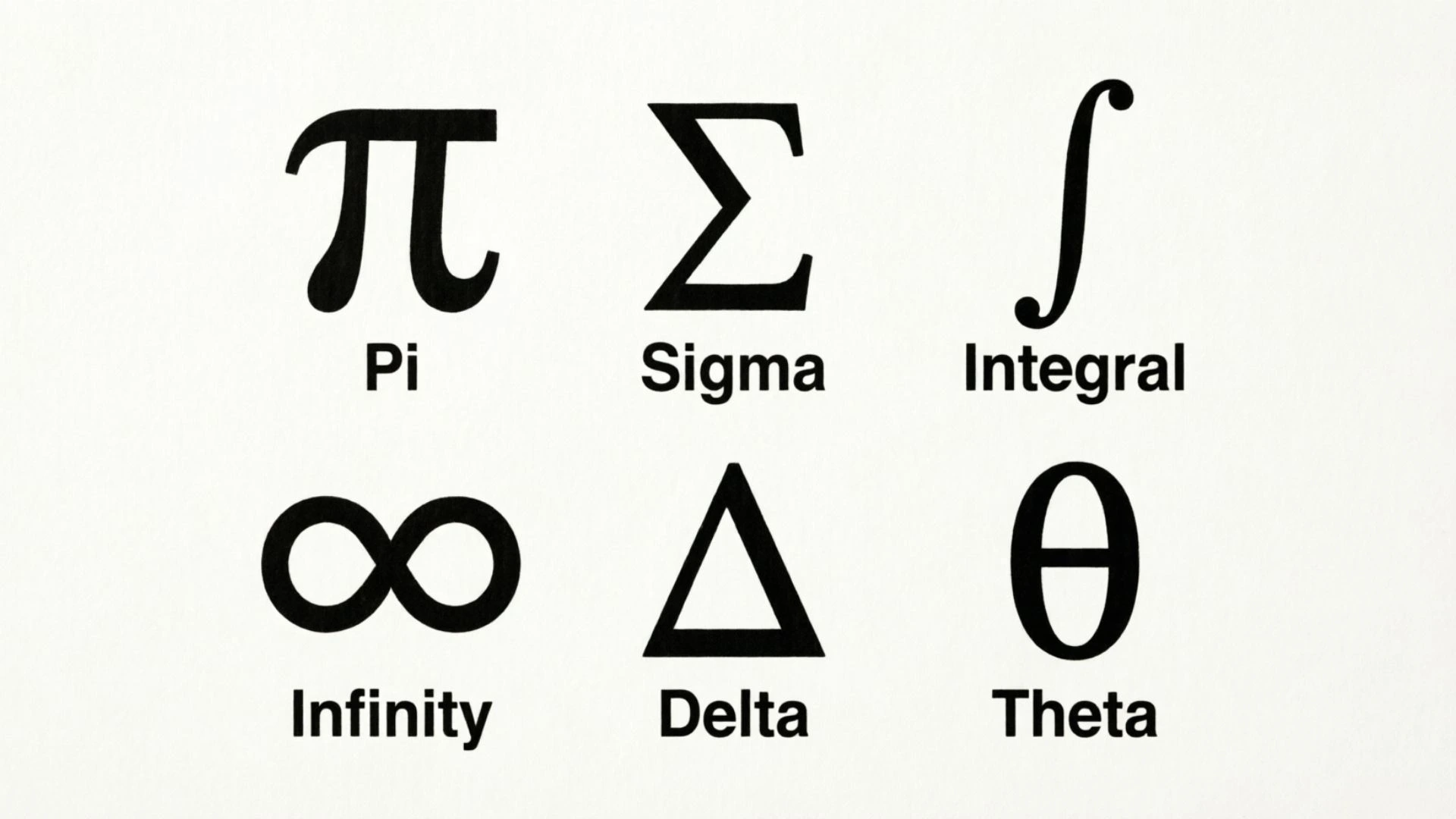
Mathematical symbols make numbers, equations, and ideas easier to understand without writing long explanations. When you know the mathematical symbols with name, you can read formulas more confidently and recognize what each sign means.
I have put together this guide to help you learn common math symbols in a simple, practical way. Whether you are a student, teacher, designer, researcher, or simply curious about mathematics, you can use this list as a quick reference.
You will find familiar signs such as plus (+), minus (−), equal (=), multiplication (×), division (÷), greater than (>), and less than (<), along with symbols used in algebra, geometry, calculus, statistics, and higher mathematics.
Some mathematical symbols also appear in tattoos, logos, artwork, usernames, and personal designs. In those situations, understanding the original mathematical meaning is important before giving a symbol a personal interpretation.
Quick Answer: What Are the Most Common Mathematical Symbols?
Some of the most common mathematical symbols are + (plus), − (minus), × (multiplication), ÷ (division), = (equals), ≠ (not equal), < (less than), > (greater than), ≤ (less than or equal to), ≥ (greater than or equal to), √ (square root), π (pi), and ∞ (infinity).
Their meanings depend on how they are used in an equation or mathematical expression. For example, + means addition, while = indicates that two expressions have the same value.
What Are Mathematical Symbols With Name?
Mathematical symbols are signs or characters used to represent numbers, operations, relationships, quantities, sets, measurements, and mathematical ideas.
Instead of writing “five added to three is equal to eight,” mathematics can express the same idea as 5 + 3 = 8. This makes mathematical communication shorter and easier to read.
The meaning of a symbol can also change depending on the branch of mathematics. For example, |x| can represent the absolute value of x, while vertical bars may have other meanings in different mathematical contexts.
Some symbols are basic enough for elementary school, while others are common in algebra, geometry, calculus, probability, statistics, and advanced mathematics.
Mathematical Symbols With Name: Comparison Table
| Symbol | Main Meaning | Best Use |
| + | Plus / Addition | Adding numbers |
| − | Minus / Subtraction | Subtracting numbers |
| × | Multiplication | Multiplying quantities |
| ÷ | Division | Dividing numbers |
| = | Equal to | Showing equal values |
| ≠ | Not equal to | Showing unequal values |
| < | Less than | Comparing values |
| > | Greater than | Comparing values |
| ≤ | Less than or equal to | Comparing values |
| ≥ | Greater than or equal to | Comparing values |
| √ | Square root | Finding square roots |
| ∞ | Infinity | Unbounded quantities |
Top 12 Mathematical Symbols and Their Meanings
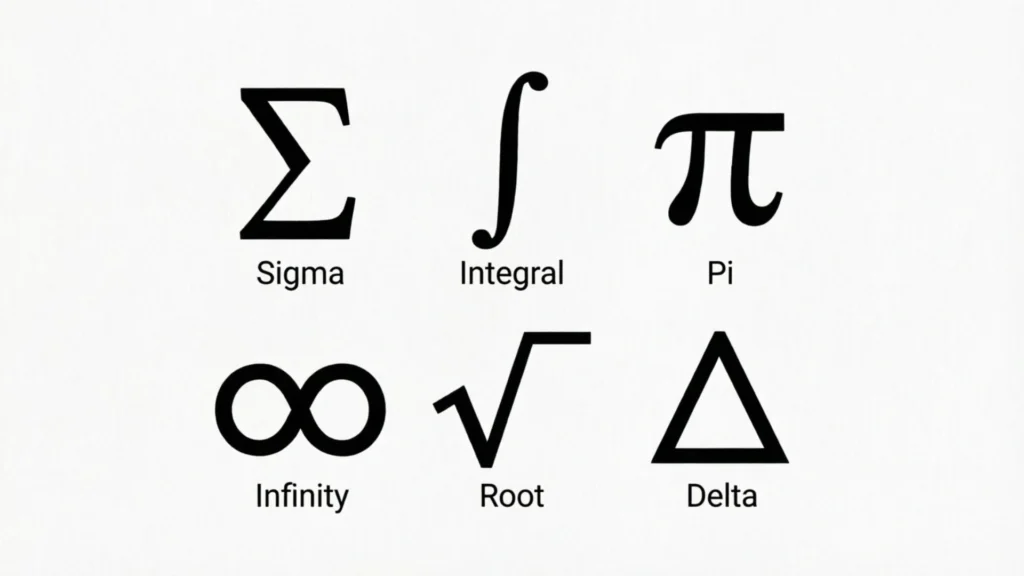
1. Plus Sign (+): Addition
The plus sign (+) is one of the first mathematical symbols most people learn. It tells you that two or more quantities should be added together.
For example, 7 + 3 = 10 means that seven and three are combined to make ten. The symbol is also used when describing positive numbers, although a positive sign is often left out when the number is clearly positive.
Today, the plus sign is instantly recognizable and appears in arithmetic, algebra, spreadsheets, calculators, programming-related contexts, and educational materials.
It can also be used creatively in designs to suggest addition, increase, or bringing things together, but those are visual interpretations rather than its formal mathematical definition.
Best for: math worksheets, educational designs, formulas, positive-number concepts, simple mathematical tattoos
2. Minus Sign (−): Subtraction and Negative Values
The minus sign (−) is used primarily for subtraction. In 10 − 4 = 6, it tells us to take four away from ten.
It can also indicate that a number is negative, as in −8. This makes the minus sign important in arithmetic, algebra, number lines, and coordinate systems.
Although people sometimes use a hyphen (-) when typing, the mathematical minus sign is technically a different character. In carefully formatted mathematics, the proper minus sign is preferred because it has the correct spacing and appearance.
Best for: subtraction, negative numbers, equations, number lines, minimalist math designs
3. Multiplication Sign (×): Multiplication
The multiplication sign (×) shows that quantities are being multiplied. For example, 6 × 4 = 24 means six multiplied by four equals twenty-four.
In algebra, multiplication is often written without the × symbol. For example, 3x means 3 multiplied by x. A centered dot, ·, may also be used for multiplication.
The × symbol is especially common in elementary arithmetic and practical calculations because its meaning is immediately recognizable.
Best for: arithmetic, school projects, calculation charts, educational graphics, mathematical artwork
4. Division Sign (÷): Division
The division sign (÷) indicates that one quantity is divided by another. For example, 20 ÷ 5 = 4.
The symbol consists of a horizontal line with a dot above and another dot below. In higher mathematics, division is frequently written as a fraction instead, such as 20/5 or a vertically arranged fraction.
The division sign remains common in elementary and everyday mathematics, especially on calculators and educational materials.
Best for: basic arithmetic, schoolwork, calculators, math posters, educational designs
5. Equal Sign (=): Equality
The equal sign (=) means that two expressions have the same value. In 4 + 6 = 10, the expression on the left has the same value as the expression on the right.
The symbol is fundamental to algebra because equations use equality to establish relationships between quantities.
Beyond formal mathematics, the equal sign is sometimes used in graphic designs or tattoos to suggest balance or equivalence. However, those interpretations are personal or symbolic rather than its basic mathematical definition.
Best for: equations, algebra, educational designs, balance-themed artwork, mathematical tattoos
6. Not Equal Sign (≠): Inequality
The not equal sign (≠) means that two values are not the same. For example, 5 ≠ 8 tells us that five is not equal to eight.
It is especially useful when comparing mathematical expressions or stating conditions. In algebra and other areas of mathematics, inequality symbols help describe values that do not have the same relationship.
Because the symbol is visually simple, it can also work well in minimalist mathematical designs. If used outside mathematics, however, its intended meaning should be explained clearly so viewers do not misunderstand it.
Best for: inequalities, comparisons, algebra, mathematical notation, minimalist designs
7. Less Than Sign (<): Smaller Value
The less than sign (<) compares two values and indicates that the number on the left is smaller than the number on the right.
For example, 3 < 9 means three is less than nine.
A useful way to remember it is to think of the wider side as facing the larger number. This symbol is widely used in arithmetic, algebra, statistics, programming, and data-related contexts.
Best for: number comparisons, inequalities, algebra, statistics, educational graphics
8. Greater Than Sign (>): Larger Value
The greater than sign (>) indicates that the value on the left is larger than the value on the right.
For example, 12 > 7 means twelve is greater than seven.
Like the less than sign, it is used extensively in algebra and inequalities. Similar comparison symbols can also appear in computer programming, although their exact function depends on the programming language.
Its simple shape makes it easy to recognize and useful in charts, classroom materials, and mathematical illustrations.
Best for: comparisons, inequalities, algebra, statistics, math education
9. Less Than or Equal To (≤): A Limited Value
The less than or equal to sign (≤) combines two ideas: a value can be smaller than another value or exactly the same.
For example, x ≤ 10 means x can be 10 or any value below 10.
This symbol is especially useful when describing limits, restrictions, ranges, and conditions. You may see it in algebra, geometry, statistics, optimization, and real-world mathematical models.
It is different from simply using < because equality is also allowed.
Best for: equations, inequalities, limits, ranges, mathematical conditions
10. Greater Than or Equal To (≥): A Minimum Value
The greater than or equal to sign (≥) means that a value is either larger than or exactly equal to another value.
For example, x ≥ 18 means x can be 18 or any number greater than 18.
This notation is useful when describing minimum requirements, mathematical restrictions, ranges, and conditions. It frequently appears in algebra, statistics, economics, science, and data analysis.
Best for: minimum values, inequalities, statistics, algebra, mathematical conditions
11. Square Root Symbol (√): Root of a Number
The square root symbol (√) is called the radical sign. It is used to show the principal square root of a number.
For example, √25 = 5, because five multiplied by itself equals twenty-five.
The square root symbol appears frequently in algebra, geometry, physics, engineering, and other technical subjects. A small number written above the radical, such as the 3 in ∛8, can indicate a different root.
Because of its distinctive appearance, √ is also sometimes selected for mathematical tattoos or academic-themed artwork.
Best for: algebra, geometry, equations, academic tattoos, math-themed designs
12. Infinity Symbol (∞): No Finite Limit
The infinity symbol (∞) represents an idea of something without a finite limit or bound. It is not an ordinary number that you can treat exactly like 5 or 100.
Infinity appears in calculus, limits, sequences, set theory, and other areas of mathematics. Outside mathematics, people often use the symbol to express ideas such as endlessness or something that continues without a known endpoint.
That broader interpretation is common in jewelry, tattoos, artwork, and personal designs, but its formal mathematical meaning is more specific.
Best for: calculus, mathematical concepts, minimalist tattoos, jewelry, personal artwork
Best Mathematical Symbols for Tattoos
Mathematical symbols can make interesting tattoos because many have simple shapes and precise meanings. The best choice depends on whether you want a strictly mathematical reference or a personal interpretation.
For a small tattoo, symbols such as ∞, π, √, +, =, or ≠ can work well because they remain recognizable even at a modest size.
Popular choices include:
- ∞ — commonly associated with endlessness
- π — connected to mathematics and geometry
- √ — a recognizable mathematical reference
- = — equality and balance in a personal interpretation
- + — addition or positivity in a personal design
- ∑ — summation and accumulation in advanced mathematics
If the tattoo has personal meaning, consider adding numbers, initials, dates, or another element rather than relying on a symbol whose formal meaning may be misunderstood.
Best Mathematical Symbols for Logos and Design
For logos, posters, social media graphics, and educational branding, simplicity matters. A complicated mathematical expression may become difficult to recognize when it is reduced to a small logo.
+, ×, =, π, √, ∞, and ∑ can be useful visual elements when the subject relates to mathematics, education, science, technology, engineering, or data.
Before using a symbol, make sure it matches the message of the brand. A multiplication sign should not be presented as an equality symbol simply because it looks attractive.
For professional design, use clean typography and enough space around the symbol so its shape remains clear at different sizes.
Best Mathematical Symbols for Family, Spiritual, or Personal Meaning
Mathematical symbols do not generally have fixed family or spiritual meanings. Their formal meanings come from mathematics, so personal interpretations should be described as personal rather than universal.
For example, someone might choose + to represent adding positive experiences to family life, or ∞ to express a personal idea of lasting love. An equal sign could be incorporated into artwork about balance or partnership.
These interpretations can be meaningful, but they should not be presented as traditional mathematical definitions.
If you are creating a family tattoo or personal artwork, combining a mathematical symbol with names, dates, initials, or a meaningful equation can make the design more specific to your story.
Before Using Cultural or Sacred Symbols

Most standard mathematical signs are not sacred symbols, but some mathematical ideas and symbols may appear alongside religious, philosophical, cultural, or spiritual imagery.
Before placing any symbol into a tattoo, product, logo, or commercial design, check its actual origin and context. Do not assume that a symbol has one universal meaning simply because it is commonly used online.
This is especially important when combining mathematical notation with religious or cultural symbols. Respect the tradition involved and avoid presenting a personal interpretation as an established cultural fact.
How to Choose the Right Symbol for Mathematical Meaning
Choosing the right symbol becomes easier when you first decide what you want it to communicate.
Consider its formal meaning: Start with the actual mathematical definition. This prevents accidental misuse.
Think about your purpose: A classroom poster, tattoo, logo, and academic document may require completely different symbols.
Keep it visually simple: If the symbol will be used in a small design, choose one that remains recognizable when reduced in size.
Check the context: Some signs have specialized meanings in advanced mathematics, science, statistics, or computing.
Add personal details carefully: For tattoos or artwork, numbers, letters, or equations can give a standard symbol a more personal meaning.
FAQs About Mathematical Symbols With Name
What is the most common mathematical symbol?
The equal sign (=) is among the most widely recognized mathematical symbols because it appears in basic arithmetic and algebra. Other extremely common signs include plus (+), minus (−), multiplication (×), division (÷), and comparison symbols such as < and >.
What symbol represents mathematics?
There is no single official symbol that universally represents all of mathematics. Common visual choices include π, √, ∞, equations, numbers, and the plus or equal signs. The best choice depends on whether you want to represent arithmetic, geometry, algebra, calculus, or mathematics in general.
What is a good mathematical symbol tattoo?
A good mathematical tattoo should be simple, readable, and meaningful to you. π, ∞, √, =, +, and ∑ are popular choices because they are visually distinctive. Before getting one, verify the symbol’s mathematical definition so your design says what you intend.
What symbol represents family in mathematics?
Mathematics does not have one universal symbol specifically meaning family. However, mathematical notation can be used creatively in family artwork. For example, a plus sign may represent bringing people together in a personal design, while an equation can incorporate family members’ initials or important numbers.
What is a simple symbol for mathematics?
The π (pi) symbol is one of the simplest recognizable symbols associated with mathematics, particularly geometry. The equal sign (=), plus sign (+), and square root (√) are also easy-to-recognize mathematical symbols commonly used in educational and visual designs.
What does infinity mean in mathematics?
Infinity (∞) describes something that has no finite bound or endpoint in the relevant mathematical context. It is important to remember that infinity is not simply a very large ordinary number. Its exact role depends on the mathematical concept being discussed.
What is the difference between < and >?
The symbol < means “less than,” while > means “greater than.” For example, 4 < 9 means four is less than nine, while 9 > 4 means nine is greater than four. Both symbols are used to compare quantities.
Why are mathematical symbols important?
Mathematical symbols make complex ideas shorter, clearer, and easier to communicate. Instead of writing an entire sentence to describe a relationship or operation, a single symbol can often express it. This common notation allows students, teachers, scientists, engineers, and mathematicians to understand equations efficiently.
Final Thoughts
Learning mathematical symbols with name is more useful than simply memorizing a list. When you understand what each sign means and where it belongs, equations become much easier to read.
From + and − to √, π, and ∞, every symbol has a specific mathematical role. Some can also inspire tattoos, educational artwork, logos, or personal designs, but their formal meanings should always come first. Choose a symbol because you understand it—not simply because it looks interesting.

Adam Sullivan is a dedicated writer who enjoys transforming everyday topics into engaging and informative content. His writing focuses on making complex ideas simple, practical and enjoyable for readers of all backgrounds. Adam is also the fictional author of The Lantern Beyond Autumn Hills and Where the Morning Horizon Waits. Outside of writing, he enjoys photography, traveling and discovering inspiration through new experiences. He believes great content should be both helpful and easy to connect with.
 Lily Anderson