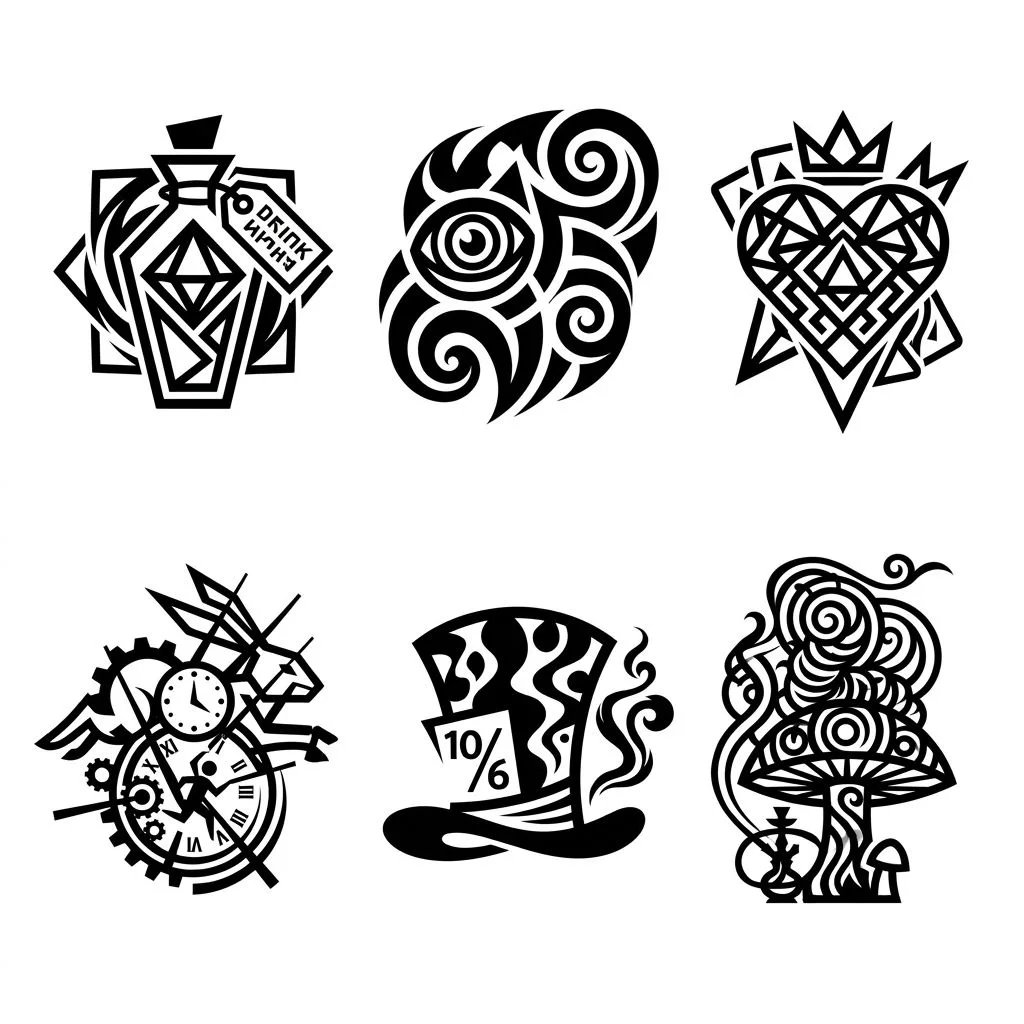
Alice in Wonderland symbols are some of the most memorable parts of Lewis Carroll’s Alice’s Adventures in Wonderland. The White Rabbit, rabbit hole, golden key, Cheshire Cat, mushroom, Caterpillar, Mad Hatter, Queen of Hearts, playing cards, tea party, and Alice’s changing size all add meaning to her strange journey.
At first, Wonderland seems like a world of random nonsense. Animals talk, objects behave strangely, people argue about impossible questions, and ordinary rules stop making sense. Yet many of these scenes can be connected to larger ideas such as identity, curiosity, transformation, time, authority, language, childhood, and growing up.
It is important to remember that not every symbol has one official meaning. Some interpretations come directly from what happens in the story, while others come from literary criticism, later readers, adaptations, and popular culture.
This guide explores the major Alice in Wonderland symbols and their meanings, explains how they work in the original story, and separates textual evidence from interpretations that developed later.
Alice in Wonderland Symbols and Meanings (Quick Answer)
Here is a quick overview of the major symbols found in Alice’s Adventures in Wonderland.
| Symbol | Common Interpretation |
| White Rabbit | Curiosity, urgency, time, and pursuit |
| Rabbit Hole | Entering the unknown and leaving the familiar world |
| Golden Key | Access, discovery, opportunity, and solutions |
| Locked Door | Barriers, inaccessible goals, and frustration |
| Garden | Desire, beauty, and an ideal destination |
| “Eat Me” and “Drink Me” | Transformation, experimentation, and consequences |
| Changing Size | Identity, growth, insecurity, and adaptation |
| Mushroom | Transformation, choice, and control |
| Caterpillar | Identity, questioning, and transformation |
| Cheshire Cat | Mystery, ambiguity, uncertainty, and independent thinking |
| Hatter | Disrupted time, absurdity, and unconventional behavior |
| Tea Party | Social conventions, confusion, and broken rules |
| Pocket Watch | Time, urgency, deadlines, and routine |
| Queen of Hearts | Authority, hierarchy, punishment, and arbitrary power |
| Playing Cards | Games, hierarchy, rules, chance, and social order |
| Croquet | Unstable rules and unfair competition |
| Trial | Authority, justice, procedure, and absurdity |
| Pack of Cards | The fragile nature of Wonderland’s authority |
| Pool of Tears | Frustration, emotion, confusion, and vulnerability |
| Dodo | Absurd competition and meaningless procedure |
| Caucus Race | Systems without clear rules or useful goals |
| Language and Riddles | Unstable meaning, logic, communication, and wordplay |
| Wonderland | The unknown, imagination, confusion, and freedom from ordinary rules |
These meanings are interpretations based on the story and its recurring ideas. They should not automatically be treated as proof of what Lewis Carroll personally intended.
What Is Symbolism in Alice in Wonderland?
Symbolism occurs when a character, object, setting, action, or recurring image carries meaning beyond its literal role in a story.
In Alice’s Adventures in Wonderland, symbolism is complicated because Carroll also uses nonsense, parody, wordplay, contradictions, and playful logic.
That means readers should not assume that every strange object hides a secret message.
For example, the White Rabbit is literally a rabbit who leads Alice into Wonderland. At the same time, his behavior can support interpretations involving curiosity, urgency, and time.
Both levels can exist together.
Symbol vs. Motif vs. Theme
These three literary terms are related but different.
A symbol is something that can carry an additional meaning.
A motif is an image, idea, pattern, or element that appears repeatedly.
A theme is a larger idea explored throughout the story.
For example:
Alice’s changing size → symbol and recurring motif → identity and growth → larger theme
Another example is:
White Rabbit’s watch → symbol → time and urgency → theme involving time and routine
Understanding this difference makes literary analysis more precise.
White Rabbit Symbolism
The White Rabbit is one of the most important symbols in Alice in Wonderland because his appearance begins Alice’s adventure.
Alice sees him behaving like a hurried human being. He is concerned about being late and carries a watch. Instead of ignoring this unusual sight, Alice follows him.
That decision takes her away from the familiar world.
What Does the White Rabbit Represent?
The White Rabbit can be interpreted as a symbol of:
- Curiosity
- Urgency
- Time
- Pursuit
- Distraction
- The attraction of the unknown
- A transition into a new experience
The important point is that Alice does not enter Wonderland because someone forces her to go there.
She follows the Rabbit because she wants to understand what is happening.
This makes him closely connected to curiosity.
Why Is the White Rabbit Always Late?
The Rabbit’s concern about being late introduces the theme of time very early in the story.
His watch and repeated anxiety about schedules contrast with Wonderland’s later treatment of time.
At the Hatter’s tea party, time no longer behaves like a simple clock that moves predictably from one moment to the next.
The White Rabbit therefore helps establish an important contrast:
Ordinary world: time is measured and scheduled.
Wonderland: time and logic can become unpredictable.
Rabbit Hole Symbolism
The rabbit hole is one of the most recognizable images associated with Alice.
Alice follows the White Rabbit into the hole and begins a long fall before reaching Wonderland.
The rabbit hole can represent the movement from a familiar world into an unfamiliar one.
What Does the Rabbit Hole Represent?
Common interpretations include:
- Entering the unknown
- Curiosity
- Discovery
- Adventure
- Change
- Leaving childhood familiarity
- Crossing a boundary
The hole functions as a doorway between two types of experience.
Before Alice enters it, she is in an ordinary environment.
Afterward, she is surrounded by talking animals, strange rules, changing dimensions, and impossible situations.
This makes the rabbit hole an effective symbol for transition.
The Modern Meaning of “Going Down the Rabbit Hole”
The phrase “going down the rabbit hole” has become part of modern language.
People often use it to describe becoming deeply involved in a subject, investigation, hobby, story, or complicated question.
That modern expression grew from the cultural impact of Carroll’s imagery.
The phrase does not mean exactly the same thing as the literal event in the book, but it retains the basic idea of moving from something familiar into something increasingly strange or complicated.
Door and Golden Key Symbolism
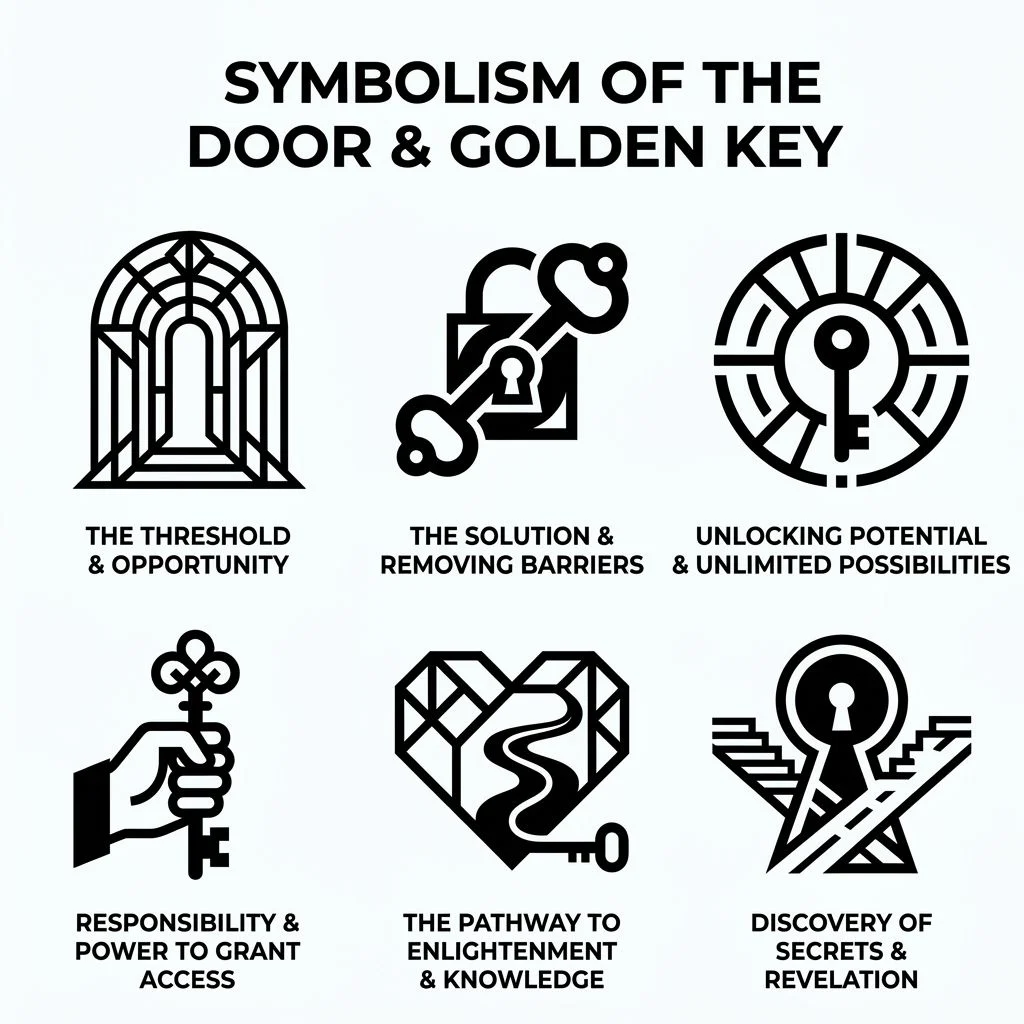
After entering Wonderland, Alice discovers a beautiful garden that she wants to reach.
The problem is that she cannot simply walk into it.
She finds a small door and a golden key, but the key does not solve every problem immediately.
What Does the Golden Key Symbolize?
The golden key can be interpreted as representing:
- Access
- Discovery
- Opportunity
- Knowledge
- A solution
- The possibility of reaching a goal
The key gives Alice access to a door, but she is initially unable to use the doorway because of her size.
That detail matters.
Having a solution available does not necessarily mean a person is ready to use it.
What Does the Locked Door Symbolize?
The locked door can represent:
- Barriers
- Frustration
- Unreachable goals
- Desire
- Limited access
- A challenge that requires adaptation
Alice can see the beautiful garden but cannot immediately reach it.
This establishes one of the story’s recurring patterns: what Alice wants and what Alice can currently achieve are not always the same thing.
“Eat Me” and “Drink Me” Symbolism
The labels “Eat Me” and “Drink Me” are among the most recognizable details from Alice’s early experiences in Wonderland.
They are connected directly to her changing size.
Alice encounters mysterious food and drink without knowing exactly what will happen when she consumes them.
What Do “Eat Me” and “Drink Me” Represent?
They can be interpreted as symbols of:
- Transformation
- Experimentation
- Curiosity
- Choice
- Risk
- Consequences
- Loss of control
Alice has to make decisions without having complete information.
That is important because Wonderland repeatedly places her in situations where there is no reliable instruction manual.
She experiments, experiences consequences, and adjusts her behavior.
Transformation Through Food and Drink
The food and drink also introduce a recurring question:
How much can Alice change while remaining Alice?
Her body changes dramatically, but her sense of identity does not disappear completely.
This connects the physical transformations to the larger theme of identity.
Alice’s Changing Size and Identity
Alice’s changing size is one of the most important recurring motifs in the book.
She becomes larger and smaller repeatedly, often at inconvenient moments.
Her physical changes affect how she moves through Wonderland and how she interacts with other characters.
What Does Alice’s Changing Size Symbolize?
It can be interpreted through ideas such as:
- Growing up
- Identity
- Insecurity
- Vulnerability
- Confidence
- Power
- Adaptation
- Physical and emotional change
When Alice becomes small, she can feel vulnerable and powerless.
When she becomes large, she may feel uncomfortable or struggle to fit into the environment.
Neither condition is permanently comfortable.
Size and the Experience of Childhood
Children experience the world partly through their changing relationship with adults, objects, spaces, and physical size.
Alice’s unusual transformations exaggerate this experience.
Doors become too small.
Rooms become difficult to navigate.
Other characters treat her differently.
Her body seems unstable.
This makes changing size a useful literary device for exploring identity and growth.
Is Changing Size a Symbol of Growing Up?
It can reasonably be interpreted that way.
However, it should not be presented as the only meaning.
The changing size also creates humor, drives the plot, creates physical obstacles, and allows Carroll to play with perspective and scale.
A good interpretation therefore considers both the story’s literal function and its possible symbolic meaning.
Mushroom Symbolism
The mushroom becomes important when Alice encounters the Caterpillar.
Different parts of it affect her size.
Because of this, the mushroom is closely connected with transformation.
What Does the Mushroom Represent?
The mushroom can symbolize:
- Change
- Transformation
- Choice
- Experimentation
- Control
- Uncertainty
- Adaptation
The interesting part is that Alice eventually learns to use the mushroom deliberately.
Instead of simply reacting to Wonderland, she gains more control over her physical situation.
Is the Mushroom a Drug Symbol?
Modern readers sometimes interpret the mushroom and Alice’s altered size as imagery connected with psychedelic experiences.
This interpretation is popular in modern culture, but it should not be presented as an established fact about Carroll’s intention.
The original story does not simply announce that the mushroom represents drugs.
A careful literary analysis should distinguish:
Textual evidence: the mushroom changes Alice’s size.
Modern interpretation: some readers associate the imagery with altered perception or psychedelic experiences.
Those are not the same claim.
Caterpillar Symbolism
The Caterpillar is another character strongly connected with identity and transformation.
His questioning of Alice makes her think about who she is.
What Does the Caterpillar Represent?
The Caterpillar can be interpreted as representing:
- Transformation
- Identity
- Self-questioning
- Growth
- Transition
- Uncertainty
His own form also creates an obvious association with transformation because a caterpillar’s natural life cycle involves significant physical change.
More importantly, his conversation with Alice brings the question of identity directly into the story.
“Who Are You?” and Alice’s Identity
Alice’s identity becomes increasingly uncertain as her body changes.
The Caterpillar’s questioning therefore fits one of the central concerns of the story:
If everything about you seems to change, what makes you the same person?
The story does not provide a simple philosophical answer.
Instead, Alice continues moving through Wonderland and gradually becomes more confident in dealing with its strange situations.
Cheshire Cat Symbolism
The Cheshire Cat is one of the most recognizable figures in the story.
He appears and disappears, gives Alice confusing information, and seems unusually comfortable with Wonderland’s strange logic.
What Does the Cheshire Cat Represent?
The Cheshire Cat can symbolize:
- Mystery
- Ambiguity
- Uncertainty
- Independent thinking
- Unstable reality
- Multiple possible paths
He rarely behaves like a straightforward guide.
Instead, he gives Alice information that often creates more questions.
The Cheshire Cat’s Disappearing Body
The Cat’s ability to disappear is particularly significant as an image.
His smile can remain visible after the rest of him has vanished.
This creates a visual contradiction: an expression appears without the person normally associated with it.
The scene fits Wonderland’s larger tendency to separate things that normally belong together.
It also reinforces the idea that appearance and reality do not always match.
Mad Hatter and Tea Party Symbolism
The character commonly called the Mad Hatter is referred to as the Hatter in Carroll’s original story.
His tea party is one of the most famous scenes in Alice in Wonderland.
What Does the Hatter Represent?
The Hatter can be interpreted through themes of:
- Absurdity
- Disrupted time
- Social conventions
- Unconventional behavior
- Confusing communication
- Circular reasoning
His behavior challenges Alice’s expectations about how a polite social gathering should work.
What Does the Tea Party Symbolize?
The tea party can represent a familiar social ritual that has been turned upside down.
A normal tea gathering might involve:
- Conversation
- Courtesy
- Taking turns
- Food and drink
- Social expectations
The Wonderland tea party includes these familiar ingredients but rearranges their normal meaning.
Characters move around the table, argue about time, ask confusing questions, and participate in conversations that don’t follow ordinary logic.
The result is a parody of social order.
Time and the Pocket Watch
Time is an important recurring idea in Alice in Wonderland.
The White Rabbit has a watch.
The Hatter has an unusual relationship with Time.
The tea party becomes trapped in a repetitive cycle.
What Does the Pocket Watch Symbolize?
The pocket watch can suggest:
- Deadlines
- Urgency
- Routine
- Responsibility
- Human attempts to control time
- Anxiety about being late
The White Rabbit’s obsession with punctuality contrasts with the Hatter’s disrupted experience of time.
This contrast helps make time itself feel unstable in Wonderland.
Why Is Time So Strange in Wonderland?
The story does not treat time simply as a measurement.
During the tea party, the characters’ relationship with time becomes personal and absurd.
This helps Carroll turn an ordinary concept into something that behaves according to Wonderland’s unusual logic.
The result can be interpreted as a challenge to the assumption that familiar systems always behave rationally.
Queen of Hearts Symbolism
The Queen of Hearts represents one of the strongest examples of authority in Wonderland.
She commands others, expects obedience, and frequently threatens punishment.
What Does the Queen of Hearts Represent?
She can be interpreted as a symbol of:
- Authority
- Hierarchy
- Punishment
- Fear
- Arbitrary power
- Rules without proportional justice
Her behavior often makes Wonderland’s court feel unstable.
A minor disagreement can become a serious threat.
The Queen and Authority
Alice gradually becomes less willing to accept the Queen’s authority simply because the Queen holds a royal position.
This becomes especially important near the end of the story.
Alice’s changing attitude toward Wonderland’s rulers can be read as part of her movement toward independence and confidence.
Playing Card Symbolism
Playing cards dominate the Queen’s court.
They are soldiers, servants, gardeners, and other figures in the royal hierarchy.
What Do the Playing Cards Represent?
The cards can symbolize:
- Hierarchy
- Social rank
- Rules
- Games
- Chance
- Competition
- Artificial authority
A deck of cards naturally contains different ranks and suits.
Carroll uses this familiar system to create a strange society.
Cards as a Social Hierarchy
The Queen and King occupy the highest positions.
Other cards perform lower-status roles.
This makes the court resemble a miniature social hierarchy.
Yet the ending undermines this structure.
When Wonderland’s cards collapse into a literal pack of cards, the authority that seemed real becomes something much less stable.
Croquet Game Symbolism
The Queen’s croquet game is one of the clearest examples of Wonderland’s broken rules.
Instead of ordinary sports equipment, the players use flamingos as mallets and hedgehogs as balls.
The objects do not behave predictably.
What Does the Croquet Game Represent?
The game can symbolize:
- Unstable rules
- Unfair competition
- Arbitrary authority
- Confusion
- Social absurdity
- Systems that appear organized but are not
A game normally depends on agreed rules.
Wonderland’s croquet game makes those rules almost impossible to follow.
The Queen still expects everyone to obey her.
This creates an important contrast between having authority and having a rational system.
Trial and Pack of Cards Symbolism
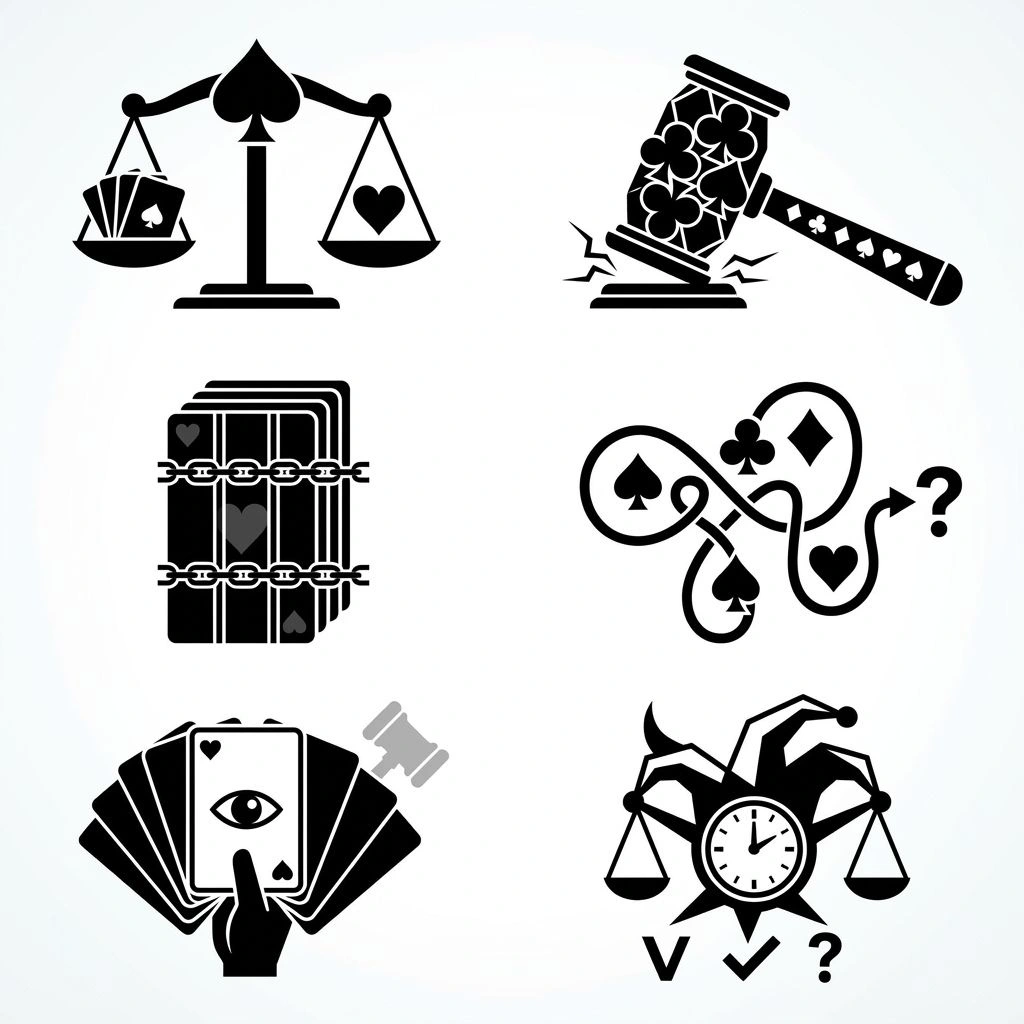
The trial near the end of the story brings together many of Wonderland’s major ideas.
There is a court.
There are officials.
There are witnesses.
There are rules.
There is a Queen demanding punishment.
Yet the process becomes increasingly absurd.
What Does the Trial Symbolize?
The trial can be interpreted as representing:
- Authority
- Justice
- Legal procedure
- Bureaucracy
- Arbitrary rules
- The difference between appearance and fairness
The existence of a formal court does not automatically make the process reasonable.
The trial exaggerates this idea until the legal system becomes almost completely disconnected from ordinary logic.
What Does the Pack of Cards Represent?
The final transformation of the court into a pack of cards can be read as a collapse of Wonderland’s artificial authority.
The characters who seemed powerful are revealed as part of the same strange card-based world Alice has been navigating all along.
This makes the ending especially important for interpretations involving authority, hierarchy, and Alice’s growing independence.
Dodo and Caucus Race Symbolism
The Dodo is connected with the famous Caucus Race, in which the participants run around without the normal structure of a race.
What Does the Caucus Race Symbolize?
The race can be interpreted as a parody of:
- Competition
- Bureaucracy
- Meaningless procedures
- Social systems
- Rules created without purpose
Everyone runs, but there is no ordinary winner.
Eventually, everyone is declared a winner.
This is funny because it imitates the appearance of a competition while removing the features that normally make competition meaningful.
Why Is the Dodo Important?
The Dodo helps lead the strange activity.
His role can therefore be associated with absurd leadership and pointless organization.
The scene is less about the Dodo alone and more about the larger pattern of systems that look organized but make little practical sense.
Pool of Tears Symbolism
Alice’s tears eventually create a pool large enough to become part of the physical world around her.
What Does the Pool of Tears Represent?
The pool can symbolize:
- Frustration
- Emotional overwhelm
- Vulnerability
- Confusion
- Loneliness
- The physical consequences of strong emotions
Instead of simply describing Alice as upset, Carroll turns her emotion into a literal environment.
This is one of the story’s recurring techniques.
An internal experience becomes an external, impossible event.
Garden Symbolism
The beautiful garden is one of Alice’s earliest goals.
She sees it before she can reach it.
What Does the Garden Represent?
The garden can be interpreted as:
- Desire
- Beauty
- An ideal destination
- Curiosity
- A goal
- Something that appears easier from a distance
Alice wants to enter the garden, but her physical circumstances repeatedly prevent her from doing so.
The garden therefore becomes an early example of Wonderland’s larger pattern:
Seeing what you want is not the same as being able to reach it.
Language, Riddles, and Nonsense
One of the biggest mistakes in discussing Alice in Wonderland is focusing only on visual symbols.
Language itself is central to the book.
Carroll constantly plays with words, meanings, questions, definitions, grammar, and logic.
Why Is Language Important in Wonderland?
In ordinary conversation, people generally expect words to communicate shared meanings.
Wonderland repeatedly disrupts that expectation.
A character may interpret a statement literally.
A question may be answered in a way that changes its assumptions.
A riddle may have no clear answer.
A familiar expression may be treated as if it were physically true.
What Does Wordplay Symbolize?
Language and wordplay can be connected with:
- Communication
- Misunderstanding
- Unstable meaning
- Logic
- Power
- Interpretation
- The limits of ordinary reasoning
This is why Wonderland should not be reduced to a collection of “secret symbols.”
Sometimes the strange meaning comes from the way language itself is being used.
Riddles and the Limits of Logic
The Hatter’s famous riddle about the raven and writing desk is a good example of Wonderland’s unusual approach to questions.
The question looks as though it should have a logical answer.
Instead, its structure itself becomes part of the joke.
This challenges the assumption that every question has a rational solution.
Wonderland as a Symbol
The entire setting of Wonderland can be treated as a symbolic environment.
Alice enters a place where the assumptions she brought from home frequently fail.
What Does Wonderland Represent?
Wonderland can suggest:
- The unknown
- Imagination
- Curiosity
- Confusion
- Freedom from ordinary rules
- A challenge to conventional thinking
- A world of unstable logic
But Wonderland is not simply a world without rules.
It has rules.
The problem is that Alice often cannot understand them.
This distinction is important.
The story creates much of its humor by placing Alice in situations where the existence of rules does not guarantee that those rules will make sense.
Major Themes Behind Alice in Wonderland Symbols
The symbols become more meaningful when they are connected to the story’s larger themes.
Identity and Growing Up
Alice repeatedly questions who she is.
Her body changes.
Her surroundings change.
Other characters challenge her assumptions.
This makes identity one of the most natural themes associated with the story.
The changing-size episodes provide a visual way to explore uncertainty about personal identity and growth.
Curiosity and the Unknown
Alice’s curiosity is what starts the adventure.
She follows the Rabbit even though she doesn’t understand where he is going.
The rabbit hole then carries her into a world where almost everything is unfamiliar.
This creates a recurring tension between curiosity and uncertainty.
Authority and Rules
The Queen’s court, croquet game, trial, and playing cards all contribute to the story’s interest in authority.
Wonderland repeatedly presents rules that Alice is expected to follow without necessarily explaining why those rules are reasonable.
As Alice becomes more confident, she increasingly questions the authority of the people around her.
Time
Time appears through:
- The White Rabbit’s watch
- The Hatter’s tea party
- The strange relationship between the Hatter and Time
- Repetition
- Schedules and lateness
The story turns time from an ordinary measurement into a source of confusion and comedy.
Logic and Language
Wonderland constantly tests Alice’s expectations about how communication should work.
Questions may have strange answers.
Words may be interpreted literally.
Arguments may follow technically correct but absurd reasoning.
This makes language and logic major parts of the book’s literary identity.
Appearance and Reality
Alice frequently discovers that things are not what they initially appear to be.
A small door leads to a huge adventure.
A mushroom changes her body.
A smiling cat can disappear.
A royal court can collapse into cards.
These events repeatedly challenge the assumption that appearances tell us everything we need to know.
Alice in Wonderland Symbols by Category
Organizing the symbols into categories makes them easier to study.
Character Symbols
Important characters include:
- Alice
- White Rabbit
- Cheshire Cat
- Caterpillar
- Hatter
- Queen of Hearts
- King of Hearts
- Dodo
- Mock Turtle
Object Symbols
Important objects include:
- Golden key
- Locked door
- Mushroom
- “Eat Me” cake
- “Drink Me” bottle
- Pocket watch
- Playing cards
- Teacups
Setting Symbols
Important settings include:
- Rabbit hole
- Garden
- Pool of tears
- Queen’s court
- Tea party setting
Event Symbols
Important events include:
- Falling down the rabbit hole
- Caucus Race
- Mad Tea Party
- Queen’s croquet game
- Trial
Conceptual Symbols and Motifs
The story also repeatedly returns to:
- Time
- Identity
- Size
- Language
- Logic
- Authority
- Curiosity
- Transformation
- Rules
Alice in Wonderland Symbols for Tattoos
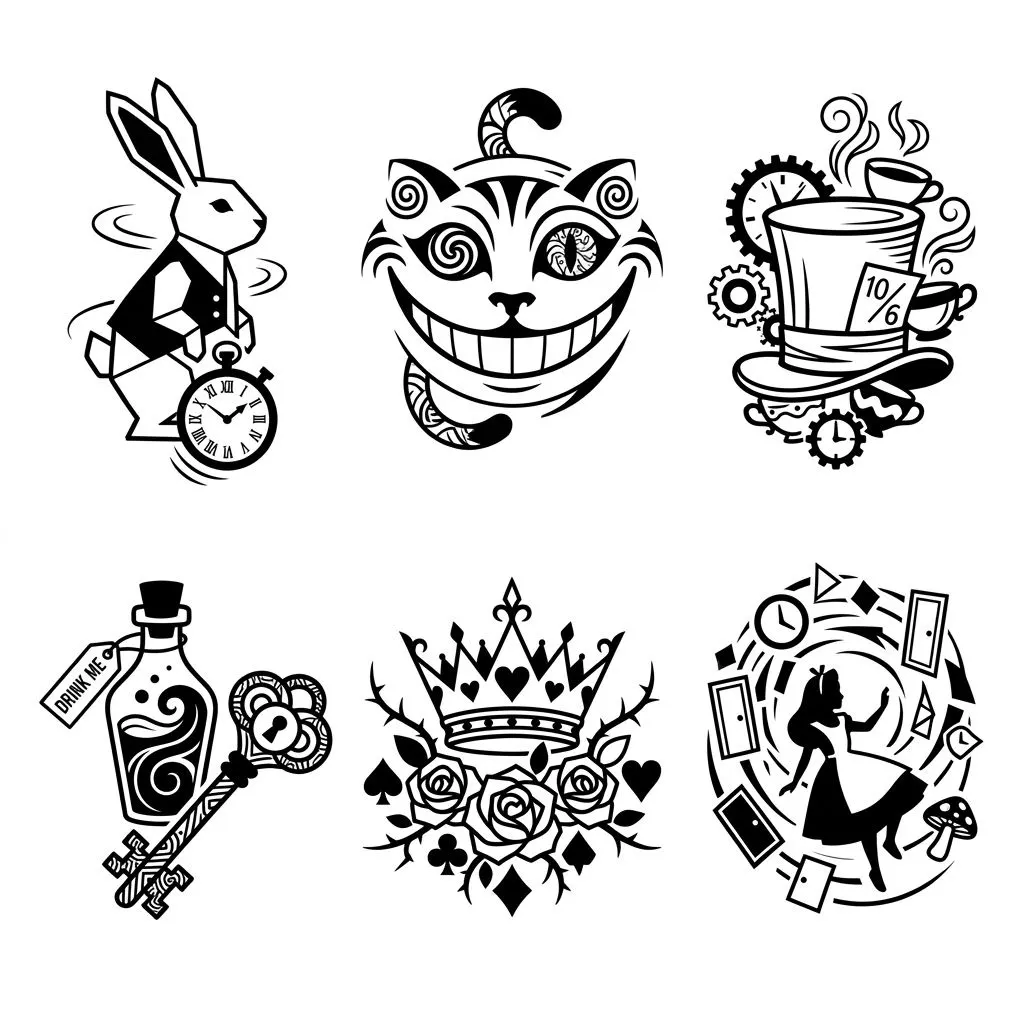
Alice in Wonderland imagery is popular in tattoos because many objects have recognizable shapes and can be given personal meanings.
Rabbit Hole Tattoo
A rabbit hole can represent:
- Entering a new chapter
- Curiosity
- Discovery
- Taking an unexpected path
- Exploring the unknown
Key and Keyhole Tattoo
A key can represent:
- Opportunity
- Access
- Discovery
- A solution
- Opening a new part of life
Cheshire Cat Tattoo
The Cheshire Cat can represent:
- Mystery
- Individuality
- Uncertainty
- Playfulness
- Seeing beyond appearances
Pocket Watch Tattoo
The watch can represent:
- Time
- Change
- Important moments
- Deadlines
- The passing of life
Mushroom Tattoo
A mushroom can represent:
- Transformation
- Personal change
- Experimentation
- Growth
These tattoo meanings are personal interpretations, not fixed definitions. A person can choose a symbol because of its connection to the book, a personal experience, an artistic style, or an entirely different meaning.
Alice in Wonderland Book vs. Movie Symbolism
It is important to separate Lewis Carroll’s original book from later adaptations.
The original Alice’s Adventures in Wonderland was published in 1865 and illustrated by John Tenniel. Later films, television productions, artwork, and other adaptations have introduced their own visual styles and interpretations.
Why Adaptations Matter
A film can emphasize:
- Colors
- Costumes
- Facial expressions
- Lighting
- Music
- Character relationships
- Visual imagery
These choices can create symbolic meanings that are not necessarily present in the original book.
For example, a movie may give a particular color greater importance than the text does.
Therefore, when analyzing an Alice in Wonderland symbol, always ask:
Am I discussing Carroll’s original text or a particular adaptation?
Original Text vs. Modern Interpretations
The original story provides the foundation.
Later versions may add:
- New character histories
- Different visual symbolism
- Expanded relationships
- New settings
- Different emotional interpretations
- Additional mythology
A strong article should not automatically treat all versions as if they were one story.
Is Alice in Wonderland an Allegory?
Whether Alice’s Adventures in Wonderland should be treated as a straightforward allegory is a complicated question.
An allegory usually involves a sustained system in which characters, events, and objects consistently stand for another set of ideas.
Alice in Wonderland does contain symbolism and can support many interpretations, but that does not mean every character has one fixed symbolic equivalent.
Why Readers Interpret the Book in Different Ways
Different readers focus on different elements:
- Childhood
- Growing up
- Identity
- Language
- Logic
- Authority
- Social conventions
- Education
- Time
- Imagination
- Nonsense
One reader may emphasize Alice’s identity.
Another may focus on the book’s treatment of language.
Another may examine its portrayal of authority and rules.
These interpretations can coexist.
Symbolism Is Not the Same as a Hidden Code
The strongest literary analysis does not try to decode every object into one secret answer.
Instead, it asks:
What does this object do in the story, and what ideas does its role make possible?
That approach gives readers more room to understand the book as literature rather than as a puzzle with one official solution.
Is Alice in Wonderland About Drugs?
This question appears frequently in modern discussions because of the story’s mushrooms, changing size, strange environments, unusual creatures, and altered perceptions.
However, it is important to distinguish modern cultural interpretation from documented authorial intent.
Why People Make the Connection
Readers may associate Wonderland with psychedelic experiences because:
- Alice’s perception changes
- Her physical size changes
- Mushrooms play a role
- The environment becomes surreal
- Ordinary logic breaks down
- Characters behave strangely
These similarities can inspire a modern interpretation.
What Does the Original Story Actually Establish?
The original text establishes that Alice consumes strange food and drink that change her size.
It does not simply establish a universal drug metaphor for the entire story.
Therefore, the careful answer is:
Alice in Wonderland can be interpreted through modern psychedelic imagery, but it is not accurate to present the drug interpretation as the single proven meaning of the original book.
How to Analyze Alice in Wonderland Symbols for an Essay
Students can use a simple five-step method when analyzing symbolism.
Step 1: Identify the Symbol
Choose the object, character, setting, or event.
For example:
The White Rabbit
Step 2: Describe What Happens
Explain the symbol’s literal role.
The White Rabbit appears early and leads Alice toward Wonderland.
Step 3: Identify a Possible Meaning
Connect it to an idea.
For example:
Curiosity and urgency
Step 4: Use Story Evidence
Explain how the character’s actions support your interpretation.
The Rabbit’s hurried behavior and Alice’s decision to follow him support the connection with curiosity and time.
Step 5: Connect It to a Theme
Move from the individual symbol to the larger story.
The White Rabbit can connect to the theme of entering the unknown through curiosity.
This method is much stronger than simply writing:
“The White Rabbit symbolizes curiosity.”
A good literary analysis explains why.
Alice in Wonderland Symbols Cheat Sheet
For a quick study guide, remember these connections:
- White Rabbit → curiosity, urgency, time
- Rabbit hole → entering the unknown
- Golden key → access and discovery
- Locked door → barriers and unreachable goals
- Garden → desire and an ideal destination
- Eat Me → transformation and consequences
- Drink Me → transformation and experimentation
- Changing size → identity and growth
- Mushroom → transformation and choice
- Caterpillar → identity and questioning
- Cheshire Cat → mystery and ambiguity
- Hatter → disrupted time and absurdity
- Tea party → social conventions turned upside down
- Pocket watch → time and urgency
- Queen of Hearts → authority and arbitrary punishment
- Playing cards → hierarchy and rules
- Croquet → unstable rules
- Trial → authority and justice
- Pack of cards → fragile authority
- Pool of tears → frustration and emotional overwhelm
- Caucus Race → meaningless procedure
- Language and riddles → unstable meaning and logic
- Wonderland → the unknown and imaginative freedom
Common Misconceptions About Alice in Wonderland Symbolism
Every Symbol Has One Official Meaning
It does not.
A literary symbol can support multiple interpretations depending on context.
Alice in Wonderland Is Only About Growing Up
Growing up and identity are important interpretations, but the book also explores language, logic, authority, time, social conventions, curiosity, and nonsense.
Every Strange Detail Has a Secret Meaning
Not necessarily.
Some details exist because Carroll is playing with language, humor, parody, narrative structure, or absurdity.
The Mad Hatter Represents Only Madness
That interpretation is too narrow.
His scenes also involve time, social behavior, riddles, repetition, communication, and disrupted expectations.
The Mushroom Proves the Story Is About Drugs
The mushroom is certainly connected with Alice’s changing size.
A psychedelic interpretation is a later reading and should not automatically be treated as established authorial intent.
Movie Symbolism Is Automatically Book Symbolism
It isn’t.
Adaptations can introduce new visual meanings, character details, colors, and relationships.
The Queen of Hearts Definitely Represents One Historical Person
Claims connecting the Queen directly to a particular historical figure should be treated as interpretations unless supported by reliable evidence of Carroll’s intention.
Frequently Asked Questions
What are the main symbols in Alice in Wonderland?
The main symbols include the White Rabbit, rabbit hole, golden key, locked door, “Eat Me” and “Drink Me” items, changing size, mushroom, Caterpillar, Cheshire Cat, Hatter, tea party, pocket watch, Queen of Hearts, playing cards, croquet game, trial, and pack of cards.
What does the White Rabbit symbolize in Alice in Wonderland?
The White Rabbit can symbolize curiosity, urgency, time, and the attraction of the unknown. Alice follows him, and that decision begins her journey into Wonderland.
What does the rabbit hole symbolize?
The rabbit hole commonly represents entering an unfamiliar world or moving from ordinary experience into the unknown. It can also be interpreted as a symbol of curiosity, transition, and discovery.
What does Alice’s changing size symbolize?
Alice’s changing size can be interpreted as a representation of identity, growth, vulnerability, confidence, and the uncertainty of changing circumstances. It is also an important device for humor and physical storytelling.
What does the Cheshire Cat symbolize?
The Cheshire Cat can symbolize mystery, ambiguity, uncertainty, and the instability of appearances. His ability to disappear reinforces Wonderland’s unusual relationship with reality and logic.
What does the Mad Hatter symbolize?
The Hatter can be connected with disrupted time, absurdity, unconventional behavior, confusing communication, and social conventions turned upside down.
What does the Queen of Hearts symbolize?
The Queen of Hearts can represent authority, hierarchy, punishment, and arbitrary power. Her court repeatedly demonstrates the difference between having authority and exercising it fairly.
What does the mushroom symbolize in Alice in Wonderland?
The mushroom is associated with transformation because it changes Alice’s size. It can also be interpreted as a symbol of choice, experimentation, and adaptation.
What do the playing cards symbolize?
The playing cards can symbolize hierarchy, rules, games, chance, and artificial social structures. Their transformation into a pack of cards at the end also undermines the apparent stability of Wonderland’s court.
What do “Eat Me” and “Drink Me” symbolize?
They can represent experimentation, transformation, choice, risk, and consequences. Alice consumes them without fully understanding what will happen, causing dramatic changes in her size.
What does the Queen’s croquet game symbolize?
The croquet game can symbolize unstable rules and arbitrary authority. The equipment behaves unpredictably, making the game difficult to understand or control.
What does the trial symbolize?
The trial can be interpreted as a parody of authority and legal procedure. It creates the appearance of a formal justice system while repeatedly behaving in irrational and unfair ways.
Is Alice in Wonderland an allegory?
It can support allegorical and symbolic interpretations, but it is better not to reduce the entire book to one fixed allegory. Its symbolism is intertwined with nonsense, wordplay, parody, logic, identity, and imaginative storytelling.
Is Alice in Wonderland really about drugs?
The story’s mushrooms and changing perceptions have inspired modern psychedelic interpretations. However, the original text does not establish a simple, universally accepted drug metaphor, so this interpretation should be distinguished from documented textual evidence.
What is the most important symbol in Alice in Wonderland?
There is no single officially designated “most important” symbol. The White Rabbit, rabbit hole, changing size, Cheshire Cat, Queen of Hearts, and other recurring elements all contribute to the story’s major ideas.
Conclusion
The Alice in Wonderland symbols are much more than a collection of strange characters and objects. The White Rabbit introduces curiosity and urgency, while the rabbit hole takes Alice from the familiar world into the unknown. The golden key and locked door create a pattern of access and obstacles, while “Eat Me” and “Drink Me” introduce transformation and consequences.
Alice’s changing size connects the physical world of Wonderland with questions about identity, growth, vulnerability, and adaptation. The Caterpillar reinforces the question of identity, while the Cheshire Cat represents ambiguity and uncertainty. The Hatter and tea party challenge ordinary ideas about time and social behavior.
The Queen of Hearts, playing cards, croquet game, and trial create a world where authority and rules often appear arbitrary. Meanwhile, riddles, wordplay, and nonsense show that even language and logic can become unstable.
The most useful way to understand these symbols is not to search for one secret meaning behind every detail. Instead, examine what each symbol does in the story, how it connects with recurring ideas, and whether an interpretation comes from the original text or from later readers and adaptations.

Dylan Anderson is a writer who enjoys turning complex topics into simple, engaging content that readers can actually use. His work focuses on clear explanations, practical insights and storytelling that feels natural and relatable. He is also the fictional author of The Quiet Compass of Ashford and Where the Cedar Lantern Glows. When he’s away from his keyboard, Dylan enjoys hiking, reading, and discovering inspiration in everyday life. He believes great writing should be informative, easy to understand and enjoyable from beginning to end.
 Adam Sullivan