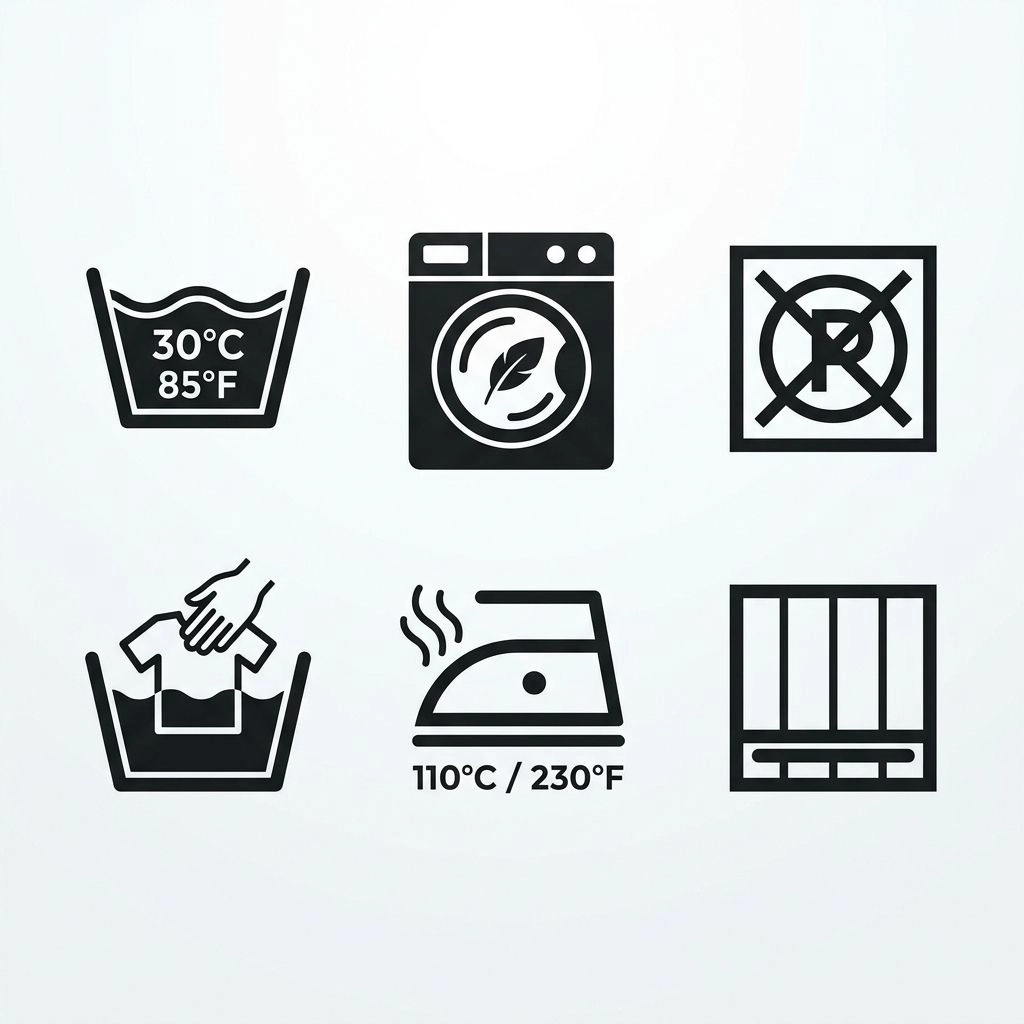
Have you ever looked at the tiny symbols on a clothing label and wondered, “What do the washing symbols mean?” Those small shapes are a simple care language that tells you how to wash, bleach, dry, iron, and professionally clean a garment.
The easiest way to understand them is to learn the five basic symbol families. A tub means washing, a triangle means bleaching, a square means drying, an iron means ironing, and a circle means professional textile care. Numbers, dots, lines, and crosses then add important details to each symbol.
For example, a number inside a washing tub gives the maximum washing temperature. A line underneath the tub means a milder washing process, while two lines mean a very mild process. A cross over a symbol means the treatment should not be used.
Once you understand these basic rules, most clothing care labels become much easier to read.
What Do the Washing Symbols Mean? (Quick Answer)
Washing symbols tell you how a garment should be cared for without relying on long written instructions.
Here is the basic decoder:
| Symbol Family | What It Means | What You Should Check |
| Washing tub | Washing | Temperature, hand wash, or gentle cycle |
| Triangle | Bleaching | Whether bleach is allowed |
| Square | Drying | Tumble drying or natural drying |
| Iron | Ironing | Permitted heat level |
| Circle | Professional care | Dry-cleaning or professional wet cleaning |
| Crossed symbol | Treatment prohibited | Do not use that treatment |
The washing tub is the symbol you need when you specifically want to know whether and how an item can be washed. The complete care label, however, may contain several symbols that must be considered together.
The Five Basic Laundry Symbols You Need to Know
Learning the five basic shapes is the quickest way to understand laundry labels.
The Washing Tub Means Washing
A tub filled with water represents domestic washing. It applies to both machine and hand washing.
Numbers inside the tub indicate the maximum washing temperature in degrees Celsius. Lines underneath the tub indicate that a gentler washing process is required.
The Triangle Means Bleaching
A triangle represents bleaching instructions.
Depending on the markings inside it, the label may permit all bleaching agents, restrict bleaching to oxygen or non-chlorine bleach, or prohibit bleaching altogether.
The Square Means Drying
A square represents drying.
A circle inside the square indicates tumble drying. Other markings inside the square can describe natural drying methods such as line drying, drip drying, or flat drying.
The Iron Means Ironing
The iron symbol tells you whether ironing is permitted and, when dots are present, the permitted heat level.
More dots indicate a higher permitted ironing temperature within the applicable care-symbol system.
The Circle Means Professional Textile Care
A circle represents professional textile care. Letters or other markings inside the circle can tell a professional cleaner which process or solvent category is permitted.
Washing Symbols Explained
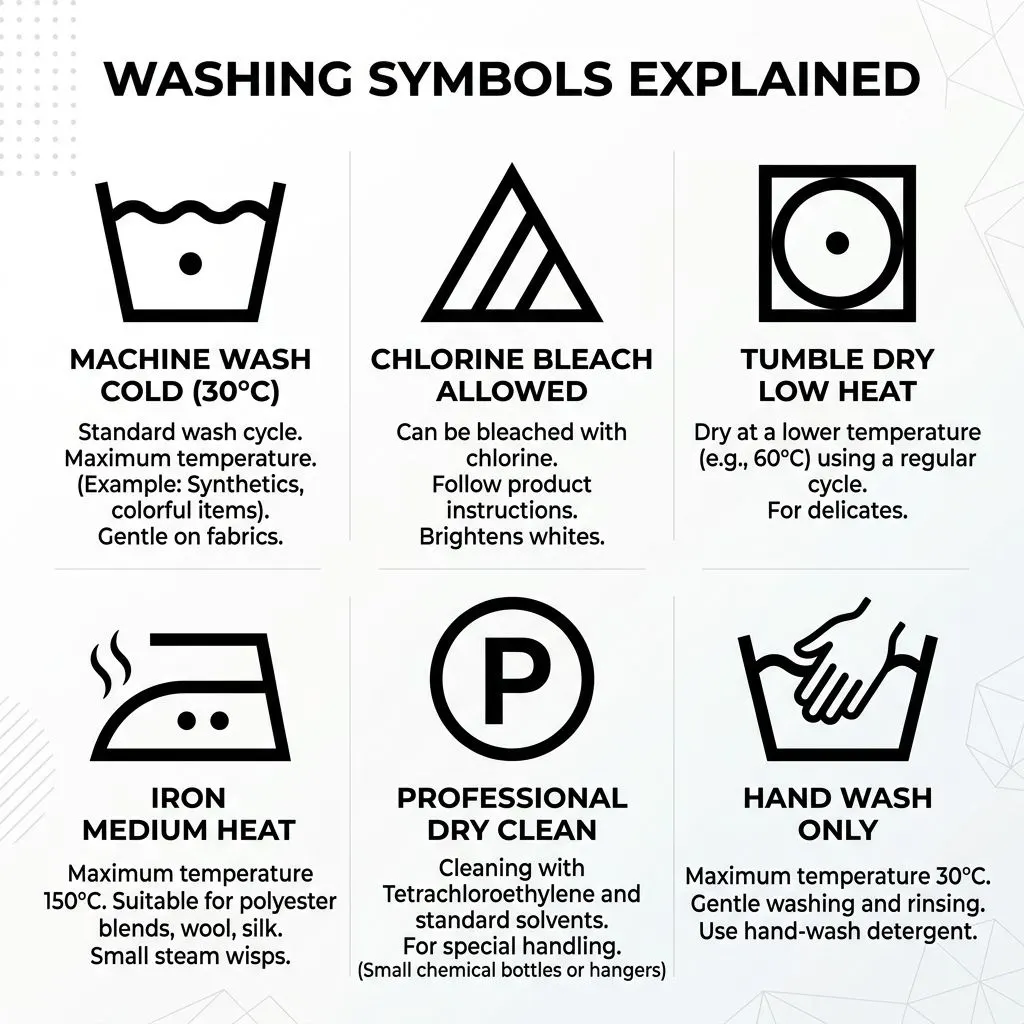
If your main question is “Can I put this clothing item in the washing machine?”, start with the washing tub.
The washing symbol can tell you:
- Whether domestic washing is permitted.
- The maximum washing temperature.
- Whether a mild process is needed.
- Whether a very mild process is required.
- Whether the item should be hand washed.
- Whether washing is prohibited.
GINETEX states that the washing symbol covers both hand and machine washing, while the number specifies the maximum temperature that should not be exceeded.
What Does a Number Inside the Washing Tub Mean?
A number inside the tub represents the maximum washing temperature in Celsius.
For example:
| Number | Meaning |
| 30 | Maximum wash temperature of 30°C |
| 40 | Maximum wash temperature of 40°C |
| 60 | Maximum wash temperature of 60°C |
| 95 | Maximum wash temperature of 95°C where this symbol is used |
The number is a maximum, not necessarily a command to use that exact temperature. GINETEX explains that lower temperatures and milder treatments than those shown on the label are permitted.
What Does 30°C Mean on a Washing Label?
A 30°C washing symbol means the garment should not be washed above 30°C under that care instruction.
It does not mean you must always use exactly 30°C. If a suitable lower-temperature cycle can clean the item effectively, a lower temperature may be used.
The rest of the label still matters. A 30°C item may also require a gentle or very gentle process if lines appear underneath the tub.
What Does 40°C Mean on a Washing Label?
A 40°C symbol means the maximum washing temperature is 40°C.
It is important to look for any lines underneath the tub because the washing action may need to be gentler than a normal cycle.
What Does 60°C Mean on a Washing Label?
A 60°C symbol means the washing temperature should not exceed 60°C.
Again, the number gives the maximum temperature. It does not mean every wash must be run at 60°C.
What Does the Hand-Wash Symbol Mean?
A hand inside the washing tub indicates hand washing.
This means the garment requires hand washing rather than treating it as a normal machine-wash item. Gentle handling is important, particularly because aggressive rubbing, twisting, or wringing can distort some textiles.
The precise temperature should still be taken from the label.
What Does One Line Under the Washing Symbol Mean?
One line underneath the washing tub indicates a milder washing process with reduced mechanical action.
The temperature and the washing action are separate pieces of information.
For example:
30°C + one line
means a maximum temperature of 30°C combined with a milder washing process.
GINETEX describes the single bar as a reduced-mechanical-action process suitable for easy-care and mechanically sensitive articles.
What Do Two Lines Under the Washing Symbol Mean?
Two lines under the washing tub indicate a very mild washing process.
GINETEX specifically associates the double-bar instruction with very mild treatment, including care appropriate for some woollen articles.
The two lines do not mean “wash at a lower temperature.” They primarily communicate the need for gentler mechanical treatment.
What Does a Crossed-Out Washing Symbol Mean?
A crossed-out washing tub means do not wash.
The garment should not receive the washing treatment represented by that symbol. It may be unsuitable for domestic washing or sensitive to wet treatment.
Do not assume that because an item cannot be washed, it can automatically be dry-cleaned. Check the professional-care symbol as well.
Complete Washing Symbol Guide: Meaning and Action
The most useful way to read a care label is to connect each symbol with an action.
| Washing instruction | Meaning | What you should do |
| Tub with 30 | Maximum 30°C wash | Use a wash temperature no higher than 30°C |
| Tub with 40 | Maximum 40°C wash | Use a wash temperature no higher than 40°C |
| Tub with 60 | Maximum 60°C wash | Use a wash temperature no higher than 60°C |
| Hand in tub | Hand wash | Wash gently by hand |
| Tub with one bar | Mild process | Select a gentler cycle |
| Tub with two bars | Very mild process | Use a very gentle cycle |
| Crossed tub | Do not wash | Do not use domestic washing |
These symbols communicate the permitted treatment rather than guaranteeing that every stain will disappear. GINETEX notes that proper care helps prevent textile damage but is not a guarantee that all dirt or stains will be removed.
What Do the Numbers, Dots, Lines, and Crosses Mean?
You can understand many laundry symbols without memorizing dozens of individual designs.
Four simple rules help.
Numbers Usually Indicate Maximum Temperature
Numbers inside the washing tub specify the maximum washing temperature.
For example:
30 = maximum 30°C
40 = maximum 40°C
60 = maximum 60°C
The number should not be confused with dots used in other care symbols.
Dots Indicate Heat Level
Dots are used in symbols such as tumble drying and ironing to communicate temperature severity.
For ironing, fewer dots mean lower heat and more dots mean higher permitted heat. The same basic idea applies to the dots inside the tumble-drying symbol.
Lines Under the Tub Mean Gentler Washing
Lines under the washing tub indicate reduced mechanical action.
One line means a mild process.
Two lines mean a very mild process.
The lines do not represent temperature.
A Cross Means Do Not Use That Treatment
A cross over a care symbol means the treatment represented by that symbol should not be used.
For example:
- Crossed tub = do not wash.
- Crossed triangle = do not bleach.
- Crossed dryer = do not tumble dry.
- Crossed iron = do not iron.
- Crossed circle = do not dry-clean.
This is one of the easiest laundry-symbol rules to remember.
Why Temperature and Washing Action Are Different
A common mistake is to look only at the number.
Imagine you see two different labels:
30°C
and
30°C + one line
Both have the same maximum temperature, but they don’t require the same washing action.
| Label | Maximum temperature | Washing action |
| 30°C | 30°C | Normal process |
| 30°C + one line | 30°C | Mild process |
| 30°C + two lines | 30°C | Very mild process |
The lines tell the washing machine operator to reduce mechanical action. GINETEX distinguishes normal, mild, and very mild processes in this way.
This is particularly important for mechanically sensitive and delicate articles.
Bleaching Symbols Explained
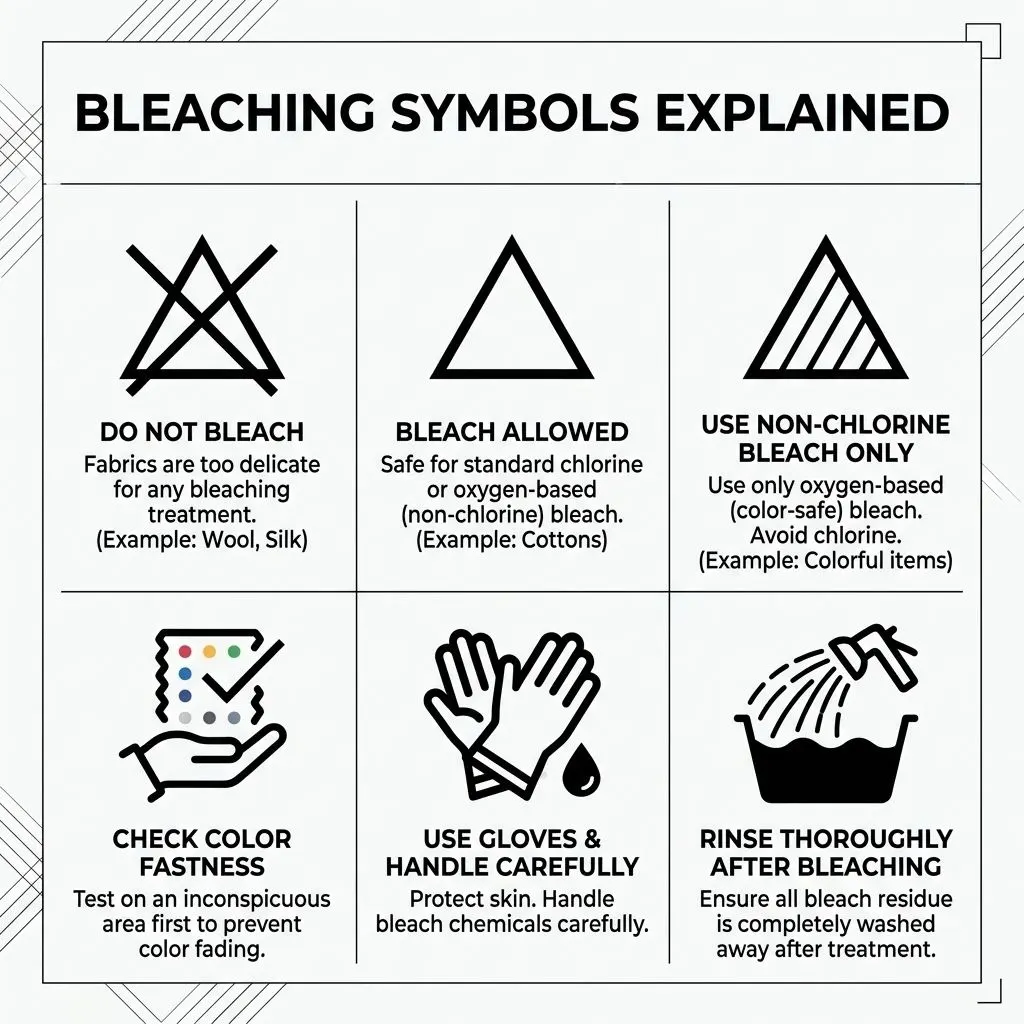
The triangle is the symbol family for bleaching.
It is separate from the washing symbol.
That means a garment can have one instruction for washing and another instruction for bleaching.
What Does an Empty Triangle Mean?
Under the ISO/GINETEX system, an empty triangle indicates that bleaching is permitted, including chlorine and oxygen-based bleaching agents where applicable.
Always follow the product instructions for the particular bleach you use.
What Does a Triangle With Two Diagonal Lines Mean?
A triangle containing two diagonal lines indicates that only oxygen or non-chlorine bleach is permitted.
Chlorine bleach should not be used when this restriction applies.
This distinction is important because “bleach allowed” does not always mean “every type of bleach allowed.”
What Does a Crossed Triangle Mean?
A crossed triangle means do not bleach.
If you see this symbol, don’t add bleach to the wash even if you believe the garment could benefit from it.
GINETEX recommends bleach-free detergent when bleaching is prohibited.
Drying Symbols Explained
The square is the main symbol for drying.
This category can be confusing because a square by itself and a square containing a circle communicate different information.
What Does a Square Mean on a Clothing Label?
A square belongs to the drying family.
Depending on the markings inside it, the label may give instructions for natural drying, such as line drying, drip drying, flat drying, or drying in the shade.
What Does a Square With a Circle Mean?
A circle inside a square indicates tumble drying.
The dots inside the circle provide information about the permitted drying temperature or severity.
This is one of the most important distinctions on a laundry label:
Square + circle = dryer
Circle by itself = professional care
What Do Dots in the Dryer Symbol Mean?
Dots inside the tumble-dryer symbol indicate the permitted temperature level.
The care system uses the dots to communicate the severity of the drying temperature.
The exact settings available on modern dryers can differ, so select the closest appropriate lower-temperature setting when necessary.
What Does a Crossed-Out Dryer Symbol Mean?
A crossed-out square with a circle means do not tumble dry.
If tumble drying is prohibited, use the permitted natural-drying instruction shown elsewhere on the label.
What Does Line Dry Mean?
A line-drying symbol indicates that the garment should be hung to dry rather than placed in a tumble dryer.
This is a natural-drying instruction.
What Does Drip Dry Mean?
A drip-drying symbol indicates that the garment should be allowed to drip dry.
The item may be hung while still carrying substantial moisture, according to the applicable care instruction.
What Does Dry Flat Mean?
A flat-drying symbol means the garment should be laid horizontally to dry.
This can be particularly useful for garments whose shape may be affected by hanging while wet.
However, always follow the actual care label rather than assuming that every knit or delicate garment must be dried flat.
What Does Dry in the Shade Mean?
A diagonal marking associated with a natural-drying symbol can indicate drying in the shade.
This means the item should be dried away from direct sunlight as specified by the care instruction.
Ironing Symbols Explained
The iron symbol tells you whether ironing is allowed and how much heat can be used.
What Does One Dot on an Iron Mean?
One dot indicates a low ironing temperature.
Use a low heat setting and avoid unnecessary heat exposure.
What Do Two Dots on an Iron Mean?
Two dots indicate a medium ironing temperature.
This permits more heat than a one-dot instruction but still places a limit on the ironing temperature.
What Do Three Dots on an Iron Mean?
Three dots indicate a higher ironing temperature within the applicable care system.
The GINETEX care-symbol table identifies three ironing levels corresponding to maximum soleplate temperatures of 110°C, 150°C, and 200°C.
What Does a Crossed Iron Mean?
A crossed-out iron means do not iron.
Do not use an iron or deliberately apply ironing heat to the garment when this symbol appears.
Some care systems may also provide additional instructions concerning steam. The ASTM chart, for example, includes a no-steam instruction.
Professional Cleaning and Dry-Cleaning Symbols
A circle belongs to the professional textile-care category.
This is different from the tumble-dryer symbol because the tumble-dryer circle is enclosed within a square.
What Does a Circle Mean on a Clothing Label?
A circle indicates professional textile care.
The information inside the circle can identify the permitted professional process or solvent category.
What Does P Mean Inside a Circle?
In the ASTM care-symbol system, P identifies a professional dry-cleaning process using specified solvent restrictions. The FTC’s ASTM chart describes P as permitting solvents except trichloroethylene.
The symbol is primarily communication for the professional cleaner, so consumers do not need to choose the solvent themselves.
What Does F Mean Inside a Circle?
In the ASTM system, F indicates a professional dry-cleaning process using petroleum solvent.
Again, this is mainly useful to the professional cleaner handling the garment.
What Does W Mean in a Professional-Care Symbol?
A W can be used in professional-care systems to identify professional wet cleaning.
This should not be confused with ordinary household washing.
GINETEX includes professional wet cleaning among its professional textile-care instructions.
What Does a Crossed Circle Mean?
A crossed-out circle means do not dry-clean under the applicable care system.
Do not assume that the item can simply be placed in a household washing machine. Check the washing symbol and other care instructions.
How to Read an Entire Clothing Care Label
A garment may have several symbols because cleaning involves more than washing.
The standard sequence is generally:
Washing → Bleaching → Drying → Ironing → Professional textile care.
Step One: Find the Washing Symbol
Look for the tub.
Check:
- Temperature.
- Hand-wash instruction.
- Lines underneath.
- Crossed-out treatment.
Step Two: Check Bleaching
Look for the triangle.
Determine whether:
- Any bleach is allowed.
- Only oxygen/non-chlorine bleach is allowed.
- Bleaching is prohibited.
Step Three: Check Drying
Look for the square.
Determine whether you can:
- Tumble dry.
- Line dry.
- Drip dry.
- Dry flat.
- Dry in the shade.
Step Four: Check Ironing
Look for the iron.
Count the dots to determine the permitted heat level.
Step Five: Check Professional Care
Look for the circle.
Letters or other markings can provide instructions for professional cleaners.
Reading the entire label is important because one treatment may be permitted while another is prohibited.
Real-World Clothing Label Examples
Understanding complete combinations is easier than memorizing isolated symbols.
Example One: 30°C + Mild Wash + No Bleach
Imagine a label showing:
30°C wash + one bar + crossed triangle
In plain English, this means:
- Wash at no more than 30°C.
- Use a mild washing process.
- Do not bleach.
The number controls temperature, the bar controls the gentleness of washing action, and the crossed triangle prohibits bleaching.
Example Two: Hand Wash + Dry Flat
Imagine a label showing:
Hand wash + dry flat
This tells you:
- Wash the garment gently by hand.
- Follow the specified washing temperature.
- Lay the garment flat for drying.
Do not automatically substitute a regular washing-machine cycle simply because the garment appears sturdy.
Example Three: 40°C + Two Bars + Do Not Tumble Dry
This combination means:
- Wash at no more than 40°C.
- Use a very mild washing process.
- Do not tumble dry.
The drying instruction is separate from the washing instruction.
Example Four: 40°C + Tumble Dry + Two-Dot Iron
This combination communicates three different stages:
- Wash at no more than 40°C.
- Tumble dry according to the permitted dryer temperature.
- Iron at the two-dot temperature level.
This is why reading the entire label is more useful than looking at only the washing temperature.
Laundry Symbols That Are Easy to Confuse
Some symbols look similar but communicate completely different instructions.
Square vs Square With a Circle
Square: drying information.
Square with circle: tumble drying.
The circle changes the meaning because it identifies machine drying.
This is one of the easiest mistakes to make when reading a small label.
Dots vs Lines
Dots: temperature or heat severity in symbols such as ironing and tumble drying.
Lines under the washing tub: reduced mechanical action.
They are not interchangeable.
Number vs Dots
A number inside a washing tub tells you the maximum washing temperature.
Dots in ironing or tumble-drying symbols communicate heat severity.
Understanding this difference makes many labels much easier to decode.
How Do I Know If Clothes Can Go in the Washing Machine?
Start with the washing tub.
A standard wash-tub instruction indicates that domestic washing is possible according to the specified conditions.
A hand-wash symbol tells you to wash by hand.
A crossed-out tub means the item should not be washed.
The FTC also explains that care instructions identify whether an item should be washed by hand or machine and, where required, provide a water-temperature instruction.
Do not use the washing symbol alone to decide how the garment should be dried afterward. Check the drying symbol separately.
Can I Wash at a Lower Temperature Than the Label Shows?
Yes, when appropriate.
Under the ISO/GINETEX care system, the temperature shown in the wash tub is the maximum temperature, and milder treatments and lower temperatures than those indicated are permitted.
For example, if the label allows a maximum of 40°C, it does not mean that 40°C must always be used.
However, lowering the temperature does not cancel other instructions. A garment marked for a very mild process still needs that gentler treatment.
What Happens If You Ignore a Care Symbol?
Ignoring a care symbol can expose the garment to a treatment it was not designed to tolerate.
Depending on the textile and treatment, problems can include:
- Shrinkage.
- Shape changes.
- Stretching.
- Fabric distortion.
- Color damage.
- Heat damage.
- Surface damage.
- Unwanted wrinkling.
- Damage from unsuitable bleach.
Care symbols communicate the maximum permitted treatment intended to prevent damage when the instructions are followed. GINETEX also notes that the symbols consider factors such as coloring, finishing, accessories, and applications on the textile article.
Following the label does not guarantee that every stain will disappear, but it helps you choose an appropriate care process.
Are Washing Symbols the Same in Every Country?
The basic visual language is internationally recognizable, but care-label systems are not identical everywhere.
GINETEX’s symbols form the basis of the ISO 3758 international care-labeling standard, while the United States has its own regulatory framework and ASTM care symbols. The FTC states that ASTM symbols are similar to, but not identical to, ISO symbols.
This matters when interpreting unusual symbols.
For everyday readers, the most useful approach is:
- Identify the symbol family.
- Read its markings.
- Follow the complete label.
- Don’t assume an unfamiliar regional symbol means exactly the same thing as a similar-looking symbol from another system.
What If the Care Label Is Missing or Faded?
Sometimes a label becomes difficult to read after repeated washing, or it may have been removed because it was uncomfortable.
If you don’t know the manufacturer’s care instructions, avoid automatically choosing the harshest washing, drying, or ironing method.
Instead:
- Check the manufacturer’s product information if available.
- Look for the garment’s care instructions elsewhere.
- Identify the material and construction.
- Use a gentler treatment when appropriate.
- Consider professional textile care for valuable or particularly delicate items.
The goal should be to avoid guessing with heat or aggressive mechanical action.
What Does “Do Not Wring” Mean?
A do-not-wring instruction means you should not twist or squeeze the garment aggressively to remove water.
Wringing can distort some fabrics or change the shape of a garment.
The U.S. ASTM care-symbol chart includes a specific do not wring warning among its additional laundry instructions.
If the label gives a specific drying instruction, follow that instruction rather than inventing your own method.
Washing Symbols for Delicate Clothes
Delicate garments should be interpreted according to their actual care labels rather than by appearance alone.
Look especially for:
- Hand-wash instructions.
- One line under the washing tub.
- Two lines under the washing tub.
- Low-temperature instructions.
- Flat-drying instructions.
- Professional-care symbols.
The double bar under the washing tub represents a very mild process under the ISO/GINETEX system.
A garment that looks delicate may still be machine washable if its care label permits it. Conversely, a garment that looks durable may have special construction requiring gentle treatment.
Why Clothing Care Labels Matter
Care labels provide more than basic laundry advice.
They help consumers understand the maximum treatment a textile can receive under the specified care instructions. GINETEX explains that the symbols are intended for both consumers and professional cleaners.
In the United States, the FTC Care Labeling Rule requires covered manufacturers and importers to provide appropriate care information and warnings, and the FTC explains that care instructions should have a reasonable basis showing that following them will not substantially harm the product.
That makes the label more than a collection of decorative icons. It is practical information about how the garment should be maintained.
Quick Laundry Symbol Cheat Sheet
If you only need the basics, remember these rules:
- Washing tub: tells you how to wash.
- Number in tub: maximum washing temperature.
- Hand in tub: hand wash.
- One bar under tub: mild washing process.
- Two bars under tub: very mild washing process.
- Crossed tub: do not wash.
- Triangle: bleaching instructions.
- Two diagonal lines in triangle: oxygen/non-chlorine bleach only under the ISO/GINETEX system.
- Crossed triangle: do not bleach.
- Square: drying instructions.
- Circle inside square: tumble dry.
- Dots in dryer symbol: drying temperature severity.
- Crossed dryer: do not tumble dry.
- Iron: ironing instructions.
- Dots on iron: ironing temperature.
- Crossed iron: do not iron.
- Circle: professional textile care.
- P, F, or other letters: professional-care information depending on the applicable system.
- Crossed circle: do not dry-clean.
- Cross over any symbol: do not use that treatment.
Frequently Asked Questions
What do the washing symbols mean?
Washing symbols tell you how a garment should be washed. The tub identifies washing, numbers indicate the maximum temperature, lines underneath indicate gentler washing processes, and a crossed tub means the item should not be washed.
What does 30 mean on a washing label?
A 30 inside the washing tub means the maximum washing temperature is 30°C. A lower temperature may be used when appropriate because the number represents the maximum temperature.
What does 40 mean on clothes?
A 40 inside the washing tub means the garment should not be washed above 40°C under that care instruction. Check for lines underneath the tub because they indicate whether a milder washing process is required.
What does one line under the washing symbol mean?
One line means the garment requires a mild washing process with reduced mechanical action. It does not mean that the washing temperature is automatically lower.
What do two lines under the washing symbol mean?
Two lines indicate a very mild washing process. The instruction is designed for textiles that need especially gentle mechanical treatment.
What does a crossed-out washing symbol mean?
A crossed-out washing tub means do not wash. The garment should not receive the domestic washing treatment represented by the symbol.
What does the triangle mean on a clothing label?
The triangle represents bleaching. Its markings indicate whether bleaching is permitted, restricted to oxygen/non-chlorine bleach, or prohibited.
What does a square mean on a laundry label?
A square represents drying instructions. A circle inside the square indicates tumble drying, while other markings can describe natural drying methods.
What does a circle mean on a clothing label?
A circle generally represents professional textile care. Letters or markings inside the circle can provide information about the professional process or solvent category.
What does a circle inside a square mean?
A circle inside a square means tumble drying. The dots inside the circle indicate the permitted temperature severity.
What do dots mean on laundry symbols?
Dots indicate heat or temperature severity in symbols such as tumble drying and ironing. More dots generally indicate a higher permitted temperature within the applicable care system.
Can I wash clothes at a lower temperature than the number shown?
Yes, under the ISO/GINETEX system the number in the washing tub represents the maximum temperature, and lower temperatures and milder treatments are permitted.
What does a crossed triangle mean?
A crossed triangle means do not bleach. Use a detergent or cleaning method that does not involve bleaching.
What does a crossed-out iron mean?
A crossed-out iron means do not iron. Avoid applying an iron to the garment.
What does a crossed-out dryer mean?
A crossed-out tumble-dryer symbol means do not tumble dry. Follow the natural-drying instruction provided on the care label instead.
What does P mean on a dry-cleaning symbol?
In the ASTM system, P identifies a professional dry-cleaning process with specified solvent restrictions. It is primarily information for the professional cleaner.
Are washing symbols the same in the U.S. and Europe?
Not exactly. ISO/GINETEX symbols are used internationally, while the United States has ASTM care symbols within its regulatory framework. The FTC notes that the systems are similar but not identical.
Do washing symbols tell me how to remove stains?
Not necessarily. Care symbols tell you the permitted care treatment, but following them does not guarantee that every stain will be removed.
Conclusion
Understanding what the washing symbols mean becomes much easier once you learn the basic shapes.
The washing tub tells you how to wash, the triangle tells you about bleaching, the square covers drying, the iron covers ironing, and the circle identifies professional textile care. Numbers usually indicate maximum washing temperature, dots communicate heat levels, lines under the wash tub call for gentler mechanical action, and a cross means the treatment is prohibited.
The most important habit is to read the entire care label, not just the washing temperature. A garment may be washable at 40°C but require a gentle cycle, prohibit bleach, require flat drying, or prohibit ironing.
Once you know what each shape and marking means, clothing-care labels stop looking like confusing little pictures and become a practical set of instructions for keeping your clothes in good condition

Adam Sullivan is a dedicated writer who enjoys transforming everyday topics into engaging and informative content. His writing focuses on making complex ideas simple, practical and enjoyable for readers of all backgrounds. Adam is also the fictional author of The Lantern Beyond Autumn Hills and Where the Morning Horizon Waits. Outside of writing, he enjoys photography, traveling and discovering inspiration through new experiences. He believes great content should be both helpful and easy to connect with.
 Dylan Anderson