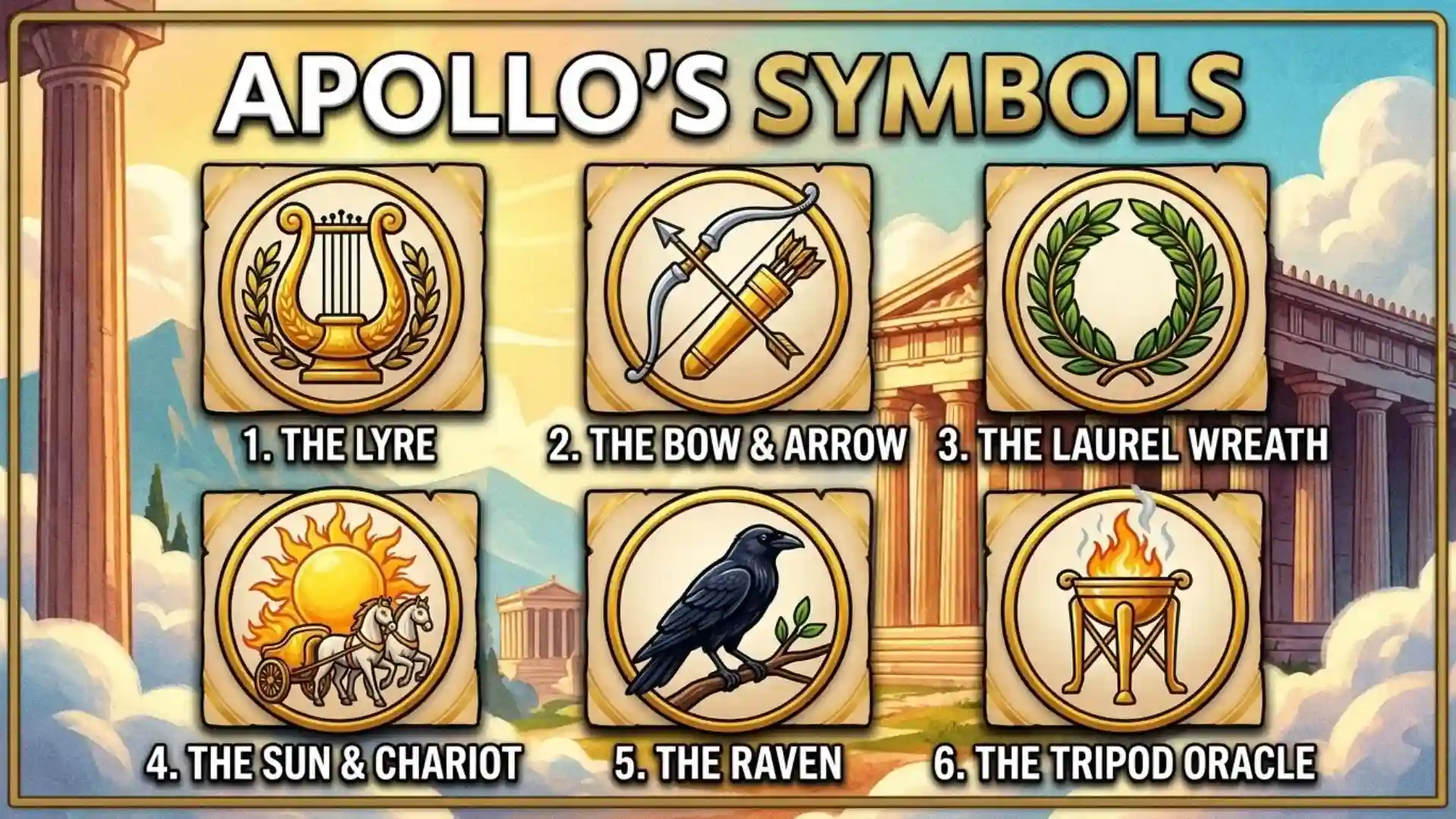
Apollo’s symbols reveal his many roles in Greek mythology, from music and poetry to archery, prophecy, and healing. His most recognizable attributes include the lyre, bow and arrows, laurel wreath, tripod, and omphalos stone. Sacred animals such as the raven, swan, and dolphin also appear in stories and artwork connected with him.
Apollo was the son of Zeus and Leto and the twin brother of Artemis. Ancient Greeks honored him through religious ceremonies, festivals, artistic performances, and the famous oracle at Delphi. His symbols helped people recognize him in sculptures, pottery, temples, and other works of art.
Each symbol tells a different part of Apollo’s story. The lyre highlights his musical talent, the bow reflects his power as an archer, and the tripod connects him with prophecy. The laurel wreath recalls the myth of Daphne, while the omphalos stone represents Delphi’s special place in Greek religious tradition.
This guide explains Apollo’s principal symbols, their meanings, the myths behind them, and how to recognize them in classical artwork. It also explores his connection with healing and the sun, distinguishes his major attributes from less common associations, and answers frequently asked questions about Apollo’s symbols.
What Are Apollo’s Main Symbols?
Apollo had several recognizable attributes in ancient Greek art and religion. Artists often included these objects to identify him and communicate the particular aspect of his divine power being represented.
The lyre, bow and arrows, laurel branch, tripod, and omphalos are among his most important symbols. Other objects and animals are associated with particular myths, local traditions, or artistic representations.
Apollo’s Symbols and Their Meanings at a Glance
| Symbol | Main meaning | Connection to Apollo |
| Lyre | Music, poetry, and harmony | Apollo was a divine musician and patron of the arts |
| Bow and arrows | Archery and divine power | He could strike enemies from a distance and bring punishment |
| Laurel wreath | Apollo, victory, and honor | Connected with the myth of Daphne and traditions honoring the god |
| Tripod | Prophecy and sacred authority | Associated with Apollo’s oracle at Delphi |
| Omphalos stone | Sacred center of the world | Connected with Delphi’s religious significance |
| Quiver | Archery and readiness | Holds the arrows Apollo uses as an archer |
| Kithara | Musical excellence | A larger stringed instrument frequently shown with Apollo |
| Raven or crow | Mythological messages and particular stories | Associated with stories involving Apollo and Coronis |
| Swan | Sacred and artistic associations | Appears in some traditions and representations connected with Apollo |
| Dolphin | Delphi and the sea | Connected with the myth of Apollo guiding sailors to his sanctuary |
| Palm tree | Birth and sacred memory | Associated with the tradition of Apollo’s birth on Delos |
| Wolf | Particular cults and mythological traditions | Appears in some regional and historical associations |
These symbols do not all have equal importance. The lyre, bow, laurel, and tripod are particularly useful when identifying Apollo. The meanings of animals and less common attributes depend more heavily on the myth, artwork, or historical setting.
Which Symbols Are Most Important?
If you need to remember only a few symbols, start with these five:
- Lyre: Apollo’s connection with music and poetry.
- Bow and arrows: His skill as an archer and his capacity to punish or protect.
- Laurel wreath: His mythological connection with Daphne and his association with honor.
- Tripod: His prophetic role and the oracle at Delphi.
- Omphalos: Delphi’s symbolic importance as the center of the world.
The Acropolis Museum identifies the lyre, bow, quiver, tripod, omphalos, and laurel branch among Apollo’s attributes. These museum-documented associations provide a useful starting point for understanding his iconography.
The Most Important Symbols of Apollo
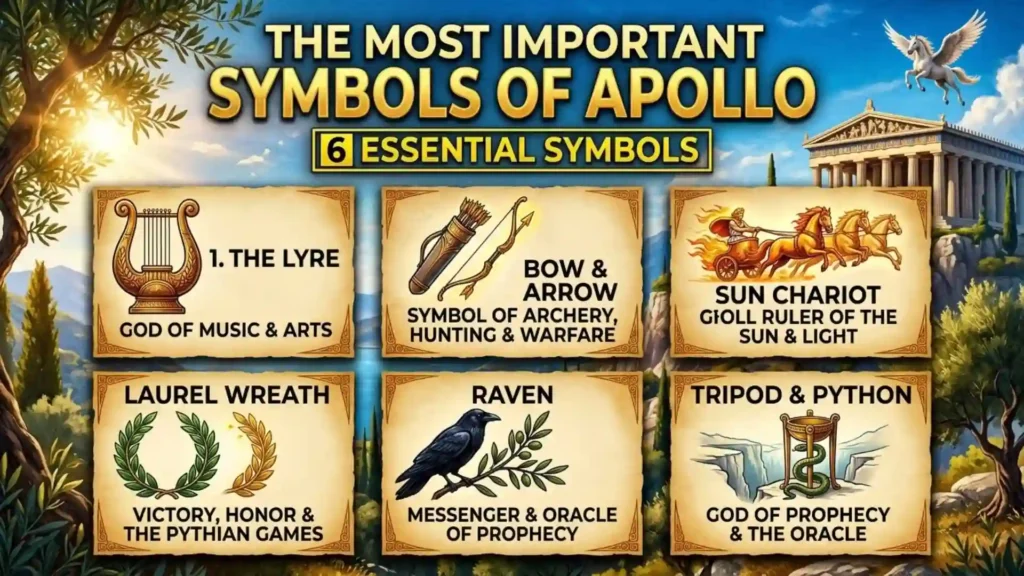
Apollo’s principal attributes connect directly with his myths, powers, and religious traditions. Understanding their individual meanings makes it easier to recognize the god in ancient art.
The Lyre: Apollo’s Symbol of Music and Poetry
The lyre is one of Apollo’s most recognizable symbols. This ancient stringed instrument represents music, poetry, artistic achievement, and harmony.
In Greek culture, music was important in religious ceremonies, education, public celebrations, and storytelling. Apollo’s mastery of the lyre reflected his role as a patron of music and the arts.
The instrument also connects Apollo with the nine Muses, divine figures associated with artistic and intellectual pursuits. Apollo was known as Musagetes, meaning leader of the Muses, a title that reflects his place in the world of music and poetry.
What Does Apollo’s Lyre Symbolize?
Apollo’s lyre is associated with several ideas:
- Music and song: It identifies him as a divine musician.
- Poetry: It represents artistic expression and the performance of verse.
- Harmony: It can suggest balance, proportion, and disciplined creativity.
- Artistic excellence: It connects Apollo with the pursuit of skill and beauty.
- The Muses: It reflects his relationship with the divine patrons of the arts.
These meanings are connected, but they are not identical. Music is the instrument’s most direct association, while harmony and artistic excellence are broader interpretations of Apollo’s role.
How Did Apollo Receive the Lyre?
A famous myth connects the lyre with Hermes, the messenger god. According to the story, Hermes created an early lyre using a tortoise shell and strings. After a dispute involving Apollo’s cattle, the instrument helped bring the two gods to an agreement.
Apollo became associated with the lyre and developed a reputation as a remarkable musician. The story explains how the instrument became part of his identity while highlighting Hermes’s inventiveness and cleverness.
The details differ across ancient accounts and later retellings, so it is best to treat the story as a mythological tradition rather than a single historical account.
The Lyre and Kithara in Apollo’s Artwork
The kithara was a stringed instrument related to the lyre, generally built for more formal musical performance. Both instruments appear in depictions of Apollo.
In artwork, Apollo may hold the instrument, play it, or stand beside it. A lyre or kithara combined with a youthful male figure and other attributes can help identify him as the god of music.
The Fitzwilliam Museum explains how Apollo’s lyre became a recognizable artistic attribute and how the instrument reflects his connection with music, balance, and the Muses. Explore the museum’s guide to the lyre.
The Bow and Arrows: Apollo’s Power as an Archer
Apollo’s bow and arrows represent his extraordinary skill in archery. Greek myths describe him as an archer whose weapons could reach targets from a great distance.
His arrows were not limited to ordinary combat. In some stories, they brought disease or punishment. In other traditions, Apollo’s divine power was associated with protection and the restoration of health.
This dual role is important. Apollo was not simply a god who attacked enemies; his powers could also help communities and individuals.
What Do Apollo’s Bow and Arrows Mean?
The bow and arrows can symbolize:
- Precision: Apollo is portrayed as a highly skilled archer.
- Distant power: His arrows allow him to strike from far away.
- Divine punishment: He can respond forcefully when his sacred obligations or family are offended.
- Protection: His strength can be used against dangerous enemies.
- Control: The bow represents the ability to direct power toward a chosen target.
The most appropriate interpretation depends on the scene. A statue showing Apollo with a bow emphasizes archery, but a narrative painting may use the same weapon to communicate anger, defense, or a particular myth.
Apollo’s Arrows in the Iliad
In Homer’s Iliad, Apollo sends a plague through the Greek army after Agamemnon dishonors Chryses, a priest of the god.
The episode demonstrates Apollo’s capacity to punish those who disregard religious obligations. It also shows the importance of honoring the gods and respecting their priests in the epic’s moral world.
This myth connects the bow and arrows with divine authority rather than merely physical strength. Apollo’s weapon becomes an expression of his power over human fortunes.
Apollo and Artemis: Two Divine Archers
Apollo and his twin sister Artemis are both associated with bows and arrows. This shared attribute can make identifying them in ancient artwork more difficult.
Apollo is frequently shown with a lyre, laurel wreath, or tripod. Artemis is commonly associated with hunting, wild animals, and a bow suited to her role as a huntress.
These clues are helpful, although not every artwork follows the same visual conventions. The setting and combination of attributes are more reliable than the weapon alone.
The Laurel Wreath: Apollo’s Connection to Daphne and Victory
The laurel wreath is one of Apollo’s most recognizable attributes. Artists often depict him wearing a crown of laurel leaves or holding a branch from the plant.
Its meaning connects mythology with broader Greek traditions of honor and achievement. Laurel was associated with Apollo, while laurel wreaths also became symbols of victory and recognition.
The Myth of Apollo and Daphne
The story of Apollo and Daphne is a major explanation for the connection between the god and the laurel tree.
In Ovid’s Metamorphoses, a Roman retelling of Greek mythological material, Apollo falls in love with Daphne after an encounter involving Cupid’s arrows. Daphne does not return his feelings and tries to escape him.
As Apollo catches up with her, Daphne calls for help and is transformed into a laurel tree. Apollo then associates the tree with himself and adopts its leaves as a lasting emblem.
The story explains why laurel appears in representations of Apollo. It also explores desire, pursuit, and transformation, making the plant more than a simple decorative feature.
What Does Apollo’s Laurel Wreath Represent?
The laurel wreath can represent:
- Identification: It is a familiar attribute of Apollo in ancient and later art.
- Mythological memory: It recalls the story of Daphne.
- Victory and honor: Laurel wreaths became associated with achievement in Greek culture.
- Poetry and artistic distinction: Laurel crowns were later used to honor poets and other accomplished figures.
- Religious tradition: Laurel was connected with Apollo’s worship and sacred settings.
A laurel wreath does not always mean the person wearing it represents Apollo. Athletes, poets, and rulers could also wear laurel as a sign of victory or honor.
Why Laurel Is Connected With Delphi
Delphi was home to Apollo’s famous oracle. Laurel was associated with the god’s religious traditions, and wreaths became important in celebrations connected with achievement.
The Pythian Games, held in honor of Apollo at Delphi, included athletic and artistic competitions. The association between laurel and victory helped strengthen the plant’s cultural importance.
When laurel appears alongside Apollo’s lyre or tripod, it can help connect the artwork with his musical or prophetic roles.
The Tripod: Apollo’s Symbol of Prophecy
The tripod is a three-legged stand used to support a vessel, bowl, or seat. It is closely associated with Apollo’s oracle at Delphi and is one of the clearest symbols of his prophetic role.
At Delphi, the Pythia, or priestess of Apollo, delivered oracular responses. Ancient traditions connected her seat with a tripod, which became an important object in the sanctuary’s religious life.
What Does the Tripod Symbolize?
The tripod represents:
- Prophecy: It is closely connected with Apollo’s oracle.
- Divine communication: It recalls the delivery of sacred responses.
- Religious authority: It represents Apollo’s influence at Delphi.
- Ritual practice: It reflects the material objects used in ancient religious settings.
The tripod was not merely a piece of furniture in the stories surrounding Delphi. It became a recognizable sign of Apollo’s authority over prophecy.
Apollo and the Oracle at Delphi
People from across the Greek world visited Delphi to seek guidance about personal, political, and religious questions. Rulers and communities consulted the oracle on important decisions.
According to one tradition recorded by the Archaeological Site of Delphi, Apollo took control of the oracle after defeating the serpent Python. The tripod subsequently became one of his symbols, and the Pythia sat on it when delivering oracles.
Another myth describes Heracles attempting to seize the tripod after a dispute over the oracle. Apollo intervenes, and the conflict illustrates the object’s importance to the god’s prophetic authority.
The Delphi museum provides a detailed account of these traditions and explains the tripod’s role in ancient representations of Apollo.
The Omphalos Stone: Delphi as the Center of the World
The omphalos was a sacred stone associated with Delphi. Its name is commonly translated as “navel,” and ancient Greek tradition treated it as a marker of the world’s symbolic center.
The stone connects Apollo with the special status of Delphi in Greek religious geography. The sanctuary was not simply a place to consult an oracle; it held a distinctive position in the religious imagination of the ancient Greek world.
What Does the Omphalos Symbolize?
The omphalos is associated with:
- The symbolic center of the world: It reflects Delphi’s importance in ancient tradition.
- Sacred geography: It marks a location considered especially significant.
- Apollo’s oracle: It connects the stone with the god’s prophetic role.
- Religious identity: It helps identify the sanctuary and its traditions.
The omphalos is less familiar than the lyre or bow, but it adds depth to the study of Apollo’s symbols. It helps explain why Delphi was central to his worship and reputation.
How to Recognize the Omphalos
In artistic representations, the omphalos may appear as a rounded stone or a shaped object with a net-like pattern. Its precise appearance can vary in surviving images and replicas.
A stone-like object alone is not enough to identify it with certainty. The surrounding scene, historical record, or museum description provides stronger evidence.
Apollo’s Sacred Animals and Other Symbols
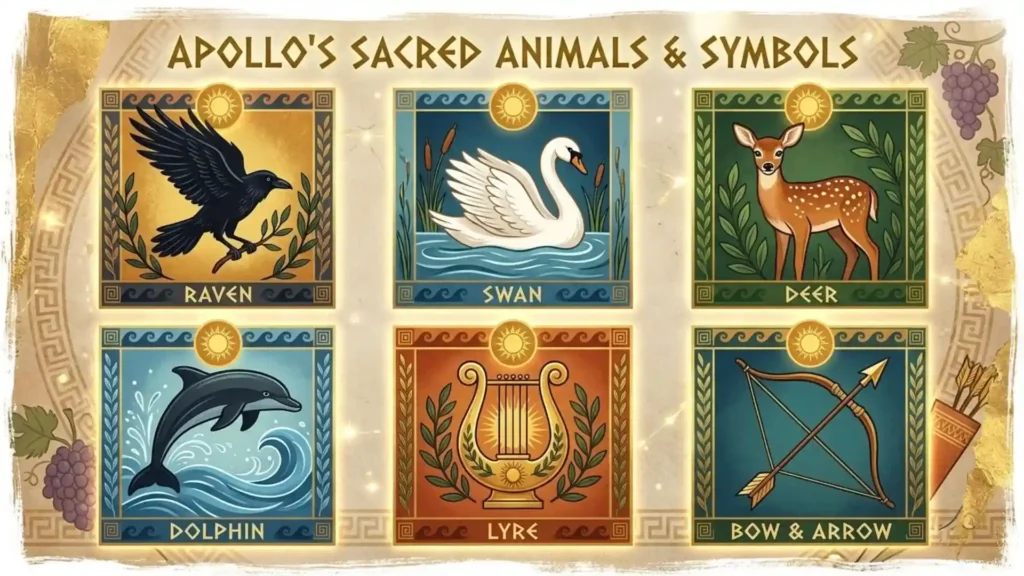
Several animals and additional objects appear in myths and artistic traditions associated with Apollo. Their significance varies, so they should not all be treated as equally important or universally recognized attributes.
The Raven and Crow: Messages and Mythology
The raven is associated with a story involving Apollo and Coronis, a woman connected with the god in Greek mythology. In one version, a bird reports news about Coronis, leading to a tragic sequence of events.
Later retellings explain the raven’s black feathers through Apollo’s anger. This story connects the bird with messages, observation, and the consequences of revealing unwelcome information.
The raven and crow are related birds, and their identification may vary in translations or modern summaries. When examining a particular artwork, use its historical description rather than assuming that every black bird represents Apollo.
The raven is a recognizable mythological association, but it is not as direct an identifier as Apollo’s lyre, bow, or tripod.
The Swan: Beauty and Sacred Associations
The swan appears in some traditions and artistic representations connected with Apollo. Its graceful appearance and associations with song make it a fitting presence in artistic settings involving music and beauty.
Swans can also have significance in broader Greek mythology, so the bird’s presence does not automatically identify Apollo.
If a swan appears with a lyre, laurel wreath, or another attribute strongly associated with the god, the identification becomes more convincing. The specific scene remains important.
The Dolphin: Apollo’s Journey to Delphi
The dolphin has a particularly interesting connection with Apollo’s mythology.
In the Homeric Hymn to Apollo, the god takes the form of a dolphin in a story about reaching Delphi and guiding sailors who will serve his sanctuary. This tradition links Apollo with the sea, travel, and the founding of his religious center.
The Vatican Museums describe an ancient Greek vase painting in which Apollo travels on a winged tripod over the sea, accompanied by dolphins. The scene combines several of his attributes: the lyre, bow and quiver, laurel wreath, tripod, and dolphin.
This example demonstrates how ancient artists could combine several symbols to tell a story rather than represent a single aspect of the god.
The Wolf: A Less Common Association
The wolf appears in some ancient traditions connected with Apollo, including regional cults and divine titles. However, its significance is more complex than a simple association with danger or aggression.
Greek gods could have different titles and attributes in different places. The meaning of an animal might depend on a local religious tradition, a myth, or a particular artistic setting.
The wolf is therefore best understood as a secondary association rather than one of Apollo’s most universal identifying symbols.
The Palm Tree: Apollo’s Birth on Delos
According to Greek tradition, Apollo and Artemis were born on the island of Delos. The palm tree is associated with this birth story and the sacred identity of the island.
The palm connects Apollo with his origin story and the religious traditions surrounding Delos. It is not as common an identifying attribute as the lyre or laurel wreath, but it can be important in artwork that refers to his birth.
The Griffin: A Mythical Creature
The griffin is a mythical creature generally described as having a lion’s body and an eagle’s head and wings. Griffins appear in ancient art connected with various deities and legendary settings, including some representations associated with Apollo.
Because the creature appears in more than one mythological context, it should not be treated as an exclusive symbol of Apollo. Its meaning depends on the artwork and the traditions it references.
What Apollo’s Symbols Reveal About His Powers
Apollo’s attributes make the most sense when considered alongside his major roles in Greek mythology. Each symbol highlights a particular aspect of his identity, but together they reveal a much broader figure.
Music and Poetry
The lyre and kithara emphasize Apollo’s connection with music, song, poetry, and artistic performance. His association with the Muses places him within a wider tradition of divine inspiration and creative achievement.
Music also connects with the ideals of harmony and balance often associated with Apollo in Greek thought. His role was not simply to entertain the gods; he represented the artistic and cultural value of music.
Prophecy and Sacred Knowledge
The tripod and omphalos connect Apollo with Delphi, where people sought guidance through the oracle.
His prophetic role placed him at the center of religious decisions and questions about the future. The symbols associated with Delphi therefore communicate more than supernatural knowledge: they also reflect the sanctuary’s social and religious influence.
Healing, Disease, and Purification
Apollo had a complex relationship with health and illness. In some myths, he sends disease or punishment; in others, he protects people or helps restore health.
This dual role reflects an ancient understanding of divine power in which the source of harm could also be asked to remove it. Apollo was associated with healing and purification, although his son Asclepius became especially prominent as a deity of medicine.
Asclepius is often represented with a staff entwined by a serpent, which is a distinct symbol associated with medicine and healing. It should not be confused with Apollo’s primary attributes.
Apollo’s connection with healing is important to understanding him fully. He was not only a musician and archer but also a deity whose power could affect the health and well-being of individuals and communities.
Archery and Divine Power
Apollo’s bow, arrows, and quiver express his ability to act from a distance. His weapons could bring punishment, but they also reflect his strength as a protector.
Stories involving Apollo’s archery often explore the relationship between humans and divine authority. His actions may be frightening or destructive, but they also reinforce the idea that the gods could intervene directly in human affairs.
Light and the Sun: Apollo vs. Helios
Apollo is frequently associated with light and the sun, particularly in later Greek and Roman traditions. However, the history of this association requires a distinction between Apollo and Helios.
Helios was the Greek personification of the sun, traditionally imagined driving his chariot across the sky. Apollo had a broader range of roles, including music, prophecy, archery, and healing. Over time, Apollo became increasingly connected with solar imagery and was sometimes identified closely with the sun.
This means that a sun symbol may be associated with Apollo in later art or modern interpretations, but it is not as straightforward as saying Apollo and Helios were always the same deity.
The distinction is especially useful when interpreting ancient sources, where different traditions and periods may present the gods differently.
How to Identify Apollo in Art and Statues
Apollo is often portrayed as a youthful, idealized male figure. However, his appearance alone cannot always distinguish him from other gods, heroes, or mythological figures.
The objects surrounding him are usually more useful clues.
Look for the Lyre or Kithara
A stringed instrument is one of the clearest signs of Apollo’s musical identity. If a figure holds a lyre or kithara, check for other attributes that support the identification.
Check for the Bow and Quiver
A bow and quiver suggest Apollo’s role as an archer, but Artemis also carries a bow. Look for a lyre, laurel wreath, tripod, or other clues before deciding which deity is shown.
Examine the Laurel Wreath
A laurel wreath may help identify Apollo, especially when it appears alongside a lyre or other familiar attribute. However, laurel wreaths were also used to signify victory and honor, so the plant alone is not conclusive.
Look for the Tripod or Omphalos
A tripod or omphalos stone can point to Delphi and Apollo’s prophetic role. If the artwork includes other references to the oracle, the identification becomes stronger.
Consider the Entire Scene
Ancient artwork often combines several attributes to represent a myth or divine function. A famous example in the Vatican Museums shows Apollo with a tripod, lyre, bow, quiver, laurel wreath, and dolphins. Each object contributes to the scene’s meaning.
Check Reliable Museum Descriptions
When identifying a statue, vase, or other historical object, consult a museum catalogue or archaeological record. Some objects are damaged, restored, or open to more than one interpretation.
The strongest identification uses several clues together instead of relying on a single shape or a general resemblance.
Apollo’s Symbols in Tattoos, Jewelry, and Modern Design
Apollo’s symbols remain popular in contemporary art and design. People may choose them to express creativity, achievement, interest in classical mythology, or a personal connection with a particular story.
These modern meanings can be valid personal interpretations, but they should be distinguished from the symbols’ documented historical associations.
Apollo Symbol Tattoos
Apollo-inspired tattoos often feature the lyre, laurel wreath, bow and arrows, or a classical representation of the god.
- Lyre tattoo: May express music, creativity, poetry, or a love of the arts.
- Laurel wreath tattoo: Can represent achievement, honor, victory, or a connection with Apollo.
- Bow and arrow tattoo: May suggest precision, focus, or an interest in Greek mythology.
- Tripod tattoo: Can represent prophecy, sacred knowledge, or the traditions of Delphi.
- Sun-inspired tattoo: May reflect a personal association with Apollo’s later solar identity or with light and renewal.
There is no single universal meaning for an Apollo tattoo. If you choose one, consider whether you want to reference a specific ancient myth, a historical attribute, or a personal idea inspired by the god.
Apollo Symbols in Jewelry
Laurel wreaths, lyres, and classical depictions of Apollo can appear in pendants, rings, bracelets, and decorative objects.
A lyre may appeal to musicians or people interested in poetry. Laurel can suggest honor or achievement, while a small figure of Apollo may express a broader interest in classical mythology.
Modern jewelry does not necessarily retain the original religious function of a similar object from antiquity. Its meaning depends on the design and the person wearing it.
Apollo Symbols in Logos and Artwork
Designers may use Apollo’s attributes to suggest artistic skill, excellence, creativity, or classical inspiration.
For example, a music organization might use a lyre to communicate its connection with performance. A laurel wreath may suggest achievement or recognition.
However, using a mythological symbol does not automatically communicate one fixed message. Its interpretation depends on the audience, visual style, and surrounding design.
Common Misconceptions About Apollo’s Symbols
Apollo’s mythology includes many stories and regional traditions, so simplified explanations can sometimes create confusion.
Apollo and Helios Were Not Always Interchangeable
Apollo became strongly associated with the sun in later traditions, but Helios was the distinct Greek personification of the sun. Their identities and relationship developed over time.
It is therefore more accurate to explain the historical overlap than to claim that Apollo was always the sole Greek sun god.
Every Laurel Wreath Does Not Represent Apollo
Laurel is strongly associated with Apollo, but it also became a broader symbol of victory and honor. An athlete, poet, or ruler wearing a laurel wreath does not necessarily represent the god.
The surrounding imagery and historical context help determine the intended meaning.
The Raven Is Not Apollo’s Only Sacred Animal
Ravens and crows appear in stories associated with Apollo, but other animals are also connected with him in different traditions. These include the swan, dolphin, and wolf.
Their roles vary, so no single animal should be treated as the only possible representation of Apollo.
Apollo’s Healing Symbol Is Not the Same as Asclepius’s Staff
Apollo was associated with healing and disease, while his son Asclepius became particularly connected with medicine.
The serpent-entwined staff is most directly associated with Asclepius, not one of Apollo’s main identifying attributes. The two gods are related through mythology, but their symbols should not be confused.
Not Every Symbol Has One Fixed Meaning
A lyre strongly suggests music, but a laurel wreath may indicate Apollo, victory, or honor. A bow could identify Apollo or Artemis, depending on the scene.
The most accurate interpretation considers the symbol, the artwork, and the historical tradition together.
Frequently Asked Questions About Apollo’s Symbols
What Are Apollo’s Five Main Symbols?
Five of Apollo’s most important symbols are the lyre, bow and arrows, laurel wreath, tripod, and omphalos stone. They represent his connection with music, archery, mythology, prophecy, and Delphi’s sacred significance.
What Does Apollo’s Lyre Symbolize?
Apollo’s lyre symbolizes music, poetry, harmony, and artistic excellence. It also connects him with the Muses and his role as a patron of the arts.
Why Is Laurel Sacred to Apollo?
Laurel is connected with Apollo through the myth of Daphne and through religious traditions associated with his worship. Laurel wreaths also became symbols of victory and honor in ancient Greek culture.
What Does Apollo’s Bow and Arrow Represent?
Apollo’s bow and arrows represent his skill as an archer and his power to strike from a distance. In mythology, his arrows can bring punishment or disease, while his broader divine role also includes protection and healing.
What Is Apollo’s Symbol for Prophecy?
The tripod is one of Apollo’s clearest symbols of prophecy. It is associated with the oracle at Delphi, where the Pythia delivered sacred responses.
What Is Apollo’s Symbol for Healing?
Apollo is associated with healing, disease, and purification, but he does not have one universally recognized healing emblem comparable to the lyre or bow. His son Asclepius is more directly associated with medicine and is commonly represented with a serpent-entwined staff.
Which Animals Are Associated With Apollo?
Animals connected with Apollo include the raven, crow, swan, dolphin, and wolf. Their meanings depend on particular myths, regional traditions, and artistic contexts.
Why Is the Dolphin Associated With Apollo?
The dolphin is linked to a myth in which Apollo takes the form of a dolphin and guides sailors toward Delphi. This story connects the animal with the god’s sanctuary and the traditions surrounding its foundation.
Is Apollo the Same as Helios?
Not in every ancient tradition. Helios personified the sun in Greek mythology, while Apollo had a broader range of roles, including music, prophecy, archery, and healing. Apollo’s solar associations became stronger over time, especially in later Greek and Roman traditions.
What Does Apollo’s Symbol Mean in a Tattoo?
An Apollo-inspired tattoo may represent creativity, music, focus, achievement, prophecy, or an interest in Greek mythology. The lyre, laurel wreath, bow, and tripod carry different historical associations, while personal meanings depend on the individual.
How Can You Identify Apollo in a Greek Statue?
Look for a combination of attributes such as the lyre, bow and quiver, laurel wreath, tripod, or omphalos. His youthful appearance may provide an additional clue, but objects and the scene’s context are generally more reliable than appearance alone.
Conclusion
Apollo’s symbols provide a visual guide to his many roles in Greek mythology. The lyre represents music and poetry, the bow and arrows reflect his power as an archer, the laurel wreath recalls the myth of Daphne, and the tripod connects him with prophecy at Delphi. The omphalos stone adds another layer by representing Delphi’s sacred importance.
Animals such as the raven, swan, and dolphin reveal further connections with mythological stories and religious traditions. Apollo’s association with healing and his later connection with the sun also show why his identity cannot be reduced to one symbol or role.
To understand Apollo’s symbols accurately, consider the object, the myth behind it, and the historical setting in which it appears. A combination of attributes usually tells a richer story than any single image. By looking at these symbols together, you can better recognize Apollo in ancient artwork and understand why his mythology continues to influence modern art, literature, and design.

Lily Anderson is a passionate writer who enjoys turning everyday ideas into engaging and easy-to-read stories. She loves creating content that helps readers learn something new while keeping them entertained. Lily is the author of the original titles Whispers Between Ordinary Days and The Quiet Map of Tomorrow. When she’s not writing, she enjoys reading, exploring new places, and finding inspiration in everyday life. Her goal is to create meaningful content that readers can connect with and remember.
 Adam Sullivan
 Dylan Anderson