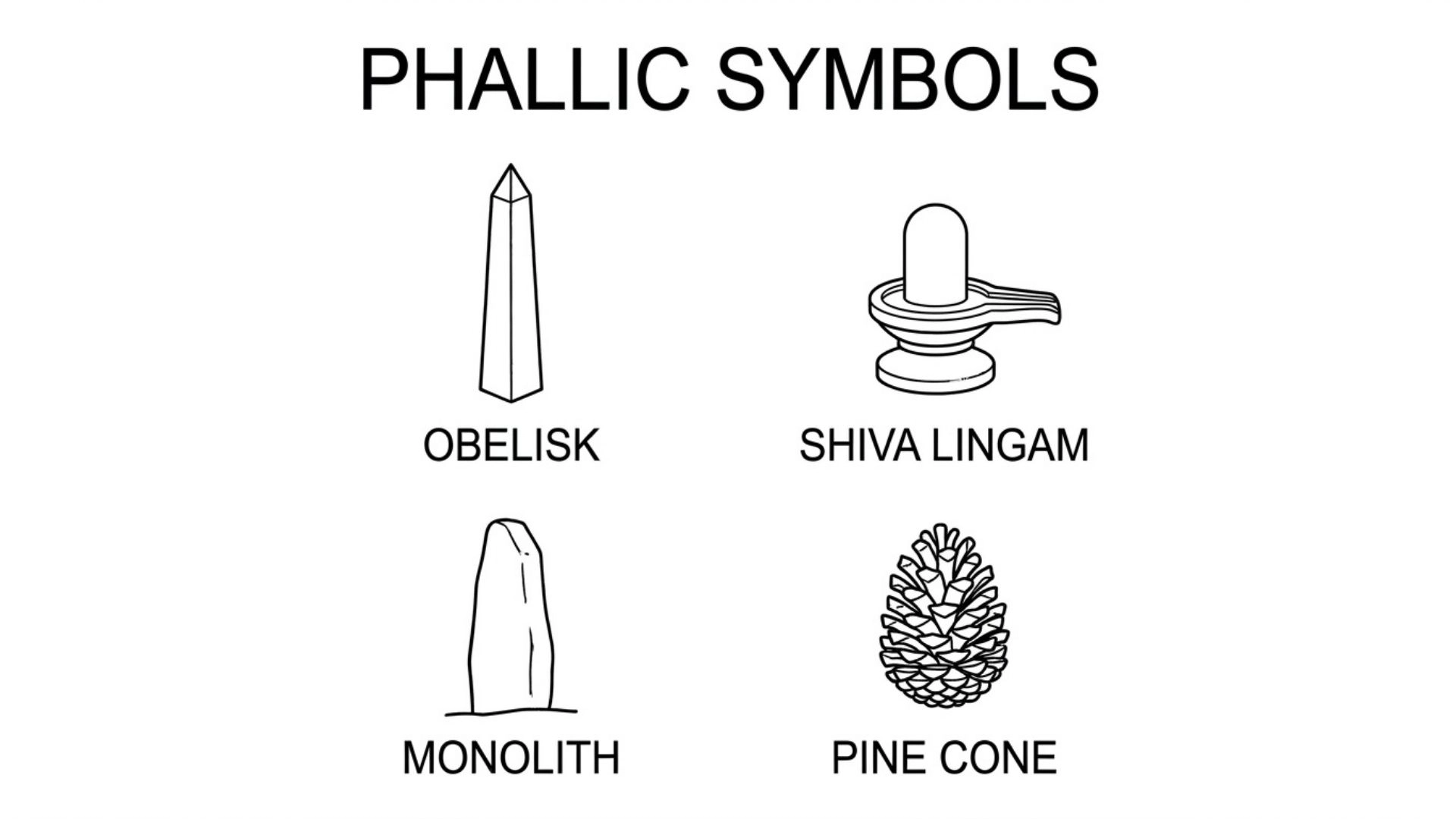
Phallic symbols are images, objects, or shapes that resemble or represent the penis and communicate ideas beyond their physical appearance. Across different societies, they have been associated with fertility, creation, protection, masculinity, sexual identity, and power. Their meanings, however, depend on the culture and historical setting in which they appear.
You might encounter phallic symbolism in ancient amulets, religious sculptures, mythology, architecture, paintings, jewelry, or contemporary art. Some examples are explicit and historically documented. Others, such as a tall monument or an elongated sculpture, may be interpreted as phallic because of their shape, even when there is no evidence that the creator intended that meaning.
That distinction matters. A symbol that represented protection in ancient Rome may have a different meaning from a sacred image in Hinduism or a provocative sculpture in a modern gallery. Looking at shape alone rarely tells the whole story.
This guide explains what phallic symbols mean, explores important historical examples, discusses their religious and psychological interpretations, and shows you how to evaluate their significance without confusing established facts with speculation.
What Are Phallic Symbols?
A phallic symbol is an object, image, structure, or artistic form that represents or resembles the penis. The word phallic comes from phallus, a term commonly used in discussions of anatomy, art, history, and symbolism.
Phallic symbols can be realistic, stylized, or abstract. An ancient pendant shaped like male genitalia is an explicit example. An elongated sculpture may be described as phallic if its form suggests the same association, but that interpretation does not automatically establish the artist’s intention.
The term is used in several fields, including archaeology, religious studies, art history, psychology, and cultural criticism. Each field approaches the subject differently. Archaeologists may investigate how an object was used, while art historians may examine its visual meaning. Psychologists and cultural critics may explore how phallic imagery relates to identity, desire, authority, or social expectations.
What Do Phallic Symbols Represent?
Phallic symbols can communicate different ideas. Their meaning depends on the object itself, the people who used it, and the beliefs surrounding it.
- Fertility and reproduction: Phallic imagery may refer to the ability to produce offspring or continue a family line.
- Creation and generative power: In some traditions, it represents the capacity to generate life or participate in a broader creative force.
- Protection and good fortune: Certain historical amulets used phallic imagery as a charm against harmful influences or the evil eye.
- Masculinity and virility: Some images emphasize male identity, reproductive capacity, or culturally valued ideas about manhood.
- Power and authority: In particular artistic or political contexts, phallic imagery may suggest dominance, status, or control.
- Sexuality and desire: Artists may use it to explore attraction, eroticism, or sexual identity.
- Humor and satire: Phallic forms can appear in jokes, caricatures, festivals, and works that challenge social conventions.
These meanings are possibilities, not a universal checklist. A protective Roman amulet does not necessarily have the same significance as a religious sculpture or a modern satirical artwork.
What Is the Difference Between a Phallus and a Phallic Symbol?
A phallus refers to the penis, particularly when discussing its anatomical or artistic representation. A phallic symbol uses that form, or a shape associated with it, to express an additional meaning.
For example, an ancient object shaped like male genitalia may be described as a phallus amulet. If historical evidence shows that people used it to ward off harm, it also functions as a protective symbol.
An abstract sculpture that resembles a phallus can be described as phallic in appearance. However, without supporting evidence, you should not assume that its creator intended a message about fertility, masculinity, or sexuality.
Are All Phallic Shapes Intentional Symbols?
No. This is one of the most important distinctions when interpreting phallic imagery.
A creator may deliberately use anatomical imagery to communicate a specific idea. In other cases, viewers notice a resemblance that the creator never intended. An upright tower, a narrow column, or an elongated rock may remind someone of male anatomy without having been designed for that purpose.
To determine whether an object has a documented phallic meaning, researchers consider its original setting, historical records, inscriptions, artistic conventions, and related objects. Shape can suggest an interpretation, but it cannot prove intention by itself.
History of Phallic Symbols in Ancient Cultures
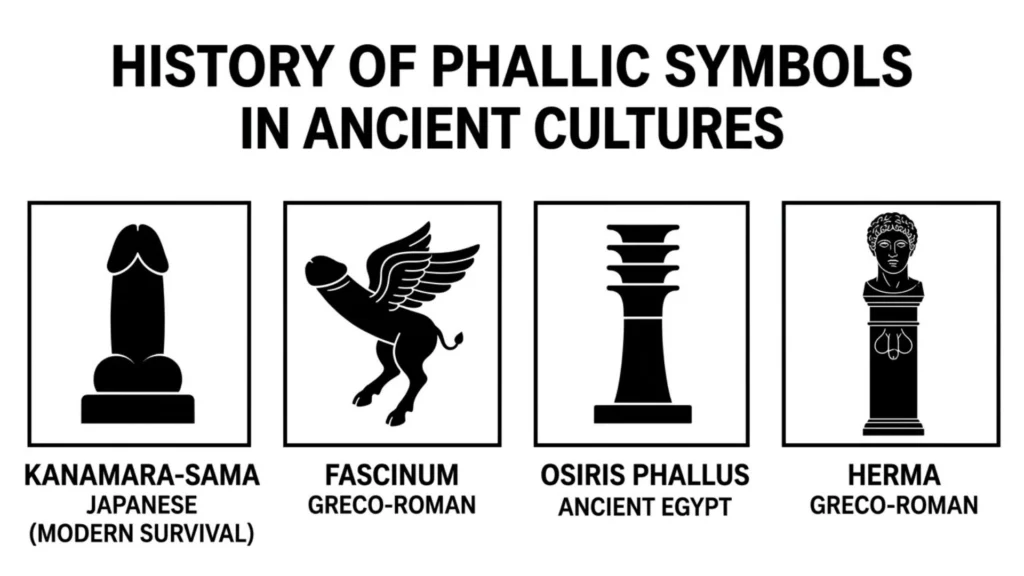
Phallic imagery appears in the artistic and archaeological records of several ancient societies. However, these societies did not necessarily share the same beliefs or use such objects in the same way.
Historical context is essential. It helps explain why an object may have served a protective, religious, decorative, political, or sexual purpose.
Phallic Symbols in Ancient Rome
Ancient Rome offers particularly clear examples of phallic objects used in everyday life. Roman artisans produced pendants, bronze ornaments, household decorations, and other objects featuring male genitalia.
Some of these objects served as protective charms. Roman beliefs about the evil eye held that a hostile or envious gaze could bring harm. Phallic imagery was among the forms used to counter that danger.
The Metropolitan Museum of Art documents first-century CE Roman bronze phallic amulets. One example combines a phallus with a hand gesture known as the mano fica. The museum identifies the combined imagery as protective against the evil eye. Other Roman examples were associated with good luck and protection from harmful forces
These objects challenge the assumption that explicit genital imagery always served a private or erotic purpose. In ancient Rome, it could appear in public settings and on everyday objects as part of familiar protective traditions.
The precise function of an individual artifact still depends on its evidence. Not every phallic object necessarily had the same use, and its shape alone does not reveal the beliefs of every person who encountered it.
Phallic Symbols in Ancient Greece
In ancient Greece, phallic imagery appeared in mythology, pottery, sculpture, religious celebrations, and theatrical traditions.
Two familiar mythological figures are Priapus and Pan. Priapus was associated with fertility, gardens, and generative power, while Pan was connected with nature and rustic life. Artistic representations of these figures could include exaggerated sexual features.
Phallic imagery also appeared in traditions associated with Dionysus, a god linked with wine, theater, festivity, and altered states of experience. Some Greek artistic and theatrical settings combined sexual humor, ritual, and public celebration.
Academic research on penile representations in ancient Greek art examines their appearance in pottery, sculpture, and theater, including their connections with fertility-related figures and traditions.
It would be misleading to say that every Greek phallic image had one religious meaning. Greek society included different communities, festivals, artistic conventions, and beliefs. An image in a comic performance might function differently from one used in a religious ceremony.
Phallic Imagery in Ancient Egypt
Ancient Egyptian religious art also included representations of male reproductive power. The god Min, for example, was associated with fertility and was sometimes depicted with an erect phallus.
Such imagery belonged to a broader religious system in which deities could be connected with reproduction, agricultural abundance, kingship, and the continuation of life. The significance of a particular image depends on its date, location, and relationship to other religious symbols.
Egyptian history spans thousands of years, so it is important not to treat every period as culturally identical. Artistic conventions and religious practices developed over time, and an interpretation supported for one object may not apply to another.
When researching a possible Egyptian phallic symbol, look for museum records, archaeological reports, and studies of the relevant deity or period. These sources are more reliable than modern lists that assign the same meaning to every anatomical image.
Phallic Symbols in Prehistoric Art
Some prehistoric objects have been interpreted as phallic because of their elongated or anatomical appearance. However, these interpretations can be difficult to establish.
Prehistoric communities often left no written explanations for their objects. Researchers must therefore consider the object’s material, shape, location, wear patterns, associated finds, and similarities to other artifacts.
Even with this evidence, uncertainty may remain. An object might have had a practical function, a symbolic purpose, or both. A shape that resembles male anatomy to a modern observer does not prove that prehistoric people viewed it in the same way.
The careful description possibly phallic is more accurate than presenting an uncertain interpretation as established fact. This approach respects the evidence while leaving room for further research.
Common Examples of Phallic Symbols
Phallic symbolism appears in a range of forms. Some examples are explicit and well documented, while others are debated or depend on the context in which they are viewed.
The Phallus Amulet
A phallus amulet is a small object shaped like male genitalia. Such objects were used in parts of the ancient Mediterranean world, including Roman society.
Roman examples could be made from bronze or other materials and worn as pendants or attached to larger objects. Some were associated with protection against the evil eye or with good fortune.
The design of an amulet may include additional features, such as hands, wings, or other protective imagery. These details can help researchers understand how the object was intended to function.
Today, an ancient phallus amulet might be displayed in a museum as an example of Roman religion, material culture, or everyday belief. Its modern presentation as an archaeological artifact does not mean that it originally served only as decoration.
The Shiva Lingam
The Shiva lingam, also spelled Shiva linga, is a sacred form associated with the Hindu god Shiva. It is an important focus of worship in many Hindu traditions and can be found in temples and other devotional settings.
Some scholars discuss the lingam’s phallic form and its associations with generative power. However, describing it solely as a sexual object ignores its wider theological and devotional significance.
Research on the lingam examines its role in Hindu mythology, iconography, pilgrimage, and worship. Benjamin J. Fleming’s academic overview, for example, explores the symbol’s complex history and its place in traditions devoted to Shiva. Read The Form and Formlessness of Śiva: The Linga in Indian Art, Mythology, and Pilgrimage.
The lingam may be interpreted within Hindu traditions in relation to Shiva’s divine presence, generative power, and other theological concepts. In some settings, it is paired with a yoni, a form associated with the feminine principle. Interpretations vary across traditions and texts.
The important point is that a sacred symbol cannot be understood fully through physical resemblance alone. Its ritual use, religious teachings, and significance to practitioners are central to an accurate explanation.
The Obelisk
An obelisk is a tall, tapering monument, usually made of stone. Some modern observers interpret obelisks as phallic because of their upright shape.
However, an obelisk’s documented meaning may involve religious symbolism, royal authority, commemoration, or architectural tradition. These historical roles should not be replaced by a modern interpretation based only on its shape.
A phallic reading may be discussed as one possible interpretation when supported by relevant evidence or scholarly analysis. It should not automatically be presented as the original purpose of every obelisk.
When examining a particular monument, consider its inscriptions, date, cultural origin, placement, and historical use. These details offer a stronger basis for interpretation than appearance alone.
Phallic Jewelry and Pendants
Jewelry can communicate identity, status, beliefs, or personal taste. In some ancient societies, phallic pendants functioned as protective charms. In modern settings, similar imagery may appear in fashion jewelry, contemporary art, or novelty accessories.
The context changes the interpretation. An ancient amulet with a documented protective function is not equivalent to a modern pendant worn for humor or artistic expression.
A useful analysis asks who made the object, who used it, and what purpose it served. Without that information, it is easy to project modern assumptions onto a historical artifact.
Phallic Imagery in Art and Architecture
Artists may use anatomical forms, exaggerated proportions, or abstract shapes to explore sexuality, masculine identity, dominance, or social power.
Architecture can also attract phallic interpretations. Towers, columns, spires, and monuments are sometimes discussed in terms of their resemblance to male anatomy. These interpretations can be relevant to cultural criticism, but they require care.
For example, an art critic might argue that a particular monument communicates masculine authority because of its form and political context. That is an interpretation that can be assessed through evidence. Simply claiming that every tall building is a phallic symbol is an unsupported generalization.
The strongest analysis distinguishes between a shape’s appearance, the creator’s intention, and the meaning that later viewers assign to it.
Religious and Spiritual Meanings of Phallic Symbols
Religious symbolism deserves careful treatment because an object may carry sacred meaning for its practitioners even when outside observers focus on its physical form.
Phallic imagery has appeared in some religious and ritual settings in connection with creation, fertility, protection, and divine power. These associations are not identical across cultures.
Fertility and Creation
In some traditions, phallic imagery refers to reproduction or the generation of life. Such imagery may be linked with agricultural abundance, family continuity, or divine creative power.
However, fertility is not the only possible meaning. A symbol may also represent protection, a deity, a social identity, or a particular ritual. Its interpretation depends on the tradition in which it appears.
It is also important to distinguish between fertility symbolism and claims about actual religious practices. An image that resembles male anatomy does not by itself prove that a community worshipped it or performed fertility rituals around it.
The Shiva Lingam in Hindu Worship
The Shiva lingam demonstrates why religious context matters. It is worshipped as a sacred form associated with Shiva, and its significance is shaped by Hindu theology, ritual practice, and devotional traditions.
Some interpretations discuss its relationship to generative power and the union of complementary principles. Other explanations emphasize Shiva’s presence and the symbol’s role in worship. These perspectives may differ depending on the tradition and source.
It is therefore inaccurate to reduce the lingam to a purely anatomical object. A respectful explanation acknowledges its religious importance and distinguishes scholarly discussion of its form from the beliefs of the people who worship it.
Protection and Ritual Objects
Some historical phallic objects were used as protective amulets rather than as images intended primarily to express sexual desire.
Roman amulets are a well-documented example. Their association with the evil eye shows that anatomical imagery could function as a form of protection in a particular cultural system.
That evidence should not be applied automatically to similar-looking objects from other places. Each artifact needs to be interpreted according to its own historical and cultural context.
Psychological Meaning of Phallic Symbols
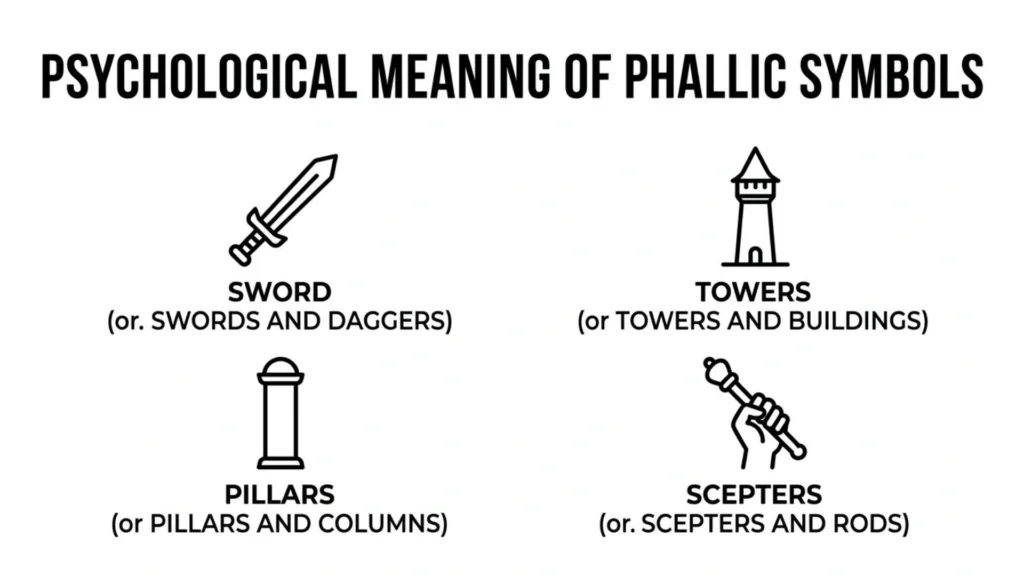
Phallic imagery also appears in psychology, psychoanalysis, literary criticism, and cultural studies. In these fields, it may be used to discuss sexuality, identity, masculinity, authority, or desire.
Psychological interpretations can be useful, but they are not universal explanations for every object or behavior.
Phallic Symbolism in Psychoanalysis
Psychoanalytic traditions, particularly those associated with Sigmund Freud and later theorists, gave phallic symbolism an important place in discussions of psychosexual development and unconscious meaning.
In psychoanalytic interpretation, phallic imagery may be connected with sexuality, identity, power, or developmental experiences. These ideas have influenced literary criticism and the interpretation of visual art.
However, psychoanalytic concepts are theoretical frameworks. They should not be treated as proof that a person who creates or notices an elongated shape has a particular unconscious desire.
A careful analysis distinguishes a theory’s interpretation from an established historical fact.
Masculinity, Dominance, and Authority
In cultural criticism, phallic imagery may be used to examine how societies represent masculinity and power.
An artwork might use an exaggerated phallic form to criticize a leader’s dominance or to question traditional expectations about men. Another work might use similar imagery to explore vulnerability, sexuality, or the limits of social authority.
The interpretation depends on the artwork’s wider context. The title, artist’s statements, surrounding imagery, and historical setting can all influence its meaning.
Why Psychological Interpretations Can Differ
Two viewers may interpret the same image differently because they bring different experiences, beliefs, and theoretical assumptions to it.
One viewer may see a monument as a statement about authority. Another may focus on its architectural function. A third may interpret it as a sexual reference.
These interpretations should not be treated as equally supported simply because each is possible. Evidence from the artwork, creator, or historical setting can help determine which readings are most convincing.
Phallic Symbols in Modern Art and Popular Culture
Phallic imagery continues to appear in modern art, advertising, humor, fashion, and popular culture. Its meaning depends on how and why it is used.
Phallic Imagery in Contemporary Art
Contemporary artists may use phallic forms to explore gender, sexuality, censorship, identity, consumer culture, or political power.
Some artworks are deliberately provocative. Others use anatomical imagery in an abstract or critical way. The presence of phallic imagery does not automatically make a work pornographic or mean that the artist is celebrating masculinity.
To interpret a modern artwork, consider what the artist is trying to communicate, how the form relates to other elements, and how the work responds to its cultural setting.
Humor, Satire, and Everyday Language
Phallic references can appear in jokes, cartoons, satire, and informal conversation. People may use the term to describe an object that resembles male anatomy, even when no sexual message was intended.
Humor can make the term playful in one situation and insulting or inappropriate in another. The audience and setting matter.
In academic or professional writing, it is generally better to explain the visual resemblance or cultural interpretation directly rather than use the term as a substitute for evidence.
Phallic Symbolism in Design and Advertising
Designers and advertisers sometimes use suggestive shapes to attract attention, create humor, or provoke a response. Critics may also interpret certain products or structures as phallic because of their shape or the cultural ideas surrounding them.
However, an observer’s reading is not the same as confirmed design intent. Unless a creator’s statements or other evidence support the interpretation, it is more accurate to describe it as a possible reading.
This distinction helps prevent subjective interpretations from being presented as proven facts.
How to Interpret a Phallic Symbol Correctly
If you encounter a possible phallic symbol in a museum, religious setting, historical text, building, or artwork, a few practical steps can help you assess its meaning.
1. Describe What You Can Actually See
Start with the object’s visible features. Is it an explicit anatomical representation, a stylized image, a religious sculpture, or an abstract structure?
A clear description separates observation from interpretation. Instead of immediately declaring a monument a fertility symbol, describe its shape and identify the evidence that supports a symbolic reading.
2. Identify Its Origin and Historical Period
Find out where and when the object was made, who created or used it, and where it was originally displayed.
The same form may have different meanings across historical periods and cultures. A Roman amulet should not be interpreted using the assumptions applied to a contemporary sculpture without considering the differences between their settings.
3. Look for Reliable Historical Evidence
Museum catalogues, archaeological reports, inscriptions, scholarly books, and academic articles can help explain an object’s likely purpose.
Prefer sources that identify the object, explain its provenance, and provide reasons for their interpretation. A short online claim that a shape is a phallic symbol is not enough to establish its historical significance.
4. Consider Alternative Explanations
An object might have served a practical, decorative, religious, protective, political, or sexual purpose. These possibilities should be assessed using evidence rather than treated as equally likely.
For example, a monument may have a documented royal or religious function even if modern viewers notice a phallic resemblance. The resemblance may be worth discussing, but it does not erase the monument’s known history.
5. Separate Original Meaning From Modern Interpretation
Modern viewers sometimes see meanings that the original creator did not intend. At other times, an object once used in a ritual or religious setting may be misunderstood when removed from its original context.
A strong interpretation makes this distinction explicit. It explains what is known, what is likely, and what remains uncertain.
Common Misconceptions About Phallic Symbols
Several common assumptions can lead to inaccurate or oversimplified explanations.
Every Tall Object Is a Phallic Symbol
No. Towers, columns, pillars, spires, and monuments have many architectural, religious, commemorative, and political functions. Their shape alone does not prove that they were intended as phallic symbols.
A phallic interpretation may be discussed when relevant, but it should not replace the historical evidence about a structure’s purpose.
Phallic Symbols Always Represent Sexual Desire
Not necessarily. Documented historical examples include objects used for protection, such as Roman amulets associated with warding off the evil eye.
Other examples may be linked with fertility, religious beliefs, artistic expression, humor, or social power. The meaning depends on the particular object and setting.
All Ancient Cultures Understood Phallic Imagery in the Same Way
Ancient societies had different religious systems, artistic conventions, and social values. Greek, Roman, Egyptian, and Hindu traditions should not be treated as interchangeable.
Similar forms can appear in different cultures without proving that the people who used them shared the same beliefs.
The Shiva Lingam Is Only a Sexual Object
This is an oversimplification. The Shiva lingam is a sacred form associated with Shiva and has an established role in Hindu worship.
Although scholars may discuss its physical form and generative associations, a complete explanation must also consider its theological, devotional, and ritual significance.
A Symbol Has Only One Possible Meaning
Some objects have well-documented functions, while others invite several interpretations. Historical evidence can help narrow the possibilities, but not every artwork or artifact has a single universally accepted meaning.
The best explanations distinguish between established facts, scholarly interpretations, and speculation.
Why Phallic Symbols Matter in the Study of Culture
Phallic symbols help researchers investigate how different societies have represented the body, reproduction, protection, masculinity, and religious belief.
Their value lies not simply in their appearance but in what they reveal about the people who made, used, displayed, or interpreted them.
They Reveal Historical Beliefs About Fertility and Protection
Some phallic objects provide evidence of beliefs about reproduction, good fortune, or protection from harm. Roman amulets, for instance, help researchers study how protective imagery appeared in everyday material culture.
These artifacts are most informative when examined alongside evidence about their date, location, and use.
They Show How Art Communicates Complex Ideas
A symbol can communicate an idea without spelling it out in words. Phallic imagery may express humor, religious meaning, sexual identity, or criticism of authority through a recognizable visual form.
The same image may communicate different ideas to different audiences. That makes context essential to art interpretation.
They Help Explain Changing Social Attitudes
The way people respond to phallic imagery has changed across cultures and historical periods. An object used as a familiar protective charm in one society may be viewed as sexual, humorous, or controversial by a modern audience.
Studying these differences helps readers avoid projecting present-day assumptions onto the past. It also reveals how social values influence the interpretation of art and material objects.
Frequently Asked Questions About Phallic Symbols
What Is the Meaning of a Phallic Symbol?
A phallic symbol is an object, image, or shape that represents or resembles the penis. Depending on its context, it may be associated with fertility, creation, protection, masculinity, sexuality, humor, or power. Its specific meaning depends on the culture and historical setting.
What Are Some Examples of Phallic Symbols?
Examples include ancient Roman phallic amulets, phallic imagery in ancient Greek art, the Hindu Shiva lingam, and some artworks interpreted as phallic. These examples do not all have the same meaning, and interpretations of abstract forms may be debated.
What Did Phallic Symbols Mean in Ancient Rome?
In ancient Rome, phallic objects could be associated with protection against the evil eye and with good fortune. Museum records document Roman bronze amulets that combined phallic imagery with other protective elements. The function of an individual artifact should still be assessed in its historical context.
Are Phallic Symbols Always Sexual?
No. Although phallic imagery relates to male anatomy, it can serve religious, protective, artistic, political, or humorous purposes. Its meaning depends on how it was created and used.
What Does the Shiva Lingam Symbolize?
The Shiva lingam is a sacred form associated with the Hindu god Shiva. It plays an important role in Hindu worship and has religious meanings connected with Shiva, divine presence, and generative power. Its significance cannot be reduced to a purely sexual interpretation.
Is an Obelisk a Phallic Symbol?
Some people interpret obelisks as phallic because of their tall, upright shape. However, obelisks also have specific architectural, historical, religious, and political roles. A phallic interpretation should be supported by relevant evidence rather than assumed from appearance alone.
What Is the Difference Between a Phallus and a Phallic Symbol?
A phallus refers to the penis or its artistic representation. A phallic symbol is an object, image, or shape that represents or resembles the phallus and communicates an additional idea, such as protection, fertility, power, or sexuality.
Why Did Ancient Romans Wear Phallic Amulets?
Some Romans wore phallic amulets as protective charms. These objects were associated with warding off the evil eye and attracting good fortune. Museum collections document examples from the Roman period, although the function of each object depends on its design and context.
Can an Object Be Phallic Without Its Creator Intending It?
Yes. A viewer may interpret an object as phallic because of its shape, even when there is no evidence that its creator intended a sexual reference. It is important to distinguish a viewer’s interpretation from documented artistic intent.
How Can You Research the Meaning of a Historical Phallic Symbol?
Start by identifying the object’s origin, date, material, and original setting. Then consult museum catalogues, archaeological reports, and academic research. Reliable sources can help distinguish established meanings from theories and modern speculation.
Why Are Phallic Symbols Important in Art History?
Phallic symbols help art historians study how societies represented sexuality, fertility, protection, religion, masculinity, and power. Their interpretation can reveal changing cultural values, but it requires attention to the object’s historical setting and the evidence surrounding it.
Conclusion
Phallic symbols have appeared in art, religion, jewelry, architecture, and everyday objects across many cultures and historical periods. Depending on their context, they may be associated with fertility, creation, protection, masculinity, authority, sexuality, or humor.
Roman protective amulets, phallic imagery in ancient Greek art, Egyptian religious representations, and the Hindu Shiva lingam illustrate how different societies have understood these forms in distinct ways. They also show why it is misleading to assign one universal meaning to every phallic image.
The most reliable way to understand a phallic symbol is to look beyond its shape. Consider who created it, how it was used, what historical evidence survives, and how people within its cultural tradition understood it. This approach produces a more accurate, respectful, and meaningful interpretation.

Dylan Anderson is a writer who enjoys turning complex topics into simple, engaging content that readers can actually use. His work focuses on clear explanations, practical insights and storytelling that feels natural and relatable. He is also the fictional author of The Quiet Compass of Ashford and Where the Cedar Lantern Glows. When he’s away from his keyboard, Dylan enjoys hiking, reading, and discovering inspiration in everyday life. He believes great writing should be informative, easy to understand and enjoyable from beginning to end.
 Adam Sullivan