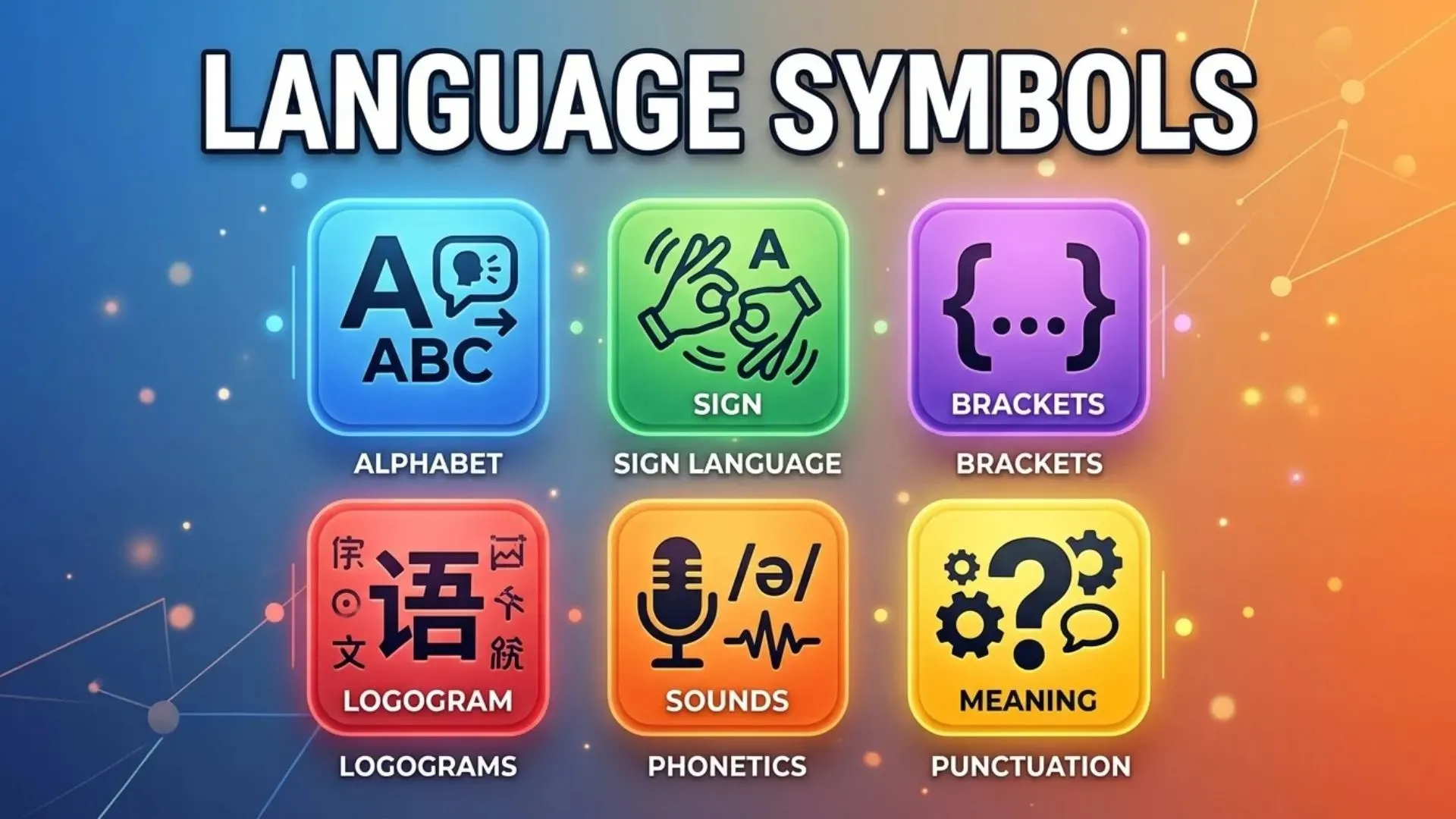
Language symbols help people communicate ideas, express emotions, record information, and understand messages. They include familiar letters such as A and B, punctuation marks such as ? and !, pronunciation symbols, and many other written characters.
In broader communication, symbols can also include images, gestures, and signs that people learn to interpret.
However, not every symbol works in the same way. A letter represents a unit within a writing system, a punctuation mark helps organize written language, and a symbol such as $ represents a particular currency.
A hand gesture may communicate a message, while a formal sign language uses a complete linguistic system with its own grammar and structure.
Understanding language symbols helps you read more accurately, recognize different writing systems, interpret messages, and appreciate how people communicate across cultures. This guide explains what language symbols mean, the main types, common examples, and the role context plays in understanding them.
What Are Language Symbols?
Language symbols are recognizable forms that represent sounds, words, ideas, grammatical information, or other meanings within a communication system. They can appear as written characters, marks, signs, or structured movements. Their meanings depend on how people use and interpret them.
For example, the letter A is part of the English writing system. The question mark ? indicates a question in standard English writing. The symbol % represents a percentage, while a familiar warning sign may communicate danger without using a complete sentence.
Language symbols do not always resemble the things they represent. The written word water does not look like water, and the letter W does not resemble the sound associated with it. People understand these forms because they have learned the conventions of a particular language or system.
How Language Symbols Represent Meaning
A symbol connects a visible or recognizable form with an idea, sound, object, or function. The relationship between the form and its meaning can work in different ways.
Some symbols represent speech sounds. Alphabetic letters, for example, help readers identify words and connect written language with spoken language. The relationship is not always one-to-one because a single letter can represent different sounds, depending on the word.
Other symbols communicate meaning through established conventions. A period usually marks the end of a statement in English, while a question mark signals a direct question. In mathematics, the equals sign indicates that two expressions have the same value.
Visual symbols may communicate through resemblance. A simple drawing of a house can represent a home or a place to stay. A crossed-out cigarette icon on a sign can communicate that smoking is prohibited.
The important point is that people interpret symbols through learned knowledge, context, and shared practices. A mark may be familiar to one group but confusing to someone who has never encountered it.
Why Shared Meaning Matters
Communication works best when the people involved understand the system being used. If you read an English sentence, you recognize the letters, words, and punctuation because you have learned their usual functions.
The same principle applies to other languages and symbol systems. A reader familiar with Arabic script can recognize its characters and follow the conventions of Arabic writing. Someone who has studied the International Phonetic Alphabet can interpret pronunciation notation that may look unfamiliar to other readers.
Shared understanding does not mean that every symbol has one universal meaning. Symbols can change meaning across languages, communities, professions, and situations. A character used in one writing system may have a different function in another, and an everyday gesture may be interpreted differently across cultures.
For this reason, understanding a symbol requires more than recognizing its shape. You also need to know the system in which it appears.
Main Types of Language Symbols
Language symbols come in several forms. Some are essential to written language, while others support pronunciation, specialized communication, or the exchange of information. The categories below provide a practical overview rather than a single formal classification used by every linguist.
Alphabet and Writing Symbols
Alphabetic letters are among the most familiar language symbols. They help represent words and, in many writing systems, correspond to speech sounds.
English uses the Latin alphabet, which contains 26 letters. These include uppercase forms such as A, B, and C and lowercase forms such as a, b, and c.
Other languages use different scripts. Arabic uses Arabic script, Russian uses Cyrillic, and Hindi commonly uses Devanagari. Chinese writing uses characters that represent meaningful linguistic units, often morphemes, rather than relying on an alphabet in the same way English does.
Writing systems do not all organize symbols according to the same principles. Some are alphabetic, some represent syllables, and others use characters associated with meaningful units. Many systems combine features or use additional marks to represent pronunciation and grammatical information.
Here are a few examples:
| Symbol or system | Main function | Example |
| Latin alphabet | Represents words through letters | English: book |
| Cyrillic script | Writes languages such as Russian | Russian: книга |
| Arabic script | Writes Arabic and other languages | Arabic: كتاب |
| Devanagari | Writes Hindi and several other languages | Hindi: भाषा |
| Chinese characters | Represent linguistic units within Chinese writing | 中文 |
| Japanese kana | Represent morae in Japanese | かな |
These examples show why it is inaccurate to assume that all languages use the same alphabet. Each writing system follows its own conventions, and a symbol’s role depends on the language in which it appears.
Punctuation Marks
Punctuation symbols organize written language. They help readers identify sentence boundaries, distinguish questions from statements, separate items, and understand how different parts of a sentence relate to one another.
Common punctuation marks include:
| Symbol | Name | Common use |
| . | Period | Ends a statement in American English |
| , | Comma | Separates items or parts of a sentence |
| ? | Question mark | Marks a direct question |
| ! | Exclamation point | Expresses strong feeling or emphasis |
| : | Colon | Introduces an explanation, list, or example |
| ; | Semicolon | Connects closely related independent clauses or separates complex list items |
| ‘ | Apostrophe | Marks possession or omitted letters in contractions |
| ” “ | Quotation marks | Enclose direct quotations or other quoted material, depending on style |
| ( ) | Parentheses | Add supplementary information |
| — | Em dash | Marks a break or adds emphasis in a sentence |
Consider these examples:
- Statement: You are learning about language symbols.
- Question: What do language symbols mean?
- Exclamation: That is an interesting discovery!
- List: Bring a notebook, pencil, ruler, and eraser.
Changing punctuation can affect how a sentence is read. Compare “Let’s eat, Grandma!” with “Let’s eat Grandma!” The comma separates the person being addressed from the invitation. Without it, the sentence can appear to suggest something very different.
Punctuation conventions also vary across languages and writing styles. Therefore, you should learn the rules of the language you are reading or writing instead of assuming that every mark is used identically everywhere.
Phonetic Symbols
Phonetic symbols represent speech sounds. They are especially useful in dictionaries, language learning, linguistics, speech research, and pronunciation guides.
One well-known system is the International Phonetic Alphabet (IPA). It provides symbols for describing speech sounds across languages. Unlike ordinary spelling, which can represent pronunciation inconsistently, phonetic notation is designed to show how words are pronounced.
For example, the IPA symbol /ʃ/ represents the initial sound in the English word ship. The symbol /ʃ/ also appears in the word shoe. It represents a sound, not the spelling of a complete word.
Here are a few common IPA examples:
| IPA symbol | Example word | Sound description |
| /ʃ/ | ship | The initial sound in ship |
| /tʃ/ | chair | The initial sound in chair |
| /ŋ/ | sing | The final sound in sing |
| /æ/ | cat | The vowel sound in many American pronunciations of cat |
| /θ/ | think | The initial sound in think |
These examples use broad, simplified pronunciation descriptions. Exact pronunciation can vary by accent, and IPA transcriptions may differ depending on whether a writer is describing phonemes or more detailed phonetic sounds.
Phonetic symbols are helpful because spelling does not always reveal pronunciation. For example, English words such as though, through, and tough contain similar letter combinations but have different pronunciations. A phonetic transcription can make those differences easier to understand.
Symbols Used in Grammar and Linguistics
Linguists use specialized symbols to describe the structure of language. These symbols allow researchers, teachers, and students to discuss speech sounds, word formation, sentence structure, and meaning with precision.
Some symbols appear in grammatical explanations, while others belong to technical notation. Their meaning depends on the framework or discipline in which they are used.
Examples include:
- * — often placed before a linguistic example judged ungrammatical or unattested under a particular analysis.
- / — commonly used to enclose phonemic transcriptions, as in /p/.
- [ ] — often used for phonetic transcriptions or additional technical notation.
- → — may indicate a rule or a change from one form to another in a formal analysis.
- Ø — can represent the absence of an element in certain linguistic descriptions.
These conventions are not universal across every branch of linguistics. For example, square brackets and slashes have different functions when describing phonetic detail and phonemic categories. The surrounding explanation tells you how to interpret them.
If you encounter an unfamiliar symbol in a textbook, check the book’s notation guide or glossary. A symbol may have a specialized meaning that differs from its everyday use.
Mathematical and Scientific Symbols
Mathematical and scientific symbols often appear alongside ordinary language. They communicate relationships, quantities, measurements, and technical concepts in a compact form.
Common examples include:
| Symbol | Name | Meaning or use |
| + | Plus sign | Addition |
| − | Minus sign | Subtraction or a negative value |
| = | Equals sign | Indicates equality |
| ≠ | Not equal to | Indicates that values differ |
| < | Less than | Compares two values |
| > | Greater than | Compares two values |
| % | Percent sign | Expresses a value per hundred |
| ° | Degree sign | Used for angles or temperature scales |
| π | Pi | A mathematical constant |
| √ | Square root sign | Indicates a square root operation |
For example, 4 + 3 = 7 uses mathematical symbols to express a complete relationship. The plus sign indicates addition, and the equals sign shows that the expression on the left has the same value as the number on the right.
Currency signs also appear in written communication. Symbols such as $, €, and £ can represent currencies, but their interpretation may depend on the country and the surrounding context. The dollar sign, for instance, is used for more than one currency.
These examples demonstrate that symbols can make information concise. However, technical notation should be explained when an audience may not recognize it.
Visual Symbols and Signs
Visual symbols communicate information through pictures, shapes, colors, or familiar designs. They appear on road signs, public notices, maps, packaging, websites, and mobile applications.
Some visual signs resemble the objects they represent. A small drawing of a bicycle can indicate a bicycle route. Other signs depend on learned conventions, such as a red circle with a diagonal line commonly used to indicate that an action is prohibited.
Examples include:
- A pedestrian symbol at a designated crossing.
- A directional arrow showing which way to go.
- A recycling symbol used to identify recycling-related information.
- A warning triangle used to draw attention to a hazard.
- A magnifying-glass icon commonly used for search functions.
Not all visual signs are language symbols in the narrow linguistic sense. Some communicate through images or standardized visual conventions without representing words or speech sounds. Still, they are relevant to the broader study of how people exchange information.
The surrounding environment often determines their precise meaning. An arrow on a road sign may direct traffic, while the same arrow in a software interface may indicate navigation or expansion.
Gestures and Sign Languages
Gestures can communicate messages without spoken words. People may wave to greet someone, point toward an object, nod to express agreement, or use facial expressions to show emotion.
However, ordinary gestures should not be confused with formal sign languages.
Sign languages are complete natural languages, not merely collections of hand signs. They have linguistic structure and use features such as handshape, movement, location, facial expression, and body position to convey meaning. Their grammar and vocabulary are not simply copies of spoken languages.
American Sign Language (ASL), for example, is a language used by many people in the United States and parts of Canada. It is distinct from English and has its own grammatical patterns. Other communities use other sign languages, which can differ substantially from ASL.
A gesture that seems obvious to one person may not have the same meaning in another community. Even a familiar gesture can be misunderstood when the cultural context changes.
When writing about sign language, it is important to respect its status as a language. Do not describe it as universal, and do not assume that a person who knows one sign language automatically understands another.
Digital Symbols and Emoji
Digital communication uses many symbols to convey information quickly. These include punctuation, currency signs, arrows, interface icons, special characters, and emoji.
Emoji can add emotional tone or context to a text message. For example, a smiling face may signal friendliness, while a thumbs-up emoji may express approval or acknowledgment. Yet the intended meaning can depend on the conversation, relationship, culture, and platform.
Consider the message “Great job 👍.” In one conversation, it may be sincere praise. In another, the same emoji might feel brief or sarcastic. The surrounding words and relationship between the people help determine how it is understood.
Digital symbols also rely on technical standards. The Unicode Standard provides a consistent way for computers to represent characters used in many writing systems, along with punctuation, mathematical signs, and emoji. This helps text move between compatible devices and software without each system needing a completely separate character scheme.
Still, the same emoji may appear slightly different across platforms. Its visual design can influence how a reader interprets its tone, even when the underlying character is the same.
Common Language Symbols and Their Meanings
The phrase “language symbols” covers several categories, so it helps to look at examples side by side. The following table focuses on common written symbols and their usual functions.
| Symbol | Name or category | Common meaning or function | Example |
| A | Letter | Represents a unit in the Latin alphabet | Apple |
| ? | Question mark | Marks a direct question | Where are you? |
| ! | Exclamation point | Adds emphasis or expresses strong feeling | Wonderful! |
| , | Comma | Separates items or sentence elements | Red, blue, and green |
| & | Ampersand | Represents “and” in certain names and expressions | Research & Development |
| @ | At sign | Used in email addresses and online usernames | name@example.com |
| # | Number sign or hash | Used for numbers, labels, and hashtags | #Language |
| % | Percent sign | Expresses a proportion per hundred | 25% |
| $ | Dollar sign | Represents a dollar-denominated currency | $10 |
| € | Euro sign | Represents the euro currency | €20 |
| → | Right arrow | Indicates direction or a relationship | A → B |
| = | Equals sign | Indicates equality | 2 + 2 = 4 |
| ≠ | Not-equal sign | Indicates inequality | 5 ≠ 7 |
| / | Slash | Separates items or has technical uses | and/or |
| … | Ellipsis | Indicates omission or a trailing pause in many styles | I was thinking… |
A symbol’s function can change with context. The hash sign, for example, may introduce a number in one setting and form part of a social-media hashtag in another. A slash may separate alternatives in everyday writing but represent division in mathematics.
This is why a useful symbol guide should explain not only the name of a character but also its common functions and the situations in which those functions apply.
How to Read Unfamiliar Symbols
If you come across a symbol you do not recognize, use a few simple steps to work out its meaning.
- Look at the surrounding text. Words, numbers, and punctuation nearby often provide clues.
- Identify the type of material. A symbol in a dictionary may be phonetic, while one in a spreadsheet may be mathematical or technical.
- Consider the language or writing system. A character may belong to a script you have not studied.
- Check a reliable reference. Dictionaries, academic resources, specialist glossaries, and official standards can help confirm its function.
- Avoid assuming one universal meaning. A symbol may have several uses across different fields or communities.
For example, the slash in a date may separate month, day, and year. In a mathematical expression, it can indicate division. In phonemic notation, slashes can enclose a transcription. Its shape remains similar, but the convention changes with the context.
What Is the Difference Between Symbols, Signs, and Icons?
The words symbol, sign, and icon are sometimes used interchangeably in everyday conversation. In semiotics and communication studies, however, they can describe different relationships between a form and what it represents.
A symbol commonly depends on a learned convention. The written word cat refers to an animal because English speakers have learned the word’s meaning. The letters do not physically resemble a cat.
An icon represents something through resemblance. A drawing of a cat can be recognized because it looks like the animal it depicts.
An index points to something through a connection or indication. Smoke, for example, may be evidence that something is burning. This relationship does not depend only on an arbitrary label.
A sign is a broader term that can include many forms of meaning-bearing information. Depending on the theory being used, signs may include symbols, icons, and indexes.
These distinctions are useful, but not every academic framework defines the terms in precisely the same way.
Examples of Symbols, Icons, and Indexes
| Type | Example | How it communicates |
| Symbol | The word “home” | Uses a learned language convention |
| Icon | A drawing of a house | Resembles the object it represents |
| Index | Smoke from a fire | Indicates a likely physical cause |
| Visual sign | A directional arrow | Communicates direction through a convention |
| Language character | The letter B | Functions within a writing system |
The categories can overlap in practical situations. An icon may also function as a symbol in a particular interface, and a sign may combine text, color, and imagery. The goal is not to force every example into one rigid box but to understand how the form communicates information.
How Context and Culture Affect Symbol Meaning
Symbols do not always carry the same meaning everywhere. Language, cultural experience, social expectations, and the situation in which a symbol appears can all affect interpretation.
The Role of Context
Context helps readers determine which meaning is intended when a symbol has more than one possible use.
Take the symbol #. On a social-media platform, it often introduces a hashtag, as in #TravelTips. In some countries or contexts, the same mark may be called a number sign and appear before a number. A telephone keypad may label it as a hash key.
The mark itself has not changed. Its function depends on where and how it is used.
The same principle applies to words, gestures, and punctuation. A question mark in a sentence indicates a question, but a question mark used alone in a message may express confusion or request clarification.
Cultural Differences in Symbol Meaning
Some symbols have meanings shaped by history, religion, custom, or local practice. Colors, animals, hand gestures, and decorative designs may carry different associations in different communities.
For example, a gesture used as a friendly greeting in one place may be unfamiliar or inappropriate in another. A color associated with celebration in one cultural setting may have a different association elsewhere.
Do not assume that a symbol’s meaning is universal simply because it is familiar to you. When discussing cultural symbols, use sources from the relevant community whenever possible, especially if the symbol has religious, historical, or ceremonial significance.
Why Symbols Can Be Misunderstood
Misunderstandings occur when people interpret a symbol using different conventions. Someone unfamiliar with a technical notation may mistake it for decoration. A reader who does not know a writing system may be unable to identify a character. A brief digital message may also seem rude or sarcastic if the recipient interprets its tone differently from the sender’s intention.
To reduce confusion, use symbols consistently, explain unfamiliar notation, and provide context when communicating with people who may not share the same background.
Why Language Symbols Matter in Communication
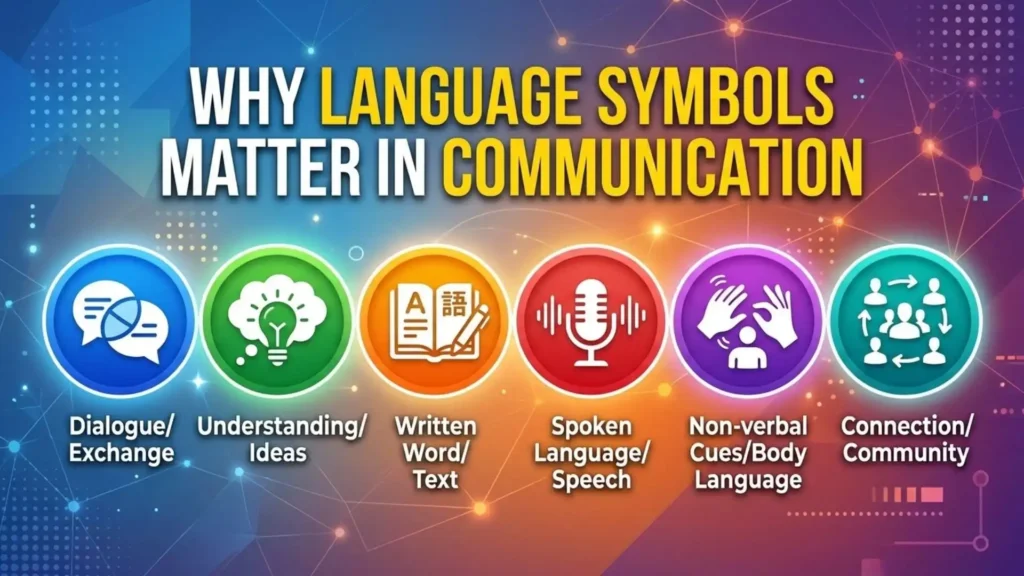
Language symbols make it possible to record, share, and interpret information across time and distance. Their importance extends from everyday conversations to education, science, technology, and cultural preservation.
They Help People Read and Write
Letters and other writing characters allow people to record language in a visible form. Readers can revisit a message, study a text, or share information with people who are not present.
Writing systems also support education. Students learn to recognize characters, connect them with words and meanings, and follow the conventions that make written communication understandable.
They Make Complex Information Easier to Express
A short symbol can communicate information that would otherwise require several words. Mathematical notation allows people to describe relationships between quantities. Scientific symbols help researchers represent units, processes, and technical concepts.
Punctuation performs a similar function within ordinary writing. It helps organize sentences and makes relationships between ideas easier to follow.
They Support Communication Across Languages
Different writing systems allow communities to record their languages in ways suited to their linguistic traditions. Digital standards such as Unicode help computers process and exchange text from many scripts, rather than limiting communication to a small set of characters.
This technical support is important for education, international communication, publishing, and the preservation of languages that use less widely supported scripts.
They Preserve Knowledge and Culture
Writing and symbol systems help communities record stories, literature, historical documents, names, and specialized knowledge. Traditional inscriptions and writing practices can provide valuable evidence about past societies.
Symbols may also carry cultural meaning beyond their everyday function. Their interpretation deserves care, particularly when they are connected to a community’s identity, beliefs, or heritage.
They Improve Digital Communication
Digital symbols make interfaces easier to navigate and messages easier to interpret. A magnifying-glass icon commonly suggests search, a gear often indicates settings, and an arrow may show navigation.
These conventions are useful only when people can understand them. Clear labels, familiar designs, and accessible alternatives help users who may not recognize an icon immediately.
Common Misunderstandings About Language Symbols
All Languages Use the Same Symbols
They do not. Languages use different writing systems, and some share scripts while others do not. Even when two languages use the same script, individual characters may have different sounds or functions.
Every Symbol Has Only One Meaning
Many symbols have multiple uses. Their meaning can change according to context, culture, and the field in which they appear. A symbol guide should explain common functions instead of claiming that one interpretation always applies.
Symbols Always Look Like What They Represent
Some visual icons resemble objects, but many symbols do not. Letters, words, and mathematical signs often depend on convention rather than visual resemblance.
Sign Language Is Just Gestures
Formal sign languages are complete natural languages with their own grammar and linguistic structure. Everyday gestures are not automatically part of a sign language, and sign languages are not universal.
Emoji Have Exactly the Same Meaning for Everyone
Emoji can communicate emotion or add tone, but their interpretation varies. The conversation, relationship between participants, culture, and platform can influence how a particular emoji is understood.
A Symbol’s Meaning Never Changes
Symbol use can evolve over time. New technologies create new uses, social practices change, and older symbols may acquire additional meanings. It is best to consult current and context-appropriate sources when a symbol’s interpretation matters.
Frequently Asked Questions
What are language symbols?
Language symbols are forms that represent sounds, words, ideas, grammatical information, or other meanings within a communication system. Examples include letters, punctuation marks, phonetic symbols, and characters from different writing systems.
What are some examples of language symbols?
Common examples include A, B, and C; punctuation marks such as ?, !, and ,; phonetic symbols such as /ʃ/; and specialized marks such as +, =, and %. Visual signs, gestures, and emoji can also communicate meaning in broader communication systems.
What are the main types of language symbols?
Common categories include alphabetic letters, characters from other writing systems, punctuation marks, phonetic symbols, linguistic notation, mathematical and scientific symbols, visual signs, and digital symbols. Formal sign languages also use structured visual forms to communicate linguistic meaning.
Why are symbols important in language?
Symbols help people record information, represent speech and ideas, organize writing, express relationships, and communicate across distances. They also support education, technical work, digital communication, and the preservation of cultural knowledge.
Are language symbols universal?
No. Some symbols are widely recognized, but many depend on a particular language, culture, or specialized system. The same symbol can have different functions in different contexts, so its meaning should not automatically be assumed to be universal.
What is the difference between a letter and a symbol?
A letter is a character used within a writing system, often to represent a speech sound or part of a written word. Symbol is a broader term that can include letters as well as punctuation marks, mathematical signs, and other forms that represent meaning.
What is the difference between a symbol and an icon?
A symbol often communicates through a learned convention, while an icon commonly represents something through resemblance. The written word tree is a symbol, whereas a drawing of a tree is an icon. In practice, one item can serve more than one function.
How do I find the meaning of an unfamiliar symbol?
Start by examining the surrounding text and the type of material in which it appears. Then identify the relevant language or field and consult a reliable dictionary, academic resource, or specialist reference. Context is often essential to choosing the correct interpretation.
Conclusion
Language symbols are an essential part of how people represent words, sounds, ideas, and information. They appear in alphabets, writing systems, punctuation, pronunciation guides, scientific notation, digital messages, and many forms of visual communication.
Learning about these symbols helps you understand written language, interpret unfamiliar marks, and recognize the conventions that make communication possible. It also reminds you that a symbol’s meaning is not always fixed or universal. Context, culture, and shared knowledge all influence how people understand what they see.
Whether you are studying a new language, reading a dictionary, using digital tools, or exploring communication across cultures, start by identifying the system in which a symbol appears. Once you understand its context and purpose, its meaning becomes much easier to interpret.

Dylan Anderson is a writer who enjoys turning complex topics into simple, engaging content that readers can actually use. His work focuses on clear explanations, practical insights and storytelling that feels natural and relatable. He is also the fictional author of The Quiet Compass of Ashford and Where the Cedar Lantern Glows. When he’s away from his keyboard, Dylan enjoys hiking, reading, and discovering inspiration in everyday life. He believes great writing should be informative, easy to understand and enjoyable from beginning to end.
 Adam Sullivan