
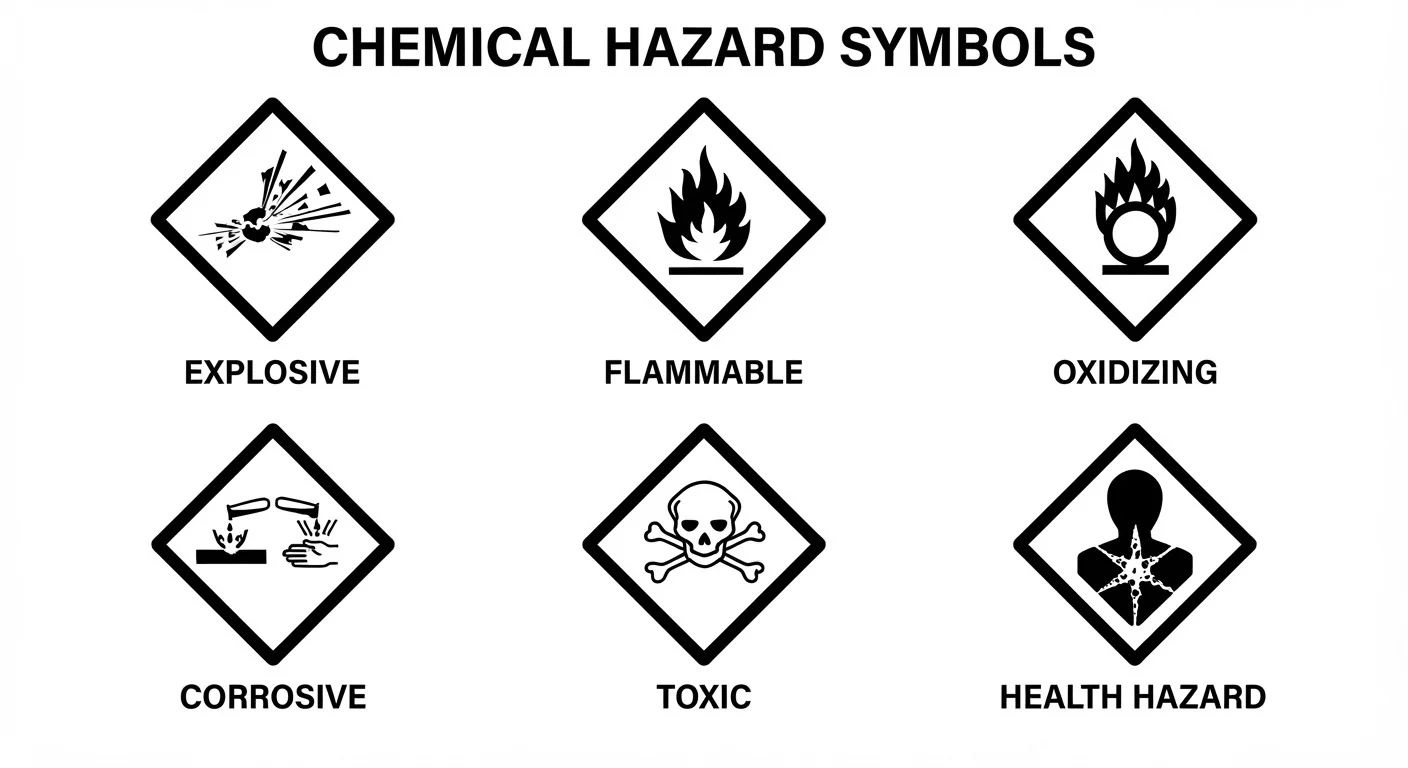
Chemical hazard symbols help you recognize dangerous substances before handling, storing, transporting, or using them. You can find these warning symbols on chemical bottles, laboratory containers, industrial materials, cleaning products, and agricultural chemicals. Each symbol communicates a particular type of danger and helps people understand the risks associated with a substance.
Some chemical hazard symbols warn about flammable liquids, explosive materials, and gases under pressure. Others identify toxic substances, corrosive chemicals, and materials that may cause serious health problems. Understanding these warnings can help you avoid accidents, choose suitable protective equipment, and handle chemicals more responsibly.
The Globally Harmonized System of Classification and Labelling of Chemicals (GHS) recognizes nine standard hazard pictograms. Each pictogram uses a black symbol inside a white diamond with a red border. Together, they communicate physical, health, and environmental hazards.
This guide explains all nine chemical hazard symbols, their meanings, common examples, and safety precautions. You will also learn how to read chemical labels, understand hazard categories, recognize OSHA requirements, compare GHS with NFPA symbols, and respond to accidental chemical exposure.
Complete Chemical Hazard Symbols Chart With Meanings
The nine GHS chemical hazard symbols provide a quick way to identify different types of chemical dangers. Each pictogram has a specific meaning, although one chemical may display several symbols when it presents multiple hazards.
Here is a quick reference chart showing all nine pictograms, their GHS codes, and the dangers they communicate.
| Chemical hazard symbol | GHS code | Meaning |
| Exploding Bomb | GHS01 | Explosive or unstable substances |
| Flame | GHS02 | Flammable materials and fire-related hazards |
| Flame Over Circle | GHS03 | Oxidizing substances that intensify fires |
| Gas Cylinder | GHS04 | Gases stored under pressure |
| Corrosion | GHS05 | Severe skin burns, eye damage, and metal corrosion |
| Skull and Crossbones | GHS06 | Severe acute toxicity |
| Exclamation Mark | GHS07 | Irritation and certain harmful effects |
| Health Hazard | GHS08 | Serious or long-term health effects |
| Environment | GHS09 | Toxicity to aquatic organisms and ecosystems |
Why Are Chemical Hazard Symbols Important?
Chemical hazard symbols communicate risks quickly and consistently. A person does not need to understand every technical detail about a chemical to recognize that a warning deserves attention.
These symbols are particularly useful in workplaces where employees handle unfamiliar substances or work with several chemicals throughout the day.
Their main purposes include:
- Identifying dangers: They help people recognize explosive, flammable, toxic, and corrosive substances.
- Preventing accidents: They encourage workers to take appropriate precautions before handling chemicals.
- Improving communication: Standardized pictograms make important warnings easier to recognize across language barriers.
- Supporting safe storage: They help users identify incompatible substances and follow suitable storage arrangements.
- Protecting health: They alert people to chemicals that may cause immediate injuries or long-term health problems.
- Reducing environmental damage: They identify substances that may harm aquatic organisms and ecosystems.
For example, a bottle displaying the flame pictogram warns users about fire-related hazards. A container showing the corrosion pictogram communicates the potential for serious skin burns, eye damage, or metal corrosion.
What Are Chemical Hazard Symbols?

Chemical hazard symbols are standardized pictograms used on labels to communicate the dangers associated with substances and chemical mixtures.
Most modern chemical warning labels follow the Globally Harmonized System of Classification and Labelling of Chemicals, commonly called GHS.
The United Nations developed GHS to create a consistent approach to classifying chemical hazards and communicating safety information. It provides a common framework for governments, manufacturers, suppliers, employers, and chemical users.
Under the GHS framework, a standard hazard pictogram contains three main visual elements:
- A white background.
- A black hazard symbol.
- A red diamond-shaped border.
The black image communicates the type of danger. The red border helps users recognize the pictogram as part of the chemical labeling system.
GHS covers three broad groups of hazards: physical hazards, health hazards, and environmental hazards.
For example, a flammable liquid presents a physical hazard because it can ignite. A toxic substance presents a health hazard because exposure can harm the body. A chemical that damages aquatic organisms presents an environmental hazard.
How Many Chemical Hazard Symbols Are Required by OSHA?
The GHS system recognizes nine standard chemical hazard pictograms. However, the United States Occupational Safety and Health Administration (OSHA) requires eight pictograms under its Hazard Communication Standard.
The environmental hazard pictogram is the ninth symbol. OSHA does not require this pictogram because environmental hazards fall outside the scope of its workplace hazard communication requirements.
Here is how the systems differ:
| Requirement | GHS framework | US OSHA Hazard Communication Standard |
| Standard pictograms | Nine | Eight required |
| Physical hazard warnings | Included | Included |
| Health hazard warnings | Included | Included |
| Environmental pictogram | Included | Not mandatory |
| Red diamond design | Standard format | Standard format |
You may still encounter the environmental pictogram on products or labels used in the United States. Its presence does not mean the label is incorrect. It may provide additional environmental information.
The distinction matters because GHS is an international framework, while OSHA implements chemical hazard communication requirements through US workplace regulations.
Countries and regions can adopt the framework differently. Therefore, users should follow the regulations that apply to their location and the product concerned.
9 Chemical Hazard Symbols and Their Meanings
Each GHS pictogram identifies a particular hazard or group of hazards. Learning the differences can help you understand chemical labels and recognize potential dangers before exposure.
1. Exploding Bomb Symbol (GHS01)
The exploding bomb symbol warns about explosives and certain unstable chemicals that may react violently under particular conditions.
These substances can release large amounts of energy, heat, pressure, or dangerous fragments. Some may become unstable when exposed to impact, friction, heat, or other triggering conditions.
Common hazards associated with this pictogram include:
- Explosive substances and mixtures.
- Certain self-reactive chemicals.
- Certain organic peroxides.
- Materials that may undergo dangerous decomposition.
Examples: Certain explosive compounds, unstable chemical mixtures, and specific organic peroxides may receive this classification.
Safety precautions:
- Keep the substance away from ignition sources and excessive heat.
- Avoid unnecessary impact, friction, or rough handling.
- Follow the manufacturer’s specific storage instructions.
- Do not mix the chemical with other substances without an approved procedure.
- Allow only trained and authorized personnel to handle materials requiring specialized controls.
The exploding bomb pictogram should never be treated as an ordinary warning. If you encounter an unfamiliar container carrying this symbol, avoid disturbing it and follow the relevant workplace safety procedures.
2. Flame Symbol (GHS02)
The flame symbol identifies flammable substances and certain other chemicals that create fire-related hazards.
These substances may ignite when exposed to sparks, open flames, heat, or other ignition sources. Some release vapors that can travel through the air and ignite away from the original container.
The flame pictogram can apply to several types of hazards:
- Flammable gases.
- Flammable liquids.
- Flammable solids.
- Pyrophoric substances.
- Self-heating chemicals.
- Substances that release flammable gases when exposed to water.
- Certain self-reactive substances and organic peroxides.
Examples: Certain ethanol products, acetone, gasoline, and flammable industrial solvents may carry this pictogram.
The exact classification depends on the product’s properties and applicable regulatory criteria.
Safety precautions:
- Keep flammable substances away from flames, sparks, and hot surfaces.
- Store them in suitable, approved containers.
- Provide appropriate ventilation when handling volatile liquids.
- Avoid smoking in areas where flammable chemicals are present.
- Follow workplace procedures for controlling ignition sources.
- Keep containers properly closed when they are not in use.
Remember that flammable vapors can create dangers even when the liquid itself does not appear to be burning.
3. Flame Over Circle Symbol (GHS03)
The flame-over-circle symbol identifies oxidizing chemicals. These substances can cause or intensify fires by supporting combustion.
An oxidizer does not necessarily burn by itself. However, it may make other materials ignite more easily or burn more intensely.
This pictogram applies to:
- Oxidizing gases.
- Oxidizing liquids.
- Oxidizing solids.
Examples: Certain concentrated hydrogen peroxide products, potassium permanganate, and specific nitrate compounds may be classified as oxidizers.
Safety precautions:
- Keep oxidizing chemicals away from incompatible combustible materials.
- Follow the manufacturer’s storage and separation instructions.
- Avoid contamination with oils, grease, and other incompatible substances.
- Use suitable protective equipment.
- Follow approved procedures when handling or transferring oxidizers.
The important difference between the flame and flame-over-circle symbols is their meaning. The flame warns about flammability and other fire-related hazards, while the flame over a circle warns about substances that can support or intensify combustion.
4. Gas Cylinder Symbol (GHS04)
The gas cylinder symbol warns that a container holds gas under pressure.
Compressed gases can be dangerous when their containers become damaged, overheated, or improperly handled. Some refrigerated liquefied gases can also cause severe cold injuries.
This pictogram is associated with:
- Compressed gases.
- Liquefied gases.
- Refrigerated liquefied gases.
- Dissolved gases.
- Certain gases under pressure that may explode when heated.
Examples: Oxygen cylinders, carbon dioxide cylinders, nitrogen containers, and industrial gas cylinders may display this warning.
Safety precautions:
- Secure cylinders to prevent them from falling.
- Protect containers from excessive heat.
- Use compatible regulators, valves, and connections.
- Follow the supplier’s instructions for storage and transportation.
- Keep cylinders in appropriate, ventilated storage areas.
- Protect valves from damage.
Never attempt to repair a damaged cylinder or valve yourself. A pressurized container requires proper handling and qualified assistance.
5. Corrosion Symbol (GHS05)
The corrosion symbol warns about chemicals that can cause severe skin burns, serious eye damage, or corrosion of metals.
These substances may destroy living tissue following direct contact. The severity of an injury depends on the chemical’s properties, concentration, amount, and exposure time.
The corrosion pictogram identifies hazards such as:
- Skin corrosion.
- Serious eye damage.
- Corrosion of metals.
Examples: Certain concentrated hydrochloric acid, sulfuric acid, and sodium hydroxide products may carry this symbol.
Safety precautions:
- Wear suitable chemical-resistant gloves.
- Use protective goggles or a face shield when required.
- Avoid direct skin and eye contact.
- Follow appropriate storage and handling instructions.
- Use suitable ventilation when the procedure requires it.
- Keep incompatible chemicals separated.
- Follow established spill-response procedures.
If a corrosive substance contacts your skin or eyes, begin emergency flushing immediately according to the product’s safety instructions and seek appropriate medical assistance. Do not delay emergency action while searching for additional information.
6. Skull and Crossbones Symbol (GHS06)
The skull and crossbones symbol indicates severe acute toxicity.
Chemicals carrying this pictogram may cause serious poisoning or death after exposure. Depending on the substance, harmful exposure can occur through swallowing, inhalation, or skin contact.
This pictogram covers certain categories of:
- Acute oral toxicity.
- Acute dermal toxicity.
- Acute inhalation toxicity.
Examples: Certain highly toxic pesticides, specific poisonous industrial chemicals, and some laboratory substances may carry this warning.
Safety precautions:
- Never taste or directly smell an unknown chemical.
- Avoid inhaling dust, vapors, and gases.
- Use the protective equipment specified for the substance.
- Handle the chemical only according to approved procedures.
- Keep containers properly closed and labeled.
- Store toxic materials securely.
- Follow emergency procedures after suspected exposure.
The skull and crossbones symbol communicates a serious immediate health risk. Never assume that a small amount of a toxic substance is harmless.
7. Exclamation Mark Symbol (GHS07)
The exclamation mark symbol identifies certain chemicals that may cause irritation, harmful effects, or other less severe health hazards.
Depending on the chemical classification, it may warn about skin irritation, eye irritation, allergic skin reactions, or harmful acute toxicity.
Hazards associated with this symbol include:
- Skin irritation.
- Eye irritation.
- Skin sensitization.
- Harmful acute toxicity.
- Respiratory tract irritation.
- Certain narcotic effects, such as dizziness or drowsiness.
Examples: Certain solvents, detergents, household cleaning products, and chemical mixtures may display this pictogram.
Safety precautions:
- Avoid direct contact with the substance.
- Wear suitable gloves and eye protection.
- Work in an appropriately ventilated area.
- Avoid breathing dust, mist, or vapors.
- Wash your hands after handling chemicals.
- Follow the label’s first-aid instructions.
Although the exclamation mark generally indicates less severe hazards than the skull and crossbones, it should not be ignored. Repeated exposure to irritants can still cause significant health problems.
8. Health Hazard Symbol (GHS08)
The health hazard symbol identifies chemicals that may cause serious or long-term health effects.
These effects may develop after repeated exposure or occur through specific exposure routes. Some hazards may not produce immediate symptoms, which makes careful handling especially important.
This pictogram is associated with:
- Carcinogenicity.
- Germ cell mutagenicity.
- Reproductive toxicity.
- Respiratory sensitization.
- Specific target organ toxicity.
- Aspiration toxicity.
Examples: Certain benzene-containing products, classified industrial solvents, and specific respiratory sensitizers may carry this symbol.
Safety precautions:
- Read the chemical’s health hazard information before handling it.
- Minimize exposure as much as possible.
- Follow workplace exposure-control procedures.
- Use suitable ventilation or approved respiratory protection when required.
- Wear the protective clothing specified for the task.
- Avoid unnecessary or repeated exposure.
- Follow medical surveillance requirements when applicable.
The main difference between this symbol and an immediate toxicity warning is the type of health risk it communicates. The health hazard pictogram often identifies serious effects that may develop over time or through particular forms of exposure.
9. Environmental Hazard Symbol (GHS09)
The environmental hazard symbol warns that a chemical may harm aquatic organisms and ecosystems.
Certain substances can damage fish, aquatic plants, and other organisms. Some may also cause long-lasting environmental effects.
Hazards associated with this symbol include:
- Acute aquatic toxicity.
- Chronic aquatic toxicity.
- Long-lasting harmful effects on aquatic environments.
Examples: Certain pesticides, biocides, and industrial chemicals may receive this classification.
Safety precautions:
- Never pour hazardous chemicals into drains or waterways.
- Prevent spills from reaching soil, rivers, and lakes.
- Follow approved chemical waste disposal procedures.
- Keep containers properly closed.
- Use suitable spill-control measures.
- Follow local environmental regulations.
This symbol is particularly important in agriculture, manufacturing, laboratories, and facilities that store hazardous materials.
Remember that the environmental pictogram belongs to the nine-symbol GHS framework, but it is not one of the eight pictograms required by OSHA’s Hazard Communication Standard.
Types of Chemical Hazards

Chemical hazards fall into three broad groups under the GHS framework: physical hazards, health hazards, and environmental hazards.
Each group describes a different way that a substance or mixture may create danger.
Physical Hazards
Physical hazards relate to the chemical’s physical or chemical properties and the dangerous reactions it may produce.
They can cause fires, explosions, pressure-related accidents, and other dangerous events.
Common examples include:
- Flammable gases and liquids.
- Explosive substances.
- Oxidizing materials.
- Self-reactive substances.
- Self-heating chemicals.
- Gases under pressure.
- Chemicals that release flammable gases when exposed to water.
For example, a flammable solvent can release vapors that ignite when they encounter a spark. A compressed gas cylinder presents a different danger because its pressurized contents can escape or the container can rupture if damaged or overheated.
Health Hazards
Health hazards describe the harmful effects chemicals may have on the human body.
Some chemicals cause immediate injuries, while others create health problems after repeated or prolonged exposure.
Common health hazards include:
- Skin and eye irritation.
- Chemical burns.
- Acute poisoning.
- Respiratory sensitization.
- Cancer-causing effects.
- Reproductive toxicity.
- Genetic damage.
- Organ damage.
- Aspiration toxicity.
For example, a corrosive substance can cause immediate skin damage. A chemical classified as a carcinogen may increase cancer risk following exposure.
Environmental Hazards
Environmental hazards describe the potential damage chemicals can cause to living organisms and natural ecosystems.
These hazards matter when substances enter soil, water, or other environmental areas.
Common examples include:
- Toxicity to aquatic organisms.
- Long-lasting damage to aquatic environments.
- Contamination of water sources.
- Harm to fish and other aquatic species.
For example, certain pesticides can harm aquatic organisms when they enter rivers, lakes, or other waterways.
What Are GHS Hazard Classes and Categories?
GHS hazard classes and categories explain how chemicals are classified according to the dangers they present.
Although pictograms provide a quick visual warning, they do not communicate every detail about a chemical’s risk. Hazard classes and categories provide more specific information.
What Is a GHS Hazard Class?
A hazard class identifies the type of danger associated with a chemical.
Examples include:
- Flammable liquids.
- Explosives.
- Oxidizing solids.
- Acute toxicity.
- Skin corrosion.
- Carcinogenicity.
- Reproductive toxicity.
- Hazardous to the aquatic environment.
Each class has its own classification criteria.
For example, flammable liquids are evaluated using properties such as flash point and initial boiling point. Acute toxicity is evaluated using toxicological information and specific exposure routes.
What Is a GHS Hazard Category?
A hazard category identifies the classification level within a particular hazard class.
Categories help distinguish between different levels or types of hazard.
For example, flammable liquids are divided into categories according to their physical properties. Acute toxicity also has different categories based on the severity of toxic effects.
One important detail is that category numbers do not have the same severity meaning across every hazard class.
For example, Category 1 represents a more severe classification than Category 3 within certain hazard classes, but you should not assume that the category numbering works identically for all hazards.
Difference Between Hazard Class, Category, and Pictogram
| Term | Meaning | Example |
| Hazard class | Identifies the type of danger | Flammable liquid |
| Hazard category | Identifies the classification within that class | Flammable Liquid Category 2 |
| Pictogram | Provides a visual warning | Flame |
| Signal word | Communicates relative hazard severity | Danger or Warning |
| Hazard statement | Describes the specific danger | Highly flammable liquid and vapor |
Understanding these terms helps explain why two chemicals with similar pictograms may have different label information.
How to Read a Chemical Hazard Label
A chemical hazard label provides more information than the pictogram alone. It helps users identify the product, understand its risks, and follow appropriate safety precautions.
A GHS label may contain several important elements.
Product Identifier
The product identifier tells you the name of the chemical or another identifying reference.
It helps you confirm which substance or mixture you are handling. You can also use this information to locate the matching safety data sheet.
Signal Words
Signal words communicate the relative severity of a classified chemical hazard.
GHS uses two main signal words:
- Danger: Used for more severe hazard categories.
- Warning: Used for less severe hazard categories.
A label generally uses only one signal word. If a product qualifies for both, the more serious signal word takes priority.
Hazard Statements
Hazard statements describe the nature of the danger associated with a chemical.
Examples include:
- Highly flammable liquid and vapor.
- Causes severe skin burns and eye damage.
- May cause cancer.
- Toxic if inhaled.
- May cause respiratory irritation.
These statements explain the risk more specifically than a pictogram can.
Precautionary Statements
Precautionary statements explain how to prevent exposure, respond to an accident, and store or dispose of a chemical safely.
They generally cover four areas:
- Prevention.
- Response.
- Storage.
- Disposal.
For example, a chemical label may instruct users to keep the product away from heat, wear protective gloves, or store it in a well-ventilated place.
Supplier Information
The label also identifies the manufacturer, importer, or other responsible supplier.
This information helps users contact the company when they need additional safety or product information.
Can One Chemical Have Multiple Hazard Symbols?
Yes. A chemical can display several hazard pictograms when it has more than one classified hazard.
A substance may be flammable, harmful if inhaled, irritating to the eyes, and hazardous to aquatic organisms at the same time.
Its label may therefore contain several pictograms to communicate the different risks.
For example, a particular chemical mixture might require:
- The flame pictogram for its flammability.
- The exclamation mark for certain harmful or irritating effects.
- The environmental pictogram for aquatic toxicity, where applicable.
The actual pictograms depend on the chemical’s classification and the regulations governing its label.
Why Do Some Chemical Bottles Have More Symbols Than Others?
Different substances have different chemical properties.
A product with only one classified hazard may need one pictogram. A mixture with several hazards may require multiple pictograms.
The number of pictograms does not provide a complete measure of how dangerous a product is. You must also consider its hazard statements, signal word, concentration, exposure route, and handling instructions.
Another important detail is that the same pictogram normally appears only once on a particular GHS label, even if multiple hazard classifications require that symbol.
Where Are Chemical Hazard Symbols Used?
Chemical hazard symbols appear in many environments where people manufacture, store, transport, or use potentially dangerous substances.
Laboratories
Laboratories use chemical hazard symbols on bottles, containers, and other packaging.
Researchers, students, and laboratory technicians use these warnings to recognize chemicals that may cause burns, poisoning, fires, or other injuries.
For example, a container holding a classified corrosive acid may display the corrosion pictogram.
Factories and Industrial Facilities
Manufacturing facilities use hazard pictograms on chemical containers, storage areas, and workplace labels.
Workers may encounter warnings for flammable solvents, toxic materials, compressed gases, and corrosive substances.
These warnings help employees understand the dangers before operating equipment or handling chemicals.
Household Cleaning Products
Some cleaning products contain chemicals that can irritate the skin, damage the eyes, or create harmful reactions when mixed.
Depending on their classification and applicable regulations, their packaging may display chemical hazard pictograms.
Examples include certain concentrated detergents, drain cleaners, and cleaning solvents.
Always read the instructions before using these products. Never mix household cleaning chemicals unless the manufacturer specifically confirms that the combination is safe.
Agricultural Products
Agricultural products such as pesticides and other crop-treatment chemicals may carry hazard warnings.
These labels help farmers and agricultural workers identify risks associated with inhalation, skin contact, toxicity, and environmental exposure.
They also provide instructions for protective equipment, application, storage, and disposal.
Chemical Transportation and Storage
Chemical hazard information is important during storage and transportation.
Workers responsible for moving hazardous materials need to understand the risks associated with each substance.
Different regulations may apply to workplace containers, chemical packaging, and transport containers. Following the correct labeling requirements helps reduce accidents during handling and delivery.
Common Chemical Hazard Symbols on Household Cleaning Products
Household cleaning products may contain substances that create health or physical hazards. Understanding their labels helps you recognize risks before using them.
Not every household product carries a GHS pictogram. The requirement depends on its formulation, hazard classification, and applicable regulations.
Corrosion Symbol on Drain Cleaners
Certain drain cleaners contain highly corrosive substances that can cause severe skin burns and eye damage.
A product carrying the corrosion pictogram requires careful handling. Follow its instructions and use the recommended protective equipment.
Flame Symbol on Solvent-Based Products
Some cleaning products contain flammable solvents.
The flame pictogram warns that the product may ignite when exposed to heat, sparks, or open flames.
Use these products according to their ventilation and ignition-control instructions.
Exclamation Mark on Cleaning Products
Certain detergents, toilet cleaners, and other household products may carry the exclamation mark.
Depending on their classification, they may cause skin irritation, eye irritation, or other harmful effects.
Avoid direct contact and follow the manufacturer’s instructions.
Safe Storage of Household Chemicals
Keep household chemicals in their original, clearly labeled containers.
Store them according to the manufacturer’s instructions and away from children and pets. Do not transfer chemicals into food or drink containers.
Never combine cleaning products unless their manufacturers specifically state that doing so is safe.
Why Are Chemical Hazard Symbols Red, White, and Black?
GHS pictograms use a consistent visual design to help people recognize chemical warnings.
The standard design contains a black hazard symbol on a white background surrounded by a red diamond-shaped border.
Each visual element serves a purpose.
White Background
The white background provides contrast behind the black pictogram.
This makes the central warning easier to recognize.
Black Hazard Symbol
The black pictogram communicates the specific hazard.
For example, a flame represents certain fire-related hazards, while a skull and crossbones warns about severe acute toxicity.
Red Diamond Border
The red border helps distinguish the pictogram as part of the GHS labeling system.
It provides a consistent visual format across different chemical labels.
The red border does not mean that every chemical carrying a pictogram has the same level of danger. The actual risk depends on the substance and its classification.
What Is the Difference Between GHS and Chemical Hazard Symbols?
GHS and chemical hazard symbols are related, but they do not mean exactly the same thing.
GHS stands for the Globally Harmonized System of Classification and Labelling of Chemicals. It is the overall framework used to classify chemical hazards and communicate safety information.
Chemical hazard symbols are the pictograms used as one part of that framework.
GHS includes:
- Hazard classification criteria.
- Chemical hazard pictograms.
- Signal words.
- Hazard statements.
- Precautionary statements.
- Safety data sheet requirements.
For example, the flame pictogram is a chemical hazard symbol within GHS. It communicates certain fire-related dangers, while the wider GHS system provides the classification and labeling rules behind that warning.
What Is the Difference Between GHS and NFPA Hazard Symbols?
GHS and NFPA both communicate chemical dangers, but they have different purposes and visual designs.
GHS uses standardized pictograms and written information on chemical labels. The NFPA 704 system uses a four-colored diamond to communicate material hazards to emergency responders.
The NFPA diamond contains four sections:
| NFPA color | Hazard information |
| Blue | Health hazards |
| Red | Flammability |
| Yellow | Instability or reactivity |
| White | Special hazards |
The blue, red, and yellow sections contain numerical ratings from 0 to 4. A rating of 0 represents the lowest degree of hazard, while 4 represents the highest degree within that NFPA rating scale.
The white section may contain special hazard information rather than a numerical rating.
What Do the Numbers on an NFPA Chemical Hazard Diamond Mean?
The numbers in the NFPA diamond communicate the severity of specific hazards.
- 0: Minimal hazard.
- 1: Slight hazard.
- 2: Moderate hazard.
- 3: Serious hazard.
- 4: Severe hazard.
For example, a high number in the red section indicates a greater flammability hazard under the NFPA system.
The white section can contain special markings. Examples include:
- OX: Oxidizer.
- W with a line through it: Unusual or dangerous reactivity with water.
NFPA 704 is intended primarily for emergency hazard identification at facilities. It is not a replacement for GHS chemical labels.
The two systems also use different classification methods, so their numbers and hazard categories should never be treated as interchangeable.
What Is the Difference Between Chemical Hazard Symbols and Safety Signs?
Chemical hazard symbols and general workplace safety signs both help prevent accidents, but they communicate different information.
Chemical hazard pictograms identify dangers associated with particular substances and mixtures.
Workplace safety signs communicate warnings, prohibitions, mandatory actions, and emergency information.
For example:
- A GHS flame pictogram warns that a chemical presents a classified fire-related hazard.
- A workplace flammable-material sign warns people about an area where flammable materials are present.
- A mandatory protective-equipment sign instructs workers to wear specified safety equipment.
- An emergency exit sign identifies an escape route.
Understanding this difference helps prevent confusion between chemical labels and general workplace safety communication.
Are GHS Chemical Symbols the Same as Dangerous Goods Symbols?
No. GHS pictograms and dangerous-goods transport labels serve related but different purposes.
GHS communicates chemical hazards through product and workplace labeling. Transport labels communicate dangerous-goods classifications during transportation.
Transport labels may contain different diamond designs, colors, numbers, and symbols.
For example, a flammable-liquid transport label commonly uses a red diamond with a flame and a class number. A GHS flame pictogram also uses a red diamond, but its purpose and classification rules are different.
A chemical may require particular transport markings and workplace labeling depending on its properties and the regulations that apply.
Never assume that a transport label replaces all workplace chemical labeling requirements.
How to Stay Safe Around Hazardous Chemicals
Recognizing chemical hazard symbols is an important first step, but you also need to understand how to handle hazardous substances safely.
Following suitable precautions can reduce the risk of exposure, fires, chemical burns, and other accidents.
Read the Chemical Label Before Use
Always check the chemical label before handling a substance.
Look for its product identifier, hazard pictograms, signal words, hazard statements, and precautionary instructions.
If a label is missing or unreadable, do not use the substance until its identity and hazards have been confirmed.
Wear Appropriate Personal Protective Equipment
Personal protective equipment (PPE) helps reduce the risk of chemical exposure.
Depending on the chemical and task, suitable equipment may include:
- Chemical-resistant gloves.
- Safety goggles.
- Face shields.
- Laboratory coats.
- Protective clothing.
- Appropriate respiratory protection.
Choose equipment according to the chemical’s properties and the task. Ordinary gloves or basic face coverings may not provide sufficient protection.
Store Chemicals Correctly
Different chemicals require different storage conditions.
Keep incompatible substances separated and use suitable, clearly labeled containers.
For example, oxidizers may need to be stored away from incompatible combustible materials. Flammable liquids may require approved storage arrangements that control ignition risks.
Always follow the manufacturer’s instructions and applicable safety requirements.
Never Mix Unknown Chemicals
Mixing chemicals without understanding their compatibility can produce toxic gases, excessive heat, fires, or violent reactions.
Never combine cleaning products or laboratory substances simply because they appear similar.
Check the relevant safety data sheets and follow approved procedures before mixing chemicals.
Use Proper Ventilation
Some chemicals release harmful vapors, gases, or dust.
Use appropriate ventilation systems, such as chemical fume hoods, when the substance or procedure requires them.
Do not rely on ordinary room ventilation when specialized exposure controls are necessary.
Follow Workplace Safety Procedures
Employers and laboratory supervisors should provide suitable chemical safety information and training.
Workers should understand how to recognize hazard labels, use protective equipment, store chemicals, and report unsafe conditions.
Never handle a hazardous substance without the required training and safety instructions.
What Should You Do After Exposure to a Hazardous Chemical?
Chemical exposure can happen through skin contact, eye contact, inhalation, or swallowing.
The correct response depends on the chemical and the amount of exposure. Always follow the product’s emergency instructions and consult its safety data sheet.
Skin Contact
If a hazardous chemical contacts your skin:
- Follow the product’s first-aid instructions immediately.
- Flush the affected area with water when directed by the chemical’s emergency guidance.
- Remove contaminated clothing and jewelry when appropriate.
- Avoid spreading the substance to unaffected areas.
- Seek medical attention according to the chemical’s hazards and exposure severity.
For serious chemical burns or significant exposure, obtain urgent medical assistance.
Eye Contact
Chemical exposure to the eyes requires immediate attention.
- Begin flushing at an appropriate eyewash station.
- Follow the product-specific instructions for rinsing.
- Remove contact lenses if they come out easily during flushing.
- Continue emergency care according to the SDS and medical guidance.
- Obtain urgent medical evaluation.
Do not delay eye flushing while searching for the safety data sheet.
Inhalation
If someone breathes in hazardous chemical vapors, gases, or dust:
- Move away from the exposure only if it is safe to do so.
- Get the affected person to fresh air when this can be done safely.
- Contact emergency services if breathing difficulties, severe symptoms, or significant exposure occur.
- Do not enter a contaminated area without appropriate training and protective equipment.
Some inhalation injuries may become serious even when symptoms are not immediately obvious.
Swallowing a Chemical
If someone accidentally swallows a hazardous substance:
- Follow the product’s emergency instructions.
- Contact Poison Control or an appropriate medical service immediately.
- Do not induce vomiting unless a qualified medical professional specifically instructs you to do so.
- Keep the product container or label available for identification.
In the United States, Poison Control can be reached at 1-800-222-1222. Call 911 for a life-threatening emergency.
Chemical Spills
A chemical spill may create additional risks through skin contact, inhalation, fire, or environmental contamination.
Do not attempt to clean an unfamiliar or dangerous spill without the proper training and equipment.
Follow your workplace spill-response plan. Evacuate the affected area when necessary and contact trained personnel.
What Is a Safety Data Sheet (SDS)?
A Safety Data Sheet (SDS) is a document that provides detailed information about a chemical’s hazards, properties, handling, storage, and emergency response.
It helps users understand risks that cannot be explained by a pictogram alone.
An SDS generally follows a standardized 16-section format under GHS-aligned regulations.
The 16 Sections of a Safety Data Sheet
| Section | Information provided |
| 1. Identification | Product name, recommended use, and supplier details |
| 2. Hazard identification | Chemical hazards, pictograms, and classification |
| 3. Composition and information on ingredients | Chemical ingredients and relevant concentrations |
| 4. First-aid measures | Actions to take after exposure |
| 5. Firefighting measures | Suitable firefighting methods and related hazards |
| 6. Accidental release measures | Spill response and containment information |
| 7. Handling and storage | Safe handling and storage instructions |
| 8. Exposure controls and personal protection | Exposure limits and protective equipment |
| 9. Physical and chemical properties | Physical characteristics of the substance |
| 10. Stability and reactivity | Stability, reactivity, and incompatible materials |
| 11. Toxicological information | Health effects and exposure information |
| 12. Ecological information | Environmental effects |
| 13. Disposal considerations | Safe disposal guidance |
| 14. Transport information | Transportation-related classifications |
| 15. Regulatory information | Relevant safety and regulatory information |
| 16. Other information | Preparation and revision details |
Which SDS Sections Are Most Important?
Different sections become important depending on the task.
For example:
- Section 2 helps you understand the chemical’s hazards.
- Section 4 explains first-aid measures.
- Section 5 provides firefighting information.
- Section 6 covers accidental releases.
- Section 7 explains safe handling and storage.
- Section 8 describes exposure controls and protective equipment.
- Section 10 explains stability and reactivity.
You should consult the complete SDS rather than relying on one section alone.
The 16-section format is widely used, although the exact regulatory requirements for SDS content can vary between jurisdictions.
How to Identify a Chemical Using Its Hazard Label and SDS
Identifying a chemical correctly is essential for safe handling.
If you encounter a substance you do not recognize, never guess its identity from its color, appearance, smell, or location.
Use the following steps to identify it safely.
Step 1: Check the Product Identifier
Look for the chemical name, product name, or other identifying information on the original container.
Confirm that the label matches the substance you are expected to handle.
Step 2: Identify the Manufacturer or Supplier
Find the manufacturer’s or supplier’s information on the label.
This can help you obtain product-specific safety documents and technical guidance.
Step 3: Locate the Matching Safety Data Sheet
Use the product identifier and supplier information to find the correct SDS.
Make sure the document matches the product and formulation. A similar product name is not enough to confirm that you have the right document.
Step 4: Review the Hazard Identification Section
Read Section 2 of the SDS.
It generally provides the chemical’s hazard classification, pictograms, signal word, hazard statements, and relevant precautions.
Step 5: Check Handling and Storage Instructions
Review Section 7 to understand safe handling and storage requirements.
Pay attention to incompatible materials, temperature conditions, ventilation, and other relevant restrictions.
Step 6: Review Personal Protection Information
Section 8 provides information about exposure controls and personal protective equipment.
Use the recommendations that apply to the substance and the task.
If the chemical is unlabeled or its identity cannot be confirmed, do not use it. Follow workplace procedures for unidentified substances.
Chemical Hazard Symbols Explained for Kids and Students
Chemical hazard symbols are warning pictures that help people recognize dangerous substances.
Scientists, teachers, and laboratory workers use them to communicate safety information.
You may see these symbols on chemical bottles, cleaning products, laboratory containers, and industrial materials.
Why Do Students Need to Learn Chemical Hazard Symbols?
Learning chemical hazard symbols helps students understand basic science and laboratory safety.
These symbols teach students to recognize substances that may:
- Catch fire.
- Explode.
- Cause burns.
- Poison people.
- Irritate the eyes or skin.
- Create long-term health problems.
- Harm plants and aquatic animals.
Simple Meanings of the Nine Symbols
Here is an easy way for students to remember the nine pictograms:
| Symbol | Simple meaning |
| Exploding Bomb | Something may explode |
| Flame | Something may catch fire |
| Flame Over Circle | Something may make a fire stronger |
| Gas Cylinder | Gas is stored under pressure |
| Corrosion | Something may burn skin or damage metal |
| Skull and Crossbones | Something may cause serious poisoning |
| Exclamation Mark | Something may irritate or harm you |
| Health Hazard | Something may cause serious health problems |
| Environment | Something may harm aquatic life |
Students should never touch, taste, smell directly, or mix unknown chemicals. They should always follow their teacher’s instructions and use the required protective equipment.
Chemical Hazard Symbols Quiz: Test Your Knowledge
A short quiz can help you remember the meanings of chemical hazard symbols and understand how they are used.
Try answering these questions before checking the answers.
Question 1: Which symbol warns about flammable chemicals?
A. Gas cylinder
B. Flame
C. Corrosion
D. Environment
Correct answer: B. Flame
The flame pictogram identifies certain flammable substances and other fire-related hazards.
Question 2: What does the skull and crossbones symbol mean?
A. Environmental damage
B. Gas under pressure
C. Severe acute toxicity
D. Skin irritation
Correct answer: C. Severe acute toxicity
This symbol warns that exposure to a chemical may cause serious poisoning or death.
Question 3: Which symbol identifies oxidizing chemicals?
A. Flame over circle
B. Exploding bomb
C. Exclamation mark
D. Health hazard
Correct answer: A. Flame over circle
Oxidizers can cause or intensify combustion.
Question 4: What does the gas cylinder pictogram indicate?
A. Explosive chemicals
B. Flammable liquids
C. Corrosive substances
D. Gases under pressure
Correct answer: D. Gases under pressure
The symbol warns about risks associated with compressed, liquefied, or other classified gases under pressure.
Question 5: Which pictogram identifies certain serious long-term health hazards?
A. Flame
B. Health hazard
C. Environment
D. Gas cylinder
Correct answer: B. Health hazard
The health hazard pictogram can indicate carcinogenicity, reproductive toxicity, respiratory sensitization, and other serious health risks.
Question 6: How many standard GHS hazard pictograms are there?
A. Five
B. Six
C. Eight
D. Nine
Correct answer: D. Nine
The GHS framework recognizes nine standard hazard pictograms. OSHA requires eight under its Hazard Communication Standard.
Question 7: What should you do if a chemical container has no readable label?
A. Smell the substance to identify it.
B. Mix a small amount with water.
C. Avoid using it until its identity and hazards are confirmed.
D. Assume it is safe.
Correct answer: C. Avoid using it until its identity and hazards are confirmed.
Never guess the identity or safety of an unknown chemical.
Frequently Asked Questions About Chemical Hazard Symbols
How many chemical hazard symbols are there?
The Globally Harmonized System of Classification and Labelling of Chemicals recognizes nine standard hazard pictograms. They identify physical, health, and environmental hazards. OSHA requires eight of these pictograms under its US Hazard Communication Standard.
What are the nine GHS hazard symbols?
The nine GHS hazard symbols are the exploding bomb, flame, flame over circle, gas cylinder, corrosion, skull and crossbones, exclamation mark, health hazard, and environment. Each communicates a particular type of chemical danger.
What is the most dangerous chemical hazard symbol?
The skull and crossbones indicates severe acute toxicity, including hazards that may be fatal after exposure. However, no single pictogram represents the most dangerous chemical in every situation. Explosive, corrosive, and long-term health hazards can also create serious risks.
What does the flame symbol mean on a chemical bottle?
The flame symbol warns that a chemical may ignite easily or present another flame-related hazard, such as pyrophoric or self-heating behavior. Keep these substances away from ignition sources and follow their specific handling instructions.
What does the corrosion symbol mean?
The corrosion symbol warns that a chemical may cause severe skin burns, serious eye damage, or corrosion of metals. It commonly appears on certain concentrated acids and alkaline products.
What is the difference between toxic and harmful chemical symbols?
The skull and crossbones identifies more severe acute toxicity, including substances that may be fatal or toxic after exposure. The exclamation mark can identify harmful acute toxicity and other effects, such as skin irritation, eye irritation, and respiratory irritation.
What is the difference between GHS and NFPA symbols?
GHS uses red diamond pictograms to communicate chemical hazards on labels. NFPA 704 uses a four-colored diamond with numerical ratings to help emergency responders recognize health, flammability, instability, and special hazards at facilities.
Can one chemical have more than one hazard symbol?
Yes. A chemical can display multiple pictograms when it has several classified hazards. For example, a particular product may be flammable, harmful if inhaled, and hazardous to aquatic organisms. Its label may contain several symbols depending on its classification and applicable regulations.
Are chemical hazard symbols the same worldwide?
GHS provides an internationally harmonized framework, but countries implement its requirements through their own laws and regulations. The core pictograms are standardized, although specific labeling requirements and implementation dates can vary.
Why are chemical hazard symbols important?
Chemical hazard symbols help people recognize dangerous substances before handling them. They communicate warnings about fires, explosions, poisoning, chemical burns, long-term health effects, and environmental damage. Understanding them supports safer chemical handling and storage.
Where can I find chemical hazard symbols?
You can find chemical hazard symbols on laboratory bottles, industrial chemical containers, certain cleaning products, agricultural chemicals, and other hazardous substance packaging. They may also appear in safety training materials and chemical safety documentation.
Conclusion
Chemical hazard symbols provide essential information about the dangers associated with chemicals. They help you recognize risks before handling, storing, transporting, or using hazardous substances.
The nine GHS pictograms communicate different hazards, including flammability, explosions, toxicity, corrosion, and environmental damage. Understanding these symbols makes it easier to interpret chemical labels and recognize situations that require extra care.
However, pictograms alone do not explain every risk. Always read the complete chemical label, check the relevant safety data sheet, and follow the recommended protective measures.
Whether you work in a laboratory, factory, school, or home, learning chemical hazard symbols is an important step toward protecting yourself, other people, and the environment.

 Adam Sullivan
 Dylan Anderson