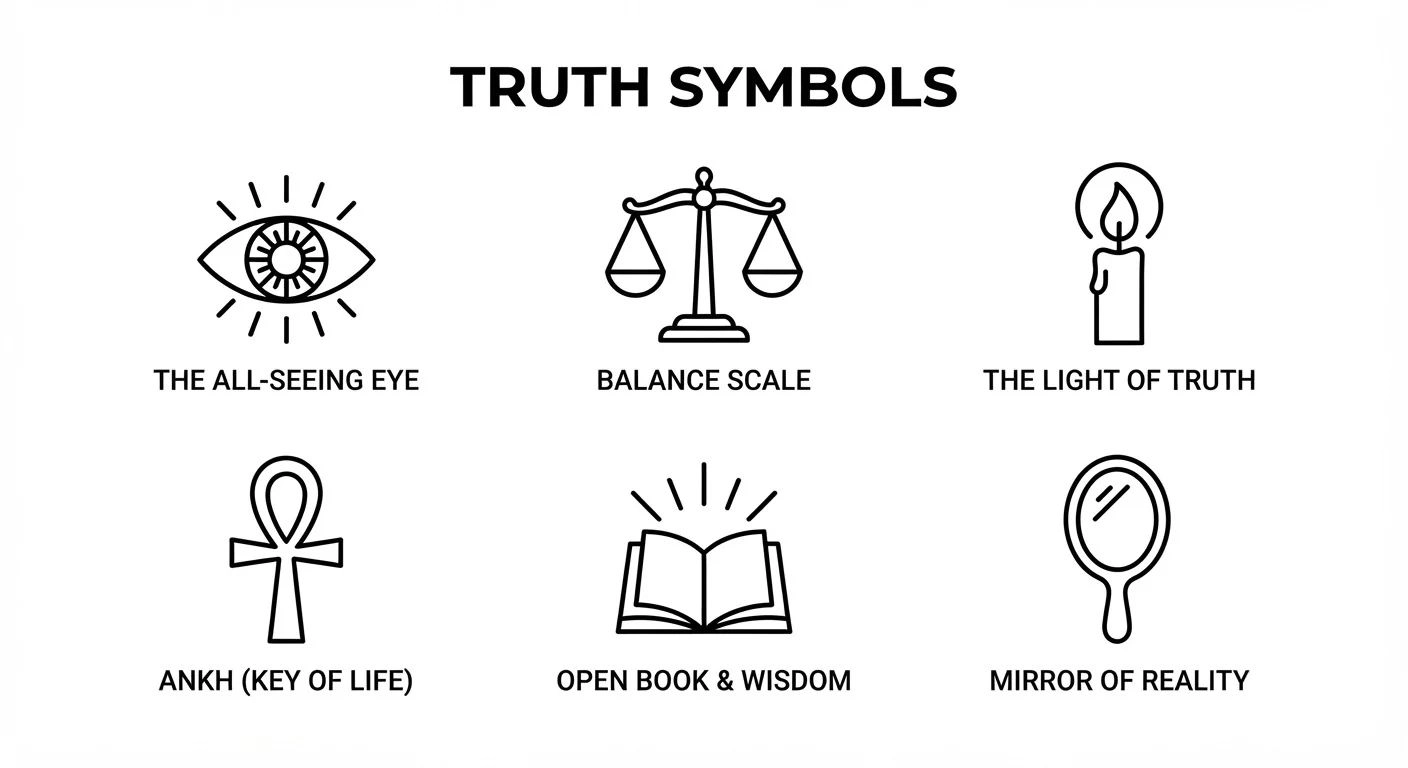
Truth can mean different things depending on the situation. It may mean telling the truth, recognizing reality, treating people fairly, or staying loyal to your values. Across history, people have expressed these ideas through objects, animals, religious imagery, and natural elements.
Some truth symbols have deep historical roots. The feather of Ma’at, for example, represented truth and moral order in ancient Egyptian belief. Scales became associated with judgment and justice. Other images, such as mirrors, compasses, and clear water, are modern visual metaphors for self-honesty, integrity, and transparency.
There is no single symbol of truth accepted by every culture. The meaning of an image depends on its history, religious setting, and how people use it today.
This guide explores 20 symbols connected with truth, honesty, justice, and wisdom. It explains their backgrounds, distinguishes historical meanings from modern interpretations, and helps you choose a symbol for a tattoo, logo, artwork, or personal reminder.
Truth Symbols: 20 Symbols of Truth, Honesty, and Their Meanings
Truth can mean different things depending on the situation. It may mean telling the truth, recognizing reality, treating people fairly, or staying loyal to your values. Across history, people have expressed these ideas through objects, animals, religious imagery, and natural elements.
Some truth symbols have deep historical roots. The feather of Ma’at, for example, represented truth and moral order in ancient Egyptian belief. Scales became associated with judgment and justice. Other images, such as mirrors, compasses, and clear water, are modern visual metaphors for self-honesty, integrity, and transparency.
There is no single symbol of truth accepted by every culture. The meaning of an image depends on its history, religious setting, and how people use it today.
This guide explores 20 symbols connected with truth, honesty, justice, and wisdom. It explains their backgrounds, distinguishes historical meanings from modern interpretations, and helps you choose a symbol for a tattoo, logo, artwork, or personal reminder.
What Are the Symbols of Truth?
Symbols of truth are images, objects, or visual signs that communicate honesty, reality, fairness, knowledge, or moral responsibility. They turn an abstract idea into something people can recognize.
Some symbols have a direct historical connection to truth. Others represent qualities that help people discover or protect it.
For example, the feather of Ma’at has a documented connection with truth in ancient Egyptian belief. A mirror, however, is generally a metaphor for self-reflection and personal honesty. Both can communicate truth, but their backgrounds are different.
Common symbols associated with truth include:
- Feather of Ma’at
- Scales of justice
- Sun
- Torch
- Mirror
- Open eye
- Owl
- Open book
- Lighthouse
- Compass
- Lotus flower
- Dharma wheel
- White dove
- Clear water
- Crystal
- Sword
- Straight path
- Open hand
- Flame
- Scroll
These images do not all carry the same meaning. Understanding their differences helps you select a symbol that communicates your intended message.
Why Do People Use Symbols to Represent Truth?
Truth can be difficult to represent visually because it is an idea rather than a physical object. Symbols give people a way to communicate it through familiar images.
A feather can suggest moral balance. A mirror can remind someone to face personal mistakes. A torch can represent the search for knowledge.
People use truth-related symbols for several reasons:
- Personal values: To express honesty, integrity, and responsibility.
- Spiritual meaning: To represent religious teachings or the search for deeper understanding.
- Historical interest: To connect with ancient beliefs and traditions.
- Art and tattoos: To communicate a personal message through visual design.
- Business identity: To suggest transparency, fairness, and reliability.
The best symbol depends on the meaning you want to express.
Which Symbols Represent Truth Most Directly?
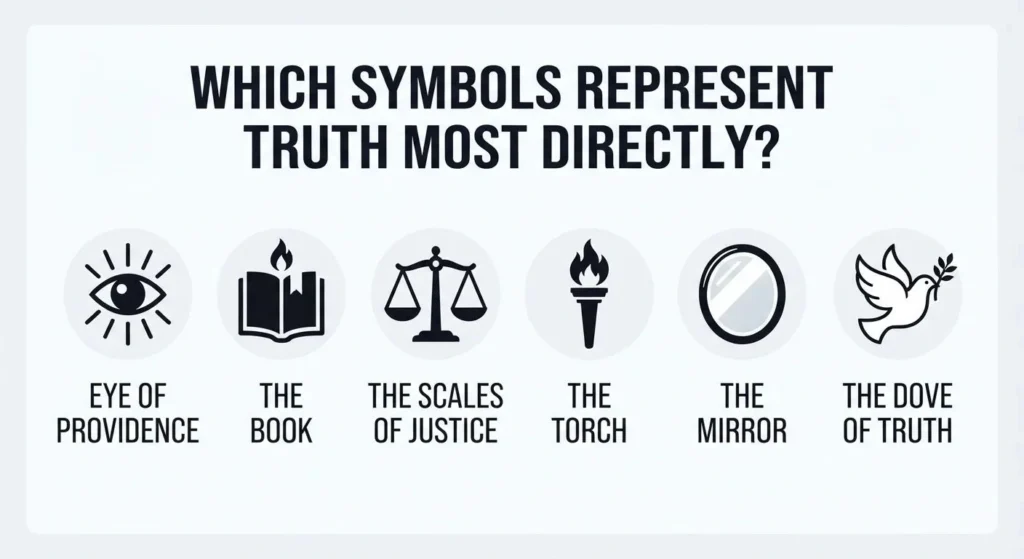
Not every image associated with wisdom or clarity is a direct symbol of truth. Some have specific historical connections, while others communicate related values through modern interpretation.
The feather of Ma’at is one of the clearest historical examples. The scales of justice also have a long association with judgment and fairness. Other symbols, such as mirrors and compasses, are better understood as personal metaphors.
Direct Historical Symbols of Truth
The feather of Ma’at is especially important in ancient Egyptian belief. Ma’at represented truth, justice, balance, and the proper order of the world.
During the judgment of the dead, the deceased person’s heart was weighed against Ma’at’s feather. This scene connected truth with a person’s actions and moral character.
The Greek concept of Aletheia is another important historical connection. Aletheia means truth and appears in ancient Greek thought and literature. It is a concept and personification rather than one universally recognized visual emblem.
Symbols of Justice and Fair Judgment
Scales represent the careful weighing of evidence and the search for a fair decision. They are associated with justice, impartiality, and accountability.
A sword can also appear in justice imagery. It suggests authority and the power to uphold a decision, rather than truth alone.
Modern Symbols of Personal Truth
Some images communicate truth through their everyday qualities:
- A mirror suggests self-honesty.
- A compass suggests moral direction.
- Clear water suggests transparency.
- An open book suggests access to knowledge.
- A lighthouse suggests guidance through uncertainty.
These images are meaningful choices, but their connection with truth is mainly metaphorical.
Quick Guide to Symbols of Truth and Their Meanings
Use this table if you want to find a symbol that matches a particular meaning without reading every description first.
| Meaning you want to express | Symbol to consider |
| Historical truth and moral order | Feather of Ma’at |
| Fairness and balanced judgment | Scales of justice |
| Clarity and revelation | Sun |
| Knowledge and discovery | Torch |
| Self-honesty | Mirror |
| Awareness and observation | Open eye |
| Wisdom and insight | Owl |
| Learning and reliable information | Open book |
| Guidance during uncertainty | Lighthouse |
| Integrity and moral direction | Compass |
| Spiritual growth | Lotus flower |
| Buddhist teachings and awakening | Dharma wheel |
| Peace and sincere intentions | White dove |
| Transparency | Clear water |
| Mental clarity | Crystal |
| Courage to defend what is right | Sword |
| Consistent ethical behavior | Straight path |
| Openness and sincerity | Open hand |
| Inspiration and revelation | Flame |
| Preserved knowledge and records | Scroll |
20 Symbols of Truth and Their Meanings
The following symbols represent different aspects of truth. Some have documented historical or religious meanings, while others are modern visual interpretations.
1. Feather of Ma’at: Truth and Moral Balance
The feather of Ma’at is one of the strongest historical symbols connected with truth.
In ancient Egyptian religion, Ma’at represented truth, justice, balance, and the proper order of the world. She was also associated with the principles that maintained harmony in society and the universe.
The feather played an important role in the ancient Egyptian judgment of the dead. The deceased person’s heart was weighed against the feather of Ma’at. The heart was understood as the center of thought, memory, and personal character.
If the judgment showed that the deceased had lived according to Ma’at, the person could continue toward the afterlife. The scene expressed the belief that a person’s actions mattered and that moral life could be judged.
The feather therefore represents more than speaking honestly. It connects truth with fairness, responsibility, and living according to moral principles.
What it symbolizes:
- Truth and justice
- Moral balance
- Accountability
- Fairness
- Right conduct
Modern use: A feather of Ma’at can be a meaningful tattoo or artwork for someone interested in ancient Egyptian history and the connection between truth and personal responsibility.
2. Scales of Justice: Fairness and Objective Judgment
The scales of justice represent fairness, balanced judgment, and the careful examination of evidence.
A traditional balance has two sides. This makes it a useful image for the idea that a fair decision should consider different arguments instead of favoring one person without reason.
Scales also appear in ancient Egyptian judgment imagery, where a heart was weighed against Ma’at’s feather. Later Greek and Roman traditions developed their own images of justice and judgment.
Modern legal imagery often combines scales with a sword or a blindfolded figure. The scales suggest impartial judgment, while the sword communicates authority and the power to enforce the law.
What it symbolizes:
- Fair judgment
- Equality
- Impartiality
- Evidence and accountability
- Justice and moral responsibility
Modern use: Scales are suitable for legal artwork, law firm branding, justice-related tattoos, and designs about fairness.
3. The Sun: Light, Clarity, and Revelation
The sun is a natural symbol of light and visibility. It illuminates places that would otherwise remain dark, making it a fitting image for clarity and revelation.
In modern symbolic language, sunlight often suggests that hidden information has become visible. It can represent the moment when confusion ends and someone begins to understand what is real.
Many ancient cultures also gave the sun religious and cultural importance. Its meaning varied between traditions, so it should not be described as a universal historical symbol of truth.
What it symbolizes:
- Clarity and understanding
- Revelation
- Awareness
- New beginnings
- Discovering what was hidden
Modern use: A rising sun can represent a fresh start after confusion, deception, or a difficult period.
4. The Torch: Knowledge That Reveals Truth
A torch produces light in darkness. For this reason, it is often used as a metaphor for knowledge, education, discovery, and the search for truth.
Learning can help people understand complicated situations, question misleading information, and make better decisions. A torch represents this process of bringing understanding into places where confusion once existed.
It can also suggest the responsibility to share knowledge rather than keep useful information hidden.
What it symbolizes:
- Knowledge and education
- Discovery
- Enlightenment
- Clear thinking
- The courage to reveal information
Modern use: Torch imagery works well in academic artwork, educational logos, motivational designs, and tattoos about learning.
5. The Mirror: Self-Honesty and Reality
A mirror reflects what stands before it. It provides a simple visual metaphor for facing reality instead of hiding from it.
In modern symbolic language, looking into a mirror can represent self-honesty. It reminds people to recognize their strengths, weaknesses, mistakes, and emotions.
Mirrors also appear in literature and art as symbols of identity, illusion, self-discovery, and reflection. Their meaning depends on the story or cultural setting.
What it symbolizes:
- Self-awareness
- Personal honesty
- Reality and reflection
- Accepting imperfections
- Understanding one’s identity
Modern use: A mirror tattoo can remind someone to be honest with themselves before judging other people.
6. The Open Eye: Awareness and Seeing Clearly
An open eye represents observation, awareness, attention, and the ability to notice what is happening.
It can connect with truth because seeing clearly is often the first step toward understanding reality. An open eye may also suggest vigilance and the refusal to ignore uncomfortable facts.
However, not all eye symbols have the same meaning. The Eye of Horus, for example, has specific ancient Egyptian associations with protection, healing, and restoration. It should not be presented as a universal symbol of truth.
What it symbolizes:
- Awareness and observation
- Clear perception
- Understanding
- Watchfulness
- Seeing beyond appearances
Modern use: An open-eye design can represent awareness, personal growth, or a commitment to examining situations honestly.
7. The Owl: Wisdom and Insight
The owl is widely associated with wisdom, knowledge, and thoughtful observation.
In ancient Greek tradition, the owl was connected with Athena, a goddess associated with wisdom. The Acropolis Museum identifies the owl as Athena’s sacred bird and a symbol of wisdom and prudence.
Its ability to see in low light makes it a natural image for insight. People may connect this quality with the search for truth because wisdom helps us examine evidence and question assumptions.
Still, an owl is primarily a symbol of wisdom, not a universal symbol of truth.
What it symbolizes:
- Wisdom and knowledge
- Insight
- Careful observation
- Thoughtful judgment
- Intellectual curiosity
Modern use: Owl tattoos and logos can represent a love of learning, clear judgment, and the pursuit of understanding.
8. The Open Book: Knowledge and Transparency
An open book represents learning, information, and access to knowledge.
Unlike a closed book, it suggests that information is available for people to read, examine, and understand. This makes it a useful modern symbol of transparency and the search for truth.
Books can also represent education, research, written evidence, and the preservation of ideas. Religious texts may carry more specific meanings within their traditions.
What it symbolizes:
- Knowledge and learning
- Access to information
- Transparency
- Education
- The pursuit of understanding
Modern use: An open-book design works well for schools, libraries, educational projects, research organizations, and tattoos about lifelong learning.
9. The Lighthouse: Guidance Through Confusion
A lighthouse sends light across dark waters to help ships navigate safely. It is a strong modern metaphor for guidance, direction, and hope.
When connected with truth, a lighthouse can represent reliable information that helps someone make a sound decision. It suggests that clear principles can guide people through confusing situations.
The lighthouse is not an ancient universal emblem of truth. Its symbolic meaning comes mainly from its practical purpose and later artistic interpretation.
What it symbolizes:
- Guidance and direction
- Clarity during uncertainty
- Reliable principles
- Hope and reassurance
- Finding the right path
Modern use: A lighthouse tattoo can represent staying true to your values even when life becomes difficult.
10. The Compass: Moral Direction and Integrity
A compass helps travelers identify direction. This makes it a useful modern metaphor for personal values and moral guidance.
When used as a truth-related symbol, a compass can represent the ability to stay honest even when other people apply pressure. It reminds someone to follow their principles instead of choosing the easiest route.
A compass does not historically mean truth by itself. Its connection with honesty comes mainly from its role as a guide.
What it symbolizes:
- Moral direction
- Integrity
- Consistency
- Personal values
- Staying on the right path
Modern use: Compass tattoos can remind people to follow their conscience and remain true to themselves.
11. The Lotus Flower: Spiritual Growth and Understanding
The lotus flower has important meanings in several Asian religious and cultural traditions, particularly Hinduism and Buddhism.
It grows from muddy water and rises above the surface to bloom. This natural process has made it an image of spiritual development, purity, and awakening.
Its connection with truth depends on the tradition. In Buddhist contexts, the lotus can relate to awakening and spiritual understanding. It is not a universal symbol of factual honesty.
What it symbolizes:
- Spiritual growth
- Purity and awakening
- Inner understanding
- Wisdom
- Moving beyond ignorance
Modern use: A lotus tattoo can represent personal transformation, spiritual reflection, or the search for deeper understanding.
12. The Dharma Wheel: Buddhist Teachings and Truth
The Dharma wheel, also known as the Dharmachakra, is an important Buddhist symbol. It represents the Buddha’s teachings and the path toward awakening.
The wheel is commonly shown with eight spokes associated with the Noble Eightfold Path. This path provides guidance for ethical conduct, mental development, and wisdom.
Truth is central to Buddhist teaching, including the Four Noble Truths. However, the Dharma wheel represents the broader Buddhist teaching and path rather than serving as a simple standalone emblem of honesty.
What it symbolizes:
- Buddhist teachings
- Wisdom and understanding
- Ethical conduct
- The path toward awakening
- Spiritual insight
Modern use: The Dharma wheel is meaningful in Buddhist art and religious settings. Because it is a sacred religious symbol, use it with cultural understanding and respect.
13. The White Dove: Peace and Sincerity
The white dove is commonly associated with peace, hope, and purity. In some religious and artistic settings, it also represents spiritual qualities.
Its connection with truth is more interpretive than historical. A dove may communicate honest intentions because people often use it to express peaceful and gentle values.
In Christian symbolism, a dove can represent the Holy Spirit. Its meaning should be understood within the religious or artistic context.
What it symbolizes:
- Peace and hope
- Purity
- Sincerity
- Gentle intentions
- Reconciliation
Modern use: A white dove can appear in artwork about forgiveness, peaceful communication, and rebuilding trust.
14. Clear Water: Transparency and Purity
Clear water allows people to see what lies beneath its surface. This makes it a natural modern metaphor for transparency and openness.
In symbolic artwork, clear water can represent honest communication, clean intentions, and freedom from deception. It may also suggest emotional clarity and a fresh beginning.
Water has many meanings across cultures and religions. Its connection with truth in this context comes from its visible clarity rather than one universal historical tradition.
What it symbolizes:
- Transparency
- Purity
- Clear intentions
- Emotional clarity
- Openness
Modern use: Clear-water imagery works well in artwork, personal reminders, and designs about honest relationships.
15. The Crystal: Clarity and Understanding
A clear crystal is often used in modern symbolic and decorative designs to represent clarity, focus, and openness.
Its transparent appearance makes it a fitting image for seeing through confusion. In spiritual and wellness settings, different crystals may receive additional meanings, but those interpretations vary and should not be confused with scientific facts.
For truth-related artwork, a clear crystal can simply represent a clear mind and an honest perspective.
What it symbolizes:
- Mental clarity
- Focus
- Transparency
- Understanding
- Clear intentions
Modern use: Crystal imagery can appear in jewelry, decorative artwork, and tattoos representing self-awareness and clarity.
16. The Sword: Justice and the Courage to Defend Truth
A sword can represent justice, authority, protection, and the courage to defend what is right.
In traditional images of justice, a sword sometimes appears alongside scales. The scales represent balanced judgment, while the sword communicates the authority to uphold a decision.
A sword is not exclusively a truth symbol. Its meaning depends on the setting and may also involve conflict, power, or protection.
What it symbolizes:
- Justice and authority
- Courage
- Protection of principles
- Accountability
- Defending what is right
Modern use: A sword can be used in artwork or tattoos about standing up for the truth and protecting personal values.
17. The Straight Path: Honesty and Consistency
A straight path is a simple visual metaphor for honesty. It suggests moving forward without deliberately hiding, twisting, or changing the truth.
The image also appears in moral and spiritual language. Many traditions use the idea of a righteous or correct path to describe ethical living.
Its exact meaning varies by context. In a personal design, a straight road can represent the decision to remain honest even when the journey becomes difficult.
What it symbolizes:
- Honesty
- Integrity
- Consistency
- Ethical choices
- Staying true to personal values
Modern use: A straight road or path can make a subtle tattoo or illustration about living with honesty and purpose.
18. The Open Hand: Honesty and Openness
An open hand can communicate welcome, peace, generosity, and the absence of concealment. It is often used in modern designs to express transparency and sincere intentions.
The image can also represent a willingness to communicate without manipulation or hidden motives.
However, open-hand gestures carry different meanings in different cultures. Some hand symbols have specific religious or historical significance, so understand the design before using it.
What it symbolizes:
- Openness
- Sincerity
- Peaceful intentions
- Generosity
- Honest communication
Modern use: An open-hand design can represent trust, truthful communication, and a willingness to listen.
19. The Flame: Truth That Cannot Stay Hidden
A flame produces light and makes its surroundings visible. It can therefore represent truth coming into the open.
In literature and modern artwork, a flame may symbolize knowledge, inspiration, courage, or the determination to uncover hidden information.
Its meaning changes with the setting. A candle flame may suggest reflection and hope, while a torch flame may suggest education and discovery.
What it symbolizes:
- Revelation
- Knowledge
- Courage
- Inspiration
- The search for truth
Modern use: A candle or flame tattoo can represent the decision to remain honest or seek understanding through difficult times.
20. The Scroll: Written Truth and Recorded Knowledge
A scroll represents written information, records, teachings, and the preservation of knowledge.
Before modern books became widespread, scrolls were important formats for storing and sharing information in several ancient societies. They could contain religious teachings, legal documents, literature, and historical records.
This makes the scroll a meaningful modern image for truth supported by written evidence and preserved knowledge.
What it symbolizes:
- Recorded knowledge
- Historical memory
- Written teachings
- Evidence and documentation
- The preservation of information
Modern use: A scroll can work in academic, historical, religious, or personal artwork about knowledge and reliable records.
Symbols of Truth in Ancient Mythology
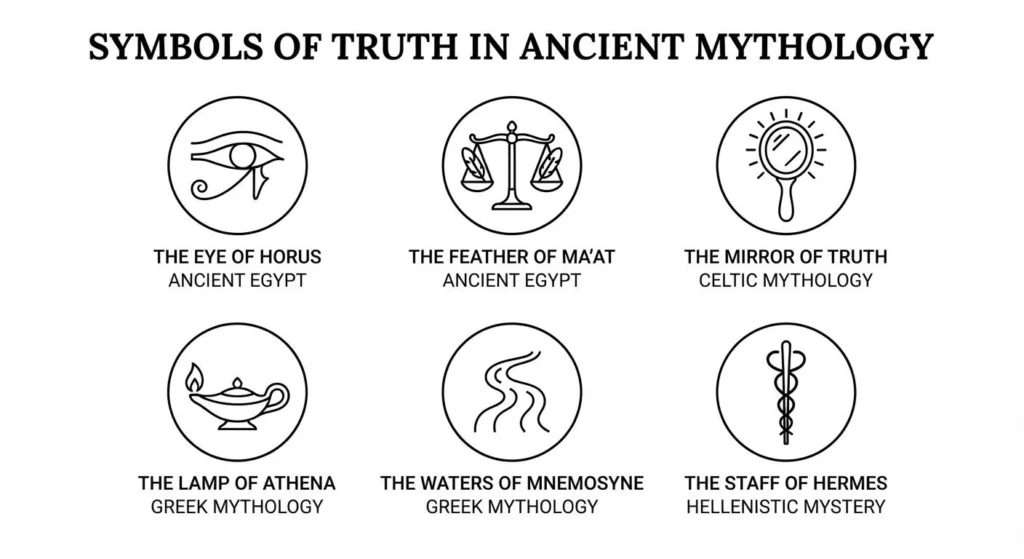
Ancient mythology often represented abstract ideas through gods, goddesses, and personified qualities. Truth, justice, and moral order were not always treated as the same concept.
Understanding these differences helps explain why certain figures became connected with truth-related imagery.
Ma’at in Ancient Egyptian Mythology
Ma’at represented truth, justice, balance, and the proper order of the world in ancient Egyptian belief.
Her feather became an important part of the judgment of the dead. The deceased person’s heart was weighed against it, making the feather a direct visual connection with truth and moral responsibility.
Aletheia in Greek Thought
Aletheia is the ancient Greek word for truth. It appears in Greek literature and philosophy and became associated with the idea of revealing or expressing what is true.
Aletheia is important as a concept and personification, but it does not have one universally recognized visual symbol comparable to Ma’at’s feather.
For readers interested in Greek truth symbolism, Aletheia is more directly relevant than simply choosing a Greek goddess associated with justice.
Themis and Dike in Greek Tradition
Themis and Dike are Greek figures associated with justice and moral order.
Themis was connected with divine law, order, and the proper organization of society. Dike was associated with justice and the right treatment of people.
Their meanings overlap with truth because fair judgment depends on accurate information and ethical decisions. However, they are primarily associated with justice rather than truth alone.
Justitia in Roman and Later European Imagery
Justitia is the Roman personification of justice. Later European images often show her holding scales and a sword, sometimes with a blindfold.
The scales represent balanced judgment. The sword suggests authority and enforcement. The blindfold is commonly interpreted as impartiality, although the details of justice imagery changed over time.
Justitia is therefore a strong symbol of justice and fair judgment, not a direct replacement for the feather of Ma’at.
Truth Symbols in Different Cultures and Spiritual Traditions
Different cultures and religions express truth through ethical principles, teachings, and visual imagery. Some traditions have a specific symbol connected with truth, while others emphasize truthful behavior rather than a single emblem.
Truth in Ancient Egyptian Culture
Ancient Egyptian belief connected Ma’at with truth, justice, balance, and cosmic order.
Her feather played an important role in the judgment of the dead. The heart-weighing scene expressed the belief that a person’s actions mattered and that moral life could be examined.
The feather of Ma’at is one of the clearest historical examples of a symbol directly associated with truth.
Truth in Buddhism
Buddhist teachings emphasize understanding reality, overcoming ignorance, and following the path toward awakening.
The Dharma wheel represents the Buddha’s teachings. The Four Noble Truths explain suffering, its origin, its cessation, and the path leading to its cessation.
The lotus is also important in Buddhist art and symbolism, often expressing purity and spiritual awakening.
These symbols connect with truth through Buddhist teachings and practice rather than through a single universal emblem of honesty.
Truth in Hindu Traditions
Satya is a Sanskrit term commonly translated as truth or truthfulness. It is an important ethical and spiritual principle in Hindu traditions.
Satya can refer to truthful speech, honest conduct, and a commitment to what is real. It also involves consistency between what a person thinks, says, and does.
There is no single universal visual symbol that represents Satya across all Hindu traditions. Its importance comes primarily from the principle itself and the way people practice it.
Truth in Christian Symbolism
Christian traditions often connect truth with divine teaching, spiritual light, and the Word of God.
Light can represent guidance, understanding, and the revelation of what is good. The Bible also contains teachings about honesty, truthful speech, and living according to faith.
A candle, open Bible, or light ray may therefore appear in Christian artwork about truth. Their specific meanings depend on the passage, artwork, or religious setting.
Truth in Islamic Teachings
Truthfulness is an important ethical value in Islam. The Arabic term sidq refers to truthfulness and sincerity.
Islamic teachings emphasize honest speech, trustworthy conduct, and avoiding deception. The concept also involves consistency between a person’s intentions and actions.
There is no single universally recognized visual emblem that represents truth in Islam. It is more accurate to discuss truthfulness as an ethical principle than to claim that a particular decorative image is the official Islamic symbol of truth.
What Animals Symbolize Truth, Honesty, and Wisdom?
Animals can communicate values through their appearance, behavior, and roles in cultural stories. Some are associated with wisdom or peace, while others represent courage and strength.
However, no animal universally represents truth in every culture.
Owl: Wisdom and Careful Observation
The owl is a strong choice for representing wisdom and thoughtful judgment. Its connection with Athena in ancient Greek tradition gives it a documented association with wisdom and prudence.
It can represent the effort to understand a situation before accepting a claim as true.
Dove: Peace and Sincere Intentions
The white dove commonly represents peace and hope. In religious and artistic settings, it may also carry spiritual meanings.
For a truth-related design, it can suggest peaceful communication and sincere intentions rather than factual truth itself.
Lion: Courage and Moral Strength
The lion is often used in art and modern symbolism to communicate courage, strength, and leadership.
Someone may choose a lion to represent the courage to speak honestly or defend what is right. This is a contextual interpretation, not a universal historical meaning of the animal.
Elephant: Wisdom and Memory
Elephants can be associated with wisdom, memory, strength, and patience in different cultural settings.
For a personal design, an elephant may suggest thoughtful judgment and learning from experience. Its meaning varies by tradition and should not be presented as a universal truth symbol.
What Colors Symbolize Truth and Honesty?
Colors can communicate trust, openness, and sincerity in artwork and design. However, color meanings change across cultures, religions, and historical periods.
Blue, white, and gold are common choices for truth-related designs, but none represents truth everywhere.
Blue: Trust and Reliability
Blue is widely used in modern branding to communicate stability, reliability, and professionalism.
It can be a useful choice for designs about trustworthy communication or responsible leadership. Its meaning depends on the shade and surrounding design.
White: Openness and Sincerity
White can suggest purity, simplicity, openness, and sincerity in some cultural settings.
It may work well in artwork about honest intentions or clear communication. However, white also carries different meanings in different cultures, including mourning in some traditions.
Gold: Wisdom and Value
Gold often communicates value, achievement, importance, or wisdom in modern decorative designs.
It can add a sense of dignity to a truth-related image, particularly when paired with a feather, book, or scales.
Green: Growth and Renewal
Green is often associated with nature, growth, renewal, and balance.
In a modern design, it can suggest personal development and the effort to live according to honest values. Its connection with truth is indirect.
What Is the Difference Between Truth, Honesty, Integrity, Justice, and Wisdom?
These ideas are connected, but they do not mean exactly the same thing. Understanding the differences helps you choose a symbol that expresses your intended message.
| Concept | Meaning | Related symbols |
| Truth | What is accurate or real | Feather of Ma’at, mirror, sun |
| Honesty | Communicating without deliberate deception | Open hand, clear water, open book |
| Integrity | Acting consistently with your values | Compass, straight path |
| Justice | Making fair and balanced decisions | Scales, sword |
| Wisdom | Using knowledge and judgment thoughtfully | Owl, torch, lotus |
Truth Means Recognizing What Is Real
Truth concerns accuracy and reality. A truthful statement should match the facts as closely as possible.
For example, admitting that a mistake happened rather than blaming someone else is a way of acknowledging what is true.
Honesty Means Avoiding Deception
Honesty describes how someone communicates and behaves.
An honest person does not deliberately mislead others. They try to communicate sincerely, even when the truth is uncomfortable.
Integrity Means Following Your Values
Integrity involves consistency between beliefs, words, and actions.
For example, a person shows integrity when they follow an ethical rule even when nobody is watching.
Justice Means Treating People Fairly
Justice involves fairness, accountability, and decisions based on appropriate principles.
A fair decision should consider relevant evidence rather than personal favoritism.
Wisdom Means Using Knowledge Well
Wisdom involves understanding situations and making thoughtful decisions.
It helps people evaluate information, recognize uncertainty, and avoid accepting every claim without examination.
Symbols of Truth for Tattoos
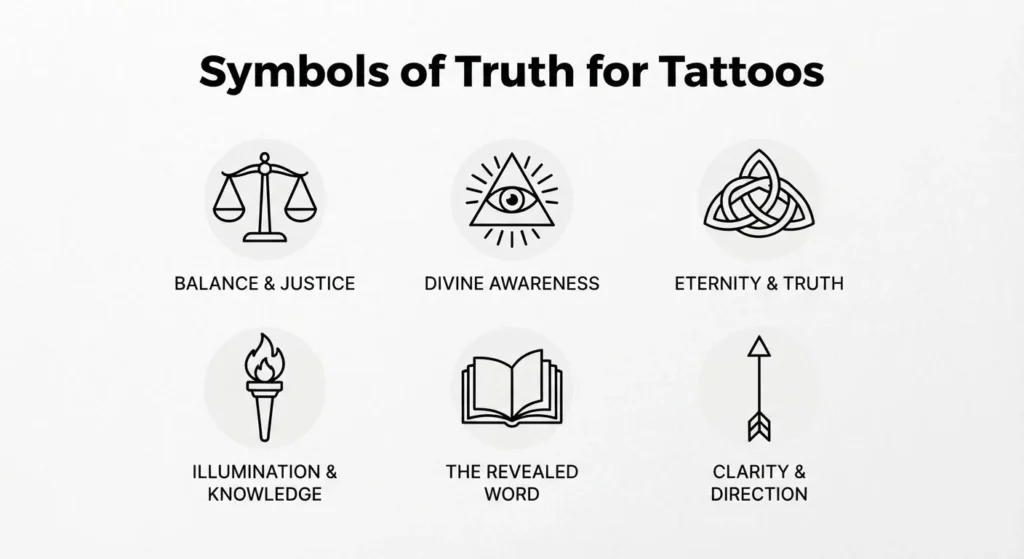
A truth-themed tattoo can represent personal honesty, self-awareness, fairness, or a commitment to living according to your values.
The best design depends on the message you want to carry. Some people prefer a symbol with a documented cultural background, while others choose a simple image with personal meaning.
Feather of Ma’at Tattoo
The feather of Ma’at can represent truth, moral balance, and accountability. It is a meaningful choice for someone interested in ancient Egyptian history and ethical responsibility.
Mirror Tattoo
A mirror can represent self-honesty, self-awareness, and the willingness to face personal mistakes.
It works well for someone whose main message is being truthful with themselves.
Scales of Justice Tattoo
Scales can represent fairness, impartiality, and balanced judgment.
This design may appeal to people who value justice or want to remember the importance of treating others fairly.
Compass Tattoo
A compass can represent integrity and moral direction. It suggests staying true to your values even when circumstances change.
Torch Tattoo
A torch can represent knowledge, learning, and the search for truth. It is suitable for people who value education, discovery, and independent thinking.
Before choosing a culturally or religiously significant symbol, learn about its origins and traditional use. A design should reflect your intended meaning without misrepresenting another community’s beliefs.
Symbols of Truth for Logos and Businesses
Businesses often use symbols to communicate trust, transparency, fairness, and reliability. A suitable design can help express these values without relying on complicated wording.
Scales for Legal and Mediation Services
Scales communicate fairness and balanced judgment. They are suitable for legal practices, mediation services, and organizations focused on justice.
Open Book for Education and Research
An open book suggests learning, access to information, and knowledge.
It works well for schools, libraries, publishing companies, and research organizations.
Lighthouse for Guidance-Based Services
A lighthouse can represent direction, clarity, and dependable support.
It may suit consulting services, advisory organizations, and businesses that help customers navigate difficult decisions.
Compass for Leadership and Consulting
A compass suggests direction, consistency, and strong principles.
It can work for consulting firms, leadership programs, and organizations that emphasize responsible decision-making.
Torch for Learning and Discovery
A torch communicates education, discovery, and the spread of knowledge.
It is a suitable option for academic projects, training organizations, and educational brands.
A symbol alone cannot prove that a business is honest. Consistent actions, accurate information, fair policies, and transparent communication build real trust.
How to Choose the Right Symbol of Truth
The right symbol depends on what you want to communicate. A historical symbol may suit someone interested in ancient traditions, while a simple modern image may work better as a personal reminder.
Consider these questions before choosing:
- What kind of truth do you mean? Are you thinking about honesty, spiritual understanding, fairness, or self-awareness?
- Does the symbol have a historical background? Learn whether its meaning comes from a documented tradition or a modern interpretation.
- Will you use it personally or professionally? A tattoo, gift, and business logo may need different designs.
- Is the symbol culturally significant? Research religious and cultural meanings before using it.
- Does the image communicate your message clearly? Choose a design that people can understand without excessive explanation.
For a direct historical connection with truth, the feather of Ma’at is a strong choice. For fairness, consider the scales of justice. For personal honesty, a mirror may communicate your message more clearly.
Frequently Asked Questions About Truth Symbols
What Is the Main Symbol of Truth?
There is no single universal symbol of truth. The feather of Ma’at is one of the strongest historical examples because ancient Egyptian belief connected it with truth, justice, and moral order. Other common symbols include scales, mirrors, the sun, and the torch.
What Is the Oldest Known Symbol of Truth?
It is difficult to identify one oldest symbol because ancient cultures used different images and concepts to express truth. The feather of Ma’at is among the best-documented ancient symbols directly associated with truth and moral order in Egyptian belief.
What Animal Represents Truth?
No animal universally represents truth. The owl is commonly associated with wisdom and insight, while the white dove often represents peace and sincerity. Both can connect with truth through broader interpretations, but neither has one fixed meaning across all cultures.
What Flower Represents Truth?
The lotus flower can represent spiritual growth, purity, and awakening in several Asian traditions. People may connect these qualities with the search for truth. However, the lotus is not universally recognized as a direct symbol of honesty.
What Color Represents Truth?
Blue is often associated with trust and reliability in modern design. White can suggest purity and openness, while gold may communicate wisdom or value. These meanings vary across cultures and design contexts, so no color represents truth everywhere.
What Is the Egyptian Symbol of Truth?
The feather of Ma’at is a well-known ancient Egyptian symbol of truth and moral order. In the judgment of the dead, the deceased person’s heart was weighed against Ma’at’s feather to examine whether the person had lived according to truth and justice.
What Is the Greek Symbol of Truth?
Aletheia is the ancient Greek word and personification associated with truth. Themis and Dike are more closely connected with justice and moral order. These figures represent related ideas, but they should not be treated as interchangeable symbols.
What Is the Buddhist Symbol of Truth?
The Dharma wheel represents the Buddha’s teachings and the path toward awakening. It connects with truth through Buddhist teachings, including the Four Noble Truths. It represents a broader spiritual path rather than honesty alone.
What Symbol Represents Self-Honesty?
A mirror is a meaningful modern symbol of self-honesty. It represents looking at yourself clearly, accepting your actions, and recognizing your strengths and weaknesses without hiding from reality.
What Is a Good Tattoo Symbol for Truth?
The feather of Ma’at, scales of justice, mirror, sun, and compass are meaningful tattoo choices. Each expresses a different idea, such as moral balance, fairness, self-awareness, clarity, or integrity. Choose one that reflects your personal values.
Is the Eye of Horus a Symbol of Truth?
The Eye of Horus is better known for its ancient Egyptian associations with protection, healing, and restoration. It should not be described as a universal symbol of truth. If you want a historically direct Egyptian truth symbol, the feather of Ma’at is a stronger choice.
What Symbol Represents Speaking the Truth?
There is no universal emblem specifically for speaking the truth. An open book can suggest honest information, while an open hand may communicate sincerity and openness. The feather of Ma’at offers a historical connection with truth and moral responsibility.
Conclusion
Truth symbols help express ideas that can be difficult to put into words. The feather of Ma’at connects truth with moral balance and justice, while the scales represent fair judgment. The sun and torch suggest clarity and discovery, and the mirror encourages self-honesty.
Other symbols, such as the lotus, Dharma wheel, owl, and open book, connect truth with spiritual understanding, wisdom, and knowledge. Their meanings depend on their cultural backgrounds and the way people use them today.
Whether you want a tattoo, logo, artwork, or personal reminder, choose a symbol that reflects your intended message. Learn its history, understand its meaning, and use it with respect. The most meaningful symbol is one whose values you are willing to practice.

Adam Sullivan is a dedicated writer who enjoys transforming everyday topics into engaging and informative content. His writing focuses on making complex ideas simple, practical and enjoyable for readers of all backgrounds. Adam is also the fictional author of The Lantern Beyond Autumn Hills and Where the Morning Horizon Waits. Outside of writing, he enjoys photography, traveling and discovering inspiration through new experiences. He believes great content should be both helpful and easy to connect with.
 Dylan Anderson