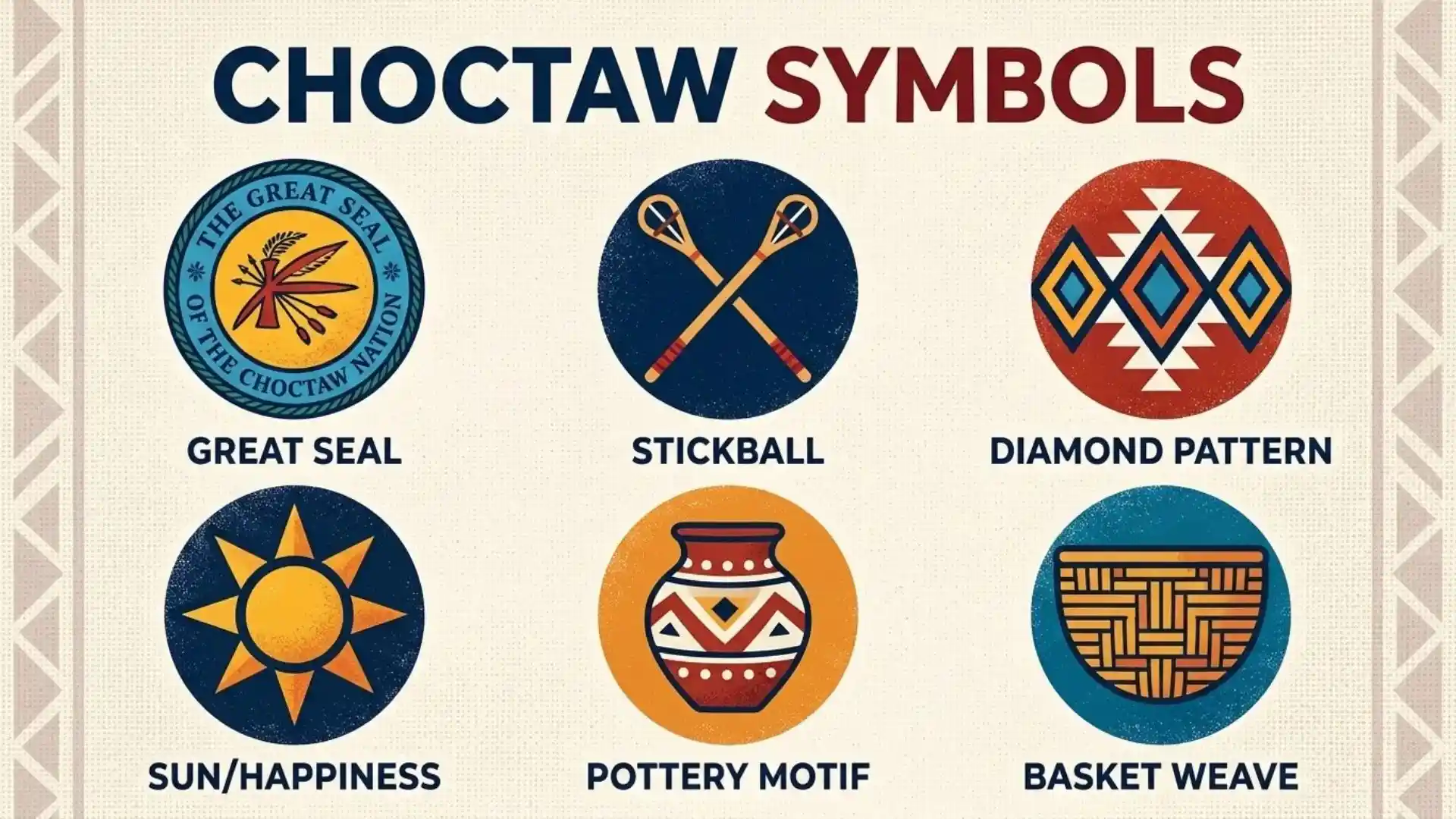
Choctaw symbols reflect a rich cultural heritage shaped by nature, community, traditional arts, and the history of the Choctaw people. Some of the best-known examples include the full diamond and half-diamond patterns found in traditional clothing, the X and O designs associated with stickball, and the Great Seal of the Choctaw Nation of Oklahoma. Each has a distinct context, and understanding that context helps explain what the design communicates.
The Choctaw people are an Indigenous people whose ancestral homelands lie in the southeastern United States. Today, Choctaw communities continue to preserve and develop their traditions through clothing, beadwork, basketry, pottery, music, dance, and sports. These practices connect generations while allowing contemporary artists and community members to express their identities.
In this guide, you’ll learn what important Choctaw symbols mean, how to recognize traditional patterns, what the official Great Seal represents, and how these designs remain relevant today. You’ll also discover why it is important to distinguish documented cultural meanings from interpretations that may vary by artist or community.
What Are Choctaw Symbols?
Choctaw symbols are patterns, objects, and official emblems associated with Choctaw history, cultural knowledge, artistic traditions, and community identity. They appear on traditional garments, woven baskets, beadwork, pottery, and other objects. Official symbols, such as the Great Seal of the Choctaw Nation of Oklahoma, communicate the history and values of the nation itself.
Not every Choctaw symbol has one universal meaning. A diamond pattern on a traditional dress, for example, has a documented association with the eastern diamondback rattlesnake. A diamond used in a different artistic setting may need to be interpreted according to that object’s context.
The most useful way to understand these symbols is to examine both their appearance and their cultural setting.
Main Choctaw symbols and their meanings
| Symbol or design | Documented meaning or association | Common context |
| Full diamond | Respect for nature; inspired by the eastern diamondback rattlesnake | Traditional clothing and beadwork |
| Half diamond | Choctaw homelands, including hills and valleys; sometimes a river, path, or journey | Traditional clothing |
| X-shaped motif | Associated with crossed stickball sticks; the Choctaw Nation describes an expression about paths crossing again | Traditional dress and stickball-related designs |
| O-shaped motif | Associated with the ball used in stickball | Traditional dress and stickball-related designs |
| Unstrung bow | Peaceful intentions and willingness to defend the nation if attacked | Great Seal |
| Three arrows | Honor three historic Choctaw chiefs | Great Seal |
| Pipe-hatchet | Community alliances and relationships with neighbors | Great Seal |
| Diamond and half-diamond basket patterns | Connections with Choctaw design traditions and respect for nature | Traditional basketry |
| Starburst or sun-like beadwork | Associations with the Creator, light, warmth, and the life-giving properties of the sun | Traditional beadwork |
| Comb and band pottery designs | Traditionally associated with patterns in nature and movements in dance | Pottery |
Traditional Choctaw Clothing Symbols
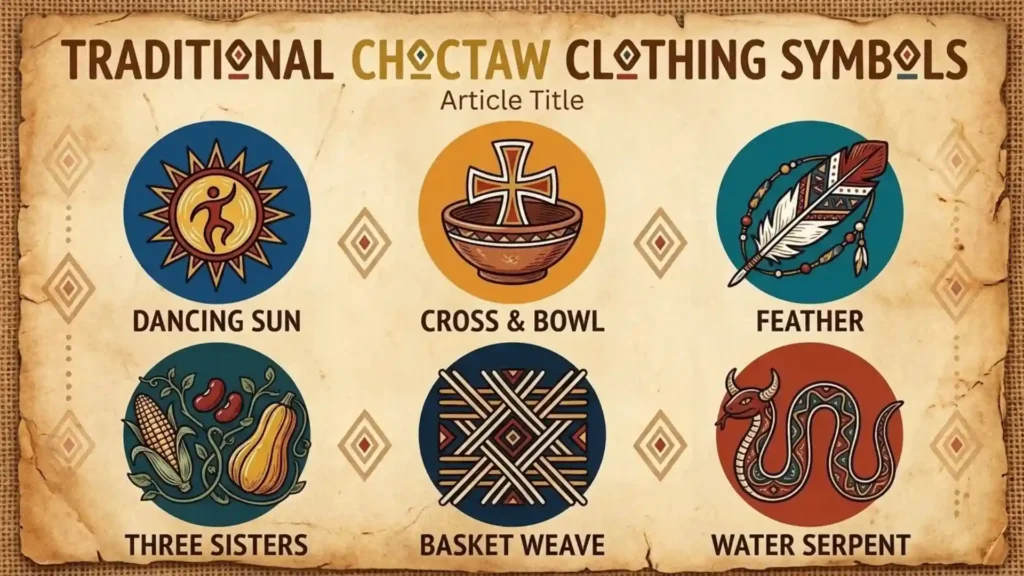
Traditional Choctaw clothing provides some of the clearest examples of symbolic design. Garments can feature colorful trim, hand-sewn appliqué, and geometric patterns that communicate cultural connections.
The Choctaw Nation of Oklahoma identifies the full diamond, half diamond, and X/O stickball designs among the common motifs in traditional clothing. These patterns are not simply decorative additions. Their documented meanings connect them with nature, the homeland, and community traditions.
The full diamond symbol
The full diamond is one of the most recognizable patterns in Choctaw traditional clothing and beadwork. Its documented inspiration is the eastern diamondback rattlesnake, an animal native to the southeastern United States.
The Choctaw Nation explains that the pattern pays homage and respect to nature. Choctaw ancestors respected the rattlesnake for its venom and its prominent place among other creatures.
This association gives the design a meaning rooted in the natural world. Rather than treating the diamond as a generic sign of strength, it is more accurate to explain the specific relationship between the pattern and the rattlesnake in Choctaw cultural tradition.
You can find the design on traditional dresses and beadwork. Diamond patterns also appear in Choctaw basketry, although the meaning of any particular basket design should be understood within the context of the basket itself.
The half-diamond symbol
The half-diamond resembles the full diamond but has its own documented associations. According to the Choctaw Nation, it is commonly connected with the hills and valleys of Choctaw homelands.
The horizontal bar along the bottom is often said to represent a river or path. The pattern can therefore be interpreted as a journey, whether someone is traveling through a landscape or experiencing the figurative ups and downs of life.
This interpretation connects the design with both place and movement. It also demonstrates why similar-looking symbols should not automatically be assigned identical meanings.
When identifying a half-diamond pattern, look at its shape and placement on the garment. Then consult a Choctaw cultural resource before assigning a meaning to a design that may be modified or combined with other motifs.
X and O symbols associated with stickball
Stickball is a longstanding Choctaw tradition. The game involves handcrafted sticks and a ball, and it continues to bring communities together through competition, teamwork, and cultural education.
The Choctaw Nation’s traditional dress guide explains that X and O motifs are associated with stickball equipment. The X relates to the crossed sticks, while the O relates to the ball. The guide also associates the X with the expression “May our paths cross again.”
However, geometric designs can have different histories and interpretations. The Mississippi Band of Choctaw Indians notes that a related motif of circles and crosses on traditional dresses may represent stickball and its equipment, but may also have roots in earlier designs.
That distinction matters. The X and O patterns are useful examples of how Choctaw clothing can reflect a community tradition, but not every cross or circle on every object should automatically be identified as a stickball symbol.
The Great Seal of the Choctaw Nation
The Great Seal of the Choctaw Nation of Oklahoma is an official emblem with a documented history. It differs from traditional clothing patterns because it represents the nation through a specific combination of objects and their established meanings.
The seal features an unstrung bow, three arrows, and a pipe-hatchet. The design was formalized through Choctaw governmental action in the nineteenth century and has been used on official national papers.
The unstrung bow: Peace and defense
The unstrung bow symbolizes the Choctaw people’s love of peace and their willingness to defend themselves if attacked.
The unstrung state communicates peaceful intentions. The bow itself also represents the capacity to protect the nation when necessary.
Its meaning therefore involves more than a simple contrast between peace and conflict. It expresses a nation’s desire to maintain peaceful relationships while retaining the ability to defend its people.
The three arrows: Historic Choctaw leaders
The three arrows honor three historic Choctaw chiefs:
- Pushmataha
- Moshulatubbee
- Apuckshunnubbee
These leaders are associated with the Choctaw districts during an important period in the nation’s history. The arrows connect the seal with Choctaw leadership, political history, and the people who guided the nation through significant changes.
This is a specific historical meaning. It should not be replaced by a generic explanation that arrows simply symbolize courage or ambition.
The pipe-hatchet: Alliances and relationships
The pipe-hatchet represents the Choctaw Nation’s desire to establish beneficial alliances with neighboring peoples. The official historical explanation also suggests a possible association with prowess.
The combined object is part of the seal’s specific cultural and political symbolism. Its meaning is best understood through the historical context provided by the Choctaw Nation rather than through general lists of Indigenous symbols.
For a detailed account of the seal’s development and meaning, read the Choctaw Nation’s article,
The Choctaw Flag and Its Meaning
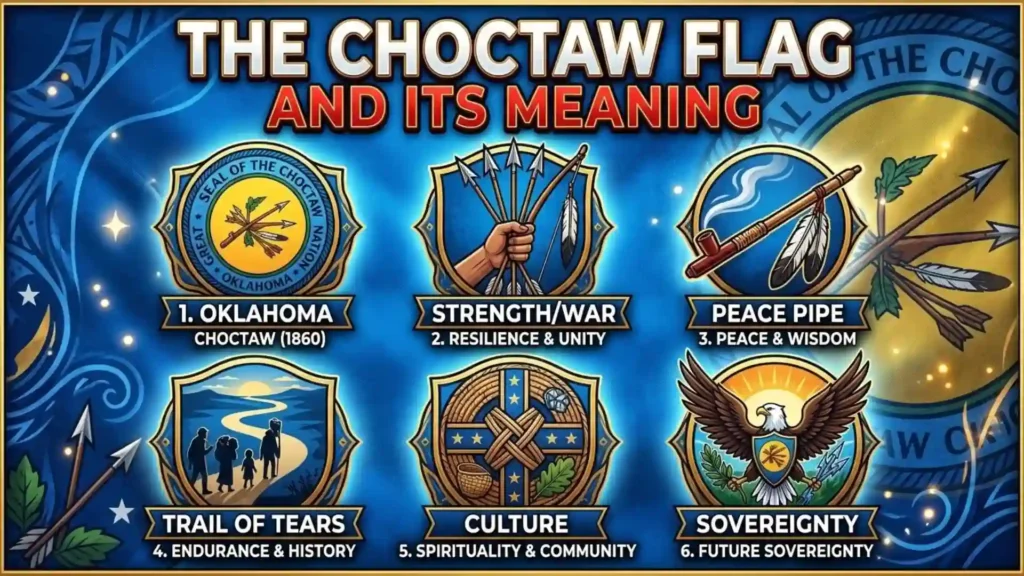
The Choctaw Nation’s flag incorporates the Great Seal, making the seal’s imagery central to understanding the flag. It serves as an official representation of the nation’s identity, history, and values.
A flag can communicate the identity of a sovereign nation to its own citizens and to the wider world. For the Choctaw Nation, the Great Seal provides a visual connection to its leaders, diplomatic relationships, and historical traditions.
Why the Great Seal matters on the flag
The bow, arrows, and pipe-hatchet are not interchangeable decorative objects. Each has a specific explanation in the nation’s historical record.
The bow expresses peaceful intentions and readiness to defend the nation. The arrows honor three historic chiefs, and the pipe-hatchet represents beneficial relationships with neighboring communities.
Together, these elements provide a concise visual account of aspects of Choctaw history and national identity.
Is the Choctaw flag the same as the Great Seal?
No. The Great Seal is the emblem used within the flag’s design. The flag is the larger official symbol, while the seal is a particular component with its own history and meaning.
If you are studying the flag, use the official Choctaw Nation version and its historical explanation. Avoid relying on unofficial images that may show outdated or altered versions of the seal.
Choctaw Basketry Symbols and Patterns
Choctaw basketry combines practical knowledge, artistic skill, and traditions passed between generations. Baskets were historically used for storing, sorting, carrying, and trading goods. Today, they remain important cultural objects and works of art.
The Mississippi Band of Choctaw Indians and the Choctaw Nation of Oklahoma both document basket weaving as a continuing tradition. Their resources also show how makers preserve established techniques while experimenting with colors, forms, and patterns.
Diamond and half-diamond patterns in baskets
Choctaw baskets can feature diamond, half-diamond, and other geometric patterns. The Choctaw Nation’s basketry guide connects common designs with respect for nature and the cultural importance of the diamondback rattlesnake.
A design’s meaning should still be considered in context. A pattern in a basket may share visual features with a clothing motif, but its specific interpretation depends on the source and object.
When describing a basket, distinguish the documented meaning of a traditional pattern from an individual artist’s interpretation. This approach respects the maker’s work without assigning unsupported meanings.
The stair-step pattern
The stair-step is another geometric design used in Choctaw basketry. It creates a repeated visual rhythm through the arrangement of woven strips.
Like other patterns, it demonstrates how basket makers use the structure of the weave to create recognizable forms. Its significance also lies in the skill needed to produce a consistent design from natural materials.
Avoid assuming that every stair-step motif has one fixed symbolic meaning unless a reliable cultural source explains that particular pattern.
River cane and traditional craftsmanship
River cane, known in Choctaw as uksi, is a traditional material used in basketry. It is a semi-aquatic grass native to the southeastern United States.
Preparing the cane requires harvesting and splitting it into usable strips. The maker then arranges and weaves the strips to create the basket’s shape and pattern.
This process connects the finished object with environmental knowledge and skills developed over many generations. The availability of healthy river cane is also an important concern for contemporary makers who want to preserve the craft.
Choctaw Beadwork Symbols
Beadwork is another important part of Choctaw artistic tradition. It involves careful planning, skill, and patience, and its designs have changed over time as artists have worked with different materials and styles.
The Choctaw Nation explains that traditional beadwork includes designs drawn from Choctaw life and philosophy. The practice continues today, with both men and women helping carry the tradition into future generations.
Diamond designs in beadwork
The diamond is a traditional motif in Choctaw beadwork. The Choctaw Nation associates it with the eastern diamondback rattlesnake, an animal respected for its strength and its ability to defend itself.
This explanation gives the pattern a specific cultural context. It is more informative than simply describing the diamond as a symbol of power, because it identifies the animal and explains the relationship between the design and the natural world.
Starburst and sun-like designs
Some Choctaw beadwork features starburst or sun-like radial patterns. The Choctaw Nation’s beading guide associates these designs with the Creator, who is linked with light, warmth, and the life-giving properties of the sun.
This meaning should be attributed to the documented Choctaw tradition rather than generalized to every starburst design in every culture.
The precise interpretation of a particular piece may depend on its design, maker, and intended use. When possible, consult the artist or a reliable cultural source to understand the work more fully.
Beadwork as a living tradition
Traditional beadwork remains part of contemporary Choctaw cultural expression. Artists preserve familiar techniques while adapting materials and designs to new forms of creative work.
This continuity is important because it shows that Choctaw symbols are not limited to objects from the past. They remain part of the community’s living artistic knowledge.
Choctaw Pottery Designs and Their Meanings
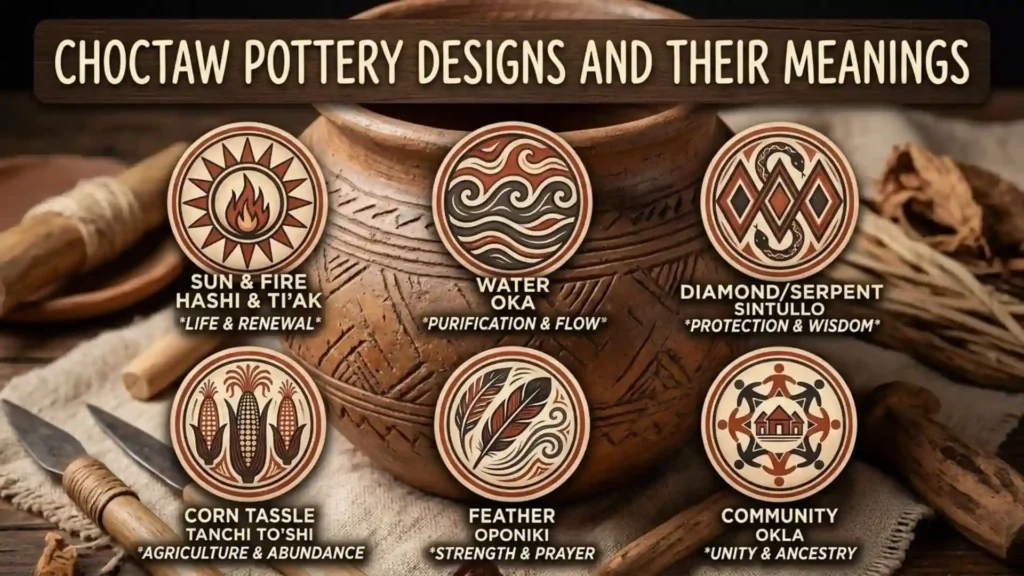
Choctaw pottery includes functional vessels and decorated objects made using traditional techniques. Some pieces have polished surfaces, incised patterns, or linear designs. Different forms were created for different purposes, including cooking and serving food.
The Choctaw Nation explains that the symbolism of pottery is subjective. Artists can interpret traditional designs in different ways, and each generation contributes new ideas while maintaining connections to earlier practices.
Comb and band designs
Comb and band designs are among the recurring patterns found on Choctaw pottery. The Choctaw Nation describes traditional associations between these designs and patterns in nature, including movements of the stars, wind, and sun.
These designs are also associated with the step patterns of Choctaw dances, including the snake dance. Similar patterns have been found on pottery from ancestral sites in Mississippi, Alabama, and Louisiana.
These associations help explain how pottery designs can connect artistic expression with the natural world and cultural practices. However, they should not be treated as rigid meanings that apply to every vessel.
How pottery connects generations
Choctaw pottery represents an important link between ancestral craftsmanship and contemporary cultural life. Traditional methods were affected by colonization and other historical disruptions, but the practice continued and has been revitalized through cultural programs and classes.
Contemporary Choctaw potters continue to make work that draws on earlier forms while expressing their own perspectives. This process allows cultural knowledge to be preserved without requiring artists to repeat every historic design exactly.
Choctaw Dance Symbols and the Meaning of Four
Traditional Choctaw dance is a cultural practice that connects people through movement, music, clothing, and shared participation. Some dances also communicate ideas about life, community, and the natural world.
The meaning of a dance depends on the particular tradition. One dance’s symbolism should not be applied automatically to every Choctaw dance.
The Four-Step War Dance
The Choctaw Nation describes the Four-Step War Dance as a tradition in which the number four carries special significance. The four steps are associated with recurring cycles of life, including birth, growth, decline, and death. They are also connected with the changing seasons.
The nation’s cultural explanation describes four paths: an entrance, an exit, and escape to the spiritual. The dance has different variations and descriptions, so it is important to consult the specific source when explaining its symbolism.
The participation of women alongside men in the War Dance is also significant in the Choctaw Nation’s account, reflecting the important role women hold in the community.
Animal dances and cultural expression
Some Choctaw social dances are associated with animals and qualities attributed to them. The meaning of a specific dance should be understood through the relevant Choctaw cultural explanation rather than through assumptions about animal symbolism in general.
Dance can communicate cultural knowledge through action and shared experience. It also gives younger generations opportunities to learn from older community members.
How to Identify Choctaw Symbols in Clothing and Art
Recognizing a Choctaw symbol involves more than spotting a familiar geometric shape. The object’s context, the design’s details, and the cultural source all help establish what the symbol means.
Start with the shape
Look closely at the design before assigning a meaning.
- A full diamond in traditional clothing or beadwork may be associated with the eastern diamondback rattlesnake.
- A half diamond in traditional clothing may be connected with hills, valleys, a path, or a journey.
- X and O motifs may be associated with stickball equipment.
- A combination of an unstrung bow, three arrows, and a pipe-hatchet identifies the central elements of the Choctaw Nation’s Great Seal.
These are useful identification clues, but they do not guarantee that every similar-looking design has the same origin or meaning.
Consider the object and its setting
A motif on a dress may have a different documented context from a similar pattern on a basket or pottery vessel. The material, arrangement, and surrounding imagery can help you determine which cultural resource is most relevant.
For example, if you see a diamond pattern on a basket, compare it with Choctaw basketry resources rather than relying only on explanations written about clothing.
Verify the interpretation with Choctaw sources
Use official cultural guides, historical explanations, museum collections, and information provided by Choctaw artists and educators. If a photograph does not show enough detail to identify the design confidently, acknowledge the uncertainty.
A careful identification is more useful than a confident but unsupported guess.
Choctaw Symbols in Modern Art, Jewelry, and Tattoos
Choctaw designs can inspire interest in Indigenous art, cultural heritage, and traditional craftsmanship. However, understanding a symbol’s origin is important before using it in a new context.
Choctaw symbols for tattoos
If you are considering a Choctaw-inspired tattoo, first research the exact design and its documented meaning. A full diamond, for example, has a specific association with the eastern diamondback rattlesnake in Choctaw clothing and beadwork.
That historical meaning does not automatically become a universal personal meaning when the design is used as a tattoo. If you intend the tattoo to express Choctaw identity or heritage, seek guidance from knowledgeable Choctaw sources or artists.
Avoid choosing a design based on an online list that combines symbols from different Indigenous cultures without explaining their origins.
Choctaw designs in jewelry and clothing
Traditional beadwork and appliqué can inspire contemporary clothing and jewelry. When purchasing Indigenous art, look for clear information about the artist and the origin of the piece.
Buying directly from Choctaw artists or reputable cultural programs can help support the people who maintain these traditions. It also gives buyers a better opportunity to learn about the techniques and meanings behind the work.
Using the Great Seal in artwork
The Great Seal is an official emblem of the Choctaw Nation of Oklahoma. It represents the nation as a whole, rather than simply serving as a decorative pattern.
Before reproducing the seal on merchandise, logos, jewelry, or other products, check the Choctaw Nation’s current guidance and any applicable permissions. Respecting an official national emblem is different from drawing inspiration from a general geometric form.
Choctaw Symbols Compared with Other Indigenous Symbols
Choctaw symbols belong to a specific cultural and historical context. Similar shapes may appear in the art of other Indigenous nations, but that does not mean the designs have identical meanings.
A diamond, cross, circle, or animal image may be interpreted differently according to the community, object, and tradition in which it appears.
For example, the Choctaw Nation’s documented association between the full diamond and the eastern diamondback rattlesnake should not be applied automatically to a diamond design from another Indigenous culture.
When researching Indigenous symbols, identify the specific nation or community connected with the design. Use sources produced by that community whenever possible, and avoid presenting Indigenous cultures as if they share one universal set of symbols.
Common Misunderstandings About Choctaw Symbols
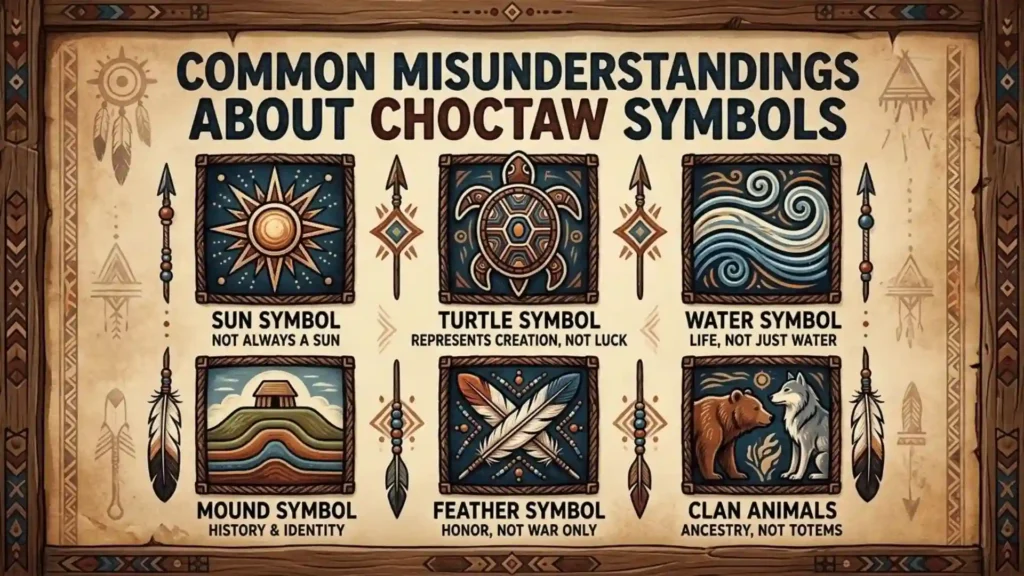
Every diamond pattern has the same meaning
Not necessarily. The full diamond and half diamond have specific documented associations in Choctaw traditional clothing. Similar designs can appear in other art forms, and their meaning should be understood in context.
The Great Seal is just a collection of generic symbols
The Great Seal’s unstrung bow, three arrows, and pipe-hatchet have documented meanings tied to Choctaw history and national identity. The three arrows, in particular, honor specific historic chiefs.
Choctaw designs belong only to the past
Choctaw clothing, basketry, beadwork, pottery, dance, and stickball remain part of contemporary cultural life. Artists and community members continue to preserve and develop these traditions.
Every pattern has one fixed interpretation
Some designs have clearly documented meanings, while others allow room for individual artistic interpretation. The Choctaw Nation explicitly acknowledges that pottery symbolism is subjective and that contemporary artists bring their own viewpoints to traditional forms.
A responsible explanation should distinguish established cultural information from possibilities or personal interpretations.
Frequently Asked Questions About Choctaw Symbols
What are the main Choctaw symbols?
Some of the best-known examples are the full diamond, half diamond, X/O stickball motifs, and the official Great Seal of the Choctaw Nation of Oklahoma. Their meanings differ according to context, ranging from respect for nature to the history and identity represented by the national emblem.
What does the Choctaw diamond symbol mean?
The full diamond in Choctaw traditional clothing and beadwork is associated with the eastern diamondback rattlesnake. The Choctaw Nation explains that the pattern expresses respect for nature and reflects the animal’s important place in the natural world.
What does the half-diamond pattern represent?
The half diamond is commonly associated with the hills and valleys of Choctaw homelands. Its lower bar is often said to represent a river or path, and the pattern can be interpreted as a journey through a landscape or through life’s changing experiences.
What do the X and O patterns mean?
The X and O motifs are associated with stickball equipment. The X relates to the crossed sticks, while the O relates to the ball. The Choctaw Nation’s dress guide also associates the X with the expression about paths crossing again.
What do the three arrows on the Choctaw seal represent?
The three arrows honor historic Choctaw chiefs Pushmataha, Moshulatubbee, and Apuckshunnubbee. Their inclusion connects the Great Seal with Choctaw leadership and history.
What does the unstrung bow on the Choctaw seal mean?
The unstrung bow symbolizes the Choctaw people’s love of peace and willingness to defend the nation if attacked. Its meaning combines peaceful intentions with the responsibility to protect the community.
What does the pipe-hatchet represent?
The pipe-hatchet on the Great Seal represents the Choctaw Nation’s desire to establish beneficial alliances with neighboring peoples. The nation’s historical explanation also suggests a possible association with prowess.
What do Choctaw basket patterns mean?
Choctaw basketry includes diamond, half-diamond, stair-step, and other geometric designs. Some are connected with respect for nature and the diamondback rattlesnake. The meaning of an individual pattern should be verified through the relevant cultural resource or artist.
Are Choctaw symbols still used today?
Yes. Choctaw patterns and cultural traditions remain active in clothing, beadwork, basketry, pottery, dance, and stickball. Contemporary artists and community members continue to teach and develop these practices.
Can anyone use Choctaw symbols in tattoos or artwork?
It depends on the design and its intended use. Research the symbol’s cultural context, credit artists appropriately, and consult official guidance before reproducing the Great Seal or other official imagery. Avoid treating culturally specific designs as generic decoration.
Conclusion
Choctaw symbols offer insight into the relationship between nature, community, history, and artistic expression. The full diamond and half diamond have documented associations with the natural world and Choctaw homelands. Stickball motifs connect clothing designs with a longstanding community tradition, while the Great Seal represents the Choctaw Nation through its unstrung bow, three arrows, and pipe-hatchet.
Basketry, beadwork, pottery, and dance reveal additional ways cultural knowledge is preserved and shared. These traditions are not simply remnants of the past. They continue through Choctaw artists, educators, families, and communities today.
When researching a Choctaw symbol, consider where it appears, which community explains it, and whether its meaning is firmly documented or open to interpretation. That approach leads to a more accurate understanding and shows respect for the people whose culture gives these designs their significance.

Adam Sullivan is a dedicated writer who enjoys transforming everyday topics into engaging and informative content. His writing focuses on making complex ideas simple, practical and enjoyable for readers of all backgrounds. Adam is also the fictional author of The Lantern Beyond Autumn Hills and Where the Morning Horizon Waits. Outside of writing, he enjoys photography, traveling and discovering inspiration through new experiences. He believes great content should be both helpful and easy to connect with.
 Dylan Anderson