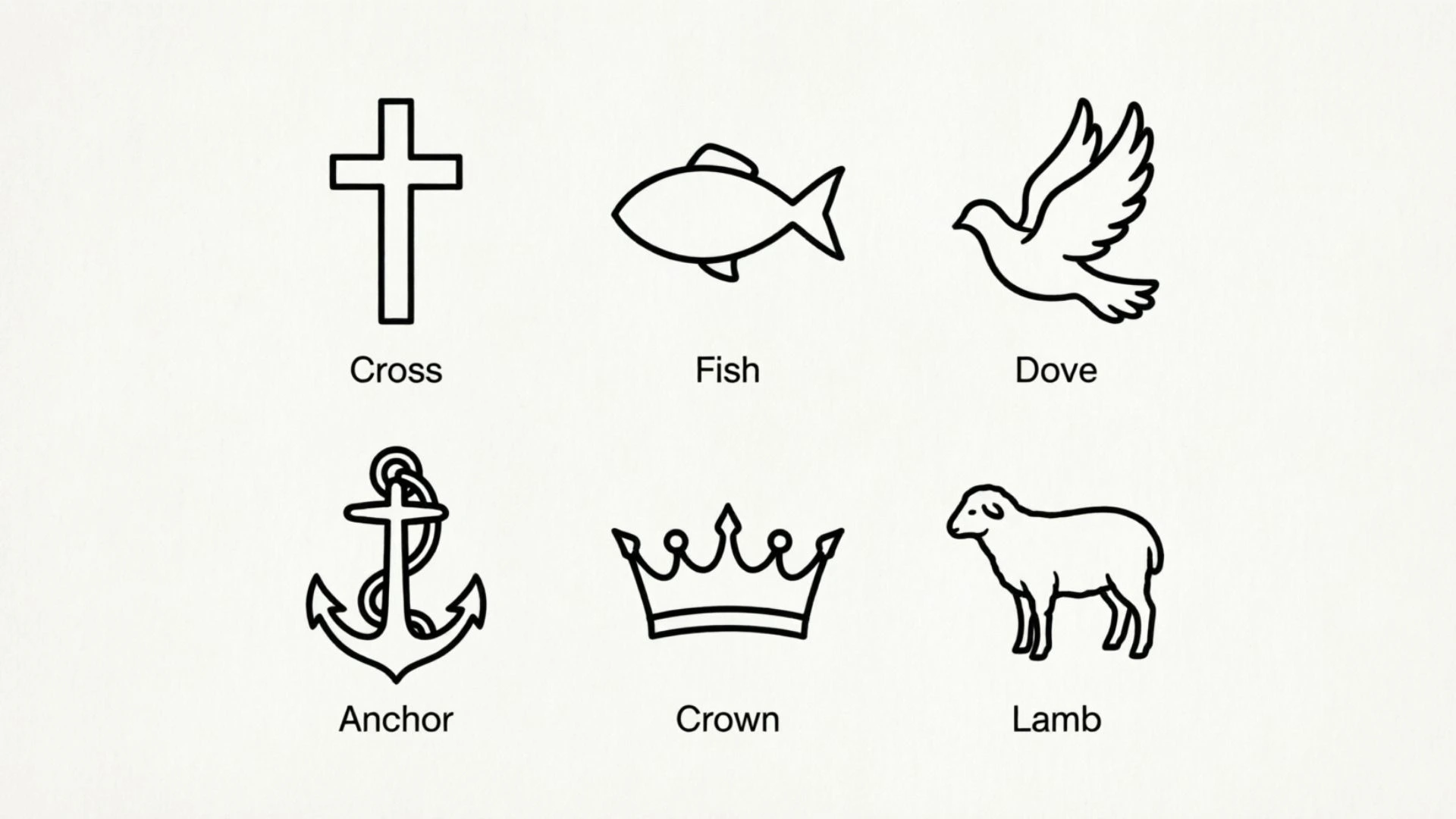
Christian religious symbols give visual form to some of the most important ideas in Christianity. A cross can remind believers of Jesus Christ’s crucifixion and resurrection, while a dove may represent the Holy Spirit. A fish can point to Christ and Christian identity, while an anchor can express hope and steadfast faith.
But not every symbol used by Christians comes directly from the Bible. Some images have clear biblical foundations, while others developed through early Christian history, church tradition, worship, architecture, and religious art. Understanding this difference makes it easier to appreciate what these symbols mean and why Christians continue to use them.
In this guide, you will find the meanings of major Christian religious symbols, their biblical connections, historical background, differences among Christian traditions, and examples of how they are used today.
Whether you are researching Christianity, choosing a meaningful symbol, studying religious art, or simply curious about the signs you see in churches and Christian communities, this guide provides a clear starting point.
What Are Christian Religious Symbols?
Christian religious symbols are images, objects, signs, or designs that communicate Christian beliefs and ideas. They can represent Jesus Christ, God, the Holy Spirit, salvation, sacrifice, resurrection, faith, hope, eternal life, or important events described in Scripture.
Symbols are useful because they communicate ideas visually. A person may see a cross and immediately connect it with the central story of Jesus’ death and resurrection. A church window showing a dove may bring to mind the Holy Spirit.
Some Christian symbols have a direct connection to biblical passages. Others became important through centuries of Christian practice and art.
This distinction is important because it prevents us from assuming that every traditional Christian image was specifically prescribed in Scripture.
Christian Religious Symbols at a Glance
Here are some of the most recognizable Christian religious symbols and their commonly associated meanings.
| Symbol | Common Meaning | Main Connection |
| Cross | Sacrifice, redemption, resurrection, Christian faith | Jesus’ crucifixion |
| Crucifix | Christ’s suffering and crucifixion | Jesus on the cross |
| Ichthys/Fish | Jesus Christ and Christian identity | Early Christian tradition and biblical fish imagery |
| Dove | Holy Spirit, peace, purity | Baptism of Jesus and other biblical imagery |
| Alpha and Omega | God’s eternity and completeness | Revelation |
| Chi-Rho | Christ | Early Christian tradition |
| Lamb | Christ, sacrifice, innocence | Biblical imagery |
| Anchor | Hope and steadfast faith | Hebrews 6:19 and early Christian use |
| Crown | Kingship, victory, eternal life | Biblical themes |
| Vine | Life and relationship with Christ | John 15 |
| Flame | Holy Spirit and spiritual presence | Acts 2 |
| Bread and wine | Communion and remembrance of Christ | Last Supper |
| Shepherd | Christ’s care and guidance | Biblical imagery |
| Light | Christ, truth, guidance, spiritual life | John 8:12 and other passages |
| Ship | The Church, faith, spiritual journey | Christian tradition |
| IHS | Jesus or the name of Jesus | Christian tradition |
| Trinity symbols | Father, Son, and Holy Spirit | Christian theology |
| Sacred Heart | Christ’s love and compassion | Especially Catholic tradition |
The meaning of a symbol can vary depending on denomination, historical period, artistic setting, and personal interpretation.
The Most Important Christian Symbols and Their Meanings
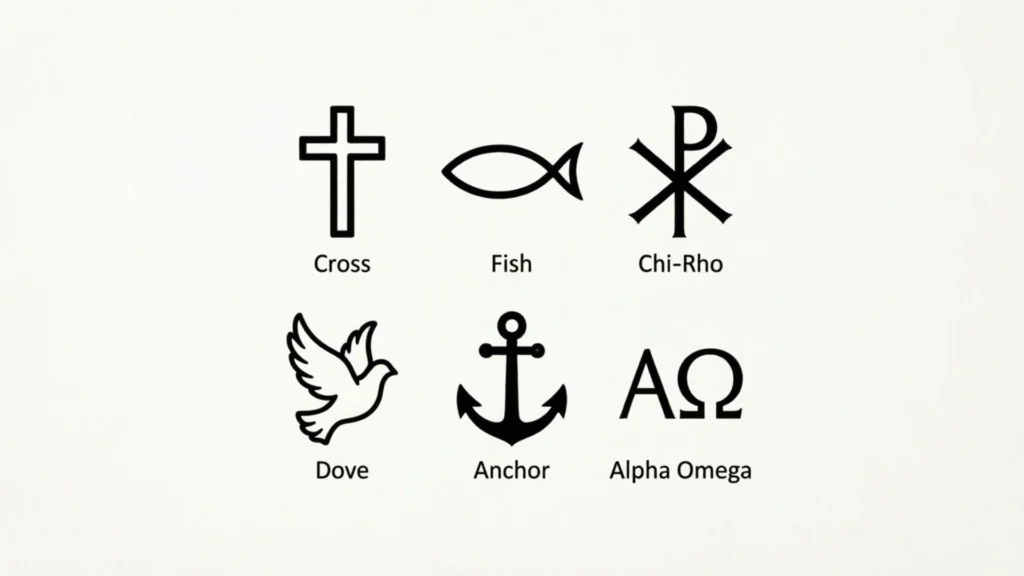
The Cross
The cross is widely recognized as the central symbol of Christianity. It recalls the crucifixion of Jesus and is closely associated with Christian teachings about sacrifice, redemption, forgiveness, and resurrection.
The New Testament presents the crucifixion as a defining event in the Christian story. Because of this, the cross can represent both suffering and hope. It reminds believers of Christ’s death while also pointing toward the resurrection.
The cross appears on churches, books, jewelry, artwork, clothing, memorials, and many other Christian objects.
For many Christians, wearing or displaying a cross is an outward expression of faith.
The Crucifix
A crucifix is a cross that includes a representation of Jesus’ body. While a simple cross focuses on the cross itself, a crucifix places greater visual emphasis on Christ’s crucifixion and suffering.
Crucifixes are particularly prominent in Catholic and some other Christian traditions, although their use varies among churches.
The distinction is simple:
- Cross: Usually shows the cross without a figure of Jesus.
- Crucifix: Shows Jesus on the cross.
Neither should automatically be treated as representing a completely different faith. Both are connected with the Christian understanding of Christ’s crucifixion.
The Ichthys or Christian Fish
The fish, often called the Ichthys, is one of the best-known early Christian symbols.
The Greek word ichthys means “fish.” Christians associated the word with a Greek phrase referring to Jesus Christ as Son of God and Savior. Because of this association, the fish became an important Christian sign.
The New Testament also contains many references to fish. Jesus called fishermen to become his disciples, performed miracles involving fish, and used fishing imagery in his teachings.
The fish is therefore connected to both biblical imagery and the development of Christian symbolism.
A popular modern story says that persecuted Christians secretly used the fish as a hidden identification sign. While the fish certainly has an important early Christian history, the details of this particular secret-code story are often presented more confidently than the historical evidence allows. It is better to describe the fish as an early Christian symbol without treating every later legend as established fact.
The Dove
The dove is strongly associated with the Holy Spirit.
During Jesus’ baptism, the Gospels describe the Spirit descending like a dove. This imagery helped establish the dove as a powerful Christian representation of the Holy Spirit.
The dove can also represent peace, purity, gentleness, and spiritual renewal.
In Christian artwork, a dove may appear above Jesus, near scenes of baptism, or alongside representations of the Father and Son.
Alpha and Omega
Alpha and Omega are the first and last letters of the Greek alphabet.
They are used symbolically in Revelation to express God’s eternal nature and the completeness of divine authority. Revelation 1:8 describes God as “the Alpha and the Omega,” and similar language appears elsewhere in Revelation.
Because the symbols represent the beginning and the end, they can communicate ideas such as:
- Eternity
- Completeness
- Divine authority
- God’s sovereignty
- The beginning and end of all things
You may see Alpha and Omega together in church architecture, crosses, artwork, and religious manuscripts.
The Chi-Rho
The Chi-Rho is an early Christian monogram formed from two Greek letters associated with the word for Christ.
It is one of the best-known Christograms, meaning a visual representation associated with the name or title of Christ.
The symbol became especially prominent in Christian history during the Roman period. It can appear in manuscripts, church decoration, coins, artwork, and other historical Christian objects.
Unlike the cross, the Chi-Rho is not usually encountered as an ordinary biblical illustration. Its importance developed through Christian history and tradition.
The Lamb
The lamb has deep biblical symbolism.
In the Gospel of John, John the Baptist identifies Jesus with the phrase “Lamb of God.” The imagery connects Christ with sacrifice, innocence, redemption, and salvation.
The lamb also connects with the broader biblical tradition of sacrificial offerings.
In Christian art, a lamb may therefore represent:
- Jesus Christ
- Sacrifice
- Innocence
- Redemption
- Salvation
- Christ’s victory
The symbol becomes especially powerful when paired with other Christian images.
The Anchor
The anchor is a traditional symbol of hope and steadfastness.
Hebrews 6:19 describes hope as an anchor for the soul. This biblical imagery helped give the anchor an important place in Christian symbolism.
The anchor can represent:
- Hope
- Stability
- Perseverance
- Faith during hardship
- Confidence in God’s promises
The anchor also became associated with early Christian symbolism and can be found in historical Christian art and inscriptions.
The Crown
A crown can symbolize kingship, victory, glory, authority, and eternal reward.
Christian symbolism often uses the crown in connection with Christ as King. It can also represent the promised reward of faithful believers.
The exact meaning depends on the context. A crown surrounding a cross, for example, can communicate ideas about Christ’s kingship and victory.
The Vine
The vine has a particularly clear connection to Jesus’ teaching.
In John 15, Jesus describes himself as the true vine and his followers as branches. The image emphasizes connection, spiritual life, dependence, and fruitfulness.
Because of this passage, the vine can symbolize:
- Life in Christ
- Spiritual growth
- Connection between Christ and believers
- Fruitfulness
- Dependence on God
Vines and grape imagery also have broader biblical significance and appear in Christian art and communion-related symbolism.
The Flame
Fire and flame are important images in Christian symbolism, especially in relation to the Holy Spirit.
Acts 2 describes the Holy Spirit coming upon the disciples at Pentecost with imagery resembling tongues of fire.
A flame can therefore symbolize:
- The Holy Spirit
- Spiritual power
- God’s presence
- Renewal
- Zeal
- Pentecost
Flame imagery appears in church logos, artwork, stained glass, candles, and denominational symbols.
Bread and Wine
Bread and wine are closely associated with the Christian practice of Communion or the Eucharist.
At the Last Supper, Jesus used bread and wine in connection with his body and blood. The Gospel accounts and Paul’s discussion in 1 Corinthians provide the biblical foundation for Christian Communion.
The exact theological interpretation varies among Christian traditions, but bread and wine generally point toward:
- Jesus’ sacrifice
- Remembrance
- Communion
- Fellowship
- Christ’s presence
- The Last Supper
Because Communion is understood differently across denominations, the meaning should be explained in a tradition-sensitive way.
The Shepherd
Shepherd imagery is frequently used for Jesus.
Jesus describes himself as the Good Shepherd in John 10. The image communicates care, protection, guidance, sacrifice, and a close relationship between Christ and his followers.
The shepherd can therefore represent:
- Jesus Christ
- Guidance
- Protection
- Care
- Sacrifice
- Leadership
A shepherd carrying a lamb is a particularly recognizable image in Christian art.
Light and the Candle
Light is a major biblical and Christian image.
Jesus says, “I am the light of the world” in John 8:12. Christian symbolism therefore often uses light to represent Christ, truth, guidance, hope, and spiritual life.
Candles are also used in many Christian worship settings, although their meaning and importance differ among traditions.
A candle can represent the presence of Christ, prayer, remembrance, hope, or spiritual light depending on the context.
Biblical Symbols vs. Christian Tradition
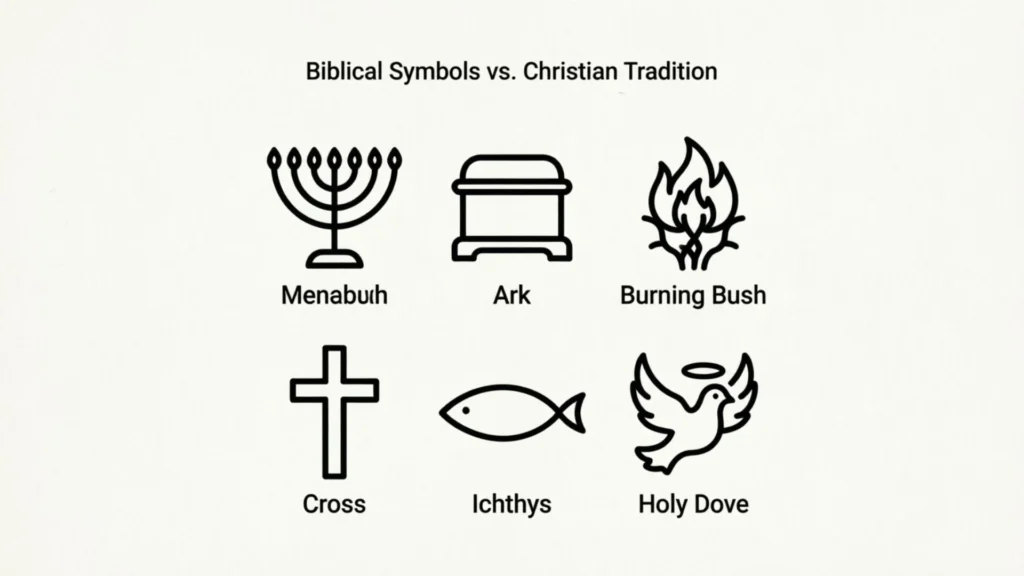
One of the easiest ways to misunderstand Christian symbolism is to assume that every symbol originated directly in the Bible.
Christian symbolism has developed over a very long period. Some symbols have explicit biblical foundations, while others were created or expanded by Christians later.
Symbols With Strong Biblical Connections
Examples include:
- Cross
- Dove
- Lamb
- Vine
- Alpha and Omega
- Bread and wine
- Shepherd
- Light
- Anchor imagery
- Flame/fire
These symbols can be connected to specific passages, teachings, events, or recurring imagery in Scripture.
Symbols Developed Through Christian Tradition
Other symbols became important through church history, theology, art, liturgy, and early Christian practice.
Examples include:
- Chi-Rho
- IHS
- Some forms of the Trinity symbol
- Particular cross designs
- Christian monograms
- Many artistic combinations of biblical symbols
This does not make traditional symbols less meaningful. It simply means their history is different from the history of symbols directly described in Scripture.
Why This Difference Matters
Being precise about origins makes Christian symbolism easier to understand.
Instead of saying:
“The Bible says Christians must use this symbol.”
it is often more accurate to say:
“This symbol developed in Christian tradition and is associated with this biblical idea.”
That small distinction improves historical and theological accuracy.
Christian Symbols That Represent Jesus Christ
Many Christian symbols are specifically connected with Jesus.
Cross
The cross represents Christ’s crucifixion and is also associated with redemption and resurrection.
Fish
The Ichthys became a Christian sign associated with Jesus Christ and Christian identity.
Lamb
The “Lamb of God” imagery connects Jesus with sacrifice and salvation.
Chi-Rho
The Chi-Rho is a historical Christogram associated with Christ.
IHS
IHS is a Christian monogram associated with the name of Jesus and has a particularly strong history in Western Christianity.
Vine
Jesus’ teaching about the true vine makes this an important symbol of the relationship between Christ and his followers.
Good Shepherd
The shepherd represents Jesus’ care, leadership, protection, and willingness to lay down his life for his sheep.
Christian Symbols of the Holy Spirit
The Holy Spirit is represented through several forms of biblical imagery.
Dove
The dove is connected especially with the Spirit’s descent at Jesus’ baptism.
Flame
Fire or flame recalls Pentecost and the coming of the Holy Spirit upon the disciples.
Wind
The biblical account of Pentecost also uses the imagery of a powerful wind. This can represent the unseen but powerful movement of the Spirit.
Water
Water has multiple Christian meanings, including baptism, cleansing, new life, and spiritual renewal. Its exact symbolism depends on the biblical passage and Christian context.
These images should not be confused with the idea that the Holy Spirit literally has the physical appearance of a dove, flame, or wind. They are symbolic forms used to communicate theological ideas.
Christian Symbols That Represent the Trinity
The Trinity refers to the Christian belief in one God understood through the Father, Son, and Holy Spirit.
Different Christian traditions use various visual forms to communicate this doctrine.
The Triquetra
The triquetra is a three-part interwoven design that has been used in Christian contexts to represent unity and the threefold nature of the Trinity.
However, it is important to remember that the design itself is not exclusively Christian. Similar three-part forms can have meanings outside Christianity.
Three Interlocking Circles
Three connected circles can be used to represent the Father, Son, and Holy Spirit while emphasizing their unity.
Triangle
A triangle can represent the three persons of the Trinity and their unity.
Trinity Knot Designs
Some Christian artwork uses interwoven knot-like designs to express the idea of three-in-one.
No single Trinity symbol is universally required by all Christian churches. Different communities may prefer different visual traditions.
Early Christian Symbols and Their History
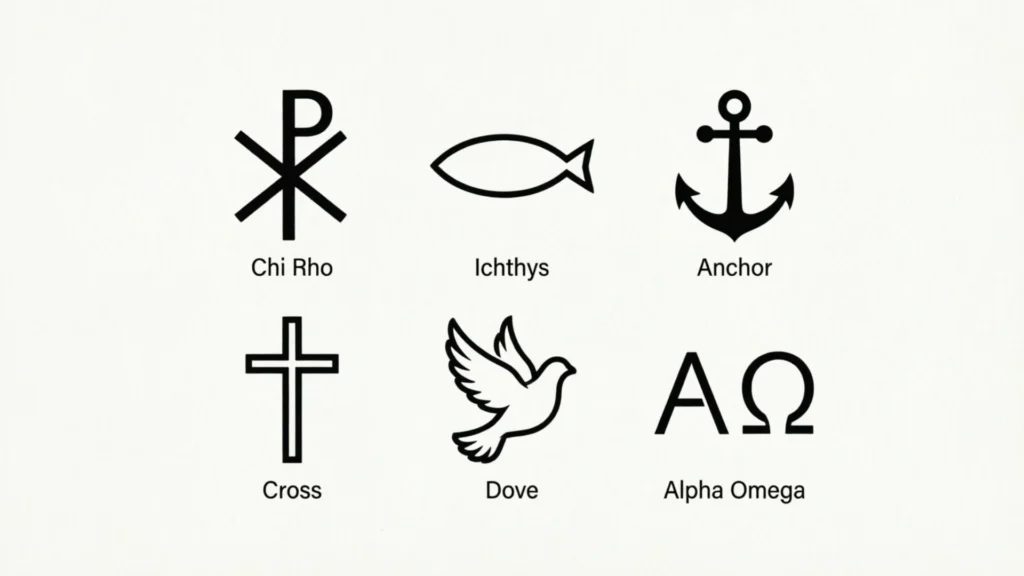
Early Christians developed a visual language that helped communicate faith, identity, hope, and biblical ideas.
Among the images associated with early Christianity are the fish, anchor, shepherd, dove, lamb, vine, and Chi-Rho.
These symbols were particularly useful in Christian art because they could communicate complex ideas through simple images.
Fish
The fish became associated with Christ and Christian identity and is among the best-known early Christian symbols.
Anchor
The anchor could communicate hope and steadfastness and also appears in early Christian contexts.
Shepherd
The shepherd was a natural image for Christ’s care and protection of believers.
Dove
The dove carried associations with peace and the Holy Spirit.
Chi-Rho
The Chi-Rho developed as an important Christogram in Christian history.
Why Early Christians Used Symbols
Symbols could communicate religious ideas visually in a world where literacy was not universal.
They also allowed artists to express biblical stories and theological concepts through sculpture, painting, mosaics, manuscripts, and architecture.
It is important, however, not to turn every later story about early Christians into historical fact. Some popular explanations of Christian symbols are based partly on tradition or later retellings rather than strong contemporary evidence.
Christian Symbols Across Different Traditions
Christianity includes many traditions and denominations, so the use of symbols is not identical everywhere.
Catholic Christian Symbols
Catholic churches commonly use a wide range of religious imagery.
Examples include:
- Crosses
- Crucifixes
- Sacred Heart imagery
- IHS
- Eucharistic symbols
- Alpha and Omega
- Saints’ symbols
- Marian imagery
- Lamb imagery
Catholic religious art often combines symbols to communicate biblical stories and theological ideas.
The Sacred Heart, for example, is particularly important within Catholic devotion and represents Christ’s love.
Orthodox Christian Symbols
Eastern Orthodox Christianity has a rich tradition of icons, crosses, liturgical imagery, and symbolic art.
The Orthodox cross is a recognizable form associated with Eastern Christian tradition. Orthodox churches also make extensive use of icons representing Christ, Mary, saints, and biblical events.
Orthodox symbolism should be understood within the tradition of iconography rather than treated simply as decoration.
Protestant Christian Symbols
Protestant churches vary considerably in their use of religious imagery.
Many Protestant communities prominently display the cross. Some traditions use stained glass, biblical symbols, and Christian artwork extensively, while others prefer simpler worship spaces.
There is no single Protestant rule about how many symbols a church should use.
Why Christian Symbolism Varies
Differences in Christian symbols can reflect:
- Theology
- Worship practices
- Church history
- Cultural traditions
- Attitudes toward religious art
- Denominational identity
For this reason, a symbol that is especially common in one Christian tradition may be less common in another.
Christian Symbols of Faith, Hope, Love, and Salvation
Christian symbolism is not limited to identifying Jesus or the Holy Spirit. Many symbols communicate broader spiritual ideas.
Symbols of Faith
The cross, fish, and anchor can all express Christian faith.
Symbols of Hope
The anchor has a particularly strong association with hope. Light can also communicate hope, especially in Christian art and worship.
Symbols of Love
The cross is closely connected with Christian understandings of Christ’s sacrificial love. The Sacred Heart is another important representation of Christ’s love, particularly in Catholic tradition.
Symbols of Salvation
The cross, lamb, empty tomb imagery, and resurrection-related symbols can communicate salvation and victory over death.
Symbols of New Life
Water, light, the vine, and butterfly imagery may be used to communicate renewal or new life. Some of these meanings are based strongly on Scripture, while others developed through later Christian artistic tradition.
Different Types of Christian Crosses
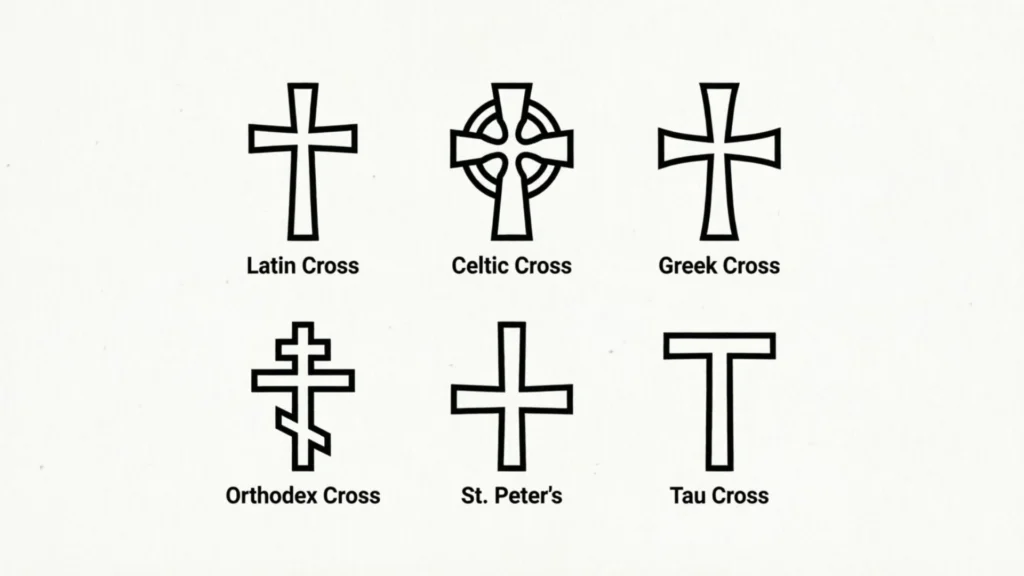
Not all Christian crosses look the same. Different designs developed in different historical and cultural settings.
Latin Cross
The Latin cross is one of the most recognizable Christian cross designs. It is widely associated with the crucifixion of Jesus.
Greek Cross
The Greek cross has arms of approximately equal length. It appears in various Eastern Christian and other historical contexts.
Orthodox Cross
The Orthodox cross commonly includes additional horizontal elements and is strongly associated with Eastern Orthodox tradition.
Its symbolism can include references to the crucifixion and the theological meaning attached to Christ’s death.
Celtic Cross
The Celtic cross combines a cross with a circular ring and is strongly associated with Celtic Christian art and later Christian heritage.
Today it may be used as a religious, cultural, historical, or decorative symbol.
Coptic Cross
The Coptic cross is associated with Coptic Christianity and has distinctive designs that developed within the Coptic Christian tradition.
Jerusalem Cross
The Jerusalem cross consists of a large central cross surrounded by smaller crosses. It has historical associations with Christianity and Jerusalem.
Why Cross Designs Differ
Different cross designs reflect different historical periods, regions, artistic styles, and Christian traditions. They should not all be treated as having exactly the same history.
Christian Religious Symbols in Art and Churches
Christian symbols are deeply connected with religious art.
You may see them in:
- Stained-glass windows
- Church doors
- Altars
- Pulpits
- Mosaics
- Paintings
- Sculptures
- Manuscripts
- Baptismal areas
- Cemetery monuments
- Vestments
- Church furniture
A symbol can help viewers understand a biblical story without requiring a long written explanation.
For example, a dove may identify a scene involving the Holy Spirit, while a lamb may point toward Christ’s sacrificial role.
Stained Glass
Stained-glass windows often combine several Christian symbols into one visual story.
A window may contain a cross, dove, crown, lamb, vine, or biblical figure. The colors, placement, and surrounding imagery can add further meaning.
Church Architecture
Crosses are often incorporated into the structure of Christian churches.
Other symbols can appear on doors, walls, towers, floors, and decorative elements.
The meaning of a symbol can change according to its location. A cross above an altar, for example, can have a different visual role from a small cross worn as personal jewelry.
Christian Religious Symbols for Tattoos, Jewelry, and Personal Use
Christian symbols are also common in modern personal expressions of faith.
People may choose a symbol for a tattoo, necklace, bracelet, ring, artwork, memorial, or personal decoration.
Cross Tattoos
A cross tattoo can represent faith, Christ, sacrifice, remembrance, or personal spiritual commitment.
Fish Tattoos
An Ichthys tattoo can communicate Christian identity and connection with Jesus.
Dove Tattoos
A dove can symbolize the Holy Spirit, peace, purity, or spiritual renewal.
Anchor Tattoos
An anchor can represent hope, stability, perseverance, and faith during difficult circumstances.
Chi-Rho Tattoos
The Chi-Rho can be meaningful for someone who wants a less immediately recognizable symbol associated with Christ.
Trinity Symbols
A triquetra or another Trinity design may be chosen to represent the Father, Son, and Holy Spirit.
The meaning of a tattoo or piece of jewelry is ultimately personal. Two Christians may choose the same symbol while attaching different personal experiences to it.
How to Choose a Christian Symbol Based on Its Meaning
If you want to choose a Christian symbol, start with the idea you want it to express.
To Represent Jesus’ Sacrifice
Choose the cross or crucifix.
To Represent Christian Identity
The Ichthys is a recognizable choice.
To Represent the Holy Spirit
The dove or flame can be appropriate.
To Represent Hope
The anchor has a strong biblical connection to hope.
To Represent Christ
The Chi-Rho, fish, lamb, or cross can communicate a connection with Jesus.
To Represent God’s Eternity
Alpha and Omega can express the idea of God’s eternal nature and completeness.
To Represent Spiritual Growth
The vine is especially meaningful because of Jesus’ teaching in John 15.
To Represent Christian Love
The cross or, in Catholic contexts, the Sacred Heart can express Christ’s love and sacrifice.
The best choice depends on whether you want the symbol to emphasize biblical meaning, Christian history, denominational tradition, or your own personal interpretation.
Are All Christian Symbols Found in the Bible?
No.
Some Christian symbols have a direct connection to Scripture, while others developed later through Christian history.
For example, the Bible contains the cross as part of the crucifixion story, the dove in connection with Jesus’ baptism, the vine in Jesus’ teaching, and Alpha and Omega in Revelation.
Other symbols, such as the Chi-Rho and IHS, developed as Christian traditions and visual forms rather than appearing in the Bible as established symbols.
This does not mean traditional symbols are unimportant. Christian communities have used art and visual language for centuries to express biblical teachings and theological ideas.
The important point is to identify the source accurately.
Are All Religious Symbols Exclusively Christian?
No.
Some images have meanings in several cultures or religions.
A dove, for example, can represent peace in a broader cultural context, even though it has specific Christian associations with the Holy Spirit.
Likewise, light, water, trees, crowns, animals, and other images can have symbolic meanings outside Christianity.
Context matters.
A symbol should therefore be identified according to how it is being used rather than assuming that every familiar religious image belongs exclusively to Christianity.
What Is the Difference Between a Christian Symbol and a Religious Symbol?
A Christian symbol is specifically connected with Christian beliefs, Scripture, worship, history, theology, or identity.
A religious symbol is a broader term that can refer to symbols used by Christianity, Judaism, Islam, Hinduism, Buddhism, and other religious traditions.
Therefore, Christian symbols are a category within the much larger world of religious symbolism.
Why Are Christian Symbols Important?
Christian symbols are important because they make abstract beliefs easier to see and remember.
A symbol can represent an entire theological idea in a single image.
The cross can remind a believer of Christ’s sacrifice. An anchor can express hope. A vine can communicate spiritual dependence on Christ. A dove can point toward the Holy Spirit.
Symbols can also connect generations. A design used in early Christian art may still appear in churches, books, jewelry, and artwork today.
Their importance is therefore both religious and cultural.
Christian Religious Symbols FAQs
What is the most important Christian religious symbol?
The cross is generally regarded as the central and most recognizable symbol of Christianity because it is directly connected with Jesus’ crucifixion and the Christian message of salvation and resurrection.
What does the Christian cross symbolize?
The cross primarily recalls Jesus Christ’s crucifixion. It can also represent sacrifice, redemption, forgiveness, salvation, Christian faith, and hope in the resurrection.
What is the difference between a cross and a crucifix?
A cross normally shows the cross without Jesus’ body, while a crucifix includes a representation of Jesus on the cross. Their use varies among Christian traditions.
What does the Christian fish symbol mean?
The Christian fish, or Ichthys, became associated with Jesus Christ and Christian identity. The Greek word for fish was connected by early Christians with a phrase identifying Jesus as Christ, Son of God, and Savior.
What does a dove symbolize in Christianity?
A dove is strongly associated with the Holy Spirit because the Gospels describe the Spirit descending like a dove at Jesus’ baptism. It can also represent peace and purity.
What Christian symbol represents hope?
The anchor is one of the strongest Christian symbols of hope because Hebrews 6:19 compares hope to an anchor for the soul.
What symbol represents Jesus in Christianity?
Several symbols can represent Jesus, including the cross, fish, lamb, Chi-Rho, IHS, vine, and shepherd. Their use and emphasis can vary according to context and tradition.
What are the symbols of the Holy Spirit?
Common Christian imagery for the Holy Spirit includes the dove, flame or fire, wind, and water. The dove and flame have especially recognizable biblical connections.
What does Alpha and Omega mean in Christianity?
Alpha and Omega are the first and last letters of the Greek alphabet. In Revelation, they express God’s eternal nature and completeness.
What is the Chi-Rho symbol?
The Chi-Rho is an early Christian Christogram formed from Greek letters associated with Christ. It became an important Christian symbol through church history.
Is the anchor a Christian symbol?
Yes. The anchor became an important Christian symbol of hope and steadfastness. Its meaning has a strong connection with Hebrews 6:19 and also appears in early Christian symbolism.
Are Christian symbols mentioned in the Bible?
Some are directly connected to biblical passages, while others developed later in Christian history. The cross, dove, lamb, vine, Alpha and Omega, shepherd, and other images have strong biblical connections, whereas symbols such as Chi-Rho developed through Christian tradition.
What are common Christian symbols of love?
The cross is strongly associated with Christ’s sacrificial love. The Sacred Heart is another important symbol of Christ’s love, especially within Catholic tradition.
What Christian symbol represents new life?
Water, light, the vine, and resurrection imagery can represent new life in Christian contexts. The precise meaning depends on the biblical or artistic context.
Why do different Christian churches use different symbols?
Christian denominations developed different traditions concerning worship, art, theology, and church history. As a result, some symbols are widely shared while others are especially important in particular traditions.
Final Thoughts on Christian Religious Symbols
Christian religious symbols are more than decorative images. They provide a visual language for expressing ideas about Jesus Christ, the Holy Spirit, salvation, sacrifice, hope, faith, love, and eternal life.
The cross remains the central Christian symbol for many believers, while the fish, dove, lamb, anchor, Alpha and Omega, Chi-Rho, vine, flame, and other images add different layers of meaning.
One of the most important things to remember is that Christian symbolism has more than one source. Some symbols come directly from biblical imagery, while others developed through early Christian history, theology, worship, and art. Their meanings can also differ between Catholic, Orthodox, Protestant, and other Christian traditions.
When you understand both the biblical foundation and the historical development of these symbols, Christian religious art becomes much easier to read. A simple image can reveal a connection to a biblical passage, a theological belief, an ancient tradition, or a personal expression of faith.

Adam Sullivan is a dedicated writer who enjoys transforming everyday topics into engaging and informative content. His writing focuses on making complex ideas simple, practical and enjoyable for readers of all backgrounds. Adam is also the fictional author of The Lantern Beyond Autumn Hills and Where the Morning Horizon Waits. Outside of writing, he enjoys photography, traveling and discovering inspiration through new experiences. He believes great content should be both helpful and easy to connect with.
 Dylan Anderson