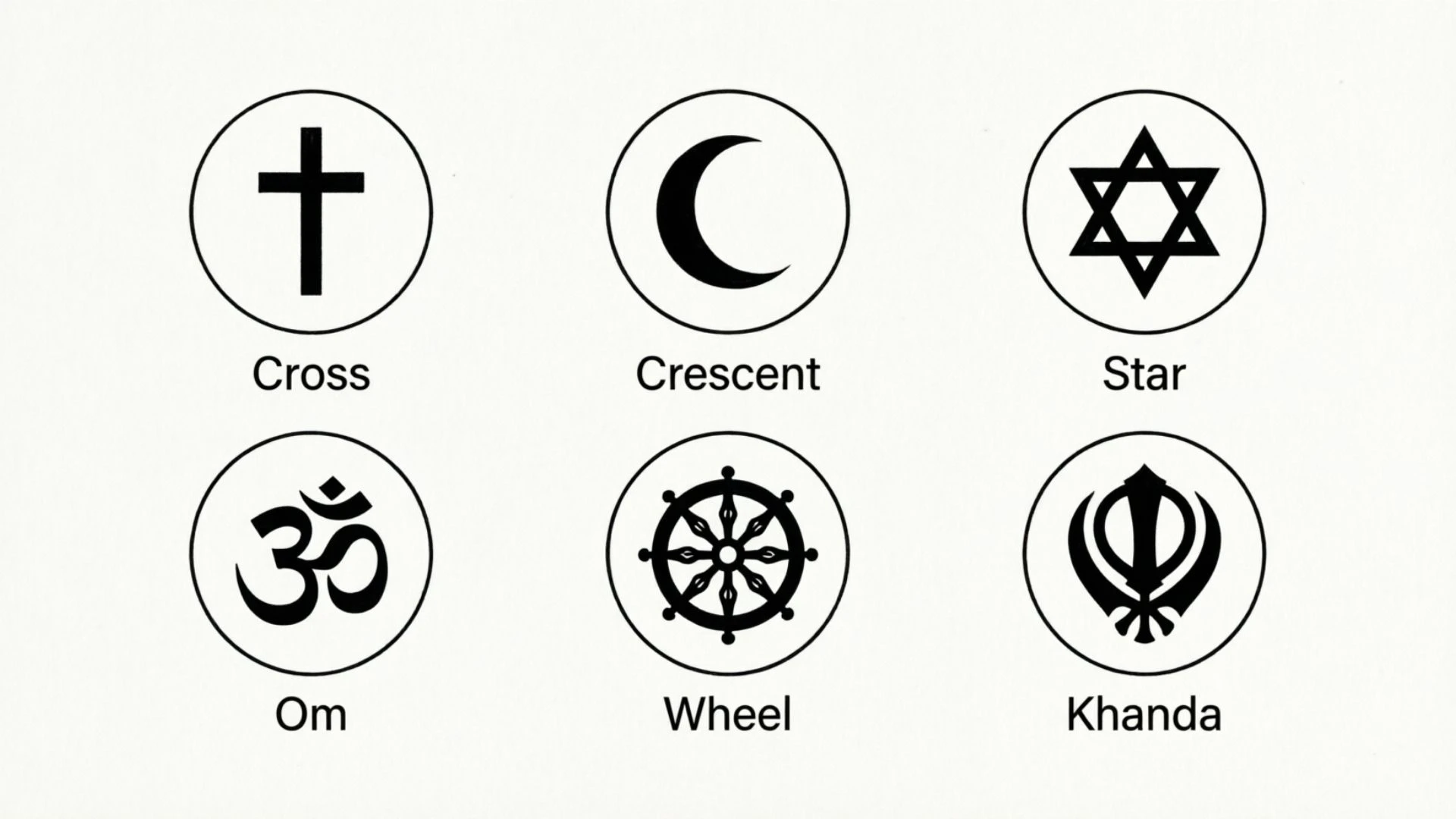
Religious symbols and meanings offer a fascinating way to understand how people express faith, identity, history, spirituality, and sacred beliefs.
A cross, lotus, Om symbol, Star of David, Dharma Wheel, Khanda, or torii gate may look simple, but each can carry layers of meaning shaped by religious teachings, history, culture, and community traditions.
People search for religious symbols and meanings for many reasons. Some want to identify an unfamiliar symbol. Others are researching world religions, choosing meaningful jewelry or artwork, studying history, looking for a tattoo idea, or simply trying to understand what a sacred image represents.
One important point is that religious symbols do not always have one fixed meaning. A symbol may have different interpretations in different traditions, historical periods, or cultures. Some symbols are closely connected to a particular religion, while others are shared among several communities.
This guide brings together important religious symbols from around the world and explains their commonly understood meanings in clear language. It also explores religious symbols in art, architecture, jewelry, and tattoos, explains why context matters, and provides practical guidance for identifying unfamiliar symbols respectfully.
What Are Religious Symbols and What Do They Mean? (Quick Answer)
Religious symbols are images, objects, letters, shapes, signs, or designs that communicate ideas connected with a religious or spiritual tradition. They may represent faith, devotion, sacred teachings, identity, prayer, protection, enlightenment, sacrifice, unity, or a connection with the divine.
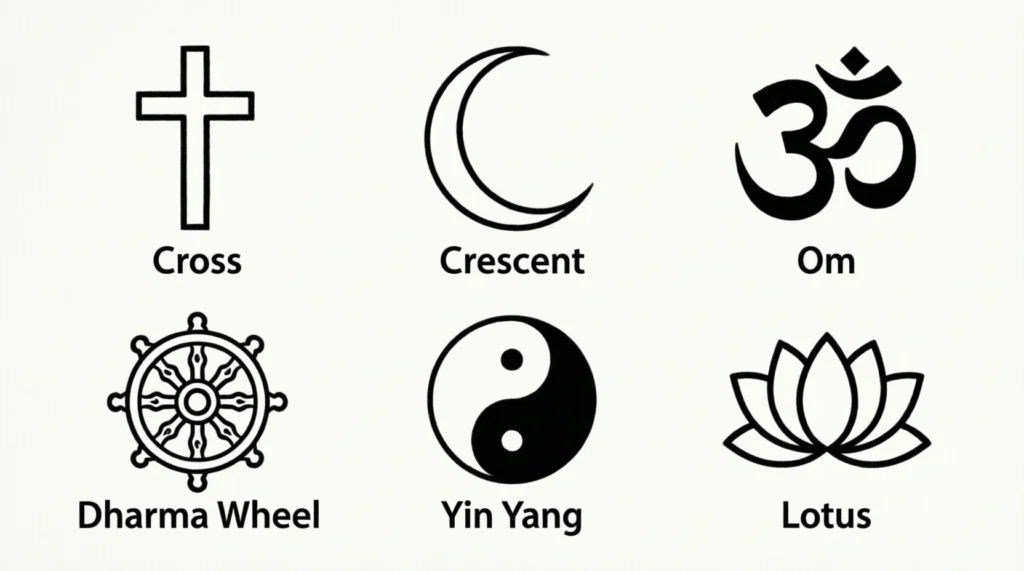
Here are some well-known examples:
| Symbol | Name | Associated Religion or Tradition | Common Meaning or Association |
| ✝ | Cross | Christianity | Christ, sacrifice, salvation, resurrection |
| ☪ | Crescent and star | Islamic cultures | Historical and cultural association with Islam |
| ✡ | Star of David | Judaism | Jewish identity and heritage |
| 🕎 | Menorah | Judaism | Temple tradition, light, Jewish history |
| ॐ | Om/Aum | Hindu traditions | Sacred sound and spiritual reality |
| 🪷 | Lotus | Hinduism, Buddhism | Purity, growth, transformation |
| ☸ | Dharma Wheel | Buddhism | Buddha’s teachings and Dharma |
| 🌳 | Bodhi Tree | Buddhism | Enlightenment and awakening |
| ☬ | Khanda | Sikhism | Sikh identity and religious principles |
| ੴ | Ik Onkar | Sikhism | Oneness of God |
| ☯ | Yin-yang | Taoist tradition | Complementarity and balance |
| ⛩️ | Torii | Shinto | Entrance into sacred space |
| 🪬 | Hamsa | Jewish, Muslim, and broader Middle Eastern traditions | Protection and blessing in various contexts |
| 卍 | Swastika | Hindu, Buddhist, Jain traditions | Auspiciousness and well-being in traditional contexts |
| Faravahar | Faravahar | Zoroastrian tradition | Zoroastrian identity and heritage |
| 𐤀 | Nine-pointed star | Baháʼí Faith | Unity and completeness |
These are simplified starting points. The precise meaning of any symbol depends on the tradition, community, period, and context in which it is used.
What Are Religious Symbols?
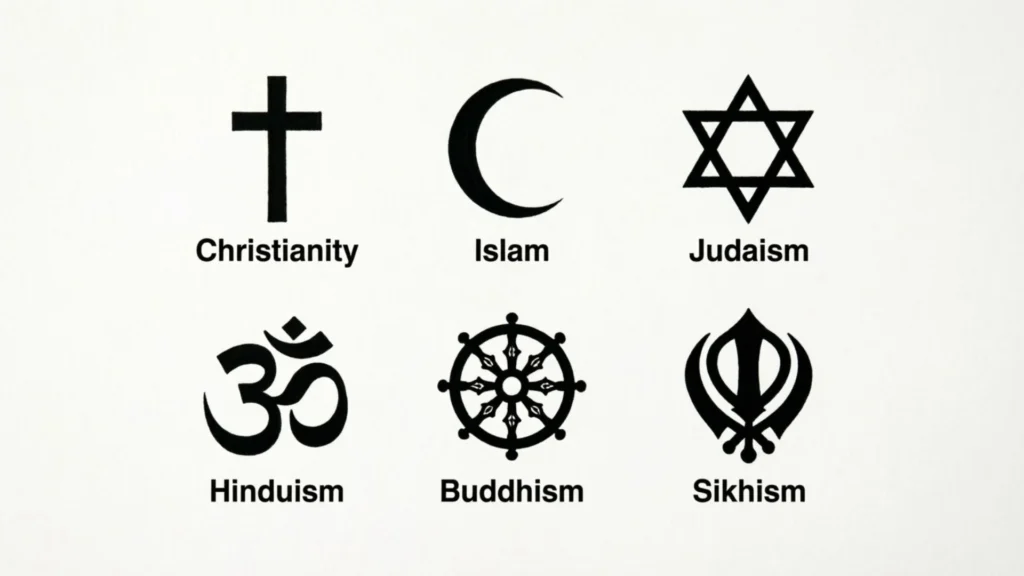
A religious symbol is something that communicates an idea associated with a faith or spiritual tradition. It may be visual, written, architectural, material, or ceremonial.
A symbol does more than identify a religion. It can help believers remember teachings, express devotion, mark sacred spaces, celebrate religious events, or communicate membership in a community.
For example, a cross can immediately communicate Christian identity while also recalling central Christian beliefs about Jesus. A Dharma Wheel can point toward Buddhist teachings, while a torii can indicate a transition into a Shinto sacred setting.
Religious symbols can therefore work on several levels at once:
- Identity: showing connection with a religious community.
- Teaching: expressing religious ideas visually.
- Memory: recalling important people, events, or teachings.
- Worship: participating in prayer and religious practice.
- Community: creating a shared visual language.
- Reflection: encouraging meditation or spiritual thought.
- Cultural heritage: preserving traditions across generations.
Not every meaningful religious object is technically a symbol, and not every symbol is an official emblem. This distinction is important when researching religion.
Why Do Religions Use Symbols?
Symbols Make Abstract Ideas Easier to Understand
Religious beliefs often involve concepts such as eternity, salvation, enlightenment, divine unity, compassion, sacrifice, or spiritual transformation. These ideas can be difficult to communicate through ordinary language alone.
Symbols provide a visual or physical way to represent those ideas.
Symbols Connect People With Tradition
A familiar symbol can connect an individual with family, community, history, and religious heritage.
For example, a person wearing a religious pendant may be expressing more than a personal belief. The object may also represent family tradition or cultural identity.
Symbols Help Mark Sacred Spaces
Religious symbols can help distinguish ordinary spaces from places regarded as sacred.
A torii at a Shinto shrine, religious imagery inside a church, or sacred calligraphy in an Islamic setting can communicate that a particular space has religious significance.
Symbols Preserve Historical Memory
Some symbols survive for centuries and become visual reminders of important religious events and communities.
Their meanings may develop over time, which is why historical research is sometimes necessary before assigning a single definition.
Religious Symbols and Meanings Chart
The following expanded chart provides a quick reference for some of the most recognizable symbols.
| Symbol | Name | Tradition | Main Association |
| ✝ | Cross | Christianity | Christ, sacrifice, salvation |
| 🐟 | Ichthys | Christianity | Jesus and Christian identity |
| ☧ | Chi-Rho | Christianity | Christ |
| Α Ω | Alpha and Omega | Christianity | Beginning and end, eternity |
| 🕊️ | Dove | Christianity and other traditions | Peace, Spirit, purity in particular contexts |
| ☪ | Crescent and star | Islamic cultures | Historical/cultural association |
| 🕋 | Kaaba | Islam | Sacred worship and pilgrimage |
| ✡ | Star of David | Judaism | Jewish identity |
| 🕎 | Menorah | Judaism | Temple tradition and Jewish history |
| חַי | Chai | Judaism | Life |
| ॐ | Om | Hindu traditions | Sacred sound and spiritual reality |
| 🪷 | Lotus | Hinduism/Buddhism | Purity and spiritual development |
| 卍 | Swastika | Hinduism/Jainism/Buddhism | Auspiciousness in traditional contexts |
| 🔱 | Trishula | Hindu traditions | Associated with Shiva and spiritual symbolism |
| ☸ | Dharma Wheel | Buddhism | Dharma and Buddha’s teachings |
| 🌳 | Bodhi Tree | Buddhism | Enlightenment |
| 🪢 | Endless Knot | Tibetan Buddhism | Interconnection and related teachings |
| ☬ | Khanda | Sikhism | Sikh identity and principles |
| ੴ | Ik Onkar | Sikhism | Oneness of God |
| ☯ | Yin-yang | Taoist tradition | Complementary forces |
| ⛩️ | Torii | Shinto | Sacred boundary or entrance |
| 🪬 | Hamsa | Several traditions | Protection and blessing |
| ✴️ | Nine-pointed star | Baháʼí Faith | Unity and completeness |
| Faravahar | Faravahar | Zoroastrian tradition | Identity and heritage |
| 🖐️ | Jain hand | Jainism | Ahimsa and nonviolence |
The chart is intended as a starting point rather than a universal religious dictionary.
Christian Symbols and Meanings
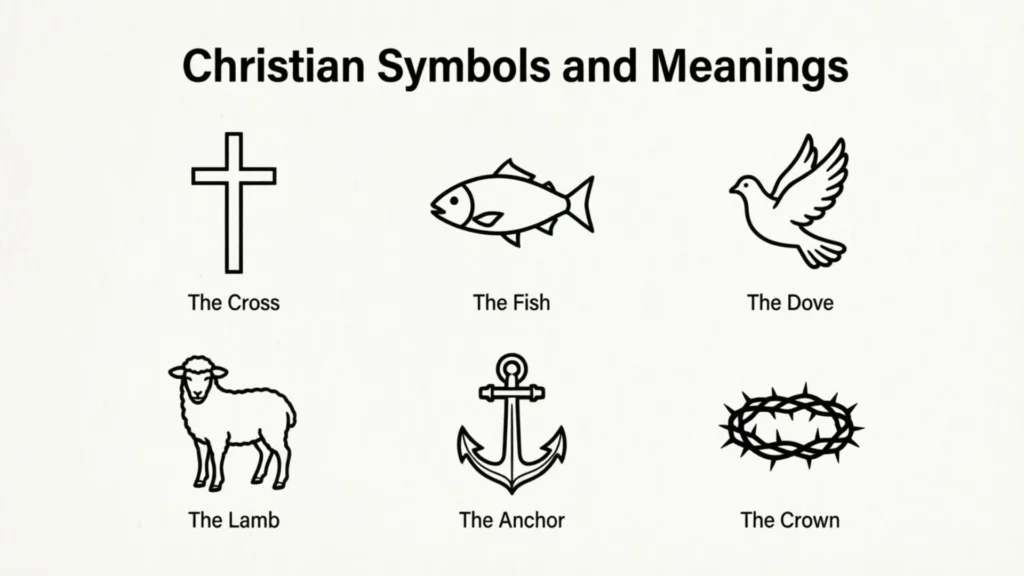
Christianity has a long and diverse tradition of symbolism. Different denominations and historical periods may emphasize different symbols.
The Cross
The cross is the best-known Christian symbol.
It is closely connected with the crucifixion of Jesus Christ and commonly represents sacrifice, salvation, faith, and resurrection.
Different forms exist, including the Latin cross and other historical Christian cross designs.
The Ichthys or Jesus Fish
The fish symbol, commonly called the Ichthys, has a long association with Christianity.
The Greek word for fish became connected with a Christian phrase referring to Jesus Christ. The fish consequently became a recognizable expression of Christian identity.
Today, it may appear on jewelry, vehicles, artwork, and other objects.
Chi-Rho
The Chi-Rho is a Christian monogram formed from Greek letters associated with Christ.
It appears in historical Christian artwork, manuscripts, and objects and became particularly prominent in early Christian visual culture.
Alpha and Omega
Alpha and Omega are the first and last letters of the Greek alphabet.
In Christian symbolism, they are associated with ideas of beginning and end, eternity, and divine completeness.
Dove
The dove appears in Christian art and scripture-related symbolism and can represent the Holy Spirit, peace, purity, or other meanings depending on context.
It is important not to assume that every dove image is automatically a Christian symbol because the bird also has broader cultural meanings.
Islamic Symbols and Meanings
Islam requires special attention because the popular idea that Islam has one official universal symbol is misleading.
The crescent and star are strongly associated with Islam in many modern contexts, but they are better understood as historical and cultural symbols rather than a universally required emblem of the religion.
Crescent and Star
The crescent and star have become widely associated with Muslim-majority societies.
Their connection with Islam developed historically and became especially prominent through Ottoman and later national usage.
Therefore, saying simply “the crescent is the symbol of Islam” removes important historical context.
The Kaaba
The Kaaba in Mecca is one of the most sacred sites in Islam.
Muslims around the world face toward the Kaaba during formal prayer, and the site is central to the pilgrimage known as Hajj.
Images of the Kaaba may therefore represent pilgrimage, worship, sacred geography, and Muslim unity.
Arabic Calligraphy
Arabic calligraphy plays an important role in Islamic visual culture.
Quranic verses, religious phrases, and sacred names may be rendered artistically through calligraphy. Different Islamic cultures and artistic traditions have developed distinctive approaches to written religious expression.
The Shahada
The Shahada is the Islamic declaration of faith.
Its words have profound theological significance, and written forms of the declaration can appear in Islamic art and calligraphy.
It should therefore be treated as a religious statement rather than merely a decorative symbol.
Jewish Symbols and Meanings
Jewish symbolism includes objects and images connected with scripture, worship, history, identity, and religious practice.
Star of David
The Star of David, or Magen David, is one of the most recognizable symbols of Jewish identity today.
It appears in religious, cultural, communal, and national contexts.
Its historical development is complex, and it was not always used as the universal symbol of Judaism that it is often perceived to be today.
Menorah
The seven-branched menorah is deeply connected with ancient Jewish Temple tradition.
It is one of the oldest recognizable symbols of Jewish heritage and continues to have major cultural and religious significance.
It is important to distinguish the seven-branched menorah from the nine-branched hanukkiah used during Hanukkah.
Chai
The Hebrew word chai means “life.”
The word is sometimes represented as jewelry or artwork and can express Jewish identity, appreciation for life, and cultural heritage.
Shofar
The shofar is a ram’s horn used in Jewish religious practice, particularly during important occasions such as Rosh Hashanah.
Although it is an actual ritual instrument rather than simply a decorative sign, its image can symbolize Jewish worship, remembrance, and religious tradition.
Hindu Symbols and Meanings
Hindu traditions contain an extensive variety of sacred symbols, deities, objects, sounds, animals, geometric forms, and ritual elements.
There is no single symbol that fully represents all Hindu traditions.
Om or Aum
Om is one of the most recognizable sacred symbols associated with Hindu traditions.
It is connected with sacred sound and profound philosophical and spiritual ideas. Om may appear in prayer, meditation, religious texts, temples, and artwork.
Lotus
The lotus has important symbolic associations in Hindu traditions.
Because the flower rises from muddy water while remaining visually pure and beautiful, it can represent purity, spiritual development, beauty, transformation, and transcendence.
The lotus also appears in religious imagery connected with Hindu deities.
Swastika
The swastika is one of the symbols requiring the greatest historical context.
The symbol existed for centuries before the Nazi appropriation of it in Europe. In Hindu, Jain, and some Buddhist contexts, traditional forms of the swastika have long been associated with auspiciousness, well-being, prosperity, or positive fortune.
Its Nazi association has given it a very different meaning in many modern Western contexts.
Therefore, the historical and cultural setting must always be considered.
Trishula
The trishula, or trident, is strongly associated with Shiva in Hindu traditions.
Its three-pronged form has received different interpretations in Hindu thought and iconography, making it another example of a symbol whose meaning should be explained through its religious context rather than reduced to one word.
Buddhist Symbols and Meanings
Buddhism uses many symbols to communicate teachings about the Buddha, Dharma, enlightenment, compassion, wisdom, and spiritual practice.
Dharma Wheel
The Dharma Wheel, or Dharmachakra, is one of the best-known Buddhist symbols.
It represents the Buddha’s teachings, known as the Dharma.
Its form and interpretations can vary between Buddhist traditions, but the wheel is broadly connected with teaching and the Buddhist path.
Bodhi Tree
The Bodhi Tree is associated with the Buddha’s enlightenment.
According to Buddhist tradition, Siddhartha Gautama attained enlightenment while meditating beneath a sacred fig tree.
The tree therefore represents awakening, wisdom, meditation, and liberation.
Endless Knot
The Endless Knot is especially recognizable in Tibetan Buddhist traditions.
Its interwoven design is associated with interconnectedness and can be interpreted in relation to Buddhist ideas concerning wisdom, compassion, and the interconnected nature of existence.
Lotus
The lotus is also important in Buddhist symbolism.
Its growth from muddy water into a beautiful flower provides a powerful visual metaphor for spiritual development and awakening.
Conch Shell
The conch is another symbol found in Buddhist traditions, particularly within Tibetan Buddhist symbolism.
It can be associated with the spreading of Buddhist teachings, with its sound serving as a metaphor for teachings reaching outward.
Sikh Symbols and Meanings
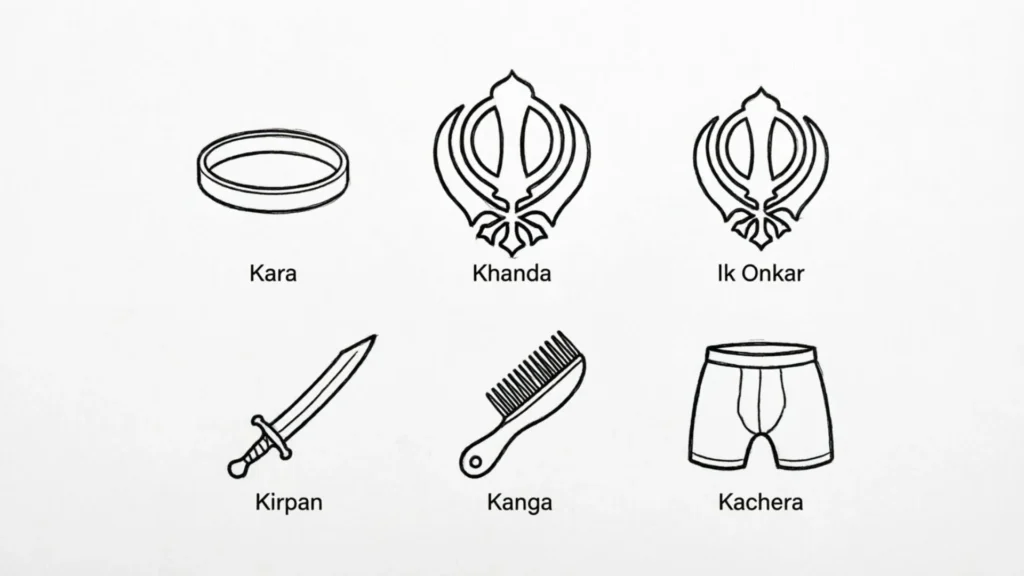
Sikhism has distinctive symbols that communicate important aspects of Sikh identity and belief.
Khanda
The Khanda is one of the most recognizable Sikh symbols.
Its design includes a central double-edged sword, a circular element, and two curved swords. The complete composition is strongly associated with Sikh identity and religious principles.
Ik Onkar
Ik Onkar expresses a fundamental Sikh belief in the oneness of God.
It is associated with the opening of the Guru Granth Sahib and has profound theological significance.
Nishan Sahib
The Nishan Sahib is the Sikh flag displayed outside gurdwaras.
It serves as a visible marker of Sikh presence and community and has important religious and communal significance.
Taoist Symbols and Meanings
Yin-Yang
The yin-yang symbol, known as the taijitu, is widely associated with Chinese philosophy and Taoist traditions.
Its two interdependent forms are commonly understood through ideas of complementary forces, balance, transformation, and interconnectedness.
It should not be reduced to the simplistic idea of “good versus evil.” The traditional philosophical concept is more nuanced.
The symbol is now widely used in popular culture, where its meaning may be broader than its historical philosophical context.
Jain Symbols and Meanings
Jainism places strong emphasis on nonviolence, spiritual discipline, and liberation.
Jain Hand
A raised hand is commonly used in Jain symbolism in connection with ahimsa, or nonviolence.
It can remind followers of the importance of avoiding harm and practicing compassion toward living beings.
Jain Emblem
The broader Jain emblem contains several elements representing aspects of Jain philosophy and the path toward liberation.
Because the emblem combines multiple symbols, it demonstrates how a religious tradition can communicate an entire framework of beliefs through one visual composition.
Shinto Symbols and Meanings
Torii Gate
The torii is one of the most recognizable symbols associated with Shinto shrines in Japan.
It commonly marks the entrance or boundary of a sacred shrine area.
Passing through a torii can therefore represent movement from an ordinary environment into a space associated with the sacred.
Shimenawa
A shimenawa is a sacred rope used in Shinto contexts to mark objects or spaces associated with sacred presence.
It is another example of how religious symbolism can be integrated into physical environments rather than appearing only as an emblem or logo.
Zoroastrian Symbols and Meanings
Faravahar
The Faravahar is strongly associated with Zoroastrian identity and Persian cultural heritage.
It is widely used today as a recognizable representation of Zoroastrian tradition.
Interpretations of its precise historical symbolism vary, so it is better to avoid presenting one modern explanation as an unquestionable ancient definition.
Baháʼí Symbols and Meanings
Nine-Pointed Star
The nine-pointed star is associated with the Baháʼí Faith.
The number nine carries symbolic importance in Baháʼí tradition, and the star can represent ideas connected with unity and completeness.
The Baháʼí Faith also has other important symbols and expressions, so the nine-pointed star should not be treated as its only sacred representation.
Hamsa Symbols and Meanings
Hamsa Hand
The Hamsa is a hand-shaped symbol found across parts of the Middle East and Mediterranean world.
It has appeared in Jewish, Muslim, and broader cultural contexts and has been associated with protection, blessing, and the avoidance of harmful forces.
Its history is complex, so describing it as exclusively belonging to one religion is misleading.
The Hamsa is a good example of why religious symbols and meanings must be studied through culture and history rather than appearance alone.
Religious Symbols That Represent Faith
Some symbols are commonly chosen to express personal faith or spiritual commitment.
Examples include:
- Cross
- Om
- Dharma Wheel
- Khanda
- Ik Onkar
- Star of David
- Menorah
- Lotus
- Religious calligraphy
- Sacred architectural symbols
The meaning depends on the religious tradition.
For example, a Christian may use a cross as an expression of faith in Christ, while a Buddhist may choose a Dharma Wheel as a reminder of Buddhist teachings.
There is no universal religious symbol of “faith” that means exactly the same thing across all traditions.
Religious Symbols That Represent Protection
Protection is another common reason people search for religious and spiritual symbols.
Symbols that have been associated with protection in particular cultural or religious contexts include:
- Hamsa
- Certain Buddhist protective imagery
- Religious inscriptions
- Sacred objects
- Amulets used within particular traditions
- Specific symbols associated with deities or saints
However, protection is not automatically the meaning of every religious symbol.
A symbol should be understood within the tradition that uses it rather than assigned a modern spiritual meaning without evidence.
Religious Symbols That Represent Peace
Peace is represented in many religious and cultural contexts through different images.
The dove is one well-known example, particularly in Christian art, although it also has broader cultural meanings.
Other religious traditions express peace through concepts such as compassion, nonviolence, harmony, spiritual liberation, and reconciliation rather than relying on one universal peace symbol.
The important point is that peace can be a religious value without there being one universal religious symbol for it.
Religious Symbols That Represent Hope and Spiritual Growth
Many religious traditions use images that can communicate spiritual growth or hope.
Lotus
The lotus is a powerful example because its growth from muddy water can be understood as a metaphor for moving toward spiritual purity or awakening.
Bodhi Tree
The Bodhi Tree can represent the possibility of awakening and wisdom.
Light
Light is used symbolically in many religious traditions to communicate ideas such as knowledge, divine presence, guidance, purity, or hope.
Religious Candles and Lamps
Candles, lamps, and other forms of light can carry different meanings depending on the religion and ceremony in which they appear.
Because light symbolism is widespread, context is essential.
Religious Symbols of the World
Religious symbolism varies greatly around the world.
South Asian Traditions
Hinduism, Buddhism, Jainism, and Sikhism contain rich visual traditions involving sacred letters, wheels, flowers, animals, geometric designs, objects, and architectural forms.
Middle Eastern Traditions
Judaism, Christianity, Islam, and other traditions that developed in or around the Middle East have distinctive symbolic languages shaped by scripture, history, worship, and cultural development.
East Asian Traditions
Chinese, Japanese, Korean, and Tibetan religious cultures contain diverse symbolic traditions involving architecture, calligraphy, geometric designs, natural elements, and ritual objects.
Persian Traditions
Zoroastrianism has an important symbolic heritage connected with Persian history and religious identity.
The diversity of these traditions shows why it is better to talk about religious symbols rather than assuming that all religions use symbols in the same way.
Religious Symbols in Art
Religious symbolism has played a major role in visual art for centuries.
Symbols can appear in:
- Paintings
- Sculpture
- Manuscripts
- Textiles
- Ceremonial objects
- Jewelry
- Wall decoration
- Icons
- Temple decoration
- Religious architecture
Artists may use a symbol to communicate a story, identify a sacred figure, express theological ideas, or guide the viewer toward a particular interpretation.
This is why recognizing symbols can make religious art much easier to understand.
Religious Symbols in Architecture
Sacred symbolism is not limited to individual objects.
Architecture itself can communicate religious meaning.
Examples include:
- Crosses and Christian imagery in churches
- Menorah imagery and Jewish decorative traditions
- Islamic calligraphy and geometric patterns
- Buddhist temple designs
- Torii gates at Shinto shrines
- Sikh flags and gurdwara features
- Hindu temple iconography
Architecture can therefore function as a large-scale symbolic language.
Religious Symbols in Jewelry
Religious jewelry is often worn for devotion, identity, remembrance, heritage, or personal meaning.
Common examples include:
- Cross necklaces
- Star of David pendants
- Chai jewelry
- Om pendants
- Khanda necklaces
- Religious calligraphy
- Lotus designs
- Hamsa jewelry
Before purchasing or wearing a symbol, it is worth understanding its meaning within the tradition.
A piece that looks decorative to one person may be deeply sacred to another.
Religious Symbols for Tattoos
Religious tattoos can carry deeply personal meanings.
Someone may choose a religious symbol to represent:
- Faith
- Family heritage
- Spiritual growth
- Personal transformation
- Devotion
- Remembrance
- Hope
- Religious identity
Popular choices can include crosses, Om, lotus designs, Buddhist symbols, Star of David designs, and Sikh symbols.
However, research should come before permanent use.
A sacred symbol may have specific religious expectations or cultural significance that is not obvious to someone unfamiliar with the tradition.
A respectful approach is to learn:
- The symbol’s traditional name.
- Its religious history.
- Its traditional meaning.
- How contemporary followers use it.
- Whether the design has meanings beyond the religion.
- Whether your chosen version changes the original symbolism.
Religious Symbols in Clothing and Personal Expression
Religious symbols may also appear on clothing, headwear, accessories, and other personal items.
For believers, this can be a way to publicly express identity or devotion.
For others, religious imagery may represent family heritage, cultural history, or artistic appreciation.
Because clothing can make a symbol highly visible, understanding its significance is especially important when using imagery from a tradition that is not your own.
How to Identify an Unknown Religious Symbol
If you find an unfamiliar symbol, do not rely only on its shape.
Use a step-by-step approach.
Step 1: Look at the Shape
Determine whether it resembles:
- A cross
- Star
- Wheel
- Hand
- Flower
- Animal
- Letter
- Geometric design
- Tool or ritual object
Step 2: Examine Any Writing
Look for:
- Hebrew
- Arabic
- Sanskrit or Devanagari
- Gurmukhi
- Greek
- Chinese characters
- Other religious scripts
Written language can provide an important clue.
Step 3: Consider Where You Found It
Was it on:
- A church?
- Mosque?
- Synagogue?
- Temple?
- Shrine?
- Gurdwara?
- Religious book?
- Necklace?
- Tattoo?
- Flag?
- Painting?
The location can provide valuable context.
Step 4: Check the Historical and Cultural Context
Ask where the object originated and which community used it.
A symbol that appears religious may also be cultural, historical, national, or decorative.
Step 5: Compare Multiple Reliable Sources
For unfamiliar or disputed symbols, compare museum collections, academic sources, religious organizations, and reputable reference works.
Do not accept the first definition you see online as automatically correct.
Why the Same Symbol Can Have Different Meanings
One of the most important lessons when studying religious symbols and meanings is that symbols can change across cultures and periods.
A symbol may have:
- An ancient religious meaning
- A later cultural meaning
- A modern political meaning
- A personal meaning
- A decorative meaning
The swastika is an especially clear example. Traditional forms have ancient associations in several Asian religions, while Nazi appropriation created an extremely different and painful association in modern Western history.
Similarly, the crescent and star may be strongly associated with Islam today without being a universally prescribed symbol of Islamic faith.
Context protects readers from oversimplification.
Religious Symbols vs. Religious Emblems
A religious symbol can represent an idea, teaching, story, or spiritual concept.
A religious emblem is more likely to function as an identifying mark for a group or organization.
The distinction is not always absolute.
For example, the cross is both a symbol of Christian beliefs and a widely recognized marker of Christian identity.
This is why terms such as symbol, emblem, sign, and sacred object should not always be treated as interchangeable.
Are All Religious Symbols Official?
No.
This is one of the most common misunderstandings about religious symbolism.
A symbol may be:
- Officially adopted by an organization
- Traditionally associated with a religion
- Commonly used by followers
- Connected to a particular denomination
- Primarily cultural
- Historically important
- Popular in modern culture
These categories are different.
For example, the crescent and star is strongly recognized as an Islamic-associated image, but Islam does not require every Muslim to use it as an official religious emblem.
Likewise, Hinduism has many sacred symbols rather than one single symbol that represents every Hindu tradition.
How to Use Religious Symbols Respectfully
Learn Before You Use
Research the symbol’s actual history and meaning before using it in a tattoo, product, design, or public setting.
Avoid Assuming One Meaning
If a symbol has multiple interpretations, acknowledge that.
Respect Sacred Context
Some religious objects and images are intended for particular forms of worship or ceremonial use.
Don’t Treat Sacred Imagery as Decoration Without Context
A symbol may be aesthetically attractive while also carrying profound religious meaning.
Be Careful With Shared Symbols
If multiple communities use the same symbol, identify the specific context instead of assigning it to only one religion.
Separate Ancient and Modern Meanings
A symbol’s current popular meaning may be very different from its historical meaning.
Religious Symbols and Meanings for Students
Students researching religious symbols should look beyond memorizing names.
A stronger research approach is to study four things:
Symbol → Tradition → Historical context → Meaning
For example:
Dharma Wheel → Buddhism → Buddhist teaching tradition → Dharma
This approach helps students understand symbolism rather than simply memorize a list.
It is also useful for assignments about world religions, art history, anthropology, cultural studies, and religious history.
Religious Symbols and Meanings for Designers and Content Creators
Designers should be especially careful when using religious imagery commercially.
Before incorporating a symbol into a logo, illustration, product, or marketing campaign, research:
- Its religious significance
- Its cultural associations
- Its historical background
- Whether it has political meanings
- Whether the intended use could be considered disrespectful
A symbol should not be chosen only because it “looks spiritual.”
Common Mistakes When Interpreting Religious Symbols
Mistake 1: Assuming Every Religion Has One Symbol
Many traditions have numerous symbols and sacred forms.
Mistake 2: Treating Cultural Symbols as Official Religious Requirements
A symbol can become strongly associated with a religion without being formally required by it.
Mistake 3: Ignoring Historical Context
Meanings can change over time.
Mistake 4: Assuming a Symbol Has One Universal Meaning
The same design can have different meanings in different communities.
Mistake 5: Using Modern Internet Definitions Without Verification
Popular websites sometimes simplify complicated religious histories.
Mistake 6: Confusing a Religious Object With a Decorative Symbol
Some objects are used as part of actual religious practice and deserve more careful explanation.
Frequently Asked Questions About Religious Symbols and Meanings
What are the most common religious symbols?
Some of the best-known include the Christian cross, Star of David, menorah, Om, lotus, Dharma Wheel, Khanda, Ik Onkar, yin-yang, torii, Hamsa, and crescent and star.
What symbol represents all religions?
There is no universally accepted symbol that officially represents all religions. Different traditions have their own beliefs, histories, practices, and sacred imagery.
What are the symbols of the world’s major religions?
Commonly recognized examples include the cross for Christianity, Star of David for Judaism, Om for Hindu traditions, Dharma Wheel for Buddhism, Khanda for Sikhism, and the crescent and star as a cultural symbol associated with Islam.
These associations are useful for identification but should not be treated as complete definitions of the religions themselves.
What religious symbol represents faith?
There is no single universal symbol for faith. Different communities use different symbols to express belief and devotion. The cross, Om, Khanda, Dharma Wheel, and Star of David can all have faith-related significance within their respective traditions.
What religious symbol represents protection?
The Hamsa is associated with protection in several Jewish, Muslim, and broader Middle Eastern contexts. Other religious traditions also have protective symbols, prayers, objects, and images.
What religious symbol represents peace?
There is no single universal religious peace symbol. The dove is commonly connected with peace and has Christian associations in particular contexts, while other religions express peace through concepts such as nonviolence, compassion, harmony, and spiritual liberation.
What is the oldest religious symbol?
There is no simple answer because symbolic markings and religious imagery date back to prehistoric periods, and determining whether an ancient mark was specifically religious can be difficult. Different symbols have extremely long histories, and their meanings may not be completely known.
Why do religions use symbols?
Religions use symbols to communicate beliefs, preserve traditions, express identity, mark sacred spaces, support worship, and make complex spiritual ideas easier to represent visually.
Can the same symbol belong to different religions?
Yes. Some symbols have been used by multiple religions and cultures. Their meanings can differ significantly according to context.
Is the crescent and star an official symbol of Islam?
The crescent and star are widely associated with Islam and Muslim-majority cultures, but they are not a universally mandated symbol of Islam. Their strong modern association developed through historical and cultural usage.
What does the Om symbol mean?
Om, or Aum, is a sacred sound and symbol in Hindu traditions and is associated with profound spiritual and philosophical ideas. It is widely used in prayer, meditation, religious texts, and artwork.
What does the Dharma Wheel symbolize?
The Dharma Wheel represents the Buddha’s teachings, known as the Dharma. It is one of the most recognizable symbols associated with Buddhism.
What does the Khanda symbolize?
The Khanda is a major symbol of Sikh identity and is composed of several elements that are interpreted in relation to Sikh beliefs and principles.
Is the swastika always a Nazi symbol?
No. The swastika has a much older history and has traditional religious meanings in Hinduism, Jainism, Buddhism, and other Asian contexts. Nazi Germany appropriated and transformed the symbol in the 20th century, giving it a deeply different association in many modern Western contexts.
Can I use a religious symbol as a tattoo?
You can choose a religious symbol as a personal tattoo, but researching its history and meaning first is important. Some symbols have sacred significance that may not be obvious from their appearance.
Are religious symbols always sacred?
Not necessarily. A religious image can be used in worship, cultural settings, historical contexts, educational material, art, or decoration. Its significance depends on how and where it is used.
Final Thoughts on Religious Symbols and Meanings
Religious symbols and meanings provide a valuable window into the beliefs, histories, identities, and traditions of communities around the world. A simple cross, wheel, flower, star, hand, letter, or architectural feature can carry centuries of religious and cultural significance.
The most important thing to remember is that a symbol’s appearance does not always tell you its complete meaning. Historical period, religious tradition, geographic location, community practice, and intended use all matter.
Some symbols are strongly associated with one faith, while others are shared across cultures. Some are official emblems, while others are simply common cultural associations. Understanding these differences makes research more accurate and respectful.
Whether you are studying world religions, identifying an unfamiliar image, researching a tattoo, choosing meaningful jewelry, creating artwork, or learning about cultural history, start with context. Learn the symbol’s name, discover where it came from, understand how the relevant community uses it, and recognize that interpretations can sometimes differ.
That approach turns a simple list of religious symbols into a deeper understanding of the people and traditions behind them.

Adam Sullivan is a dedicated writer who enjoys transforming everyday topics into engaging and informative content. His writing focuses on making complex ideas simple, practical and enjoyable for readers of all backgrounds. Adam is also the fictional author of The Lantern Beyond Autumn Hills and Where the Morning Horizon Waits. Outside of writing, he enjoys photography, traveling and discovering inspiration through new experiences. He believes great content should be both helpful and easy to connect with.
 Dylan Anderson