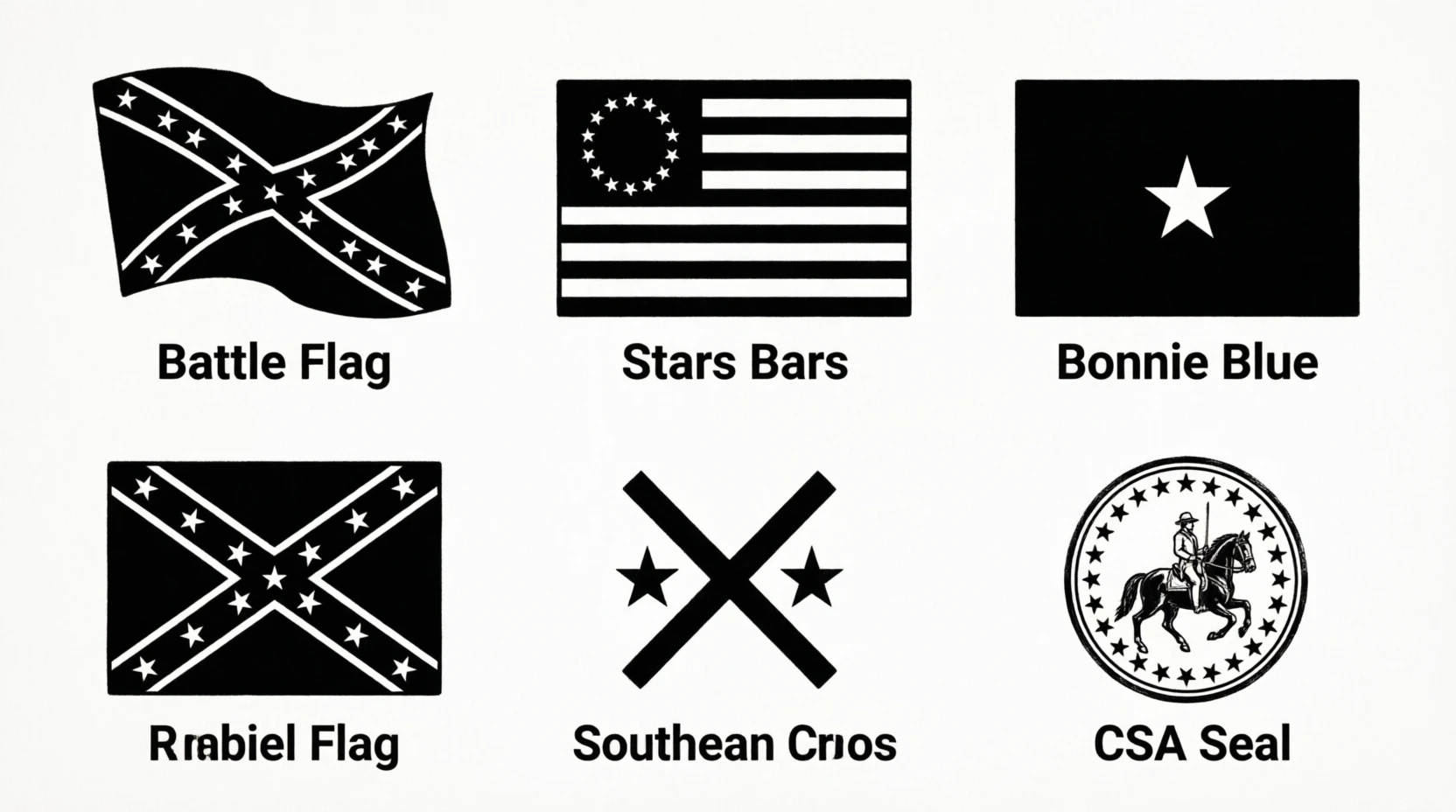
When I first started learning about Confederate symbols, I realized that people often attach very different meanings to them.
You may have seen these symbols in history books, museums, protests, movies, or public debates.
Understanding where they came from and why they remain controversial helps us better understand American history and its lasting impact.
Rather than relying on myths or assumptions, it’s important to explore these symbols with historical accuracy and respect.
Their meanings have changed over time, and different communities view them in very different ways.
Quick Answer: What Are Confederate Symbols?
Confederate symbols are flags, emblems, monuments, uniforms, and other images associated with the Confederate States of America, a group of eleven Southern states that seceded from the United States during the American Civil War (1861–1865). Today, these symbols are widely debated because many people view them as reminders of slavery, racism, and white supremacy, while others have historically described them as symbols of Southern heritage. Their meaning depends on historical context, location, and personal interpretation.
What Are Confederate Symbols?
Confederate symbols are visual representations connected to the Confederate States of America during the Civil War. They appeared on military flags, government seals, uniforms, currency, monuments, and memorials.
Historically, these symbols identified the Confederate government and its armed forces. Since the Confederacy fought to preserve a society built on slavery, many historians explain that these symbols cannot be separated from that historical reality.
Over the decades, Confederate symbols have also been used by various political movements, heritage organizations, museums, and, in some cases, extremist groups. Because of this long and complex history, their meaning varies depending on the setting and the people using them.
Confederate Symbols Comparison Table
| Symbol | Historical Meaning | Common Context Today |
| Confederate Battle Flag | Military battlefield identification | Historical discussion, controversy |
| First National Flag (“Stars and Bars”) | National flag of the Confederacy | Museums, historical collections |
| Second National Flag | Official Confederate flag (1863–1865) | Historical research |
| Third National Flag | Final Confederate national flag | Museum exhibits |
| Great Seal of the Confederacy | Official government seal | Historical documents |
| Confederate Soldier Statue | Memorial to Confederate soldiers | Public monument debates |
| Gray Confederate Uniform | Confederate military clothing | Reenactments, museums |
| Confederate Currency | Money issued by the Confederacy | Collecting, education |
| Confederate Naval Jack | Naval military flag | Maritime history |
| Stone Mountain Carving | Monument featuring Confederate leaders | Public discussion |
| Monument Avenue Memorials | Confederate monuments | Historical preservation debates |
| Sons of Confederate Veterans Emblem | Heritage organization insignia | Heritage organization activities |
Major Confederate Symbols and Their Historical Meanings
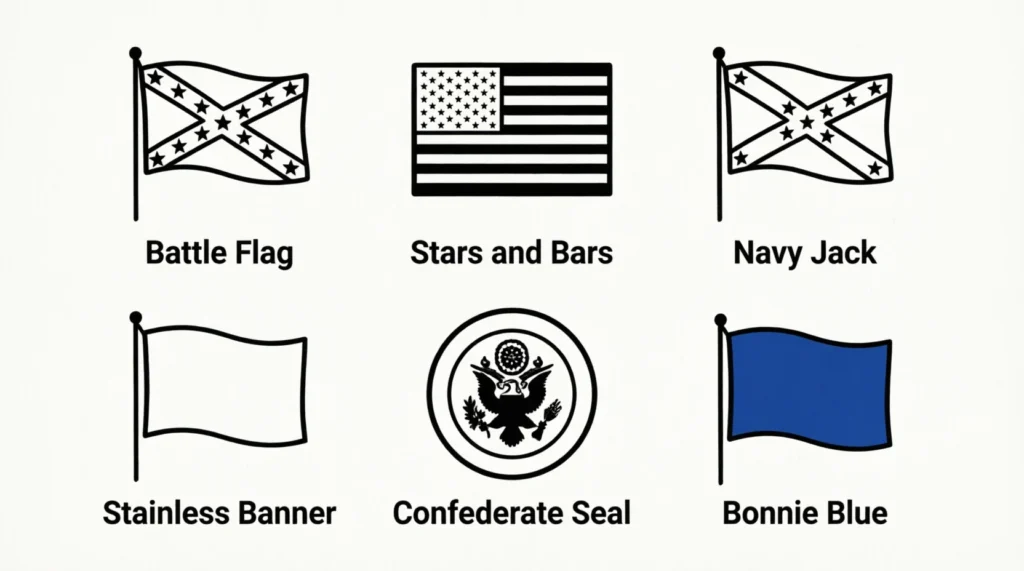
Confederate Battle Flag
The Confederate Battle Flag is the best-known Confederate symbol today. Although it was originally designed to help soldiers identify one another during battle, it later became far more widely recognized than the Confederacy’s official national flags.
After the Civil War, the flag was adopted by some heritage organizations. During the twentieth century, it also became associated with resistance to civil rights reforms and was adopted by several white supremacist groups. Because of these later uses, many people see the flag primarily as a symbol of racism and oppression, while others continue to describe it as representing Southern heritage.
Its meaning depends heavily on historical and social context.
First National Flag (“Stars and Bars”)
The First National Flag served as the Confederacy’s first official national flag in 1861.
Its design closely resembled the United States flag, which created confusion during battles. This practical problem eventually led Confederate military leaders to adopt separate battle flags.
Today, this flag mainly appears in museums, educational materials, and historical collections. It is studied as part of Civil War history rather than commonly displayed in public.
Second National Flag
The Second National Flag became the Confederacy’s official national flag in 1863.
It featured a mostly white background with the Confederate battle emblem in the upper corner. Some critics at the time argued that the large white field resembled a flag of surrender when hanging without wind.
Today, historians discuss it as one stage in the evolution of Confederate national symbols.
Third National Flag
The Third National Flag was introduced only months before the Confederacy collapsed in 1865.
A vertical red stripe was added to the previous design to reduce confusion with white flags. Because it was used for such a short period, it is less familiar than the Battle Flag.
It primarily appears in historical research, museums, and educational publications examining the final months of the Civil War.
Great Seal of the Confederacy
The Great Seal functioned as the official government seal of the Confederate States.
It featured an equestrian image of George Washington surrounded by agricultural imagery that reflected the South’s economy. The seal appeared on official government documents and represented the authority of the Confederate government.
Today, historians use it to study Confederate political institutions and government organization.
Confederate Soldier Monuments
Across the United States, especially in Southern states, thousands of monuments honoring Confederate soldiers were erected between the late nineteenth and early twentieth centuries.
Supporters often describe these monuments as memorials to fallen soldiers. Critics argue that many were built during periods of racial segregation and served to reinforce white supremacy rather than simply commemorate history.
Many communities continue debating whether these monuments should remain, be relocated to museums, or be removed.
Gray Confederate Uniform
The gray military uniform identified Confederate soldiers during the Civil War.
Although gray became associated with Confederate armies, uniform colors varied depending on available materials and supply shortages.
Today, replicas appear mainly in museums, educational exhibits, documentaries, and historical reenactments that seek to portray Civil War events accurately.
Confederate Currency
The Confederate government issued its own paper money throughout the Civil War.
Because the Confederacy struggled economically and ultimately collapsed, much of this currency lost its value. Today, surviving notes are studied by historians and collected as historical artifacts that illustrate wartime economics.
Collectors generally value them for historical interest rather than monetary worth.
Confederate Naval Jack
The Confederate Naval Jack was used by Confederate naval forces during the Civil War.
Its design shares similarities with the famous Battle Flag but served different military purposes aboard Confederate ships.
Today, it is primarily examined within military and maritime history rather than commonly displayed in public settings.
Stone Mountain Confederate Memorial
The Stone Mountain carving in Georgia depicts Confederate leaders Jefferson Davis, Robert E. Lee, and Stonewall Jackson.
Completed decades after the Civil War, it remains one of the world’s largest relief sculptures.
The monument has become part of broader discussions about public memory, historical interpretation, and how societies remember controversial historical figures.
Heritage Organization Emblems
Organizations such as the Sons of Confederate Veterans use their own emblems that incorporate Confederate imagery.
Members generally describe these symbols as representing family ancestry and historical preservation. Critics argue that such imagery cannot be separated from the Confederacy’s defense of slavery.
Understanding these differing viewpoints requires examining both historical evidence and modern social context.
Why Confederate Symbols Remain Controversial
Confederate symbols continue to spark debate because they represent different things to different people.
Many historians emphasize that the Confederacy was created to preserve a system based on slavery. For descendants of enslaved people and many others, Confederate symbols represent racial oppression and injustice.
Others argue that certain symbols honor family members who fought in the Civil War or reflect regional identity rather than support for slavery.
Because these perspectives coexist, public discussions often focus on where Confederate symbols belong—in museums, historical sites, public spaces, or private collections.
Confederate Symbols in Modern Culture
Today, Confederate symbols appear far less frequently in official government settings than they once did.
Many states, schools, universities, and organizations have removed Confederate flags or renamed buildings and monuments. Museums increasingly present these objects within historical exhibits that explain both their origins and evolving public perception.
Films, television programs, and books also continue to examine how Confederate imagery has influenced American culture.
Before Interpreting Historical Symbols
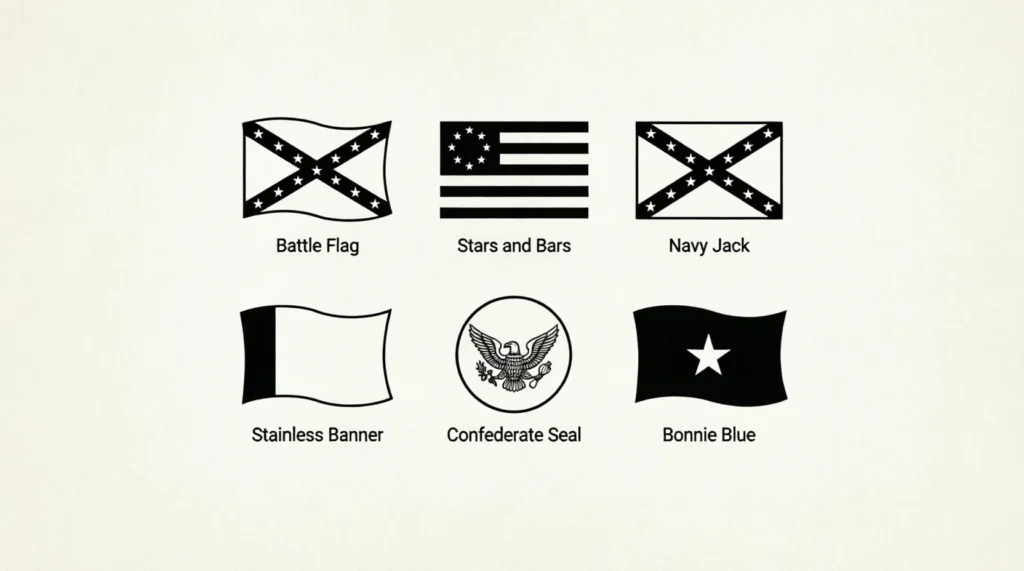
Historical symbols often carry meanings that evolve over time.
Confederate symbols should be understood within the historical context of the Civil War, slavery, Reconstruction, the Civil Rights Movement, and later political movements. Viewing them through only one period of history may overlook how their meanings have changed.
Studying original historical sources, museum collections, and scholarly research provides a more complete understanding than relying on popular myths or social media discussions.
How to Learn About Confederate Symbols Responsibly
If you want to understand Confederate symbols, consider these practical steps:
- Read multiple historical perspectives.
- Visit museums and Civil War exhibits.
- Learn about both Confederate and Union history.
- Consider how different communities interpret these symbols.
- Distinguish between historical study and modern political use.
- Be cautious of unsupported historical claims shared online.
Learning history from diverse, credible sources leads to a more balanced understanding.
FAQs About Confederate Symbols
What are Confederate symbols?
Confederate symbols are flags, emblems, monuments, uniforms, and official images associated with the Confederate States of America during the American Civil War. Today, they remain subjects of historical study and public debate.
What is the most recognized Confederate symbol?
The Confederate Battle Flag is the most widely recognized Confederate symbol. Although originally a military flag, it later became associated with various political movements, making it one of the most controversial historical symbols in the United States.
Why are Confederate symbols controversial?
Many people associate Confederate symbols with slavery, racism, segregation, and white supremacy because of both the Confederacy’s historical purpose and the later use of these symbols by extremist groups. Others have described them as representing Southern ancestry or regional heritage, leading to ongoing public debate.
Are Confederate symbols still displayed today?
Yes. Confederate symbols can still be found in museums, historical sites, private collections, some cemeteries, and a limited number of public locations. Their presence often generates discussion about history, education, and public memory.
Did the Confederacy have more than one flag?
Yes. The Confederate States adopted three official national flags during the Civil War, along with several military flags, including the well-known Confederate Battle Flag.
Are Confederate monuments being removed?
Many communities have relocated, removed, or reinterpreted Confederate monuments in recent decades. Decisions vary by state and local government, reflecting different approaches to preserving history while addressing community concerns.
What is the difference between the Confederate Battle Flag and the national flags?
The Battle Flag was primarily used by Confederate armies during combat, while the First, Second, and Third National Flags served as the official flags of the Confederate government.
Why is historical context important?
Historical context helps explain why Confederate symbols were created, how they were originally used, and why their meanings have changed over more than 150 years. Understanding that context encourages informed discussions rather than oversimplified conclusions.
Final Thoughts
Understanding Confederate symbols requires looking beyond simple labels and considering the full historical record.
These symbols are closely tied to the history of the Confederate States, the American Civil War, slavery, and the continuing conversation about race and public memory in the United States.
By learning from reliable historical sources and respecting differing experiences, we gain a clearer understanding of why these symbols continue to matter today.

Dylan Anderson is a writer who enjoys turning complex topics into simple, engaging content that readers can actually use. His work focuses on clear explanations, practical insights and storytelling that feels natural and relatable. He is also the fictional author of The Quiet Compass of Ashford and Where the Cedar Lantern Glows. When he’s away from his keyboard, Dylan enjoys hiking, reading, and discovering inspiration in everyday life. He believes great writing should be informative, easy to understand and enjoyable from beginning to end.
 Adam Sullivan