Sacred geometry has fascinated people for centuries because simple shapes can carry complex mathematical, artistic, religious, and spiritual meanings. Today, healing sacred geometry symbols are especially popular among people interested in meditation, mindfulness, energy work, personal reflection, tattoos, jewelry, and spiritual practices.
The Flower of Life, Seed of Life, Metatron’s Cube, Sri Yantra, Vesica Piscis, mandalas, Merkaba, and spirals are among the patterns commonly discussed in modern sacred-geometry practices. Different traditions and communities give these symbols different meanings, so there isn’t one universal definition for every design.
It is also important to understand what “healing” means in this context. People may use sacred geometry as a focus for meditation, intention-setting, emotional reflection, or spiritual practice. That is different from claiming that a geometric symbol can medically diagnose or cure a disease. Research on meditation and mind-body practices should not automatically be treated as evidence that a particular sacred geometry pattern has a unique medical effect.
If you’re looking for the meaning behind a particular symbol, choosing a design for a tattoo, or simply wondering how sacred geometry is used for healing and meditation, this guide explains the major symbols and their modern interpretations.
What Are Healing Sacred Geometry Symbols?
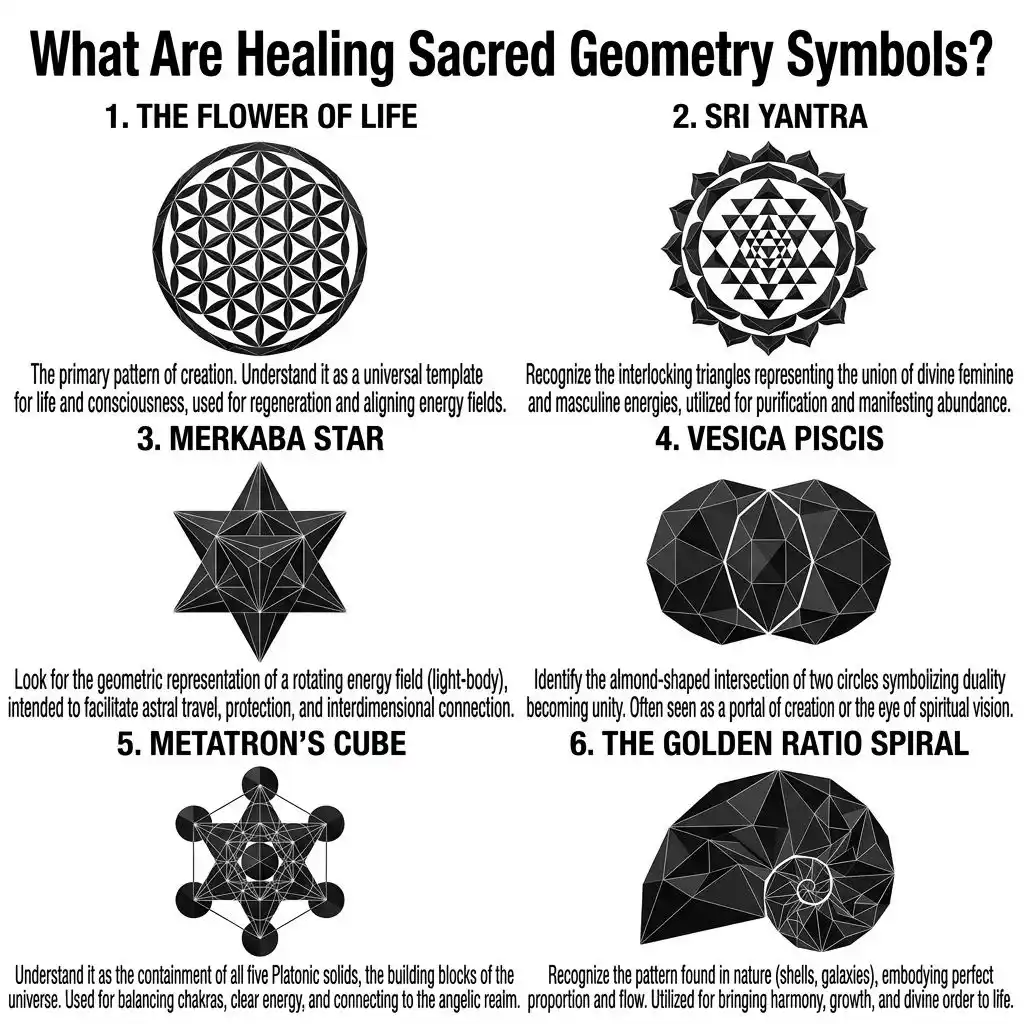
Healing sacred geometry symbols are geometric patterns that people associate with ideas such as balance, harmony, renewal, interconnectedness, transformation, concentration, and spiritual reflection.
The word “healing” can mean different things depending on the person. Someone may use a symbol while recovering emotionally from a difficult experience. Another person may use one during meditation to create a feeling of calm and concentration. Someone else may see a geometric design as a reminder of personal growth.
This means the symbol itself does not have to be viewed as a medical treatment for it to have personal significance.
Sacred geometry generally gives symbolic or spiritual meaning to geometric forms and proportions. Contemporary sources commonly discuss the Flower of Life, Seed of Life, Metatron’s Cube, Sri Yantra, Merkaba, Torus, and Vesica Piscis among these designs.
What Does “Healing” Mean in Sacred Geometry?
In spiritual contexts, healing may refer to inner change rather than physical treatment.
For example, a person might use the Flower of Life as a reminder of connection after experiencing loneliness. Someone beginning a new chapter might choose the Seed of Life because of its association with beginnings and growth.
A person practicing meditation may use the Sri Yantra to maintain concentration.
These are symbolic and contemplative uses. They should not be confused with evidence that a particular shape can cure illness.
Spiritual Meaning vs. Scientific Evidence
This distinction is important because online discussions sometimes present spiritual interpretations as scientific facts.
A spiritual practitioner might say that a symbol helps them feel balanced or connected. That is a personal experience.
A scientific claim would require evidence demonstrating that the symbol itself produces a particular physical or medical outcome.
Current research can provide evidence about some meditation and mind-body practices, but that does not establish that the geometry of a Flower of Life, Metatron’s Cube, or another symbol independently heals a medical condition. Research on meditation should therefore be kept separate from claims about the special healing power of individual symbols.
Healing Sacred Geometry Symbols at a Glance
Different symbols are associated with different ideas in contemporary spiritual practices.
| Symbol | Common Symbolic Association | Common Use |
| Flower of Life | Unity, connection, wholeness | Meditation and reflection |
| Seed of Life | Beginnings, creation, growth | New intentions and personal growth |
| Metatron’s Cube | Order, balance, structure | Meditation and visualization |
| Sri Yantra | Concentration, spiritual contemplation | Focused meditation |
| Vesica Piscis | Union, balance, relationship | Reflection and symbolism |
| Mandala | Wholeness, centeredness | Meditation and creative practice |
| Merkaba | Transformation, balance, spiritual visualization | Visualization |
| Spiral | Growth, cycles, transformation | Reflection and journaling |
| Torus | Cycles and continuous movement | Symbolic contemplation |
| Golden Ratio | Proportion and mathematical harmony | Art, design, and geometric study |
These meanings aren’t universal rules. A symbol can have a specific historical or religious meaning in one context and a newer spiritual interpretation in another.
Flower of Life
The Flower of Life is one of the most recognizable designs associated with modern sacred geometry.
It consists of overlapping circles arranged in a repeating, symmetrical pattern. The design is often discussed alongside the Seed of Life and other geometric constructions. Contemporary spiritual sources commonly associate it with unity, interconnectedness, creation, and harmony.
Flower of Life Meaning
The repeated circles can be interpreted as a visual reminder that separate elements can form one larger pattern.
This is why the symbol is often connected with ideas such as:
- interconnectedness
- unity
- wholeness
- harmony
- creation
- relationships
- spiritual reflection
For someone using the symbol for personal healing, the idea of interconnectedness may be especially meaningful.
It can become a reminder that personal experiences are part of a larger life story.
Using the Flower of Life for Meditation
The symmetrical structure gives you plenty of visual details to observe without needing to analyze them intellectually.
You can place the image in front of you, relax your gaze, and focus on the center. When your thoughts wander, gently bring your attention back to the circles.
This turns the symbol into a visual meditation anchor.
The calming experience, if you have one, should be understood as part of your contemplative practice rather than proof that the symbol itself medically heals the body.
Flower of Life for Emotional Reflection
You can also use the Flower of Life as a journaling prompt.
Ask yourself:
- Where do I feel connected?
- Where do I feel disconnected?
- What relationships support me?
- What part of my life needs greater balance?
- What does wholeness mean to me?
The geometry then becomes a starting point for reflection rather than merely a decorative image.
Seed of Life
The Seed of Life is commonly shown as seven overlapping circles: one central circle surrounded by six others.
It is frequently interpreted in contemporary sacred-geometry material as a symbol of creation, beginnings, potential, and growth.
Seed of Life Meaning
The word “seed” naturally suggests something that has the potential to grow.
Because of this, the design can work well as a personal symbol for:
- a fresh beginning
- personal development
- a new relationship
- a new habit
- recovery from a difficult period
- creative development
- spiritual exploration
The important point is that these are symbolic associations, not guaranteed effects.
Seed of Life for New Beginnings
If you are starting something new, you can use the Seed of Life as a visual reminder that growth often happens gradually.
For example, someone beginning a meditation routine could place the symbol beside a journal.
Each time they see it, they might remember:
Small steps can become meaningful changes.
That simple association can make a geometric design personally useful without requiring supernatural claims.
Metatron’s Cube
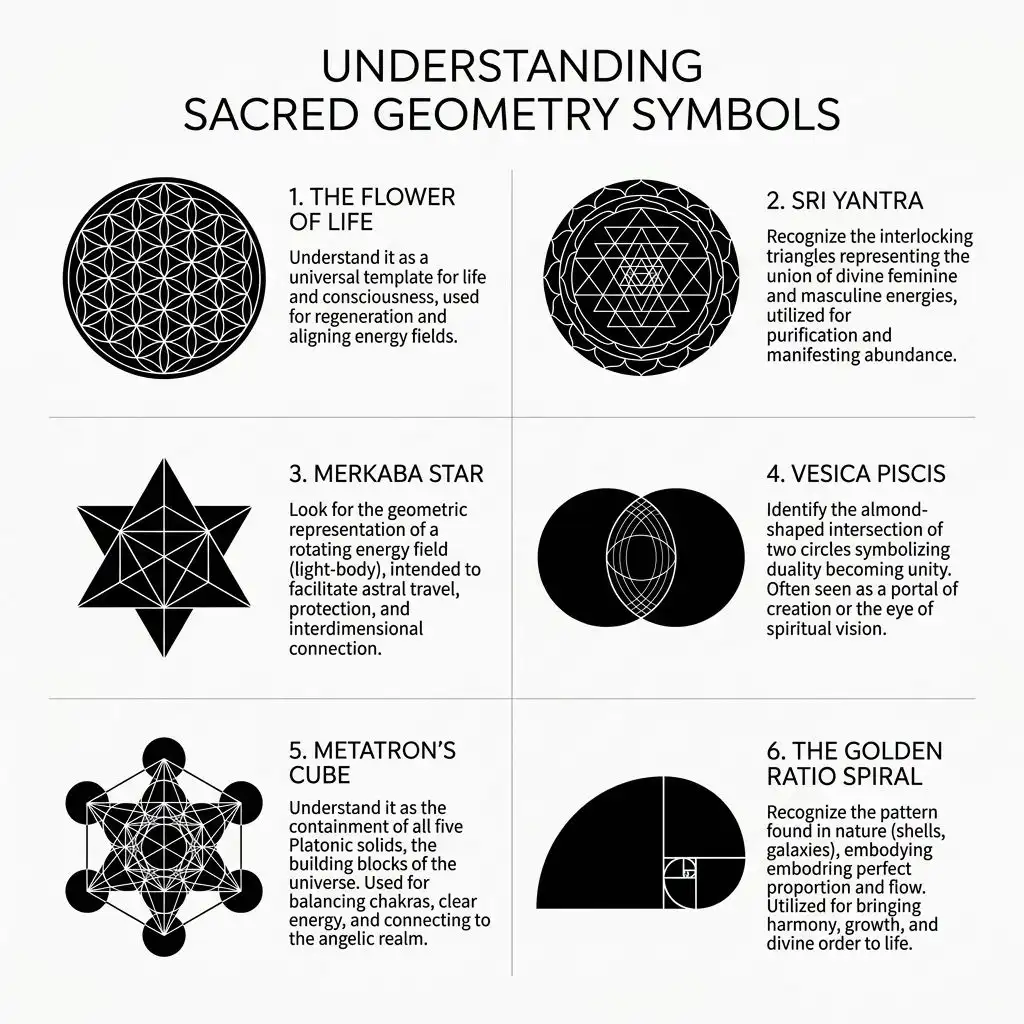
Metatron’s Cube is one of the more complex designs in sacred geometry.
It is commonly described as a geometric figure containing the five Platonic solids: the tetrahedron, cube, octahedron, dodecahedron, and icosahedron. Contemporary sacred-geometry sources often associate the symbol with order, balance, protection, and spiritual visualization.
Metatron’s Cube Meaning
Because the pattern contains numerous lines and geometric relationships, it is often interpreted as a representation of structure and order.
Modern spiritual interpretations may connect it with:
- balance
- order
- protection
- interconnectedness
- transformation
- contemplation
- geometric structure
However, interpretations involving energy cleansing or energetic protection belong to spiritual belief rather than established medical science. Some contemporary practitioners explicitly use the symbol in those ways.
Metatron’s Cube for Meditation
The complexity of Metatron’s Cube can make it useful for people who prefer detailed visual objects.
You can begin at the center and slowly follow the surrounding lines.
Instead of trying to understand the whole pattern at once, allow your attention to move gradually through the geometry.
This can make the practice feel similar to tracing a path.
Sri Yantra
The Sri Yantra is an important geometric diagram in Hindu and Tantric traditions.
It contains interlocking triangles arranged around a central point called the bindu. Contemporary explanations commonly describe nine interlocking triangles and a layered structure that draws attention toward the center.
Because the Sri Yantra has a specific cultural and religious context, it should not be reduced to a generic “healing symbol.”
Sri Yantra Meaning
The Sri Yantra is associated with spiritual contemplation and concentration within traditions that use it.
Its geometry can encourage the practitioner to move attention from the outer parts of the design toward the central point.
Modern practitioners may therefore use it for:
- concentration
- meditation
- contemplation
- spiritual practice
- visualization
Sri Yantra Meditation
A simple practice is to sit comfortably and allow your eyes to rest on the central bindu.
After a few breaths, gradually notice the surrounding triangles and other geometric elements.
You can then return your attention to the center.
Some contemporary meditation guides specifically recommend gazing at the bindu and gradually expanding awareness across the design.
The important cultural point is that this practice comes from a broader spiritual tradition and should be understood in that context.
Vesica Piscis
The Vesica Piscis is created by the intersection of two equal circles.
Where the circles overlap, they form an almond-like central shape.
Although the construction is mathematically simple, the form has accumulated symbolic interpretations in art, geometry, and spiritual traditions.
Vesica Piscis Meaning
In contemporary sacred-geometry discussions, the Vesica Piscis may be associated with:
- union
- balance
- relationship
- duality
- creation
- the meeting of two elements
This makes it a useful symbol for reflecting on relationships or situations involving two different perspectives.
Vesica Piscis and Balance
The two circles remain distinct while also sharing a central space.
Someone might use this visually as a metaphor for relationships:
Two individuals can remain themselves while still sharing something meaningful.
That interpretation can be especially useful for journaling about family, friendship, partnership, or personal boundaries.
Mandalas
A mandala is not one single symbol. It is a broad category of designs that often use circles, symmetry, repeated forms, and a central point.
Mandalas have important roles in several religious and artistic traditions, particularly within Buddhist and Hindu contexts.
Today, mandalas are also widely used in art, coloring, meditation, and mindfulness activities.
Mandala Meaning
A mandala’s circular structure can encourage attention toward the center.
Contemporary spiritual interpretations may associate mandalas with:
- wholeness
- balance
- centeredness
- order
- contemplation
- inner reflection
But the meaning depends on the particular mandala and its cultural context.
Mandala for Emotional Reflection
Creating or coloring a mandala can become a focused activity.
Instead of trying to finish quickly, you can concentrate on:
- repeating shapes
- symmetry
- line patterns
- color choices
- breathing
- the movement of your hands
The activity can provide a structured period for quiet attention.
It is more accurate to describe this as a contemplative or creative practice than to claim that mandala coloring independently treats a medical condition.
Merkaba
The Merkaba is commonly represented in modern sacred-geometry circles as two interlocking tetrahedral forms creating a three-dimensional star-like structure.
Contemporary spiritual interpretations may connect it with transformation, movement, balance, consciousness, and visualization.
Merkaba Meaning
The geometric form has a strong three-dimensional appearance, which makes it particularly suitable for visualization practices.
People may associate it with:
- transformation
- spiritual exploration
- balance
- movement
- consciousness
- visualization
Different communities use the term and symbol differently, so it is important to avoid presenting one modern interpretation as the only historical meaning.
Merkaba Visualization
A practitioner may imagine the two geometric forms surrounding the body or slowly rotating.
This can be used as a visualization exercise.
If you choose this practice, treat the image as a focus for attention and intention rather than assuming that it creates a scientifically demonstrated protective field.
Spiral Symbols
Spirals are among the most visually recognizable geometric forms.
They appear in nature, artwork, architecture, and many cultural traditions.
Because a spiral appears to move continuously inward or outward, it is often interpreted symbolically as:
- growth
- change
- transformation
- cycles
- movement
- development
Spiral for Personal Transformation
A spiral can make a useful journaling symbol during a period of change.
You could draw a simple spiral and write around it:
- What am I leaving behind?
- What am I learning?
- What am I moving toward?
- What needs more time?
- What have I already changed?
The symbol becomes a visual map for reflection.
Torus Geometry
A torus is a mathematical shape resembling a doughnut.
In modern spiritual discussions, toroidal forms are sometimes interpreted as representations of circulation, cycles, and continuous movement. These spiritual interpretations are different from the mathematical definition of the shape.
Torus Symbolism
As a symbolic image, a torus may suggest:
- cycles
- circulation
- continuity
- movement
- renewal
- balance
Someone might use it during meditation while thinking about recurring patterns in life.
For example, you might reflect on habits that repeatedly return and consider which patterns you want to change.
Golden Ratio and Sacred Geometry
The golden ratio, represented by the Greek letter φ, is a mathematical proportion of approximately 1.618.
It has attracted considerable interest in mathematics, art, architecture, and design.
Sacred-geometry discussions sometimes connect the golden ratio with beauty, proportion, balance, and natural patterns.
However, the existence of a mathematical ratio does not establish that it has a special healing power.
Golden Ratio as a Symbol of Harmony
The golden ratio can still have symbolic value.
Someone interested in sacred geometry may view proportional relationships as reminders of order and balance.
That interpretation can be meaningful aesthetically or philosophically without turning mathematics into a medical claim.
Sacred Geometry Symbols for Emotional Healing
The word healing often refers to emotional recovery rather than physical illness.
Someone experiencing grief, heartbreak, loneliness, uncertainty, or major life changes may be attracted to symbols representing renewal and connection.
Symbols for Inner Peace
A mandala or Flower of Life can be used as a visual focus during quiet reflection.
The goal isn’t to force difficult emotions away.
Instead, you can use the symbol to create a few minutes of intentional stillness.
Symbols for New Beginnings
The Seed of Life is naturally suited to the idea of starting again.
You might use it when:
- beginning a new job
- moving to a new place
- developing a new habit
- starting a creative project
- rebuilding your routine
Symbols for Transformation
The spiral can represent the fact that change isn’t always a straight line.
You may revisit old feelings or challenges while still moving forward.
This can make the spiral a useful personal metaphor for growth.
Symbols for Connection
The Flower of Life is frequently associated in contemporary spiritual practice with interconnectedness and unity.
You can use that meaning to reflect on relationships, community, family, or your connection with nature.
Sacred Geometry for Meditation
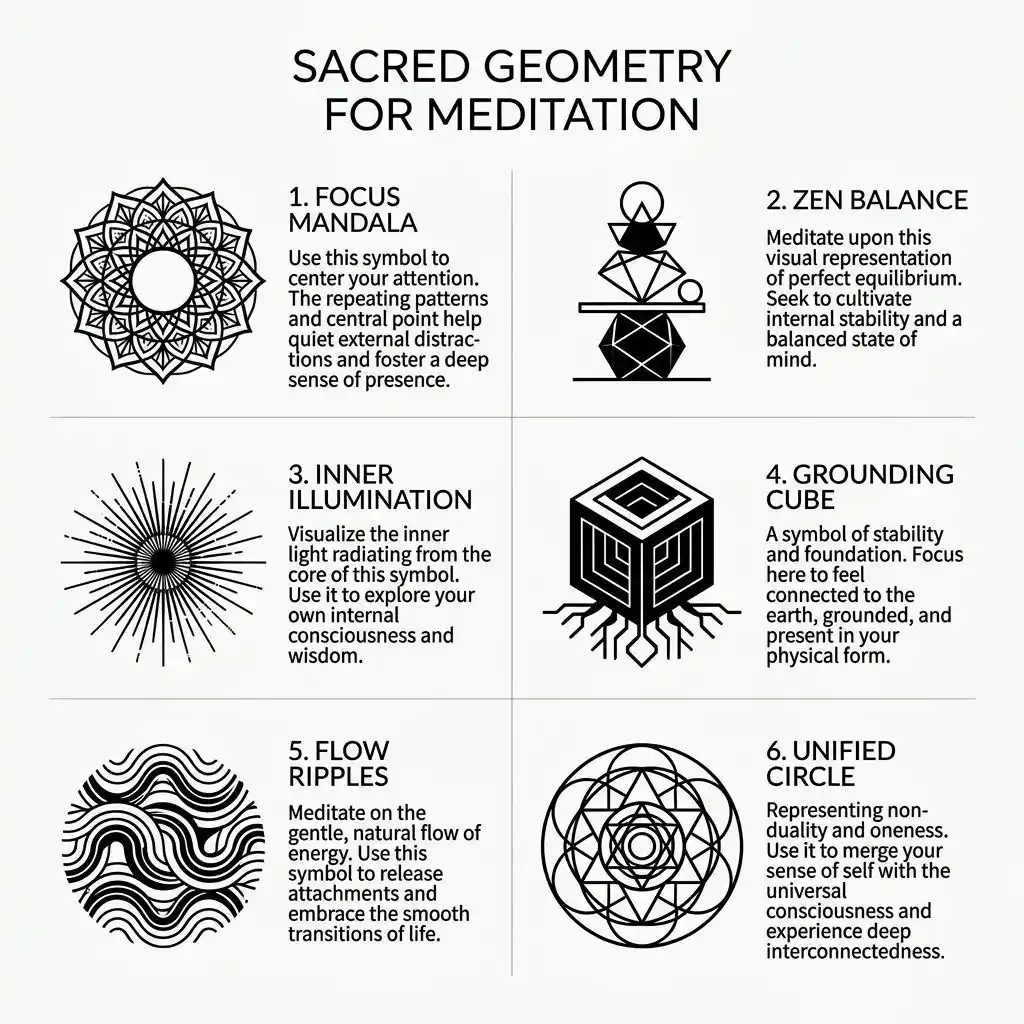
Sacred geometry can be used in meditation by turning a geometric design into a visual anchor.
Instead of concentrating only on your breathing, you have a visible pattern to return to whenever your attention wanders.
Current meditation guides describe several approaches, including gazing at a symbol, visualization, drawing the pattern, and pairing the geometry with an intention or breathing practice.
How to Meditate With a Sacred Geometry Symbol
Choose one symbol rather than constantly switching between different designs.
Then:
- Sit somewhere comfortable.
- Place the symbol at a natural viewing distance.
- Relax your shoulders and face.
- Take a few comfortable breaths.
- Look softly at the center of the design.
- Notice its circles, lines, triangles, or symmetry.
- Let thoughts come and go without chasing them.
- Return your attention to the symbol when distracted.
- Continue for five to fifteen minutes.
- Finish by sitting quietly for another minute.
You don’t need an elaborate ritual.
The purpose is simply to create a consistent point of attention.
Drawing Sacred Geometry as Meditation
You can also draw a geometric pattern yourself.
This can be particularly useful because drawing requires patience and attention.
A compass, ruler, pencil, paper, and eraser are enough for many basic constructions.
You can begin with:
- a circle
- Vesica Piscis
- Seed of Life
- simple mandala
- Flower of Life
The goal doesn’t have to be perfect geometry.
The repetitive process can simply encourage focused attention.
Sacred Geometry and Crystal Grids
Sacred geometry is also commonly used in modern crystal-grid practices.
A crystal grid typically places stones or crystals around a geometric design according to a particular intention.
Contemporary spiritual practitioners may combine patterns such as the Flower of Life with crystals and intention-setting. Current online guides explicitly connect sacred geometry with crystal-grid practices.
How People Use Sacred Geometry Crystal Grids
A person might:
- Choose an intention.
- Select a geometric layout.
- Place crystals around the design.
- Spend several minutes in meditation.
- Reflect on the chosen intention.
- Keep the arrangement in a quiet space.
The spiritual meaning comes from the practitioner’s beliefs and ritual.
There isn’t established scientific evidence that the geometric arrangement gives crystals a medically measurable healing ability.
Sacred Geometry and Chakras
Some modern spiritual practices combine sacred geometry with the chakra system.
Practitioners may assign particular shapes, colors, or geometric patterns to different energy centers.
These associations vary considerably between traditions.
Using Geometry in Chakra Meditation
A person might select a symbol associated with a particular intention and visualize it during meditation.
For example, they might focus on symmetry while thinking about balance, communication, confidence, or emotional openness.
This can function as a visualization exercise.
It should not be presented as a scientifically established method for treating a physical disease or correcting a medical condition.
Healing Sacred Geometry Symbols for Tattoos
Sacred geometry tattoos are popular because a geometric pattern can carry both visual appeal and personal symbolism.
Before getting one, research the design rather than choosing it only because it looks attractive.
Flower of Life Tattoo
A Flower of Life tattoo can symbolize:
- connection
- unity
- wholeness
- personal spirituality
It may work well for someone who wants a reminder of interconnectedness.
Seed of Life Tattoo
The Seed of Life can represent:
- new beginnings
- potential
- growth
- personal development
It may be meaningful after a major life transition.
Metatron’s Cube Tattoo
Metatron’s Cube can symbolize:
- structure
- balance
- geometric order
- spiritual reflection
Because the design is detailed, it usually requires a tattoo artist who is comfortable with precise geometric work.
Sri Yantra Tattoo
The Sri Yantra carries specific religious and cultural associations.
Anyone considering it as a tattoo should learn about its Hindu and Tantric context rather than treating it simply as a generic geometric pattern.
Mandala Tattoo
A mandala can represent:
- centeredness
- wholeness
- balance
- contemplation
Its meaning can change significantly depending on the design and cultural inspiration.
Sacred Geometry Symbols for Jewelry
The same designs are commonly used in pendants, rings, bracelets, wall art, and other decorative objects.
A person may wear a Flower of Life necklace as a reminder of connection or a geometric pendant as a personal meditation cue.
Jewelry can be especially meaningful because the symbol remains visible throughout the day.
However, wearing a geometric pendant doesn’t establish that the object physically protects the wearer or changes their body’s energy.
Its practical value may instead come from personal meaning, intention, memory, and visual association.
How to Choose a Sacred Geometry Symbol for Your Intention
You don’t have to find one universally “best” symbol.
A better approach is to start with the quality you want the symbol to remind you of.
| Personal Intention | Symbol You Could Explore | Why It May Fit |
| Connection | Flower of Life | Often associated with interconnectedness |
| New beginnings | Seed of Life | Commonly associated with creation and growth |
| Focus | Sri Yantra | Used in contemplative practices |
| Structure | Metatron’s Cube | Complex, highly ordered geometry |
| Transformation | Spiral | Visually suggests movement and change |
| Centeredness | Mandala | Circular and symmetrical |
| Union | Vesica Piscis | Created by intersecting circles |
| Visualization | Merkaba | Three-dimensional geometric form |
| Cycles | Torus | Represents continuous circular form |
These are suggestions for symbolic reflection, not rankings of therapeutic effectiveness.
Choose Based on Meaning, Not Hype
Online spiritual content sometimes describes one symbol as the “most powerful” healing symbol.
There isn’t a universally accepted scientific ranking that establishes one sacred geometry design as the strongest healing symbol.
Even contemporary holistic sources acknowledge that different symbols are associated with different qualities and that personal response can matter more than a fixed hierarchy.
Instead of asking:
“Which symbol is the most powerful?”
a more useful question is:
“Which symbol’s meaning fits what I want to reflect on?”
What Science Says About Sacred Geometry and Healing
This is one of the most important parts of understanding the subject.
There is a difference between studying meditation and proving that a particular geometric symbol heals the body.
Research exists on meditation and other mind-body practices. For example, a 2026 scoping review examined evidence surrounding a particular meditation practice and reported an emerging evidence base across several cognitive, neurophysiological, and clinical areas.
But that does not mean the Flower of Life, Sri Yantra, Metatron’s Cube, or another geometric pattern has independently been proven to cure disease.
What Sacred Geometry May Offer as a Practice
When used as part of meditation, drawing, journaling, or quiet reflection, a symbol may serve as:
- a visual anchor
- a reminder of an intention
- a creative focus
- a prompt for self-reflection
- part of a spiritual routine
- a way to create a quiet moment
These uses can be meaningful without requiring a claim about supernatural or medical effects.
What Sacred Geometry Should Not Replace
Sacred geometry should not replace:
- medical diagnosis
- prescribed medication
- professional therapy
- emergency treatment
- evidence-based medical care
If you have a health problem, use appropriate professional care. A geometric symbol can be part of your personal spiritual or reflective routine, but it should not be treated as a substitute for necessary treatment.
Sacred Geometry vs. Medical Healing
The word healing can create confusion because it may describe very different things.
| Type | Meaning |
| Spiritual healing | A person’s sense of spiritual growth or connection |
| Emotional healing | Processing feelings and adapting after difficult experiences |
| Meditative practice | Focused attention, breathing, or contemplation |
| Creative healing | Using art and creative activity for reflection |
| Medical treatment | Professional diagnosis and treatment of health conditions |
Sacred geometry can naturally fit within the first three or four categories as a personal practice.
Medical treatment is a separate category.
Keeping this distinction clear makes it easier to appreciate sacred geometry without making claims that go beyond available evidence.
A Simple Sacred Geometry Healing Practice
If you’d like to explore the topic for yourself, you can create a short practice without complicated rituals.
Five-Minute Practice
Choose one symbol.
Sit comfortably and place it in front of you.
Spend the first minute simply observing the pattern.
For the next two minutes, breathe naturally while keeping your attention near the center.
During the fourth minute, think about one intention such as:
peace, acceptance, growth, connection, or renewal.
During the final minute, close your eyes and notice how you feel.
Then write down one sentence about what you noticed.
This practice does not require you to believe that the symbol has a supernatural power.
The symbol can simply serve as a reminder to slow down and pay attention.
Frequently Asked Questions About Healing Sacred Geometry Symbols
What is the most common sacred geometry symbol associated with healing?
The Flower of Life is one of the most widely recognized sacred geometry designs associated with healing, harmony, unity, and interconnectedness in contemporary spiritual practices. Other commonly discussed symbols include the Seed of Life, Metatron’s Cube, Sri Yantra, Merkaba, and mandalas.
What symbol represents healing and renewal?
There isn’t one universal healing symbol. The Seed of Life is often associated with beginnings, creation, and growth, while the Flower of Life is commonly associated with unity and wholeness. A spiral can also be used symbolically to represent transformation and continuing growth.
Is the Flower of Life a healing symbol?
In contemporary sacred-geometry practices, the Flower of Life is commonly associated with interconnectedness, harmony, and spiritual reflection. Some practitioners use it during meditation or other spiritual practices. However, there is no established basis for treating the design itself as a medical cure.
Can sacred geometry help with meditation?
Sacred geometry can be used as a visual focus during meditation. Practitioners may gaze at a symbol, visualize it, draw it, or use it alongside breathing and intention-setting. These are contemplative practices, and evidence about meditation in general should not automatically be interpreted as evidence for unique healing properties of a particular geometric shape.
Which sacred geometry symbol is good for emotional healing?
The answer depends on what emotional quality you want to explore. A Flower of Life may be meaningful for connection, a Seed of Life for renewal, a spiral for transformation, and a mandala for centeredness. These are symbolic associations rather than medically proven treatments.
What does Metatron’s Cube represent?
Modern sacred-geometry sources commonly associate Metatron’s Cube with order, balance, interconnectedness, protection, and spiritual contemplation. Geometrically, it is associated with the five Platonic solids.
What is the Sri Yantra used for?
The Sri Yantra is used in particular Hindu and Tantric spiritual contexts and is associated with meditation and contemplation. Its complex arrangement of interlocking triangles draws attention toward the central bindu.
Can sacred geometry be used in a crystal grid?
Yes. Modern spiritual practitioners often incorporate geometric layouts into crystal-grid practices and combine them with intention-setting or meditation. These practices belong to contemporary spiritual traditions and should not be confused with scientifically established medical treatment.
Can I get a sacred geometry symbol as a healing tattoo?
Yes, if you find the symbolism personally meaningful. The Flower of Life, Seed of Life, Metatron’s Cube, mandalas, and Sri Yantra are examples people may choose. Before using a culturally or religiously significant design, learn about its original context and meaning.
Does sacred geometry scientifically heal the body?
There is not established evidence that a particular sacred geometry symbol directly cures disease or physically repairs the body. Meditation and other mind-body practices are studied separately, but findings about those practices should not be turned into proof that a specific geometric symbol has a unique medical healing effect.
Conclusion
Healing sacred geometry symbols combine mathematical forms with spiritual, cultural, artistic, and personal meanings. The Flower of Life is commonly associated with interconnectedness, the Seed of Life with beginnings, Metatron’s Cube with geometric order, the Sri Yantra with contemplation, and the spiral with transformation.
You can use these symbols for meditation, journaling, visualization, creative work, tattoos, jewelry, or simply as reminders of a personal intention.
The most useful approach is to understand where a symbol comes from, what its traditional or modern meaning is, and how you personally want to use it. A sacred geometry design can be meaningful without being described as a medically proven cure.
When approached thoughtfully, these patterns can serve as visual reminders of connection, reflection, balance, growth, and renewal while leaving medical decisions to appropriate healthcare professionals.

Dylan Anderson is a writer who enjoys turning complex topics into simple, engaging content that readers can actually use. His work focuses on clear explanations, practical insights and storytelling that feels natural and relatable. He is also the fictional author of The Quiet Compass of Ashford and Where the Cedar Lantern Glows. When he’s away from his keyboard, Dylan enjoys hiking, reading, and discovering inspiration in everyday life. He believes great writing should be informative, easy to understand and enjoyable from beginning to end.
 Adam Sullivan