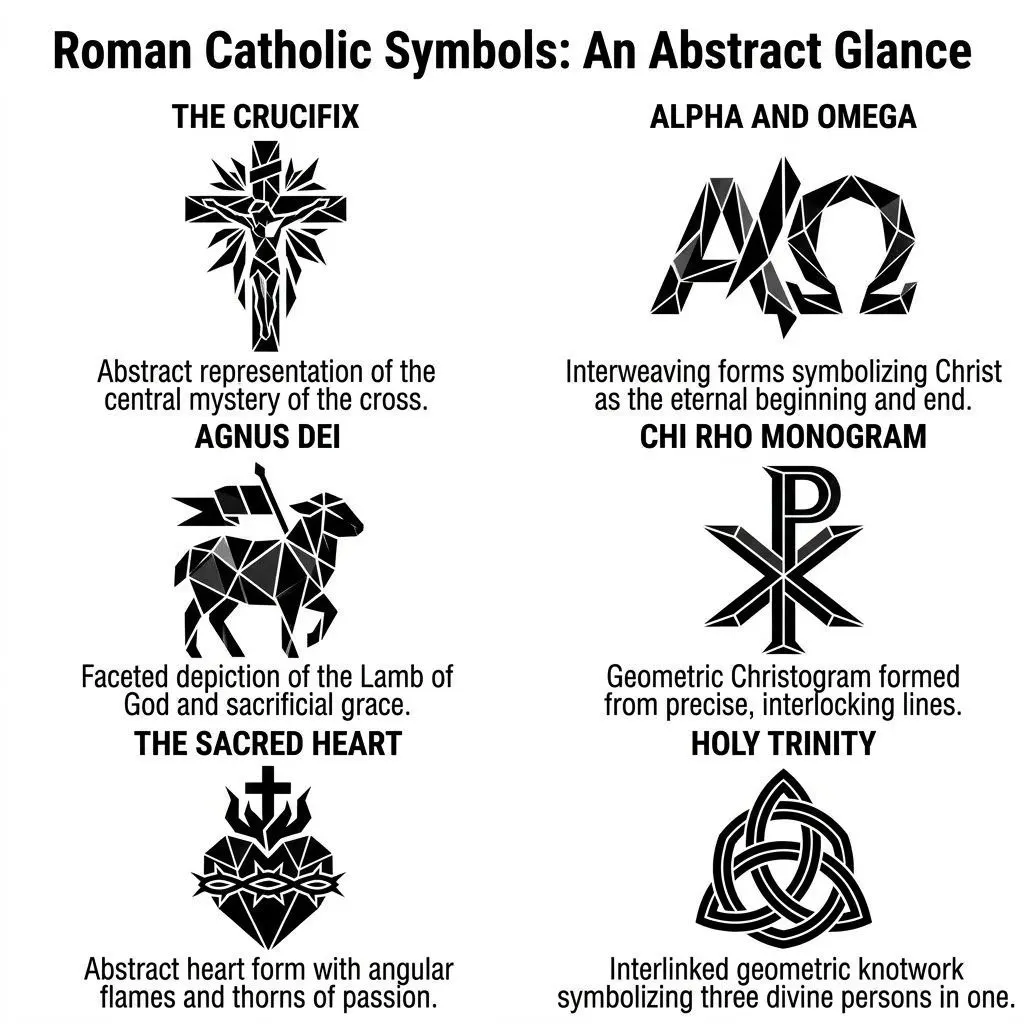
Roman Catholic symbols are visual signs, objects, letters, gestures, and images that communicate important ideas about Catholic faith, worship, Scripture, Jesus Christ, Mary, the saints, and the Church. You can find them in Catholic churches, homes, cemeteries, artwork, prayer books, religious jewelry, medals, and personal devotional items.
The crucifix, Rosary, Sacred Heart, Immaculate Heart of Mary, crossed keys, IHS, and Eucharistic imagery are good examples.
This difference matters when you are trying to identify a religious symbol. A cross may tell you that something is Christian, but it does not necessarily tell you that it is specifically Roman Catholic. A Rosary or an image of the Sacred Heart, on the other hand, has a much stronger association with Catholic devotional tradition.
Catholic teaching gives an important place to signs and symbols. The Catechism explains that sacramentals are sacred signs that help people receive spiritual effects through the Church’s prayer, and it specifically mentions signs such as the Sign of the Cross and the sprinkling of holy water.
What Are Roman Catholic Symbols?
Roman Catholic symbols are visible signs that point toward religious beliefs, biblical events, sacred mysteries, people, prayers, or traditions within Catholic life.
They can represent:
- Jesus Christ
- His Crucifixion and Resurrection
- the Eucharist
- the Holy Trinity
- the Virgin Mary
- the saints
- Saint Peter and the papacy
- prayer and devotion
- Baptism
- Christian hope
- salvation
- God’s love
A symbol does not always have just one meaning.
Why Symbols Matter in Catholicism
Catholic worship uses visible signs because Christianity is concerned with both spiritual and physical realities. The Catechism explains that liturgical celebrations use signs and symbols to communicate spiritual realities. Sacred images can also direct believers toward Christ and the mysteries of faith.
This is why Catholic churches often contain visual elements rather than relying only on written words.
A crucifix, for example, does more than decorate a wall. It visually directs attention toward Christ’s Passion. A chalice and host point toward the Eucharistic celebration.
Catholic Symbols vs. General Christian Symbols
Not every symbol found in a Catholic church is uniquely Catholic.
| Symbol | Strongly Catholic? | Also Used by Other Christians? |
| Crucifix | Strong Catholic association | Yes |
| Plain cross | No | Yes |
| Rosary | Strong Catholic association | Yes |
| Sacred Heart | Strong Catholic devotional tradition | Less broadly associated |
| Immaculate Heart | Strong Catholic devotional tradition | Yes, in wider Christian contexts |
| Crossed keys | Strong papal/Catholic association | Connected to Saint Peter more broadly |
| IHS | Strong Catholic use | Yes |
| INRI | No | Yes |
| Dove | No | Yes |
| Lamb | No | Yes |
| Alpha and Omega | No | Yes |
| Chi-Rho | No | Yes |
This distinction helps prevent a common misunderstanding: a Christian symbol is not automatically an exclusively Catholic symbol.
The Most Recognizable Roman Catholic Symbols
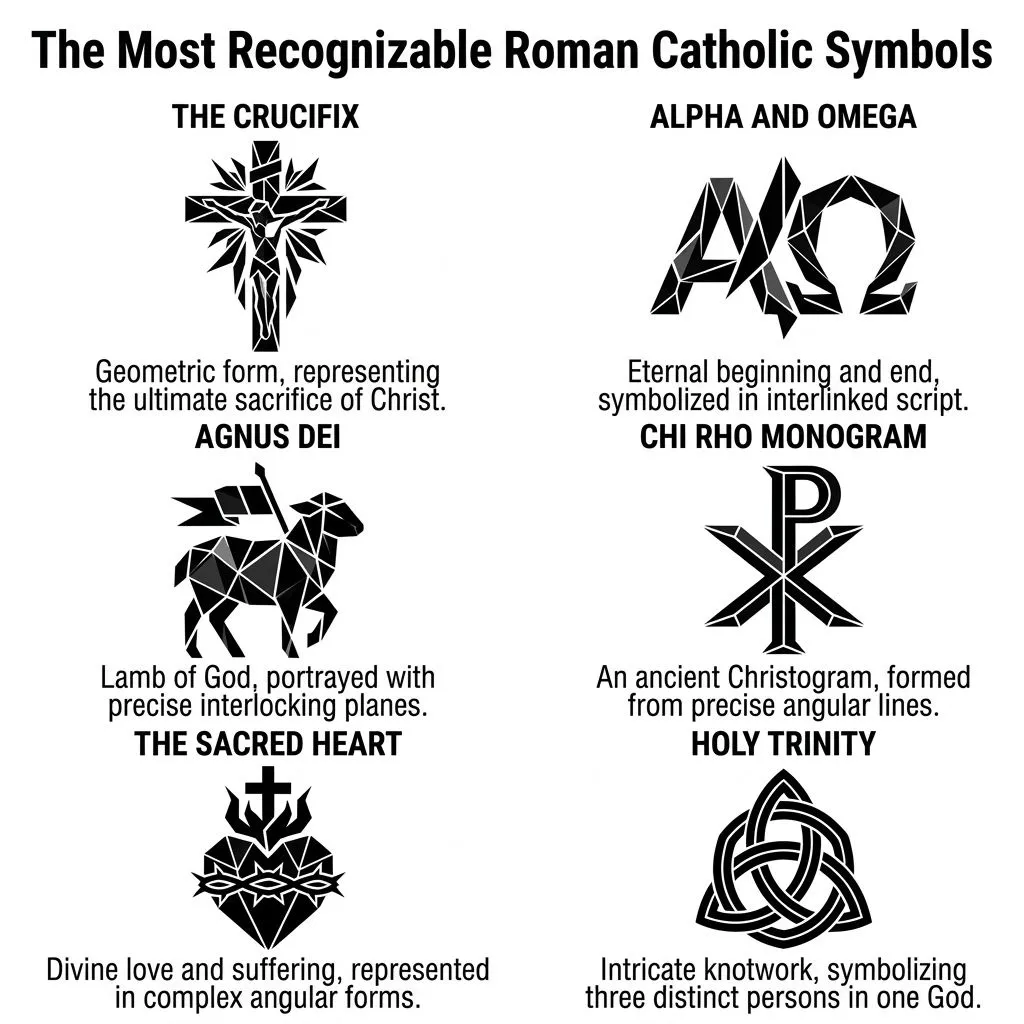
The Crucifix
It shows Jesus Christ on the Cross, unlike a plain cross that does not usually include the figure of Jesus.
The crucifix draws attention to Christ’s Passion, death, and self-giving love. It is commonly found in Catholic churches, homes, schools, cemeteries, chapels, and devotional objects.
You may see a crucifix:
- above or near an altar
- on a Rosary
- in a Catholic classroom
- inside a home
- on a necklace
- in a cemetery
- in religious artwork
The crucifix is therefore both a recognizable visual symbol and an important devotional image.
The Cross
The cross is the central symbol of Christianity and is also fundamental to Catholic faith.
It recalls Christ’s Crucifixion and, together with the Resurrection, the heart of Christian belief about salvation.
A plain cross can appear on:
- church buildings
- altars
- books
- necklaces
- rings
- graves
- prayer cards
- vestments
The Eucharistic Host and Chalic
Catholic teaching gives the Eucharist a central place in Christian life and worship. Eucharistic imagery may therefore appear in church decoration, religious art, medals, prayer cards, and other Catholic materials.
A host and chalice together can help identify an image as relating to:
- the Eucharist
- Holy Communion
- the Mass
- Eucharistic devotion
- the Blessed Sacrament
The Rosary
The Rosary is one of the symbols most closely associated with Catholic devotional life.
A traditional Rosary consists of beads used to count prayers and usually includes a crucifix.
The Rosary is structured around mysteries connected with important events in the lives of Jesus and Mary. The Vatican’s presentation of the Rosary describes twenty mysteries arranged in four groups: Joyful, Luminous, Sorrowful, and Glorious.
The Rosary can therefore symbolize:
- prayer
- meditation
- devotion to Mary
- contemplation of Christ’s life
- Catholic spiritual tradition
It is important to understand that the Rosary is more than an ornament. Its beads have a practical role in Catholic prayer.
The Sacred Heart of Jesus
The Sacred Heart of Jesus is a major Catholic devotional symbol.
It is often shown as a heart associated with Jesus and may include:
- flames
- a crown of thorns
- a cross
- rays of light
- a wound or opening
The image represents Christ’s love and points toward the person of Jesus.
In Dilexit Nos, Pope Francis explains that the heart is used as a symbol of the human and divine love of Jesus Christ and emphasizes that devotion to the Sacred Heart is directed toward Christ himself rather than toward an isolated physical image.
This makes the Sacred Heart particularly important in Catholic devotional art.
The Immaculate Heart of Mary
The Immaculate Heart of Mary is a Marian symbol associated with Mary’s love, holiness, and relationship with Jesus.
It is commonly represented as a heart and may include:
- flowers
- flames
- rays
- a sword
- a crown
The exact artistic design can vary.
The Immaculate Heart is often shown alongside the Sacred Heart of Jesus. The two images are related but have different devotional meanings.
The Sacred Heart focuses on Christ, while the Immaculate Heart points toward Mary and her relationship with God and her Son.
IHS
IHS is a Christian Christogram associated with the name of Jesus.
It appears in many Catholic settings, including:
- altars
- church decorations
- Eucharistic imagery
- vestments
- religious medals
- prayer cards
- Catholic artwork
The letters are historically connected with the Greek form of Jesus’ name.
When you see IHS in a Catholic church, it is generally intended to draw attention to Jesus Christ.
INRI
INRI is commonly displayed above Jesus on a crucifix.
It comes from the Latin words:
Iesus Nazarenus, Rex Iudaeorum
This translates as:
Jesus of Nazareth, King of the Jews.
The letters refer to the title associated with Jesus at his Crucifixion.
Unlike IHS, which is a Christogram associated with Jesus’ name, INRI is connected specifically with the inscription associated with the Crucifixion.
The Crossed Keys
The crossed keys are among the strongest symbols associated with Saint Peter and the papacy.
The Vatican’s official explanation connects the keys with the Gospel account of the keys given by Christ to the Apostle Peter. The Holy See has used the two crossed keys as its official insignia since the fourteenth century.
The familiar design normally shows:
- one gold key
- one silver key
- the keys crossed
- a papal tiara above them in Vatican heraldry
Because of this association, crossed keys are particularly useful when identifying imagery connected with:
- Saint Peter
- the Pope
- the papacy
- the Holy See
- Vatican imagery
The Paschal Candle
The Paschal Candle is an important Catholic Easter symbol.
It is a large candle associated especially with the Easter celebration and Christ as the light of the world.
It may contain visible markings such as:
- a cross
- Alpha
- Omega
- the current year
- grains of incense
The Paschal Candle can also be used during other important Catholic celebrations during the year.
Catholic Eucharistic Symbols
The Monstrance
The monstrance is one of the most distinctive objects associated with Eucharistic adoration in the Catholic tradition.
It is generally designed to display the consecrated Eucharistic host, often in a central circular opening surrounded by decorative rays.
Because of its appearance, it is sometimes mistaken for a sun symbol.
In a Catholic context, a monstrance usually points toward:
- the Blessed Sacrament
- Eucharistic adoration
- devotion to Christ in the Eucharist
The rays surrounding the host are therefore part of the visual presentation of Eucharistic devotion.
Wheat and Grapes
Wheat can represent bread, while grapes can represent wine.
Together, they can point toward the Eucharistic celebration.
You may find these designs on:
- church furnishings
- chalices
- vestments
- stained glass
- altar decorations
- religious medals
These symbols are not exclusively Catholic, but they are highly relevant to Catholic Eucharistic imagery.
The Chalice
The chalice is a sacred cup associated with the Eucharistic celebration.
In Catholic artwork, a chalice may be shown by itself or together with a host.
A chalice can therefore be an easy visual clue that an image is connected with:
- the Eucharist
- Mass
- Holy Communion
- priestly ministry
Catholic Marian Symbols
Marian Monograms
A Marian monogram is a stylized combination of letters associated with Mary’s name.
It may appear in:
- Catholic churches
- Marian shrines
- religious artwork
- medals
- prayer cards
- devotional objects
The exact design varies, so context is important when identifying it.
The Twelve Stars
The imagery has a biblical connection with Revelation 12 and has been interpreted within Christian tradition in relation to the People of God and Mary.
Because stars also have many nonreligious meanings, their context matters.
A group of twelve stars surrounding an image of Mary is more likely to have a Marian Christian interpretation than a random group of stars on its own.
The Lily
The lily is commonly associated with Mary and purity in Christian art.
Lilies may appear in:
- Marian paintings
- statues
- church decorations
- religious medals
The lily is also strongly associated with Saint Joseph, so the surrounding image is important.
A lily by itself does not automatically identify an image as Marian.
The Miraculous Medal
The Miraculous Medal is a well-known Catholic devotional medal associated with the Virgin Mary.
It has a distinctive design and is often worn as a necklace or carried as a devotional object.
Like other Catholic sacramentals, its significance is connected with prayer and devotion rather than magical properties. The Catechism describes sacramentals as sacred signs instituted by the Church to sanctify aspects of Christian life.
Symbols Associated With the Pope and Holy See
The Papal Tiara
The papal tiara, also called the triregnum, is a traditional papal symbol.
It is especially familiar from historical papal heraldry and Vatican imagery.
It is important to distinguish this historical heraldic symbol from the ordinary liturgical headwear used by Catholic bishops today.
The Vatican Coat of Arms
The Vatican’s official heraldic imagery prominently features the crossed keys and papal tiara.
The Vatican explains that the crossed keys are traditionally represented in gold and silver and are connected with the keys given to Saint Peter.
This combination is one of the easiest ways to recognize imagery associated with the Holy See or Vatican City.
The Papal Cross
The papal cross traditionally has three horizontal bars.
It is associated with the Pope and can be found in Catholic artwork and papal imagery.
It should not be confused with an ordinary Christian cross or the patriarchal cross, which has a different historical and heraldic context.
Christian Symbols Commonly Found in Catholic Churches
Alpha and Omega
Alpha and Omega are the first and last letters of the Greek alphabet.
In Christian symbolism, they point toward God and Christ as the beginning and the end.
They are particularly common in:
- church art
- Easter decorations
- Paschal Candles
- stained glass
- liturgical objects
Because this imagery comes from the broader Christian tradition, it is not exclusively Roman Catholic.
Chi-Rho
The Chi-Rho is a Christian monogram made from Greek letters associated with Christ.
It often resembles an X combined with a P.
The Chi-Rho has an ancient Christian history and can be found in Catholic churches and artwork, but it should be considered a broader Christian symbol rather than something exclusive to Roman Catholicism.
The Dove
The dove is commonly associated with the Holy Spirit.
Catholic artwork may use a dove in scenes connected with:
- Baptism
- Pentecost
- the Trinity
- the Holy Spirit
The symbol is shared widely across Christianity.
The Lamb
The lamb is a biblical symbol associated with Christ as the Lamb of God.
It can appear in:
- Easter artwork
- church decoration
- stained glass
- Eucharistic imagery
- paintings of Christ
The lamb therefore has important Christian meaning but is not uniquely Catholic.
The Fish
The fish, often represented by the Greek-derived Christian symbol commonly known as the Ichthys, is another ancient Christian symbol.
It can represent Christian faith and is connected with early Christian symbolism.
Because it is used by many Christian groups, it is not a reliable symbol for identifying something specifically as Roman Catholic.
Catholic Symbols Associated With Saints
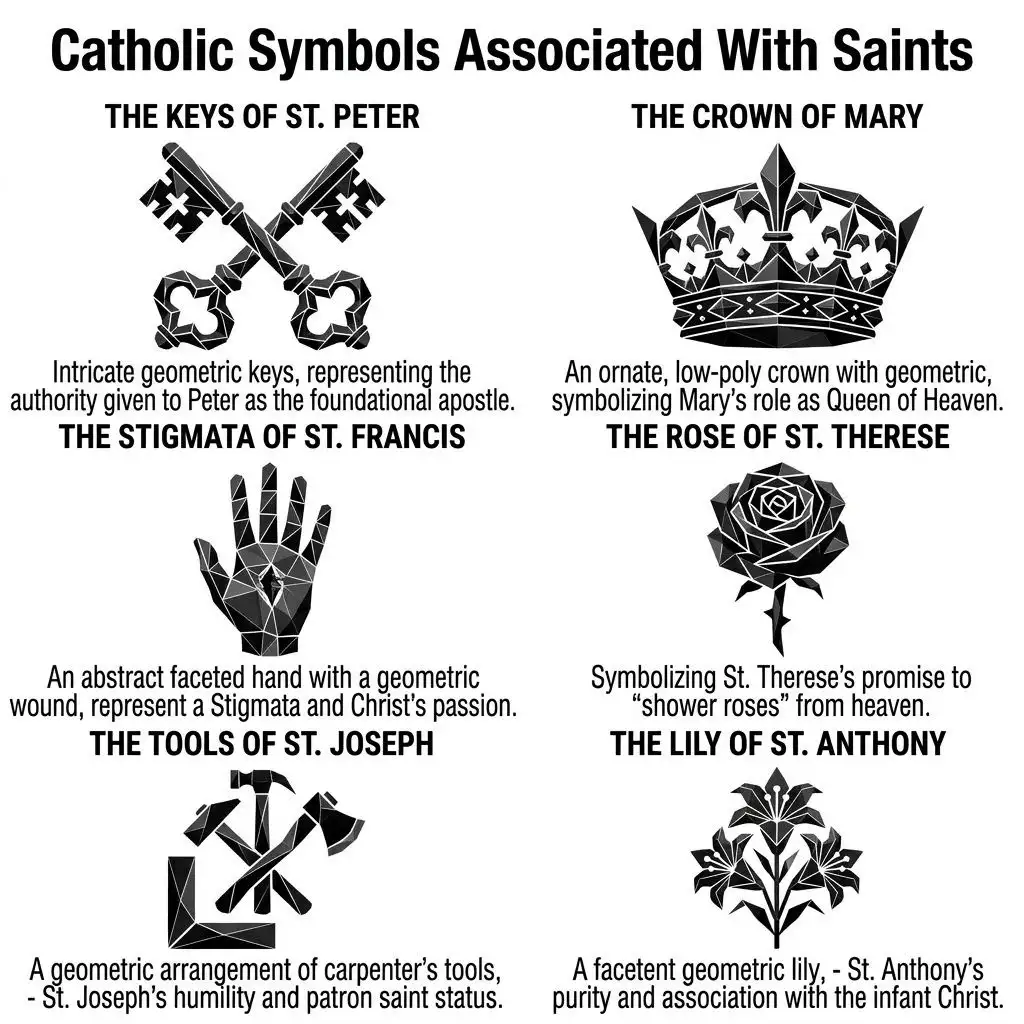
Saint Peter’s Keys
Keys are the traditional attribute most closely associated with Saint Peter.
When an image shows a saint holding keys, Saint Peter is often the person being represented.
The association comes from the Gospel passage in which Christ speaks of giving Peter the keys of the kingdom.
The same imagery later became closely connected with papal symbolism.
Saint Paul’s Sword
A sword is traditionally associated with Saint Paul.
It can represent his martyrdom and is also connected with artistic traditions depicting him.
When a Catholic statue shows a saint holding a sword, the sword alone is not enough for absolute identification, but it can be an important clue when combined with the person’s appearance and other attributes.
Saint Joseph’s Lily
A lily is frequently associated with Saint Joseph.
In Catholic art, Saint Joseph may be shown holding a lily, symbolizing qualities traditionally associated with his holiness and purity.
This is another reason context matters when interpreting a symbol.
Other Saint Attributes
Catholic art uses many traditional objects to identify saints.
Examples include:
| Saint | Common Attribute |
| Saint Peter | Keys |
| Saint Paul | Sword |
| Saint Joseph | Lily |
| Saint Sebastian | Arrows |
| Saint Lawrence | Gridiron |
| Saint Andrew | X-shaped cross |
| Saint Catherine of Alexandria | Wheel |
| Saint Anthony of Padua | Child Jesus, book, or lily |
These are best described as traditional attributes of saints, rather than universal Catholic symbols.
Catholic Symbols Used in Churches
The Altar and Sanctuary
The Catholic sanctuary can contain several important visual elements, including:
- altar
- crucifix
- candles
- tabernacle
- ambo
- sacred images
- Eucharistic objects
A crucifix near the altar is particularly useful when trying to identify a Catholic church.
Stained-Glass Windows
Catholic stained-glass windows may depict:
- Jesus
- Mary
- saints
- angels
- biblical events
- crosses
- Eucharistic symbols
- Christian monograms
These windows often combine storytelling with religious symbolism.
Holy Water
A Catholic church may have a font or container near the entrance where people can use holy water while making the Sign of the Cross.
The Catechism specifically identifies the sprinkling of holy water as a sign that recalls Baptism.
Candles
Candles are common in Catholic worship and devotional settings.
They can symbolize:
- light
- prayer
- Christ
- hope
- remembrance
The exact meaning depends on the liturgical or devotional context.
Catholic Symbols on Jewelry, Medals, and Tattoos
Catholic Jewelry
Catholic symbols frequently appear on jewelry.
Common examples include:
- crucifix necklaces
- cross necklaces
- Rosary bracelets
- Sacred Heart pendants
- saint medals
- Miraculous Medals
- Catholic rings
A piece of jewelry can have devotional, cultural, family, memorial, or personal meaning.
Therefore, the image itself does not always tell you exactly why someone wears it.
Catholic Medals
Catholic medals often feature:
- Jesus
- Mary
- saints
- crosses
- Sacred Heart imagery
- devotional inscriptions
They are generally connected with Catholic devotion and prayer.
The medal’s meaning depends on the saint or image shown on it.
Catholic Tattoos
Catholic-inspired tattoos can include:
- crucifixes
- crosses
- Rosaries
- Sacred Hearts
- Mary
- saints
- angels
- Scripture
- Eucharistic imagery
A person may choose such a design for religious devotion, family tradition, remembrance, cultural reasons, or personal expression.
It is better not to assume a single meaning for every tattoo. The person who chose the design is the best source for its personal significance.
Catholic Symbols on Gravestones and Headstones
Common Cemetery Symbols
Catholic cemetery monuments may contain:
- crosses
- crucifixes
- Rosaries
- angels
- doves
- Sacred Hearts
- praying hands
- saint imagery
- Alpha and Omega
- biblical inscriptions
These designs may express faith, remembrance, prayer, resurrection, or hope.
How to Identify Catholic Cemetery Imagery
A crucifix can be a strong Catholic clue, especially when combined with other Catholic devotional imagery.
A Rosary, Sacred Heart, or saint medal design can provide additional context.
However, a plain cross or angel does not automatically mean that a grave is Catholic because those symbols are used by many Christian communities.
Roman Catholic Symbols and Their Meanings: Quick Reference
| Symbol | Common Meaning or Association | Catholic Specificity |
| Crucifix | Christ’s Passion and sacrifice | Strong Catholic association |
| Cross | Christ’s death and Christian faith | Broad Christian symbol |
| Rosary | Prayer and meditation on Christ and Mary | Strong Catholic association |
| Sacred Heart | Christ’s human and divine love | Strong Catholic devotion |
| Immaculate Heart | Marian love and holiness | Strong Catholic devotion |
| Host and chalice | Eucharist | Strong Catholic liturgical association |
| Monstrance | Eucharistic adoration | Strong Catholic association |
| IHS | Jesus Christ | Catholic and broader Christian use |
| INRI | Jesus of Nazareth, King of the Jews | Broader Christian use |
| Crossed keys | Saint Peter and papacy | Strong Catholic/papal association |
| Papal tiara | Historical papal insignia | Strong Catholic association |
| Alpha and Omega | Beginning and end | Broad Christian symbol |
| Chi-Rho | Christ | Broad Christian symbol |
| Dove | Holy Spirit | Broad Christian symbol |
| Lamb | Christ as Lamb of God | Broad Christian symbol |
| Fish | Christian faith | Broad Christian symbol |
| Lily | Purity; Mary or Saint Joseph in context | Christian/Catholic art |
| Paschal Candle | Christ’s light and Easter | Strong Catholic liturgical association |
How to Identify a Catholic Symbol
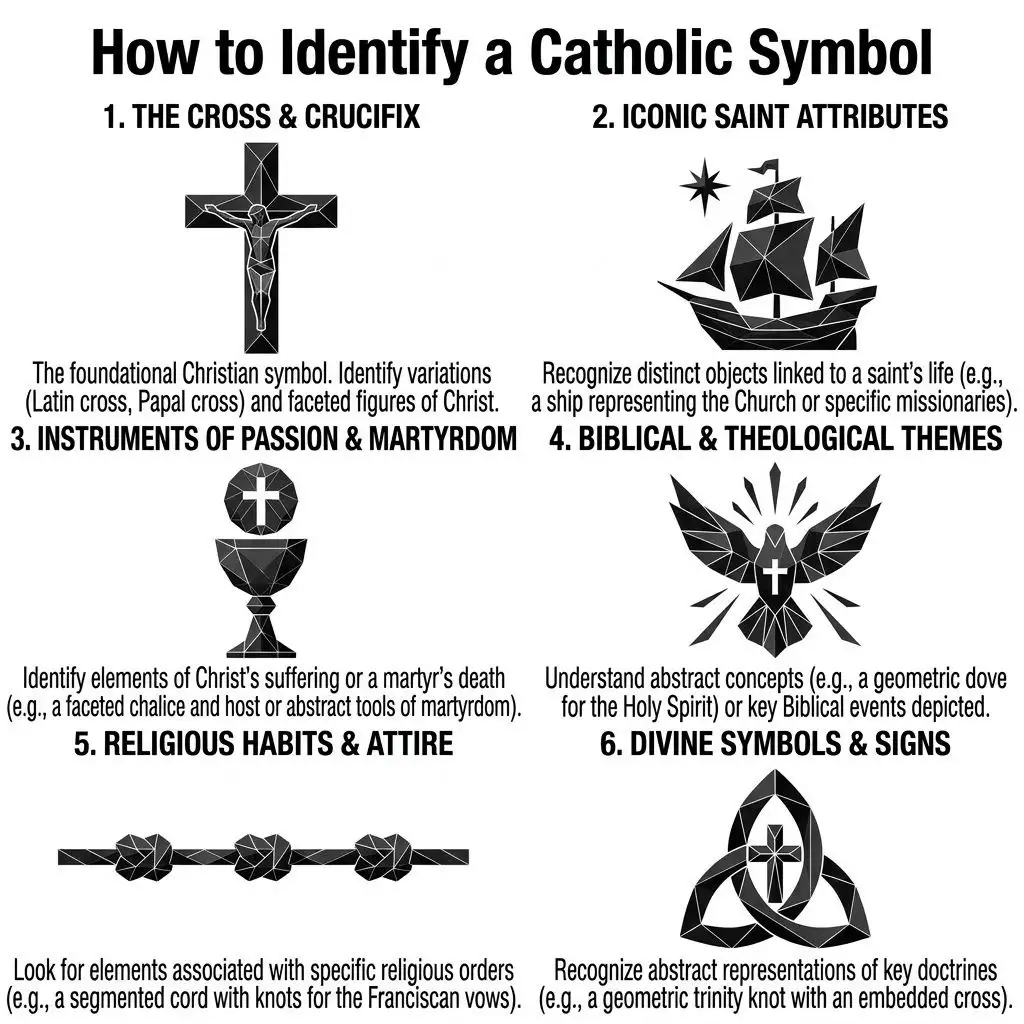
Look at the Shape
Start by examining the main object.
Is it:
- a cross?
- a crucifix?
- a heart?
- a key?
- a chalice?
- a candle?
- a Rosary?
- a dove?
- a fish?
The shape often provides the first clue.
Look at the Words or Letters
Letters can make identification much easier.
For example:
- IHS → Christogram associated with Jesus
- INRI → inscription associated with Jesus’ Crucifixion
- Alpha and Omega → Christian biblical symbolism
Words, initials, and inscriptions can sometimes tell you more than the image itself.
Look at the Surrounding Religious Context
Context is essential.
A plain key does not automatically mean Saint Peter.
A key shown with:
- Saint Peter
- a crucifix
- papal imagery
- Vatican heraldry
has a much stronger Catholic interpretation.
Likewise, a heart could simply be a symbol of love in secular art. A heart shown with flames, thorns, a cross, and an image of Christ is much more likely to represent the Sacred Heart of Jesus.
Why Catholic Symbols Can Have Different Meanings
Biblical Meaning
Some symbols come directly from biblical imagery.
Examples include:
- keys
- lamb
- dove
- Alpha and Omega
- cross
Liturgical Meaning
Other symbols are closely connected with Catholic worship.
Examples include:
- chalice
- host
- monstrance
- Paschal Candle
- holy water
Devotional Meaning
Some symbols are especially associated with personal Catholic devotion.
Examples include:
- Rosary
- Sacred Heart
- Immaculate Heart
- Miraculous Medal
- saint medals
Artistic Meaning
Artists may also use symbols in ways influenced by centuries of Christian visual tradition.
That means the same object can have more than one layer of meaning.
Frequently Asked Questions
What is the main symbol of Roman Catholicism?
The cross and crucifix are among the most recognizable symbols of Catholic Christianity. The crucifix has a particularly strong association with Catholic devotional and liturgical tradition because it depicts Christ on the Cross.
What are the most common Roman Catholic symbols?
Common Catholic symbols include the crucifix, cross, Rosary, Sacred Heart, Immaculate Heart of Mary, Eucharistic host and chalice, IHS, INRI, crossed keys, monstrance, and Paschal Candle.
What is the difference between a cross and a crucifix?
A cross normally shows the cross without a figure of Jesus. A crucifix includes a representation of Jesus Christ on the Cross. Both are Christian symbols, but the crucifix has a particularly prominent place in Catholic tradition.
What does IHS mean in Catholicism?
IHS is a Christogram associated with the name of Jesus. It is commonly found in Catholic churches, Eucharistic artwork, vestments, medals, and other religious objects.
What does INRI mean?
INRI comes from the Latin phrase Iesus Nazarenus, Rex Iudaeorum, meaning Jesus of Nazareth, King of the Jews.
What do the two crossed keys represent?
The crossed keys are associated with Saint Peter and the papacy. The Vatican explains that they are connected with the keys given to Peter by Christ and have been an official insignia of the Holy See since the fourteenth century.
What does the Sacred Heart symbolize?
The Sacred Heart of Jesus represents Christ’s love.
What does the Rosary symbolize?
The Vatican describes its mysteries as significant events or moments in the lives of Jesus and Mary.
Is the cross only a Catholic symbol?
A cross by itself does not prove that an object or church is specifically Roman Catholic.
Are all Roman Catholic symbols exclusive to Catholicism?
The cross, dove, lamb, fish, Alpha and Omega, and Chi-Rho are examples of broader Christian symbols. Other imagery, such as the Rosary, Sacred Heart, crossed keys, and Catholic medals, has a stronger Catholic association.
What symbol represents the Eucharist?
The host and chalice are major Eucharistic symbols. The monstrance is also strongly associated with Eucharistic adoration and the display of the consecrated host.
What Catholic symbol represents Mary?
There are several Marian symbols. The Immaculate Heart of Mary, Marian monograms, twelve stars, lilies, and images of Mary are common examples. Their exact meaning depends on the artistic and devotional context.
What Catholic symbols appear on gravestones?
Catholic gravestones may feature crosses, crucifixes, Rosaries, angels, Sacred Hearts, saints, doves, and biblical symbols. A plain cross is not exclusively Catholic, so additional imagery can provide more context.
Conclusion
Roman Catholic symbols provide a visual language for faith, worship, devotion, Scripture, and Christian tradition. The crucifix points toward Christ’s Passion, while the cross expresses the central Christian mystery of Christ’s death and salvation. The Rosary is closely connected with Catholic prayer and meditation, and the Sacred Heart of Jesus represents Christ’s human and divine love. The Immaculate Heart of Mary belongs to Catholic Marian devotion, while the host, chalice, and monstrance point toward Eucharistic faith and worship. The crossed keys are strongly associated with Saint Peter, the papacy, and the Holy See. Other symbols, including the dove, lamb, fish, Alpha and Omega, and Chi-Rho, are shared more widely across Christianity. Understanding both the symbol and its context is the best way to identify its meaning accurately and respectfully.

Adam Sullivan is a dedicated writer who enjoys transforming everyday topics into engaging and informative content. His writing focuses on making complex ideas simple, practical and enjoyable for readers of all backgrounds. Adam is also the fictional author of The Lantern Beyond Autumn Hills and Where the Morning Horizon Waits. Outside of writing, he enjoys photography, traveling and discovering inspiration through new experiences. He believes great content should be both helpful and easy to connect with.
 Dylan Anderson