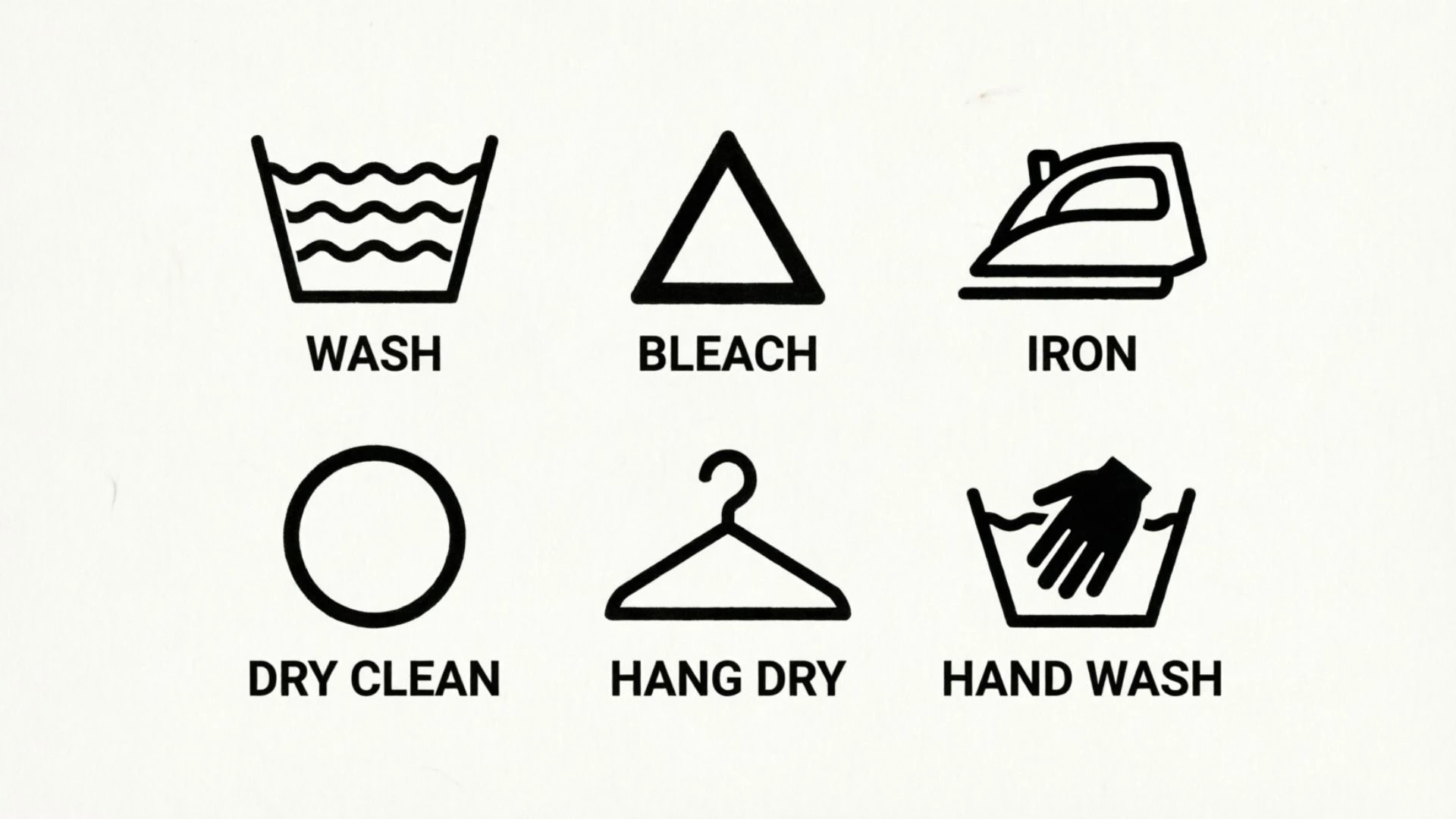
International laundry symbols make clothing-care instructions easier to understand, even when the label uses little or no written language.
I know those tiny symbols can look confusing at first, especially when a shirt has several symbols in a row.
You may see a tub, triangle, square, iron, or circle and wonder what each one means.
The good news is that the basic system is designed to give clear care information across different languages and countries.
In this guide, you will learn how to read washing, bleaching, drying, ironing, and professional-care symbols correctly.
Once you understand the shapes, lines, dots, and crosses, clothing labels become much easier to follow.
What Symbol Represents International Laundry Care? (Quick Answer)
There is not one single laundry symbol. International laundry symbols form a standardized care-label system covering washing, bleaching, drying, ironing, and professional textile care.
The basic symbols are:
- Tub = washing
- Triangle = bleaching
- Square = drying
- Iron = ironing
- Circle = professional textile care
The current international standard is ISO 3758:2023, which defines graphical symbols for textile care and identifies the maximum treatments that should not cause irreversible damage to the textile.
What Are International Laundry Symbols?
International laundry symbols are graphic signs printed on clothing and textile care labels. They tell you how a garment should be washed, bleached, dried, ironed, or professionally cleaned.
The system is designed to reduce language barriers. Instead of writing a long instruction in several languages, manufacturers can use recognizable symbols.
The current international standard, ISO 3758:2023, covers domestic washing, bleaching, drying, and ironing, as well as professional dry and wet cleaning.
One important point is often missed: a care symbol generally tells you the maximum permitted treatment, not necessarily the treatment you must use every time. GINETEX notes that milder treatments and lower temperatures than those shown on the label are permitted.
For example, if a label allows washing at 40°C, washing at a lower temperature is generally the gentler choice.
International Laundry Symbols Comparison Table
| Symbol | Main Meaning | Best Use |
|---|---|---|
| 🛁 Tub | Washing | Machine or hand washing |
| 🛁 Tub + hand | Hand wash | Delicate garments |
| 🛁 Tub + cross | Do not wash | Items unsuitable for washing |
| △ Triangle | Bleaching | Checking bleach suitability |
| △ + cross | Do not bleach | Colored or sensitive fabrics |
| □ Square | Natural drying | Air-drying instructions |
| □ + ○ | Tumble drying | Dryer instructions |
| □ + lines | Line or flat drying | Natural drying |
| ♨ Iron | Ironing | Heat and ironing guidance |
| ○ Circle | Professional care | Dry or wet cleaning |
| ○ + cross | Do not professionally clean | Avoid specified professional care |
| • Dots | Heat level | Washing, drying, or ironing temperature |
Top 12 International Laundry Symbols and Their Meanings
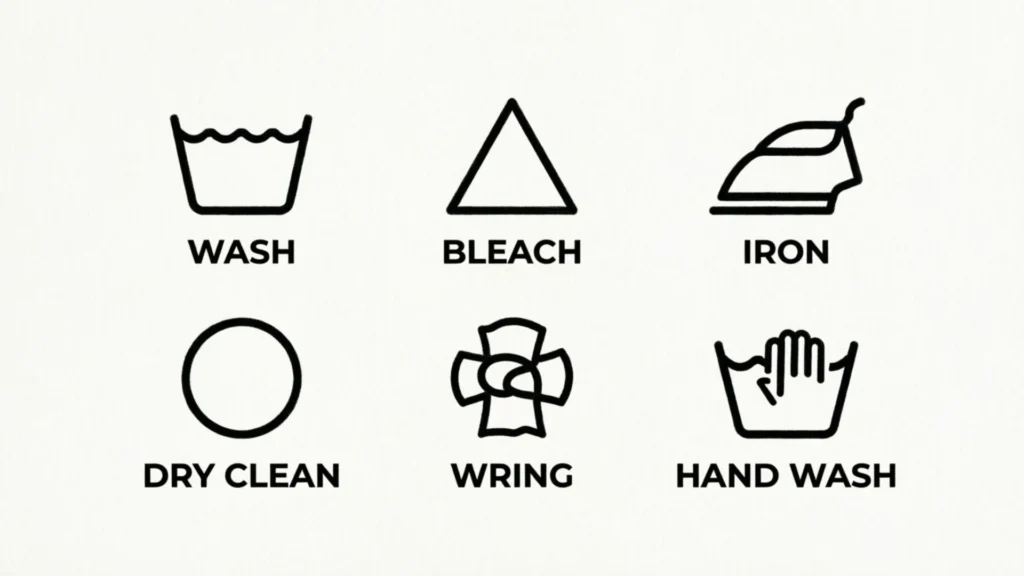
1. Washing Tub: Check How the Garment Can Be Washed
The washing tub is one of the easiest international laundry symbols to recognize. It means the garment can be washed using a domestic washing process, and it may apply to either machine washing or hand washing depending on the specific symbol.
Numbers inside the tub indicate the maximum washing temperature in degrees Celsius. For example, a tub marked “30” means the garment should not be washed above 30°C.
A bar underneath the tub indicates a milder process with reduced mechanical action. Two bars indicate a very mild process, commonly used for especially sensitive textiles such as wool garments.
Best for: everyday laundry, shirts, trousers, bedding, delicate clothing
2. Hand-Wash Symbol: Use Gentle Washing
A tub containing a hand symbol means the garment should be hand washed according to the conditions shown on the label.
This symbol is common on delicate clothing that may be damaged by normal machine agitation. Examples can include certain wool, silk, lace, and finely constructed garments.
Hand washing does not mean scrubbing aggressively. Gentle movement, suitable detergent, and careful rinsing are usually more appropriate.
The exact hand-wash temperature should still be checked if one is provided on the label.
Best for: delicate garments, knitwear, silk items, fine fabrics, fragile clothing
3. Do Not Wash: Avoid Water-Based Washing
A washing tub marked with a cross means do not wash.
This instruction matters because some fabrics, finishes, decorations, or garment constructions may not tolerate domestic washing. GINETEX explains that such articles may be sensitive to wet treatment or unsuitable for domestic washing because of their construction or size.
Do not assume that a very gentle washing machine setting will make a “do not wash” garment safe.
Instead, check the professional-care symbol that follows it.
Best for: specialized garments, structured clothing, sensitive materials, professional-care items
4. Triangle: Understand Bleaching Instructions
The triangle represents bleaching.
An empty triangle indicates that bleaching is permitted under the relevant care-label system. A triangle with two diagonal lines means only oxygen/non-chlorine bleach is permitted. A crossed-out triangle means do not bleach.
This distinction is important because chlorine bleach and oxygen bleach are not interchangeable.
If the label says not to bleach, avoid bleach-containing products even if the garment appears heavily stained.
Best for: stain treatment, white clothing, checking detergent compatibility, fabric care
5. Crossed Triangle: Do Not Bleach
A crossed-out triangle means the garment should not be bleached.
Bleach can affect dyes, fibers, finishes, or printed designs. The symbol is especially useful when you are tempted to use a strong product to remove a difficult stain.
If bleaching is prohibited, choose a stain-removal method that is suitable for the garment and test any treatment according to the product and fabric instructions.
Best for: colored clothing, printed fabrics, delicate textiles, stain-care decisions
6. Square: Natural Drying Instructions
A square is the basic symbol for drying.
The lines or other marks inside the square tell you more about the type of natural drying recommended. Depending on the variation, the label can indicate line drying, drip drying, flat drying, or drying in the shade.
This matters because the wrong drying method can stretch, shrink, crease, or distort some fabrics.
For example, a heavy knitted garment may need to dry flat rather than hanging from a clothesline.
Best for: sweaters, delicate clothing, air drying, natural-fiber garments
7. Square With Circle: Tumble Drying
A circle inside a square means tumble drying.
Dots inside the circle indicate the permitted heat level. More dots allow a higher drying temperature, while fewer dots indicate greater care is needed.
A crossed-out square with a circle means do not tumble dry.
Always check the complete symbol rather than assuming that every dryer setting is suitable.
Best for: towels, everyday clothing, dryer-safe fabrics, household laundry
8. Iron Symbol: Control the Heat
The iron symbol tells you whether and at what level a garment may be ironed.
Dots inside the iron indicate the maximum temperature level. Modern care labeling can also include specific instructions about ironing without steam.
A crossed-out iron means do not iron.
If you are unsure, use a lower temperature rather than starting with high heat. Some fabrics can develop shiny marks, melt, scorch, or permanently change shape when exposed to excessive heat.
Best for: shirts, trousers, dresses, linens, wrinkle-prone fabrics
9. One-Dot Iron: Low Heat
An iron containing one dot indicates a low-temperature ironing setting.
This is useful for fabrics that are sensitive to heat. Synthetic materials often require more caution than sturdy cotton or linen, although the care label should always be the final guide for that specific garment.
When ironing a delicate item, avoid leaving the hot iron in one place for too long.
Best for: heat-sensitive fabrics, synthetic garments, delicate clothing
10. Two- or Three-Dot Iron: Higher Heat Levels
Two or three dots inside the iron indicate progressively higher permitted ironing temperatures.
The highest setting is intended for textiles that can withstand more heat. GINETEX describes the highest iron setting as a maximum sole-plate temperature of 210°C under its system.
More heat is not automatically better. If a lower temperature removes wrinkles successfully, using the lower setting can reduce unnecessary stress on the fabric.
Best for: cotton, linen, durable fabrics, garments requiring stronger heat
11. Circle: Professional Textile Care
A circle is associated with professional textile care. Depending on the symbol and letters inside it, it can provide information about professional dry-cleaning or wet-cleaning processes.
This symbol is particularly important for garments that should not be treated like ordinary machine-washable clothing.
Letters inside the circle provide information for professional cleaners rather than instructions for a typical home washing machine.
If you see a professional-care symbol, follow it carefully instead of guessing which cleaning solvent or process to use.
Best for: suits, formalwear, specialized fabrics, professional cleaning
12. Crossed-Out Symbols: Treatment Is Not Allowed
A cross over a care symbol generally means the represented treatment must not be used.
For example:
- Crossed tub = do not wash
- Crossed triangle = do not bleach
- Crossed dryer = do not tumble dry
- Crossed iron = do not iron
- Crossed professional-care circle = do not use the specified professional process
GINETEX explains that the cross applied to a symbol means the treatment represented by that symbol should not be used.
Never ignore a crossed symbol simply because the garment looks durable.
Best for: preventing accidental damage, delicate clothing, expensive garments
Best International Laundry Symbols for Tattoos
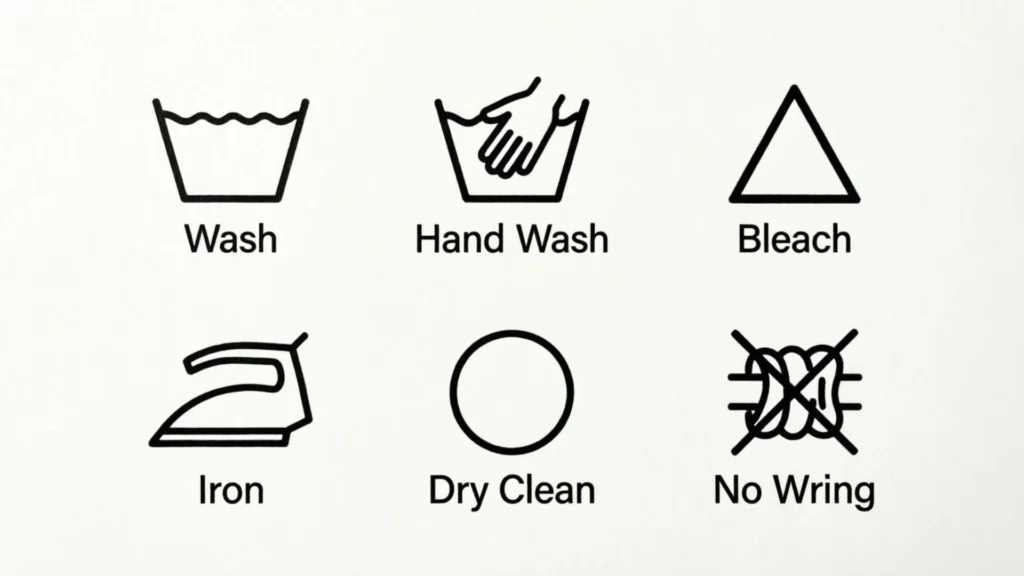
Laundry symbols are sometimes used as minimalist tattoos, especially by people who enjoy fashion, textiles, sewing, design, or the visual simplicity of care-label icons.
For tattoos, simple symbols usually work better than a crowded group of tiny marks.
Good choices include:
- Washing tub for a laundry or textile theme
- Iron symbol for fashion or garment care
- Triangle for a minimalist geometric design
- Tumble-dry symbol for a playful laundry reference
- A sequence of care symbols for a fashion or sewing-inspired tattoo
Because care symbols have precise meanings, check the exact design before getting it permanently inked.
Best International Laundry Symbols for Logos and Design
Laundry-care symbols are naturally suited to fashion, textile, clothing, tailoring, laundry, and garment-care designs.
For a logo, choose a simple symbol that remains recognizable at small sizes. A washing tub, iron, or clean line-based drying symbol can work better than a complicated label containing many variations.
If you are designing packaging or clothing labels, accuracy matters more than decoration. ISO 3758:2023 provides the international framework for textile care symbols, while GINETEX publishes detailed guidance on their use.
One practical point for commercial designers: GINETEX states that its care symbols are protected trademarks in many countries and that use may require licensing. Check the applicable rights before reproducing official symbols commercially.
Best International Laundry Symbols for Family, Personal, or Everyday Meaning
For everyday household use, the most useful symbols are the ones that answer a simple question: What can I safely do with this garment?
A family laundry cheat sheet can focus on:
- Washing temperature
- Hand wash
- Do not bleach
- Tumble dry
- Air dry
- Iron temperature
- Do not iron
- Professional cleaning
Teaching children or new household members these basic shapes can make laundry safer and reduce accidental damage.
For personal design, a row of symbols can also tell a small story about clothing, sewing, fashion, or caring for favorite garments.
Before Using Laundry Symbols in Products or Commercial Designs
Laundry-care symbols may look like simple universal icons, but they are part of a formal care-labeling system.
ISO 3758:2023 is the current international standard for textile care labeling using symbols. It replaced the previous ISO 3758:2012 edition in 2023.
If you are making clothing labels, packaging, educational materials, or commercial products:
- Use the correct symbol for the intended treatment.
- Check the current standard rather than relying on an old chart.
- Do not invent your own variation and present it as an official care symbol.
- Check trademark and licensing requirements where applicable.
- Make sure the complete care sequence is clear.
GINETEX states that care symbols are normally presented in the order washing, bleaching, drying, ironing, and professional textile care.
How to Choose the Right Symbol for International Laundry Care
Reading a care label becomes easier when you use the symbols in order.
Step 1: Look at the shape.
Tub = wash, triangle = bleach, square = dry, iron = iron, circle = professional care.
Step 2: Look for numbers or dots.
These usually indicate temperature or heat limits.
Step 3: Check for lines.
Lines can indicate a gentler washing process or a particular natural-drying method.
Step 4: Look for a cross.
A crossed symbol means that treatment is not permitted.
Step 5: Follow the strictest instruction.
If one part of the label says “do not tumble dry,” do not put the garment in the dryer just because another symbol allows washing.
Step 6: When in doubt, choose the gentler option.
Lower temperatures and milder processes are generally safer when they are compatible with the garment.
FAQs About International Laundry Symbols
What is the best international laundry symbol guide?
The most reliable reference is ISO 3758:2023, the current international standard for textile care labeling. GINETEX also provides a detailed overview of the care symbols and their variations.
What do the five main laundry symbols mean?
The five basic symbol families represent washing, bleaching, drying, ironing, and professional textile care. Their shapes make the care instructions easier to understand across different languages and markets.
What does a circle mean on a laundry label?
A circle indicates professional textile care. Letters or other marks inside the circle provide additional information about permitted professional cleaning processes. It is not the symbol for ordinary home washing.
What does a triangle mean on a clothing label?
A triangle relates to bleaching. An empty triangle indicates permitted bleaching, while diagonal lines can restrict bleaching to oxygen/non-chlorine products. A crossed triangle means do not bleach.
What does one line under the washing symbol mean?
One line beneath the washing tub indicates a milder washing process with reduced mechanical action. Two lines indicate a very mild process. These details are important for fabrics that can be damaged by stronger agitation.
What does a square with a circle mean?
A square containing a circle means tumble drying. Dots inside the circle indicate the permitted temperature level. A crossed-out version means the garment should not be tumble dried.
Can I use a lower temperature than the label shows?
Generally, yes. Care labels indicate maximum permitted treatments, and GINETEX states that milder treatments and lower temperatures than those indicated are permitted. A lower setting can therefore be a useful gentler choice when it still provides the desired result.
Are international laundry symbols the same everywhere?
The symbols are based on an international standard intended to harmonize textile care labeling, but local labeling laws and practices can differ. The current ISO standard is ISO 3758:2023, so manufacturers and consumers should also consider applicable national requirements.
Final Thoughts
International laundry symbols turn complicated clothing-care instructions into a simple visual language. Learn the five basic shapes first: tub for washing, triangle for bleaching, square for drying, iron for ironing, and circle for professional care.
Then pay attention to dots, numbers, lines, and crosses. These small details tell you how gentle or restrictive the recommended treatment is. When you follow the label instead of guessing, your clothes have a much better chance of keeping their shape, color, and finish.

Adam Sullivan is a dedicated writer who enjoys transforming everyday topics into engaging and informative content. His writing focuses on making complex ideas simple, practical and enjoyable for readers of all backgrounds. Adam is also the fictional author of The Lantern Beyond Autumn Hills and Where the Morning Horizon Waits. Outside of writing, he enjoys photography, traveling and discovering inspiration through new experiences. He believes great content should be both helpful and easy to connect with.
 Dylan Anderson