
Laundry symbols are small pictures printed on clothing labels to explain how you should care for your garments. They tell you whether an item can be machine-washed, bleached, tumble-dried, ironed, or professionally cleaned. Understanding these symbols helps you avoid shrinking, fading, stretching, and other common laundry problems.
However, laundry labels can look confusing at first. A small dot, an extra line, or a cross over a symbol can completely change its meaning. For example, a washtub with one line underneath calls for a gentler washing process than a tub without a line. A square with a circle gives drying instructions, while a plain square describes natural drying.
This guide explains the meaning of laundry symbols in simple language. You will learn how to recognize the five basic symbol categories, understand washing temperatures, choose the right dryer setting, and follow special instructions for delicate fabrics. You will also find practical examples, comparison charts, and answers to common laundry questions.
What Are Laundry Symbols?
Laundry symbols are standardized care instructions found on clothing labels, bedding tags, towels, and other textile products. They use simple shapes to communicate how an item should be washed, bleached, dried, ironed, or professionally cleaned.
Manufacturers use these instructions to help consumers care for garments without causing avoidable damage. A label may contain five main symbol categories:
- Washtub: Explains washing instructions and maximum water temperature.
- Triangle: Shows whether bleaching is permitted.
- Square: Provides tumble-drying or natural-drying instructions.
- Iron: Explains safe ironing temperatures.
- Circle: Gives instructions for professional textile cleaning.
The international care-labeling system follows ISO 3758. Its symbols appear in a standard sequence: washing, bleaching, drying, ironing, and professional textile care.
A crossed-out symbol means the treatment shown should not be used. Dots and lines add extra information about temperature or how gently you should handle the fabric.
Why Are Laundry Symbols Important?
Laundry symbols help you make better decisions before putting clothes in the washing machine. They are especially useful when a garment contains several materials or has a special finish.
For example, a cotton shirt may tolerate a regular wash, but a cotton garment with delicate decorations may need gentler care. A wool sweater might also require a very mild washing cycle and flat drying.
Following the care label can help you:
- Reduce the risk of shrinking and stretching.
- Protect fabric colors and printed designs.
- Prevent heat damage from dryers and irons.
- Avoid using unsuitable bleach.
- Keep delicate materials in better condition.
- Understand when professional cleaning is necessary.
Care symbols describe the maximum treatment a textile can tolerate under the relevant care system. They do not mean you must always use the highest permitted temperature or strongest treatment.
Complete Laundry Symbols Chart With Meanings
The quickest way to understand laundry labels is to learn the basic symbols and their variations. The chart below describes common international ISO-style care symbols in words so you can identify them on a clothing tag.
| Symbol appearance | Category | Meaning | What You Should Do |
| Washtub | Washing | Domestic washing is permitted | Follow the temperature and cycle details |
| Washtub with a number | Washing | Maximum washing temperature | Do not exceed the displayed temperature |
| Washtub with one line | Washing | Mild washing process | Choose a gentle cycle |
| Washtub with two lines | Washing | Very mild washing process | Use a very gentle cycle |
| Hand inside a washtub | Washing | Hand wash | Wash carefully by hand |
| Crossed-out washtub | Washing | Do not wash | Avoid household washing |
| Empty triangle | Bleaching | Bleaching is permitted | Use a suitable bleaching product |
| Triangle with diagonal lines | Bleaching | Oxygen or non-chlorine bleach only | Avoid chlorine bleach |
| Crossed-out triangle | Bleaching | Do not bleach | Use bleach-free products |
| Square with a circle | Tumble drying | Tumble drying is permitted | Follow the heat setting |
| Square with a circle and one dot | Tumble drying | Low heat | Select a low-heat dryer setting |
| Square with a circle and two dots | Tumble drying | Medium heat | Select a medium-heat setting |
| Square with a circle and three dots | Tumble drying | High heat | Use high heat only if appropriate |
| Crossed-out square with a circle | Tumble drying | Do not tumble dry | Use an approved natural-drying method |
| Square with a vertical line | Natural drying | Line dry | Hang the garment to dry |
| Square with a horizontal line | Natural drying | Dry flat | Place the garment flat to dry |
| Square with a diagonal line | Natural drying | Dry in the shade | Keep it away from direct sunlight |
| Iron with one dot | Ironing | Low temperature | Use a low iron setting |
| Iron with two dots | Ironing | Medium temperature | Use a medium iron setting |
| Iron with three dots | Ironing | High temperature | Use a high setting if the fabric permits |
| Crossed-out iron | Ironing | Do not iron | Avoid direct ironing |
| Circle with P | Professional care | Specific professional dry-cleaning process | Show the label to your cleaner |
| Circle with F | Professional care | Specific hydrocarbon-solvent dry cleaning | Let a professional cleaner interpret it |
| Circle with W | Professional care | Professional wet cleaning | Use a professional wet-cleaning service |
The chart covers common symbol families. Additional variations may include lines beneath symbols, diagonal marks, or combinations that provide more specific instructions.
Important: P and F inside a professional-care circle identify dry-cleaning solvent systems in the international system. W inside a circle identifies professional wet cleaning. These letters are not ordinary home-washing instructions.
Meaning of Basic Laundry Symbols
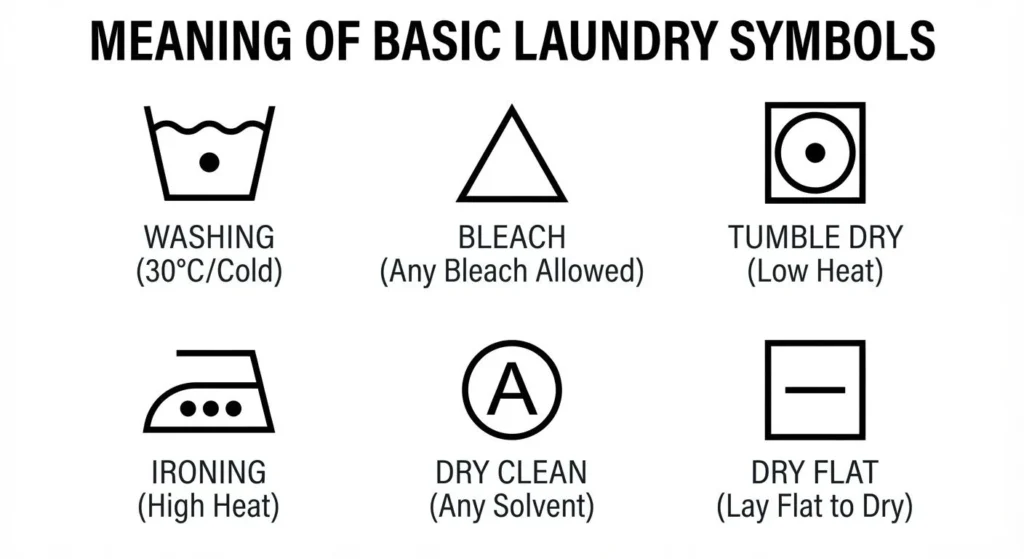
Most laundry instructions use five basic shapes. Learning these shapes makes it easier to understand even unfamiliar care labels.
What Does the Washtub Symbol Mean?
The washtub symbol represents washing with water. It may apply to machine washing or hand washing, depending on the markings inside the tub.
A number inside the tub shows the maximum washing temperature in Celsius under the international ISO system. A hand inside the tub means hand washing. One or two lines underneath indicate that you need a milder washing cycle.
If the tub has a cross over it, do not wash the garment using a domestic washing process.
What Does the Triangle Symbol Mean?
The triangle represents bleaching. It tells you whether you can use a bleaching agent to treat stains or brighten fabric.
An empty triangle means bleaching is permitted under the applicable instructions. A triangle with two diagonal lines allows oxygen or non-chlorine bleach but excludes chlorine bleach. A crossed-out triangle means you should not bleach the item.
Never assume that a white garment can automatically tolerate bleach. Always check the triangle before using a bleaching product.
What Does the Square Symbol Mean?
A square represents drying instructions. Its markings tell you whether to use a tumble dryer or dry the garment naturally.
A circle inside the square means tumble drying. Dots inside the circle indicate the permitted heat level. A square without a circle may contain lines that explain natural drying methods.
For example, a horizontal line generally means dry flat, while a vertical line indicates line drying.
What Does the Iron Symbol Mean?
The iron symbol gives instructions for ironing a garment. The number of dots indicates the permitted temperature level.
- One dot means low-temperature ironing.
- Two dots mean medium-temperature ironing.
- Three dots mean high-temperature ironing.
- A crossed-out iron means do not iron.
Some labels also include a crossed-out steam symbol or another marking that restricts steam use.
What Does the Circle Symbol Mean?
The circle represents professional textile care. It provides instructions for professional dry cleaning or wet cleaning.
Letters inside the circle identify the permitted professional cleaning process. A line underneath the circle indicates that the cleaner must use a more restricted process.
These symbols are mainly intended for professional cleaners. If you see unfamiliar letters inside a circle, show the complete label to your cleaning service.
Washing Symbols and Their Meanings
Washing symbols tell you how to clean a garment with water. They help you choose the correct temperature, machine cycle, or hand-washing method.
Normal Machine Wash Symbol
A plain washtub without a line underneath generally permits a normal washing process.
Use a washing machine program that matches the temperature shown inside the tub. You should still separate clothes by color and fabric type.
A normal wash may involve more mechanical action than a mild or very mild cycle. Avoid using it for garments that have a special gentle-washing instruction.
Mild Wash Symbol
A washtub with one horizontal line underneath indicates a mild washing process.
This instruction calls for reduced mechanical action. It may be suitable for easy-care fabrics and garments that need gentler handling.
Choose a gentle or mild washing program when your machine offers one. Avoid overloading the drum because tightly packed clothing cannot move freely.
Very Mild Wash Symbol
A washtub with two horizontal lines underneath indicates a very mild washing process.
This symbol commonly appears on delicate garments, including some wool items. It calls for particularly gentle mechanical action.
Choose a specialized wool or very delicate cycle when it matches the garment’s instructions. Use a suitable detergent and avoid unnecessary spinning.
Hand Wash Symbol
The hand-wash symbol shows a hand inside a washtub.
It means the garment should be washed carefully by hand rather than through an ordinary machine cycle.
To hand-wash an item:
- Fill a clean basin with water at the temperature allowed by the label.
- Dissolve a suitable gentle detergent.
- Place the garment in the water.
- Move it carefully without rubbing or twisting.
- Rinse until the detergent is removed.
- Press out excess water gently.
- Follow the label’s drying instructions.
Do not wring delicate garments aggressively. Twisting can stretch fibers and distort their shape.
Do Not Wash Symbol
A crossed-out washtub means the garment should not be washed using a domestic washing process.
Water and household washing action may damage the fabric, lining, decorations, or construction. Check whether the garment has a professional-cleaning instruction.
Do not ignore this symbol simply because the garment looks sturdy. Its construction may be more delicate than its outer fabric suggests.
Laundry Temperature Symbols and Their Meanings
Numbers inside a washing tub show the maximum washing temperature in the international ISO-style system. The temperature is measured in degrees Celsius.
For example, a washtub marked 30 means the washing temperature must not exceed 30°C.
Common Washing Temperature Chart
| Temperature | Fahrenheit equivalent | General interpretation |
| 20°C | 68°F | Very cool wash |
| 30°C | 86°F | Cool wash |
| 40°C | 104°F | Warm wash |
| 50°C | 122°F | Hotter wash |
| 60°C | 140°F | Hot wash |
| 70°C | 158°F | High-temperature wash |
| 95°C | 203°F | Very high-temperature wash |
These are temperature conversions, not universal recommendations for every fabric. Always follow the number printed on the actual garment label.
What Does 30°C Mean on a Laundry Label?
A tub marked 30 means the garment should not be washed above 30°C, which is approximately 86°F.
This setting is commonly used for clothes that benefit from cooler washing. It may help reduce color fading and unnecessary heat exposure.
A lower temperature may also be suitable if it cleans the garment effectively. However, temperature alone does not determine the correct cycle. Check for lines underneath the tub.
What Does 40°C Mean on a Laundry Label?
A tub marked 40 means the maximum washing temperature is 40°C, or approximately 104°F.
It appears on many everyday garments, including some cotton and synthetic clothing. Use the appropriate cycle and detergent for the material.
Do not automatically wash every garment at 40°C. Some fabrics need cooler water or reduced mechanical action.
What Does 60°C Mean on a Laundry Label?
A tub marked 60 means the garment can tolerate washing at a maximum of 60°C, or approximately 140°F, under the specified process.
This temperature may be used for certain durable textiles. However, it is not suitable for every cotton item, colored garment, or fabric blend.
Check the complete label before choosing a hot wash.
What Is the Difference Between Cold, Warm, and Hot Washing?
Cold, warm, and hot are general descriptions. Their exact temperatures may vary depending on the washing machine and labeling system.
When a care label gives a specific number, follow that number rather than relying on the words cold or warm.
For example, a 30°C label gives you a clearer maximum than a general cold-wash setting.
What Do Numbers and Dots Mean on Laundry Symbols?
Numbers and dots both provide temperature information, but they do not mean the same thing in every symbol category.
Understanding the shape surrounding a marking is essential.
Numbers Inside a Washtub
Numbers inside a washtub indicate the maximum washing temperature in Celsius in the international system.
For example:
- 30 means a maximum of 30°C.
- 40 means a maximum of 40°C.
- 60 means a maximum of 60°C.
These numbers refer to washing water, not dryer or iron temperature.
Dots Inside an Iron
Dots inside an iron show the permitted ironing heat.
| Iron marking | International ISO maximum soleplate temperature |
| One dot | 120°C |
| Two dots | 160°C |
| Three dots | 210°C |
These values follow the current international ISO-style system. Other national or regional care-symbol charts may use different values or presentations.
Dots Inside a Tumble-Drying Symbol
Dots inside a circle within a square indicate the permitted dryer heat level.
| Dryer marking | Meaning |
| One dot | Low heat |
| Two dots | Medium heat |
| Three dots | High heat |
| Cross over symbol | Do not tumble dry |
The dots communicate the heat category. Check your dryer’s available programs to choose an appropriate setting.
Why the Shape Matters
Never interpret a dot without looking at the complete symbol.
A dot inside an iron relates to ironing temperature. A dot inside a tumble-drying circle relates to dryer heat. A number inside a washtub indicates washing temperature.
The surrounding shape tells you which part of garment care the marking describes.
Do Laundry Symbols Show Maximum or Recommended Washing Settings?
Laundry symbols generally describe the maximum permitted treatment for a garment. They do not mean you must always use the highest temperature or strongest process shown.
For example, if a label permits washing at 40°C, a cooler wash may also be suitable.
The purpose of the label is to prevent treatments that could cause irreversible damage. A milder process can be a sensible choice when it still cleans the garment effectively.
Keep these points in mind:
- Do not exceed the washing temperature shown.
- Use a gentler cycle when the label includes one or two lines.
- Choose a lower dryer heat when appropriate.
- Avoid stronger bleaching products than the label permits.
- Never use a treatment marked with a cross.
A lower temperature is not automatically the best choice for every cleaning task. Consider the type of soil, detergent instructions, hygiene needs, and garment construction.
American vs. International Laundry Symbols: What’s the Difference?
Laundry labels can vary between countries. The international ISO 3758 system and the American ASTM care-symbol system are related, but their symbols and some details are not identical.
This matters if you buy clothing from international brands or read care instructions written for another market.
International ISO Laundry Symbols
The ISO 3758 system uses five main symbol categories:
- Washing.
- Bleaching.
- Drying.
- Ironing.
- Professional textile care.
Washing temperatures appear as numbers inside the washtub in degrees Celsius. Dots and lines provide additional instructions.
The system is designed to communicate care information across language barriers.
American Laundry Symbols
In the United States, the FTC Care Labeling Rule governs care instructions for covered textile wearing apparel and certain piece goods.
The rule allows specified ASTM care symbols to be used in place of words when its requirements are met. Manufacturers can also provide appropriate written care instructions.
American shoppers may therefore encounter:
- Written washing instructions.
- Temperature information in Fahrenheit.
- ASTM care symbols.
- International symbols on imported garments.
- A combination of words and symbols.
The FTC’s regulatory material identifies ASTM D5489-96c for the symbol exemption under the rule. Do not assume that every international symbol has an identical American counterpart.
How to Read an International Label in the United States
If you buy clothing from another country, check the complete care label rather than relying on one symbol.
For example, a washing tub marked 30 in the international system means a maximum of 30°C, approximately 86°F.
If a symbol is unfamiliar, look for written instructions or check the manufacturer’s care guidance. For valuable or delicate clothing, ask a professional cleaner before attempting an uncertain treatment.
Bleaching Symbols and Their Meanings

The triangle symbol explains whether you can use bleach on a garment. Bleach can remove certain stains and brighten some fabrics, but the wrong product may damage colors or fibers.
Empty Triangle: Bleaching Allowed
An empty triangle means bleaching is permitted under the care system.
It does not mean you should automatically use bleach every time you wash the garment. Follow the product directions and use a bleaching agent appropriate for the fabric.
Triangle With Two Diagonal Lines: Non-Chlorine Bleach Only
A triangle containing two diagonal lines means only oxygen or non-chlorine bleach is permitted.
Avoid chlorine bleach because it may damage the fabric or affect its color.
Check the label on your laundry product. Some products contain oxygen-based bleaching agents, while others use chlorine.
Crossed-Out Triangle: Do Not Bleach
A triangle with a cross over it means bleaching is not permitted.
Use a bleach-free detergent instead. Do not assume that a white garment can tolerate chlorine bleach simply because it has no visible color.
Oxygen Bleach vs. Chlorine Bleach
Oxygen bleach and chlorine bleach are different products.
Oxygen-based products are often marketed for color-safe stain removal, although you should still follow the garment’s label and product directions.
Chlorine bleach is stronger and may damage dyes or certain fibers. Never use it when the care label prohibits bleaching or allows only non-chlorine products.
Drying Symbols and Their Meanings
Drying symbols explain how to remove moisture from clothing after washing. They help you decide whether to use a tumble dryer or allow the garment to dry naturally.
The basic drying symbol is a square. A circle inside the square indicates tumble drying, while lines inside a plain square describe natural drying.
Square With a Circle: Tumble Dry Allowed
A square containing a circle means the garment can be tumble-dried.
Check the number of dots inside the circle to identify the permitted heat level. A crossed-out version means you should not use a tumble dryer.
Tumble Dry With One Dot
One dot inside the tumble-drying symbol means low heat.
Choose a low-temperature dryer program. This setting helps limit heat exposure for garments that need gentler drying.
Tumble Dry With Two Dots
Two dots mean medium heat.
Use a medium-heat program if your dryer offers one. Make sure the garment’s fabric and construction are suitable for this treatment.
Tumble Dry With Three Dots
Three dots indicate high heat.
This allows a higher dryer temperature under the applicable symbol system. Use it only when the garment label permits it.
Crossed-Out Tumble-Drying Symbol
A square with a circle crossed out means do not tumble dry.
Choose an approved natural-drying method instead. Depending on the garment, that may mean hanging it, laying it flat, or allowing it to drip dry.
All Natural Drying Symbols Explained
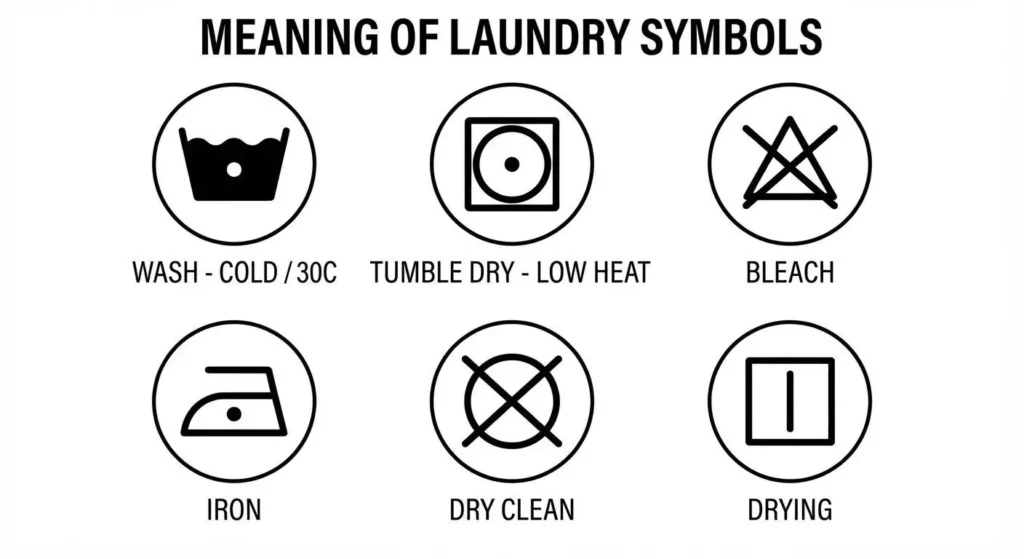
Natural-drying symbols use a square with lines inside it. These markings tell you how to position the garment while it dries.
They are especially important for delicate clothing that may stretch, lose its shape, or become damaged in a dryer.
What Does Line Dry Mean?
A square containing one vertical line means line dry.
Hang the garment on a clothesline, drying rack, or suitable hanger. Allow air to circulate around it while it dries.
Check the garment’s shape before hanging it. Some heavy or stretchy items may need flat drying instead.
What Does Drip Dry Mean?
A square containing three vertical lines indicates drip drying.
Hang the garment while allowing excess water to drain naturally. The instruction avoids the need for additional wringing or aggressive water removal.
This method can be useful for delicate items that should not be twisted.
What Does Dry Flat Mean?
A square containing one horizontal line means dry flat.
Place the garment on a clean, flat drying surface. Reshape it gently and allow air to circulate.
Flat drying helps prevent stretching caused by the weight of wet fabric. It is often useful for sweaters and other garments that can lose their shape when hung.
What Does Drip Flat Mean?
A square containing horizontal lines for the drip-flat process means the garment should dry flat while excess water drains naturally.
Do not twist or wring the garment to remove water. Place it carefully on a suitable surface and let it dry.
What Does Dry in the Shade Mean?
A diagonal line inside a natural-drying square indicates that the garment should dry in the shade.
Keep the item away from direct sunlight while it dries. This instruction can help protect fabrics and colors that may be affected by strong sunlight.
What Is the Difference Between Line Dry and Drip Dry?
Both methods involve hanging a garment, but they describe different ways of handling excess water.
| Drying method | What it means |
| Line dry | Hang the garment to dry |
| Drip line dry | Hang it while allowing water to drain |
| Dry flat | Place it flat on a surface |
| Drip flat dry | Lay it flat and allow excess water to drain |
| Dry in shade | Keep it away from direct sunlight |
Follow the exact symbol rather than treating all natural-drying instructions as interchangeable.
Ironing Symbols and Their Meanings
Ironing symbols help you select a safe heat level. The iron shape is easy to recognize, and dots inside it indicate the permitted temperature.
Always check the label before ironing a garment. Some fabrics can develop shiny marks, melt, or lose their finish when exposed to excessive heat.
Iron With One Dot
One dot means low-temperature ironing.
Under the international ISO system, the maximum soleplate temperature is 120°C. Use a low setting and take care with delicate or synthetic fabrics.
If the label also restricts steam, follow that instruction.
Iron With Two Dots
Two dots mean medium-temperature ironing.
The international ISO maximum soleplate temperature is 160°C. This setting is associated with a moderate ironing process.
Use a suitable pressing cloth when the garment has a surface that may become shiny or damaged.
Iron With Three Dots
Three dots mean high-temperature ironing.
The international ISO maximum soleplate temperature is 210°C. It is intended for garments that can tolerate higher ironing heat.
Do not assume that every cotton or linen garment can automatically handle this temperature. Follow the complete care label.
Crossed-Out Iron: Do Not Iron
A crossed-out iron means ironing is not permitted.
Direct heat may cause permanent damage, melting, flattening, or unwanted changes to the fabric.
If the garment looks wrinkled, consider an approved alternative such as careful hanging or professional steaming only when the care instructions allow it.
What Does the No-Steam Instruction Mean?
Some ironing labels include a crossed-out steam marking or written instruction to avoid steam.
This means you should not use the steam function when ironing the garment.
Use the permitted dry-iron setting if ironing is allowed. Never assume that a low-temperature symbol automatically permits steam.
Dry Cleaning Symbols and Their Meanings
Professional-cleaning symbols appear inside a circle. They give textile cleaners information about which professional cleaning processes or solvents may be used.
These letters are not intended to tell you which household washing-machine setting to select.
What Does P Mean on a Dry Cleaning Label?
A P inside a professional-care circle identifies a permitted professional dry-cleaning solvent system.
Under the international system, it refers to dry cleaning with specified solvents, including perchloroethylene and certain hydrocarbons, subject to the process instructions.
The cleaner must consider the complete label and select the appropriate process.
What Does F Mean on a Dry Cleaning Label?
An F inside a professional-care circle identifies a hydrocarbon-solvent dry-cleaning process.
It gives professional cleaners information about the permitted solvent system. It does not mean that you should use a household cleaning product containing a similar chemical.
Show the complete label to your cleaner rather than trying to interpret the letter as a home-care instruction.
What Does W Inside a Circle Mean?
A W inside a circle indicates professional wet cleaning in the international care-symbol system.
Professional wet cleaning uses water, specialized equipment, controlled mechanical action, and appropriate finishing techniques.
It is not the same as putting a garment in an ordinary washing machine. Professional cleaners use equipment and processes designed for garments that need special handling.
What Does a Line Under a Professional-Care Circle Mean?
A line beneath a professional-care symbol indicates a milder or more restricted cleaning process.
The restriction may involve mechanical action, moisture, or drying temperature. Two lines indicate an even more delicate process in the relevant symbol system.
Tell your cleaner about any additional instructions on the label.
What Does a Crossed-Out Circle Mean?
A crossed-out professional-care symbol means the specified professional cleaning treatment is not permitted.
Check the complete label to understand which cleaning method remains available. Do not assume that a garment marked against dry cleaning can automatically be machine-washed.
Dry Cleaning vs. Professional Wet Cleaning: What’s the Difference?
Dry cleaning and professional wet cleaning are two different professional textile-care methods.
They both require suitable equipment and trained handling, but they use different cleaning processes.
| Feature | Professional Dry Cleaning | Professional Wet Cleaning |
| Main cleaning method | Uses suitable cleaning solvents | Uses water-based cleaning |
| Equipment | Commercial dry-cleaning equipment | Specialized wet-cleaning equipment |
| Mechanical action | Controlled according to the garment | Carefully controlled according to the garment |
| Care label | Circle with relevant solvent letters | Circle with W |
| Main purpose | Clean suitable textiles with professional solvents | Clean suitable textiles using a controlled water-based process |
Professional wet cleaning should not be confused with ordinary hand washing or a delicate washing-machine cycle.
If a garment has a professional-care symbol, take it to a cleaner who understands the relevant process.
What Do Lines, Dots, and Crosses Mean on Laundry Symbols?
Small markings can change the meaning of a laundry symbol. Learning these details will help you avoid common mistakes.
One Line Under a Washtub
One line under a washing tub indicates a mild process with reduced mechanical action.
Choose a gentle washing program rather than an ordinary cycle.
Two Lines Under a Washtub
Two lines indicate a very mild process.
Use a specialized delicate or wool cycle when suitable. Reduce unnecessary spinning and avoid overloading the machine.
Lines Under a Professional-Care Circle
One or two lines under a professional-care circle indicate restrictions on the professional cleaning process.
These markings help the cleaner understand how carefully the garment must be treated.
Dots Inside Symbols
Dots communicate heat levels in specific categories.
- Dots inside an iron relate to ironing heat.
- Dots inside a tumble-drying circle relate to dryer heat.
The exact temperature ranges depend on the applicable symbol standard.
Crossed-Out Symbols
A cross over a care symbol means the treatment shown is prohibited.
For example:
- Crossed-out washtub: Do not wash.
- Crossed-out triangle: Do not bleach.
- Crossed-out tumble-drying symbol: Do not tumble dry.
- Crossed-out iron: Do not iron.
- Crossed-out professional-care symbol: The indicated professional treatment is not allowed.
Never ignore a cross just because the garment appears durable.
How to Read Laundry Symbols on a Clothing Label

A clothing label usually contains several symbols arranged in a sequence. Read them from left to right or follow the order shown on the label.
The international sequence is washing, bleaching, drying, ironing, and professional textile care.
Use this simple method:
- Find the washing symbol and check the maximum temperature.
- Look for lines underneath the washtub to identify the required cycle.
- Check the triangle before using bleach.
- Read the drying symbol before choosing a dryer or natural-drying method.
- Check the iron symbol before pressing the garment.
- Read the professional-care symbol if the item requires specialist cleaning.
Example: Reading a Wool Sweater Label
Imagine a wool sweater has these instructions:
- Washtub marked 30°C with two lines.
- Crossed-out triangle.
- Square with a horizontal line.
- Iron with one dot.
Here is how to interpret the label:
Washing: Use a very mild 30°C washing process if the label permits domestic washing.
Bleaching: Do not use bleach.
Drying: Lay the sweater flat to dry.
Ironing: Use low-temperature ironing only if needed and appropriate.
This example shows why you must read the entire label. Looking at only the washing symbol would leave out important drying and ironing instructions.
Example: Reading a Cotton Shirt Label
Imagine a cotton shirt has:
- Washtub marked 40°C.
- Empty triangle.
- Square with a circle and two dots.
- Iron with three dots.
This label allows washing up to 40°C, permits bleaching under the applicable instructions, and allows medium-heat tumble drying. It also permits high-temperature ironing under the international symbol system.
However, you should still consider the shirt’s color, print, and construction. A gentler treatment may be suitable.
How to Match Laundry Symbols With Washing Machine Settings
Laundry symbols describe garment-care limits. Your washing machine uses program names such as normal, cotton, permanent press, delicate, and wool.
The names are not always identical across brands. Choose the program that best matches the care label.
Normal or Cotton Cycle
A normal or cotton cycle may be appropriate for durable cotton items when the label permits regular machine washing.
Check the maximum temperature and spin instructions before selecting the program.
Permanent Press Cycle
Permanent press programs are generally designed to reduce creasing and provide gentler handling than some regular cycles.
They may be suitable for certain easy-care garments when the label permits the process.
Do not assume that the permanent press setting is suitable for every fabric.
Delicate Cycle
A delicate cycle uses gentler washing action than a regular program.
It may be appropriate for garments that require reduced mechanical action. Check whether the label specifies one line or two lines under the washtub.
Wool Cycle
A wool cycle is designed for suitable machine-washable wool garments.
Use it only when the label permits machine washing. Some wool items require hand washing or professional cleaning instead.
Choosing the Right Spin Setting
Spinning removes water from clothes, but excessive mechanical action can stretch or distort delicate garments.
If the label requires a mild or very mild process, avoid unnecessarily high spin settings.
For delicate garments, follow the machine manufacturer’s instructions and the garment’s care label together.
How to Read Laundry Symbols for Different Fabrics
Fabric composition can help you understand a garment, but it should never replace the care label. A textile’s dye, finish, lining, decoration, and construction can change its care requirements.
Cotton Laundry Symbols and Washing Instructions
Cotton is used in shirts, jeans, towels, bedding, and many everyday garments.
Some cotton items can tolerate regular washing, while others need cooler temperatures or gentle cycles.
Check the washing temperature, bleaching permission, and drying instructions. Printed or colored cotton garments may need more careful treatment than plain white fabric.
Wool Laundry Symbols and Care Instructions
Wool can shrink, stretch, or lose its shape when exposed to unsuitable heat and mechanical action.
Look for a hand-wash symbol or a washtub with two lines. These instructions indicate that the garment needs careful washing.
Some machine-washable wool items can use a specialized wool cycle. Follow the label and lay flat to dry when instructed.
Silk Laundry Symbols and Care Instructions
Silk is a delicate material that can be affected by heat, harsh detergents, and rough handling.
Check whether the garment permits hand washing or requires professional care. Avoid aggressive rubbing and wringing.
If the label says dry clean only or shows a professional-care instruction, use a suitable cleaning service.
Polyester Laundry Symbols and Drying Instructions
Polyester is a common synthetic fiber used in shirts, sportswear, jackets, and blended fabrics.
Many polyester garments tolerate machine washing, but the correct temperature and dryer setting depend on the complete garment.
Avoid high heat when the label calls for low-temperature drying or low-temperature ironing.
Linen Laundry Symbols and Ironing Instructions
Linen is a natural fiber often used in shirts, dresses, trousers, and bedding.
Some linen garments tolerate regular washing, while others have special finishes or delicate construction.
Check the washing temperature and ironing symbol. If ironing is permitted, use the appropriate setting and follow any steam instructions.
Viscose and Rayon Laundry Symbols
Viscose and rayon can become more delicate when wet. Their shape and strength may change during unsuitable washing.
Follow the care label closely. Some items require hand washing or professional cleaning, while others are designed for gentle machine washing.
Avoid assuming that all viscose garments have identical care requirements.
Spandex and Elastane Laundry Symbols
Spandex and elastane are stretchy fibers used in leggings, swimwear, sportswear, and fitted clothing.
Excessive heat can damage elasticity. Follow the washing and drying instructions, and avoid high dryer temperatures unless the label permits them.
Cashmere Laundry Symbols
Cashmere is a delicate type of wool that needs careful handling.
Check whether the garment allows hand washing, a specialized wool cycle, or professional cleaning. Do not twist or wring it aggressively.
If the label instructs you to dry it flat, reshape it gently and allow it to dry on a clean surface.
Down Jackets and Padded Clothing Care Symbols
Down jackets and padded garments may contain delicate filling, special coatings, or complicated construction.
Their care instructions can differ significantly. Check the complete label before washing or drying.
Some garments permit machine washing and tumble drying with specific settings. Others require professional care.
Laundry Symbols for Bedding, Towels, and Household Fabrics
Laundry symbols are not limited to everyday clothing. You can also find them on sheets, blankets, curtains, towels, and other household textiles.
Washing Symbols for Bedsheets
Bedsheets may contain cotton, linen, polyester, or blended fibers.
Check the washing temperature and whether the label permits bleaching. Colored sheets may need more careful treatment than plain white ones.
Do not wash every bedsheet at the same temperature simply because it looks similar to another set.
Laundry Symbols for Blankets and Comforters
Blankets and comforters can contain bulky filling that needs special handling.
Check whether the item is machine-washable or requires professional cleaning. Also review the drying instructions because some fillings need careful drying to prevent clumping or damage.
Washing Symbols for Towels
Towels are commonly made from cotton or cotton blends.
Their care labels may permit regular machine washing, but temperature limits and bleaching instructions still matter.
Avoid using unsuitable products that may affect the fabric’s absorbency or color.
Drying Symbols for Curtains
Curtains may contain delicate fibers, linings, coatings, or decorative elements.
Check whether the label permits tumble drying. Some curtains need line drying or professional cleaning.
Follow any instructions about shade drying to help protect sensitive colors.
Care Symbols for Mattress Protectors
Mattress protectors can contain waterproof layers, elastic edges, and synthetic materials.
These components may have different heat tolerances from ordinary bedding. Follow the label carefully, especially when choosing a dryer setting.
Common Laundry Symbol Mistakes You Should Avoid
Even people who do laundry regularly can misunderstand care labels. Small differences in symbols can lead to the wrong washing or drying method.
Confusing Hand Wash With Delicate Machine Wash
A hand-wash symbol calls for careful manual washing. A delicate machine-wash symbol permits a specified gentle machine process.
Do not assume they mean the same thing.
Confusing Do Not Wash With Do Not Tumble Dry
A crossed-out washtub means domestic washing is not permitted.
A crossed-out tumble-drying symbol means you should avoid the dryer. It does not automatically prohibit washing.
Always identify the symbol’s basic shape before deciding what it means.
Confusing Line Dry With Drip Dry
Line drying means hanging the garment to dry.
Drip line drying means hanging it while allowing excess water to drain naturally. These instructions are not interchangeable.
Using Chlorine Bleach When Only Oxygen Bleach Is Allowed
A triangle with two diagonal lines permits oxygen or non-chlorine bleach, not chlorine bleach.
Check your product label before treating a stain.
Assuming Every Cotton Item Can Handle High Heat
Cotton is often durable, but cotton garments can contain prints, dyes, elastic, coatings, or decorative details.
Follow the complete care label rather than relying only on the fiber name.
Ignoring the Lines Under a Symbol
One or two lines can change the required washing or professional-cleaning process.
Do not overlook them when reading a small clothing tag.
Why Do Similar Clothes Have Different Laundry Symbols?
Two garments made from the same material may have different care instructions.
That happens because fabric composition is only one part of garment care. Other details can affect how an item responds to washing, drying, and ironing.
These factors include:
- Dyes: Some colors may be more sensitive to washing or bleaching.
- Finishes: Special coatings and surface treatments may need extra care.
- Accessories: Zippers, buttons, beads, and decorations can affect cleaning methods.
- Fabric blends: A garment may contain several fibers with different care needs.
- Construction: Linings, padding, and structured sections can change how a garment handles water and heat.
- Prints: Some printed designs may not tolerate high temperatures or strong cleaning products.
For this reason, always follow the care label attached to the actual garment. Do not copy instructions from another item just because both look similar.
What to Do When Laundry Symbols Are Missing or Unreadable
Sometimes a care label is faded, damaged, removed, or difficult to understand.
In that situation, avoid guessing. A wrong washing or drying method may permanently damage the item.
Try these steps:
- Check the manufacturer’s website: Search for the product name or model and look for its official care instructions.
- Review the fabric composition: Check whether the garment contains wool, silk, viscose, elastane, or other delicate materials.
- Look for another label: Some garments have separate tags containing material and care information.
- Avoid high heat: Do not use hot water, high dryer temperatures, or a hot iron when the care requirements are unknown.
- Choose caution: If the garment is delicate, valuable, structured, or heavily decorated, ask a professional cleaner.
- Keep product information: Save the manufacturer’s care instructions when you find them.
Fabric composition alone cannot tell you the safest treatment. A garment’s finish and construction also matter.
Where Are Laundry Symbols Located on Clothing Labels?
Most laundry symbols appear on a small care label attached to the inside of a garment.
The exact location depends on the clothing type and manufacturer.
Common locations include:
- Inside a side seam.
- Behind the neckline.
- Inside the waistband of trousers or skirts.
- Along the inner seam of a shirt or dress.
- On a tag attached to bedding.
- On a label sewn into towels or blankets.
Some garments have more than one tag. One may list fabric composition, while another provides washing and drying instructions.
If you cannot find a care label, check the manufacturer’s website before choosing a washing method.
Frequently Asked Questions About Laundry Symbols
What Are the Five Basic Laundry Symbols?
The five basic international laundry symbols are the washtub, triangle, square, iron, and circle. They represent washing, bleaching, drying, ironing, and professional textile care.
Each shape can contain additional markings that provide more specific instructions.
What Does 30°C Mean on a Washing Label?
A washtub marked 30 means the maximum washing temperature is 30°C, which is approximately 86°F, under the international system.
Do not exceed that temperature. A cooler wash may also be suitable if it cleans the garment effectively.
What Does a Circle With a W Mean on Laundry Symbols?
A W inside a professional-care circle indicates professional wet cleaning in the international care-symbol system.
It does not mean ordinary household machine washing. Professional wet cleaning uses specialized equipment and controlled processes.
What Is the Difference Between Line Dry and Drip Dry?
Line dry means hang the garment to dry. Drip dry means hang it while allowing excess water to drain naturally.
Drip drying avoids the need for additional wringing or aggressive water removal.
Can I Wash Clothes at a Lower Temperature Than the Label Shows?
Yes. Care symbols generally describe the maximum permitted treatment. A lower washing temperature may be suitable if it cleans the garment effectively.
However, consider the type of soil, detergent instructions, and any special care requirements.
What Does a Crossed-Out Square Mean?
A crossed-out square with a circle means do not tumble dry.
Use an appropriate natural-drying method instead, such as line drying or flat drying, depending on the garment’s other instructions.
What Does a Square With a Circle and One Dot Mean?
It means tumble dry using low heat.
Choose a low-temperature dryer program and follow any additional care instructions on the label.
What Do Two Lines Under a Washing Tub Mean?
Two horizontal lines underneath a washtub indicate a very mild washing process.
This instruction calls for reduced mechanical action and careful handling. It commonly appears on delicate garments and some machine-washable wool items.
What Does P Mean Inside a Dry-Cleaning Circle?
P identifies a professional dry-cleaning solvent system under the international care-symbol standard.
It provides technical information for professional textile cleaners. It is not a home-washing instruction.
What Should I Do if My Clothing Care Label Is Missing?
Check the manufacturer’s website for the product’s official care instructions. Review the fabric composition, but do not rely on fiber content alone.
Avoid high heat and aggressive washing until you understand the garment’s requirements. Ask a professional cleaner if the item is delicate or valuable.
Conclusion
Laundry symbols make clothing care easier once you understand their basic shapes and markings. The washtub explains washing, the triangle covers bleaching, the square provides drying instructions, the iron indicates ironing heat, and the circle gives professional-cleaning information.
Pay attention to numbers, dots, lines, and crossed-out symbols because small details can change the correct treatment. Always read the complete label before washing, drying, bleaching, or ironing a garment.
When you are unsure, choose a cautious approach rather than guessing. A few seconds spent checking laundry symbols can help protect your clothes, preserve their shape, and keep them looking good for longer.

Adam Sullivan is a dedicated writer who enjoys transforming everyday topics into engaging and informative content. His writing focuses on making complex ideas simple, practical and enjoyable for readers of all backgrounds. Adam is also the fictional author of The Lantern Beyond Autumn Hills and Where the Morning Horizon Waits. Outside of writing, he enjoys photography, traveling and discovering inspiration through new experiences. He believes great content should be both helpful and easy to connect with.
 Dylan Anderson