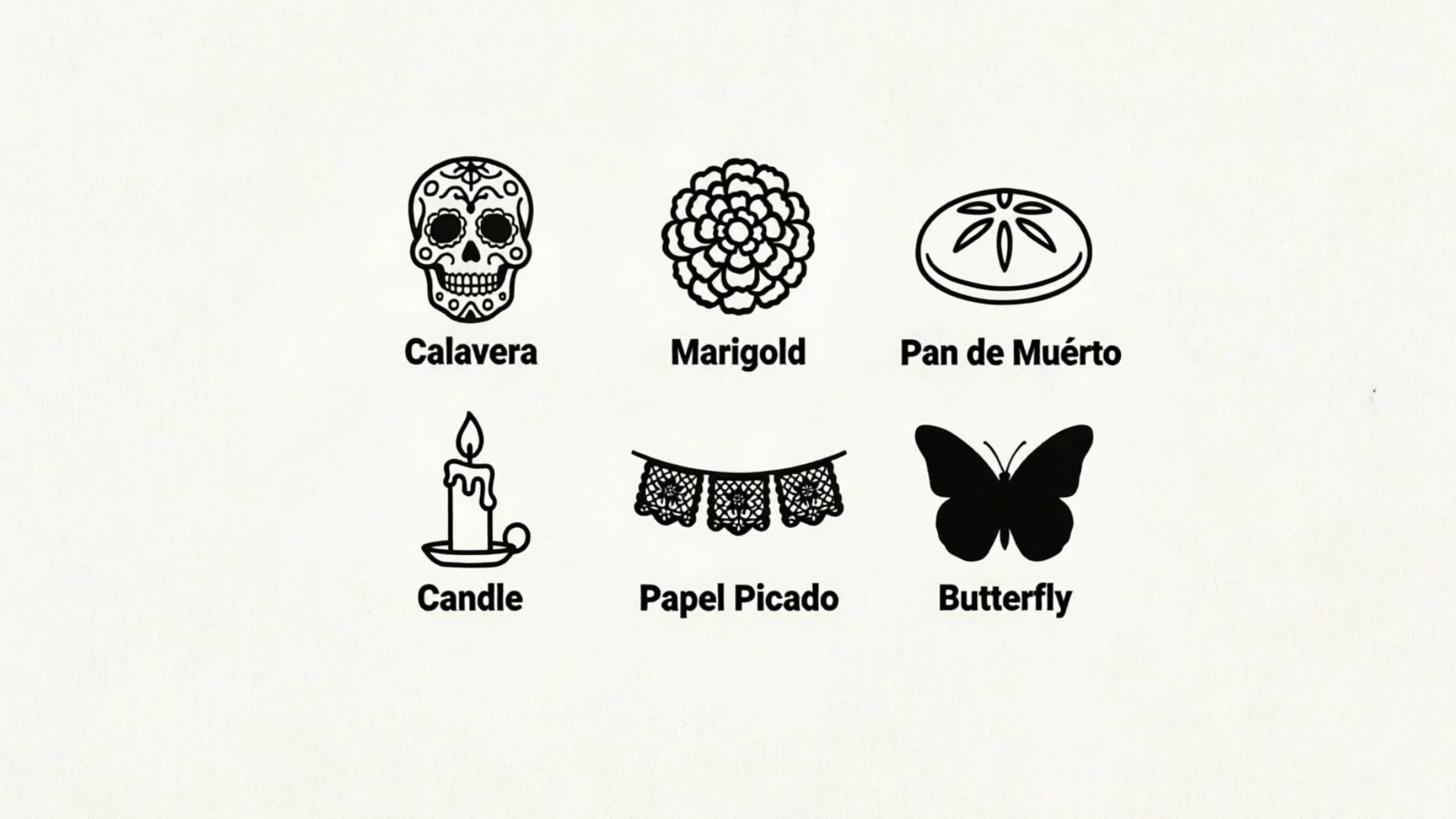
The symbols of Day of the Dead are colorful, meaningful, and closely connected to remembering loved ones who have died. The ofrenda, or altar, is one of the central symbols, while marigolds, candles, decorated skulls, papel picado, food, and photographs help create a space for remembrance.
When I look at these symbols together, I see a tradition that treats remembrance as something active rather than simply sad. You may recognize the bright colors and skeleton designs, but their meanings go much deeper.
Day of the Dead, or Día de los Muertos, is celebrated in different ways across Mexico and Mexican communities. Meanings and customs can vary by region and family, so no single list explains every tradition.
Here are the most important symbols, their meanings, and practical ideas for tattoos, artwork, family memorials, and respectful designs.
What Symbol Represents Day of the Dead? (Quick Answer)
The ofrenda is one of the most important symbols of Día de los Muertos because it provides a place for families to honor deceased loved ones with photographs, food, flowers, candles, and personal objects.
Other widely recognized symbols include:
- Cempasúchil (marigolds) flowers and a path associated with welcoming the returning dead
- Calaveras (skulls) reminders of death, life, and remembrance
- La Catrina an iconic skeleton figure associated with Day of the Dead imagery
- Papel picado colorful cut-paper decorations
- Candles light and guidance
- Monarch butterflies associated in some traditions with returning souls
- Pan de muerto bread placed as an offering
- Photographs personal remembrance of deceased family members
What Are Symbols of Day of the Dead?
Symbols of Day of the Dead are objects, images, foods, decorations, and natural elements used during Día de los Muertos to honor and remember people who have died.
The tradition has developed over centuries through Indigenous traditions, Catholic influences, and different regional and community practices. Mexico’s National Institute of Anthropology and History notes that Day of the Dead celebrations vary considerably across cultural regions.
This matters because it is easy to treat Day of the Dead as a single fixed celebration. In reality, families may build different kinds of altars and use different foods, flowers, prayers, decorations, and rituals.
The symbols below are therefore best understood as widely recognized elements, not rules that every family follows.
Symbols of Day of the Dead Comparison Table
| Symbol | Main Meaning | Best Use |
| Ofrenda | Honoring and remembering the dead | Altars, family memorials |
| Cempasúchil | Welcoming and guiding returning souls | Altars, flowers, tattoos |
| Calavera | Mortality, remembrance, life’s cycle | Art, tattoos, decorations |
| La Catrina | Iconic skeleton imagery and social satire | Art, costumes, tattoos |
| Papel picado | Decoration, movement, and the wind element | Altars, banners, design |
| Candles | Light and guidance | Ofrendas, memorials |
| Monarch butterfly | In some traditions, association with returning spirits | Art, tattoos |
| Pan de muerto | Food offering and remembrance | Ofrendas, cultural artwork |
| Photographs | Personal memory of loved ones | Ofrendas, family memorials |
| Water | Refreshment for visiting spirits | Ofrendas |
| Salt | Common offering in some traditions | Ofrendas |
| Copal/incense | Ritual fragrance and ceremonial atmosphere | Ofrendas, traditional settings |
Top 12 Symbols of Day of the Dead and Their Meanings
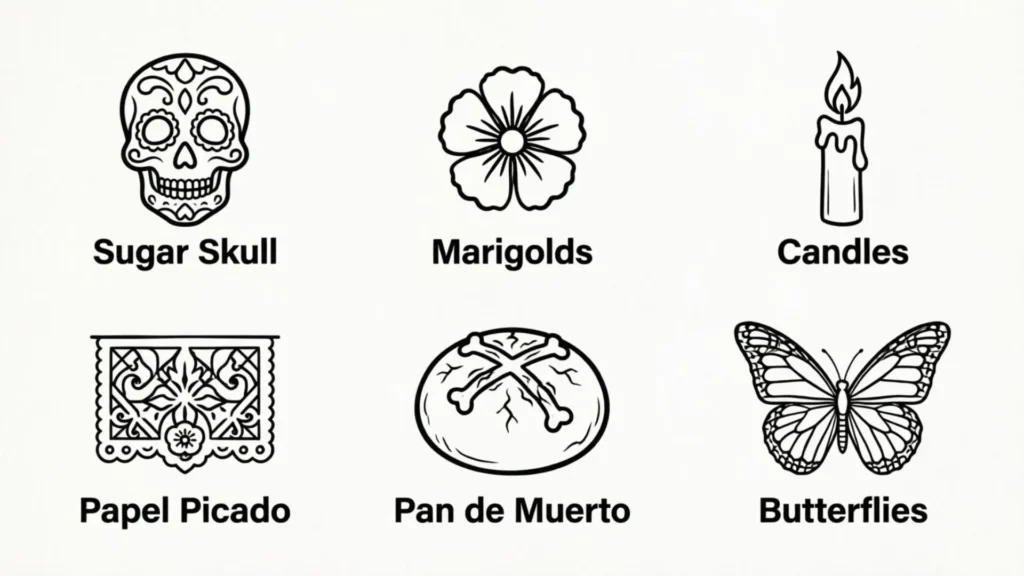
1. Ofrenda: A Place to Remember Loved Ones
The ofrenda is a temporary altar created to honor deceased family members and friends. It may include photographs, favorite foods, drinks, candles, flowers, personal belongings, and religious items.
Rather than being simply a decoration, the altar creates a dedicated space for memory and family connection. The exact objects placed on it can depend on the person being remembered and the family’s traditions.
An ofrenda is especially meaningful for family artwork because it can include objects connected to a specific person’s life.
Best for: family memorials, cultural artwork, educational designs, home displays, remembrance projects
2. Cempasúchil: The Marigold Flower
The bright orange cempasúchil, commonly known as Mexican marigold, is among the most recognizable Day of the Dead symbols.
Its petals are traditionally used to decorate altars, graves, paths, and other spaces. Mexico’s INAH explains that the flower has long been associated with the sun and renewal, while its color, scent, and petals are used in traditions connected with the return of the dead.
A path of marigold petals is often described as helping guide the returning souls toward their families.
Best for: floral tattoos, altar decorations, family art, jewelry, seasonal designs
3. Calavera: The Decorated Skull
The calavera, or skull, is one of the most recognizable images associated with Día de los Muertos.
Unlike a purely frightening Halloween skull, a Day of the Dead calavera is often colorful, decorated, and artistic. Sugar skulls, or calaveritas de azúcar, are commonly associated with the celebration. The Smithsonian explains that decorated skull imagery can serve as a reminder of life’s cycle rather than simply representing horror.
For many modern designs, the calavera has become a visual way to express remembrance, identity, and celebration of a person’s life.
Best for: tattoos, paintings, posters, masks, jewelry
4. La Catrina: An Iconic Skeleton Figure
La Catrina is a famous skeleton figure that has become closely associated with Día de los Muertos imagery.
The Smithsonian’s National Museum of the American Latino also identifies La Catrina as an iconic Day of the Dead figure.
Best for: detailed tattoos, portraits, costume art, posters, cultural illustrations
5. Papel Picado: Colorful Cut Paper
Papel picado consists of decorative sheets of paper cut into detailed patterns. spaces used for Day of the Dead celebrations.
The Smithsonian notes that papel picado can represent the wind among the four elements traditionally included in an ofrenda.
Its movement and delicate construction also make it visually distinctive. Designs often include flowers, skeletons, hearts, lettering, or other festive patterns.
Best for: banners, invitations, posters, backgrounds, digital designs, altar decoration
6. Candles: Light and Guidance
Their light helps create a welcoming and ceremonial space.
However, candle arrangements can differ among families and traditions.
Best for: memorial designs, altar artwork, spiritual imagery, tattoos
7. Monarch Butterflies: A Seasonal Connection
The Smithsonian notes that some traditions associate monarchs with the spirits of departed people.
The image is especially fitting because butterflies naturally suggest transformation and movement.
Best for: memorial tattoos, butterfly artwork, family designs, nature-inspired illustrations
8. Pan de Muerto: Bread of the Dead
Food is important because Day of the Dead is not only about imagery; it is also a family and community tradition involving cooking, sharing, remembering, and gathering.
Best for: food illustrations, altar designs, educational graphics, cultural artwork
9. Photographs: Personal Memory
Photographs may be the most personal object on an ofrenda.
This is why an ofrenda is much more than a collection of decorative objects. Personal memories give the altar its individual meaning.
Best for: family memorials, remembrance artwork, home altars, personalized designs
10. Water: An Offering for the Journey
Water is another traditional element found on many ofrendas.
The Smithsonian explains that water may be offered so that visiting spirits can refresh themselves. It is also connected with the four-element structure often described in explanations of the altar.
Because altar practices vary, not every family will arrange water in exactly the same way.
Best for: traditional altar displays, educational illustrations, symbolic artwork
11. Salt: Purification and Offering
Salt can appear on some Day of the Dead altars as part of the offerings.
Its use varies by family and region, so it should not be presented as a universal requirement. In designs, salt can be included alongside other traditional altar elements when the goal is to represent an ofrenda rather than create a generic skull-themed image.
Best for: altar illustrations, educational projects, cultural displays
12. Copal and Incense: Ritual Fragrance
Copal, a fragrant tree resin, has deep Indigenous roots in Mesoamerica and has been used in ceremonial contexts.
In Day of the Dead settings, incense can contribute to the ritual atmosphere of an altar. Its meaning and use vary across communities, so it is best understood within the particular tradition being represented rather than assigned one universal definition.
Best for: cultural artwork, traditional altar scenes, educational illustrations, ceremonial designs
Best Symbols of Day of the Dead for Tattoos
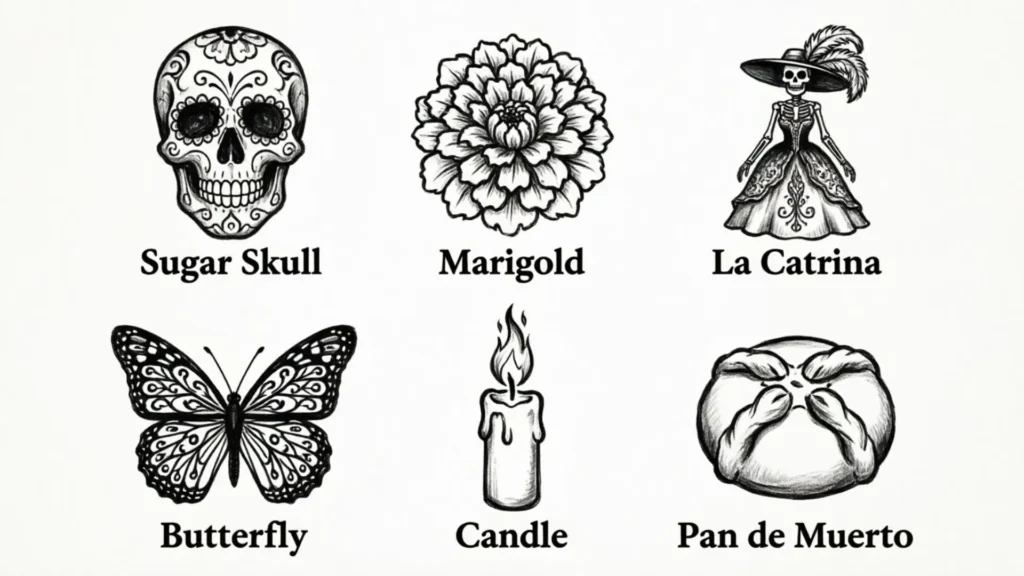
Day of the Dead imagery can work especially well for tattoos because many of its symbols have distinctive shapes and colors.
Good choices include:
- Small calavera for a simple remembrance tattoo
- Cempasúchil flowers for a colorful floral design
- Monarch butterfly for a memorial tattoo
- La Catrina for a detailed portrait-style tattoo
- Papel picado for a decorative pattern
- A personalized ofrenda for a family-centered design
If the tattoo honors a particular person, adding a photograph-like portrait, initials, favorite flower, or meaningful object can make the design more personal.
Remember that a cultural tattoo carries more meaning when you understand the tradition behind the imagery instead of choosing a symbol only because it looks attractive.
Best Symbols of Day of the Dead for Logos and Design
For logos, posters, social media graphics, and other visual projects, simpler symbols usually work better.
Papel picado, a simplified calavera, marigold flowers, candles, and butterfly shapes can remain recognizable even when reduced in size.
For a logo, avoid combining too many detailed elements. A clean marigold, simple skull outline, or small papel picado pattern may communicate the theme more clearly than a crowded altar illustration.
For educational or cultural projects, an ofrenda can provide a richer visual story because it brings several traditional elements together.
Best Symbols of Day of the Dead for Family, Spiritual, or Personal Meaning
- A loved one’s favorite flower can accompany a photograph.
- A family altar can include objects connected with the person’s hobbies.
- Marigold petals can create a path around a memorial.
- A butterfly can add a nature-based element.
- A decorated calavera can represent remembrance in a more artistic style.
The best symbol is often the one that tells a specific family story.
Before Using Cultural or Sacred Symbols
Day of the Dead is a living cultural tradition, not simply a collection of colorful decorations.
Its practices differ across Mexico and among Mexican communities. INAH describes the celebration as having developed through Indigenous traditions, Catholic influences, rural and urban practices, and different regional customs.
Before using Day of the Dead imagery commercially, in a tattoo, or on products, take time to understand what the image means.
A few good practices are:
- Research the symbol’s origin.
- Avoid claiming that one meaning applies everywhere.
- Do not describe the celebration simply as “Mexican Halloween.”
- Respect religious and Indigenous elements.
- Credit cultural inspiration when appropriate.
- Avoid turning sacred or family-centered practices into stereotypes.
UNESCO recognized the Indigenous festivities dedicated to the dead as Intangible Cultural Heritage in 2008, reflecting the cultural importance and diversity of these traditions.
How to Choose the Right Symbol for Day of the Dead
Use this simple decision guide:
Do you want to honor a specific person?
↓
Choose a photograph, personal object, marigold, or personalized ofrenda.
Do you want a small tattoo?
↓
Choose a calavera, marigold, butterfly, or papel picado.
Do you want a detailed tattoo or artwork?
↓
Consider La Catrina or an illustrated ofrenda.
Do you need a simple logo?
↓
Use a clean skull, flower, candle, or papel picado shape.
Do you want a traditional altar design?
↓
Combine an ofrenda, photographs, flowers, candles, food, and other appropriate offerings.
Most importantly, choose the symbol based on its meaning and cultural context, not only its appearance.
FAQs About Symbols of Day of the Dead
What is the best symbol for Day of the Dead?
The ofrenda is one of the most central symbols because it provides a space for families to honor deceased loved ones. Marigolds, candles, photographs, skulls, papel picado, and food are also widely recognized elements. Exact practices vary by family and region.
What symbol represents remembering the dead?
An ofrenda is particularly suitable because it is specifically created to honor and remember deceased people. A photograph of the person, combined with flowers, candles, food, or personal belongings, can make the remembrance more personal.
What is a good Day of the Dead tattoo?
A calavera, cempasúchil flower, monarch butterfly, La Catrina, or papel picado can make a meaningful tattoo. For a family memorial, consider adding an element connected to the person being remembered rather than using a generic design.
What symbol represents family on Day of the Dead?
There is no single universal “family symbol.” An ofrenda with family photographs and personal belongings can be a meaningful representation because the altar centers on remembering specific loved ones and family history.
What is a simple Day of the Dead symbol?
A marigold flower, small calavera, candle, or papel picado pattern can work well as a simple symbol. These shapes are recognizable without requiring a large or complicated design.
What flower represents Day of the Dead?
The cempasúchil, or Mexican marigold, is one of the best-known flowers associated with Día de los Muertos. Its petals are used in many traditions to decorate altars and create paths associated with welcoming returning souls.
What do skulls mean in Day of the Dead?
Day of the Dead skulls, or calaveras, are not simply symbols of fear. Decorated skulls can serve as reminders of mortality, remembrance, and the cycle of life and death. Their exact interpretation can vary depending on the artwork and cultural setting.
Why are butterflies used in Day of the Dead designs?
Monarch butterflies are associated with Day of the Dead in some traditions because their seasonal arrival in Mexico coincides with the celebration. The Smithsonian notes a belief connecting the butterflies with departed spirits. This interpretation is meaningful but should not be treated as universal.
Final Thoughts
The symbols of Day of the Dead tell a story about memory, family, culture, and the ways people honor those who have died. An ofrenda, marigold, calavera, candle, photograph, or butterfly can carry meaning far beyond its appearance.
If you are choosing a symbol for a tattoo, artwork, family memorial, or design, learn about its cultural context first. A thoughtful symbol is not just beautiful it can preserve a memory and show respect for a living tradition.

Adam Sullivan is a dedicated writer who enjoys transforming everyday topics into engaging and informative content. His writing focuses on making complex ideas simple, practical and enjoyable for readers of all backgrounds. Adam is also the fictional author of The Lantern Beyond Autumn Hills and Where the Morning Horizon Waits. Outside of writing, he enjoys photography, traveling and discovering inspiration through new experiences. He believes great content should be both helpful and easy to connect with.
 Dylan Anderson