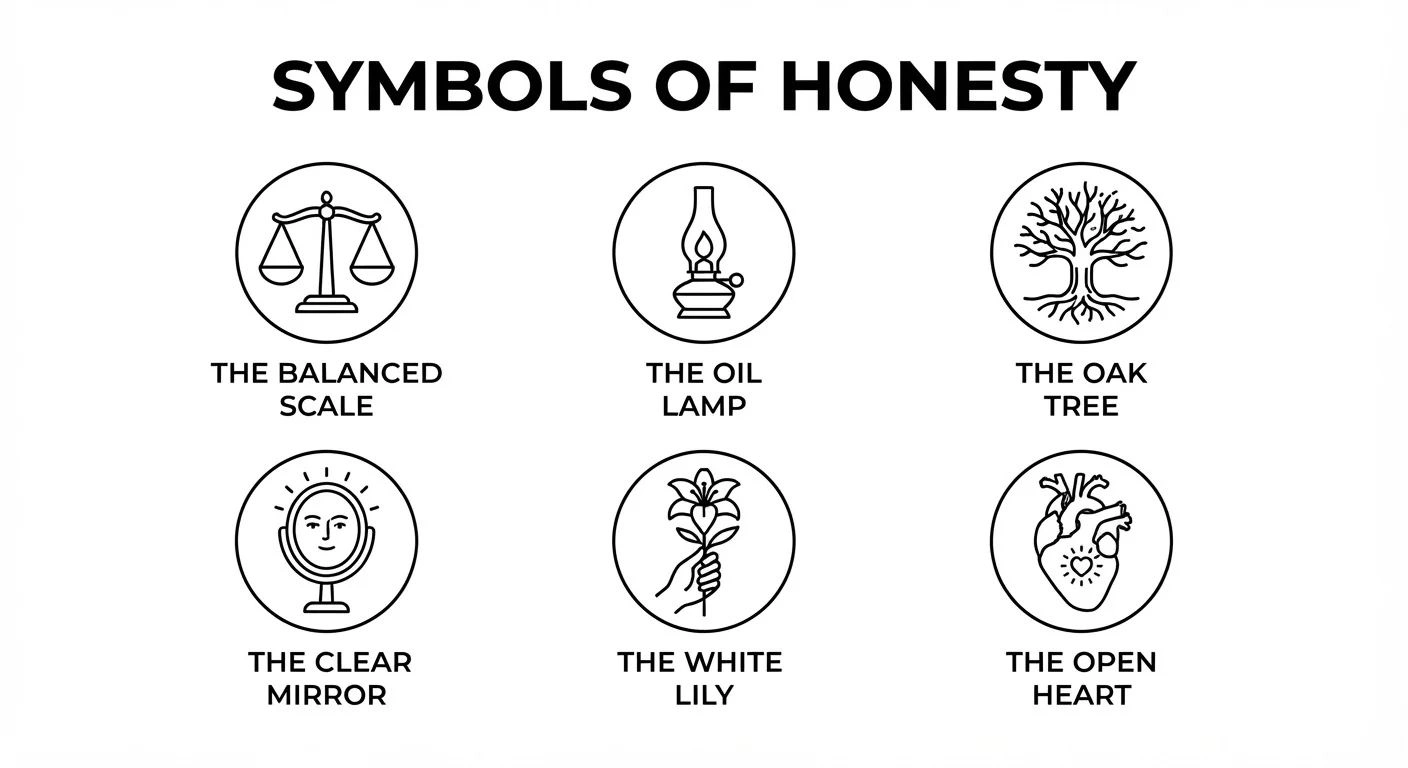
Honesty is one of the most valuable qualities a person can have. It means telling the truth, keeping promises, accepting responsibility, and treating others fairly. Although honesty is an invisible personal quality, different cultures, traditions, and artistic expressions use symbols to communicate its meaning.
The symbols of honesty include the feather of Ma’at, mirror, open hand, scales of justice, honesty plant, compass, white rose, and light. Each represents a different aspect of truthful living. Some are connected with historical traditions, while others have developed through modern interpretations of purity, sincerity, and trust.
Whether you are looking for an honesty symbol for a tattoo, meaningful gift, business logo, personal artwork, or spiritual reminder, understanding its background can help you choose the right one.
In this guide, you will discover 20 symbols associated with honesty, their meanings, historical connections, and the qualities they represent. You will also learn about animals, flowers, colors, and cultural traditions connected with truth and integrity.
What Are the Symbols of Honesty?
Symbols of honesty are visual representations of truthfulness, sincerity, transparency, fairness, and moral responsibility. They help people express personal values through recognizable objects, gestures, plants, animals, and designs.
Some symbols have direct historical connections with truth and justice. For example, the feather of Ma’at represented truth and moral order in ancient Egyptian beliefs. Similarly, the honesty plant (Lunaria annua) gets its common name from its transparent, papery seed pods.
Other symbols communicate honesty through related qualities. A mirror can represent self-awareness, a compass can suggest moral direction, and an open hand can express transparency and peaceful intentions.
There is no single universal symbol of honesty. Different societies interpret symbols according to their histories, beliefs, and experiences.
Here are some common examples:
| Symbol | Main Meaning | Connection With Honesty |
| Feather of Ma’at | Truth and justice | Moral accountability |
| Scales of Justice | Fairness | Impartial decisions |
| Mirror | Self-reflection | Being honest with yourself |
| Open Hand | Openness | Transparent communication |
| Honesty Plant | Transparency | Revealing what is inside |
| Compass | Guidance | Following moral values |
| White Rose | Purity | Sincere intentions |
| Light | Clarity | Revealing the truth |
| Bamboo | Uprightness | Strong personal principles |
| Open Book | Knowledge | Sharing accurate information |
Historical Symbols of Honesty and Truth

People have used symbolic objects to express truth and moral responsibility for thousands of years. Ancient civilizations connected honesty with divine order, fair judgment, and the consequences of human actions.
Understanding these historical connections helps distinguish established symbols from modern interpretations.
Feather of Ma’at in Ancient Egyptian Beliefs
The feather of Ma’at is one of the most historically significant symbols associated with truth and justice.
In ancient Egyptian religion, Ma’at represented truth, justice, balance, and the proper order of the universe. She was also the goddess associated with these principles. Artistic representations commonly show her wearing an ostrich feather on her head.
The feather became especially important in ancient Egyptian beliefs about the afterlife.
During the Weighing of the Heart ceremony, the heart of a deceased person was weighed against the feather of Ma’at. Ancient Egyptians considered the heart the center of a person’s thoughts, memories, emotions, and actions.
If the heart balanced with the feather, the deceased could pass judgment and continue into the afterlife. If it was heavier, the outcome was unfavorable.
This ceremony connected the feather with truthful living and moral accountability.
You can learn more about this tradition through the Australian Museum’s explanation of ancient Egyptian afterlife beliefs and the Metropolitan Museum of Art’s collection of funerary papyrus.
Meaning: Truth, justice, moral responsibility, and living according to ethical principles.
Themis in Greek Mythology
Themis was a Greek goddess associated with divine law, justice, and social order. Her role involved maintaining proper conduct and establishing order among gods and humans.
She is often connected with the development of justice symbolism in Western traditions.
Themis is especially relevant when discussing honesty because fair judgment depends on truthful information and impartial decisions.
However, her classical representations should not be confused with every modern image of Lady Justice. Traditional depictions of Themis did not always include the familiar blindfold and scales.
Meaning: Divine order, fairness, lawful conduct, and responsible judgment.
Justitia in Roman Symbolism
Justitia was the Roman personification of justice. Her image became an important part of legal and civic symbolism.
Modern representations commonly show a woman holding scales and a sword, sometimes wearing a blindfold.
Each object communicates a different idea:
- Scales represent weighing evidence and maintaining fairness.
- Sword represents the authority to enforce justice.
- Blindfold represents impartiality and freedom from favoritism.
Justitia does not represent honesty alone. Instead, she communicates the importance of fair judgment, which depends on truthful evidence and responsible decisions.
The United States Supreme Court’s historical explanation of figures of justice provides additional background on these visual traditions.
Meaning: Impartiality, justice, accountability, and fairness.
20 Symbols of Honesty and Their Meanings

Honesty involves several qualities, including transparency, self-awareness, fairness, and sincerity. The following symbols communicate these different ideas.
1. White Feather: A Symbol of Truth and Purity
A white feather is commonly associated with purity, innocence, and peaceful intentions. Its light appearance makes it a natural visual metaphor for a clear conscience and truthful behavior.
The feather also has a more specific historical connection through Ma’at in ancient Egyptian religion. Her ostrich feather represented truth and justice during the judgment of the dead.
However, not every white feather carries the same historical meaning. A decorative white feather may simply represent purity or innocence, while the feather of Ma’at has a distinct religious background.
What it represents:
- Truthful intentions.
- Moral responsibility.
- A clear conscience.
- Innocence and purity.
A white feather can make a meaningful design for jewelry, artwork, personal reminders, and tattoos.
2. Scales of Justice: A Symbol of Fairness and Honesty
Scales of justice represent fairness, balanced judgment, and impartial decisions. They remind people that every side of a situation deserves careful consideration.
In legal symbolism, balanced scales suggest that decisions should depend on evidence rather than personal preferences, wealth, or social position.
Honesty plays an important role in this process. Without truthful information, it becomes difficult to reach a fair conclusion.
The scales are therefore particularly relevant to people who value ethical leadership, equal treatment, and accountability.
What it represents:
- Fairness and equality.
- Honest judgment.
- Impartial decisions.
- Accountability.
3. Open Hand: A Symbol of Honesty and Transparency
An open hand can communicate openness, peaceful intentions, and willingness to cooperate.
Showing an empty palm has been used in different situations to demonstrate that a person is not holding a weapon. In modern visual interpretations, the same gesture can suggest that someone has nothing to hide.
The open hand also represents a willingness to listen, communicate, and share information.
In relationships and professional settings, this symbolism connects with honest conversations and mutual respect.
What it represents:
- Transparency.
- Open communication.
- Peaceful intentions.
- Cooperation and trust.
4. Mirror: A Symbol of Self-Honesty
A mirror reflects the image standing before it. This simple function makes it a familiar metaphor for self-examination and personal truth.
A mirror can remind you to recognize your mistakes rather than blaming others. It also encourages you to accept your strengths and weaknesses without creating a false image of yourself.
Self-honesty is important because meaningful personal growth begins with recognizing reality.
For example, someone who admits they made a mistake has taken the first step toward correcting it.
What it represents:
- Self-awareness.
- Acceptance of reality.
- Personal accountability.
- Authentic identity.
5. Light or Torch: A Symbol of Truth and Clarity
Light is a common metaphor for knowledge, understanding, and revelation. It makes hidden objects visible and helps people see what was previously difficult to recognize.
A torch represents carrying that light into unfamiliar or confusing situations.
In literature, artwork, and spiritual traditions, light often appears when someone discovers important information or gains a clearer understanding of the world.
Its connection with honesty comes from the idea that truth removes confusion and exposes deception.
What it represents:
- Revealing hidden information.
- Knowledge and understanding.
- Clarity.
- Courage to face the truth.
6. White Rose: A Symbol of Sincerity and Purity
The white rose is widely associated with innocence, purity, respect, and new beginnings.
Its simple appearance makes it a popular flower for expressing sincere emotions. People may use white roses in weddings, memorial arrangements, and meaningful gifts.
Although a white rose is not an exclusive historical symbol of honesty, its associations with purity and genuine intentions make it relevant to truthful relationships.
A white rose can also communicate that affection and respect should come from an honest place.
What it represents:
- Sincere feelings.
- Purity and innocence.
- Respect.
- Genuine intentions.
7. Bamboo: A Symbol of Uprightness and Integrity
Bamboo has an important place in East Asian art and cultural traditions. Its straight stalks, graceful shape, and ability to bend without easily breaking make it a symbol of resilience and uprightness.
In traditional Chinese art, bamboo is one of the Four Gentlemen, a group of plants associated with admirable qualities.
Its connection with honesty comes from the idea of maintaining strong principles while remaining humble and flexible.
A truthful person should not abandon their values whenever life becomes difficult. At the same time, they should remain willing to listen and learn.
What it represents:
- Upright character.
- Moral strength.
- Humility.
- Resilience and flexibility.
8. Compass: A Symbol of Moral Direction
A compass helps travelers find their direction, even when the path ahead is unfamiliar.
As a symbol, it represents guidance, purpose, and staying on the right course. When connected with honesty, it can represent an inner moral compass.
A moral compass helps someone distinguish between right and wrong. It encourages people to follow their values instead of choosing whatever seems easiest.
For example, returning something that does not belong to you reflects honesty, even when nobody would discover what happened.
What it represents:
- Ethical decisions.
- Personal values.
- Moral guidance.
- Staying true to yourself.
9. Open Book: A Symbol of Knowledge and Transparency
An open book represents knowledge, learning, communication, and the sharing of information.
Its visible pages suggest that information is available rather than deliberately concealed.
In education and professional settings, an open book can communicate the importance of providing accurate information and allowing others to understand the facts.
This makes it relevant to honest communication and transparency.
What it represents:
- Knowledge and wisdom.
- Sharing information.
- Openness.
- Learning and understanding.
10. Hand Over Heart: A Symbol of Sincerity
Placing a hand over the heart is a familiar gesture used to express sincerity, respect, and genuine emotion.
People may use it when making a promise, expressing gratitude, or emphasizing that their words come from the heart.
The gesture can communicate that someone takes their words seriously and intends to speak sincerely.
However, a gesture alone cannot prove that a person is telling the truth. Its meaning depends on the situation and the individual’s intentions.
What it represents:
- Genuine emotions.
- Sincere promises.
- Respect.
- Emotional honesty.
11. Sun: A Symbol of Truth and Revelation
The sun represents light, visibility, life, and new beginnings. Its brightness makes it a common metaphor for discovering something important.
In symbolic artwork, sunlight can represent truth becoming visible after a period of uncertainty.
The rising sun can also suggest a fresh start. It reminds people that acknowledging the truth can help them move forward.
Different cultures have connected the sun with divine power and knowledge, although its specific meaning varies across traditions.
What it represents:
- Clarity and awareness.
- Revelation.
- Hope and renewal.
- Understanding.
12. Owl: A Symbol of Wisdom and Clear Judgment
The owl is commonly associated with wisdom, observation, and knowledge.
Its ability to see in low-light conditions has helped make it a symbol of awareness and insight in different artistic traditions.
Honesty requires more than repeating information. People must also examine facts, question misleading claims, and make thoughtful decisions.
The owl represents the wisdom needed to recognize what is true and avoid making judgments without understanding a situation.
What it represents:
- Wisdom.
- Careful observation.
- Clear judgment.
- Knowledge.
The owl is best described as a symbol of wisdom that supports truthful judgment, rather than a universal symbol of honesty itself.
13. White Dove: A Symbol of Peace and Goodwill
The white dove is widely recognized as a symbol of peace, hope, and reconciliation.
Its gentle appearance makes it a familiar image in artwork, ceremonies, and cultural expressions of goodwill.
Its connection with honesty comes through the importance of peaceful relationships. People who communicate sincerely can resolve disagreements without relying on deception or manipulation.
However, peace and honesty are related qualities, not identical meanings.
What it represents:
- Peaceful intentions.
- Goodwill.
- Reconciliation.
- Harmony and understanding.
14. Honesty Plant: A Symbol of Transparency
The honesty plant, scientifically known as Lunaria annua, is one of the most interesting botanical examples connected with this topic.
Its mature seed pods become thin, papery, and translucent. These unusual structures reveal their inner shape, creating a natural association with openness and transparency.
The plant also has other common names, including silver dollar plant and money plant. Its flowers are usually purple, pink, or white.
Its transparent seed pods are commonly used in dried floral arrangements because they retain an attractive silvery appearance.
Unlike many other examples in this article, Lunaria has a common name directly associated with honesty. Its name is generally linked to the see-through appearance of its seed pods.
What it represents:
- Transparency.
- Openness.
- Genuine intentions.
- Revealing what is hidden.
For botanical information, see the Cambridge University Botanic Garden’s Lunaria annua profile and the Royal Horticultural Society’s honesty plant guide.
15. Anchor: A Symbol of Dependability and Trust
An anchor prevents a ship from drifting away when strong winds and waves arrive.
Because of this function, it commonly represents stability, security, commitment, and dependability.
Its connection with honesty comes from keeping promises and remaining consistent in personal values.
A trustworthy person does not change their principles whenever a situation becomes uncomfortable. They try to remain reliable through both easy and difficult times.
What it represents:
- Dependability.
- Commitment.
- Stability.
- Consistency.
16. Circle: A Symbol of Wholeness and Consistency
A circle has no obvious beginning or ending. Its continuous shape makes it a common symbol of unity, completeness, and wholeness.
When connected with honesty, a circle can represent consistency between words and actions.
For example, someone who behaves honestly in private as well as in public demonstrates consistency in their values.
A circle can also represent the idea that integrity should remain part of everyday behavior rather than appearing only when other people are watching.
What it represents:
- Wholeness of character.
- Consistency.
- Unity.
- Commitment to values.
17. White Swan: A Symbol of Grace and Purity
The white swan is commonly associated with elegance, beauty, grace, and purity.
Its appearance makes it a popular image in literature, decorative artwork, and traditional storytelling.
Its connection with honesty is mostly interpretive. The swan’s association with purity can communicate sincere intentions and respectful behavior.
It can also remind people that being honest does not require being unkind. Truthful communication can remain gentle and respectful.
What it represents:
- Grace and dignity.
- Purity.
- Sincere intentions.
- Emotional balance.
18. White Lily: A Symbol of Purity and Innocence
White lilies are associated with purity, innocence, remembrance, and renewal in different floral and cultural traditions.
Their clean appearance makes them a common choice for ceremonies, meaningful gifts, and decorative arrangements.
Their connection with honesty comes from the broader idea of purity and sincere intentions.
A white lily can communicate respect and the desire to approach relationships with genuine feelings.
However, floral meanings vary according to culture and occasion. White lilies may also be associated with mourning and remembrance.
What it represents:
- Purity.
- Innocence.
- Sincerity.
- Renewal and respect.
19. Eye: A Symbol of Awareness and Truth
The eye is a familiar symbol of perception, observation, and awareness.
It represents the ability to notice what is happening and understand information rather than accepting everything without question.
Honesty depends partly on recognizing reality and being willing to acknowledge what you discover.
Some eye symbols also have specific religious or historical meanings. For example, the Eye of Horus belongs to ancient Egyptian religious symbolism and has associations with protection, healing, and restoration. It should not automatically be described as a universal honesty symbol.
What it represents:
- Awareness.
- Perception.
- Recognition of reality.
- Clear observation.
20. Candle: A Symbol of Guidance and Hope
A candle produces light in a dark space. This makes it a familiar symbol of hope, remembrance, knowledge, and spiritual reflection.
Its connection with honesty comes from the idea that truth can help people understand difficult situations.
A candle can also represent the courage to seek answers when information is incomplete or confusing.
In different religious and cultural settings, candles may carry additional meanings related to prayer, devotion, and remembrance.
What it represents:
- Hope.
- Guidance.
- Understanding.
- Reflection.
The Honesty Plant (Lunaria Annua): Meaning and Symbolism
The honesty plant deserves special attention because its common name directly connects it with the topic of honesty.
Lunaria annua is a flowering plant in the Brassicaceae family, which also includes cabbage and mustard plants. It is native to parts of Europe and western Asia.
The plant produces clusters of flowers, usually in shades of purple, pink, or white. However, its most recognizable feature appears after flowering.
Why Is It Called the Honesty Plant?
The plant develops flat, round seed pods that become papery and translucent as they mature.
When the outer layers fall away, the remaining silvery membrane reveals the shape of the pod.
This see-through appearance is commonly associated with the idea of having nothing to hide. That is why the plant is known as honesty in English.
The name is connected with its physical appearance rather than a documented historical tradition about moral behavior.
What Do the Seed Pods Symbolize?
The transparent seed pods can represent several ideas:
- Transparency: Being open about your intentions and actions.
- Sincerity: Expressing genuine feelings without pretending.
- Openness: Allowing others to understand what is inside.
- Clarity: Avoiding unnecessary secrecy and confusion.
These meanings make the honesty plant an interesting choice for floral artwork and symbolic gifts.
Is the Honesty Plant the Same as the Money Plant?
Lunaria annua is also called the silver dollar plant and money plant because its round, silvery seed pods resemble coins.
However, common plant names can vary between regions. The term money plant is also used for unrelated species.
When identifying the plant, its scientific name, Lunaria annua, provides greater accuracy than relying on its common name alone.
How Is the Honesty Plant Used in Floral Arrangements?
The plant’s papery seed pods remain attractive after the flowers disappear. Gardeners and floral designers often use the dried stems in decorative arrangements.
They can add texture and a silvery appearance to bouquets, wreaths, and seasonal decorations.
As a symbolic gift, honesty plant stems can communicate transparency, sincerity, and openness.
Animals That Symbolize Honesty, Truth, and Trust
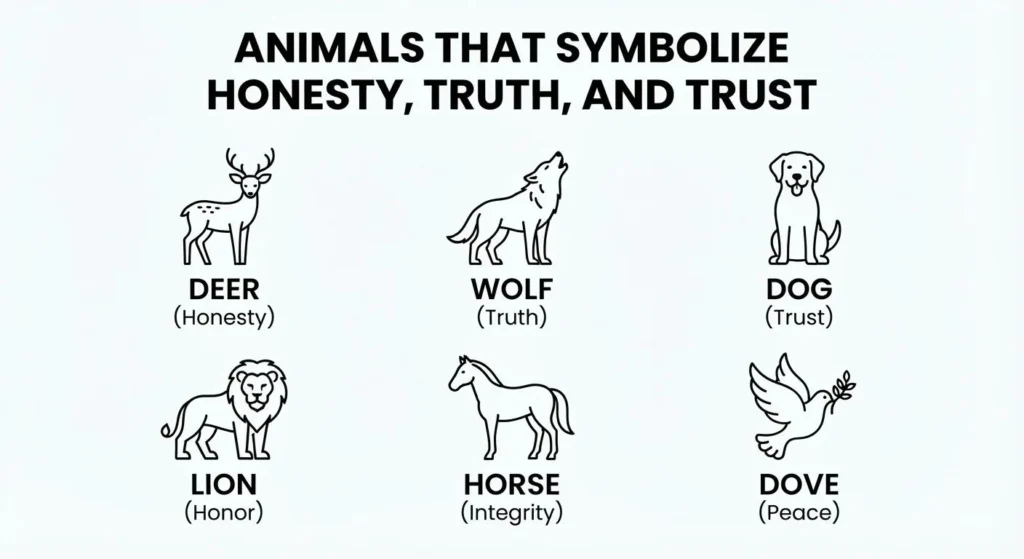
Animals have played important roles in mythology, literature, folklore, and artistic symbolism. Some are connected with honesty directly, while others represent qualities that help people build truthful relationships.
It is important to remember that animal symbolism is not universal. The same animal can carry different meanings across cultures.
Owl: Wisdom and Honest Judgment
The owl is commonly connected with wisdom, observation, and knowledge.
It represents the importance of understanding a situation before reaching a conclusion.
Its association with honesty comes from the idea that truthful judgment requires careful thinking and awareness.
Dove: Peaceful and Sincere Intentions
The dove is a familiar symbol of peace and reconciliation.
Its gentle appearance communicates goodwill and harmony. These qualities can support honest relationships because people need respect and sincere communication to resolve disagreements.
Dog: Loyalty and Faithfulness
Dogs are widely associated with loyalty, companionship, and devotion.
Their symbolic connection with honesty comes through reliability. A faithful companion is someone people can depend on during difficult situations.
A dog can therefore represent the importance of keeping promises and remaining trustworthy.
However, loyalty and honesty are different qualities. A loyal person is not automatically truthful in every situation.
Elephant: Reliability and Strong Bonds
Elephants are often associated with memory, family relationships, strength, and social bonds.
Their close family connections make them meaningful symbols of loyalty and responsibility in some modern interpretations.
Their connection with honesty is indirect. They can represent the dependability that helps maintain long-lasting relationships.
Swan: Purity and Grace
The white swan is commonly associated with elegance and purity.
Its symbolic connection with honesty comes from the broader idea of sincere intentions and dignified behavior.
It is better understood as a symbol of purity than as an established universal symbol of truthfulness.
Flowers That Represent Honesty and Sincerity
Flowers communicate different emotions through their colors, appearances, and cultural associations.
Some flowers are particularly useful when expressing honesty because they are connected with purity, sincerity, transparency, or genuine affection.
Honesty Plant: Transparency
Lunaria annua is the most directly relevant flower-related example because of its common name and transparent seed pods.
It can represent openness and the idea of having nothing to hide.
White Rose: Genuine Feelings
White roses commonly express purity, respect, innocence, and sincere affection.
They can make thoughtful gifts for someone whose honesty and character you appreciate.
White Lily: Innocence and Purity
White lilies are associated with purity, remembrance, and renewal.
Their connection with honesty comes through the idea of genuine intentions and a sincere heart.
Sunflower: Positivity and Admiration
Sunflowers are commonly associated with happiness, warmth, admiration, and optimism.
Although they are not traditional symbols of honesty, they can represent an open and positive attitude toward others.
White Jasmine: Purity and Appreciation
White jasmine flowers are associated with beauty, fragrance, purity, and affection in different cultural traditions.
Their symbolism can vary significantly between regions, making them suitable for expressing admiration and sincere feelings rather than representing honesty exclusively.
Symbols of Truth and Honesty
Truth and honesty are closely related, but they are not exactly the same.
Truth concerns what is real or factually correct. Honesty concerns how people communicate and behave in relation to what they know.
A person demonstrates honesty by communicating truthfully and avoiding deliberate deception.
Several symbols communicate both ideas.
Mirror: Recognizing Reality
A mirror represents reflection and the ability to examine what is actually present.
It connects truth with self-awareness and encourages people to recognize their actions without creating excuses.
Light: Revealing Hidden Information
Light is a metaphor for discovery and clarity.
It represents the moment when confusion disappears and important information becomes visible.
Feather of Ma’at: Truth and Moral Order
The feather of Ma’at represents truth, justice, and moral balance in ancient Egyptian religious beliefs.
It is particularly meaningful because it has a documented historical connection with the judgment of the dead.
Open Book: Sharing Accurate Information
An open book represents the availability of knowledge.
It can communicate a willingness to explain facts, share information, and encourage understanding.
Eye: Seeing Clearly
The eye represents observation and awareness.
It reminds people to examine information carefully instead of accepting misleading claims without question.
Symbols of Honesty and Integrity
Honesty and integrity work together, but each has a slightly different meaning.
Honesty means communicating truthfully and acting sincerely. Integrity means following your moral principles consistently, even when doing so becomes difficult.
The following symbols communicate qualities connected with both values.
Compass: Following Your Principles
A compass represents direction and guidance.
It can symbolize the personal values that help someone make ethical decisions when faced with difficult choices.
Bamboo: Remaining Upright
Bamboo represents uprightness, resilience, and humility in traditional East Asian artistic symbolism.
Its flexible structure can also remind people to remain open-minded without abandoning their principles.
Scales of Justice: Acting Fairly
Balanced scales represent impartial judgment and equal consideration.
They communicate the importance of applying the same standards fairly rather than changing decisions to benefit particular individuals.
Anchor: Keeping Your Commitments
An anchor represents stability and dependability.
Its connection with integrity comes from remaining consistent and keeping promises through difficult situations.
Circle: Consistency Between Words and Actions
A circle represents wholeness and continuity.
It can communicate the importance of maintaining the same moral values in different situations.
Colors That Symbolize Honesty
Colors can communicate ideas and emotions without using words. Some are commonly associated with truthfulness, sincerity, and reliability.
However, color meanings are influenced by cultural traditions, personal experiences, and design choices.
White: Purity and Sincerity
White is commonly associated with innocence, purity, and openness.
It can represent a clear conscience and the desire to approach others with genuine intentions.
White is often used in artwork and designs that communicate simplicity and sincerity.
Blue: Trust and Reliability
Blue is frequently used to communicate confidence, stability, and dependability.
Businesses often use blue in branding because it can create an impression of professionalism and reliability.
As a symbolic color, it can represent honest communication and trust.
Gold: Honor and Moral Value
Gold is commonly associated with dignity, achievement, excellence, and prestige.
Its connection with honesty comes from the idea of honorable behavior and high personal standards.
It can be used in designs about leadership, responsibility, and integrity.
Green: Growth and Authenticity
Green is associated with nature, renewal, balance, and personal growth.
It can represent the development of honest habits and the importance of staying connected with your values.
Yellow: Clarity and Optimism
Yellow is commonly associated with sunlight, happiness, and awareness.
Its connection with truth comes through the metaphor of light revealing information and helping people understand a situation.
Spiritual and Cultural Symbols of Honesty

Different religious and cultural traditions have developed their own ways of expressing truth, justice, and moral responsibility.
Some use divine figures, while others communicate these values through light, sacred objects, or ethical teachings.
Understanding the background is important because symbols should not be treated as interchangeable across religions and cultures.
Ma’at in Ancient Egyptian Religion
Ma’at represented truth, justice, balance, and cosmic order.
The feather associated with her became part of the ancient Egyptian Weighing of the Heart ceremony.
This tradition connected a person’s earthly behavior with their judgment after death.
It remains one of the clearest historical examples of a symbol associated with moral truth.
Themis in Ancient Greek Tradition
Themis represented divine law and proper order.
Her role in Greek mythology connected justice with the rules that maintained harmony among gods and humans.
Her symbolism is relevant to honesty because fair judgment requires respect for facts and ethical conduct.
Justitia in Roman Tradition
Justitia represented justice and became an important figure in Western legal imagery.
Her scales, sword, and later blindfold communicated fairness, authority, and impartiality.
Her symbolism is closely related to honest judgment rather than personal truthfulness alone.
Light in Spiritual Traditions
Light appears in many religious and spiritual traditions as a symbol of knowledge, guidance, goodness, or divine presence.
Its specific meaning differs depending on the belief system.
In a general symbolic interpretation, light can represent the discovery of truth and the movement away from confusion.
Sacred Books and Truthful Living
Sacred writings in different religions contain teachings about truthful speech, responsibility, and ethical behavior.
An open book can represent the sharing of knowledge and the importance of understanding moral principles.
However, the open-book image is a general modern symbol. It should not be presented as one universal religious symbol of honesty.
Symbols of Honesty in Different Areas of Life
Honesty has different applications in personal relationships, professional environments, creative work, and everyday decisions.
A symbol that works well as a tattoo may not be suitable for a business logo. Understanding the purpose helps you choose a design that communicates the intended message.
Symbols of Honesty for Tattoos
An honesty tattoo can serve as a personal reminder to stay truthful, maintain strong values, and accept responsibility for your actions.
Here are some meaningful designs to consider.
| Tattoo Design | Symbolic Meaning | Suggested Style |
| Feather of Ma’at | Truth and moral accountability | Detailed feather |
| Mirror | Self-honesty | Minimalist mirror |
| Compass | Moral direction | Fine-line compass |
| Scales of justice | Fairness | Traditional scales |
| Open hand | Transparency | Simple hand outline |
| Bamboo | Integrity and resilience | Vertical bamboo stalk |
| Eye | Awareness | Minimalist eye |
| Honesty plant | Openness | Botanical line art |
| Hand over heart | Sincere intentions | Simple hand illustration |
| White rose | Purity and genuine feelings | Fine-line flower |
Small Honesty Tattoo Ideas
If you prefer a subtle design, consider a small feather, tiny compass, simple mirror outline, or minimalist eye.
These designs can communicate meaningful ideas without requiring a large amount of detail.
Honesty Tattoos With Multiple Symbols
Combining two symbols can create a more personal meaning.
For example, a feather with a compass can represent truthful intentions and moral direction. A mirror with a small flower can communicate self-awareness and sincerity.
Choose combinations that have a clear personal connection instead of adding unrelated designs.
Symbols of Honesty for Logos and Businesses
Honesty is important in business because customers want accurate information, fair treatment, and dependable service.
A company’s visual identity can communicate these qualities through simple shapes and colors.
Some useful design ideas include:
- Open book: Transparent information and knowledge.
- Blue color: Reliability and confidence.
- Scales: Fair business practices.
- Compass: Ethical direction and responsible leadership.
- Open hand: Cooperation and customer care.
- Circle: Consistency and completeness.
A business should also support its visual message with real practices, including clear pricing, accurate advertising, and responsible customer service.
A trustworthy-looking logo cannot replace honest business behavior.
Symbols of Honesty in Relationships
Honesty helps people build stronger relationships because it creates an environment where they can communicate openly.
A symbolic gift can express appreciation for someone who values sincerity and keeps their promises.
Consider these examples:
- White rose: Genuine affection and respect.
- Hand over heart: Sincere promises.
- Anchor: Dependability and commitment.
- Open hand: Openness and cooperation.
- Mirror: Being honest with yourself and your partner.
- White feather: Truthful intentions.
These symbols can be included in jewelry, greeting cards, artwork, or meaningful gifts.
The important thing is to connect the design with the values you want to celebrate.
What Is the Difference Between Honesty, Truth, and Integrity?
Honesty, truth, and integrity are closely connected, but they describe different concepts.
Understanding their differences helps you choose a symbol that communicates the right message.
| Concept | Meaning | Suitable Symbol |
| Honesty | Speaking and acting truthfully | Open hand |
| Truth | What is real or factually correct | Light |
| Integrity | Following moral principles consistently | Compass |
| Trust | Confidence in another person’s reliability | Anchor |
| Fairness | Treating people impartially | Scales |
| Sincerity | Expressing genuine feelings | Hand over heart |
| Transparency | Allowing information to be understood | Open book |
For example, telling someone the truth demonstrates honesty. Keeping a difficult promise demonstrates integrity. Both qualities help develop trust.
A person can also be honest without being fair in every situation. This is why fairness, integrity, and truthfulness should be understood as related but distinct values.
How to Choose the Right Symbol of Honesty
Choosing an honesty symbol becomes easier when you understand the message you want to communicate.
A design that represents self-awareness may not be the best choice for someone who wants to express fairness or loyalty.
Consider these factors before making your selection.
Identify the Meaning You Want to Express
First, decide which aspect of honesty matters most to you.
- Choose a feather for truth and moral responsibility.
- Choose a mirror for self-honesty.
- Choose scales for fairness.
- Choose a compass for moral direction.
- Choose an open hand for transparency.
- Choose an honesty plant for openness.
A clear purpose makes the design more meaningful.
Consider Historical and Cultural Background
Some symbols have religious or cultural meanings that go beyond their modern interpretations.
For example, the feather of Ma’at has a specific connection with ancient Egyptian beliefs. The Eye of Horus has its own historical and religious associations.
Research the background before using a traditional symbol, especially in permanent designs such as tattoos.
Match the Symbol With Its Purpose
Think about where and how you plan to use the design.
A minimalist feather may work for a small tattoo. Scales may suit a legal or educational design. An open book may be appropriate for a project about knowledge and transparency.
The symbol should communicate your intended message clearly.
Choose a Design That Reflects Your Values
A symbol becomes meaningful when it connects with your experiences and personal beliefs.
You may prefer a compass because it reminds you to make ethical decisions. Someone else may choose a mirror because self-awareness is important to them.
There is no need to select a symbol simply because it is popular.
Remember that a symbol can remind you to practice honesty, but your actions are what demonstrate it.
Frequently Asked Questions About Symbols of Honesty
1. What is the most common symbol of honesty?
There is no single universally recognized symbol of honesty. The feather of Ma’at has a documented historical connection with truth and justice, while the mirror, open hand, and honesty plant are commonly used to communicate self-awareness, openness, and transparency.
2. What flower represents honesty?
Lunaria annua, commonly called the honesty plant, is directly associated with honesty because of its transparent seed pods. White roses and white lilies can also represent purity and sincere intentions.
3. What animal symbolizes honesty?
There is no universally accepted animal symbol of honesty. Owls are commonly associated with wisdom, dogs with loyalty, and doves with peace. These qualities can support honest relationships, although they are not identical to honesty.
4. What color represents honesty?
White and blue are common choices. White is associated with purity and sincerity, while blue often communicates trust and reliability. Color meanings can change depending on cultural and personal interpretations.
5. What is the spiritual symbol of honesty?
The feather of Ma’at is an important historical symbol associated with truth, justice, and moral order in ancient Egyptian religion. Light is another widely used spiritual metaphor for knowledge, guidance, and the discovery of truth.
6. What is the best tattoo symbol for honesty?
A feather, mirror, compass, open hand, or scales of justice can make meaningful honesty tattoos. Choose a design based on the personal value you want to express, such as truthfulness, self-awareness, or fairness.
7. Is honesty the same as integrity?
No. Honesty means communicating and acting truthfully, while integrity means following your moral principles consistently. Honesty is an important part of integrity, but integrity also involves responsibility and ethical behavior.
8. What is the ancient Egyptian symbol of truth?
The feather of Ma’at is a well-known ancient Egyptian symbol of truth and justice. During the Weighing of the Heart ceremony, the deceased person’s heart was weighed against Ma’at’s feather to determine whether they had lived according to moral principles.
9. What does the honesty plant symbolize?
The honesty plant symbolizes transparency and openness. Its mature seed pods become thin and translucent, allowing their inner structure to show through. This physical feature explains its common name and makes it a fitting visual representation of having nothing to hide.
10. What symbol represents someone who always tells the truth?
The feather of Ma’at can represent someone who values truth and moral responsibility. A mirror can also symbolize self-honesty, while an open hand can communicate transparency and sincere intentions.
Conclusion
The symbols of honesty show how people express truthfulness, sincerity, fairness, and integrity through meaningful images and objects. From the feather of Ma’at and scales of justice to the mirror, compass, and honesty plant, each symbol communicates a different aspect of truthful living.
Some have deep historical connections, while others represent qualities that support honest relationships. Flowers can express sincere feelings, animals can communicate loyalty or wisdom, and colors can create visual associations with trust and purity.
Whether you are choosing a tattoo, designing a logo, selecting a gift, or looking for a personal reminder, consider the meaning behind each symbol. Choose one that reflects your values and the message you want to share.
Ultimately, honesty is not defined by a picture, color, or object. It is demonstrated through truthful words, responsible decisions, and consistent actions.

Adam Sullivan is a dedicated writer who enjoys transforming everyday topics into engaging and informative content. His writing focuses on making complex ideas simple, practical and enjoyable for readers of all backgrounds. Adam is also the fictional author of The Lantern Beyond Autumn Hills and Where the Morning Horizon Waits. Outside of writing, he enjoys photography, traveling and discovering inspiration through new experiences. He believes great content should be both helpful and easy to connect with.
 Dylan Anderson