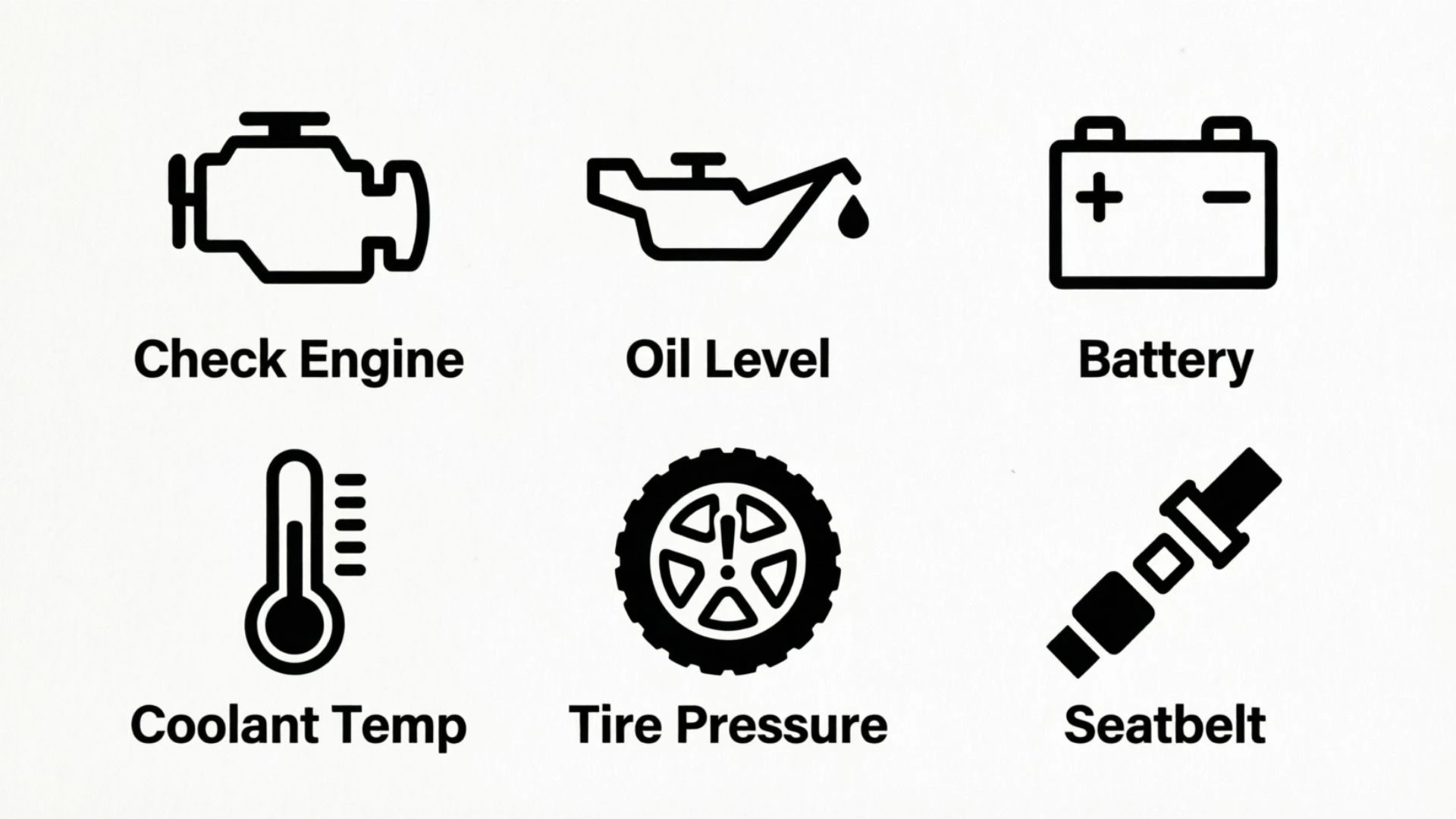
Seeing an unfamiliar symbol appear on your car’s dashboard can be confusing, especially when you are driving and do not know whether the light is simply showing that a feature is active or warning you about a problem.
Car dashboard symbols are designed to communicate important information quickly. Some tell you that a turn signal, high beam, cruise control, or another feature is operating. Others warn about issues involving the engine, brakes, tires, battery, steering, airbags, or other systems.
The color of a symbol can provide a useful first clue, but it should not be the only thing you use to judge the situation. Vehicle manufacturers can use different symbols, colors, and warning behaviors. Toyota, for example, notes that dashboard icons can appear in different colors depending on the system and vehicle, while Volkswagen warns that the interpretation of indicator lights can vary between models.
This guide explains the most common car symbols and their meanings, including what they usually look like, what they indicate, how urgent they may be, and what you should generally do next. For an exact warning on your particular vehicle, always give priority to the owner’s manual and the manufacturer’s instructions.
What Do Car Symbols Mean? (Quick Answer)
Car symbols are icons displayed on the instrument cluster to communicate a vehicle warning, system status, active feature, or maintenance message. Common examples include the check engine light, oil pressure symbol, tire-pressure symbol, ABS light, battery warning, airbag light, steering warning, turn signal, and high-beam indicator.
A useful general guide is:
| Color | General Purpose | Typical Examples |
| Red | Often indicates a high-priority condition | Oil pressure, brake system, overheating |
| Amber/Yellow | Usually indicates a warning, malfunction, or condition needing attention | Check engine, ABS, TPMS |
| Green | Usually shows an active feature or normal operating status | Turn signal, headlights, cruise control |
| Blue | Often indicates a lighting or system status | High beams |
| White/Gray | Often provides information or shows system availability | Service reminder, key, driver-assistance status |
These colors are general rather than universal rules. The symbol itself, any accompanying dashboard message, and your vehicle’s manual are more important than color alone. Toyota specifically explains that red icons generally indicate conditions requiring immediate attention, while yellow icons may indicate important conditions that are not necessarily warnings.
Car Symbols and Meanings With Pictures
A visual chart is one of the easiest ways to identify a dashboard warning. If you are adding images to your WordPress article, place an original or properly licensed illustration of each symbol beside the relevant explanation.
| Common Symbol Appearance | Symbol Name | Typical Color | What It Usually Means | General Priority |
| Engine-shaped outline | Check engine | Amber | Engine or emissions-related fault detected | Medium to high |
| Oil can | Oil pressure | Red | Low engine oil pressure or related warning | High |
| Thermometer over waves | Engine temperature | Red | Engine coolant temperature is too high | High |
| Battery rectangle | Charging system | Red | Charging-system problem | High |
| Tire outline with ! | TPMS | Amber | Tire pressure is significantly low or TPMS has a fault | Medium to high |
| Circle with ABS | ABS | Amber | Anti-lock braking system problem | High |
| Person with circle | Airbag/SRS | Red or amber | Airbag or restraint-system issue | High |
| Steering wheel with ! | Power steering | Red or amber | Steering-system problem | High |
| Car with wavy lines | Traction/ESC | Amber | Stability or traction system is active or has a fault | Medium |
| P in a circle | Parking brake | Red/amber | Parking brake engaged or system issue | Varies |
| Seat belt figure | Seat belt | Red | Seat belt is not fastened | Medium |
| Headlight with lines | Headlights | Green/blue | Lighting feature is active | Low |
| Arrow pointing left/right | Turn signal | Green | Turn signal is operating | Low |
| Snowflake | Cold-weather warning | White/blue | Outside temperature is low | Low |
| Wrench/spanner | Service reminder | White/amber | Maintenance or service is due | Medium |
The exact design can differ considerably between brands and models. Official manufacturer guides show that modern vehicles may have many additional symbols for driver assistance, hybrid systems, electric vehicles, diesel systems, parking functions, and other equipment.
Dashboard Symbols vs. Warning Lights vs. Indicators
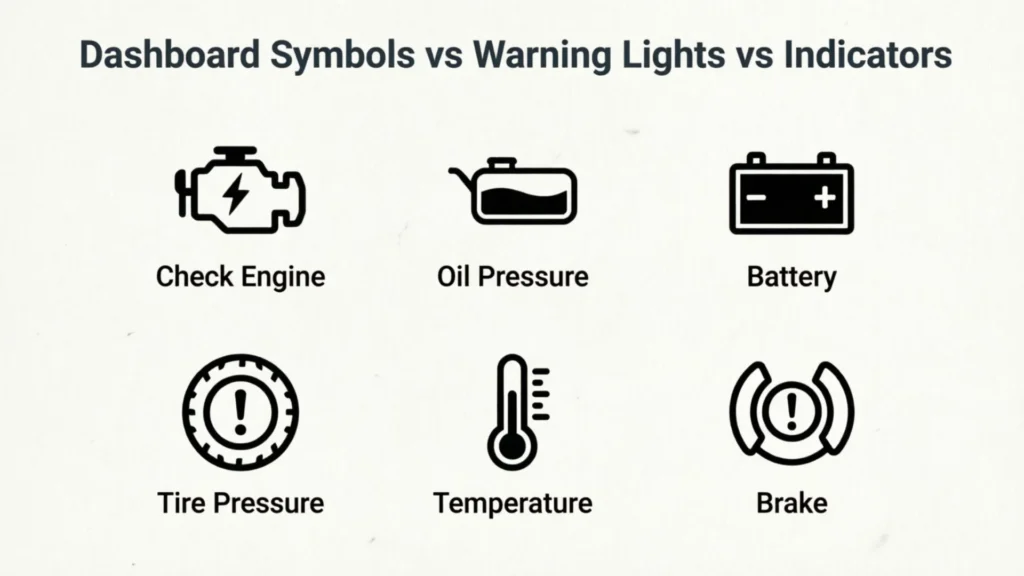
Not every dashboard symbol means something is broken.
It helps to separate dashboard symbols into three broad groups.
Warning Lights
Warning lights tell you that the vehicle has detected a condition that may need attention.
Examples include:
- Oil pressure
- Brake system
- ABS
- Airbag
- Engine temperature
- Battery or charging system
- Check engine
Some warning lights require immediate attention, while others allow you to continue driving cautiously and arrange an inspection.
Indicator Lights
Indicator lights normally tell you that a feature is operating.
Examples include:
- Turn signals
- High beams
- Fog lights
- Cruise control
- Lane-assistance status
- Parking lights
A green turn-signal arrow, for example, is normally information rather than a fault.
Status and Information Symbols
Some symbols communicate a vehicle condition without necessarily indicating a failure.
Examples include:
- EV charging
- Start-stop availability
- Low fuel
- Snowflake/cold-temperature warning
- Key detection
- Service reminder
- Driver-assistance availability
Understanding this difference prevents unnecessary panic when a normal indicator appears.
What Do Car Symbol Colors Mean?
Color can help you quickly decide how closely you should pay attention to a dashboard icon.
Red Car Symbols
Red often indicates a condition that deserves immediate attention.
Common examples include:
- Oil pressure warning
- Engine overheating
- Brake system warning
- Charging-system warning
- Serious steering-system warning
- Certain airbag or restraint warnings
For example, Toyota identifies high engine coolant temperature as a condition requiring the vehicle to be stopped safely, and identifies low engine oil pressure as a warning condition.
Do not assume every red symbol means the same thing. A red seat-belt reminder is very different from a red oil-pressure warning.
Amber and Yellow Car Symbols
Amber or yellow usually indicates a warning, malfunction, reduced functionality, or condition that needs attention.
Common examples include:
- Check engine
- ABS
- TPMS
- Traction control
- Stability control
- Power steering
- Transmission
- Driver-assistance malfunction
An amber light does not automatically mean you must stop immediately. Its urgency depends on the symbol, whether it is flashing, the vehicle’s behavior, and the manufacturer’s instructions.
Green Car Symbols
Green usually indicates that a feature is active or operating.
Examples include:
- Turn signals
- Parking lights
- Some cruise-control indicators
- Lane-assistance status
- Certain electric-drive indicators
These are generally informational rather than warnings.
Blue Car Symbols
Blue is commonly used for certain lighting or operating indicators.
The most familiar example is the blue high-beam indicator.
Volkswagen, for example, identifies its blue dashboard indicator as the high-beam light.
White and Gray Car Symbols
White or gray symbols often communicate information, availability, or system status.
Depending on the vehicle, these can include:
- Key detection
- Service reminder
- Start-stop availability
- Driver-assistance availability
- Fuel-efficiency information
- Outside-temperature information
The exact color scheme is manufacturer-specific.
20 Most Important Car Symbols to Know
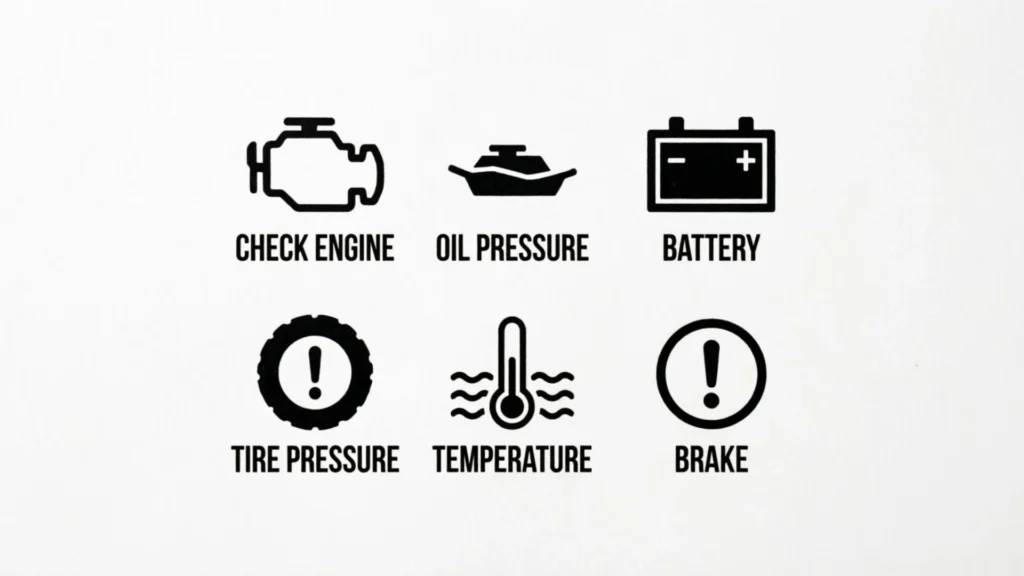
Some dashboard symbols deserve more attention than others because they can relate to safety or mechanical damage.
Oil Pressure Symbol
The oil-pressure symbol normally looks like a small oil can.
It commonly indicates that engine oil pressure is too low.
A red oil-pressure warning should not be treated like an ordinary maintenance reminder. Low oil pressure can be associated with serious engine problems, so follow the vehicle’s instructions and stop safely when required.
Do not confuse low oil pressure with low oil level. They are related but not identical warnings.
Engine Temperature Symbol
This symbol commonly looks like a thermometer above waves.
It indicates that engine coolant temperature is too high or that the cooling system has detected a related problem.
An overheating engine can suffer serious damage if you continue driving.
Toyota’s guidance specifically instructs drivers to stop safely when its high-coolant-temperature warning appears.
Brake Warning Symbol
A brake warning may appear as the word BRAKE, an exclamation mark inside a circle, or another manufacturer-specific design.
It can relate to:
- Parking brake
- Brake-fluid level
- Brake-system malfunction
- Electronic parking brake
- Other brake-related conditions
Because braking is a critical safety system, never assume a brake warning is harmless.
Check Engine Symbol
The check engine light usually looks like a small engine outline.
It indicates that the vehicle’s diagnostic system has detected a problem.
Possible causes range from relatively minor issues to more serious engine or emissions faults.
A steady light generally requires diagnosis, while a flashing check-engine light can indicate a more urgent fault. Volkswagen, for example, identifies a flashing engine-control warning with a misfire in its dashboard guide.
Battery or Charging Symbol
The battery symbol usually looks like a rectangular battery with positive and negative markings.
Despite its appearance, it often relates to the vehicle’s charging system, not simply the battery’s stored charge.
Possible causes include:
- Alternator problems
- Charging-system faults
- Battery-related problems
- Electrical-system issues
If the warning remains illuminated while driving, consult the vehicle’s instructions and arrange appropriate inspection.
ABS Symbol
The ABS symbol commonly displays the letters ABS inside a circle.
It indicates a problem with the anti-lock braking system or that the system has been disabled.
The normal braking system may still function on some vehicles, but ABS assistance may not be available.
Toyota identifies its ABS warning as a malfunction in ABS or Brake Assist.
Tire Pressure or TPMS Symbol
The TPMS symbol usually resembles a tire cross-section with an exclamation mark inside.
It generally indicates significantly low tire pressure.
NHTSA explains that the TPMS system monitors tire pressure and illuminates the dashboard symbol when pressure falls below the vehicle’s acceptable threshold.
Check the tire pressures as soon as practical and inspect the tires for visible damage.
Airbag or SRS Symbol
The airbag symbol generally shows a person seated in front of a circular airbag.
It indicates an airbag or supplemental restraint-system issue when illuminated as a warning.
A restraint-system warning deserves attention because airbags and related safety systems are designed to protect occupants during crashes.
Toyota advises prompt inspection when certain safety-system warning lights indicate a malfunction.
Power Steering Symbol
This symbol often looks like a steering wheel with an exclamation mark.
It can indicate a problem with the electric or electronic steering-assistance system.
Steering behavior may change when assistance is reduced or unavailable.
If the steering suddenly becomes unusually heavy or difficult to control, treat the situation as urgent and stop safely when possible.
Traction Control Symbol
The familiar traction-control symbol often looks like a car with two curved lines underneath it.
A flashing symbol can indicate that traction or stability control is actively working.
A continuously illuminated symbol may indicate that the system has been switched off or has detected a fault, depending on the vehicle.
Volkswagen distinguishes between ESC activity and an ESC malfunction in its warning-light guide.
Stability Control Symbol
Electronic stability control may use a similar car-with-squiggly-lines design.
It can indicate:
- Stability control is active
- Traction control is active
- Stability control has been switched off
- A system fault exists
Always check the symbol and accompanying message for the specific vehicle.
Seat Belt Symbol
This normally looks like a seated person wearing a seat belt.
It is usually a reminder rather than a mechanical fault.
The light may be accompanied by an audible warning.
Some vehicles also monitor passenger-seat occupancy, so the warning behavior can depend on the seat and vehicle configuration.
Parking Brake Symbol
A parking-brake symbol commonly uses a P or exclamation mark inside a circle.
It may simply indicate that the parking brake is engaged.
If the symbol remains on after the brake has been released, check the vehicle’s instructions because it may indicate a brake-system issue.
Low Fuel Symbol
A small fuel-pump icon normally indicates that the fuel level is low.
This is usually an amber or yellow reminder.
Refuel before the vehicle reaches an empty condition, particularly when traveling far from fuel stations.
Coolant Symbol
The coolant symbol often resembles a thermometer above waves.
Depending on the vehicle, it can indicate:
- High coolant temperature
- Low coolant level
- Cooling-system malfunction
Do not open a hot cooling system unless the manufacturer’s instructions specifically tell you how to do so safely.
Transmission Temperature Symbol
Some vehicles provide a warning when the transmission becomes too hot.
This can be particularly important under heavy loads, towing, or demanding driving conditions.
If the warning appears, follow the instructions in the owner’s manual rather than assuming it is safe to continue normally.
Wrench or Service Symbol
A wrench or spanner can indicate that scheduled maintenance is due.
The exact meaning varies.
On one vehicle it may be a service reminder; on another, it may indicate a specific system requiring attention.
Door Open Symbol
A vehicle-door symbol normally indicates that one or more doors are not completely closed.
Some cars separately show an open hood or trunk.
Before driving, make sure all doors, the hood, and trunk or liftgate are properly secured.
High-Beam Symbol
The high-beam indicator is commonly blue and resembles a headlamp with horizontal lines.
It normally means the high beams are switched on.
This is an indicator rather than a warning.
Turn Signal Symbol
Green arrows usually indicate that the left or right turn signal is operating.
If an arrow flashes unusually quickly, check the owner’s manual because some vehicles use rapid flashing to indicate a lighting fault.
Engine and Mechanical Symbols
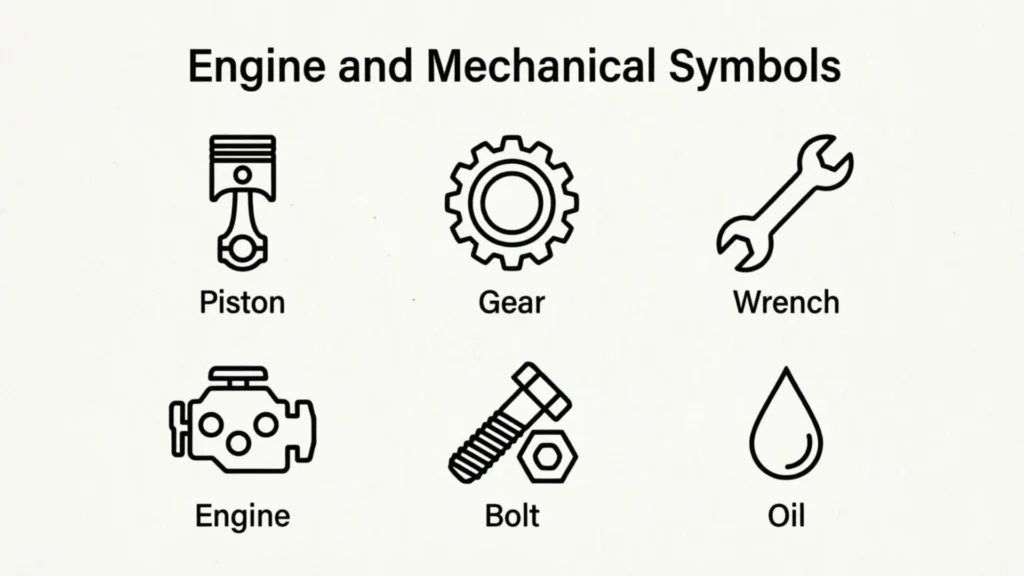
Engine-related warnings are among the most important dashboard messages because ignoring certain conditions can lead to expensive damage.
Check Engine Light
The check engine light can be triggered by many different faults.
A dashboard light alone usually cannot tell you the exact cause. A diagnostic scan may be required to retrieve the vehicle’s fault codes.
Do not automatically assume that the problem is the gas cap, battery, spark plugs, or another single component.
Oil Pressure vs. Oil Level Symbols
These two warnings are easy to confuse.
Oil pressure: relates to the pressure within the engine’s lubrication system.
Oil level: relates to the amount of oil detected by the vehicle.
A vehicle can have an acceptable oil level and still have an oil-pressure problem.
Conversely, a vehicle may report low oil level without having an immediate oil-pressure warning.
The symbols and behavior vary by vehicle. Volkswagen, for example, lists separate oil-level and oil-pressure-related indicators.
Engine Temperature Symbol
An overheating warning should never be treated as a normal service reminder.
If the vehicle reports excessive engine temperature, follow the owner’s manual and stop safely when instructed.
Transmission Warning
Transmission symbols can indicate:
- Overheating
- Electronic transmission faults
- Gear-selection problems
- Reduced functionality
The correct response depends heavily on the vehicle.
Glow Plug Symbol
Diesel vehicles may display a glow-plug symbol before starting.
A steady glow-plug indicator can be part of normal diesel preheating.
If it flashes or remains illuminated unexpectedly, it may indicate an engine-control problem. Volkswagen, for example, distinguishes normal glow-plug preheating from a flashing engine-control warning.
Diesel Particulate Filter Symbol
Diesel vehicles equipped with a DPF may display a filter-related warning when the system requires attention.
The correct procedure can vary by vehicle, driving conditions, and manufacturer instructions.
Do not assume that every DPF light can be cleared simply by driving at a certain speed for a certain number of minutes.
AdBlue or DEF Symbol
Modern diesel vehicles that use selective catalytic reduction may display an AdBlue or diesel-exhaust-fluid warning.
The warning may indicate a low fluid level or a system malfunction.
Some vehicles can eventually prevent another engine start if the required fluid is not replenished. Volkswagen’s current guide includes separate AdBlue level and system warnings.
Brake and Safety Symbols
Brake and restraint symbols deserve particular attention because they can relate directly to vehicle safety.
Brake System Symbol
A brake warning can indicate:
- Parking brake engaged
- Low brake fluid
- Brake-system malfunction
- Electronic parking-brake issue
If the brake warning appears together with another warning such as ABS, consult the manual and treat it seriously.
ABS Symbol
ABS helps prevent wheel lock during certain braking situations.
An ABS warning means the anti-lock system may not be operating normally.
It does not necessarily mean the vehicle has no braking ability, but you should not assume ABS is available when its warning is illuminated.
Brake Pad Symbol
Some vehicles have a dedicated brake-pad wear indicator.
It generally means the brake pads should be inspected and may need replacement.
Not every vehicle has a dedicated brake-pad symbol.
Electronic Parking Brake Symbol
Electronic parking brakes use an electric actuator rather than a traditional handbrake lever.
The dashboard may show a parking-brake icon when it is engaged or when the system has a fault.
Airbag and SRS Symbol
An illuminated SRS or airbag warning may indicate a fault involving:
- Airbags
- Seat-belt pretensioners
- Occupant detection
- Related restraint electronics
Because these systems are designed to work during a collision, a persistent warning should be professionally investigated.
Tire Symbols
Tire-related symbols are among the most frequently searched dashboard warnings.
TPMS Symbol
The standard TPMS symbol commonly looks like a flattened tire outline with an exclamation mark.
NHTSA says the symbol illuminates when one or more tires are significantly underinflated.
Do not judge tire pressure only by looking at the tire. NHTSA notes that underinflation can be difficult to identify visually and recommends checking pressure with an accurate gauge.
Flashing TPMS Light
A flashing TPMS warning can mean something different from ordinary low tire pressure.
NHTSA explains that a TPMS malfunction can be indicated by the symbol flashing for a period and then remaining illuminated.
Some manufacturers use a similar flashing-then-solid pattern for sensor or system faults.
TPMS Light in Cold Weather
Cold temperatures can cause tire pressure to fall enough to trigger a warning.
NHTSA notes that a TPMS symbol may temporarily appear on cold mornings when marginally low tire pressure falls below the warning threshold.
Even if the light later turns off, check the tire pressures rather than ignoring the warning.
Tire Temperature and Related Warnings
Some modern vehicles provide additional tire information, including temperature or pressure data.
These systems can be particularly useful in vehicles with advanced tire monitoring.
For exact meanings, use the vehicle’s manual.
Lighting Symbols
Lighting symbols are usually easier to understand because many represent an active feature rather than a fault.
Low-Beam Headlight Symbol
This symbol usually shows a headlamp with lines pointing downward.
It generally indicates that the low-beam headlights are operating.
High-Beam Symbol
The high-beam indicator is commonly blue.
It tells you that the high beams are switched on.
Fog-Light Symbol
Front and rear fog lights may have different symbols.
The color and orientation can vary depending on the vehicle and market.
Parking-Light Symbol
This indicates that the vehicle’s parking or position lights are active.
Turn-Signal Symbols
Green arrows normally show left or right turn-signal operation.
Emergency flashers may illuminate both arrows.
Traction and Stability Symbols
These systems can use similar-looking icons, which makes them easy to confuse.
Car With Squiggly Lines
A car with wavy or squiggly lines underneath commonly relates to traction control or electronic stability control.
If it flashes during acceleration or on a slippery surface, the system may be actively helping maintain traction.
If it stays on continuously, the system may be turned off or may have detected a fault.
ESC OFF Symbol
An OFF label may indicate that stability or traction control has been intentionally disabled.
Some vehicles allow partial system deactivation, while others use different driving modes.
Traction Control Symbol
Traction control helps reduce wheel spin.
The dashboard symbol can illuminate when the system activates.
If the symbol remains on unexpectedly, consult the vehicle’s instructions.
Driver Assistance Symbols
Modern vehicles can display many symbols for advanced driver-assistance systems.
Lane Departure Warning
This may look like a vehicle between lane markings.
It can indicate:
- Lane-departure warning active
- Lane-keeping assistance active
- System unavailable
- System malfunction
Lane Keep Assist
This system may show lane lines around a vehicle.
The color or animation can indicate whether the system is available, active, or providing assistance.
Forward Collision Warning
This may show a vehicle approaching another vehicle or a collision-style symbol.
It warns the driver about a potential forward collision detected by the vehicle’s sensors.
The exact behavior varies by manufacturer.
Automatic Emergency Braking
AEB-related symbols may show a vehicle with warning lines or another collision-alert design.
Depending on the system, the icon can indicate that the feature is active, unavailable, disabled, or malfunctioning.
Blind Spot Monitoring
Blind-spot systems often use symbols in the side mirrors or instrument cluster.
A warning may appear when another vehicle is detected in a blind spot.
Adaptive Cruise Control
Adaptive cruise-control symbols commonly combine a vehicle with a speedometer or distance indicator.
They may show whether the system is:
- Available
- Turned on
- Actively regulating speed
- Detecting a vehicle ahead
- Temporarily unavailable
Volkswagen’s current dashboard guide uses different states to communicate ACC availability and active operation.
Rear Cross-Traffic Alert
This system warns about approaching traffic when reversing.
The icon varies by manufacturer and may appear only when the feature is active or detects a vehicle.
Electric and Hybrid Car Symbols
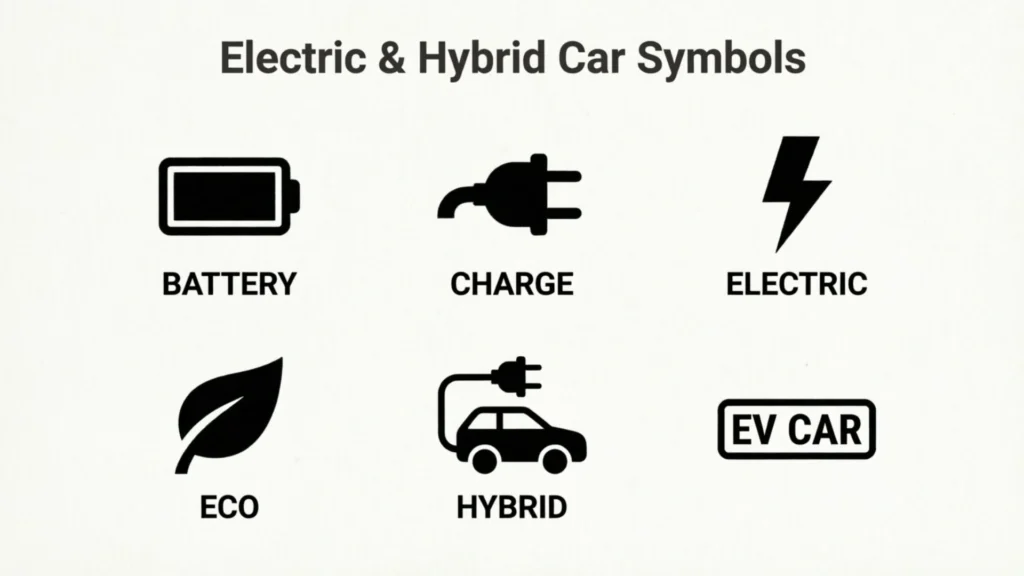
Electric and hybrid vehicles introduce additional dashboard symbols that may not appear in traditional gasoline cars.
EV Battery Symbol
A battery-shaped icon may show the high-voltage battery’s charge or a related warning.
Do not confuse a normal battery-status display with a high-voltage system fault.
EV Charging Symbol
A charging-related icon can indicate:
- Vehicle is connected to a charger
- Charging is active
- Charging is complete
- Charging is delayed
- A charging problem exists
The exact meaning depends on the vehicle.
Reduced Power or Turtle Symbol
A turtle icon can indicate limited power or a reduced-power operating mode on some electric vehicles.
Volkswagen, for example, uses a turtle-style symbol to identify a limited-power reserve mode.
Regenerative Braking Symbol
Hybrid and electric vehicles may display symbols or messages related to regenerative braking.
These can show when energy is being recovered during deceleration.
Hybrid System Warning
A hybrid-system warning can indicate a fault involving the vehicle’s hybrid components.
Because hybrid systems contain high-voltage equipment, follow the manufacturer’s instructions rather than attempting repairs yourself.
EV Ready Symbol
Some hybrids and EVs display a ready indicator when the vehicle is prepared to move.
A quiet electric vehicle can make it easy to forget that the car is powered on, so always check the vehicle’s status before exiting.
Diesel Car Symbols
Diesel vehicles can have additional emissions and fuel-system warnings.
Glow Plug
Usually associated with diesel engine preheating.
DPF
Indicates a diesel particulate filter condition or related issue.
AdBlue or DEF
Indicates that diesel exhaust fluid needs attention or that the emissions system has detected a problem.
Water in Diesel Fuel
Some diesel vehicles use a dedicated symbol to warn about water detected in the fuel system.
Volkswagen’s current dashboard guide includes symbols for glow plugs, DPF, AdBlue, and water in diesel fuel.
Common Car Symbols by Shape
Sometimes you know what a dashboard icon looks like but have no idea what it is called. Searching by shape can make identification easier.
What Do Car Symbols With an Exclamation Mark Mean?
An exclamation mark can appear in several different symbols.
The surrounding shape matters.
For example:
- Exclamation inside a tire shape: often TPMS
- Exclamation inside a brake circle: often brake-related
- Exclamation next to a steering wheel: may indicate steering-system trouble
- Exclamation inside a triangle: may be a general or master warning
Do not identify a symbol by the exclamation mark alone.
What Does a Circle With an Exclamation Mark Mean?
A circle containing an exclamation mark commonly relates to the braking system.
It may indicate:
- Parking brake
- Brake-system warning
- Low brake fluid
- Brake-system malfunction
The exact meaning depends on the manufacturer.
What Does a Triangle With an Exclamation Mark Mean?
A triangle with an exclamation mark can be a general or master warning symbol.
It may be accompanied by a text message explaining the problem.
When this type of warning appears, read the dashboard message instead of relying on the triangle alone.
What Does a Steering Wheel With an Exclamation Mark Mean?
A steering wheel with an exclamation mark commonly relates to the power-steering or steering-control system.
If steering becomes unusually heavy or difficult, treat the condition as urgent.
What Does the Car With Squiggly Lines Mean?
This commonly represents traction control or electronic stability control.
It may flash when the system is actively correcting wheel slip.
A steady warning can indicate that the system has been disabled or has detected a fault.
What Does the A in a Circle Mean?
An A surrounded by a circular arrow commonly relates to automatic engine start-stop.
It can indicate that:
- Start-stop is available
- The engine has automatically stopped
- The system is unavailable
- The system has been disabled
The exact design and meaning depend on the vehicle.
What Does the Wrench Symbol Mean?
A wrench or spanner commonly represents a service or maintenance reminder.
However, it can also indicate a system-specific issue.
Always check the owner’s manual for your exact vehicle.
What Does the Snowflake Symbol Mean?
A snowflake often warns that outside temperatures are low enough that icy road conditions may be possible.
Volkswagen, for example, uses a snowflake symbol for cold outside temperatures.
The symbol is generally an environmental warning rather than evidence that the vehicle itself has failed.
Flashing vs. Solid Dashboard Symbols
Whether a symbol is steady or flashing can change its meaning.
What Does a Solid Warning Light Mean?
A solid light generally indicates that the condition is currently detected or the feature is currently in a particular state.
The urgency depends on the specific symbol.
For example, a solid TPMS light generally points toward low tire pressure, while a solid check-engine light indicates a detected engine-control or emissions-related issue.
What Does a Flashing Warning Light Mean?
A flashing light can indicate an active event, a more urgent malfunction, or a system fault.
Examples vary by vehicle.
For TPMS, NHTSA explains that a flashing light followed by continuous illumination can indicate a malfunction in the tire-pressure monitoring system.
Volkswagen also distinguishes flashing from steady conditions for several systems, including engine control, glow plugs, steering, ESC, and TPMS.
Never assume that every flashing symbol means the same thing.
Can I Drive With a Dashboard Warning Light On?
The answer depends on the symbol.
A green turn-signal indicator is normal and does not usually indicate a fault.
A low-fuel warning normally means you need to refuel.
A TPMS warning means you should check tire pressure promptly.
A brake, oil-pressure, overheating, or serious steering warning may require much more urgent action.
| Warning Type | General Concern | Typical Approach |
| Turn signal | Normal operation | Continue normally |
| High beam | Normal operation | Turn off when appropriate |
| Low fuel | Fuel level low | Refuel |
| TPMS | Tire pressure/system | Check tires promptly |
| Check engine, steady | Fault detected | Arrange diagnosis |
| ABS | Brake-assistance fault | Drive cautiously and arrange inspection |
| Airbag/SRS | Safety-system fault | Arrange inspection promptly |
| Oil pressure | Potential lubrication problem | Stop safely and follow manual |
| Engine overheating | Excessive temperature | Stop safely and follow manual |
| Serious brake warning | Brake-system concern | Treat as high priority |
| Steering warning with steering difficulty | Steering-system concern | Stop safely when possible |
This table is only general guidance. Your vehicle’s warning message and owner’s manual take priority.
Car Warning Lights You Should Not Ignore
Some symbols deserve immediate attention because continuing to drive could create a safety risk or increase the chance of vehicle damage.
These include:
- Low oil pressure
- Engine overheating
- Serious brake-system warnings
- Certain steering-system warnings
- Some charging-system warnings
- Persistent airbag/SRS warnings
- Certain high-voltage EV or hybrid warnings
- Flashing engine-control warnings
- Other red warnings accompanied by a stop instruction
Toyota, for example, specifically identifies high coolant temperature as a condition requiring the vehicle to be stopped safely, while Volkswagen labels several oil, coolant, brake, steering, and hybrid warnings with stop instructions.
If the vehicle is behaving abnormally, such as losing power, overheating, producing smoke, making unusual noises, or becoming difficult to steer or brake, do not rely on the symbol alone. Get to a safe location and seek appropriate assistance.
Why Do Dashboard Symbols Turn On When Starting the Car?
Many dashboard lights briefly illuminate when the vehicle is switched on.
This can be part of the vehicle’s startup self-check.
The important question is what happens afterward.
A light that appears briefly and then turns off may simply be part of the normal system check.
A warning that remains illuminated may indicate a condition requiring attention.
If a safety-system light that should normally illuminate during the startup check does not appear at all, that can also be relevant. Toyota warns that certain safety-system indicators not appearing during startup may indicate that the systems are not available and should be inspected.
How to Identify an Unknown Car Symbol
You do not need to know the technical name of a symbol before you can start identifying it.
Check the Color
First determine whether the symbol is:
- Red
- Amber
- Yellow
- Green
- Blue
- White
- Gray
Color gives you an initial clue but is not enough by itself.
Identify the Shape
Ask what the icon resembles.
Is it:
- An engine?
- Oil can?
- Tire?
- Battery?
- Steering wheel?
- Person?
- Car?
- Triangle?
- Circle?
- Snowflake?
- Wrench?
- Headlight?
Check Whether It Is Flashing
Note whether the symbol is:
- Solid
- Flashing
- Appearing briefly
- Turning on and off
This can change its meaning.
Read the Dashboard Message
Modern cars often display a written message next to a warning symbol.
Do not ignore the text.
A symbol alone may have several possible meanings, while the dashboard message can narrow it down.
Check the Owner’s Manual
The owner’s manual is the final reference for your particular vehicle.
This is especially important because manufacturers can use similar symbols for different functions.
Volkswagen explicitly states that warning-light interpretation can vary across models and recommends consulting the owner’s manual.
Why Are Car Symbols Different Between Brands?
There is no single universal collection of symbols covering every dashboard feature on every vehicle.
Differences can occur because of:
- Manufacturer
- Model
- Model year
- Country or market
- Engine type
- Hybrid or EV system
- Optional equipment
- Driver-assistance features
- Instrument-cluster design
Toyota’s dashboard information, for example, identifies a core group of common warnings while directing owners to the manual for additional symbols. Volkswagen also notes that meanings can differ between models.
This is why an image found online should not automatically be treated as the correct explanation for your car.
Car Symbols by Manufacturer
If you need an exact interpretation, search for the dashboard guide for your specific vehicle.
Useful searches include:
- Toyota dashboard symbols
- Honda dashboard symbols
- Ford dashboard symbols
- BMW dashboard symbols
- Mercedes-Benz dashboard symbols
- Volkswagen dashboard symbols
- Hyundai dashboard symbols
- Kia dashboard symbols
- Nissan dashboard symbols
- Chevrolet dashboard symbols
- Tesla dashboard symbols
The best source is normally the official owner’s manual or manufacturer information for your exact model and year.
A symbol on a 2026 vehicle may not have exactly the same meaning as a similar-looking symbol on an older model.
Common Mistakes When Reading Dashboard Symbols
Assuming Every Red Light Means the Same Thing
Red often signals higher priority, but the symbol determines the actual issue.
Assuming Every Yellow Light Is Safe to Ignore
Amber warnings may indicate important system faults.
Confusing Oil Level With Oil Pressure
These are different conditions and can require different responses.
Ignoring a Flashing Symbol
Flashing can indicate a different or more urgent condition.
Relying Only on the Symbol’s Color
Color provides a clue, not a complete diagnosis.
Guessing From a Similar Car
Two vehicles from different manufacturers can use similar-looking symbols differently.
Continuing to Drive Because the Car Still Feels Normal
Some warnings appear before the driver notices a major change in vehicle behavior.
Treating TPMS as a Substitute for Checking Tires
NHTSA specifically notes that TPMS does not replace regular tire maintenance and recommends checking tire pressure with an accurate gauge.
Looking Only at Generic Internet Charts
Generic charts are useful for identification, but your owner’s manual remains the most relevant source for your specific vehicle.
Frequently Asked Questions About Car Symbols
What do all the symbols on my car dashboard mean?
Car dashboard symbols communicate warnings, system conditions, active features, or maintenance information. Common symbols include the check engine, oil pressure, brake, ABS, TPMS, battery, airbag, steering, traction-control, turn-signal, and high-beam icons. Exact symbols vary by vehicle.
What is the most serious dashboard light?
There is no single most serious light for every vehicle. Oil-pressure, overheating, serious brake, steering, and certain high-voltage warnings can require urgent attention. Always follow the message and instructions for your specific vehicle.
What does a red exclamation mark mean in a car?
A red exclamation mark often appears in or near a brake-related symbol, but the exact meaning depends on the surrounding icon and vehicle. It can relate to the parking brake, brake-fluid level, or brake-system malfunction.
What does a yellow triangle with an exclamation mark mean?
It commonly functions as a general or master warning. The vehicle may display a separate message explaining the problem. Check the instrument-cluster message and owner’s manual.
What does the circle with an exclamation mark mean?
A circle containing an exclamation mark commonly relates to the brake system or parking brake. However, the exact meaning varies by manufacturer.
What does the car with squiggly lines mean?
It commonly represents traction control or electronic stability control. A flashing icon may show that the system is actively working, while a steady icon may indicate that the system is off or has detected a problem.
What does the steering wheel with an exclamation mark mean?
It usually relates to the power-steering or steering system. If steering becomes unusually difficult or heavy, treat the situation as urgent.
What does the tire with an exclamation mark mean?
It is usually the tire-pressure monitoring symbol. It commonly indicates that one or more tires are significantly underinflated. NHTSA recommends checking tire pressure and inspecting the tires when this warning appears.
Why is my tire-pressure light flashing?
A flashing TPMS light can indicate a problem with the tire-pressure monitoring system rather than simply low tire pressure. NHTSA describes a flashing-then-solid pattern as an indication of a TPMS malfunction.
What does the wrench symbol mean on a car?
A wrench commonly represents a maintenance or service reminder. However, some manufacturers use wrench symbols for other system-specific messages, so check the owner’s manual.
What does the A in a circle mean?
It commonly relates to an automatic engine start-stop system. Depending on the vehicle, it can indicate that the feature is available, active, unavailable, or disabled.
What does the snowflake symbol mean?
A snowflake commonly warns that the outside temperature is low enough for icy conditions to be possible. Some vehicles use it around a particular temperature threshold.
What does a flashing check engine light mean?
A flashing check engine light can indicate a more urgent engine-control problem. Some manufacturer guides associate flashing engine-control warnings with misfire conditions.
Why do all my dashboard lights come on when I start the car?
Many vehicles briefly illuminate warning and indicator lights as part of a startup check. If a light stays on after the vehicle starts, consult its meaning in the owner’s manual.
Can I drive with the check engine light on?
A steady check-engine light generally means the vehicle has detected a fault that should be diagnosed. A flashing light can indicate a more urgent problem. Because the cause varies, follow the vehicle’s instructions and seek professional diagnosis.
Can I drive with the ABS light on?
An ABS warning means the anti-lock braking system may not be operating normally. The basic brakes may still function on some vehicles, but you should not assume ABS assistance is available. Arrange an inspection and drive cautiously according to the manufacturer’s guidance.
Can I drive with the tire-pressure light on?
You should check the tire pressures as soon as possible. NHTSA states that the TPMS symbol indicates significant underinflation and recommends inspecting the tires and checking pressure.
Why do car symbols differ between models?
Manufacturers design their own instrument clusters and may provide different features, powertrains, safety systems, and driver-assistance technologies. The same general function may therefore use different symbols or colors.
Conclusion
Understanding all car symbols does not mean memorizing every dashboard icon ever used by every manufacturer. The more useful skill is knowing how to identify a symbol, understand what system it represents, judge its urgency, and find the correct information for your particular vehicle.
Start with the symbol’s shape, color, and behavior. Check whether it is steady or flashing, read any message displayed beside it, and then compare it with your owner’s manual. Pay especially close attention to warnings involving the oil system, engine temperature, brakes, steering, airbags, tires, charging system, and high-voltage components.
Remember that dashboard symbols are not completely universal. Official manufacturer guides show substantial differences between models, and Volkswagen explicitly notes that warning-light meanings can vary by vehicle.
For tire-pressure warnings, NHTSA is a useful authoritative reference: the TPMS symbol generally indicates significant underinflation, while a flashing-then-solid pattern can indicate a monitoring-system malfunction.
The safest approach is simple: identify the symbol, read the dashboard message, follow the manufacturer’s instructions, and never ignore a warning that suggests a serious safety or mechanical problem.
Official Resources for Car Symbols
For the most accurate information about a specific vehicle, use authoritative sources rather than relying only on generic symbol charts.
- Toyota’s official dashboard warning-light guide explains common warning and indicator lights and directs owners to their vehicle’s manual for additional information.
- Volkswagen’s official dashboard-light guide provides extensive warning and indicator information while noting that meanings can vary between models.
- NHTSA’s TireWise information explains TPMS symbols, low-pressure warnings, and TPMS malfunction behavior.
- Your vehicle’s owner’s manual should remain the primary reference for the exact meaning and required response to a dashboard warning.
Safety Note
This article provides general educational information about common dashboard symbols. It is not a substitute for the owner’s manual, manufacturer instructions, or professional vehicle inspection. Dashboard symbols can vary by make, model, year, market, and equipment. If a warning indicates a serious problem, the vehicle behaves abnormally, or the manufacturer instructs you to stop, move to a safe location and seek appropriate assistance.

Adam Sullivan is a dedicated writer who enjoys transforming everyday topics into engaging and informative content. His writing focuses on making complex ideas simple, practical and enjoyable for readers of all backgrounds. Adam is also the fictional author of The Lantern Beyond Autumn Hills and Where the Morning Horizon Waits. Outside of writing, he enjoys photography, traveling and discovering inspiration through new experiences. He believes great content should be both helpful and easy to connect with.
 Dylan Anderson