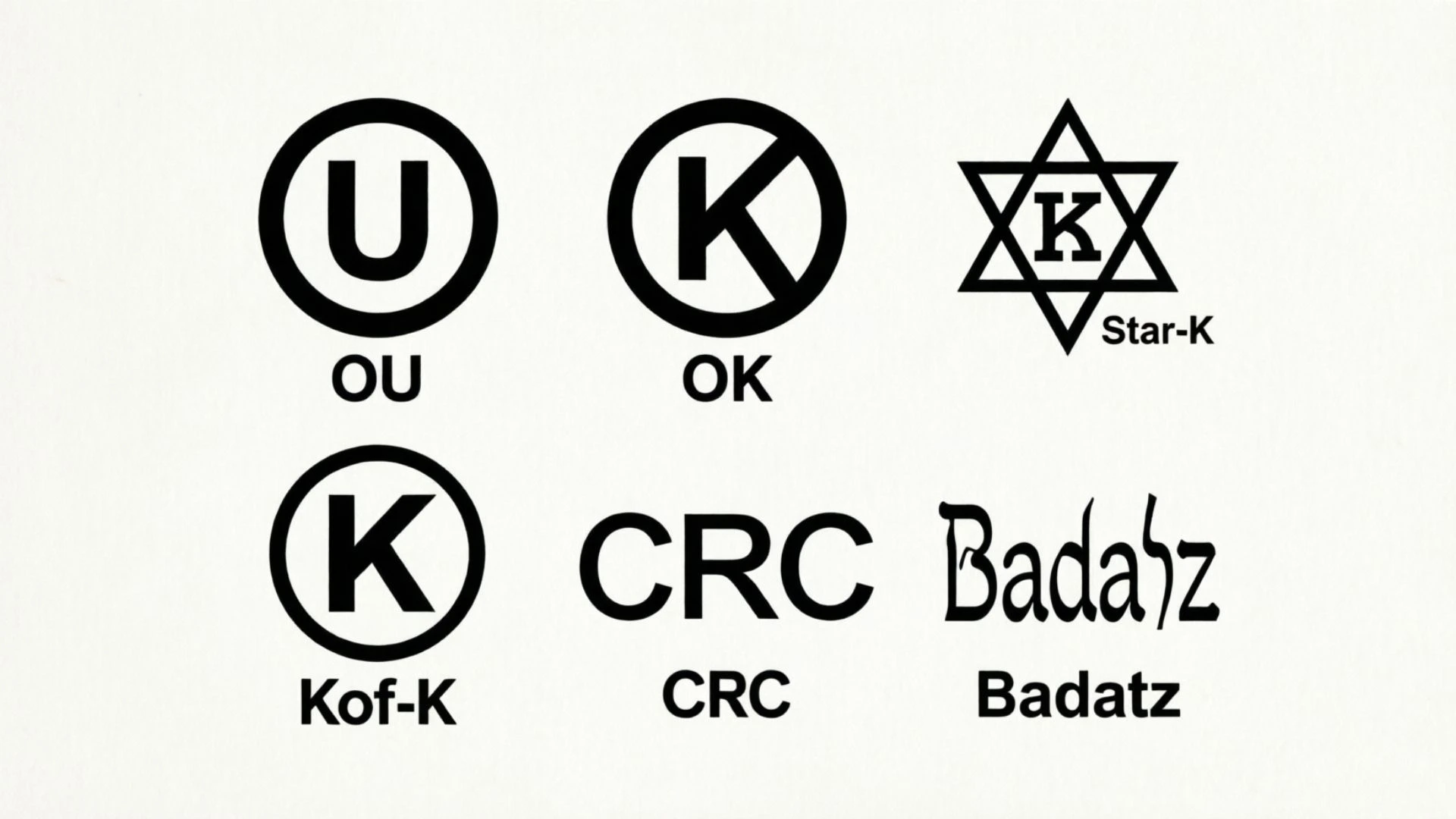
If you have ever picked up a food package and noticed a small OU, OU-D, OU-P, OK, STAR-K, KOF-K, cRc, or another K symbol, you may have wondered what it actually means. These marks are kosher certification symbols, but the letters and designations around them can provide additional information about a product’s kosher status.
For shoppers in the United States, understanding kosher symbols can make grocery shopping much easier. A symbol may tell you which organization certified the product and, depending on the certification system, whether the food is dairy, meat, pareve, fish, or certified for Passover.
However, one important rule is worth remembering: not every K-looking symbol means exactly the same thing. Certification organizations use their own marks and classifications, so an unfamiliar symbol should be checked rather than guessed.
This guide explains the most common kosher symbols found on food in the USA, what their letters mean, how kosher certification works, how Passover certification differs, and how to verify an unfamiliar mark before relying on it.
Editorial note: Kosher practices can vary between communities and according to individual rabbinic guidance. This guide explains common U.S. certification symbols and label terminology; if you follow a particular rabbinic authority, use that authority’s guidance for your specific dietary practice.
What Do Kosher Symbols on Food Mean? (Quick Answer)
Kosher symbols on U.S. food packages generally identify the kosher certification organization that has certified the product. Additional letters or words can identify a particular kosher category.
For example, the OU symbol is associated with Orthodox Union kosher certification. Under OU’s system, a plain OU symbol indicates a pareve product, while OU-D indicates dairy status, OU-F indicates fish, and OU-P indicates kosher-for-Passover status.
Other familiar U.S. certification marks include OK, STAR-K, KOF-K, and cRc. Their symbols and classifications are specific to their respective organizations.
The easiest way to read a kosher symbol is:
Identify the logo → identify the certification organization → check the modifier → verify the current product status if necessary.
Common Kosher Symbols on Food in the USA
Kosher certification is provided by different organizations, so there is no single universal logo used on every kosher product.
Here are some of the certification marks U.S. shoppers are likely to encounter.
| Kosher Symbol | Certification Organization | What It Generally Indicates |
| OU | Orthodox Union | Kosher certification; under the OU system, plain OU is pareve |
| OU-D | Orthodox Union | Dairy status |
| OU-P | Orthodox Union | Kosher for Passover |
| OU-F | Orthodox Union | Fish designation |
| OK | OK Kosher Certification | OK Kosher certification |
| STAR-K | STAR-K Kosher Certification | STAR-K certification |
| KOF-K | KOF-K Kosher Supervision | KOF-K certification |
| cRc | Chicago Rabbinical Council | cRc kosher certification |
| K or other marks | Varies | Identify the specific certifying organization before interpreting it |
The exact meaning of an additional letter or designation depends on the certification organization. For that reason, the organization behind the symbol matters just as much as the letter beside it.
What Is a Kosher Certification Symbol?
A kosher certification symbol is commonly called a hechsher. It is a mark placed on a product to identify that a kosher certification organization has approved the product under its kosher requirements.
Kosher certification involves more than looking at a finished ingredient list. Certification organizations may review ingredients, production procedures, equipment, facilities, and other aspects of manufacturing.
OK Kosher, for example, describes certification as a process in which experts in kosher law verify that products are made according to kosher requirements, with ongoing monitoring and facility oversight.
STAR-K similarly explains that kosher certification agencies use rabbis, food technologists, and field supervisors to evaluate products and production according to the laws of kashrus.
This is why a recognizable certification mark can be important to kosher consumers.
What Is a Hechsher?
Hechsher is a commonly used term for kosher certification or the certification mark associated with a kosher agency.
In everyday shopping, you may hear someone ask whether a product “has a hechsher.” They are generally asking whether the food carries an acceptable kosher certification.
A hechsher does not necessarily look the same on every product. Each certification agency has its own trademarked or otherwise controlled symbol.
Most Common Kosher Symbols on Food in the USA
OU Kosher Symbol
The OU is one of the most recognizable kosher certification marks in the United States.
According to the Orthodox Union, a plain OU symbol indicates a kosher product that is pareve under the OU system. The OU explains that such a product contains neither dairy nor meat or their derivatives and was not produced on dairy or meat equipment.
A crucial point is that plain OU does not automatically mean kosher for Passover. Passover certification is separately identified when required.
OU-D: What Does OU-D Mean?
OU-D identifies a product with dairy status under the OU certification system.
This can matter to someone who follows kosher rules concerning the separation of meat and dairy.
Do not assume that the letter D has exactly the same meaning across every kosher certification agency. Always interpret a modifier according to the organization whose symbol appears on the package.
OU-P: What Does OU-P Mean?
OU-P indicates that the product is certified kosher for Passover and is pareve under the OU system.
Passover certification requires additional considerations beyond ordinary year-round kosher certification. Products may therefore have separate Passover approval.
The OU specifically warns consumers not to assume that a random letter P, an internet image, or supermarket placement automatically establishes Passover certification. Consumers should check the individual product and its current certification.
OU-F: What Does OU-F Mean?
The OU-F designation identifies certain products containing fish ingredients under the OU system.
The presence of fish can affect the certification designation, so consumers who need to know whether a product contains fish should pay attention to the full symbol rather than looking only for the OU portion.
OU-M and OU-Glatt
The OU also uses meat-related designations, including OU-M and OU-Glatt, for products that fall into those categories under its certification system.
Because meat certification can involve specific kosher requirements, shoppers should not interpret the letter M simply as a generic “meat-free” or “meat-containing” statement across every certification system.
OK Kosher Symbol
The OK symbol is associated with OK Kosher Certification.
The organization describes its symbol as a kosher certification mark and explains that classifications such as pareve, dairy, dairy equipment, meat, fish, and Passover can appear with the OK symbol when applicable.
The important point for consumers is that the OK symbol identifies the certification organization, while any additional classification provides further information about the product.
STAR-K Symbol
STAR-K is another established kosher certification organization.
A STAR-K symbol indicates certification by STAR-K. The organization explains that kosher certification agencies evaluate food products and ingredients to assure consumers that they meet kosher requirements.
STAR-K also emphasizes that certification agencies are not identical and that consumers may consider the acceptability of a particular agency according to their own kosher practice.
KOF-K Symbol
KOF-K is another kosher certification organization whose symbol can appear on packaged food.
If you see a KOF-K mark, identify the organization and then check the product’s current certification information when you need more detail about its status.
cRc Kosher Symbol
cRc refers to kosher certification associated with the Chicago Rabbinical Council.
As with other certification organizations, the mark identifies the certifier. Consumers who have specific standards should check the organization’s current information or follow the guidance of their rabbinic authority.
What Does a Plain K Mean on Food?
A K by itself should not automatically be treated as equivalent to every other kosher certification symbol.
A K may be associated with a particular certification organization, and the meaning of nearby letters or words can depend on that agency.
This is one reason it is better to identify the actual certification organization instead of assuming that every circle-K or letter K has one universal meaning.
Kosher Symbols Chart: Meaning at a Glance
Use this quick guide when reading a U.S. food package:
| Mark or Term | Basic Meaning |
| OU | Plain OU certification; pareve under the OU system |
| OU-D | Dairy under the OU system |
| OU-P | Kosher for Passover under the OU system |
| OU-F | Fish designation under the OU system |
| OU-M | Meat designation under the OU system |
| OK | OK Kosher certification |
| STAR-K | STAR-K certification |
| KOF-K | KOF-K certification |
| cRc | Chicago Rabbinical Council certification |
| Pareve / Parve | Neither meat nor dairy in the relevant kosher classification |
| Dairy | Dairy classification |
| DE | Dairy equipment designation when used by a certifying agency |
| P / Passover | May indicate Passover certification when authorized by the certifying organization |
The final row is especially important: do not interpret a letter in isolation. The certification agency and its labeling system determine what the designation means.
What Do the Letters on Kosher Symbols Mean?
Letters beside a kosher logo are often called modifiers or classifications.
They provide information beyond the basic fact that the product has kosher certification.
D — Dairy
A D commonly identifies dairy status when used by a particular certification organization.
For example, the OU uses OU-D for dairy certification.
However, always check the organization because labeling systems can differ.
DE — Dairy Equipment
DE can mean Dairy Equipment.
This designation may be used when a product does not contain dairy ingredients but was produced using dairy equipment.
STAR-K explains that some certification agencies use DE for products without dairy ingredients that were made on dairy equipment. STAR-K itself says it does not use the DE designation.
This is a perfect example of why you should not assume that every certification organization uses the same letters.
M — Meat
An M can indicate meat status under some certification systems.
The exact designation should always be interpreted together with the certifying organization’s symbol.
P — Passover
A P can indicate Passover certification when it is an authorized part of a certification symbol.
For example, OU-P is the OU’s Passover designation.
But a random P printed somewhere on a package is not automatically proof that the product is kosher for Passover.
Pareve or Parve
Pareve, also spelled parve, generally means that a food is classified as neither meat nor dairy under the relevant kosher system.
Under the OU’s system, a plain OU symbol indicates pareve status.
Pareve does not automatically mean:
- vegan
- vegetarian
- allergen-free
- healthy
- gluten-free
Those are separate questions.
Why Kosher Modifiers Are Not Universal
One of the most important lessons for beginners is that kosher symbols are organization-specific.
A letter may have a particular meaning when attached to one agency’s logo but not necessarily carry the identical meaning when used by another agency.
That is why a reliable kosher-label guide should always explain both:
the symbol + the certification organization
rather than treating individual letters as universal codes.
What Does Pareve Mean on a Food Label?
Pareve, or parve, is a kosher classification for food that is neither meat nor dairy according to the relevant certification system.
For example, the OU states that a plain OU symbol represents a pareve product within its system.
For a beginner, the simplest way to remember it is:
Pareve = neither meat nor dairy.
But pareve should not be confused with vegan.
A pareve product can contain ingredients that are not plant-based, depending on the product and kosher rules. Fish, for example, can have its own kosher classification.
So if you are avoiding animal products for vegan reasons, you still need to read the ingredient list.
What Does Dairy Mean on a Kosher Label?
A dairy kosher designation indicates that the product has dairy status under the relevant certification system.
For example, OU-D identifies dairy status under the OU system.
Dairy status is important for kosher consumers because kosher dietary practice separates meat and dairy.
It can also matter to consumers with dietary restrictions, although a kosher dairy designation should not be treated as a substitute for reading an allergy statement or ingredient list.
What Does Meat Mean on a Kosher Label?
A meat designation indicates that the product falls into the meat category under the certification organization’s kosher system.
This is more than a simple ingredient-list issue because kosher certification can involve the source of ingredients, preparation, production equipment, and supervision.
If you need a product to meet a particular meat-related kosher standard, check the exact certification and follow your normal rabbinic guidance.
What Does DE Mean on a Kosher Label?
DE generally means Dairy Equipment when a certification organization uses that designation.
A product carrying a DE designation may not contain dairy ingredients but may have been produced using equipment that is also used for dairy products.
This distinction can matter to kosher consumers even when the ingredient list itself appears dairy-free.
Because agencies use different labeling systems, do not assume that every kosher organization uses DE in exactly the same way. STAR-K, for example, says that it does not use DE itself, while noting that other agencies use it.
Kosher Symbols for Passover: What Does OU-P Mean?
Passover creates an important second layer of kosher labeling.
A food can be kosher year-round without being certified kosher for Passover.
Under the OU system, OU-P identifies a product that is kosher for Passover and pareve.
Passover certification involves additional requirements. The OU explains that products bearing the OU-P designation are subject to special Passover certification and supervision.
Is Plain OU the Same as OU-P?
No.
A plain OU symbol is not automatically a Passover symbol.
The OU’s current product database distinguishes ordinary OU products from products with special Passover certification.
Therefore, if you specifically need food for Passover, do not assume that an ordinary kosher symbol is enough.
Can a P Anywhere on the Package Mean Passover?
Not necessarily.
The OU specifically warns that a P placed before the OU symbol, a P in a circle, internet images, or supermarket placement should not automatically be relied upon as proof of Passover certification.
The safest approach is to verify the actual product with the certifying organization.
Why Is Passover Certification Different?
Passover has additional dietary requirements beyond ordinary year-round kashrut.
As a result, products may require separate certification, production procedures, ingredient review, and supervision.
The important consumer lesson is simple:
Kosher year-round and kosher for Passover are not interchangeable labels.
OU vs. OK vs. STAR-K vs. KOF-K vs. cRc
Many beginners wonder whether one kosher logo is “the kosher logo.”
There isn’t one universal symbol.
| Certification | What It Represents | Consumer Tip |
| OU | Orthodox Union certification | Check OU modifiers |
| OK | OK Kosher certification | Check the accompanying classification |
| STAR-K | STAR-K certification | Follow STAR-K’s current product information |
| KOF-K | KOF-K certification | Identify the exact certification |
| cRc | Chicago Rabbinical Council certification | Check current agency information |
Kosher certification organizations can have different standards, policies, and levels of acceptance among different communities. STAR-K specifically notes that certification agencies are not identical and that widespread acceptability can be an important consideration.
That does not mean a shopper should simply declare one symbol “good” and another “bad.” The appropriate certification can depend on the consumer’s community and rabbinic guidance.
Are All Kosher Certification Symbols Accepted by Everyone?
No single answer works for every kosher consumer.
Kosher certification agencies have their own supervision systems and standards, and different communities may have preferences regarding which agencies they rely on.
STAR-K explains that kosher agencies are not identical and emphasizes the importance of acceptability to the intended kosher consumer.
If you already follow a specific rabbinic authority, use its recommendations.
If you are simply learning how kosher labels work, start by identifying the certification organization and then consult that organization’s official consumer information.
How to Verify an Unfamiliar Kosher Symbol
Seeing an unfamiliar K-shaped logo does not mean you have to guess.
Use this simple process.
Step 1: Find the Certification Symbol
Look around the front, back, or side of the package for a kosher mark.
It may be near the product name, ingredients, or other certification information.
Step 2: Identify the Organization
Try to determine whether the symbol belongs to:
- OU
- OK
- STAR-K
- KOF-K
- cRc
- another certification agency
Step 3: Look for Modifiers
Check for:
- D
- DE
- M
- F
- P
- Pareve
- Dairy
- Meat
- Passover
Do not interpret the modifier without considering the certification agency.
Step 4: Match the Exact Product
If you need confirmation, compare the exact:
- product name
- manufacturer
- flavor or variety
- package size when relevant
- certification symbol
This matters because a company can have multiple products with different kosher statuses.
Step 5: Check the Official Certification Database
Major certification organizations may provide online product searches and alerts.
The OU, for example, provides a consumer product-search system and says its database provides current information on OU-certified products.
Step 6: Check for Current Changes
Food manufacturers can reformulate products, change facilities, or change certification arrangements.
OK Kosher specifically reminds consumers that kosher status can change and that updates are published regularly.
Step 7: Ask When You Are Unsure
If a symbol is unclear or you cannot verify the product, contact the certification organization or follow the guidance of your rabbinic authority.
When the question involves Passover or a particular community standard, verification is especially important.
Can You Trust a Kosher Symbol Shown Online?
Be careful.
An online image of a product or kosher symbol may be outdated, incorrectly used, or separated from the current product information.
The OU specifically warns consumers that internet statements and images are not always reliable for establishing kosher or kosher-for-Passover status. It also warns that supermarket advertising or product placement can sometimes be incorrect.
This is why the physical package and current certification information are more useful than an old photograph found online.
What a Kosher Symbol Does—and Does Not—Tell You
A kosher certification mark provides important information, but it does not answer every food-related question.
| A Kosher Symbol Can Indicate | It Does Not Automatically Mean |
| Kosher certification | Healthy |
| Certification organization | Vegan |
| Dairy status when designated | Vegetarian |
| Meat status when designated | Gluten-free |
| Pareve status when designated | Allergy-free |
| Passover status when appropriately certified | Organic |
| Fish classification when designated | Low-calorie |
| Certification category | Halal |
For example, a product can be kosher and still contain a lot of sugar or sodium.
Likewise, kosher certification does not automatically make a product vegan.
Always check the package for the information that matters to your particular dietary needs.
Kosher vs. Halal, Vegan, Vegetarian, and Gluten-Free
Kosher certification and other food labels are not interchangeable.
Kosher vs. Halal
Kosher and halal are both religious dietary systems, but they are based on different religious laws and certification practices.
A product being kosher does not automatically mean that it is halal, and a halal product is not automatically kosher.
Kosher vs. Vegan
A kosher product can contain animal-derived ingredients.
Therefore:
Kosher ≠ vegan.
A vegan shopper should check the ingredients and vegan certification or labeling separately.
Kosher vs. Vegetarian
Some kosher foods may contain fish or other animal-derived ingredients.
Therefore:
Kosher ≠ vegetarian.
Kosher vs. Gluten-Free
Kosher certification does not mean a food is gluten-free.
If gluten is a concern, look for the appropriate gluten-free labeling and read the ingredient and allergen information.
How Kosher Certification Works in the USA
Kosher certification is a structured process rather than simply printing a letter K on a package.
The details vary by agency, but certification can involve several stages.
Ingredient Review
The certification organization examines the ingredients used in the product.
Ingredient sources can matter because an ingredient that appears simple may have a more complicated production or processing history.
Equipment Review
The certification process can also consider the equipment used to manufacture food.
This is one reason products can have classifications related to dairy equipment or other production conditions.
Manufacturing Review
The certification organization evaluates how the product is manufactured and whether the process meets its kosher requirements.
Certification Approval
Once the required conditions are met, the manufacturer receives authorization to use the applicable certification mark.
OK Kosher explains that companies may display its symbol after certification has been completed and the appropriate certificate has been issued.
Ongoing Oversight
Kosher certification is not necessarily a one-time label decision.
Certification agencies can monitor facilities, review changes, and issue consumer updates.
This is one reason consumers should rely on current certification information rather than assuming that an old product listing remains accurate forever.
Why Can a Product’s Kosher Status Change?
A product’s kosher status can change for several reasons.
For example:
- the manufacturer changes an ingredient
- an ingredient supplier changes
- the manufacturing facility changes
- production equipment changes
- the certification arrangement changes
- packaging is redesigned
- a product is reformulated
- special Passover status changes
OK Kosher specifically notes that kosher status can change unexpectedly because of reformulation.
This does not mean shoppers need to panic every time they buy a familiar product. It simply means that when certification is important, the current package and certification information are worth checking.
How to Read a Kosher Food Label: Step-by-Step
Reading a kosher label becomes much easier once you know what to look for.
Start With the Logo
First, identify the main certification symbol.
Do not begin by interpreting individual letters.
Identify the Certifier
Ask:
Who issued this certification?
Is it OU, OK, STAR-K, KOF-K, cRc, or another organization?
Look for the Classification
Next, look for additional letters or words.
You might see:
- Dairy
- Pareve
- Meat
- Fish
- Passover
- DE
Check the Exact Product
If you are verifying certification online, make sure the listing matches the product in your hand.
A company’s other products may have different certification statuses.
Check Passover Separately
If you are shopping for Passover, do not assume that an ordinary kosher symbol automatically qualifies.
Look for the authorized Passover designation and verify it through the relevant certifier.
Read the Rest of the Label
Kosher certification does not replace:
- ingredient lists
- allergen information
- nutrition information
- vegan labeling
- gluten-free labeling
Each label answers a different question.
Common Mistakes When Reading Kosher Symbols
Mistake 1: Assuming Every K Means the Same Thing
A K without knowing the certification organization can be ambiguous.
Identify the certifier first.
Mistake 2: Assuming OU Means Passover
A plain OU does not automatically mean kosher for Passover.
The OU distinguishes regular certification from special Passover certification.
Mistake 3: Assuming Every P Means Passover
A random P is not enough.
The OU specifically warns against relying on unauthorized P markings or internet images to establish Passover certification.
Mistake 4: Assuming Pareve Means Vegan
Pareve is a kosher classification, not a vegan certification.
Mistake 5: Assuming D Always Means Exactly the Same Thing
The meaning of a modifier depends on the certification organization.
Mistake 6: Assuming a Product Is Permanently Certified
Products can be reformulated or have certification changes.
Mistake 7: Trusting an Old Product Photo
An old image may not reflect the current package or certification status.
Mistake 8: Assuming All Certification Agencies Are Identical
Different agencies can have different standards and levels of acceptance among communities.
Kosher Symbols Cheat Sheet
For quick reference:
| Term | Simple Explanation |
| Kosher | Food meeting the relevant requirements of Jewish dietary law |
| Hechsher | Kosher certification or certification mark |
| OU | Orthodox Union certification; plain OU is pareve under its system |
| OU-D | Dairy under the OU system |
| OU-P | Kosher for Passover under the OU system |
| OU-F | Fish designation under the OU system |
| OK | OK Kosher certification |
| STAR-K | STAR-K certification |
| KOF-K | KOF-K certification |
| cRc | Chicago Rabbinical Council certification |
| Pareve / Parve | Neither meat nor dairy under the applicable kosher classification |
| DE | Dairy equipment designation when used by an agency |
| D | Common dairy designation, depending on the certifier |
| M | Common meat designation, depending on the certifier |
| P | May identify Passover certification when authorized by the certifier |
Remember that this is a reading guide, not a substitute for current certification information.
How to Choose Kosher-Certified Food in a U.S. Grocery Store
If you are new to kosher labels, you do not need to memorize every logo.
Use a simple routine.
Look for a Recognizable Certification
Start by checking the package for a kosher certification symbol.
Identify the Organization
Learn the few symbols you encounter most often.
Check the Classification
Determine whether the product is:
- pareve
- dairy
- meat
- fish
- Passover-certified
- another special category
Consider Your Own Standard
If you follow a particular rabbinic authority or community standard, make sure the certification meets that requirement.
Verify When Necessary
For an unfamiliar product, check the certifier’s official product database or contact the agency.
The OU, for example, maintains a consumer product-search system and publishes kosher alerts.
Why Kosher Symbols Matter to Consumers
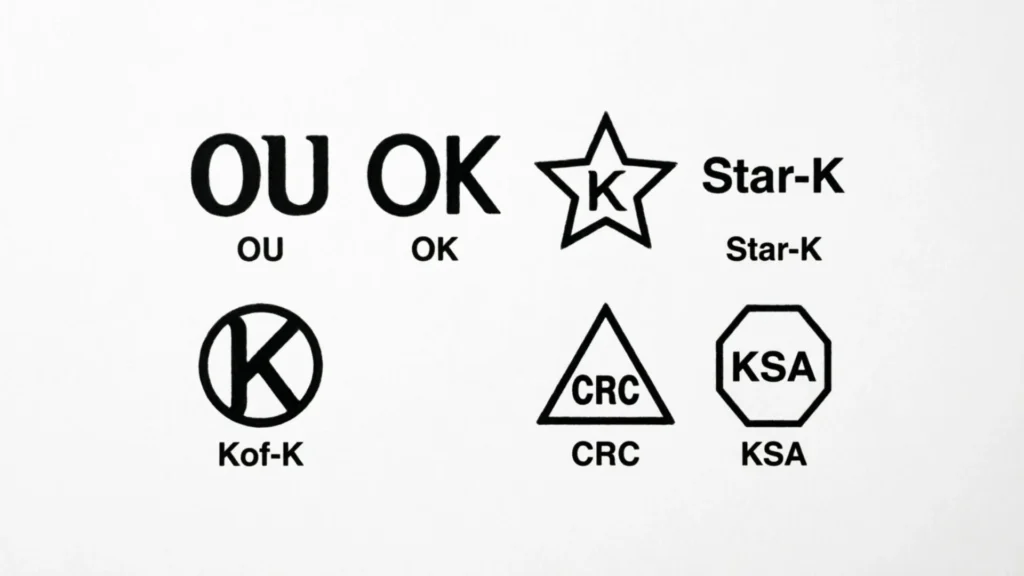
For someone who follows kosher dietary laws, a small symbol on a food package can provide information that would be difficult to determine from the ingredient list alone.
Kosher certification can involve ingredient sources, equipment, manufacturing processes, and supervision.
For a casual shopper, the symbol may look like a small logo.
For a kosher consumer, it can be an important part of deciding whether a product fits their dietary practice.
That is why understanding the certification organization, classification, and current status is more useful than memorizing a list of letters.
Frequently Asked Questions About Kosher Symbols
What does OU mean on food?
OU is a kosher certification symbol associated with the Orthodox Union. Under the OU system, a plain OU symbol indicates a pareve product and does not by itself mean kosher for Passover.
What does OU-D mean?
OU-D identifies dairy status under the OU certification system.
What does OU-P mean?
OU-P indicates that the product is certified kosher for Passover and is pareve under the OU system.
What does OU-F mean?
OU-F is used for certain products containing fish ingredients under the OU system.
What does OK mean on food?
OK is the certification symbol used by OK Kosher Certification. Additional classifications may appear with the symbol.
What does STAR-K mean?
STAR-K is a kosher certification mark associated with STAR-K Kosher Certification.
What does KOF-K mean?
KOF-K is a kosher certification mark associated with KOF-K Kosher Supervision.
What does cRc mean on food?
cRc refers to kosher certification associated with the Chicago Rabbinical Council.
What does a K mean on a food package?
A K can represent kosher certification, but the exact meaning depends on the certifying organization. If the organization is not obvious, verify the symbol before relying on it.
What does pareve mean?
Pareve, or parve, generally means that the food is neither meat nor dairy under the relevant kosher classification.
Does pareve mean vegan?
No. Pareve is a kosher classification and should not be treated as a synonym for vegan.
Does kosher mean vegetarian?
No. Kosher certification and vegetarian labeling are different. Some kosher foods can contain fish or other animal-derived ingredients.
Does kosher mean halal?
No. Kosher and halal are different religious dietary systems. A food certified kosher is not automatically certified halal.
Does kosher mean healthy?
No. Kosher certification concerns compliance with kosher requirements, not whether a food is nutritionally healthy.
What does DE mean on a kosher label?
DE commonly means dairy equipment when a certification organization uses that designation. It can identify a product without dairy ingredients that was made using dairy equipment.
Is a plain OU symbol kosher for Passover?
Not automatically. The OU distinguishes ordinary kosher certification from products with special Passover certification.
Does every P on a package mean Passover?
No. A P should not be interpreted by itself. The OU specifically warns consumers that unauthorized P markings, online images, and supermarket placement are not reliable proof of Passover certification.
Are all kosher certification agencies the same?
No. Certification agencies can have different standards and levels of acceptability among kosher communities.
Can a product lose its kosher certification?
Yes. Product formulas, ingredients, manufacturing processes, or certification arrangements can change. OK Kosher specifically notes that kosher status may change because of reformulation.
How can I verify an unfamiliar kosher symbol?
Identify the certification organization, check its official consumer resources or product database, match the exact product, and contact the agency if you remain uncertain.
Can I trust a picture of a kosher logo online?
Not always. Product images and online claims can be outdated or inaccurate. The OU specifically advises consumers not to rely on internet images or statements to establish Passover certification.
Do kosher symbols replace ingredient labels?
No. Kosher certification answers questions related to kosher status. You should still read the ingredient list, allergen information, nutrition facts, and other labels relevant to your dietary needs.
Conclusion
Understanding kosher symbols on food in the USA becomes much easier once you stop looking at the letters separately and start reading the complete certification mark.
The most important habit is simple: identify the certification organization first, then interpret any accompanying letters or words according to that organization’s system. Common U.S. marks include OU, OK, STAR-K, KOF-K, and cRc, while designations such as D, DE, M, F, and P can provide additional information depending on the certifier.
For everyday shopping, remember that a plain kosher symbol does not automatically answer every dietary question. Pareve does not mean vegan, kosher does not mean healthy, and ordinary kosher certification does not automatically mean kosher for Passover.
If you are unsure about a product, use the current information provided by the certification organization rather than relying on an old photograph, supermarket placement, or an unexplained K.
The goal is not to memorize every kosher logo. It is to know how to read, understand, and verify the symbol on the package in front of you.

Adam Sullivan is a dedicated writer who enjoys transforming everyday topics into engaging and informative content. His writing focuses on making complex ideas simple, practical and enjoyable for readers of all backgrounds. Adam is also the fictional author of The Lantern Beyond Autumn Hills and Where the Morning Horizon Waits. Outside of writing, he enjoys photography, traveling and discovering inspiration through new experiences. He believes great content should be both helpful and easy to connect with.
 Dylan Anderson