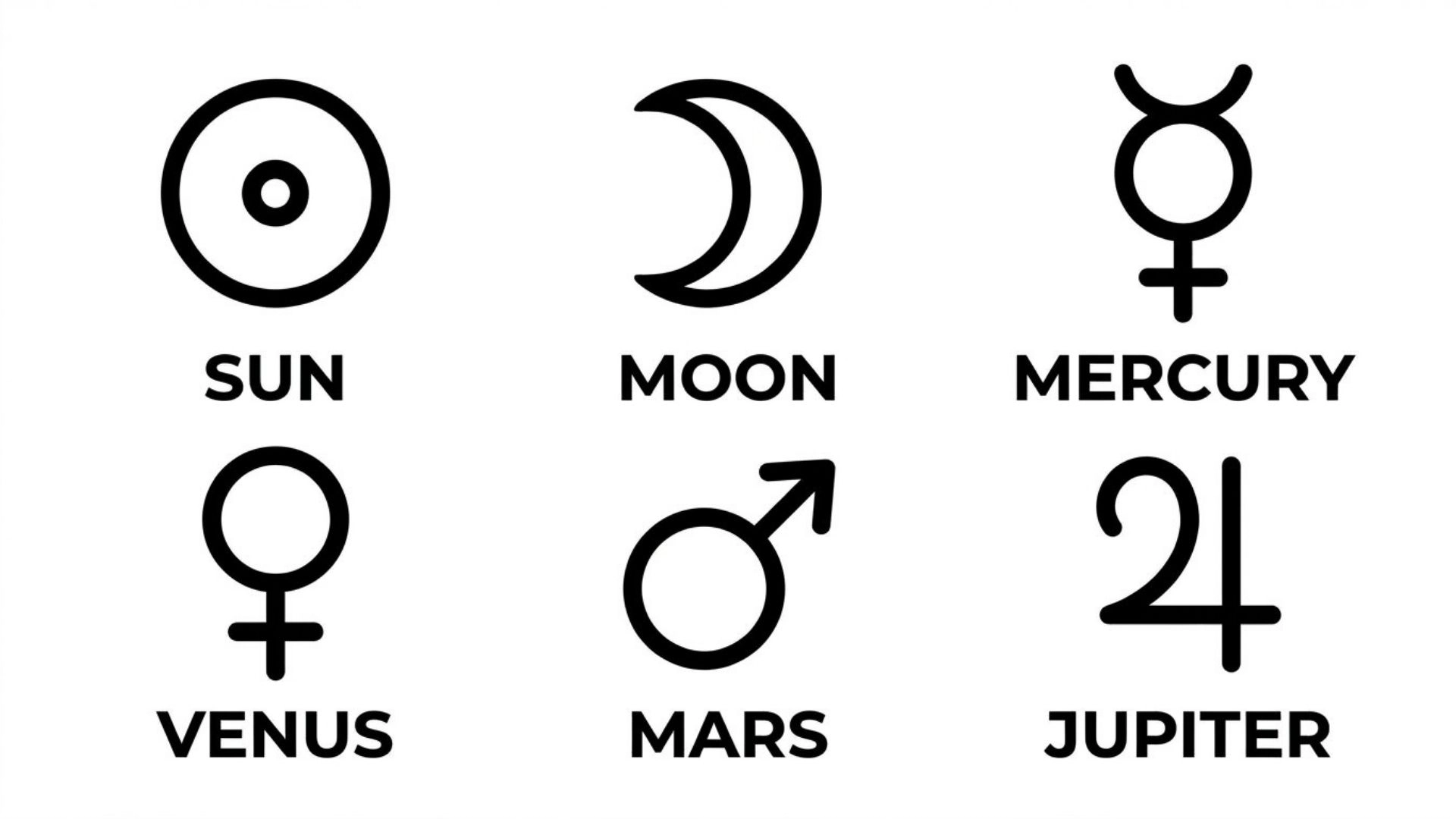
Astrology planet symbols can look confusing when you first open a birth chart, but each glyph has a specific identity and traditional meaning.
From the familiar Sun symbol ☉ and Moon symbol ☽ to the less familiar glyphs for Uranus, Neptune, and Pluto, these signs help you quickly identify different planetary influences in an astrology chart.
This guide explains astrology planet symbols, what each one represents, how planetary glyphs differ from zodiac symbols, and how to use them when reading a natal chart. It also includes a quick-reference chart, copy-and-paste symbols, memory tips, and answers to common beginner questions.
What Are Astrology Planet Symbols?
Astrology planet symbols are called planetary glyphs. They are visual characters used to identify planets and the two luminaries—the Sun and Moon—in an astrology chart.
In astrology, the Sun and Moon are usually included in the same basic symbol system as the planets. Technically, however, the Sun is a star and the Moon is Earth’s natural satellite, so they are often described as luminaries rather than planets.
A planetary glyph tells you which celestial body is being discussed. The complete interpretation comes from looking at that body’s sign, house, and relationships with other placements.
For example, seeing ♀ in a birth chart tells you that Venus is involved. To understand what that Venus placement means, you would also consider the zodiac sign Venus occupies, its house, and its aspects.
Why Are Planetary Glyphs Used?
Astrology charts contain a lot of information in a relatively small space. Writing every planet’s full name would make the chart crowded, so glyphs provide a quick visual language.
Instead of writing:
Venus in Taurus in the seventh house
a chart can use the Venus glyph ♀ along with the Taurus glyph ♉ and house information.
This makes planetary glyphs especially useful for:
- Reading natal or birth charts
- Understanding planetary placements
- Studying astrology
- Identifying planets in transit charts
- Comparing different chart interpretations
- Copying astrology symbols for notes or online content
Astrology Planet Symbols Chart
The following table provides a quick reference to the main astrology planet symbols and their commonly associated themes.
| Celestial Body | Symbol | Common Astrological Associations |
| Sun | ☉ | Identity, vitality, self-expression |
| Moon | ☽ | Emotions, instincts, comfort |
| Mercury | ☿ | Thinking, communication, learning |
| Venus | ♀ | Love, attraction, values, pleasure |
| Mars | ♂ | Action, desire, motivation, assertion |
| Jupiter | ♃ | Growth, expansion, optimism, learning |
| Saturn | ♄ | Structure, responsibility, discipline |
| Uranus | ♅ | Change, freedom, innovation |
| Neptune | ♆ | Imagination, dreams, spirituality |
| Pluto | ♇ | Transformation, power, regeneration |
These meanings describe traditional or modern astrological interpretations. They are part of astrology’s symbolic framework and should not be confused with scientifically established effects of planets on human personality or events.
Sun Symbol ☉
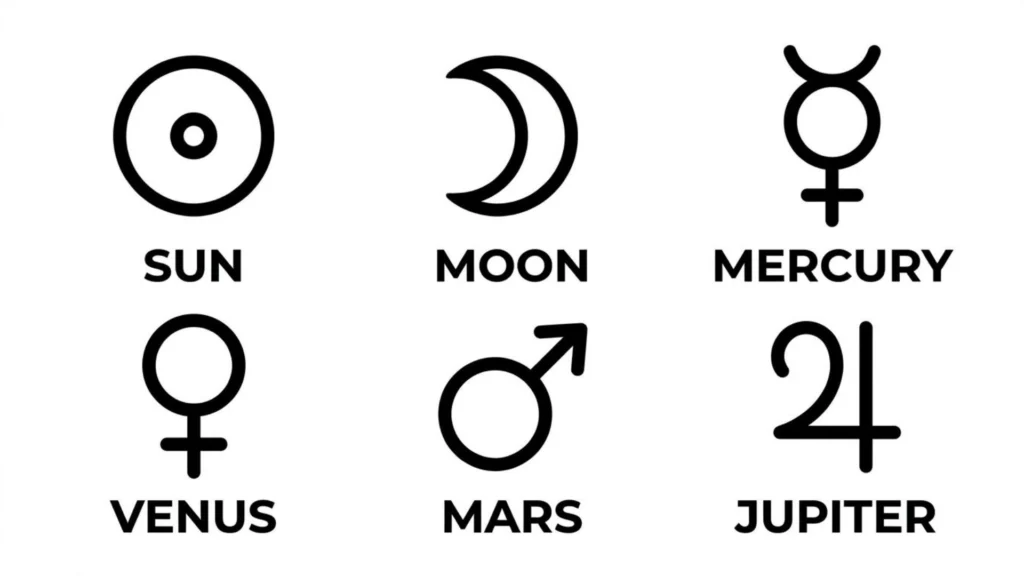
The Sun symbol ☉ is one of the easiest planetary glyphs to recognize. It consists of a circle with a dot in the center.
In astrology, the Sun is associated with identity, vitality, confidence, creativity, and self-expression. It is often connected with the sense of self and the qualities a person consciously develops and expresses.
What Does the Sun Symbol Mean?
The Sun represents the central sense of identity within an astrological interpretation. Its placement can be used to explore how someone expresses themselves and seeks recognition.
For example, a person with the Sun in Leo might be interpreted through themes such as creativity, visibility, warmth, and self-expression.
The Sun sign is the zodiac placement many people know simply as their “astrological sign.”
Moon Symbol ☽
The Moon symbol ☽ resembles a crescent Moon.
In astrology, the Moon is associated with emotions, instincts, habits, security, memories, and emotional responses. It is often used when discussing the more private or instinctive side of a person’s nature.
What Does the Moon Symbol Mean?
The Moon’s placement is traditionally interpreted as offering insight into emotional needs and habitual reactions.
For example, someone with the Moon in Cancer may be interpreted through themes of emotional sensitivity, nurturing, family, and security.
The Moon is particularly important in astrology because it moves relatively quickly through the zodiac, meaning its sign and house can add detail to a birth-chart interpretation.
Mercury Symbol ☿
The Mercury symbol ☿ has a distinctive shape and can be difficult for beginners to recognize at first.
Mercury is associated with communication, thinking, learning, information, reasoning, and everyday exchanges.
What Does the Mercury Symbol Mean?
Mercury’s position in a birth chart is traditionally considered when discussing how a person processes information and communicates.
For instance, Mercury in Gemini may be interpreted through themes such as curiosity, quick thinking, conversation, and versatility.
Mercury is also commonly discussed in connection with Mercury retrograde, when the planet appears to move backward from Earth’s perspective.
Venus Symbol ♀
The Venus symbol ♀ is widely recognized outside astrology as well. It consists of a circle above a small cross.
In astrology, Venus is associated with love, attraction, relationships, beauty, pleasure, personal values, and preferences.
What Does the Venus Symbol Mean?
Venus can be used to explore what someone appreciates, how they approach affection, and what they value in relationships and experiences.
For example, Venus in Libra is traditionally associated with themes of harmony, balance, cooperation, aesthetics, and partnership.
The Venus glyph is also closely related to the astronomical symbol traditionally associated with the planet Venus.
Mars Symbol ♂
The Mars symbol ♂ consists of a circle with an arrow extending outward.
Mars is traditionally associated with action, motivation, desire, courage, competition, physical energy, and assertiveness.
What Does the Mars Symbol Mean?
In a birth chart, Mars is often interpreted as showing how a person pursues goals, responds to challenges, and directs energy.
For example, Mars in Aries may be interpreted through themes of initiative, direct action, independence, and competitiveness.
The familiar Mars glyph is also used outside astrology as a traditional symbol associated with the male sex, reflecting the historical connection between Mars and masculinity.
Jupiter Symbol ♃
The Jupiter symbol ♃ is more complicated than the glyphs for the Sun or Moon, so it may take some practice to recognize.
Jupiter is traditionally associated with expansion, growth, opportunity, knowledge, philosophy, generosity, and optimism.
What Does the Jupiter Symbol Mean?
Astrologers often consider Jupiter when discussing areas where a person may seek growth or broader understanding.
For example, Jupiter in Sagittarius can be interpreted through themes of exploration, learning, freedom, travel, and philosophical interests.
Jupiter is also traditionally associated with abundance and expansion, although these should be understood as symbolic astrological interpretations rather than guaranteed outcomes.
Saturn Symbol ♄
The Saturn symbol ♄ is another glyph that beginners may need to memorize.
Saturn is associated with structure, discipline, responsibility, boundaries, patience, limitations, and long-term development.
What Does the Saturn Symbol Mean?
Saturn placements are traditionally examined when discussing responsibilities, rules, challenges, and areas where patience and consistent effort may be emphasized.
For example, Saturn in Capricorn may be interpreted through themes of organization, ambition, responsibility, and long-term goals.
Saturn is sometimes described as a planet of lessons because its symbolism is connected with boundaries and maturity.
Uranus Symbol ♅
The Uranus symbol ♅ is associated with change, independence, originality, innovation, and disruption.
Uranus is considered one of the outer planets in modern astrology.
What Does the Uranus Symbol Mean?
Astrologers often use Uranus to explore themes involving freedom, unconventional thinking, sudden change, and breaking from established patterns.
Because Uranus moves slowly through the zodiac, its placement can be shared by many people born during the same period. Its house placement and aspects can provide more individualized context.
You may also encounter different Uranus glyph conventions in astrology software or reference materials.
Neptune Symbol ♆
The Neptune symbol ♆ resembles a trident and is generally easy to identify once learned.
Neptune is associated with imagination, dreams, intuition, ideals, spirituality, creativity, and blurred boundaries.
What Does the Neptune Symbol Mean?
In astrology, Neptune may be considered when discussing imagination, ideals, sensitivity, and the difference between dreams and practical reality.
For example, Neptune in Pisces may be interpreted through themes of compassion, imagination, spirituality, and emotional sensitivity.
As with other planetary meanings, these are symbolic interpretations within astrology rather than scientific descriptions of personality.
Pluto Symbol ♇
The Pluto symbol ♇ is associated with transformation, power, regeneration, deep change, and psychological themes.
Pluto is considered an outer planet in modern astrology and moves very slowly through the zodiac.
What Does the Pluto Symbol Mean?
Astrologers may examine Pluto when interpreting profound changes, endings and beginnings, personal power, and transformation.
Because Pluto spends many years in one zodiac sign, its sign placement is often considered generational. Its house placement and aspects can provide more individual context.
You may see more than one glyph convention for Pluto, depending on the astrology tradition or chart software.
What Do Astrology Planet Symbols Mean?
A planetary symbol primarily identifies which celestial body appears in the chart. The deeper meaning comes from combining that planet with its placement.
A useful way to remember this is:
Planet = what
Sign = how
House = where
Aspect = how it connects
For example, if Venus is in a particular sign and house, you would not interpret Venus from the glyph alone. You would consider all of those chart factors together.
Planet Meanings at a Glance
The basic planetary associations can be remembered like this:
- Sun: identity and self-expression
- Moon: emotions and instincts
- Mercury: communication and thought
- Venus: relationships and values
- Mars: action and desire
- Jupiter: growth and expansion
- Saturn: responsibility and structure
- Uranus: freedom and change
- Neptune: imagination and ideals
- Pluto: transformation and regeneration
These keywords are useful starting points, but astrology interpretations become more detailed when the complete chart is considered.
How to Read Planet Symbols in a Birth Chart
If you are looking at a natal chart for the first time, the many symbols can seem overwhelming. You do not need to understand everything at once.
Step 1: Identify the Planetary Glyph
Start by finding the symbol.
For example:
☿ = Mercury
♀ = Venus
♃ = Jupiter
A reference chart can help while you learn.
Step 2: Identify the Zodiac Sign
Next, determine which zodiac sign contains the planet.
For example:
♀ Venus + ♉ Taurus
This tells you that Venus is placed in Taurus.
Step 3: Find the House
The house provides another layer of information. Astrology traditionally associates the twelve houses with different areas of life.
A Venus placement in one house may be interpreted differently from Venus in another house.
Step 4: Look at the Aspects
Aspects describe angular relationships between planets and other chart points.
You may see lines drawn between different placements in the center of a chart. These lines can represent different aspects such as conjunctions, trines, squares, oppositions, and sextiles.
Step 5: Combine the Information
Avoid interpreting a planet based only on its symbol.
Instead, consider:
Planet + Sign + House + Aspects
This approach gives a more complete picture of how astrologers traditionally interpret a chart.
Planet Symbols vs. Zodiac Symbols
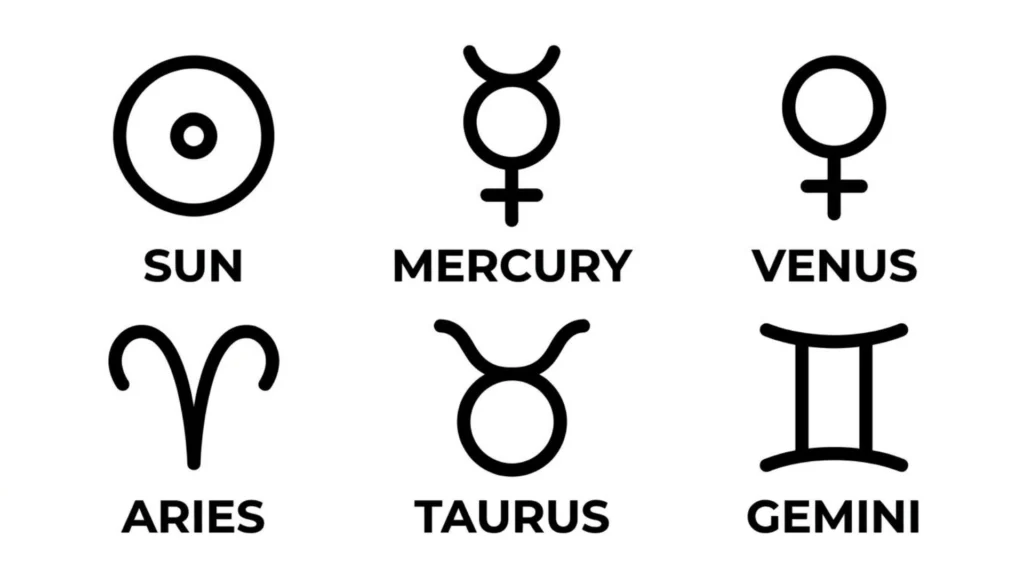
One of the most common beginner mistakes is confusing planetary glyphs with zodiac glyphs.
They are different symbol systems.
Planetary Glyphs
Planetary symbols identify celestial bodies such as:
☉ ☽ ☿ ♀ ♂ ♃ ♄ ♅ ♆ ♇
Zodiac Glyphs
Zodiac symbols identify the twelve signs:
♈ Aries
♉ Taurus
♊ Gemini
♋ Cancer
♌ Leo
♍ Virgo
♎ Libra
♏ Scorpio
♐ Sagittarius
♑ Capricorn
♒ Aquarius
♓ Pisces
For example, ♂ Aries combines a planet with a zodiac sign. Mars is the planet, while Aries is the sign.
Understanding this distinction makes reading astrology charts much easier.
Traditional and Modern Planet Symbols
Astrology has developed different traditions, so you may encounter slightly different classifications or glyph conventions.
Traditional Astrology
Traditional Western astrology primarily worked with the visible celestial bodies known in antiquity:
- Sun
- Moon
- Mercury
- Venus
- Mars
- Jupiter
- Saturn
Uranus, Neptune, and Pluto were not known to ancient astrologers because they were discovered much later.
Modern Astrology
Modern Western astrology commonly adds:
- Uranus
- Neptune
- Pluto
These planets are usually called outer planets and are often associated with broader generational themes because of their slow movement through the zodiac.
Different astrology schools may use these planets differently, so it is useful to recognize the symbols even if you follow a particular tradition.
Other Symbols You May See in an Astrology Chart
A birth chart contains much more than planetary glyphs. Once you become familiar with the main planets, you may encounter additional symbols.
Lunar Nodes
The North Node and South Node are important chart points in many astrology traditions. They are not physical planets.
Their glyphs can vary between chart systems and software.
Chiron
Chiron is another commonly displayed point in modern astrology. It is often associated symbolically with themes of wounds, healing, and growth.
Black Moon Lilith
Black Moon Lilith is another chart point that appears in some modern astrology systems. It is not a planet and should not be confused with the main planetary glyphs.
Retrograde Marker
A planet shown as retrograde may have Rx or another retrograde indicator beside its placement.
This marker is separate from the planet’s main glyph.
For example:
Mercury ☿ Rx
Here, ☿ identifies Mercury, while Rx indicates retrograde motion in the chart.
Astrology Planet Symbols Copy and Paste
If you need astrology planet symbols for notes, social posts, educational material, or chart study, you can copy them directly from this list:
Sun: ☉
Moon: ☽
Mercury: ☿
Venus: ♀
Mars: ♂
Jupiter: ♃
Saturn: ♄
Uranus: ♅
Neptune: ♆
Pluto: ♇
Quick Copy Line
☉ ☽ ☿ ♀ ♂ ♃ ♄ ♅ ♆ ♇
Keep in mind that the exact appearance of some glyphs can depend on the font, operating system, website, or astrology software being used.
Easy Ways to Remember Astrology Planet Glyphs
Memorizing ten unfamiliar symbols can take time, so start with the easiest ones.
Start With the Familiar Symbols
Learn these first:
☉ = Sun
☽ = Moon
♀ = Venus
♂ = Mars
They are visually distinctive and commonly encountered outside astrology too.
Learn the More Distinctive Glyphs Next
Then focus on:
☿ = Mercury
♃ = Jupiter
♄ = Saturn
♅ = Uranus
♆ = Neptune
♇ = Pluto
Write the planet name beside each glyph several times. After a little practice, you will begin recognizing them without needing a reference chart.
Group the Symbols by Meaning
Another useful method is to learn planets by their traditional themes:
Identity: Sun
Emotion: Moon
Thought: Mercury
Love: Venus
Action: Mars
Growth: Jupiter
Structure: Saturn
Change: Uranus
Imagination: Neptune
Transformation: Pluto
This gives the symbols a conceptual connection instead of making them a random collection of shapes.
Common Mistakes Beginners Make With Planet Symbols
Learning the glyphs is useful, but several common misunderstandings can make chart reading harder.
Assuming the Symbol Gives the Whole Interpretation
A planet’s glyph only identifies the planet. Its complete astrological interpretation depends on other chart factors.
Confusing Planets With Zodiac Signs
♄ is Saturn, while ♑ is Capricorn. They are not interchangeable.
Treating Astrology as Astronomy
Astrology uses astronomical objects and movements as part of a symbolic interpretive system. Astronomy is the scientific study of celestial objects and the universe.
The two subjects should not be presented as if they make the same kinds of claims.
Assuming Every Chart Uses Identical Glyphs
Different astrology software, traditions, and chart styles may display certain objects or symbols differently.
If a glyph looks unfamiliar, check the chart’s symbol key rather than assuming the chart is incorrect.
Frequently Asked Questions About Astrology Planet Symbols
What are astrology planet symbols called?
They are commonly called planetary glyphs. They are visual symbols used to identify planets and, in the common astrology symbol set, the Sun and Moon.
What is the astrology symbol for the Sun?
The astrology symbol for the Sun is ☉. It is traditionally associated with identity, vitality, creativity, and self-expression.
What is the astrology symbol for the Moon?
The Moon is represented by ☽, a crescent-shaped glyph. In astrology, it is commonly associated with emotions, instincts, habits, comfort, and security.
Are astrology planet symbols the same as zodiac symbols?
No. Planetary glyphs identify celestial bodies such as Venus, Mars, and Saturn, while zodiac glyphs identify signs such as Aries, Taurus, and Gemini.
What does Rx mean next to a planet in astrology?
Rx commonly indicates that a planet is retrograde in the chart. It is a notation about the planet’s apparent motion and is separate from the planet’s primary glyph.
Why are the Sun and Moon included with astrology planets?
Astrology commonly groups the Sun and Moon with planets when discussing chart symbols. More precisely, they are luminaries, because the Sun is a star and the Moon is a natural satellite rather than a planet.
Why do some astrology charts have different planet symbols?
Different astrology traditions and software programs can use variations in glyphs, especially for outer planets and additional chart points. The main planetary symbols, however, are widely recognizable.
Conclusion
Astrology planet symbols provide a simple visual language for identifying celestial bodies in a birth chart. Once you learn the main glyphs—☉, ☽, ☿, ♀, ♂, ♃, ♄, ♅, ♆, and ♇—astrology charts become much easier to navigate.
Remember that a symbol identifies the planet, but it does not provide the entire interpretation. For a fuller reading, astrologers traditionally consider the planet’s zodiac sign, house, and aspects. Learning these symbols step by step can give beginners a strong foundation for understanding natal charts and other astrology diagrams.

Adam Sullivan is a dedicated writer who enjoys transforming everyday topics into engaging and informative content. His writing focuses on making complex ideas simple, practical and enjoyable for readers of all backgrounds. Adam is also the fictional author of The Lantern Beyond Autumn Hills and Where the Morning Horizon Waits. Outside of writing, he enjoys photography, traveling and discovering inspiration through new experiences. He believes great content should be both helpful and easy to connect with.
 Dylan Anderson