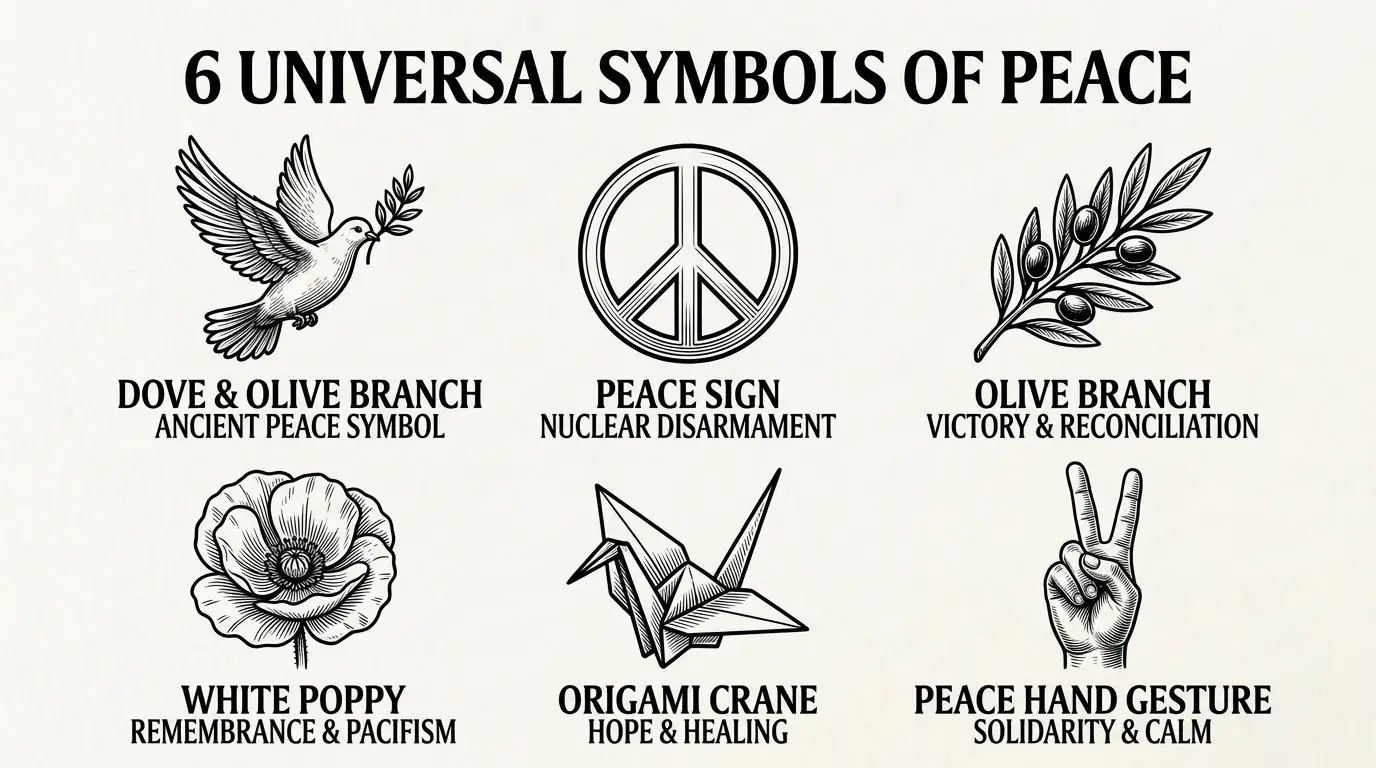
Peace is a simple word with a deep meaning. It can describe the absence of war, a peaceful relationship between people, freedom from conflict, or a calm state of mind. Throughout history, people have used images, objects, gestures, colors, and cultural symbols to communicate these ideas without saying many words.
The most recognizable symbols that represent peace include the dove, olive branch, peace sign, white flag, and paper crane. Other symbols, such as the lotus, yin-yang, open hands, rainbow, and peace bell, can represent related ideas such as harmony, reconciliation, inner peace, hope, and cooperation.
Not every peaceful image has the same historical meaning. Some symbols have ancient roots, while others were created for modern peace movements. Some are connected with particular cultures or religions. Learning the story behind each symbol makes it easier to understand why it represents peace and when it is appropriate to use it.
What Symbols Represent Peace?
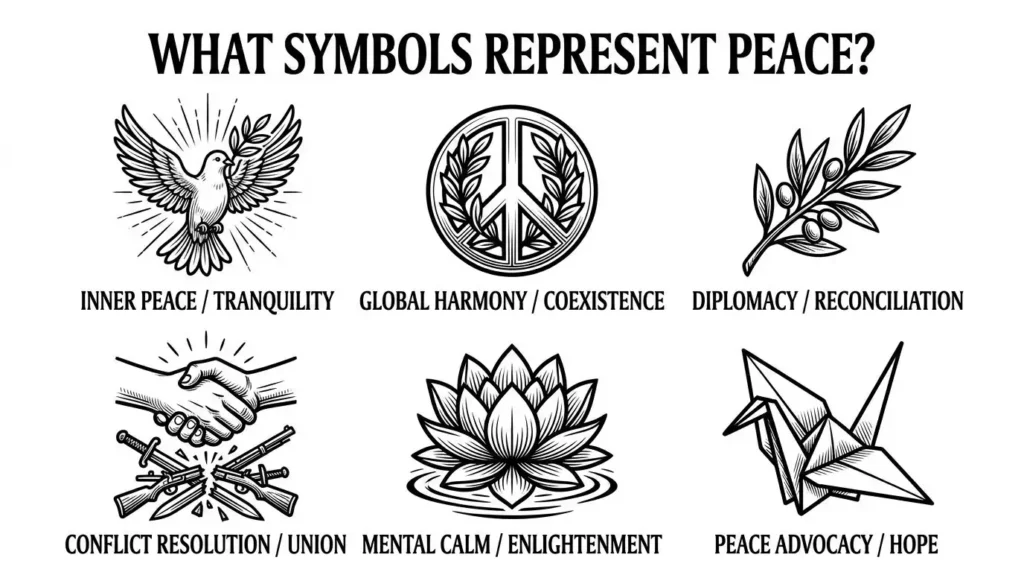
Symbols that represent peace are visual signs or objects that communicate ideas of nonviolence, harmony, reconciliation, friendship, calmness, hope, or cooperation.
Some are closely connected with actual peace movements, while others developed through religious, cultural, or historical traditions.
Here are some of the most widely recognized examples:
- White dove
- Olive branch
- Peace sign
- White flag
- Paper crane
- Peace bell
- Lotus flower
- Yin-yang
- Open hands
- Heart
- Rainbow
- Calm water
- White color
These symbols should not all be treated as interchangeable. A dove can represent general peace and hope, an olive branch can suggest reconciliation, and a white flag traditionally communicates surrender or a request for a truce.
Understanding these differences helps you choose a symbol that matches your intended message.
Most Recognized Symbols That Represent Peace
White Dove
The white dove is one of the most familiar images associated with peace.
Doves have appeared in religious art, literature, and cultural traditions with associations that include peace, hope, purity, and renewal. A dove carrying an olive branch is especially recognizable as a peace image.
The modern popularity of the dove as a peace symbol was also influenced by twentieth-century art and peace movements. Pablo Picasso’s famous dove imagery, created after World War II, helped make the dove an internationally recognizable representation of peace.
A white dove can symbolize:
- Peace
- Hope
- Reconciliation
- Nonviolence
- Purity
- Freedom
- A peaceful new beginning
The dove is a particularly useful symbol when the message is broad and positive rather than focused on a specific political movement.
Dove With an Olive Branch
A dove by itself and a dove carrying an olive branch can communicate slightly different ideas.
The combination of the two creates a particularly strong message of peace and reconciliation. The dove is associated with peacefulness, while the olive branch has a long history as a symbol of peace and settlement.
This image is often used in:
- Peace campaigns
- Religious artwork
- Memorials
- Children’s artwork
- School projects
- Posters
- Ceremonies
It can also symbolize the hope that conflict has ended and a more peaceful period is beginning.
Olive Branch
The olive branch is one of the oldest and most recognizable symbols associated with peace and reconciliation.
Its history reaches back to ancient Mediterranean cultures. Olive trees were highly important in the ancient Mediterranean world, and olive branches became connected with ideas of victory, peaceful intentions, and reconciliation.
The olive branch also has an important place in the biblical story of Noah, in which a dove returns with a fresh olive leaf after the flood. This image became strongly associated with hope and the return of peace.
Today, the expression “extend an olive branch” means to make a peaceful gesture or attempt to resolve a disagreement.
An olive branch can represent:
- Peace
- Reconciliation
- Forgiveness
- Friendship
- Truce
- Hope
- Resolution
If you want a symbol specifically connected with making peace after an argument or conflict, the olive branch is one of the strongest choices.
Peace Sign
The peace sign, ☮, is one of the most recognizable modern symbols of peace.
British artist and designer Gerald Holtom created the symbol in 1958 for the Campaign for Nuclear Disarmament. Its design incorporated semaphore signals representing the letters “N” and “D,” referring to nuclear disarmament.
The symbol later became widely associated with anti-war and peace movements, particularly during the 1960s and 1970s.
Today, the peace sign can represent:
- Peace
- Anti-war activism
- Nuclear disarmament
- Nonviolence
- Social movements
- Hope for peaceful change
Unlike the olive branch, which has ancient associations, the peace sign has a specific modern historical origin.
White Flag
The white flag is often recognized as a symbol connected with peace, but its meaning is more specific than simply “peace.”
Historically, displaying a white flag can indicate surrender, a desire for a truce, or an intention to stop fighting. Its meaning is therefore closely related to conflict resolution.
A white flag can communicate:
- Surrender
- Truce
- Ceasing hostilities
- Negotiation
- A willingness to stop fighting
For this reason, it is better to call the white flag a symbol of truce or surrender rather than saying it universally means peace.
It is particularly useful in historical discussions about warfare and negotiations.
Paper Crane
The paper crane has become an internationally recognized symbol of peace, hope, and remembrance, particularly because of its association with Japan and the aftermath of the atomic bombing of Hiroshima.
In Japanese culture, folding one thousand origami cranes, known as senbazuru, has been associated with wishes, healing, and good fortune. The story of Sadako Sasaki, a young survivor of the Hiroshima bombing who folded paper cranes while seriously ill, helped connect the crane with peace and the hope of preventing future nuclear warfare.
Today, paper cranes are frequently used in:
- Peace education
- Memorial ceremonies
- Anti-nuclear campaigns
- School activities
- Art projects
- Messages of hope
The paper crane is especially meaningful when peace is being discussed in relation to war, remembrance, and the protection of future generations.
Peace Bell
A peace bell can symbolize international cooperation and the shared desire to avoid war.
One well-known example is the Peace Bell at United Nations Headquarters in New York. It was donated by the United Nations Association of Japan in 1954 and became associated with international peace and cooperation.
A bell has an interesting symbolic quality because its sound can bring people’s attention together. A peace bell can therefore represent a collective call for peaceful action.
It can symbolize:
- International peace
- Unity
- Cooperation
- Remembrance
- Hope
- A shared commitment to peace
Symbols of Peace and Their Meanings
Different people may use peace symbols for different purposes. Organizing them according to their meaning can make it easier to find the right one.
Symbols of Peace and Reconciliation
When the goal is to communicate forgiveness or the restoration of a relationship, these symbols work well:
- Olive branch
- Dove
- Handshake
- Open hands
- Joined hands
The olive branch is particularly appropriate because “extending an olive branch” is commonly understood as making a peaceful gesture toward another person.
A handshake can suggest an agreement, while joined hands can communicate cooperation and mutual understanding.
Symbols of Peace and Hope
Peace is often connected with hope for a better future.
Symbols that can communicate this idea include:
- Dove
- Paper crane
- Rainbow
- Sunrise
- Growing plant
- Candle
These are not all traditional peace symbols. Some are visual metaphors that have acquired peaceful meanings through common use.
A paper crane can be especially meaningful when hope is connected with remembrance and the desire to prevent future wars.
Symbols of Peace and Unity
Peace often depends on people working together.
Common images of unity include:
- Joined hands
- Interlocking circles
- People standing together
- Doves flying together
- A circle
- A globe surrounded by people
These symbols are useful for community events, school posters, humanitarian campaigns, and messages about cooperation.
Symbols of Peace and Freedom
Peace and freedom are closely connected in many historical contexts.
Symbols that can communicate these ideas include:
- Peace sign
- Broken chains
- Open hands
- White dove
- Open door
- Bird in flight
Some of these are general metaphors rather than historically established peace symbols. When using them in educational material, it is helpful to explain the specific message they are intended to communicate.
Symbols That Represent Inner Peace
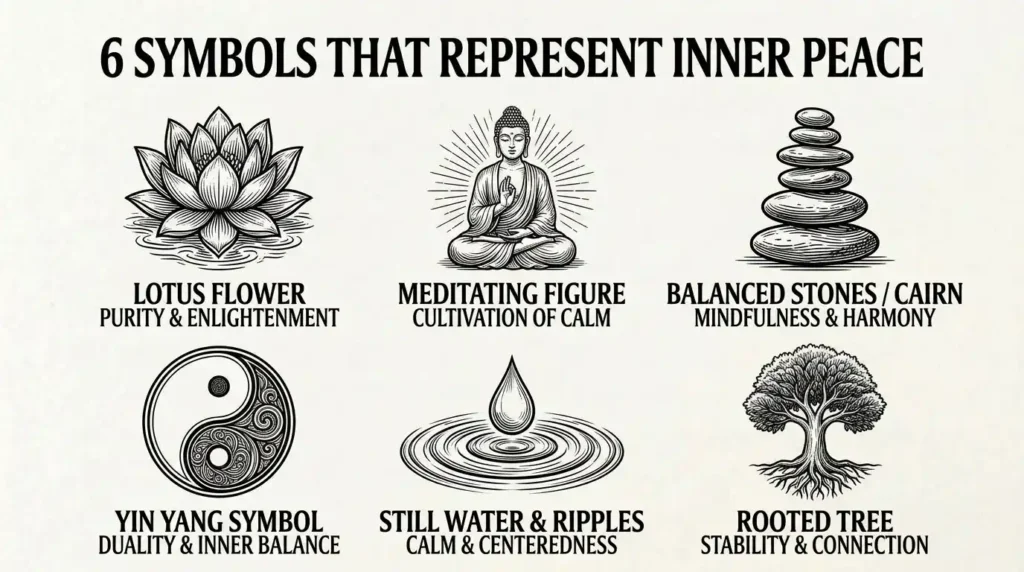
Peace does not always mean an end to war or conflict between groups. It can also describe a calm and balanced state within an individual.
For inner peace, symbols with spiritual or natural associations may be more appropriate.
Lotus Flower
The lotus is an important symbol in several Asian religious and cultural traditions.
Because the lotus grows from muddy water while producing a clean and beautiful flower, it has been used to express ideas such as purity, spiritual growth, transformation, and renewal.
In Buddhist traditions, the lotus has important associations with spiritual development and awakening.
Depending on the context, it can represent:
- Inner peace
- Purity
- Spiritual growth
- Renewal
- Wisdom
- Enlightenment
- Resilience
The lotus should therefore be described as a symbol associated with inner or spiritual peace in particular traditions rather than as a universal international peace symbol.
Yin-Yang
The yin-yang symbol is associated with Chinese philosophy and ideas of complementary forces, balance, and harmony.
It is not simply a traditional “peace symbol.” Its connection to peace comes from the broader concepts of balance and harmonious coexistence.
The yin-yang can therefore represent:
- Balance
- Harmony
- Interdependence
- Complementary forces
- Emotional or philosophical equilibrium
It can be a good choice when the intended message is harmony and balance rather than political peace.
Calm Water and Nature
Calm water, mountains, trees, clouds, and peaceful landscapes are often used as visual representations of tranquility.
These are not standardized peace symbols, but they can effectively communicate:
- Stillness
- Relaxation
- Calmness
- Stability
- Reflection
- Inner peace
They work particularly well in meditation artwork, wellness designs, and personal messages.
Peace Symbols From Different Cultures
Peace symbolism does not belong to one country or one historical period. Different societies have developed their own ways of expressing harmony, reconciliation, hope, and nonviolence.
Dove and Olive Branch
The dove and olive branch have deep roots in Mediterranean, biblical, and Western cultural traditions. Their combination became one of the most familiar images of peace in modern international culture.
Japanese Paper Crane
The paper crane has a particularly strong association with peace and remembrance because of its connection with Hiroshima and the stories surrounding origami cranes.
It is often used to communicate hope for a world without nuclear war.
Asian Lotus Symbolism
The lotus carries important meanings in several Asian religious and cultural traditions. Its association with purity, spiritual growth, and awakening makes it particularly appropriate when the intended message is inner peace.
Chinese Yin-Yang
The yin-yang comes from Chinese philosophical traditions and represents complementary aspects that exist in relationship with each other.
Its strongest connection to peace is through balance and harmony rather than through a specific historical peace movement.
Symbols That Represent Peace and Love
Peace and love are often connected because compassion and respect can help prevent conflict.
Common choices include:
- Heart
- Dove
- Olive branch
- Joined hands
- Flowers
The heart is primarily a symbol of love, but it can represent peace when used in a message about compassion, kindness, and human connection.
A dove can communicate peaceful love, while an olive branch can suggest forgiveness and reconciliation.
For a simple design, combining a heart with an olive branch can communicate both affection and peaceful intentions.
Symbols That Represent Peace and Friendship
Friendship depends on trust, communication, respect, and cooperation, all of which can contribute to peaceful relationships.
Symbols that can represent peace and friendship include:
- Handshake
- Joined hands
- Heart
- Dove
- Olive branch
- Interlocking circles
A handshake is especially useful when the message is about agreement or resolving differences.
Joined hands can represent people supporting one another despite their differences.
Symbols That Represent Peace and Harmony
Harmony means different people or elements existing together in a cooperative or balanced way.
Useful symbols include:
- Yin-yang
- Interlocking circles
- Joined hands
- Musical notes
- Rainbow
- Circle
The yin-yang is particularly suitable when discussing balance, while joined hands work well for social or community harmony.
Musical imagery can also represent harmony because different sounds can work together to create one composition.
Symbols That Represent Peace for School Projects
Peace symbols can make excellent subjects for school projects because students can investigate their history, cultural background, and meaning.
A strong project should answer three simple questions:
- What is the symbol?
- Where did it come from?
- Why does it represent peace?
Easy Peace Symbols to Draw
Some of the easiest peace-related symbols for students to draw include:
- Peace sign
- Dove
- Olive branch
- Heart
- Rainbow
- Lotus
- Paper crane
- White flag
Younger students can draw one symbol and write a few sentences about its meaning.
Older students can research the historical development of the symbol and compare it with other peace symbols.
Peace Poster Ideas
A peace poster becomes more meaningful when it combines an image with an educational message.
For example:
Dove + “Choose Peace”
A simple design focused on nonviolence.
Olive branch + two hands
A message about reconciliation.
Paper crane + world map
A message about global peace and remembrance.
Peace sign + historical timeline
A project about modern peace movements.
Lotus + calm landscape
A design focused on inner peace.
The goal should be to explain the relationship between the images rather than filling the poster with unrelated symbols.
Classroom Peace Symbol Activities
Teachers can ask students to research a peace symbol and present:
- Its name
- Its historical origin
- Its cultural background
- Its meaning
- Where it is used today
- Why the student thinks it represents peace
Another activity is to ask students to design their own peace symbol and explain the ideas behind their design.
This approach teaches students that symbols are visual forms of communication rather than simply decorative pictures.
Peace Symbols for Tattoos, Art, and Logos
People often choose peace symbols for tattoos and artwork because they want to express personal values such as calmness, forgiveness, hope, or nonviolence.
Peace Tattoo Symbols
Popular choices include:
- Olive branch
- Dove
- Peace sign
- Lotus
- Paper crane
- Yin-yang
- Minimalist heart
- Open hands
The olive branch is a good choice for reconciliation, while a lotus may better express inner peace.
Before using a culturally specific symbol as a tattoo, research its original meaning carefully. A symbol may have religious or cultural significance that goes beyond the simplified meaning commonly found online.
Peace Symbols for Logos
For a logo, simplicity is usually more effective than combining many symbols.
A dove or olive branch can communicate peaceful intentions quickly. A globe combined with an olive branch can suggest international cooperation, while joined hands can emphasize community.
The right choice depends on the organization’s purpose and audience.
How to Choose the Right Peace Symbol
The best peace symbol depends on the message you want to communicate.
For General Peace
Choose a dove, olive branch, or peace sign.
For Reconciliation
The olive branch is an excellent choice because of its long association with peaceful gestures.
For Anti-War Messages
The peace sign is particularly appropriate because of its connection with nuclear disarmament and peace activism.
For a Truce
A white flag communicates surrender or a request to stop fighting.
For Inner Peace
A lotus or other culturally appropriate spiritual symbol may be a better choice.
For Hope
A paper crane, dove, sunrise, or rainbow can communicate hope for a peaceful future.
For Unity
Joined hands, interlocking circles, or a globe can communicate cooperation and togetherness.
Established Peace Symbols vs. General Peaceful Imagery
Not every peaceful-looking image has a formal historical status as a peace symbol.
Understanding the difference can prevent misleading information.
| Symbol | Main Association | Type of Symbol |
| Dove | Peace and hope | Widely recognized peace imagery |
| Olive branch | Peace and reconciliation | Historic peace symbol |
| Peace sign | Peace and disarmament | Modern peace symbol |
| White flag | Surrender or truce | Conflict-related symbol |
| Paper crane | Peace and remembrance | Cultural peace imagery |
| Peace bell | International cooperation | Institutional peace symbol |
| Lotus | Inner peace and spiritual growth | Cultural/religious symbol |
| Yin-yang | Balance and harmony | Philosophical symbol |
| Heart | Love and compassion | General symbolic imagery |
| Rainbow | Hope and unity | General symbolic imagery |
| Calm water | Tranquility | Visual metaphor |
| Open hands | Cooperation | General symbolic imagery |
This distinction is important because it prevents readers from assuming that every image associated with calmness has the same historical meaning.
Common Mistakes When Using Peace Symbols
One common mistake is treating all peace symbols as if they originated from the same culture. They do not. Some have ancient roots, some belong to particular cultural traditions, and others were created during modern political movements.
Another mistake is confusing peace with surrender. A white flag has a specific historical association with surrender or truce and should not always be described as a general symbol of peaceful living.
It is also easy to overlook the difference between outer peace and inner peace. A peace sign is connected with social and political peace, while a lotus may be more appropriate for spiritual calm.
Another issue is removing symbols from their cultural context. The lotus and yin-yang have histories that deserve more explanation than a simple one-word definition.
Finally, avoid assuming that a symbol has exactly the same meaning everywhere. Symbolism can change across cultures, religions, historical periods, and social movements.
Quick Reference: Symbols That Represent Peace
| Symbol | Meaning | Best Use |
| White dove | Peace, hope, reconciliation | General peace messages |
| Olive branch | Peace, forgiveness, reconciliation | Conflict resolution |
| Peace sign | Peace, anti-war activism, disarmament | Modern peace campaigns |
| White flag | Surrender or truce | Conflict and military history |
| Paper crane | Hope, peace, remembrance | Peace education |
| Peace bell | International cooperation | Global peace events |
| Lotus | Inner peace, purity, spiritual growth | Spiritual themes |
| Yin-yang | Balance and harmony | Philosophical themes |
| Open hands | Cooperation and openness | Community messages |
| Heart | Love and compassion | Peace and love themes |
| Rainbow | Hope and unity | Positive peace artwork |
| Calm water | Tranquility and stillness | Inner peace designs |
Frequently Asked Questions
What is the most famous symbol of peace?
The white dove, olive branch, and peace sign are among the world’s most recognizable peace symbols. Each has a different history and communicates peace in a slightly different way.
What animal symbolizes peace?
The dove is the animal most commonly associated with peace. A dove carrying an olive branch is an especially recognizable image of peace and reconciliation.
What flower represents peace?
The lotus is commonly associated with inner peace, purity, spiritual growth, and renewal in several Asian cultural and religious traditions. It is best understood in its specific cultural context rather than as a universal peace symbol.
What does an olive branch symbolize?
An olive branch commonly represents peace, reconciliation, forgiveness, friendship, and the desire to resolve conflict. Extending an olive branch means making a peaceful gesture toward someone.
Why is the peace sign a symbol of peace?
The modern peace sign was created in 1958 for the Campaign for Nuclear Disarmament. It later became widely associated with anti-war, peace, and disarmament movements.
What does a white flag represent?
A white flag traditionally represents surrender, a truce, or a request to stop fighting. Its meaning is more specific than simply representing general peace.
What symbol represents inner peace?
The lotus is a popular symbol associated with inner peace and spiritual growth. The yin-yang can also represent balance and harmony, depending on the intended context.
What symbol represents peace and love?
A heart, dove, or olive branch can represent peace and love. A heart emphasizes compassion and affection, while an olive branch places greater emphasis on reconciliation.
What symbol represents peace and unity?
Joined hands, interlocking circles, a dove, and a globe can all communicate peace and unity. These images emphasize cooperation and togetherness.
What is a good peace symbol for a school project?
A dove, olive branch, peace sign, paper crane, or lotus can make a good school project subject. Students should explain the symbol’s origin, meaning, and connection to peace rather than using it only as decoration.
What is an easy peace symbol to draw?
The peace sign, dove, heart, olive branch, rainbow, and white flag are relatively simple designs for students and beginners. A paper crane is also a meaningful choice if the project includes an origami activity.
What symbol represents peace after war?
An olive branch can represent reconciliation after conflict, while a paper crane can represent remembrance and hope for a world without war. A white flag traditionally communicates surrender or a truce.
Conclusion
Symbols that represent peace can communicate much more than a simple message of calmness. The dove and olive branch are strongly associated with peace and reconciliation, while the modern peace sign carries a specific connection to nuclear disarmament and anti-war movements. The paper crane represents hope and remembrance in a particularly powerful historical context, while the white flag is more specifically connected with surrender and truce.
Other symbols express different forms of peace. The lotus can represent inner and spiritual peace, the yin-yang can suggest balance and harmony, and joined hands can communicate cooperation and unity. General images such as hearts, rainbows, mountains, and calm water can also express peaceful ideas when used in the right context.
The most meaningful way to use a peace symbol is to understand its history and purpose first. Whether you need a symbol for a school project, poster, tattoo, artwork, logo, ceremony, or personal message, choosing an image that matches the exact kind of peace you want to express makes the message clearer and more respectful.

Adam Sullivan is a dedicated writer who enjoys transforming everyday topics into engaging and informative content. His writing focuses on making complex ideas simple, practical and enjoyable for readers of all backgrounds. Adam is also the fictional author of The Lantern Beyond Autumn Hills and Where the Morning Horizon Waits. Outside of writing, he enjoys photography, traveling and discovering inspiration through new experiences. He believes great content should be both helpful and easy to connect with.
 Dylan Anderson