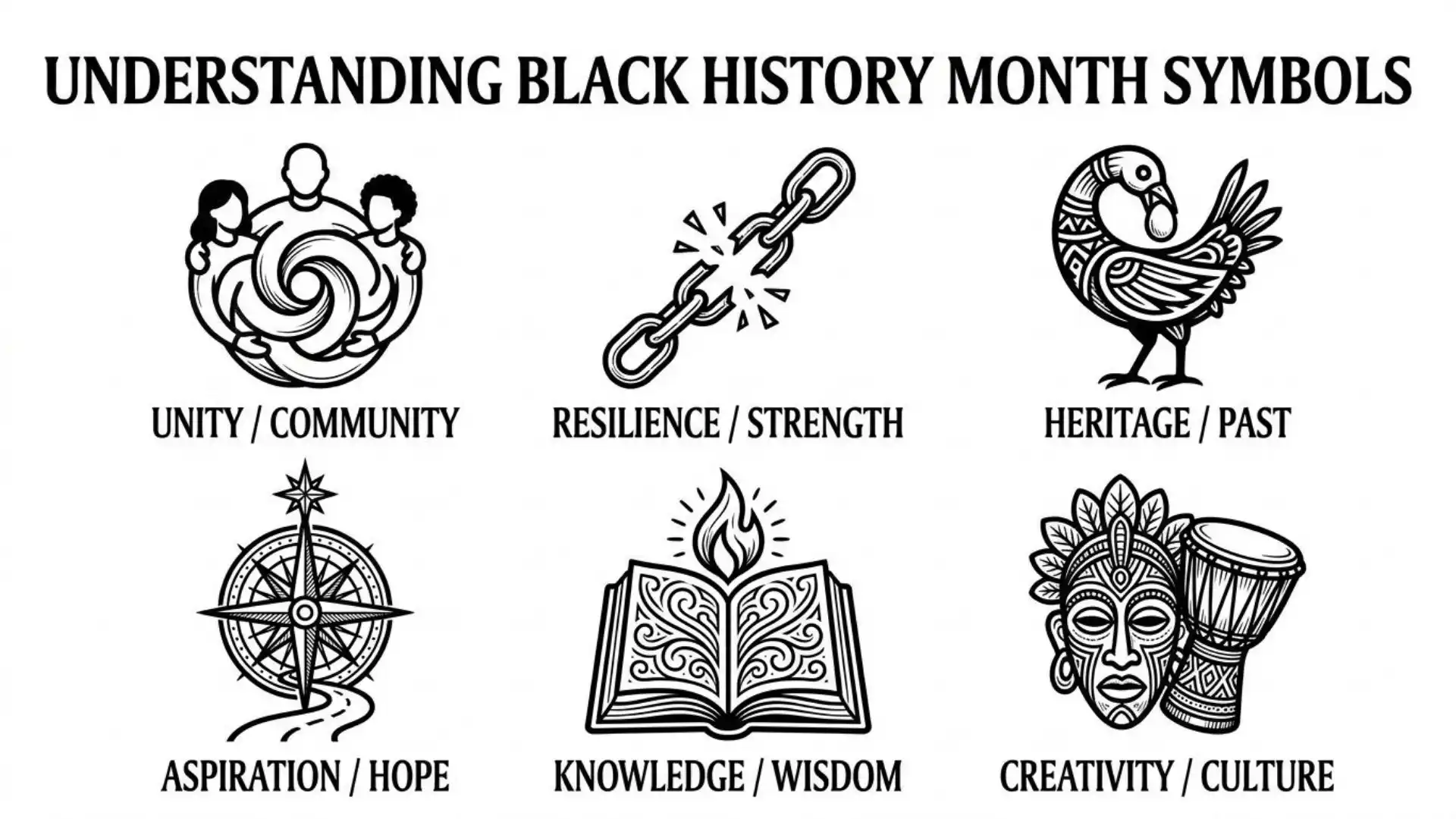
Black History Month is a time to learn, remember, celebrate, and recognize the many contributions of Black people to history and society. One way people express these ideas is through Black History Month symbols. Flags, colors, cultural signs, historical images, books, musical imagery, and freedom-related symbols can all help communicate different parts of Black history.
However, there is an important point to understand: Black History Month does not have one universal official symbol. Different symbols are connected to different histories, cultures, movements, and ideas. The Pan-African flag, for example, is strongly associated with Black identity and African heritage, while Sankofa comes from Akan cultural traditions and is connected with learning from the past.
Understanding where a symbol comes from is just as important as understanding what it means. When used thoughtfully, these symbols can make a classroom lesson, poster, presentation, cultural event, or personal artwork more meaningful.
What Are Black History Month Symbols?
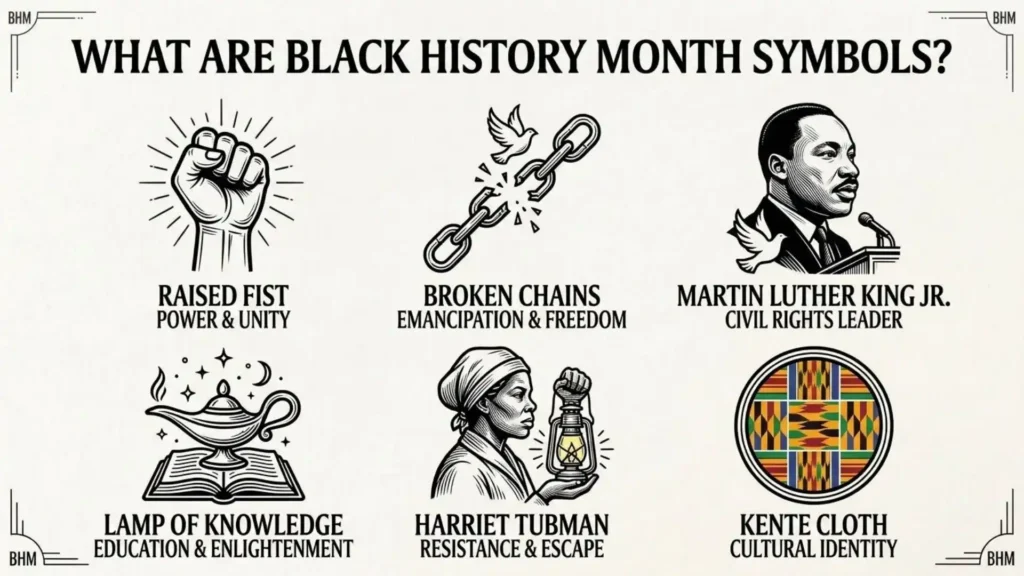
Black History Month symbols are visual signs, colors, objects, or images that can help represent themes connected with Black history and culture. They may express ideas such as heritage, identity, freedom, education, unity, achievement, remembrance, creativity, and hope.
Some symbols have a direct connection to African American history. Others come from African cultures, Pan-African movements, civil rights activism, or broader traditions of visual symbolism.
This means that a symbol should not automatically be called an “official Black History Month symbol.” A more accurate description is that it is commonly associated with Black history, Black identity, African heritage, or themes celebrated during Black History Month.
Symbols can be especially helpful because they turn complex historical ideas into something people can see and remember.
Is There an Official Black History Month Symbol?
No single symbol is universally recognized as the official symbol of Black History Month.
Black History Month is a month-long observance focused on learning about African American history, achievements, experiences, and contributions. It developed from Negro History Week, which Carter G. Woodson established in 1926. In 1976, the observance was expanded to the entire month of February in the United States.
Because the purpose of Black History Month is broad, there is no single image that can represent every person, event, achievement, culture, or historical experience included in Black history.
The Pan-African flag is one of the most recognizable symbols connected with Black identity, African heritage, unity, and liberation. Other symbols, such as Sankofa, may represent particular cultural ideas rather than Black History Month itself.
This distinction is important when creating educational content. A symbol can be highly relevant to Black History Month without being an official symbol of the observance.
Black History Month Symbols and Their Meanings
Different symbols communicate different ideas. The following are among the most useful symbols to understand when researching Black history and cultural heritage.
Pan-African Flag
The Pan-African flag is one of the most recognizable visual symbols associated with Black identity and African heritage.
It uses three main colors:
- Red
- Black
- Green
The flag is closely connected with the Pan-African movement and the Universal Negro Improvement Association and African Communities League associated with Marcus Garvey. It became a visual expression of unity and pride among people of African descent.
The flag is especially relevant during Black History Month because it can represent connections between African heritage and Black communities throughout the African diaspora.
It is important, however, to distinguish the Pan-African flag from a specific official Black History Month flag. It represents a much broader cultural and political history.
Pan-African Colors
Red, black, and green are often seen in Black History Month decorations, posters, artwork, and educational displays because of their connection to the Pan-African flag.
Their commonly understood associations include:
Red: Often connected with sacrifice, struggle, and the blood shared through historical experiences.
Black: Represents Black people, identity, and the people of African descent connected through the Pan-African idea.
Green: Associated with Africa, its land, natural wealth, and the idea of connection to the African homeland.
These meanings are connected to Pan-African symbolism rather than being a universal official color code for every Black History Month celebration.
Sankofa Symbol
Sankofa is an important symbol from the Akan cultural tradition of West Africa. It is often represented by a bird looking backward while moving forward, sometimes with an egg held in its beak.
The central idea is that people should look to the past, recover useful knowledge, and carry that knowledge into the future.
This makes Sankofa particularly meaningful in the context of Black History Month. Studying history is not simply about remembering old events. It can also help people understand the present and make better decisions about the future.
Sankofa can therefore represent:
- Learning from history
- Remembering one’s roots
- Cultural knowledge
- Ancestral wisdom
- Reflection
- Moving forward with understanding
Sankofa should be identified as an Akan cultural symbol rather than described as a symbol that originated with Black History Month.
Adinkra Symbols
Adinkra symbols come from Akan cultural traditions in West Africa. These visual symbols can communicate ideas, values, beliefs, and philosophical concepts.
Sankofa is one example, but it is only one part of the broader Adinkra tradition.
Different Adinkra symbols can communicate different concepts, including ideas related to wisdom, independence, strength, responsibility, humility, faith, and unity.
This makes Adinkra symbols valuable for cultural education during Black History Month. They can help students and readers understand that African history includes rich systems of art, communication, philosophy, and visual storytelling.
When using an Adinkra symbol, it is best to identify its specific name, cultural origin, and meaning rather than treating all African symbols as interchangeable.
Raised Fist
The raised fist is a widely recognized image of resistance, solidarity, determination, and collective action.
It has appeared in different social and political movements around the world. In Black American history, it became particularly associated with Black Power and struggles for racial justice.
During Black History Month, the raised fist may communicate:
- Resistance to injustice
- Solidarity
- Strength
- Empowerment
- Collective action
- Determination
Because the raised fist has been used by many movements, it is better to explain its historical context instead of claiming that it belongs exclusively to Black History Month.
Broken Chains
Broken chains are a common visual representation of freedom and liberation.
In discussions of African American history, chains can evoke the history of slavery and the long struggle for freedom. Broken chains can therefore symbolize emancipation, liberation, resistance, and the rejection of oppression.
This imagery can be especially appropriate when teaching about slavery, emancipation, abolition, or freedom movements.
At the same time, Black history should not be reduced to slavery and oppression. Freedom imagery is one part of a much larger history that also includes achievement, creativity, leadership, family, education, science, literature, music, and community.
Open Book
An open book can symbolize education, knowledge, historical memory, and the importance of learning.
This image has a particularly meaningful connection with Black History Month because Carter G. Woodson emphasized the importance of studying and teaching Black history.
A book can therefore work well in:
- Classroom displays
- Library decorations
- Student projects
- Historical presentations
- Educational posters
The symbol also reminds readers that preserving history requires research, reading, documentation, and the sharing of knowledge.
Music and Musical Symbols
Music is an important part of African American cultural history. Spirituals, gospel, blues, jazz, soul, hip-hop, and many other musical traditions have contributed to American culture and influenced music around the world.
Musical notes, microphones, instruments, records, and other music-related images can therefore be used in Black History Month materials when they are connected with specific historical or cultural stories.
Music can represent:
- Creativity
- Cultural expression
- Community
- Storytelling
- Innovation
- Joy
- Social commentary
Instead of simply placing musical notes on a poster, a stronger project could connect an instrument or musical genre with a particular artist, period, or cultural development.
What Do the Black History Month Colors Mean?
In historical and cultural contexts, it can remind viewers of the sacrifices made by generations who fought for freedom, dignity, and equality.
Black
Black represents Black people and Black identity within the Pan-African color tradition.
It can also communicate cultural pride, community, and a shared connection among people of African descent.
Green
Green is associated with Africa, including its land and natural resources. It can also suggest growth, renewal, and a continuing connection to African heritage.
Together, the three colors provide a recognizable visual connection to Pan-African identity.
They should not, however, be described as a mandatory or universal color scheme for every Black History Month event.
Black History Month Symbols and Their Historical Origins
Understanding a symbol becomes easier when its history is clear.
Carter G. Woodson and the Origins of Black History Month
Carter G. Woodson played a major role in developing the observance that eventually became Black History Month.
In 1926, Woodson and the Association for the Study of Negro Life and History established Negro History Week. The event encouraged schools and communities to learn about Black history at a time when African American contributions were frequently overlooked or inadequately represented.
The observance expanded over the following decades. In 1976, President Gerald Ford officially recognized Black History Month as part of the country’s bicentennial observance.
This history explains why education remains at the center of Black History Month.
The Pan-African movement promoted ideas of solidarity and connection among people of African descent around the world.
This is why the flag can be relevant to Black History Month even though it is not an official symbol of the observance itself.
African Cultural Traditions
Black history is not limited to African American history in the United States. The African continent contains hundreds of cultures and many different traditions of art, language, symbolism, religion, philosophy, and storytelling.
Symbols such as Sankofa and other Adinkra designs can introduce readers to West African cultural history.
When these symbols are used, naming their cultural origin is important. Africa is a vast continent, and a symbol from Ghana should not automatically be described as representing every African culture.
Civil Rights and Black Power
The twentieth-century struggle for racial equality produced many powerful images and forms of visual expression.
The raised fist is one example. It became associated with Black Power and broader ideas of resistance and solidarity.
Other imagery connected with civil rights history can include protest signs, photographs, historic marches, voting imagery, and portraits of activists.
These images are most meaningful when paired with historical information.
Black History Month Symbols for School Projects
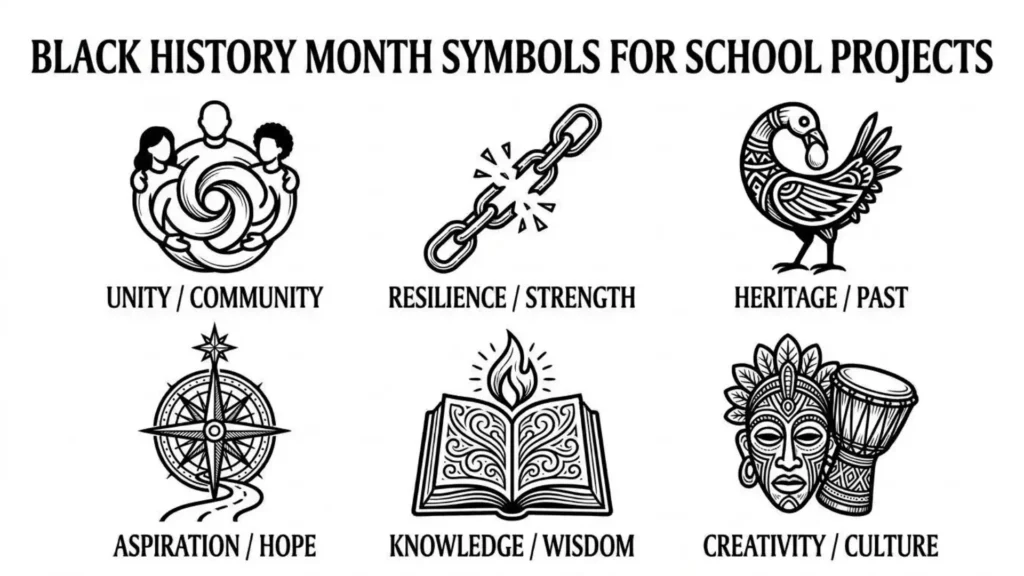
Students often need symbols for posters, presentations, bulletin boards, essays, and classroom activities.
A good project should do more than decorate a page. It should explain what the selected symbol means and why it is historically relevant.
Elementary School Ideas
For younger students, simple symbols can make history easier to discuss.
Possible choices include:
- An open book for learning
- A heart for community
- Pan-African colors for heritage
- A musical note for cultural expression
- A dove for peace
- A portrait of an important historical figure
Teachers can ask students to draw one symbol and write two or three sentences explaining it.
Middle School Ideas
Middle school students can go further by researching the origins of individual symbols.
For example, a student could create a project about Sankofa that includes:
- The name of the symbol
- Its Akan origin
- A drawing of the symbol
- Its meaning
- Its connection to learning history
- A short reflection on why remembering history matters
Another option is to compare the Pan-African flag with another historical symbol and explain how their meanings developed.
High School Ideas
Older students can explore the historical context behind symbols more deeply.
Possible projects include:
- The history of the Pan-African flag
- Symbols of the civil rights movement
- African cultural symbolism
- The relationship between art and activism
- Music as a form of cultural expression
- How historical symbols change meaning over time
Students can also compare how a symbol was used historically with how it is used today.
Black History Month Symbols for Posters and Bulletin Boards
A strong Black History Month poster should communicate an idea rather than simply contain many images.
One effective approach is to combine a symbol, a historical figure, and a short educational message.
For example, a poster might use Pan-African colors alongside a portrait of a historical figure and a sentence explaining that person’s contribution.
Another design could use Sankofa with a message about learning from the past.
An open book could be combined with names of Black authors, educators, scientists, or scholars.
A musical design could highlight the contributions of Black musicians and musical traditions.
Simple Poster Symbol Combinations
Sankofa + open book: Learning from history.
Pan-African colors + historical portrait: Heritage and achievement.
Raised fist + civil rights photograph: Resistance and social change.
Musical notes + musician: Cultural creativity.
Broken chains + historical timeline: The history of freedom and emancipation.
The strongest designs explain the relationship between the images rather than using symbols randomly.
Black History Month Symbols That Represent Black Pride
Black pride can be represented through symbols connected with identity, heritage, achievement, and community.
The Pan-African flag is particularly relevant because of its connection with Black identity and African heritage.
African cultural patterns and symbols can also communicate pride in cultural heritage when their origins and meanings are respected.
Historical portraits can represent pride in achievement, especially when they highlight contributions in areas such as science, education, literature, art, business, sports, and public service.
The message of Black pride does not have to focus only on resistance. It can also celebrate creativity, excellence, family, culture, knowledge, and accomplishment.
Black History Month Symbols That Represent Freedom
Freedom is one of the major themes that can be explored through Black history.
Symbols that may communicate freedom include:
- Broken chains
- Open doors
- Raised fists
- Birds in flight
- Open hands
- Paths leading forward
Some of these are general symbols rather than specifically Black historical symbols.
For educational purposes, it is useful to connect them to actual historical events, people, and movements. This gives the visual message a stronger foundation and prevents the article or project from becoming overly generic.
How to Use Black History Month Symbols Respectfully
Cultural symbols deserve context and care.
Research the Origin
Before using a symbol, find out where it originated and what tradition it belongs to.
A symbol from an Akan tradition should be identified as Akan rather than simply being labeled “African.”
Explain the Meaning
Do not assume that an attractive symbol speaks for itself.
Add a short explanation of what it represents and why it is relevant to your project.
Avoid Mixing Cultures Carelessly
African cultures are diverse. Symbols from Ghana, Nigeria, Ethiopia, South Africa, Senegal, and other regions do not necessarily have the same history or meaning.
Specific cultural attribution makes educational material more accurate.
Include Achievement as Well as Struggle
Black History Month includes difficult historical subjects, but Black history is much broader.
Consider including stories about:
- Scientists
- Writers
- Artists
- Inventors
- Educators
- Entrepreneurs
- Athletes
- Musicians
- Community leaders
- Civil rights leaders
This creates a more complete picture of Black history.
Use Symbols as Starting Points for Learning
A symbol should invite questions.
For example, seeing Sankofa can lead to a lesson about Akan culture. Seeing the Pan-African flag can lead to research into Pan-Africanism. Seeing an open book can lead to a discussion about Carter G. Woodson.
That is where a symbol becomes more than decoration.
Black History Month Symbols: Quick Reference
| Symbol | Origin or Context | Common Association |
| Pan-African flag | Pan-African movement | Black identity, unity, African heritage |
| Red | Pan-African color | Sacrifice and struggle |
| Black | Pan-African color | Black identity and people of African descent |
| Green | Pan-African color | Africa, land, heritage, growth |
| Sankofa | Akan tradition | Learning from the past |
| Adinkra symbols | Akan traditions | Different cultural values and ideas |
| Raised fist | Various social movements; Black Power context | Resistance and solidarity |
| Broken chains | Freedom imagery | Liberation |
| Open book | Educational imagery | Knowledge and historical learning |
| Musical symbols | Cultural expression | Music, creativity, and heritage |
| Historical portraits | Black history | Achievement and remembrance |
This table is a starting point rather than a complete list. The meaning of a symbol can change according to its historical, cultural, and social context.
Common Mistakes When Using Black History Month Symbols
One common mistake is claiming that every symbol used during Black History Month is an official symbol. There is no single universal symbol that covers the entire observance.
Another mistake is presenting a general symbol as uniquely Black. For example, an open book can represent education in many contexts. Its relevance to Black History Month comes from the educational purpose of the observance and the importance of studying Black history.
A third mistake is using African symbols without identifying their cultural origins.
Finally, reducing Black History Month to slavery and civil rights struggles leaves out a huge part of Black history. Historical hardship matters, but so do innovation, creativity, leadership, cultural traditions, achievement, and everyday community life.
Frequently Asked Questions
What is the main symbol of Black History Month?
There is no single official symbol for Black History Month. The Pan-African flag is one of the most recognizable symbols associated with Black identity, African heritage, unity, and liberation.
What are the Black History Month colors?
Red, black, and green are commonly associated with Black History Month because they are the colors of the Pan-African flag. They are generally connected with sacrifice, Black identity, and Africa and its heritage.
What does the Sankofa symbol mean?
Sankofa is an Akan cultural symbol commonly associated with the idea of looking to the past, gaining knowledge from it, and carrying that knowledge into the future.
What does the raised fist symbolize?
The raised fist can represent resistance, solidarity, strength, determination, and collective action. It has been used by different movements and is strongly associated with Black Power in certain historical contexts.
What symbols can I use for a Black History Month school project?
Students can use symbols such as the Pan-African flag, Sankofa, an open book, music imagery, historical portraits, or freedom-related imagery. The best projects explain the origin and meaning of the selected symbol.
Is the Pan-African flag the official Black History Month flag?
No. The Pan-African flag is an important symbol of Black identity, African heritage, and Pan-African unity, but it is not a universal official flag for Black History Month.
What symbols represent Black pride?
The Pan-African flag, culturally specific African symbols, historical portraits, and imagery celebrating Black achievements can all communicate Black pride when used with appropriate historical context.
What symbols represent Black freedom?
Broken chains, raised fists, and other freedom-related imagery can represent liberation and resistance. Their meaning becomes more powerful when connected to specific historical events and movements.
Conclusion
Black History Month symbols provide visual ways to explore important ideas such as heritage, identity, education, freedom, unity, achievement, and cultural expression. The Pan-African flag and its colors are among the most recognizable symbols associated with Black identity, while Sankofa and Adinkra symbols provide connections to specific African cultural traditions.
There is no single official symbol that can represent the full meaning of Black History Month. Each symbol tells a different story, and understanding its origin makes its use more meaningful. Whether you are creating a classroom project, poster, presentation, bulletin board, or cultural display, the best approach is to combine visual symbolism with accurate historical information.
Most importantly, Black History Month is about more than symbols. The symbols are invitations to learn the stories, people, cultures, achievements, and experiences behind them.

Adam Sullivan is a dedicated writer who enjoys transforming everyday topics into engaging and informative content. His writing focuses on making complex ideas simple, practical and enjoyable for readers of all backgrounds. Adam is also the fictional author of The Lantern Beyond Autumn Hills and Where the Morning Horizon Waits. Outside of writing, he enjoys photography, traveling and discovering inspiration through new experiences. He believes great content should be both helpful and easy to connect with.
 Dylan Anderson