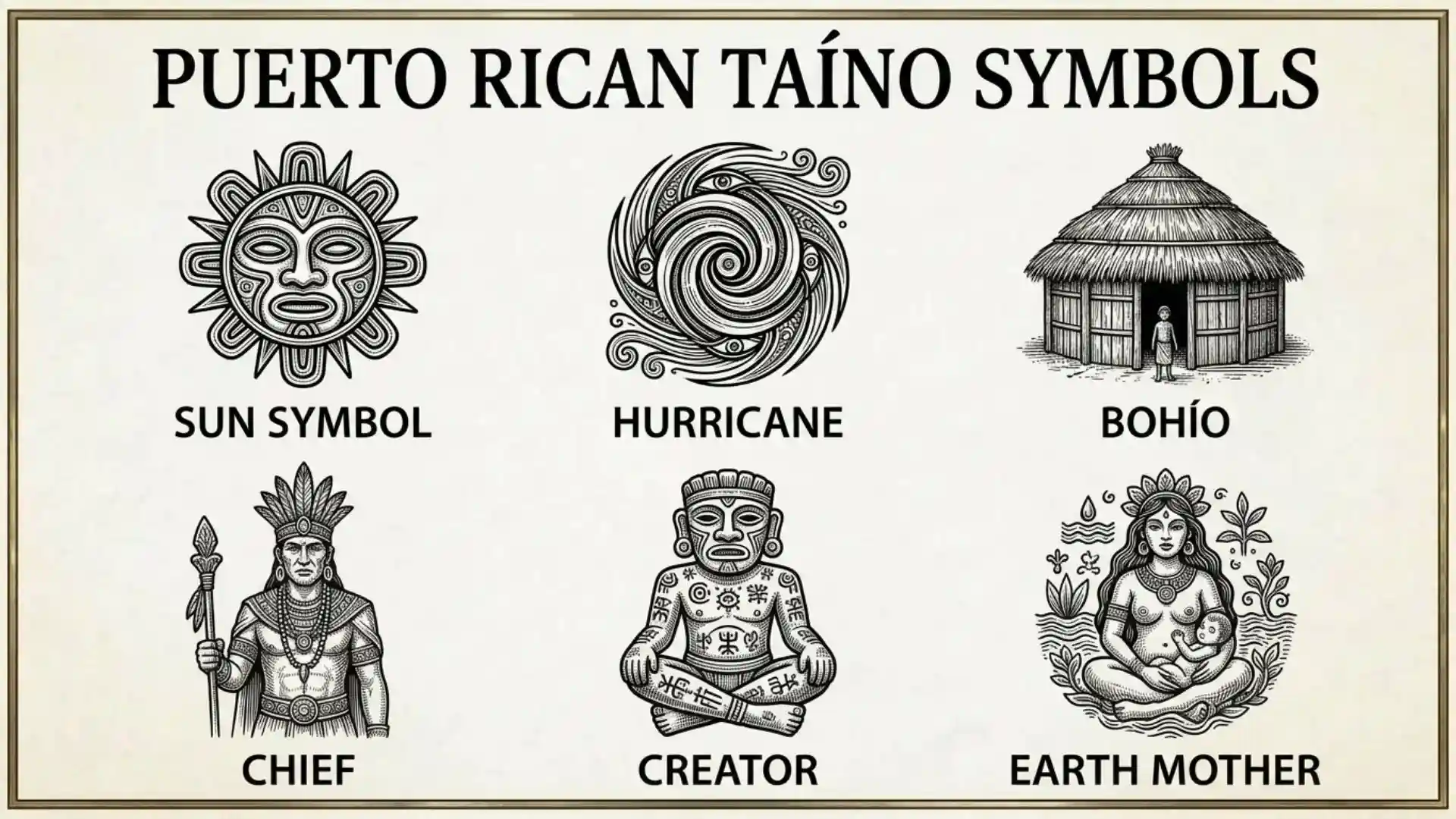
Puerto Rican Taíno symbols offer a fascinating connection to the Indigenous history of Puerto Rico and the wider Caribbean. You may have seen a carved face, spiral, animal figure, sun-like design, or cemí-inspired image and wondered what it means. The answer is not always as simple as a symbol dictionary suggests. Some meanings are supported by archaeology and historical evidence, while others are modern interpretations. In this guide, I’ll explain the most recognizable Puerto Rican Taíno symbols, what researchers can reasonably tell us about them, where they appear, and how to distinguish ancient evidence from modern tattoo symbolism.
What Are Puerto Rican Taíno Symbols?
Puerto Rican Taíno symbols are visual forms associated with the Indigenous Taíno people and their artistic, ceremonial, and spiritual traditions. They appear in rock carvings, pottery, carved objects, ceremonial items, and other archaeological materials.
Taíno Petroglyphs
A petroglyph is an image or design carved into a rock surface. Taíno-related petroglyphs have been found in places such as caves, near rivers, on large rocks, and around ceremonial spaces.
These carvings can look very different from one another. Some resemble human faces or bodies, some look like animals, and others are geometric or abstract.
Symbols Were Not a Simple Alphabet
One important point is often misunderstood online: Taíno petroglyphs should not automatically be treated as a written alphabet in which every picture represents one specific word or sound.
The Taíno language itself was not preserved as a conventional written language. Petroglyphs were part of a much broader visual and cultural tradition.
That means an image may have been connected with a person, supernatural being, ceremony, place, story, natural force, or cultural idea without functioning like a modern written sentence.
Why Meanings Can Be Difficult to Know
The original creators did not leave behind a complete symbol dictionary explaining every carving. Researchers therefore compare archaeological evidence, historical accounts, repeated motifs, locations, artifacts, and cultural context.
This is why a responsible explanation should sometimes say that the meaning of a symbol is uncertain rather than presenting a modern interpretation as historical fact.
Taíno Symbols and Meanings at a Glance
The following overview separates commonly discussed motifs from the meanings people often associate with them today.
| Symbol or Motif | What It Represents | Meaning or Interpretation |
| Cemí or zemí | Sacred being or spiritual power | Spirituality, ancestors, sacred power |
| Human face | Anthropomorphic imagery | Possible spiritual, ancestral, or human association |
| Animal figure | Zoomorphic imagery | Relationship with animals, nature, or spiritual ideas |
| Spiral | Curved geometric motif | Modern associations include cycles and continuity |
| Sun-like image | Celestial or natural imagery | Often interpreted today through light, life, and nature |
| Frog-like figure | Animal or supernatural imagery | Connected in some interpretations with water and fertility |
| Three-pointed stone | Ceremonial object | Often associated with agricultural and spiritual practices |
| Abstract geometric forms | Non-representational designs | Exact meaning frequently remains uncertain |
| Water-related imagery | Natural environment | Important connection to rivers, rain, and fresh water |
| Combined human-animal forms | Anthropomorphic or zoomorphic imagery | May relate to supernatural beings or ceremonial beliefs |
The most important detail is that these interpretations are not equally certain. A modern tattoo meaning should not automatically be presented as the original ancient meaning.
What Do Taíno Petroglyphs Actually Mean?
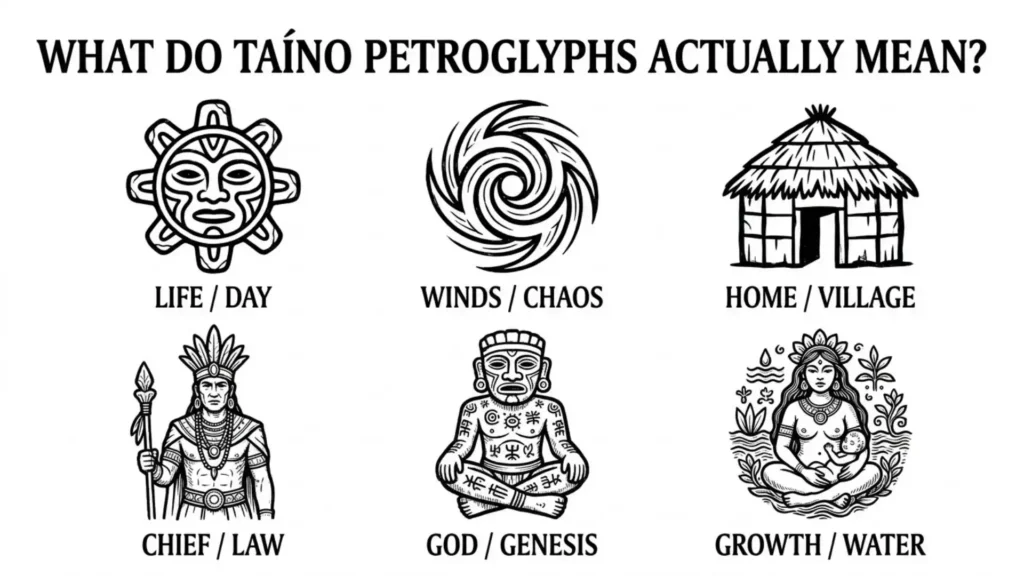
There is no single answer because Taíno rock art includes different kinds of imagery and was created in different settings.
Anthropomorphic Figures
Anthropomorphic designs resemble people. They may show faces, bodies, eyes, limbs, or combinations of human and unusual features.
Some have been interpreted in connection with ancestors, supernatural beings, ceremonial figures, or other aspects of Taíno culture. However, the exact identity of an individual carved figure cannot always be established.
A human-looking face should therefore not automatically be labeled as a particular god.
Zoomorphic Figures
Zoomorphic means that an image resembles an animal. Taíno-related imagery can include forms interpreted as frogs, birds, bats, turtles, snakes, and other creatures.
Animals were part of the natural environment in which Indigenous Caribbean communities lived, so animal imagery could have practical, cultural, ceremonial, or spiritual associations.
The specific meaning depends heavily on the design and archaeological context.
Abstract and Geometric Designs
Some carvings do not clearly resemble people or animals. They may contain circles, lines, curves, repeated shapes, or other geometric forms.
Modern websites sometimes give every geometric shape an exact meaning such as “protection,” “energy,” or “rebirth.” Such claims should be treated cautiously unless supported by historical or archaeological evidence.
The shape may have had meaning, but researchers cannot always reconstruct exactly what the original artist intended.
Important Taíno Symbols and Motifs
Many people searching for Puerto Rican Taíno symbols want to know which designs are most recognizable and what they are associated with.
Cemí or Zemí
The term cemí, also written zemí, is especially important when discussing Taíno spirituality.
A cemí could refer to a supernatural being, sacred power, or an object representing or associated with that power. Physical cemí objects could be made from materials such as stone, wood, or other substances and could take human, animal, or abstract forms.
This is why a cemí should not simply be described as “a Taíno symbol for protection.” Its cultural meaning is much broader.
Three-Pointed Stones
Three-pointed stones are among the important objects associated with Taíno archaeological collections.
Some are connected by researchers with agricultural practices and spiritual beliefs, including relationships with crops and fertility. Their forms vary, and individual objects should be interpreted according to archaeological context rather than one universal definition.
Human Faces
Carved faces are some of the most recognizable forms of Taíno-related rock art.
Large eyes, unusual facial proportions, curved lines, and other distinctive features can make these designs immediately recognizable. Their appearance has contributed to their popularity in modern art and tattoo designs.
However, a carved face does not automatically identify a particular historical individual or deity.
Frog-Like Imagery
Frog-like forms are especially interesting because frogs are important parts of Caribbean environments and also appear in interpretations of Indigenous Caribbean religious imagery.
Some traditions associate frog-like forms with fertility, water, or supernatural figures. Modern tattoo culture has also given frog imagery additional meanings such as health, endurance, and connection to Puerto Rico.
These modern associations should be distinguished from interpretations of specific archaeological carvings.
Sun-Like Designs
Sun imagery is frequently associated with Taíno-inspired Puerto Rican artwork.
Modern interpretations commonly connect sun imagery with light, warmth, life, strength, or renewal. Some historical interpretations also connect celestial imagery with supernatural or powerful forces.
Still, not every circular design with lines around it should automatically be identified as a Taíno sun.
Taíno Petroglyphs in Puerto Rico
The location of a carving can be just as important as its appearance.
Caguana and Ceremonial Spaces
Caguana in Utuado is one of Puerto Rico’s best-known Indigenous archaeological sites. Its ceremonial plazas and surrounding archaeological features provide important context for understanding Taíno life and visual culture.
The site demonstrates why Taíno symbols should not be studied as isolated drawings. Their relationship with plazas, stones, landscape, and other archaeological materials can provide clues about how these images functioned.
Caves and Rock Shelters
Caves are another important setting for Indigenous Caribbean imagery.
A cave is not simply a convenient place to carve a picture. For Indigenous communities, particular landscapes could have cultural, ceremonial, or spiritual importance.
This makes the location of a petroglyph an important part of its interpretation.
Rivers and Waterways
Many Indigenous Caribbean archaeological sites are associated with rivers and other water environments.
Water was essential for agriculture, transportation, food, and daily life. Fresh water also appears in discussions of Taíno spiritual traditions.
Because of this, researchers consider the relationship between rock art and surrounding landscapes when examining possible meanings.
Taíno Symbols and Spiritual Beliefs
Taíno visual culture cannot be fully understood without considering spirituality and relationships with supernatural beings.
Cemí and Spiritual Power
Cemí objects were associated with sacred powers and supernatural beings. Some could be represented through human-like or animal-like forms.
This helps explain why some Taíno imagery looks neither completely human nor completely animal.
Ancestors and Ceremonial Life
Taíno ceremonial practices included relationships with ancestors and supernatural forces.
Archaeological evidence can show connections between imagery, ceremonial objects, offerings, and special locations. However, many details of individual rituals remain difficult to reconstruct.
Nature and the Spiritual World
Taíno traditions included a close relationship between the natural and supernatural worlds.
Sun, water, weather, plants, animals, agriculture, and other aspects of nature could all be important within Indigenous Caribbean life.
This does not mean every drawing of an animal or natural object had a religious meaning. Context remains essential.
Are Taíno Symbols a Written Language?
No, Taíno petroglyphs should not be described as a conventional written language or alphabet.
Petroglyphs Are Visual Expressions
Petroglyphs are carved images rather than a standardized writing system in which every sign corresponds to a letter.
A carved face could carry cultural or spiritual meaning without functioning like a written sentence.
Why This Difference Matters
Calling every Taíno petroglyph a “word” can create a misleading impression that researchers possess a complete translation system.
They do not.
Instead, scholars use archaeological evidence, historical records, comparisons among artifacts, and cultural context to develop interpretations.
This distinction is particularly important for websites that publish lists claiming that every Taíno symbol has one precise translation.
Modern Taíno Writing Systems
Some contemporary Taíno cultural movements have developed reconstructed or modern writing systems inspired partly by Indigenous imagery.
These modern systems should not be confused with a confirmed ancient Taíno alphabet. They belong to contemporary cultural and linguistic reconstruction rather than proving that ancient petroglyphs functioned as a standardized alphabet.
Taíno Symbols for Tattoos and Modern Art
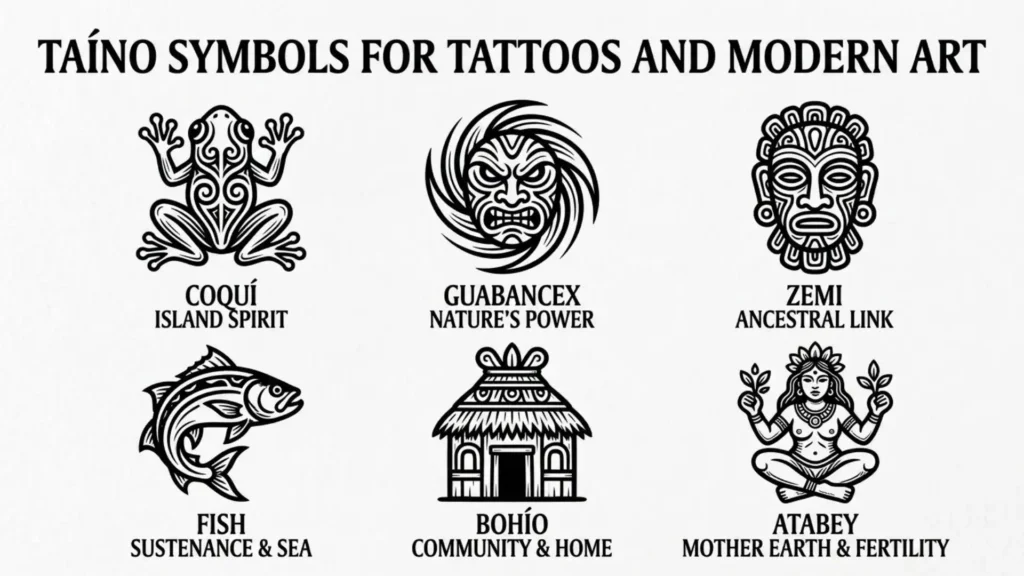
Taíno-inspired tattoos have become an important way for people to express Puerto Rican heritage, ancestry, cultural pride, and personal identity.
Popular Tattoo Motifs
Common contemporary choices include:
- Cemí-inspired figures
- Petroglyph-style faces
- Sun-like designs
- Frog or coquí imagery
- Animal figures
- Spirals and geometric patterns
- Three-pointed stone designs
- Large compositions combining several motifs
A tattoo can carry personal meaning even when the original archaeological meaning is uncertain.
Historical Meaning vs. Modern Meaning
This distinction is essential.
For example, a person may choose a spiral because they associate it with growth and continuity. That can be a meaningful personal interpretation without claiming that ancient Taíno people definitely used the spiral to mean “growth.”
Likewise, a modern tattoo may combine several motifs that did not historically appear together.
That does not necessarily make the artwork meaningless, but it does make it a modern Taíno-inspired design rather than a direct archaeological reproduction.
Choosing a Respectful Taíno-Inspired Tattoo
If historical authenticity matters to you, research the specific image before getting it tattooed.
Look for:
- documented archaeological examples
- museum collections
- photographs of actual petroglyphs
- information about the site’s location
- reliable historical explanations
- clear distinctions between evidence and modern interpretation
This approach can help you choose a design that respects the culture rather than relying on an invented internet translation.
Modern Meanings vs. Historical Evidence
One of the most important things to understand about Puerto Rican Taíno symbols is that modern meanings and ancient meanings are not always identical.
Meanings Commonly Used Today
Modern Taíno-inspired designs are often associated with:
- Puerto Rican identity
- Indigenous heritage
- family
- ancestry
- strength
- resilience
- protection
- spirituality
- nature
- cultural pride
- connection to the Caribbean
These meanings can be personally significant.
What Archaeology Can Tell Us
Archaeology can provide evidence about:
- where images were created
- what materials were used
- how motifs appeared on objects
- relationships between images and ceremonial spaces
- similarities among different archaeological sites
- connections between imagery and other artifacts
But archaeology cannot always tell us exactly what an individual artist was thinking when making a particular carving.
Why Uncertainty Is Valuable
Saying that the meaning of a symbol is uncertain is not a weakness.
It is more responsible than inventing a definite answer.
When evidence is incomplete, acknowledging uncertainty allows readers to understand both what researchers know and what remains open to interpretation.
Common Myths About Puerto Rican Taíno Symbols
The internet contains many simplified claims about Taíno imagery. Understanding the difference between popular interpretations and historical evidence can help you avoid misinformation.
Myth: Every Taíno Symbol Has One Exact Meaning
Not necessarily. Some interpretations are better supported than others, and many individual carvings remain difficult to interpret.
Myth: Taíno Petroglyphs Were an Alphabet
Petroglyphs were important visual expressions, but they should not automatically be treated as an alphabet or conventional written language.
Myth: Every Spiral Means the Same Thing
There is no universal rule proving that every spiral carved by an Indigenous Caribbean artist represented one identical idea.
Myth: Every Modern Taíno Tattoo Is an Ancient Design
Modern tattoo artists often adapt archaeological motifs, combine different designs, or create new interpretations.
Myth: A Symbol’s Modern Meaning Must Be Its Ancient Meaning
A modern person can give a symbol a personal meaning without that meaning having been documented historically.
How to Identify a Taíno Petroglyph
If you encounter an image that is described as a Taíno symbol, do not rely only on its appearance.
Check the Archaeological Context
Ask where the image was found.
A documented petroglyph from an archaeological site provides a much stronger basis for identification than a symbol copied from a modern tattoo website.
Look at the Design Carefully
Notice whether the image appears:
- human-like
- animal-like
- geometric
- abstract
- combined human and animal
- part of a larger group of carvings
The category can help with description, although it does not automatically reveal the original meaning.
Compare Reliable Sources
Museum collections, archaeological publications, national parks, cultural institutions, and academic resources are generally more useful for historical identification than unsourced symbol charts.
Do Not Treat Every Similar Shape as Identical
A modern artist may reproduce a historical motif loosely. A similar-looking symbol does not necessarily come from the same archaeological tradition.
Why Puerto Rican Taíno Symbols Still Matter Today
Taíno symbols remain meaningful because they connect modern Puerto Rico with an Indigenous past that is still being studied, discussed, and represented.
Heritage and Cultural Identity
For many people, Taíno-inspired imagery provides a way to explore Puerto Rican Indigenous heritage and express a connection to the island.
Art and Education
Petroglyphs and archaeological objects help people learn about Indigenous Caribbean creativity, technology, spirituality, and relationships with the natural environment.
Contemporary Cultural Expression
Taíno-inspired designs now appear in tattoos, jewelry, artwork, clothing, educational projects, and other forms of cultural expression.
Their modern use shows that ancient imagery can continue to influence identity while acquiring new meanings.
Respect Matters
The most meaningful way to engage with Taíno symbols is to look beyond their appearance.
Instead of asking only, “What does this shape mean?”, it is worth asking:
Where did it come from? Who created it? What evidence explains it? And what meaning are we giving it today?
Those questions lead to a deeper understanding of Puerto Rico’s Indigenous heritage.
Frequently Asked Questions
What are the most common Puerto Rican Taíno symbols?
Commonly discussed Taíno-related motifs include cemí or zemí figures, human faces, animal forms, three-pointed stones, sun-like imagery, spirals, and abstract designs. Their exact meanings vary according to archaeological and cultural context.
What does the Taíno spiral mean?
There is no universally proven ancient translation for every Taíno spiral. Today, people commonly interpret spiral-like designs as representing ideas such as continuity, cycles, growth, or movement, but these should be described as modern interpretations unless historical evidence supports a specific meaning.
What is a Taíno cemí or zemí?
A cemí or zemí can refer to a supernatural being, sacred power, or a physical object associated with that power in Taíno religious traditions. Cemí objects could have human, animal, or abstract forms.
Are Taíno petroglyphs a written language?
No, they should not be treated as a conventional alphabet or writing system. Taíno petroglyphs are visual cultural expressions, and their meanings must be interpreted through archaeology, historical records, imagery, and context.
What do Taíno symbols mean in tattoos?
Modern Taíno-inspired tattoos can represent Puerto Rican heritage, ancestry, cultural pride, strength, family, spirituality, nature, or personal identity. These modern meanings should not automatically be presented as the original meaning of an ancient carving.
Where can I see Taíno symbols in Puerto Rico?
Caguana Indigenous Ceremonial Park in Utuado is one of the most important archaeological places associated with Indigenous Puerto Rican heritage. Other rock-art sites, caves, museums, and archaeological collections also provide opportunities to study Taíno-related imagery.
Conclusion
Puerto Rican Taíno symbols are more than attractive designs; they are part of a complex Indigenous visual and cultural heritage.
Petroglyphs, cemí figures, animal imagery, human faces, and geometric forms can provide clues about Taíno life, spirituality, nature, and ceremonial traditions.
At the same time, not every symbol has a proven one-word meaning, and modern interpretations should be separated from archaeological evidence.
If you are researching Taíno heritage or considering a Taíno-inspired tattoo, understanding the history behind the design can make your choice far more meaningful.
The most respectful approach is to appreciate both what researchers know and what remains uncertain.
By looking beyond the shape itself, we can better understand the Indigenous stories, heritage, and cultural influence connected with Puerto Rico.

Adam Sullivan is a dedicated writer who enjoys transforming everyday topics into engaging and informative content. His writing focuses on making complex ideas simple, practical and enjoyable for readers of all backgrounds. Adam is also the fictional author of The Lantern Beyond Autumn Hills and Where the Morning Horizon Waits. Outside of writing, he enjoys photography, traveling and discovering inspiration through new experiences. He believes great content should be both helpful and easy to connect with.
 Dylan Anderson