If you are new to choir music, a choral score can look confusing at first. You may see unfamiliar signs above the notes, letters beside different vocal lines, numbers, curved lines, dots, rests, and instructions that tell you how a passage should be sung.
These choir symbols are not random marks. They form a musical language that helps singers understand pitch, rhythm, volume, breathing, phrasing, articulation, entrances, releases, and the relationship between different voice parts. A choral score can also contain markings specifically useful for ensemble singing, such as SATB, divisi, unison, solo, tutti, rehearsal marks, and breath marks.
Learning the most common symbols makes it easier to follow your part, understand the conductor’s instructions, and sing confidently with the rest of the choir.
What Are Choir Symbols?
Choir symbols are the signs, abbreviations, notation marks, and performance instructions used in written choral music.
Some are the same symbols used in piano, orchestral, and other forms of music. Others are especially useful in vocal scores because singers must coordinate lyrics, breathing, pronunciation, multiple parts, and ensemble timing.
A choir score can tell you:
- Which pitch to sing
- How long to hold a note
- When to remain silent
- How loudly or softly to sing
- When to breathe
- How smoothly to connect notes
- Which vocal part to follow
- When a section divides
- When singers return to unison
- When the whole choir enters
- When music should repeat
- When a phrase should slow down or speed up
The most useful way to learn these markings is not simply to memorize their names. Instead, learn what each symbol asks you to do while singing.
Choir Symbols and Meanings at a Glance
The following table provides a quick reference for common symbols and markings you may encounter in choral music.
| Symbol or Marking | Name | Meaning |
| 𝄞 | Treble clef | Establishes the pitch positions on the staff |
| 𝄢 | Bass clef | Establishes lower pitch positions on the staff |
| ♯ | Sharp | Raises a pitch by a semitone |
| ♭ | Flat | Lowers a pitch by a semitone |
| ♮ | Natural | Cancels a sharp or flat |
| 4/4 | Time signature | Organizes beats into measures |
| ♩ | Quarter note | A common note value |
| 𝄽 | Rest | Indicates silence for a specific duration |
| 𝄒 | Breath mark | Shows a place for a breath or phrase separation |
| 𝄐 | Fermata | Extends a note, rest, or musical moment |
| p | Piano | Soft |
| mp | Mezzo-piano | Moderately soft |
| mf | Mezzo-forte | Moderately loud |
| f | Forte | Loud |
| ff | Fortissimo | Very loud |
| < | Crescendo | Gradually louder |
| > | Decrescendo | Gradually softer |
| . | Staccato | Short and separated |
| — | Tenuto | Sustained for its indicated value |
| ⌒ | Slur | Connects notes smoothly |
| ♯/♭/♮ | Accidental | Changes a pitch temporarily |
| S | Soprano | Identifies the soprano part |
| A | Alto | Identifies the alto part |
| T | Tenor | Identifies the tenor part |
| B | Bass | Identifies the bass part |
| div. | Divisi | Section divides into separate parts |
| unis. | Unison | Singers return to the same line |
| solo | Solo | One singer performs |
| tutti | Tutti | Full ensemble performs |
| D.C. | Da Capo | Return to the beginning |
| D.S. | Dal Segno | Return to the sign |
| Fine | Fine | Indicates the ending |
The exact symbols, abbreviations, and conventions can vary between composers, arrangers, publishers, and individual scores.
Basic Symbols in Choir Sheet Music
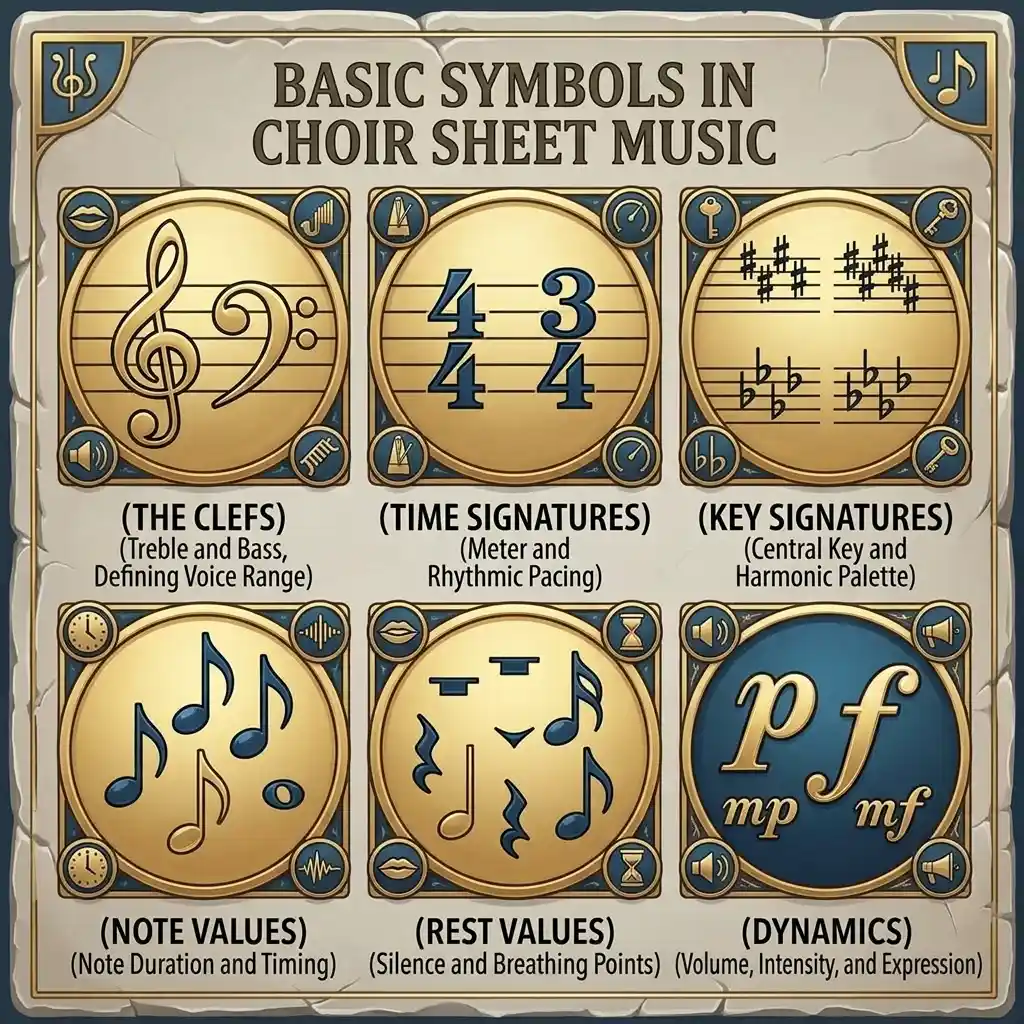
Before learning choir-specific markings, it helps to understand the basic building blocks of written music.
Staff
A staff is made of five horizontal lines and four spaces.
Notes are placed on the lines and spaces to represent different pitches. The clef at the beginning of the staff tells you how those positions should be interpreted.
In a choral score, several staves may be grouped together so that different vocal parts can be read at the same time.
Bar Lines
A vertical line through the staff is called a bar line.
Bar lines divide music into measures. They help singers understand where rhythmic groups begin and end.
Measures
A measure, also called a bar, contains the number and type of beats established by the time signature.
For example, music written in 4/4 normally organizes four quarter-note beats into each measure.
Measures make it easier for a conductor and singers to locate specific places in a piece.
Double Bar Line
A double bar line can indicate the end of a section or an important structural point.
A heavier double bar line commonly indicates the end of the composition.
Notes
Notes tell you which pitches to sing and how long they last.
Common note values include:
- Whole notes
- Half notes
- Quarter notes
- Eighth notes
- Sixteenth notes
The visual appearance of a note changes according to its rhythmic value.
Rests
A rest represents silence.
A rest is just as important as a note because it tells you when your vocal part should remain silent and for how long.
Beginners sometimes focus only on the notes they sing and accidentally rush through rests. Counting rests carefully is essential for accurate ensemble entrances.
Clef Symbols in Choir Music
Clefs provide the pitch reference for the staff.
Treble Clef
The treble clef is commonly used for higher vocal parts.
It identifies the position of G above middle C and establishes how the other notes on the staff are interpreted.
Soprano and alto parts frequently use treble clef, although the exact notation depends on the arrangement.
Bass Clef
The bass clef is used for lower vocal ranges.
It establishes the position of F below middle C and is commonly seen in bass parts and some tenor notation.
Why Clefs Matter
A note cannot be interpreted correctly simply by looking at its position.
The clef tells you how to read that position.
Therefore, when opening a new choir score, one of the first things you should identify is the clef used for your part.
SATB Choir Symbols and Voice-Part Labels
One of the most important things for a choir singer to identify is the assigned vocal part.
What Does SATB Mean?
SATB stands for:
- S — Soprano
- A — Alto
- T — Tenor
- B — Bass
SATB is a common four-part choral format. Depending on the arrangement, multiple parts may share a staff, and stem direction can help distinguish voices.
Soprano Symbol
S commonly identifies the soprano part.
Sopranos generally sing the highest standard part in a traditional SATB arrangement.
Alto Symbol
A identifies the alto part.
Altos generally sing below the soprano and frequently provide important inner harmonies.
Tenor Symbol
T identifies the tenor part.
Tenors generally sing above the bass and contribute another important layer to the harmony.
Bass Symbol
B identifies the bass part.
Bass singers usually provide the lowest vocal line and often help establish the harmonic foundation.
Other Choir Part Labels
Not every choir uses exactly the same arrangement.
You may encounter:
- SS
- SSA
- SAB
- TTBB
- SATB
- SSAATTBB
- Solo
- Ensemble
- Treble
- Baritone
The letters describe the vocal forces or sections involved in the arrangement.
Pitch Symbols in Choir Music
Pitch symbols tell you how a written note should sound.
Sharp Symbol ♯
A sharp raises the affected pitch by a semitone under standard notation.
For a singer, this means the note should be performed at the raised pitch.
Flat Symbol ♭
A flat lowers the affected pitch by a semitone.
Singers should pay close attention to flats because singing the natural pitch instead can change the harmony.
Natural Symbol ♮
A natural cancels a previously applicable sharp or flat.
It returns the pitch to its natural form within the applicable notation context.
Key Signature
The sharps or flats placed after the clef form the key signature.
The key signature establishes recurring pitch alterations throughout a passage or composition.
Instead of treating every sharp or flat as an isolated instruction, singers should first understand the key signature.
Accidentals
Sharps, flats, and naturals that appear within the music can act as accidentals.
They modify a pitch according to the rules of the notation and the surrounding musical context.
Ledger Lines
Short horizontal lines placed above or below the staff are called ledger lines.
They allow composers to notate pitches that fall outside the normal five-line staff.
This can be especially useful for vocal parts that move into higher or lower ranges.
Rhythm and Timing Symbols for Choir
Knowing the correct pitch is only half the job. Singers must also know exactly when to enter and how long to sustain each note.
Time Signature
The time signature appears near the beginning of the music and establishes the rhythmic organization of the measures.
For example:
4/4
generally means four quarter-note beats per measure.
The top number indicates how many beats are grouped together, while the bottom number identifies the note value used as the beat reference.
Dotted Notes
A dot placed after a note changes its duration according to standard rhythmic rules.
Dotted rhythms can affect how lyrics are distributed across notes, so singers should pay attention to both the note and the corresponding syllable.
Ties
A tie connects two notes of the same pitch.
Instead of restarting the second note, the singer sustains the sound across the combined duration.
Tuplets
Tuplets indicate an unusual division of rhythmic space.
A common example is a triplet, where three notes are grouped into the time normally occupied by two notes of the same basic value.
Syncopation
Syncopation occurs when rhythmic emphasis or note placement works against the expected beat pattern.
For choir singers, counting carefully is especially important because different sections may have different rhythms at the same time.
Choir Dynamic Symbols
Dynamic markings tell singers about changes in loudness and musical intensity.
In choral music, dynamics are not simply instructions to “sing louder” or “sing quieter.” Singers also need to maintain blend, diction, breath support, balance, and healthy vocal production.
Pianissimo — pp
pp means pianissimo, or very soft.
A soft sound should still have energy and control.
Piano — p
p means piano, or soft.
The choir should reduce its volume while keeping the tone focused.
Mezzo-Piano — mp
mp means mezzo-piano, or moderately soft.
It falls between piano and mezzo-forte.
Mezzo-Forte — mf
mf means mezzo-forte, or moderately loud.
It represents a middle dynamic level.
Forte — f
f means forte, or loud.
The goal should be a strong, supported sound rather than uncontrolled shouting.
Fortissimo — ff
ff means fortissimo, or very loud.
Even at this dynamic, singers should maintain musical balance and vocal control.
Crescendo — <
A crescendo tells the choir to gradually become louder.
The change should develop over the indicated passage rather than happening suddenly.
Decrescendo — >
A decrescendo tells singers to gradually become softer.
Diminuendo
Diminuendo is another term for gradually reducing the dynamic level.
In practical choral use, decrescendo and diminuendo often communicate a similar musical idea.
Choir Articulation Symbols
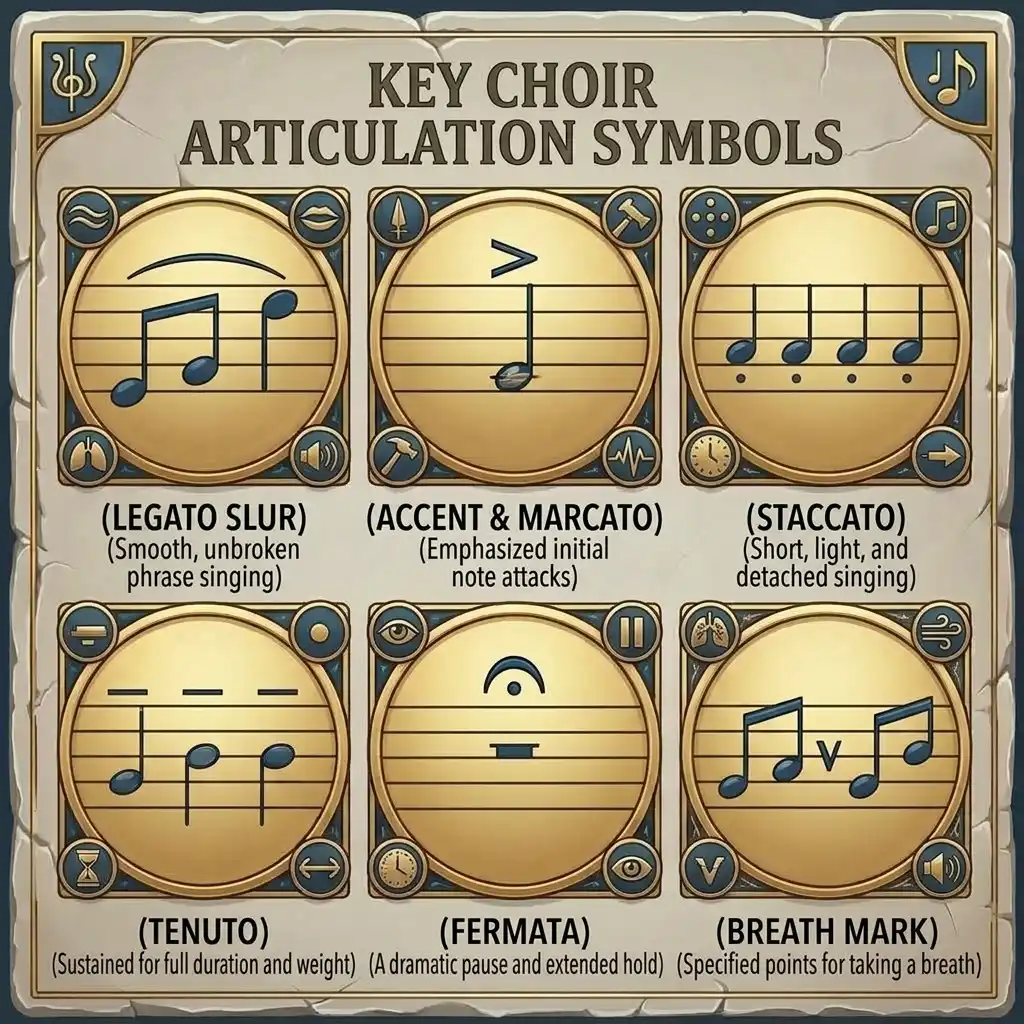
Articulation markings describe how individual notes or musical phrases should be performed.
Staccato
A staccato mark tells singers to make the note short and separated.
In vocal music, this must be coordinated with the words so that the text remains understandable.
Tenuto
A tenuto marking generally indicates that a note should receive its full written value and may receive expressive emphasis.
It does not simply mean “make the note loud.”
Accent
An accent indicates emphasis on a note.
In a choir, the emphasis should be coordinated across the section and ensemble.
Marcato
Marcato indicates that a note or passage should be strongly marked or emphasized.
The exact performance depends on the musical style and conductor.
Slur
A slur is a curved line connecting notes that should be performed smoothly as a musical gesture.
For singers, it can help indicate connected phrasing and legato movement.
Legato
Legato means smooth and connected.
A legato vocal line should flow without unnecessary breaks between notes.
Breath Marks in Choir Music
Breath marks are especially important because singers need to manage breathing while maintaining the musical phrase.
What Does a Breath Mark Mean?
A breath mark indicates a place where a singer or ensemble may take a breath or where a phrase can separate.
It does not necessarily mean that the note immediately before it should be shortened. In notation systems, the breath mark can be treated as a separate musical event.
Why Breath Marks Matter
Poorly coordinated breathing can interrupt:
- Phrasing
- Rhythm
- Blend
- Diction
- Sustained chords
- Musical continuity
A choir may also use staggered breathing, where singers breathe at different moments so that the overall sound continues.
Breath Mark vs. Slur
These two markings are related to phrasing but have different purposes.
A slur generally connects a group of notes into a smooth musical idea.
A breath mark indicates a place for breathing or separation.
A score can contain both markings at the same time.
Fermata Symbol in Choir Music
The fermata is commonly shown as an arc with a dot underneath:
𝄐
What Does a Fermata Mean?
A fermata indicates that a note, rest, or musical moment should be extended beyond its normal written duration.
It does not always have one fixed length.
The conductor may determine how long the choir sustains the sound and when everyone releases.
How Should Singers Perform a Fermata?
When you see a fermata:
- Prepare for the longer musical moment.
- Maintain the intended pitch.
- Follow the dynamic marking.
- Watch the conductor.
- Release together when directed.
This is especially important in large ensembles because individual singers holding for different lengths can make the ending sound uneven.
Divisi, Unison, Solo, and Tutti Symbols
These markings help singers understand who should be performing a particular musical line.
Divisi — div.
Divisi, usually abbreviated div., means a vocal section divides into multiple parts.
For example, an alto section might divide into:
- Alto 1
- Alto 2
The singers should determine which line has been assigned to them.
Unison — unis.
Unis. means unison.
It tells singers to perform the same musical line rather than continuing separate harmony parts.
You may see this after a divisi passage.
Solo
Solo means that an individual singer performs the indicated material.
The remaining choir may continue singing accompaniment or remain silent, depending on the arrangement.
Tutti
Tutti means the full ensemble performs.
It may appear after a solo or sectional passage to indicate that the larger group returns.
Tempo Symbols in Choir Music
Tempo markings tell singers how quickly the music should move.
Largo
Largo generally indicates a broad, slow tempo.
Adagio
Adagio generally indicates a slow tempo.
Andante
Andante generally suggests a moderate, walking-like pace.
Moderato
Moderato indicates a moderate tempo.
Allegro
Allegro generally indicates a fast, lively tempo.
Presto
Presto indicates a very fast tempo.
These traditional terms communicate more than raw speed in many musical contexts; the conductor and musical style also influence their interpretation. Choral resources commonly pair tempo terms with more specific metronome markings when an exact speed is desired.
Tempo Change Symbols and Abbreviations
A choir score may tell singers to change speed during the piece.
Ritardando — rit.
Ritardando means gradually becoming slower.
The choir should slow down together rather than having different sections change speed independently.
Accelerando — accel.
Accelerando means gradually becoming faster.
A Tempo
A tempo means returning to the previous or established tempo.
Tempo Primo
Tempo primo generally indicates a return to the original tempo.
Rehearsal and Navigation Symbols
Not every useful choir marking is about pitch or volume.
Some markings help singers and conductors find their place in the score.
Rehearsal Marks
Rehearsal marks are usually letters or numbers placed at important points in the music.
A conductor can say something such as “start at rehearsal B,” allowing the choir to find the correct passage quickly.
Measure Numbers
Measure numbers help singers identify exact locations in the score.
They are particularly useful when a conductor wants to rehearse a difficult entrance or correct a specific rhythmic problem.
Repeat Sign
A repeat sign tells singers to return to an earlier section and perform it again.
Always identify where the repeated section starts and ends.
First and Second Endings
Repeated sections can have different endings.
The first ending is performed during the first pass, while the second ending is used when the section is repeated.
D.C. — Da Capo
D.C. means Da Capo, or “from the beginning.”
It instructs performers to return to the beginning.
D.S. — Dal Segno
D.S. means Dal Segno, or “from the sign.”
It tells singers to return to the designated sign.
Fine
Fine means “end.”
It identifies where the music finishes when used with a navigation instruction.
Lyrics and Choral Notation
Lyrics are a major difference between vocal and instrumental music.
Syllables Under Notes
Each syllable is normally positioned underneath the note with which it is sung.
This helps singers determine which word belongs to which pitch.
Hyphens
A hyphen can show that a word has been divided into syllables that are sung on separate notes.
Melisma
A melisma occurs when one syllable is sung across multiple notes.
This is common in many styles of choral music.
When several notes appear above one syllable, singers should continue the same vowel sound until the musical notation indicates a change.
Word Continuation
A line or other notation may indicate that the same syllable continues across several notes.
The exact appearance varies by notation software and publishing style.
How to Read Choir Symbols Step by Step
Knowing the names of symbols is useful, but the real goal is being able to read them while singing.
Find Your Vocal Part
First locate your assigned section.
Look for:
- Soprano
- Alto
- Tenor
- Bass
- Soprano 1
- Soprano 2
- Alto 1
- Alto 2
- Other assigned parts
Do not automatically follow another vocal line just because it is easier to see.
Identify the Clef
Look at the clef before reading the notes.
The clef determines how the notes on the staff should be interpreted.
Check the Key Signature
Look for sharps or flats beside the clef.
This gives you the basic pitch framework for the piece.
Check the Time Signature
Before singing, determine how the beats are organized.
This helps prevent problems with entrances and sustained notes.
Follow Your Notes Horizontally
Read your musical line from left to right.
Pay attention to:
- Pitch
- Rhythm
- Lyrics
- Rests
- Dynamics
- Articulation
- Breaths
Look Vertically at the Score
Choir singers should also learn to look vertically.
This means noticing what the other sections are doing at the same moment.
Vertical reading can help you understand:
- Harmony
- Chords
- Unison passages
- Countermelodies
- Independent rhythms
- Dissonances
- Entrances from other sections
Both horizontal and vertical reading are useful skills for confident choral singing.
Watch for Dynamic Changes
Markings such as p, mp, mf, f, crescendo, and decrescendo show how the musical intensity changes.
Do not wait until the rehearsal to discover that your part becomes softer or louder.
Locate Breath Marks
Identify breathing points before performing the passage.
This helps you avoid taking an unexpected breath in the middle of an important musical phrase.
Check Divisi and Unison
If you see div., determine which line you should sing.
If you see unis., prepare to join the other singers on the same line.
Watch the Conductor
Printed symbols provide essential information, but they do not replace the conductor.
The conductor can communicate:
- Tempo
- Entrances
- Cutoffs
- Fermatas
- Dynamic changes
- Breaths
- Phrasing
- Expression
- Changes made during rehearsal
Your score and the conductor work together.
Choir Symbols for Conducting and Ensemble Coordination
A choir does not perform each marking independently.
Many symbols require coordinated action from the entire group.
Cutoffs
A conductor may give a cutoff that is not explicitly written as a unique musical symbol.
The purpose is to help everyone stop together.
Watch the conductor closely at the end of sustained notes and phrases.
Entrances
A written note tells you when your part should begin, but the conductor’s gesture helps coordinate the actual entrance.
This is especially important after:
- Long rests
- Fermatas
- Tempo changes
- Rubato passages
- Instrumental introductions
Dynamic Balance
A forte marking does not mean every singer should simply sing as loudly as possible.
The choir must still maintain balance between sections.
A section with the melody may need to project more than an accompanying section, even when both have the same printed dynamic.
Common Mistakes Beginners Make With Choir Symbols
Ignoring the Key Signature
Looking only at individual notes can lead to repeated pitch mistakes.
Always check the key signature first.
Forgetting Rests
A rest is part of the music.
Count it just as carefully as you count notes.
Confusing a Tie With a Slur
A tie connects notes of the same pitch and combines their duration.
A slur generally indicates smooth connection or phrasing across notes.
They may look similar but serve different purposes.
Singing Through a Breath Mark
If the score clearly indicates a coordinated breath, ignoring it can affect the phrase and ensemble timing.
Missing a Divisi Instruction
If your section divides and you continue singing the original line, the harmony can become incorrect.
Treating a Fermata as an Exact Number of Beats
A fermata extends the musical moment, but its exact duration can depend on the conductor and context.
Ignoring Dynamics
Correct notes alone do not create a complete musical performance.
Dynamics help shape the phrase and communicate its character.
Watching the Page Instead of the Conductor
A choir singer needs both.
The page provides the written information, while the conductor coordinates the ensemble in real time.
How to Memorize Choir Symbols More Easily
Trying to memorize every musical marking in one sitting is unnecessary.
Use groups.
Group 1: Pitch Symbols
Start with:
- Treble clef
- Bass clef
- Sharp
- Flat
- Natural
- Key signature
Group 2: Rhythm Symbols
Then learn:
- Notes
- Rests
- Dots
- Ties
- Time signatures
- Tuplets
Group 3: Expression Symbols
Next learn:
- p
- mp
- mf
- f
- ff
- Crescendo
- Decrescendo
- Accent
- Staccato
- Tenuto
- Slur
Group 4: Choir-Specific Markings
Finally learn:
- SATB
- Div.
- Unis.
- Solo
- Tutti
- Breath mark
- Fermata
- Rehearsal marks
Learning them in groups makes the information easier to remember.
Why Choir Symbols Are Important
Choir symbols create a common language between the composer, arranger, conductor, and singers.
Without these markings, singers would have far less information about how the music should be performed.
They help communicate:
- Pitch
- Rhythm
- Volume
- Tempo
- Phrasing
- Breathing
- Articulation
- Vocal division
- Repetition
- Musical expression
A good choir singer learns to see these symbols as instructions rather than decorations.
For example, p means more than a letter. It tells you to reduce the dynamic level. div. tells a section to divide. A breath mark provides information about phrasing and breathing. A fermata tells singers that a musical moment will be extended. The markings become much easier to understand once you connect each one with the action it requires.
Frequently Asked Questions About Choir Symbols
What are choir symbols?
Choir symbols are musical signs, abbreviations, and markings used in choral scores to communicate pitch, rhythm, dynamics, phrasing, breathing, articulation, vocal parts, repetition, and other performance instructions.
What does SATB mean in choir music?
SATB means Soprano, Alto, Tenor, and Bass. It describes a common four-part choral arrangement.
What does “div.” mean in choir music?
Div. is short for divisi. It means that a vocal section divides into two or more separate musical parts.
What does “unis.” mean in a choir score?
Unis. means unison. It tells singers to perform the same musical line instead of separate harmony parts.
What does a fermata mean for choir singers?
A fermata indicates that a note, rest, or musical moment should last longer than its normal written duration. The exact length is often determined by musical context and the conductor.
What does a breath mark mean in choir music?
A breath mark indicates a place where singers can or should breathe or where a phrase may separate. It helps coordinate breathing with musical phrasing.
What does “p” mean in choir music?
p means piano, which means soft. The choir should sing at a reduced dynamic level while maintaining support, clarity, and blend.
What does “f” mean in choir music?
f means forte, which means loud or strong. It does not mean singers should shout; the sound should remain controlled and musically balanced.
What is the difference between a slur and a tie?
A tie connects notes of the same pitch so their durations are combined. A slur connects notes to indicate smooth musical connection or phrasing.
What are the most important choir symbols for beginners?
Start with clefs, notes, rests, time signatures, key signatures, sharps, flats, dynamics, breath marks, fermatas, slurs, ties, repeat signs, SATB labels, divisi, and unison markings.
Do all choir scores use the same symbols?
No. Most choral scores use standard musical notation, but composers, arrangers, publishers, and individual ensembles can use different conventions or additional performance markings. When a symbol is unfamiliar, check the score’s notes, glossary, or ask the conductor.
How can I get better at reading choir music?
Practice following your own vocal line while also becoming aware of the other parts. Learn basic notation, count rests carefully, identify dynamics and breathing points, and watch the conductor during rehearsals and performances.
Conclusion
Understanding choir symbols turns a complicated-looking score into a useful set of instructions. Basic notation tells you where to find pitches and how to count rhythms, while dynamics, articulation, breath marks, fermatas, and phrasing markings explain how the music should be performed.
For choral singers, markings such as SATB, divisi, unison, solo, and tutti are equally important because they show how different voices work together. The best approach is to learn these symbols gradually and practice recognizing them directly in real choir music.
Most importantly, remember that written notation and the conductor work together. Your score tells you what is written, while the conductor helps the entire choir coordinate tempo, entrances, releases, breathing, dynamics, and expression. With practice, the symbols that once looked confusing will become familiar musical instructions.

Adam Sullivan is a dedicated writer who enjoys transforming everyday topics into engaging and informative content. His writing focuses on making complex ideas simple, practical and enjoyable for readers of all backgrounds. Adam is also the fictional author of The Lantern Beyond Autumn Hills and Where the Morning Horizon Waits. Outside of writing, he enjoys photography, traveling and discovering inspiration through new experiences. He believes great content should be both helpful and easy to connect with.
 Dylan Anderson