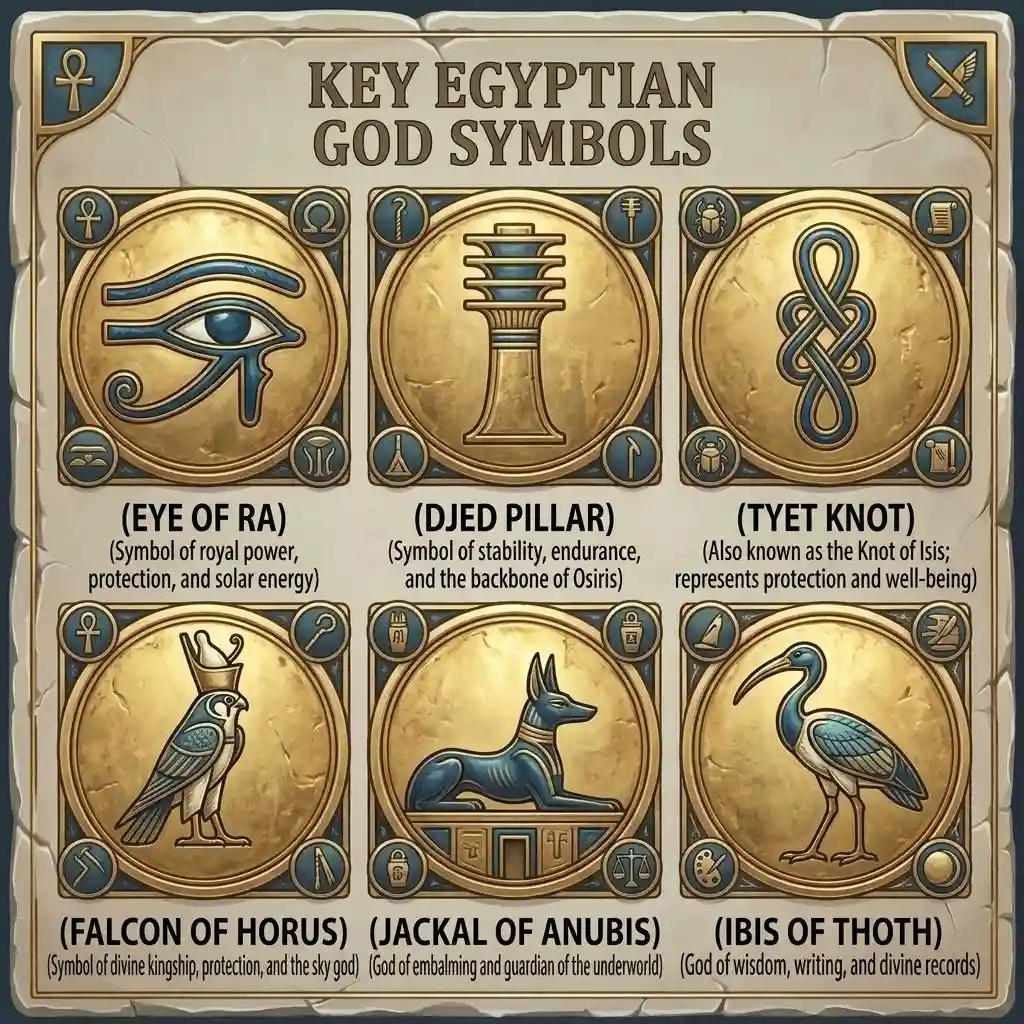
Ancient Egyptian god symbols are among the most recognizable forms of religious art in history. From the ankh and Eye of Horus to the scarab, djed, crook and flail, these symbols helped communicate ideas about life, death, protection, kingship, rebirth, and divine power.
They also helped people recognize gods and goddesses in temples, tombs, statues, amulets, and other works of art.
However, there is an important detail to understand: not every Egyptian symbol belonged to only one god. Some symbols were connected with several deities, while others were general religious or royal symbols. A god could also be identified through an animal form, crown, headdress, object, or combination of attributes.
This guide explains the most important Egyptian god symbols, what they were associated with, how to identify major Egyptian deities, and how ancient meanings differ from some modern interpretations.
What Are Egyptian God Symbols?
Egyptian god symbols are visual signs, objects, animals, crowns, and other attributes associated with particular gods and goddesses or with important ideas in ancient Egyptian religion.
Ancient Egyptian artists used visual details to communicate information. A deity might appear with an animal head, a special crown, a sacred object, or a recognizable symbol. In many cases, several clues were combined rather than relying on a single symbol.
This is why it is better to think about symbols and attributes rather than searching for one permanent symbol for every Egyptian god.
Symbols, Attributes, and Hieroglyphs
These three ideas are related but should not be treated as exactly the same.
A symbol can communicate an important religious or cultural idea. The ankh, for example, was associated with life and appears frequently in Egyptian religious art.
An attribute is a visual feature that helps identify a deity. An animal form, crown, staff, or special object can serve this purpose.
A hieroglyph is part of the ancient Egyptian writing system. Some hieroglyphic signs also had powerful visual or religious associations, but not every hieroglyph should be called a god symbol.
Understanding this difference makes it easier to interpret Egyptian artwork accurately.
Why One Symbol Can Be Connected to Several Gods
Ancient Egyptian religion developed over thousands of years, and religious traditions varied between places and periods. As a result, a symbol could be used by different gods or take on additional associations.
The ankh is a good example. It represented life and was depicted in the hands of many gods rather than belonging exclusively to one deity. The djed was strongly associated with Osiris, but the idea of stability connected to the symbol was broader.
For this reason, statements such as “this is the symbol of only one Egyptian god” should be treated carefully.
Egyptian Gods and Their Symbols at a Glance
The following table provides a quick introduction to some of the most important Egyptian gods and the visual features commonly associated with them.
| Egyptian God or Goddess | Common Symbol or Attribute | Main Association |
| Ra/Re | Solar disk, falcon imagery | Sun and divine kingship |
| Osiris | Djed, crook and flail, atef crown | Afterlife, resurrection, kingship |
| Isis | Throne emblem, wings, maternal imagery | Protection, motherhood, magic |
| Horus | Falcon, Eye of Horus | Sky, kingship, protection |
| Anubis | Jackal or canine form | Funerary rites and protection of the dead |
| Thoth | Ibis or baboon | Writing, knowledge, wisdom |
| Hathor | Cow imagery, horns and solar disk, sistrum | Motherhood, music, love, joy |
| Sekhmet | Lioness, solar disk | Power, war, healing |
| Bastet | Cat or feline form | Protection and domestic life |
| Set/Seth | Distinctive Seth animal | Desert, storms, disorder, conflict |
| Khepri | Scarab beetle | Sunrise, renewal, transformation |
| Sobek | Crocodile | Nile, fertility, royal power |
| Ma’at | Ostrich feather | Truth, balance, justice, cosmic order |
| Ptah | Composite staff with sacred symbols | Creation and craftsmanship |
| Amun | Crown and feather imagery | Kingship and divine authority |
These associations are useful for identification, but they should not be treated as rigid rules. Egyptian religious imagery changed across periods, and some attributes were shared.
Most Important Egyptian God Symbols
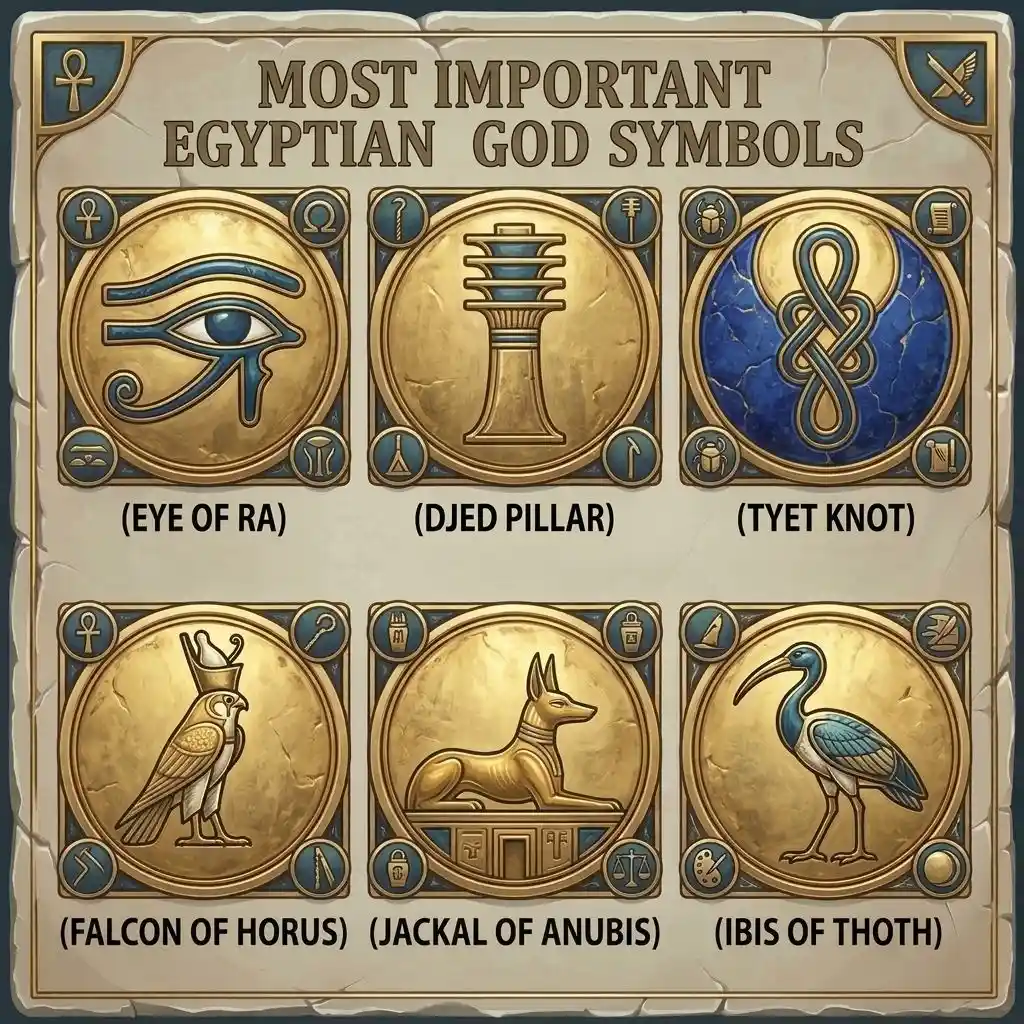
Some Egyptian symbols are especially important because they appear repeatedly in religious art, funerary objects, architecture, and amulets.
The Ankh
The ankh is one of the most famous Egyptian symbols. It has a cross-like shape with a loop at the top and is strongly associated with the idea of life and continued existence.
Ancient Egyptian art frequently shows gods holding an ankh or presenting it toward a king or another divine figure. It could appear in tombs, inscriptions, statues, and amulets. The symbol was not exclusive to Isis or any single deity.
The ankh is therefore best understood as a broad symbol of life and eternal existence, while also appearing as an attribute carried by many deities.
Today, people may use the ankh in jewelry, tattoos, artwork, and fashion because of its association with life. These modern uses should be distinguished from the way the symbol functioned within ancient Egyptian religion.
The Djed
The djed looks like a column with several horizontal lines near the top. It is primarily associated with stability, permanence, and endurance.
The djed became particularly connected with Osiris and his resurrection. Ancient Egyptian imagery sometimes linked it with the backbone of Osiris, although scholars have also proposed other interpretations for its original form.
The symbol appears in temples, tombs, sarcophagi, architectural decoration, and amulets. Its connection with Osiris made it especially meaningful in funerary contexts.
The Was Scepter
The was scepter is a long staff with a distinctive animal-like head at the top and a forked lower end. It was associated with power, authority, dominion, and divine or royal control.
Different gods could be shown holding a was scepter. This is another example of why it is misleading to assign every important Egyptian symbol to only one deity. The symbol could communicate authority while the particular deity holding it provided additional meaning.
The Eye of Horus
The Eye of Horus, often called the Wedjat or Udjat Eye, is one of the best-known Egyptian protective symbols.
It is associated with Horus and is commonly connected with ideas such as protection, restoration, and healing. Its importance comes partly from the mythology surrounding Horus and the injury and restoration of his eye.
It is also connected with myths involving divine feminine figures and the so-called Distant Goddess traditions.
The distinction matters because modern websites sometimes combine the two concepts into one simple definition. Ancient Egyptian religious symbolism was more complicated.
The Scarab
The scarab beetle is strongly associated with Khepri, a solar deity connected with the rising sun and renewal.
The behavior of the dung beetle was observed by the ancient Egyptians, and the beetle became associated with the emergence of new life. Khepri was represented through scarab imagery and connected with the sun’s daily renewal.
Scarab amulets became extremely popular in ancient Egypt. They were used in both everyday and funerary contexts and could carry inscriptions or decorative designs.
The Tyet or Knot of Isis
The tyet, also spelled tjet or tiet, is commonly called the Knot of Isis.
Because of its association with Isis, the tyet is one of the more deity-specific symbols in Egyptian iconography.
The Crook and Flail
The crook and flail are among the most recognizable objects associated with Osiris and Egyptian kingship.
Osiris is commonly shown holding both objects while appearing as a mummified ruler. They became powerful images of authority and legitimate kingship. The Egyptian king could also be connected with Horus during life and Osiris after death, helping explain why Osirian imagery was important to royal symbolism.
The Feather of Ma’at
The heart of the deceased is traditionally shown being weighed against the feather of Ma’at.
The symbol therefore connects Egyptian god symbolism with one of the central concepts of ancient Egyptian thought: maintaining order rather than allowing disorder to dominate.
The Uraeus Cobra
The uraeus is the raised cobra commonly seen on royal crowns and headdresses.
It is associated with protection and royal power. The cobra’s threatening posture made it an appropriate image for defending the king and representing divine authority.
The goddess Wadjet was particularly associated with the cobra, while the uraeus also became a major part of Egyptian royal imagery.
The Shen Ring
The shen ring is a circular symbol associated with ideas of eternity, protection, and completeness.
Its circular form made it particularly suitable for representing something without a clear beginning or end. It appears in Egyptian art and can be found in the hands or surrounding the names and figures of divine and royal individuals.
Egyptian Gods and Their Symbols
The best way to understand Egyptian god symbols is to look at the individual deities and the combination of features used to represent them.
Ra or Re
Ra, also written Re, was one of the most important solar deities of ancient Egypt.
He is commonly represented through solar imagery, including the sun disk and falcon-associated forms. The sun was central to Egyptian religious thought, and Ra’s daily journey provided a natural framework for ideas about life, death, renewal, and cosmic order.
Ra should not be identified by a single symbol in every artwork. Solar disks, falcon imagery, royal associations, and combinations with other gods can all provide clues.
Osiris
Osiris is one of the most important gods associated with the Egyptian afterlife.
His major visual attributes include the crook and flail, the atef crown, and a mummified human form. He is strongly connected with death, resurrection, renewal, and the continued existence of the deceased.
The djed is also closely connected with Osiris. Because the djed represented stability and became connected with the resurrection of Osiris, it became an important funerary symbol.
Osiris should therefore not be described simply as a “god of death.” His role is broader and includes kingship, regeneration, and the afterlife.
Isis
Isis was the wife of Osiris and mother of Horus and became one of the most important goddesses in ancient Egyptian religion.
One of her most distinctive identifiers is the throne emblem, which could appear as a crown or headdress. In later periods she could also wear a horned crown with a solar disk associated with Hathor. The Metropolitan Museum notes her close relationship with Osiris and Horus and her prominent maternal imagery.
Isis is associated with motherhood, protection, magic, healing, and the restoration of Osiris.
Her symbols should therefore be understood as a combination of visual attributes rather than one simple logo.
Horus
Horus is strongly associated with the falcon and with kingship and the sky.
The Eye of Horus is one of his most recognizable symbols. Horus could appear as a falcon, as a human with a falcon head, or in other forms depending on the period and theological context.
His relationship with kingship is particularly important. Egyptian kings were closely associated with Horus during life, while Osiris provided an important model for kingship after death.
Anubis
Anubis is commonly identified by his jackal or canine form.
He is strongly associated with funerary practices, mummification, protection of the deceased, and the journey into the afterlife.
Calling Anubis simply the “god of death” misses much of his role. His imagery is more closely connected with caring for and protecting the dead and with funerary rituals.
His black canine form became one of the easiest visual ways to identify him in Egyptian art.
Thoth
Thoth is commonly represented as an ibis-headed man or through ibis imagery. He could also be associated with the baboon.
He is strongly connected with writing, knowledge, calculation, wisdom, and the recording of divine or cosmic events.
For identification, the ibis head is one of the most useful clues. A writing-related context can provide another clue when identifying Thoth in Egyptian artwork.
Hathor
Hathor is one of the most visually distinctive Egyptian goddesses.
She is frequently associated with cow imagery, and one of her famous headdresses consists of cow horns surrounding a solar disk. She is connected with motherhood, music, joy, love, femininity, and protection.
The sistrum, a ritual musical instrument, is also strongly associated with Hathor.
Her imagery demonstrates why Egyptian god identification often requires several clues at once.
Sekhmet
Sekhmet is commonly represented as a lioness-headed woman wearing a solar disk and uraeus.
Her imagery reflects strength, destructive power, protection, war, and healing. The combination of lioness form and solar imagery makes her relatively easy to distinguish from many other Egyptian goddesses.
Bastet
Bastet is strongly associated with feline imagery.
She could appear as a lioness in earlier traditions and increasingly as a cat or cat-headed woman in later periods.
Bastet became particularly associated with protection, domestic life, motherhood, and aspects of feminine power.
A cat image alone, however, does not automatically prove that an artwork represents Bastet because cats had broader significance in Egyptian culture.
Set or Seth
Set, also called Seth, is one of the most distinctive but difficult Egyptian deities to identify.
He is traditionally represented with the unusual Seth animal, a creature whose exact zoological identity remains uncertain.
Set is associated with the desert, storms, disorder, conflict, and dangerous forces. His mythology is closely connected with Osiris and Horus.
Modern descriptions sometimes reduce Set to “the evil god,” but that is an oversimplification. Ancient Egyptian religion did not divide every deity neatly into modern categories of good and evil.
Khepri
Khepri is strongly identified with the scarab beetle.
His name and imagery are associated with the rising sun and renewal. The scarab’s behavior provided a powerful natural image for transformation and the daily emergence of the sun.
Khepri is therefore one of the clearest examples of an Egyptian deity whose animal form became a major symbol.
Sobek
Sobek is represented as a crocodile or as a human with a crocodile head.
Because crocodiles lived in the Nile, Sobek became connected with the river, fertility, dangerous natural forces, and royal power.
His symbolism demonstrates how an animal could have both protective and threatening qualities within Egyptian religion.
Ptah
Ptah was an important creator deity associated with Memphis and was also connected with craftsmen and artistic creation.
His imagery can include a close-fitting body covering and a staff combining several important symbols. One famous form combines the ankh, djed, and was elements, bringing together ideas of life, stability, and power.
Ptah is therefore a particularly good example of how several symbols could be combined rather than treated separately.
Ma’at
Ma’at represents the principle of truth, balance, justice, and cosmic order, as well as being personified as a goddess.
Her most recognizable symbol is the ostrich feather.
Ma’at is important when studying Egyptian god symbols because her imagery shows that Egyptian symbolism was not only about individual gods. Symbols could also express major concepts that Egyptians believed maintained the universe and society.
Amun
Amun was an important deity who became especially prominent at Thebes.
He is often shown wearing distinctive crown elements, including tall plumes. Over time, Amun became closely associated with Ra in the combined form Amun-Ra.
His history demonstrates how Egyptian gods could gain new importance and form theological connections with other deities.
Egyptian Animal Symbols and Gods
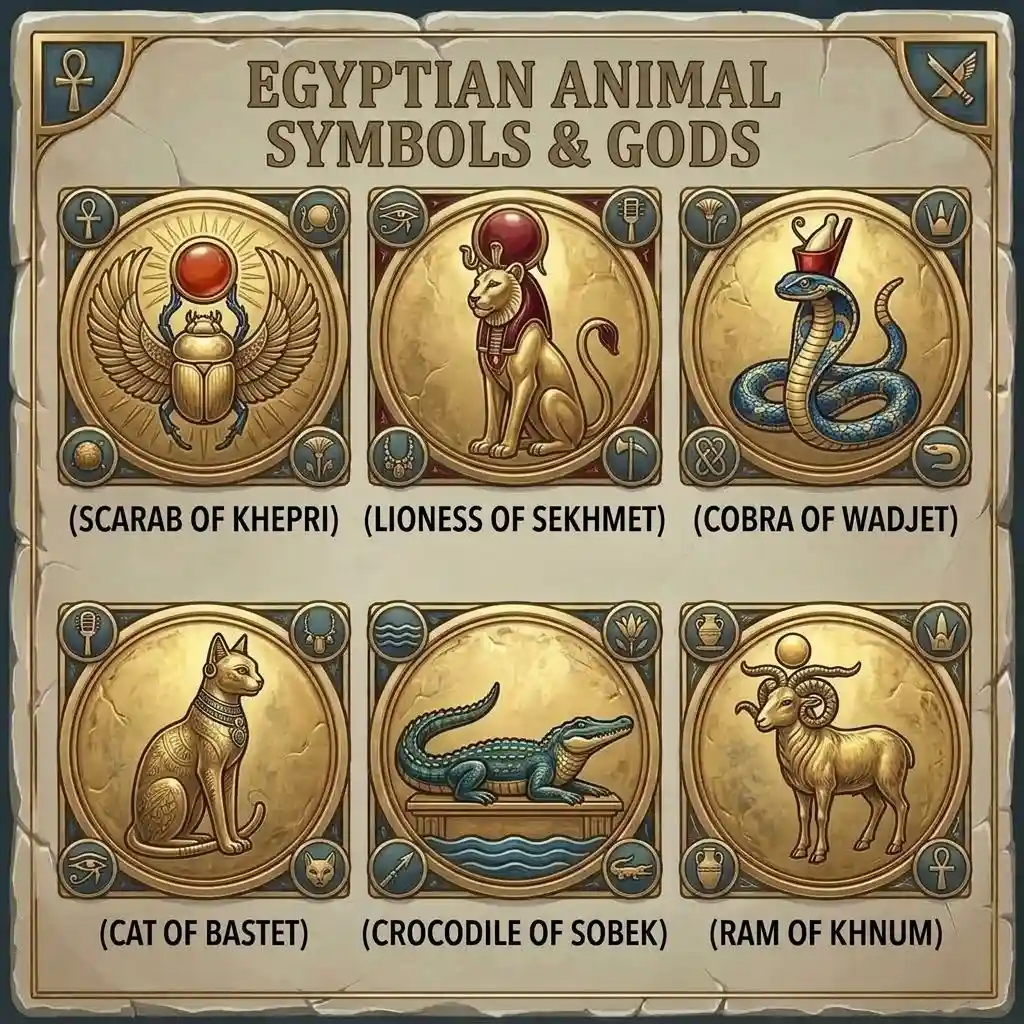
Animals played an important role in Egyptian religious art, but it is important not to assume that every animal had one exclusive divine owner.
Falcon and Horus
The falcon is one of the most recognizable forms connected with Horus.
Its connection with the sky and its ability to fly made it a fitting image for a deity associated with the heavens and kingship.
Jackal and Anubis
The jackal or canine form is strongly associated with Anubis.
Because wild canines were seen around desert burial grounds, the connection between the animal and funerary protection became particularly meaningful.
Ibis and Thoth
The ibis is strongly associated with Thoth.
The bird became a recognizable visual identifier for the god of writing and knowledge.
Scarab and Khepri
The scarab is closely connected with Khepri and the renewal of the sun.
This is one of the clearest examples of animal behavior becoming part of religious symbolism.
Cat and Bastet
Cats are strongly connected with Bastet, particularly in later Egyptian religious imagery.
However, cats had broader cultural significance, so an ancient Egyptian cat image should not automatically be labeled as Bastet without considering its context.
Lioness and Sekhmet
The lioness represents the fierce power associated with Sekhmet.
Her lioness head, often combined with a solar disk, is one of her most recognizable visual characteristics.
Crocodile and Sobek
Sobek’s crocodile form reflects the importance and danger of the Nile environment.
The crocodile could symbolize both destructive natural power and the life-giving fertility of the river.
Egyptian Crowns and Headdresses
A deity’s crown or headdress can be just as useful for identification as an animal or object.
The Atef Crown
The atef crown is strongly associated with Osiris.
It resembles a tall white crown with additional decorative elements on its sides. When this crown appears together with a mummified figure holding a crook and flail, Osiris is usually the strongest identification.
The Solar Disk
The solar disk appears in the imagery of several deities, particularly solar gods and goddesses.
It is therefore an important clue but not an exclusive symbol of one deity.
Isis’s Throne Emblem
The throne-shaped sign is an important identifier of Isis.
The Metropolitan Museum notes that Isis can be depicted wearing the throne emblem and, in later imagery, a horned crown associated with Hathor.
Horns and Solar Disk
The combination of cow horns and a solar disk is strongly associated with Hathor and can also appear in later representations of Isis.
This is another reason why the period and surrounding imagery matter.
The Uraeus
The raised cobra, or uraeus, appears frequently in royal and divine imagery.
It represents protective power and can appear alongside different crowns rather than identifying only one god.
How to Identify an Egyptian God by Its Symbols
If you are looking at an Egyptian statue, relief, painting, or illustration and want to identify the deity, do not rely on one feature alone.
Look at the Animal or Head
First check whether the figure has an animal head or animal body.
A falcon may suggest Horus, an ibis may suggest Thoth, a crocodile may suggest Sobek, and a jackal-like head may suggest Anubis.
Examine the Crown
Next, look carefully at the crown or headdress.
Atef imagery can help identify Osiris. A throne emblem can point toward Isis. Horns with a solar disk can suggest Hathor or related imagery.
Check What the Figure Is Holding
Objects provide another important clue.
Look for:
- Ankh
- Was scepter
- Crook
- Flail
- Sistrum
- Lotus
- Staff
- Other ritual objects
Remember that some objects were held by several gods.
Look at the Surrounding Symbols
The surrounding scene can be just as important as the figure.
A funerary scene may involve Anubis, Osiris, Ma’at, and other afterlife imagery. A royal scene may emphasize Horus, Ra, crowns, and symbols of kingship.
Consider the Historical Context
Egyptian religious imagery changed over time.
A representation from the Old Kingdom may look different from one produced during the New Kingdom or Ptolemaic period. Local religious traditions also influenced how gods were represented.
Look for Inscriptions
Hieroglyphic inscriptions can provide valuable information about the identity of a deity.
When an ancient object is being studied professionally, inscriptions, archaeological context, artistic style, and associated objects can all help establish its identification.
Egyptian God Symbols vs Egyptian Hieroglyphs
Egyptian god symbols and hieroglyphs are connected but should not be treated as identical.
Hieroglyphs formed a writing system used to record language. Religious symbols, meanwhile, could communicate ideas visually through objects, animals, crowns, and signs.
Some hieroglyphic signs also had symbolic importance. The ankh is a good example because it functioned as a written sign connected with the concept of life while also becoming one of the most recognizable religious symbols of ancient Egypt.
This means that calling every Egyptian symbol a “hieroglyph” is not accurate.
Egyptian God Symbols for Life, Death, Protection, and Rebirth
One reason Egyptian symbols remain popular is that many of them communicate ideas that are still meaningful today.
Symbols Connected With Life
The ankh is the most famous Egyptian symbol associated with life.
Its presence in the hands of gods and in funerary art connects physical existence with the broader Egyptian concept of continued life.
Symbols Connected With Stability
The djed is strongly associated with stability and permanence.
Its connection with Osiris also gives it an important role in ideas about resurrection and continued existence after death.
Symbols Connected With Protection
Protective imagery includes the Eye of Horus, uraeus cobra, tyet, and other amuletic signs.
These symbols appeared in religious art and personal objects and could express a desire for divine protection.
Symbols Connected With Power
The was scepter, royal crowns, uraeus, and crook and flail are important examples of imagery connected with authority and power.
These symbols helped communicate the relationship between gods, kingship, and cosmic order.
Symbols Connected With Rebirth
The scarab, djed, ankh, and Osirian imagery can all be connected with different aspects of renewal or continued life.
The scarab’s relationship with Khepri is especially important because it links the beetle with the daily rebirth of the sun.
Common Misunderstandings About Egyptian God Symbols
Egyptian symbolism is fascinating, but many modern explanations simplify it too much.
The Ankh Does Not Belong Only to Isis
The ankh is strongly associated with life and appears in the hands of many Egyptian gods.
Although it has connections with Isis, calling it exclusively “the symbol of Isis” is inaccurate.
The Eye of Horus and Eye of Ra Are Not Simply Identical
Both involve Egyptian eye symbolism, but their mythological contexts can differ.
The Eye of Horus is strongly associated with Horus, while the Eye of Ra can represent the active protective power of Ra and appear in stories involving other divine figures.
The Scarab Is More Than a Good-Luck Symbol
Modern jewelry and decorative art sometimes treat the scarab as a general good-luck charm.
Its ancient religious significance was much richer. Scarab imagery was closely connected with Khepri and ideas of solar renewal and transformation. Scarab amulets were also widely used in ancient Egypt.
Anubis Is More Than a God of Death
Anubis is closely connected with funerary practices, mummification, protection of the dead, and the transition into the afterlife.
Calling him simply a “death god” leaves out much of his religious role.
Osiris Is Not Simply a Death God
Osiris is strongly connected with the afterlife, but his symbolism also involves kingship, resurrection, fertility, renewal, and continued life.
His connection with the djed and the crook and flail demonstrates the broader meaning of his role.
Egyptian Symbols Did Not Have One Fixed Meaning Forever
Egyptian religion developed over a very long period.
A symbol could gain new associations, become connected with another deity, or be interpreted differently in a particular religious context.
This is why historical context is essential when discussing Egyptian god symbols.
Modern Uses of Egyptian God Symbols
Egyptian symbols continue to appear in modern culture.
Egyptian Symbols in Tattoos
People may choose an ankh tattoo to express life, eternity, or personal renewal. Others may choose the Eye of Horus because of its modern associations with protection.
However, a modern tattoo meaning should not automatically be presented as the exact meaning intended by ancient Egyptians.
Egyptian Symbols in Jewelry
Ankhs, scarabs, Eye of Horus designs, and other Egyptian motifs are common in jewelry.
Modern jewelry can combine several symbols for decorative or personal reasons, even when the ancient symbols originally had different contexts.
Egyptian Symbols in Art and Design
Ancient Egyptian imagery is often used in paintings, illustrations, graphic design, clothing, architecture, and decorative objects.
For historically inspired artwork, understanding the original symbolism can help prevent accidental combinations or inaccurate labels.
Egyptian Symbols in Education
These symbols are particularly useful for teaching ancient Egyptian religion and art because they allow students to connect visual imagery with mythology, kingship, funerary beliefs, and social life.
Frequently Asked Questions
What is the most famous Egyptian god symbol?
The ankh is probably the most recognizable ancient Egyptian symbol. It represents life and appears in the hands of many gods. The Eye of Horus, scarab, djed, and was scepter are also among the best-known Egyptian symbols.
What is the symbol of Anubis?
Anubis is most commonly identified through his jackal or canine form. He is associated with funerary rituals, mummification, protection of the dead, and the afterlife.
What is the symbol of Isis?
Isis has several important attributes. The throne emblem is one of her strongest identifiers, while wings, maternal imagery, and later horned crowns with solar disks can also appear in representations of her.
What is the symbol of Osiris?
Osiris is commonly associated with the djed, crook and flail, and atef crown. He is usually depicted in a mummified human form and is strongly connected with the afterlife and resurrection.
What does the Eye of Horus symbolize?
The Eye of Horus is commonly associated with protection and restoration. Its meaning is connected with the mythology of Horus and the restoration of his injured eye.
What does the ankh symbolize?
The ankh is primarily associated with life and continued existence. It was used widely in ancient Egyptian religious art and was carried by many different gods rather than belonging exclusively to one deity.
What does the scarab symbolize in ancient Egypt?
The scarab is strongly associated with Khepri and the renewal of the sun. Its imagery became connected with transformation, rebirth, and continued life. Scarab amulets were also widely used in ancient Egypt.
What Egyptian symbol represents protection?
Several Egyptian symbols have protective associations, including the Eye of Horus, the uraeus cobra, and the tyet associated with Isis. The exact meaning depends on the symbol and its historical context.
What Egyptian symbol represents rebirth?
The djed and scarab are both important symbols connected with renewal and rebirth. The djed became strongly associated with Osiris and resurrection, while the scarab was connected with Khepri and the renewed rising sun.
Are Egyptian god symbols still used today?
Yes. Egyptian symbols continue to appear in tattoos, jewelry, artwork, fashion, education, and popular culture. Modern users may give these symbols personal meanings that differ from their ancient religious context.
Conclusion
Egyptian god symbols provide a fascinating way to understand ancient Egyptian religion, mythology, art, and ideas about life and death. The ankh connects with life, the djed with stability and Osiris, the scarab with Khepri and solar renewal, and the Eye of Horus with Horus and protective imagery. Other gods can be recognized through distinctive animals, crowns, headdresses, and objects.
The most important point is that Egyptian god symbols were not always exclusive labels. A single symbol could appear with several gods, while one deity could have many different attributes. Looking at the complete combination of animal form, crown, object, inscription, and historical setting provides a much more accurate way to understand ancient Egyptian imagery.
Whether you are studying Egyptian mythology, identifying an ancient artwork, researching a symbol for a tattoo, or simply exploring the meanings behind Egyptian religious imagery, learning the context behind each symbol makes these ancient designs far more meaningful.

Dylan Anderson is a writer who enjoys turning complex topics into simple, engaging content that readers can actually use. His work focuses on clear explanations, practical insights and storytelling that feels natural and relatable. He is also the fictional author of The Quiet Compass of Ashford and Where the Cedar Lantern Glows. When he’s away from his keyboard, Dylan enjoys hiking, reading, and discovering inspiration in everyday life. He believes great writing should be informative, easy to understand and enjoyable from beginning to end.
 Adam Sullivan