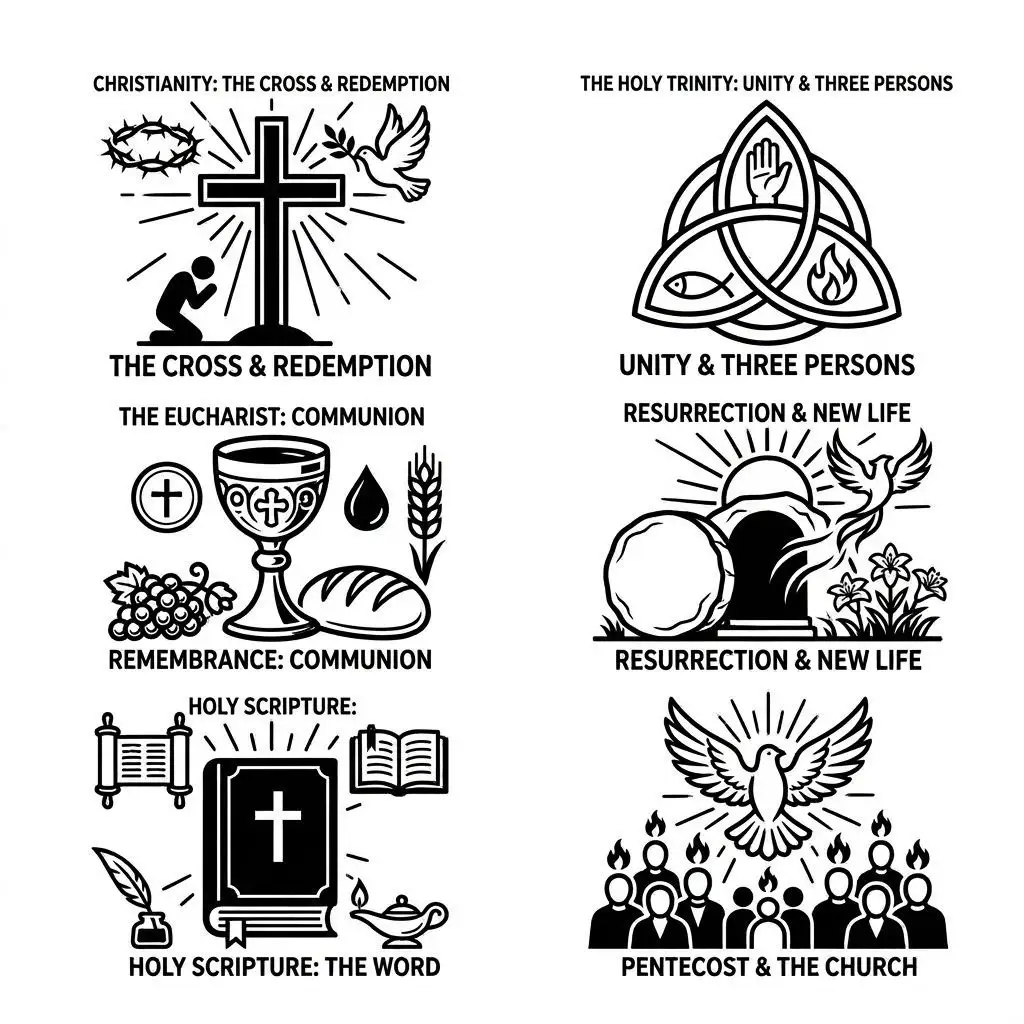
Christianity has a rich visual tradition filled with symbols that communicate important ideas about Jesus Christ, salvation, faith, hope, sacrifice, resurrection, the Holy Spirit, and eternal life. Some symbols are instantly familiar, such as the cross and crucifix, while others, including the Ichthys fish, Chi-Rho, anchor, dove, lamb, and Alpha and Omega, may be less familiar.
These Christianity religious symbols appear in churches, stained-glass windows, paintings, manuscripts, crosses, jewelry, gravestones, clothing, religious artwork, and architecture. Some have direct connections to biblical stories, while others developed through centuries of Christian art and tradition.
It is also important to understand that Christian symbols do not always have one fixed meaning. Their interpretation can depend on the biblical context, historical period, denomination, geographical region, and way the symbol is presented.
This guide explores the most important Christian symbols, their meanings, biblical connections, historical development, and modern uses. It also explains how to recognize common symbols and avoid confusing similar designs.
What Are Christianity Religious Symbols?
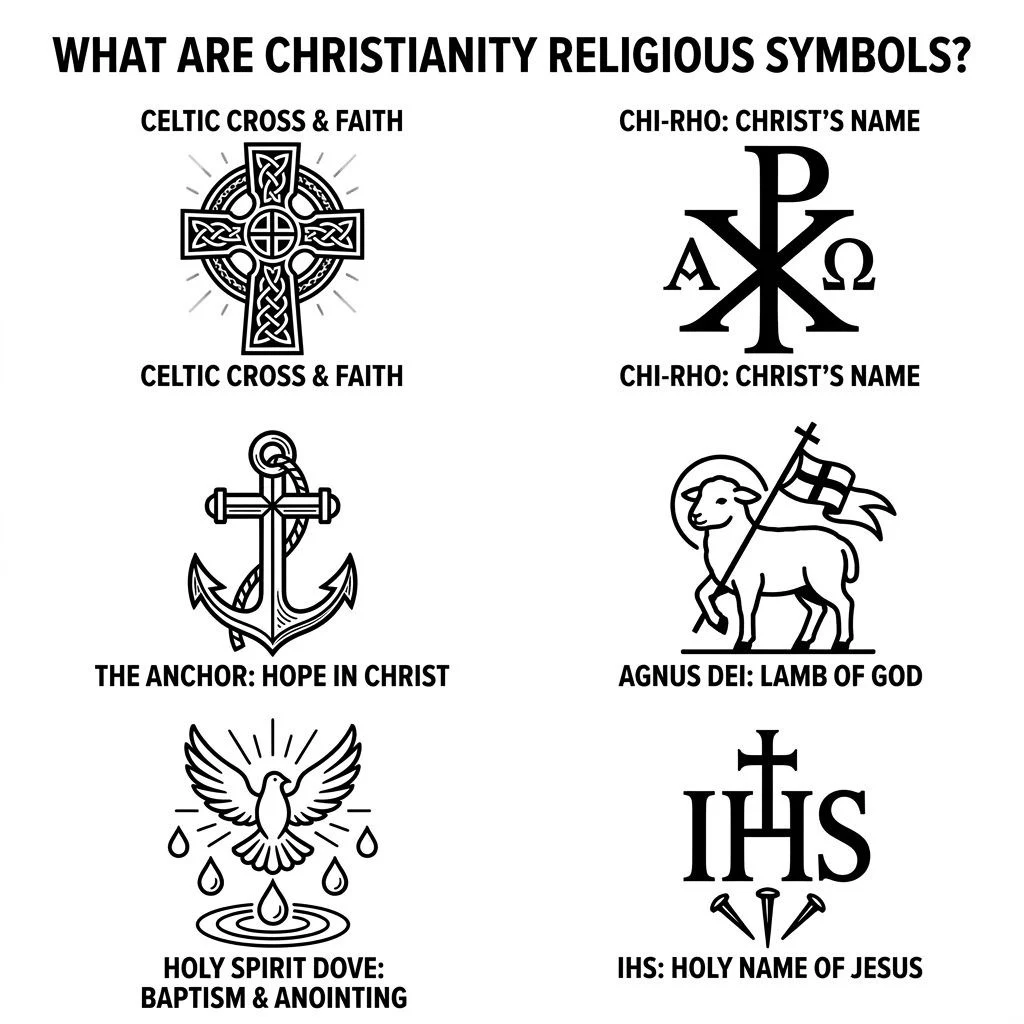
Christian religious symbols are visual signs, objects, letters, images, and designs used to communicate Christian beliefs or ideas.
A symbol can help express a complex religious concept without requiring a long explanation. For example, a cross can immediately point to the crucifixion of Jesus Christ, while Alpha and Omega can communicate the idea of God’s eternity.
Some Christian symbols developed from biblical imagery. Others became established through Christian worship, art, architecture, and tradition.
Why Are Symbols Important in Christianity?
Symbols can help Christians remember important teachings and events.
A cross can remind believers of Christ’s crucifixion and resurrection. A dove can represent the Holy Spirit, while an anchor can express hope and steadfastness.
Symbols have also been important in Christian art because they allow artists to communicate ideas through visual details. Early Christian art included symbols such as the fish, dove, anchor, and cross, showing that Christian visual language developed beyond a single symbol.
Are All Christian Symbols Directly Mentioned in the Bible?
No.
Some symbols have very strong biblical connections, but the specific artistic form of a symbol may have developed later.
For example, the cross is connected with the crucifixion of Jesus, and Alpha and Omega are connected with imagery in Revelation. The dove is connected with the Holy Spirit at Jesus’ baptism.
Other visual forms, such as particular cross designs, halos, Christograms, and elaborate Trinity symbols, developed through Christian artistic traditions over time.
Therefore, it is useful to distinguish between biblical imagery and symbols that became established in Christian tradition.
Christianity Religious Symbols at a Glance
| Symbol | Common Meaning | Main Association |
| Cross | Sacrifice, salvation, faith, resurrection | Jesus Christ |
| Crucifix | Christ’s crucifixion and sacrifice | Jesus Christ |
| Ichthys Fish | Christ and Christian faith | Jesus |
| Dove | Holy Spirit, peace, purity | Holy Spirit |
| Chi-Rho | Christ | Jesus Christ |
| Alpha and Omega | Eternity and completeness | God/Christ |
| Anchor | Hope and steadfast faith | Christian hope |
| Lamb of God | Christ, sacrifice, redemption | Jesus Christ |
| Crown of Thorns | Suffering and Passion | Jesus Christ |
| Palm Branch | Victory, martyrdom, triumph | Christ and saints |
| Halo | Holiness or divine glory | Christ, angels, saints |
| Trinity Knot | Trinity and unity | Father, Son, Holy Spirit |
| Jerusalem Cross | Jerusalem and Christian tradition | Christianity |
| Baptismal Shell | Baptism and renewal | Christian baptism |
| Good Shepherd | Christ’s care and guidance | Jesus Christ |
| Vine | Christ, spiritual life, fruitfulness | Jesus and believers |
These meanings provide a useful starting point, but the exact interpretation of a symbol can change according to its context.
The Cross
The cross is the most widely recognized symbol of Christianity.
For Christians, it recalls the crucifixion of Jesus Christ and is connected with his suffering, sacrifice, death, salvation, and resurrection.
The cross appears in many different designs. Some are plain and simple, while others contain inscriptions, images of Christ, gemstones, decorative patterns, or additional symbols.
Historical Christian objects demonstrate how the cross became an important religious and cultural sign. For example, a Byzantine cross was used in religious, military, and imperial processions, showing that the symbol could carry both devotional and broader cultural significance.
What Does the Christian Cross Mean?
The cross can represent several connected ideas:
- The crucifixion of Jesus
- Christ’s sacrifice
- Salvation
- Redemption
- Faith
- Resurrection
- Christian hope
- Victory over death
For this reason, describing the cross only as a symbol of death gives an incomplete picture of its Christian meaning.
Common Types of Christian Crosses
Christian communities have developed many forms of the cross.
The Latin cross is one of the most recognizable designs in Western Christianity.
The Greek cross has four arms of equal length.
The Celtic cross combines a cross with a circular ring and is strongly associated with Celtic Christian artistic traditions.
The Orthodox cross can have additional horizontal or slanted elements depending on the tradition.
The Ethiopian cross can feature intricate geometric designs and has its own distinctive history within Ethiopian Christianity.
These designs show that Christian symbolism has developed across different cultures rather than following one universal artistic style.
The Crucifix
A crucifix is a cross that includes an image of Jesus Christ on it.
This is the main difference between a crucifix and an empty cross.
Cross vs. Crucifix
A plain cross can be represented without the body of Christ.
A crucifix specifically shows Christ’s body, directing visual attention toward the crucifixion.
Both forms are Christian symbols, but different Christian traditions use them differently. Catholic churches and devotional objects commonly feature crucifixes, while many Protestant churches emphasize an empty cross.
What Does a Crucifix Represent?
The crucifix can emphasize:
- Christ’s suffering
- Christ’s sacrifice
- The Passion
- God’s love
- Redemption
- The reality of the crucifixion
An empty cross can place stronger visual emphasis on Christ’s victory and resurrection, although Christians may interpret both forms through the larger story of crucifixion and resurrection.
The Ichthys or Christian Fish
The Ichthys, commonly known as the Christian fish, is another important Christian symbol.
The Greek word ichthys means fish. The letters of the Greek word were also used by Christians in a phrase associated with Jesus Christ.
The fish became part of the visual language of early Christianity. Historical scholarship on early Christian art identifies fish, dove, anchor, fisherman, ship, and other images among the symbolic forms used by early Christians.
What Does the Christian Fish Mean?
The fish can represent:
- Jesus Christ
- Christian faith
- Christian identity
- Biblical fishing imagery
- The disciples
- Spiritual belonging
The symbol remains popular today on car decals, jewelry, church materials, clothing, artwork, and social media graphics.
Why Is the Fish Associated With Jesus?
The New Testament contains several important stories involving fish and fishermen.
Several of Jesus’ disciples were fishermen, and the Gospels contain stories involving miraculous catches of fish and feeding large crowds.
These biblical connections helped make the fish a meaningful image within Christian tradition.
The Dove
The dove is especially associated with the Holy Spirit in Christian symbolism.
This connection is particularly strong in artwork depicting the baptism of Jesus.
A Byzantine silver dove in The Metropolitan Museum of Art represents the Holy Spirit descending above Christ at his baptism. The museum also notes historical descriptions of metal doves suspended above church altars.
What Does the Dove Symbolize?
Depending on context, the dove can represent:
- The Holy Spirit
- Peace
- Purity
- Divine presence
- Baptism
- Spiritual renewal
The surrounding artwork is important. A dove in a baptismal scene is more likely to have a specific Holy Spirit meaning than an isolated decorative bird.
The Chi-Rho
The Chi-Rho is one of the oldest and most recognizable Christian Christograms.
It combines the Greek letters Chi (Χ) and Rho (Ρ), which come from the Greek name associated with Christ.
The symbol became particularly important in late Roman and Byzantine Christian art.
The Metropolitan Museum describes the Chi-Rho as a monogram for Christ and documents examples in which it appears alongside a cross and the Alpha and Omega.
What Does the Chi-Rho Mean?
The Chi-Rho identifies Christ.
It can therefore communicate:
- Jesus Christ
- Christian faith
- Christ’s authority
- Christian identity
- Devotion to Christ
It is often found in church decoration, manuscripts, funerary objects, jewelry, coins, and architectural elements.
Alpha and Omega
Alpha is the first letter of the Greek alphabet, while Omega is the last.
Together, Alpha and Omega became important Christian symbols of eternity, completeness, and God’s all-encompassing nature.
The Metropolitan Museum notes that these letters were widely used by Christians and connects them with the imagery of Revelation, including the statement, “I am the Alpha and the Omega.”
What Do Alpha and Omega Represent?
They can communicate:
- Beginning and end
- Eternity
- Completeness
- God’s sovereignty
- Christ’s eternal nature
They are frequently placed beside or near a cross or image of Christ.
The Anchor
The anchor is an important Christian symbol of hope and stability.
An anchor keeps a ship from drifting, making it a natural image for remaining secure during difficult circumstances.
The anchor appears among the symbols associated with early Christian art.
What Does the Christian Anchor Mean?
The anchor can symbolize:
- Hope
- Faith
- Stability
- Perseverance
- Spiritual security
- Trust in God
In some early Christian contexts, the anchor’s shape could also be connected visually with the cross, adding another layer to its meaning.
The Lamb of God
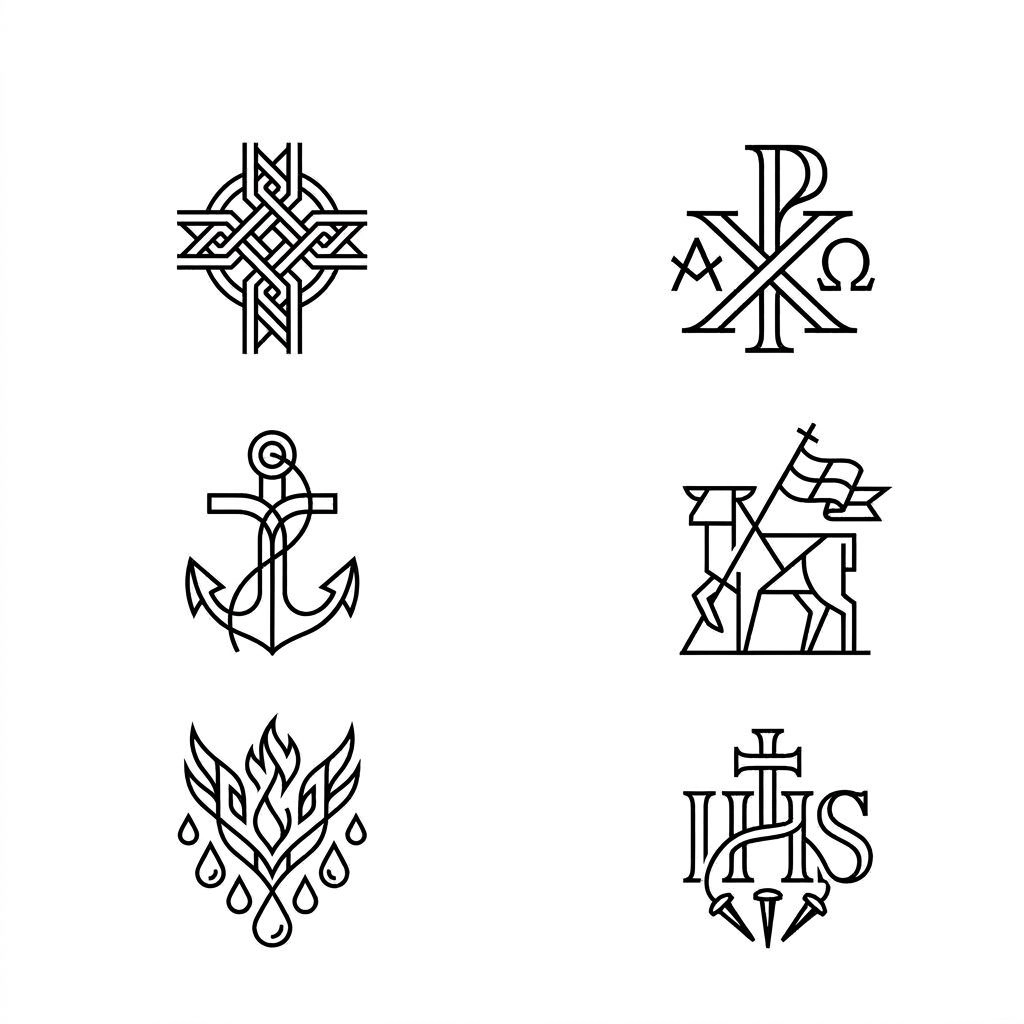
The Lamb of God, or Agnus Dei, is an important Christian symbol for Jesus Christ.
The lamb is associated with biblical sacrificial imagery and with Christ’s role in Christian theology.
Medieval Christian art frequently represented Christ through the image of a lamb. The Metropolitan Museum, for example, identifies a lamb in a medieval manuscript as an image commonly associated with Christ.
What Does the Lamb Symbolize?
The Lamb of God can represent:
- Jesus Christ
- Sacrifice
- Innocence
- Redemption
- Salvation
- Victory
- Christ’s suffering and triumph
A lamb shown with a cross is especially recognizable as Christian imagery.
The Good Shepherd
The Good Shepherd is another major Christian image of Christ.
Jesus is represented as a shepherd caring for sheep. The imagery communicates guidance, protection, love, responsibility, and care.
The Good Shepherd was particularly important in early Christian art. The Metropolitan Museum’s research on early Christian imagery notes that the Good Shepherd was one of the most widespread portrayals of Christ in that period.
What Does the Good Shepherd Symbolize?
The image can communicate:
- Christ’s care for believers
- Guidance
- Protection
- Sacrificial love
- Spiritual leadership
- The relationship between Christ and his followers
Unlike the cross, the Good Shepherd presents Christian faith through an image of care rather than through an image of suffering.
The Crown of Thorns
The crown of thorns is directly associated with the Passion of Jesus Christ.
It represents the suffering Jesus endured before his crucifixion and also creates a contrast between earthly humiliation and Christian belief in Christ’s kingship.
What Does the Crown of Thorns Symbolize?
It can represent:
- Christ’s suffering
- The Passion
- Sacrifice
- Humility
- Mockery
- Kingship
- Redemption
A crown of thorns is therefore easily recognized in Christian artwork depicting the final events of Jesus’ earthly life.
The Palm Branch
The palm branch has several important Christian associations.
It is strongly connected with Palm Sunday, which commemorates Jesus’ entry into Jerusalem.
Palm imagery can also represent victory and martyrdom in Christian art.
What Does the Palm Branch Mean?
Depending on context, it can symbolize:
- Christ’s triumph
- Victory
- Martyrdom
- Faithfulness
- Eternal life
- Spiritual victory
A saint holding a palm branch may therefore be depicted as a martyr rather than simply as a participant in the story of Palm Sunday.
The Halo
The halo is a circular or radiant form around the head of a sacred figure.
It is widely used in Christian art to indicate holiness, sanctity, or divine glory.
Who Can Have a Halo?
Halos can appear around:
- Jesus Christ
- The Virgin Mary
- Angels
- Saints
- Other sacred figures
The exact appearance of the halo can differ by artistic tradition.
A halo is therefore better understood as a visual indication of sacred status than as a symbol belonging to one particular Christian person.
Trinity Symbols
The Trinity refers to the Christian belief in one God in three persons: Father, Son, and Holy Spirit.
Christian artists have developed several visual ways to communicate this theological idea.
The Triquetra
The triquetra is a three-part interlaced design sometimes used as a Christian symbol of the Trinity.
Its three connected sections can suggest the relationship and unity of Father, Son, and Holy Spirit.
However, the design is not exclusively Christian and can have meanings outside Christianity. Context is therefore essential.
Three Interlocking Circles
Three interlocking circles may also be used to communicate the Trinity.
The separate circles can represent the three persons, while their connection suggests unity.
Different churches and artists may use different versions of this design.
The Jerusalem Cross
The Jerusalem Cross is a large central cross surrounded by four smaller crosses.
It is strongly associated with Jerusalem and Christian history.
The four smaller crosses have received different interpretations over time, so it is better to avoid assigning one universal explanation to every version.
Why Is the Jerusalem Cross Important?
It can be associated with:
- Jerusalem
- Christian pilgrimage
- The Holy Land
- Christian heritage
- Missionary and charitable traditions
Its distinctive appearance makes it relatively easy to identify among Christian cross designs.
The Baptismal Shell
A shell can be used as a Christian symbol of baptism.
The connection comes from the use of water in baptism and the use of shells in some Christian baptismal traditions.
What Does the Shell Represent?
In a Christian context, the shell can point toward:
- Baptism
- Renewal
- New life
- Christian initiation
- Water
Shell imagery may appear on baptismal fonts, church decorations, religious artwork, and Christian objects.
The Vine and Grapes
The vine and grapes are important Christian symbols connected with Jesus’ teaching and Christian ideas about spiritual life and fruitfulness.
Vine imagery can appear in church architecture, manuscripts, crosses, stained glass, and other Christian artwork.
What Does the Vine Symbolize?
The vine can communicate:
- Spiritual connection
- Growth
- Fruitfulness
- Life in Christ
- The relationship between Christ and believers
Grapes and the vine may also appear in Eucharistic imagery because of their connection with wine.
Bread and Wine
Bread and wine are important Christian symbols because of their role in the Last Supper and Christian Eucharistic traditions.
Bread can point toward Christ as the bread of life, while wine is associated with the blood of Christ in Eucharistic theology.
Why Are Bread and Wine Important?
They can represent:
- Communion
- Christ’s sacrifice
- Spiritual nourishment
- The Last Supper
- Christian fellowship
Different Christian denominations understand the Eucharist differently, so explanations should respect these theological differences.
The Four Evangelist Symbols
Christian art sometimes represents the four Gospel writers through four symbolic figures.
These are traditionally:
| Evangelist | Traditional Symbol |
| Matthew | Angel or winged human |
| Mark | Winged lion |
| Luke | Winged ox |
| John | Eagle |
These symbols are derived from Christian interpretations of the vision in Revelation and became important in medieval Christian art. The Metropolitan Museum provides an example showing these four figures surrounding the Lamb of God.
How to Recognize the Four Evangelist Symbols
If you see four unusual figures around Christ, a cross, or a Gospel manuscript, check for:
- A human or angelic figure
- A winged lion
- A winged ox
- An eagle
The four together often point toward the Evangelists.
Christian Symbols in Churches and Religious Art
Christian symbols can be found throughout religious spaces.
Stained-Glass Windows
Stained-glass windows often combine biblical scenes with symbolic objects.
A window might include a cross, dove, lamb, fish, vine, crown, or Greek letters.
The combination of symbols can help tell the story even when a viewer does not know the accompanying text.
Church Architecture
Crosses and Christograms can appear on doors, walls, columns, arches, windows, and other architectural features.
A Byzantine architectural fragment from approximately the fifth or sixth century, for example, combines a cross or Christogram with Alpha and Omega.
Graves and Memorials
Christian symbols are also common on graves.
A cross can identify Christian faith, while Alpha and Omega, a dove, lamb, angel, or anchor may communicate ideas of hope, eternal life, resurrection, or remembrance.
Christian Jewelry
Crosses, crucifixes, fish, Chi-Rho designs, anchors, and other symbols are frequently used in Christian jewelry.
The meaning can be religious, cultural, personal, or a combination of these.
Early Christian Religious Symbols
Christian symbolism developed over time rather than appearing as one complete system.
Symbols Used by Early Christians
Early Christian art included symbols such as the fish, dove, anchor, ship, fisherman, palm, and Good Shepherd.
Some symbols could have multiple interpretations, and scholars sometimes need surrounding imagery to determine whether an ancient object was specifically Christian. Historical research from The Metropolitan Museum notes that certain early Christian images could be ambiguous without contextual symbols.
Chi-Rho in Early Christian History
The Chi-Rho became widespread across Christian regions.
The Metropolitan Museum notes that the symbol appears in areas stretching from western Europe to Egypt, demonstrating how Christian symbolism traveled across different parts of the ancient world.
Christian Symbols in Byzantine Art
Byzantine Christianity developed an especially rich visual tradition.
Crosses, Christograms, images of Christ, saints, angels, and Greek inscriptions were used in churches and religious objects.
A Byzantine processional cross from around the eleventh century, for example, includes Christ, the Virgin Mary, John the Baptist, and archangels within an elaborate cross design.
Christian Symbols Across Different Denominations
Christianity includes many traditions, so the use of symbols is not identical everywhere.
Catholic Christian Symbols
Catholic churches commonly use crosses, crucifixes, images of saints, Marian symbols, the Sacred Heart, the Chi-Rho, and many other religious images.
The crucifix is especially prominent in Catholic devotional practice.
Eastern Orthodox Christian Symbols
Eastern Orthodox Christianity has a highly developed tradition of icons, crosses, halos, Christograms, saints, angels, and biblical imagery.
Orthodox cross designs can differ from the familiar Western Latin cross.
Protestant Christian Symbols
Protestant traditions vary widely.
Some churches use simple crosses with relatively little additional imagery. Others use stained glass, Christian artwork, crosses, fish, biblical symbols, and elaborate church decoration.
Therefore, it is inaccurate to assume that all Protestant churches use religious symbols in exactly the same way.
Coptic and Ethiopian Christian Symbols
Coptic and Ethiopian Christian traditions have distinctive forms of Christian art and cross design.
Ethiopian crosses can feature elaborate geometric patterns and are important expressions of Ethiopian Christian heritage.
This diversity demonstrates that Christian symbolism is not limited to one region or artistic tradition.
How to Identify Christianity Religious Symbols
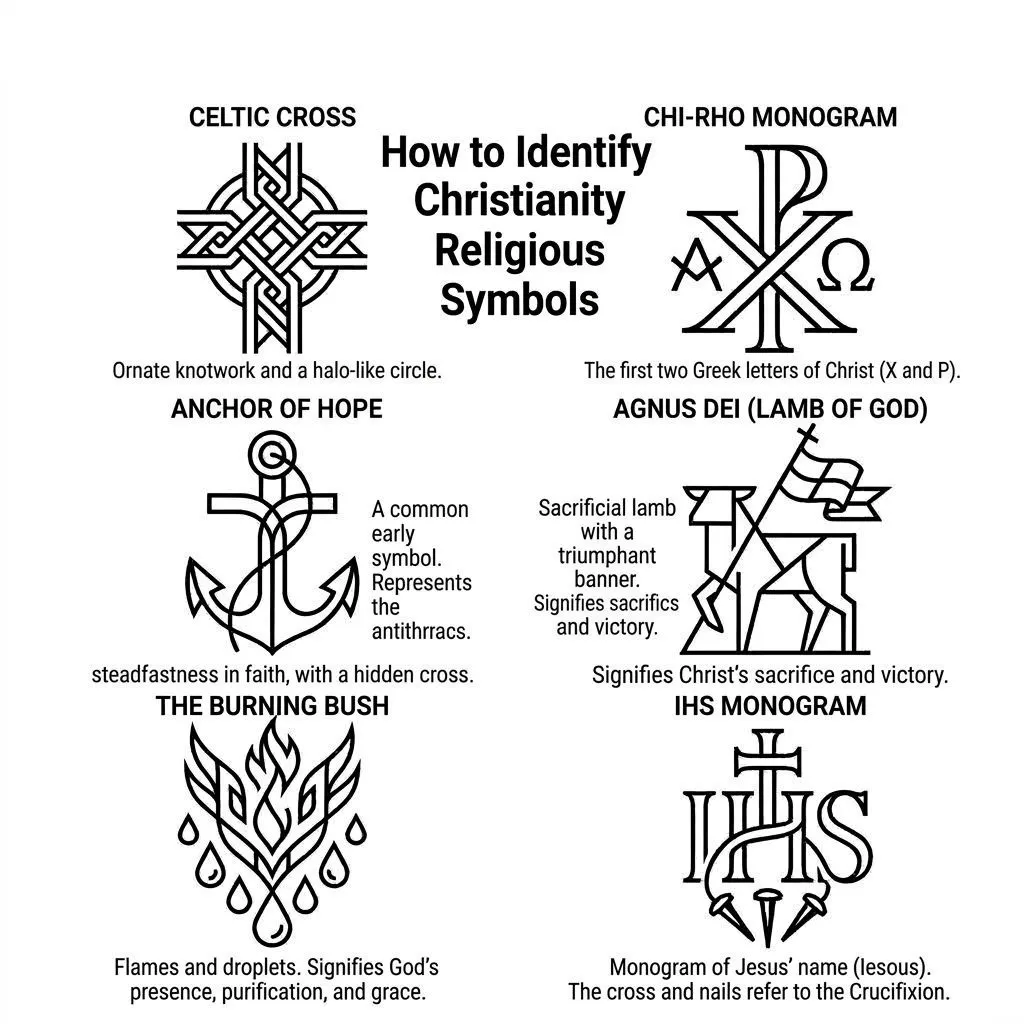
If you find an unfamiliar symbol in a church, painting, necklace, manuscript, or gravestone, examine the entire design rather than one small detail.
Start With the Basic Shape
Ask what you are looking at.
Is it:
- A cross?
- A fish?
- A dove?
- An anchor?
- A lamb?
- A crown?
- A group of letters?
- A circle or interlocking pattern?
The basic shape can quickly narrow the possibilities.
Look for Greek Letters
Greek letters can provide important clues.
Chi-Rho points toward Christ.
Alpha and Omega often communicate eternity and God’s completeness.
Letters around a figure may also identify a person or biblical scene.
Examine the Surrounding Images
Context is one of the most important parts of identification.
A dove above Christ during a baptismal scene is strongly associated with the Holy Spirit.
A lamb beside a cross may represent Christ as the Lamb of God.
A palm in the hand of a saint may indicate martyrdom.
Consider the Location
A symbol in a baptismal area may have a different meaning from the same shape on a grave.
A symbol above an altar may be part of a liturgical design, while one on a piece of jewelry may have a personal meaning.
Consider the Christian Tradition
If the object comes from a Catholic, Orthodox, Ethiopian, Coptic, Anglican, or Protestant setting, that information can help explain its design.
Consider the Historical Period
Christian symbols developed across centuries.
A symbol from early Christianity can look very different from one created during the medieval, Byzantine, Renaissance, or modern periods.
Historical context is therefore essential for accurate interpretation.
Biblical Symbols vs. Traditional Christian Symbols
One of the most important points for understanding Christianity religious symbols is recognizing that biblical imagery and later Christian symbolism are related but not identical.
Symbols With Strong Biblical Connections
Examples include:
- Cross
- Dove
- Lamb
- Vine
- Bread and wine
- Alpha and Omega
- Fish
- Shepherd
These symbols can be connected with specific biblical passages, teachings, stories, or imagery.
Symbols Developed Through Christian Tradition
Other designs became important through Christian art and worship.
Examples can include:
- Specific cross styles
- Halos
- Elaborate Christograms
- Some Trinity designs
- Regional Christian cross patterns
- Certain saintly attributes
These symbols can still be deeply Christian even when their exact visual form was developed after the biblical period.
Modern Uses of Christian Religious Symbols
Christian symbols continue to have a strong presence in modern life.
Christian Symbols in Tattoos
People may choose crosses, fish, doves, crowns of thorns, Chi-Rho designs, or other Christian symbols for tattoos.
The design may express:
- Faith
- Personal devotion
- Hope
- Family heritage
- Remembrance
- Spiritual identity
A modern tattoo can have a personal interpretation that differs from the symbol’s historical meaning.
Christian Symbols in Jewelry
Cross necklaces are among the most recognizable forms of Christian jewelry.
Other popular designs include:
- Crucifixes
- Ichthys fish
- Chi-Rho
- Alpha and Omega
- Dove
- Anchor
- Trinity symbols
Christian Symbols in Home Decor
Crosses, biblical artwork, plaques, statues, wall hangings, and decorative objects may incorporate Christian symbols.
These items can be used for worship, remembrance, education, or personal expression.
Christian Symbols in Logos
Churches, charities, schools, ministries, and Christian organizations sometimes simplify traditional symbols into modern logos.
A logo may use only the outline of a cross, fish, dove, or other symbol while keeping its general Christian association.
Common Misunderstandings About Christian Symbols
Understanding Christian symbolism requires more than memorizing a list of meanings.
The Cross Is Not Only a Symbol of Death
The cross recalls Christ’s crucifixion, but Christian belief connects the crucifixion with resurrection, salvation, and hope.
Its meaning is therefore broader than death alone.
A Cross and Crucifix Are Not the Same Design
A crucifix includes the body of Jesus.
A plain cross does not.
Both are important Christian symbols, but their visual emphasis differs.
The Christian Fish Has Historical Roots
The Ichthys is not simply a modern Christian logo.
Fish imagery was part of the symbolic language of early Christianity.
Not Every Dove Means the Holy Spirit
A dove can symbolize different ideas.
In a baptismal scene involving Jesus, it can clearly represent the Holy Spirit. Historical Christian artwork provides strong examples of this use.
Not Every Three-Part Symbol Is a Trinity Symbol
Three-part designs exist in many cultures.
A Christian setting and surrounding imagery are needed before identifying a particular design as a symbol of the Trinity.
Christian Symbols Can Have More Than One Meaning
A symbol may have a primary theological meaning and additional historical, cultural, artistic, or personal meanings.
The anchor, for example, can communicate Christian hope while also functioning as a maritime image.
Frequently Asked Questions
What is the most important symbol in Christianity?
The cross is the central and most widely recognized symbol of Christianity. It recalls the crucifixion of Jesus Christ and is associated with sacrifice, salvation, resurrection, faith, and hope.
What are the main Christianity religious symbols?
Important Christian symbols include the cross, crucifix, Ichthys fish, dove, Chi-Rho, Alpha and Omega, anchor, Lamb of God, crown of thorns, palm branch, halo, Good Shepherd, vine, and various Trinity symbols.
What does the Christian cross symbolize?
The Christian cross primarily recalls the crucifixion of Jesus Christ. It can also represent sacrifice, salvation, redemption, resurrection, faith, and Christian hope.
What is the difference between a cross and a crucifix?
A cross can be shown without the body of Jesus, while a crucifix specifically includes an image of Christ on the cross.
What does the Ichthys fish mean?
The Ichthys or Christian fish is associated with Jesus Christ and Christian identity. Fish imagery also has important connections with biblical stories involving Jesus and his disciples.
What does the dove represent in Christianity?
The dove is particularly associated with the Holy Spirit, especially in representations of Jesus’ baptism. It can also represent peace, purity, and spiritual renewal depending on context.
What does Chi-Rho mean?
Chi-Rho is a Christian monogram formed from the Greek letters Chi and Rho. It represents Christ and became an important symbol in early and Byzantine Christian art.
What do Alpha and Omega mean in Christianity?
Alpha and Omega are the first and last letters of the Greek alphabet. In Christian symbolism, they can communicate God’s eternity, completeness, and all-encompassing nature.
What does the Christian anchor symbolize?
The anchor commonly represents hope, stability, perseverance, and steadfast faith. It was also part of the symbolic vocabulary of early Christianity.
What does the Lamb of God symbolize?
The Lamb of God represents Jesus Christ and can communicate sacrifice, innocence, redemption, salvation, and victory. Christian art has used the lamb as an image of Christ for centuries.
Are Christian symbols the same in every denomination?
No. Different Christian traditions use different crosses, icons, images, Christograms, and decorative traditions. Catholic, Eastern Orthodox, Protestant, Coptic, Ethiopian, Anglican, and other communities can have distinctive approaches to religious symbolism.
Can Christian symbols have modern meanings?
Yes. People may use Christian symbols in tattoos, jewelry, artwork, logos, clothing, and home decoration. A modern personal meaning can exist alongside the symbol’s historical Christian meaning.
Conclusion
Christianity religious symbols provide a visual way to express some of the faith’s most important beliefs. The cross recalls Christ’s crucifixion and points toward Christian hope, while the crucifix places special emphasis on Christ’s suffering and sacrifice. The Ichthys fish connects with Jesus and early Christian identity, and the dove is strongly associated with the Holy Spirit.
Other symbols add different layers of meaning. The Chi-Rho identifies Christ, Alpha and Omega communicate eternity, the anchor represents hope and steadfastness, the Lamb of God points toward Christ and sacrifice, and the Good Shepherd expresses Christ’s care and guidance. Symbols such as the palm, crown of thorns, vine, halo, and Trinity designs further enrich Christian visual tradition.
The key to understanding these symbols is context. A symbol’s meaning can depend on Scripture, historical period, denomination, artwork, location, and surrounding imagery. Christian symbolism developed over many centuries, and early Christian art already contained a wide variety of visual signs.
Whether you are researching Christianity, studying church artwork, identifying a religious symbol, learning about Christian history, or choosing a meaningful design for jewelry or artwork, understanding the background of each symbol provides a clearer and more respectful picture of Christian faith and tradition.

Adam Sullivan is a dedicated writer who enjoys transforming everyday topics into engaging and informative content. His writing focuses on making complex ideas simple, practical and enjoyable for readers of all backgrounds. Adam is also the fictional author of The Lantern Beyond Autumn Hills and Where the Morning Horizon Waits. Outside of writing, he enjoys photography, traveling and discovering inspiration through new experiences. He believes great content should be both helpful and easy to connect with.
 Dylan Anderson