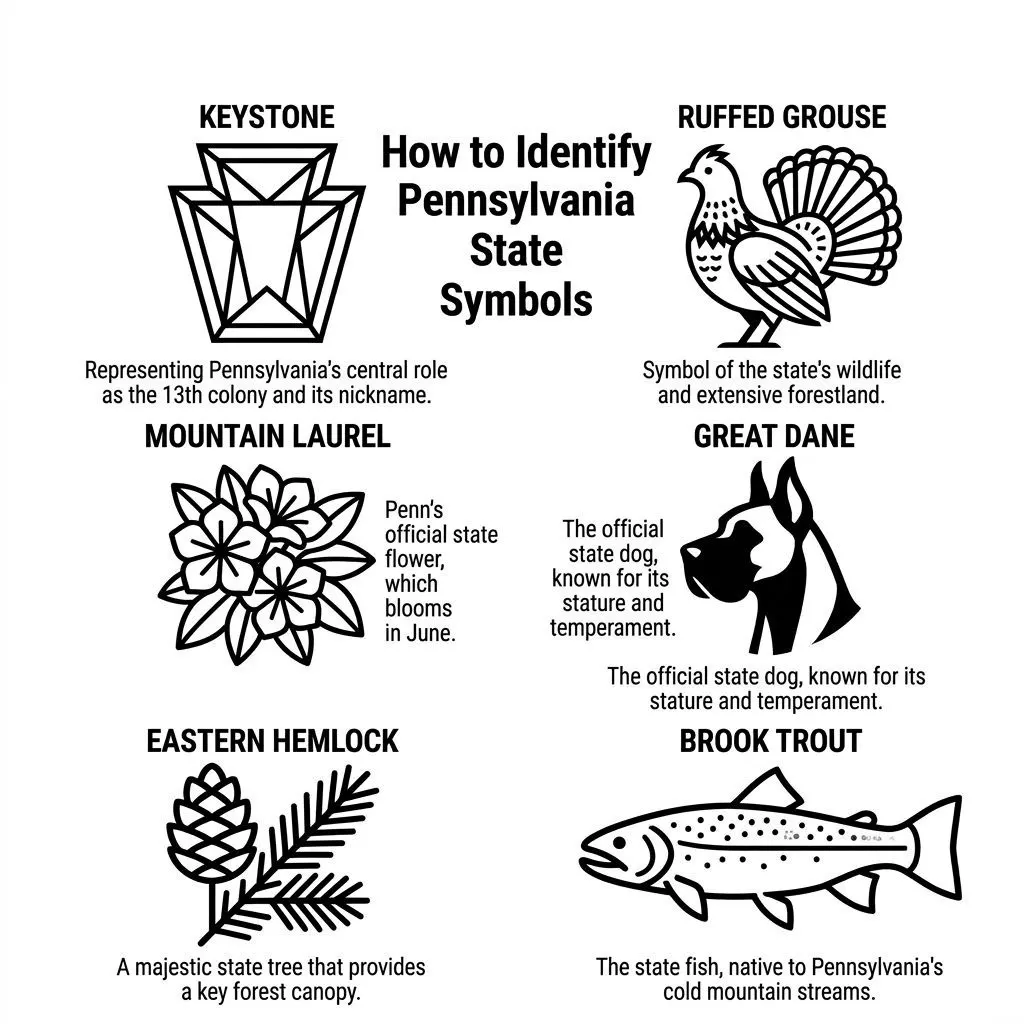
Pennsylvania has a fascinating collection of official state symbols that represent its history, wildlife, forests, agriculture, transportation, culture, and government. From the Keystone State nickname and the Pennsylvania flag to the mountain laurel, eastern hemlock, white-tailed deer, ruffed grouse, brook trout, firefly, eastern hellbender, Slinky, and U.S. Brig Niagara, each symbol highlights a different part of the Commonwealth’s identity.
If you are researching Pennsylvania state symbols for a school project, quiz, history lesson, or general interest, it helps to know more than just the most familiar flower, bird, and animal. Pennsylvania has many official designations, including some unusual ones such as a state aircraft, locomotives, theatre, firearm, and toy. The current Pennsylvania Manual documents these designations and their adoption years.
This guide brings the major official symbols together, explains what they represent, and separates official state symbols from famous Pennsylvania landmarks and cultural icons.
Pennsylvania State Symbols at a Glance
The following table gives a quick reference to many of Pennsylvania’s official symbols and designations.
| Category | Pennsylvania State Symbol | Adoption or Recognition |
| State seal | Seal of the Commonwealth | 1791 |
| State bird/game bird | Ruffed grouse | 1931 |
| State tree | Eastern hemlock | 1931 |
| State flower | Mountain laurel | 1933 |
| State animal | White-tailed deer | 1959 |
| State dog | Great Dane | 1965 |
| State fish | Brook trout | 1970 |
| State insect | Firefly | 1974 |
| State beverage | Milk | 1982 |
| State conservation plant | Penngift crownvetch | 1982 |
| State steam locomotive | Pennsylvania Railroad K4s | 1987 |
| State electric locomotive | Pennsylvania Railroad GG1 | 1987 |
| State ship | U.S. Brig Niagara | 1988 |
| State fossil | Phacops rana, later Eldredgeops rana | 1988 |
| State song | “Pennsylvania” | 1990 |
| State theatre | Walnut Street Theatre | 1999 |
| State toy | Slinky | 2001 |
| State aircraft | Piper J-3 Cub | 2014 |
| State firearm | Pennsylvania long rifle | 2014 |
| State amphibian | Eastern hellbender | 2019 |
The Pennsylvania Manual identifies these official designations, including the K4s, GG1, Niagara, fossil, Walnut Street Theatre, Piper J-3 Cub, and eastern hellbender.
Pennsylvania State Flag, Seal, and Coat of Arms
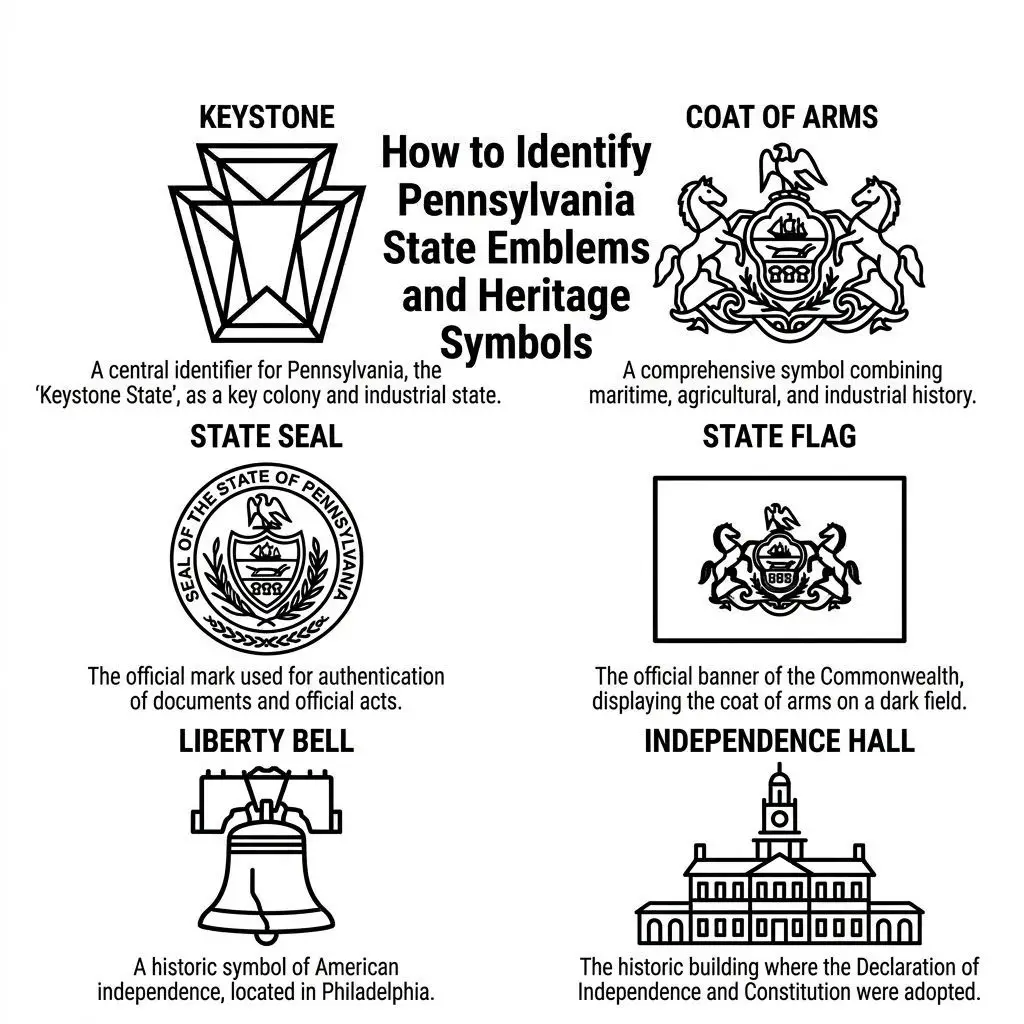
Some of the most important Pennsylvania symbols are connected to the state’s government and history. The state flag, state seal, and coat of arms are related, but they are not the same thing.
Pennsylvania State Flag
Pennsylvania’s state flag has a blue field with the state’s coat of arms in the center.
The flag connects Pennsylvania’s government, history, agriculture, commerce, and national identity in one design. The coat of arms includes a ship, plow, wheat, eagle, horses, and other elements associated with the Commonwealth.
The state began using a flag with the coat of arms in the late 18th century, while legislation in 1907 standardized the flag’s design and blue field.
The flag is one of the easiest ways to recognize Pennsylvania visually because the coat of arms appears prominently in the center.
Pennsylvania State Seal
Pennsylvania’s official state seal received legal recognition from the General Assembly in 1791. The seal has two sides, making it unusual among state seals.
The front, or obverse, features a ship, plow, and wheat. These images connect with commerce, agriculture, and Pennsylvania’s resources.
The reverse presents a symbolic image of Liberty over Tyranny and includes the words “Both Can’t Survive.”
The state seal is primarily an official governmental symbol used to authenticate or represent official state business.
Pennsylvania State Coat of Arms
The coat of arms developed from designs used in Pennsylvania during the Revolutionary era. A 1778 design by Caleb Lownes included a ship, plow, sheaves of wheat, eagle, two horses, and the motto “Virtue, Liberty, and Independence.”
The coat of arms later became a central part of the state flag.
What Do the Symbols on the Coat of Arms Mean?
Each major element adds another idea to the overall design.
- Ship: Pennsylvania’s commerce and trade.
- Plow: Agriculture and the cultivation of the land.
- Wheat: Farming, fertility, and prosperity.
- Bald eagle: Pennsylvania’s connection to the United States.
- Horses: Support the central shield.
- Olive branch: Peace.
- Cornstalk: Prosperity.
- Motto: “Virtue, Liberty, and Independence.”
Rather than representing one single idea, the coat of arms brings together several aspects of Pennsylvania’s history and identity.
Pennsylvania State Motto, Nickname, and Colors
Pennsylvania State Motto
Pennsylvania’s motto is:
“Virtue, Liberty, and Independence.”
The motto appears on the state’s coat of arms and is one of the clearest expressions of Pennsylvania’s civic identity.
The three words emphasize moral character, freedom, and self-government.
Pennsylvania State Nickname
Pennsylvania is widely known as the Keystone State.
A keystone is the central wedge-shaped stone in an arch. Without it, the structure may become unstable.
The nickname reflects Pennsylvania’s historically important position in the development of the United States. It is also an especially recognizable visual symbol of Pennsylvania.
The important distinction is that “Keystone State” is the state nickname, while symbols such as the mountain laurel and white-tailed deer are specific official designations.
Pennsylvania State Colors
Pennsylvania is associated with blue and gold as its state colors.
These colors complement the state’s visual identity and appear frequently in Pennsylvania-related educational, governmental, and civic materials.
Pennsylvania State Animal and Wildlife Symbols
Pennsylvania’s wildlife symbols highlight the Commonwealth’s forests, streams, and outdoor traditions.
State Animal: White-Tailed Deer
The white-tailed deer is Pennsylvania’s official state animal.
It was designated on October 2, 1959. Pennsylvania’s government notes that early Pennsylvanians and Native Americans depended on deer for food, clothing, and other necessities.
Today, the white-tailed deer remains strongly associated with Pennsylvania’s forests and wildlife.
Why it matters: The deer connects Pennsylvania’s modern wildlife with the long history of people living and working in the state’s wooded landscapes.
State Game Bird: Ruffed Grouse
The ruffed grouse is Pennsylvania’s official state game bird.
It was designated in 1931.
The bird is closely connected with Pennsylvania’s forests, making it a natural choice for a state with extensive wooded areas.
Its designation also reflects Pennsylvania’s long hunting and outdoor heritage.
State Fish: Brook Trout
The brook trout is Pennsylvania’s official state fish.
It became the state fish in 1970.
Brook trout are associated with Pennsylvania’s cold-water streams and freshwater ecosystems. For anglers and outdoor enthusiasts, the species is an important part of Pennsylvania’s fishing tradition.
Symbolic connection: The brook trout represents streams, clean freshwater habitats, fishing, and Pennsylvania’s natural resources.
State Amphibian: Eastern Hellbender
The eastern hellbender became Pennsylvania’s official state amphibian in 2019.
It is a large aquatic salamander that lives in Pennsylvania streams and rivers. Pennsylvania’s government notes that hellbenders can serve as indicators of waterway health because they require very clean water.
This makes the hellbender particularly meaningful as a modern environmental symbol.
It does not simply represent wildlife. It also draws attention to the importance of healthy streams and aquatic habitats.
State Insect: Firefly
The firefly is Pennsylvania’s official state insect.
The insect was designated in 1974, and Pennsylvania later specified Photuris pennsylvanica as the official species.
Fireflies, also called lightning bugs, are familiar during Pennsylvania’s warm summer evenings. Their glowing flashes make them one of the state’s most recognizable small wildlife symbols.
State Dog: Great Dane
The Great Dane is Pennsylvania’s official state dog.
It was designated in 1965.
The choice is interesting because the Great Dane is not a native Pennsylvania wildlife species. Instead, it demonstrates that state symbols can also reflect cultural preferences and historical associations rather than only native plants and animals.
Pennsylvania Plant Symbols
Plants are an important part of Pennsylvania’s state identity because forests, mountains, fields, and other natural landscapes are central to the Commonwealth.
State Flower: Mountain Laurel
The mountain laurel is Pennsylvania’s official state flower.
It was designated in 1933.
Its attractive flowers make it a familiar sight in Pennsylvania’s natural areas, particularly around wooded landscapes.
The mountain laurel is an especially appropriate state flower because it connects Pennsylvania’s official identity with the beauty of its forests and countryside.
State Tree: Eastern Hemlock
The eastern hemlock is Pennsylvania’s official state tree.
It was designated in 1931.
The tree has a long connection with Pennsylvania’s forests and human history. Hemlock timber was used for practical purposes, including construction and tanning.
As a state symbol, the eastern hemlock represents Pennsylvania’s forests and natural heritage.
State Conservation Plant: Penngift Crownvetch
Penngift crownvetch is Pennsylvania’s state beautification and conservation plant.
It was designated in 1982.
Unlike a symbol chosen mainly for beauty, this designation connects directly with conservation and landscape management.
Including this symbol is important because many simplified lists of Pennsylvania symbols leave it out.
Pennsylvania State Beverage: Milk
Milk is Pennsylvania’s official state beverage.
It was designated on April 29, 1982. Pennsylvania’s government connects the designation with the state’s agricultural and dairy industry.
Milk is therefore more than a food-related choice. It represents Pennsylvania’s farming economy and the importance of dairy production across the Commonwealth.
This is also one of the easiest symbols for students to remember because it connects a familiar everyday product with Pennsylvania agriculture.
Pennsylvania State Fossil
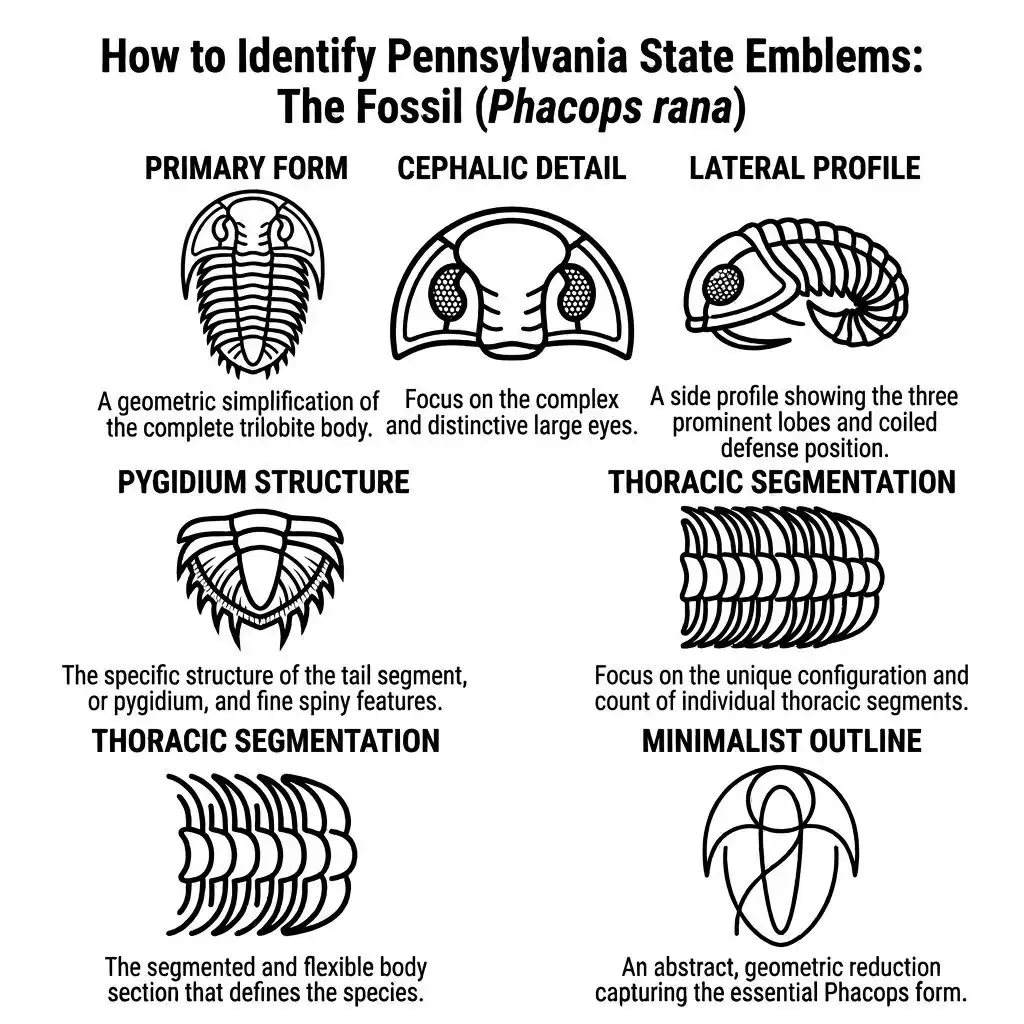
Pennsylvania’s official state fossil is a trilobite originally designated as Phacops rana.
The Pennsylvania Manual explains that the species was later reclassified as Eldredgeops rana. The original state designation dates to 1988.
What Is the Pennsylvania State Fossil?
The fossil represents Pennsylvania’s ancient geological history.
Trilobites were extinct marine arthropods that lived millions of years ago. Their fossils help scientists understand ancient environments that existed long before Pennsylvania developed its modern forests, farms, rivers, and cities.
This symbol is particularly useful in education because it connects Pennsylvania’s present landscape with its much older geological past.
Is Pennsylvania Changing Its State Fossil?
There has been a recent legislative effort to change the state fossil.
Senate Bill 829 proposed designating Hynerpeton bassetti, an early stem tetrapod, as Pennsylvania’s official state fossil. The bill passed the Pennsylvania Senate in November 2025 by a 49–0 vote, but its later House history shows that it was laid on the table on June 30, 2026.
Therefore, readers should not confuse a proposed replacement with the current official designation.
As of the latest legislative status, the existing trilobite designation remains the relevant state fossil designation.
Pennsylvania State Song
Pennsylvania’s official state song is “Pennsylvania.”
The song was written by Eddie Khoury and Ronnie Bonner and became the official state song in 1990.
A state song provides a cultural form of representation that differs from symbols such as animals and plants. It expresses ideas about Pennsylvania through music and words.
Pennsylvania State Toy: Slinky
One of Pennsylvania’s most interesting symbols is the Slinky, which is the official state toy.
The Slinky is closely associated with Philadelphia, where the toy was developed.
Pennsylvania designated it as the state toy in 2001.
This is a great example of why a complete list of Pennsylvania state symbols is more interesting than a basic list of the flower, tree, bird, and animal. The Slinky connects Pennsylvania’s official identity with invention, manufacturing, and popular culture.
Pennsylvania State Ship: U.S. Brig Niagara
The U.S. Brig Niagara is Pennsylvania’s official state ship.
It was designated in 1988 and is connected with Pennsylvania’s maritime history and the War of 1812.
The ship’s home port is Erie, where it is associated with the Erie Maritime Museum. The Pennsylvania Manual identifies the Niagara as an official state symbol.
The Niagara demonstrates that Pennsylvania’s identity is not limited to forests and farmland. The Commonwealth also has an important Great Lakes and maritime heritage.
Pennsylvania State Theatre: Walnut Street Theatre
The Walnut Street Theatre in Philadelphia is Pennsylvania’s official state theatre.
It was designated in 1999.
The theatre represents Pennsylvania’s contribution to American performing arts and cultural history.
Its inclusion among state symbols also shows how Pennsylvania’s official designations extend beyond nature and government.
Pennsylvania State Aircraft: Piper J-3 Cub
The Piper J-3 Cub is Pennsylvania’s official state aircraft.
It was designated in 2014.
The aircraft has an important connection to Pennsylvania aviation history through the Piper Aircraft company and its production history.
This makes the Piper J-3 Cub a particularly distinctive Pennsylvania symbol because it represents engineering, aviation, manufacturing, and technological history.
Pennsylvania State Firearm: Pennsylvania Long Rifle
The Pennsylvania long rifle is the state’s official firearm.
It was designated in 2014.
The rifle is historically associated with Pennsylvania and the early American frontier. It is sometimes called the Kentucky rifle in later historical contexts, although the Pennsylvania long rifle has its own important development and manufacturing history.
As a state symbol, it represents a particular part of Pennsylvania’s colonial and early American heritage.
Pennsylvania State Locomotives
Pennsylvania has official locomotive symbols that reflect its important railroad history.
State Steam Locomotive: Pennsylvania Railroad K4s
The Pennsylvania Railroad K4s was designated as the state steam locomotive in 1987.
The official designation identifies No. 1361 at the Railroaders Memorial Museum in Altoona and No. 3750 at the Railroad Museum of Pennsylvania in Strasburg.
The K4s represents Pennsylvania’s historic importance in American rail transportation.
State Electric Locomotive: Pennsylvania Railroad GG1
The Pennsylvania Railroad GG1 was designated as the state electric locomotive in 1987.
The official designation identifies No. 4859 at the Harrisburg Transportation Center.
Together, the K4s and GG1 highlight the role railroads played in Pennsylvania’s industrial and transportation history.
What Each Pennsylvania State Symbol Represents
A useful way to understand the symbols is to group them by the part of Pennsylvania they represent.
| Symbol | Main Connection |
| Keystone State | Pennsylvania’s historical importance |
| State motto | Civic ideals |
| State flag | Commonwealth identity |
| State seal | Government and official authority |
| Coat of arms | Agriculture, commerce, resources, peace |
| White-tailed deer | Wildlife and forests |
| Ruffed grouse | Forests and outdoor heritage |
| Brook trout | Streams and fishing |
| Eastern hellbender | Aquatic ecosystems |
| Great Dane | Cultural designation |
| Firefly | Pennsylvania’s natural environment |
| Mountain laurel | Natural beauty |
| Eastern hemlock | Forest heritage |
| Crownvetch | Conservation and beautification |
| Milk | Dairy farming and agriculture |
| Trilobite | Ancient geological history |
| Slinky | Invention and popular culture |
| State song | Cultural identity |
| U.S. Brig Niagara | Maritime history |
| Walnut Street Theatre | Performing arts |
| Piper J-3 Cub | Aviation history |
| Pennsylvania long rifle | Early American history |
| K4s | Railroad history |
| GG1 | Electrical railroad history |
Pennsylvania State Symbols Timeline
Pennsylvania did not adopt all of its symbols at once. The list developed over many decades.
1791: State Seal
The state seal received legal recognition from the General Assembly.
1931: Ruffed Grouse and Eastern Hemlock
Pennsylvania designated the ruffed grouse as its state game bird and the eastern hemlock as its state tree.
1933: Mountain Laurel
The mountain laurel became the official state flower.
1959: White-Tailed Deer
The white-tailed deer became Pennsylvania’s state animal on October 2, 1959.
1965: Great Dane
The Great Dane became the official state dog.
1970: Brook Trout
The brook trout became the state fish.
1974: Firefly
The firefly became Pennsylvania’s official state insect.
1982: Milk and Crownvetch
Milk became the official state beverage, while Penngift crownvetch was designated as the state beautification and conservation plant.
1987: K4s and GG1
Pennsylvania designated the Pennsylvania Railroad K4s as the state steam locomotive and the GG1 as the state electric locomotive.
1988: Niagara and State Fossil
The U.S. Brig Niagara and Pennsylvania’s trilobite fossil were designated official state symbols.
1990: State Song
“Pennsylvania” became the official state song.
1999: Walnut Street Theatre
Philadelphia’s Walnut Street Theatre became the official state theatre.
2001: Slinky
The Slinky became Pennsylvania’s official state toy.
2014: Piper J-3 Cub and Pennsylvania Long Rifle
The Piper J-3 Cub became the state aircraft, while the Pennsylvania long rifle became the official state firearm.
2019: Eastern Hellbender
The eastern hellbender became Pennsylvania’s official state amphibian.
Official Pennsylvania Symbols vs. Famous Pennsylvania Icons
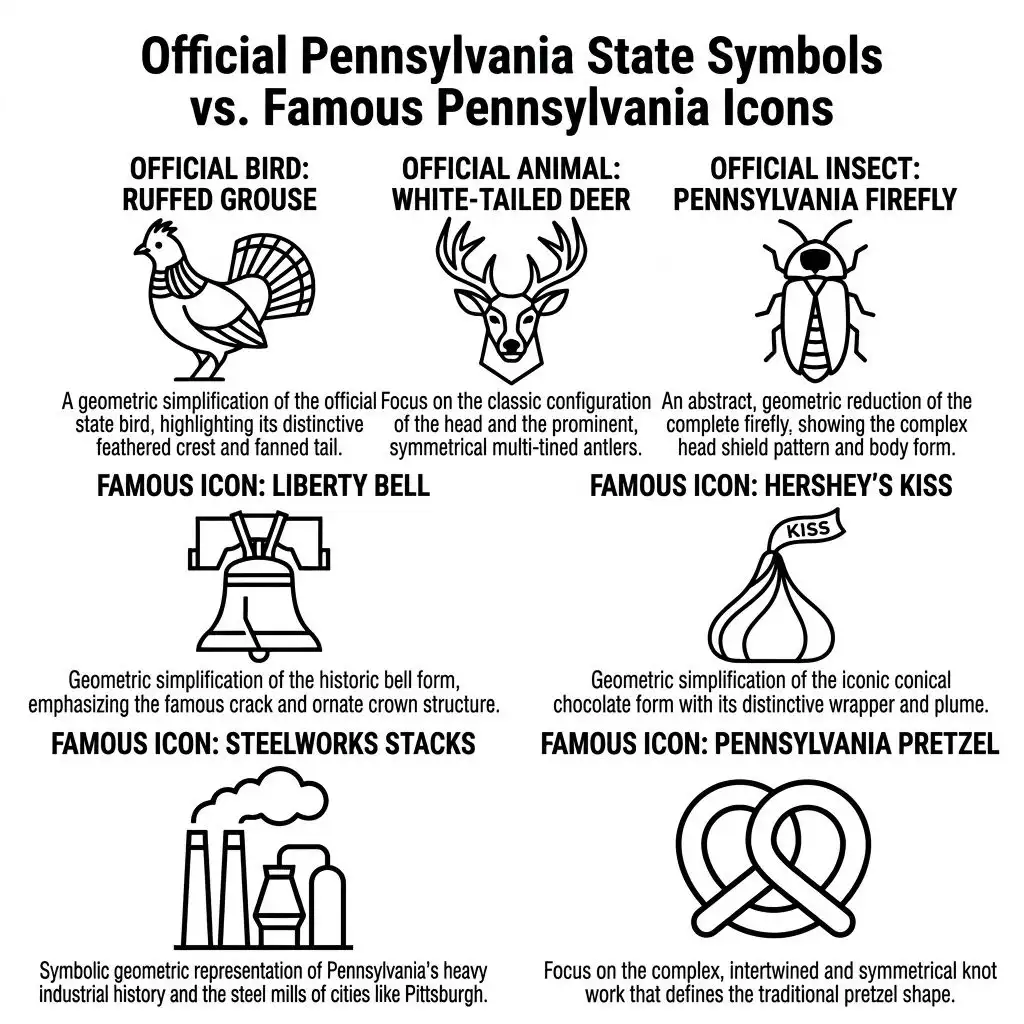
Not everything strongly associated with Pennsylvania is an official state symbol.
This distinction is important because people often search for “Pennsylvania symbols” when they really mean famous things connected with the state.
Is the Liberty Bell an Official Pennsylvania State Symbol?
The Liberty Bell is one of Pennsylvania’s most famous historical icons, but it should not be presented as the official state flower, animal, bird, or another formally designated state symbol.
Its importance comes from American history and its connection to Philadelphia and the nation’s founding era.
It can certainly be discussed in an article about Pennsylvania’s identity, but it should be clearly labeled as a famous Pennsylvania historical icon, not confused with an official state designation.
What About Independence Hall?
Independence Hall is another major Pennsylvania landmark associated with American history.
It is not the same category as the official state symbols designated by Pennsylvania law.
Including famous landmarks in a separate section helps readers understand the difference between:
- official state symbols,
- historical landmarks,
- cultural icons,
- and the state’s nickname or motto.
Why Is Pennsylvania Called the Keystone State?
Pennsylvania’s nickname, the Keystone State, is one of its most recognizable symbols.
A keystone is the central stone in an arch. The idea behind the nickname is that Pennsylvania played an important role in holding together the early United States.
The term became associated with Pennsylvania because of the state’s important geographic, political, economic, and historical position.
Today, the keystone appears throughout Pennsylvania’s visual identity and is one of the easiest symbols to connect with the Commonwealth.
Why Are Pennsylvania State Symbols Important?
State symbols give people a simple way to understand a state’s identity.
Pennsylvania’s symbols cover several major themes:
Nature
The mountain laurel, eastern hemlock, white-tailed deer, ruffed grouse, brook trout, firefly, and eastern hellbender connect with Pennsylvania’s natural environment.
Agriculture
The plow, wheat, milk, and crownvetch connect the state with farming, land use, and agricultural traditions.
History
The state seal, coat of arms, Pennsylvania long rifle, U.S. Brig Niagara, and state locomotives represent different periods of Pennsylvania’s past.
Culture
The state song, Slinky, and Walnut Street Theatre show that Pennsylvania’s identity also includes music, invention, entertainment, and popular culture.
Government
The flag, seal, coat of arms, and motto represent Pennsylvania as a Commonwealth and connect its official identity with government and civic life.
Pennsylvania State Symbols for Students
If you need to study Pennsylvania state symbols for a test or school assignment, grouping them is easier than memorizing one long list.
Nature group:
Mountain laurel, eastern hemlock, white-tailed deer, ruffed grouse, brook trout, firefly, eastern hellbender.
Government group:
Flag, seal, coat of arms, motto, colors.
Agriculture group:
Milk, wheat, plow, crownvetch.
History and transportation group:
U.S. Brig Niagara, Pennsylvania long rifle, K4s, GG1, Piper J-3 Cub.
Culture group:
State song, Slinky, Walnut Street Theatre.
Ancient history:
Trilobite state fossil.
This method makes the information easier to remember and gives students a logical framework for understanding the symbols.
Frequently Asked Questions About Pennsylvania State Symbols
What are the most important Pennsylvania state symbols?
Major Pennsylvania state symbols include the state flag, seal, coat of arms, motto, mountain laurel, eastern hemlock, white-tailed deer, ruffed grouse, brook trout, firefly, eastern hellbender, milk, state fossil, U.S. Brig Niagara, state song, Slinky, Piper J-3 Cub, and Pennsylvania long rifle.
What is Pennsylvania’s state flower?
Pennsylvania’s state flower is the mountain laurel. It became the official state flower in 1933.
What is Pennsylvania’s state animal?
The white-tailed deer is Pennsylvania’s official state animal. It was designated on October 2, 1959.
What is Pennsylvania’s state bird?
The ruffed grouse is Pennsylvania’s official state game bird. It was designated in 1931.
What is Pennsylvania’s state tree?
The eastern hemlock is Pennsylvania’s official state tree.
What is Pennsylvania’s state fish?
The brook trout is Pennsylvania’s official state fish. It became the state fish in 1970.
What is Pennsylvania’s state insect?
The firefly is Pennsylvania’s official state insect. The designation dates to 1974.
What is Pennsylvania’s state amphibian?
The eastern hellbender is Pennsylvania’s official state amphibian. It was designated in 2019.
What is Pennsylvania’s state beverage?
Milk is Pennsylvania’s official state beverage. It was designated in 1982.
What is Pennsylvania’s state fossil?
Pennsylvania’s current state fossil is the trilobite originally designated as Phacops rana and later reclassified as Eldredgeops rana. It was designated in 1988.
What is Pennsylvania’s state motto?
Pennsylvania’s motto is “Virtue, Liberty, and Independence.”
What is Pennsylvania’s state nickname?
Pennsylvania is known as the Keystone State.
What is Pennsylvania’s state toy?
The Slinky is Pennsylvania’s official state toy. It became the state toy in 2001.
What is Pennsylvania’s state ship?
The U.S. Brig Niagara is Pennsylvania’s official state ship. It was designated in 1988.
What is Pennsylvania’s state aircraft?
The Piper J-3 Cub is Pennsylvania’s official state aircraft. It was designated in 2014.
What is Pennsylvania’s state firearm?
The Pennsylvania long rifle is the official state firearm. It was designated in 2014.
Is the Liberty Bell an official Pennsylvania state symbol?
The Liberty Bell is a famous Pennsylvania historical icon, but it should not be confused with the formally designated state symbols such as the mountain laurel, white-tailed deer, or eastern hemlock.
Is the Pennsylvania state fossil being changed?
A bill proposed replacing the existing trilobite fossil with Hynerpeton bassetti. Although Senate Bill 829 passed the Senate in November 2025, the bill was laid on the table in the House on June 30, 2026. Therefore, that proposal should not be presented as a completed change to the official state fossil.
Conclusion
Pennsylvania state symbols reveal how diverse the Commonwealth’s identity really is. The mountain laurel and eastern hemlock represent its natural landscapes, while the white-tailed deer, ruffed grouse, brook trout, firefly, and eastern hellbender highlight its wildlife and waterways. The state seal, flag, coat of arms, motto, and keystone connect Pennsylvania with its government and history.
Other symbols tell less expected stories. Milk represents agriculture, the Slinky represents invention and popular culture, the U.S. Brig Niagara reflects maritime history, and the K4s and GG1 preserve Pennsylvania’s railroad heritage. The Piper J-3 Cub and Pennsylvania long rifle add aviation and early American history to the list.
Together, these symbols provide a useful way to understand Pennsylvania from several perspectives rather than reducing the state to one flower, animal, or landmark. For students, travelers, researchers, and anyone interested in Pennsylvania history, learning what each symbol represents offers a clearer picture of the Commonwealth and the people, places, industries, and natural resources that have shaped it.

Adam Sullivan is a dedicated writer who enjoys transforming everyday topics into engaging and informative content. His writing focuses on making complex ideas simple, practical and enjoyable for readers of all backgrounds. Adam is also the fictional author of The Lantern Beyond Autumn Hills and Where the Morning Horizon Waits. Outside of writing, he enjoys photography, traveling and discovering inspiration through new experiences. He believes great content should be both helpful and easy to connect with.
 Dylan Anderson